The Second Law of Thermodynamics Does Not Contradict Evolution

Super fact 73 : The second law of thermodynamics, or the fact that entropy is always increasing in an isolated system does not contradict evolution. Life is not a closed system. The environment is providing energy, the sun is providing energy, geological forces are providing energy, etc.

A photo of a trilobite fossil. | The Second Law of Thermodynamics Does Not Contradict Evolution
Does physical laws such as the second law of thermodynamics disprove evolution? This is a trilobite fossil. Shutter Stock Photo ID: 1323000239 by Alizada Studios

A lot of people have never heard of the second law of thermodynamics, or entropy and are unaware of the claim that the second law of thermodynamics contradicts evolution. So how can debunking this claim be surprising, and a super fact? The reason is that this is a popular claim among creationists and according to this Gallup poll 40% of Americans believe in creationism. The fact that this popular but false claim is rooted in a very basic misunderstanding of the second law of thermodynamics and what entropy is makes it super fact.

In the past I’ve read many creationist books that make the claim that the second law of thermodynamics contradicts evolution. One of them was Scientific Creationism (1985) by Henry M. Morris (the father of modern creation science), where he stated that the second law of thermodynamics says that everything tends towards disorder, making evolutionary development (ordering) impossible. The Death of Evolution: Restoring Faith and Wonder in a World of Doubt by Jim Nelson Black, another book I read, and which I gave a one star review on Amazon, makes the same claim. I’ve also come across a lot of people making this claim.

The people who make the claim that the Second Law of Thermodynamics contradict evolution typically do not understand the second law of thermodynamics and do not know what entropy is. Despite that fact they see it as a powerful argument against evolution. I’ve even seen it used against highly respected physics professors who “believe in”, well accept the reality of evolution, by people who had no understanding of the second law of thermodynamics. At one point I even believed the claim myself. Then I studied physics, and well, oops, I was forced to admit that I had been bamboozled.

The Second Law of Thermodynamics

The Second Law of Thermodynamics states that the total entropy (disorder) of an isolated system always increases over time. This means that natural processes tend to move from order to disorder (within the isolated system). It should be noted that disorder is a popular but imperfect metaphor for entropy. Entropy is not the same thing as what people think of as disorder. In physics entropy refers to the logarithm of the number of microstates compatible with the system’s measurable macroscopic state. As molecules randomly arrange themselves into new macroscopic states, the number of possible microstates will increase.

It also means that heat will spontaneously flow from hotter to colder objects, but never the reverse. Another thing it means is that mechanical energy can be converted to thermal energy, but never the reverse. It turns out that those seemingly different statements are physically identical.
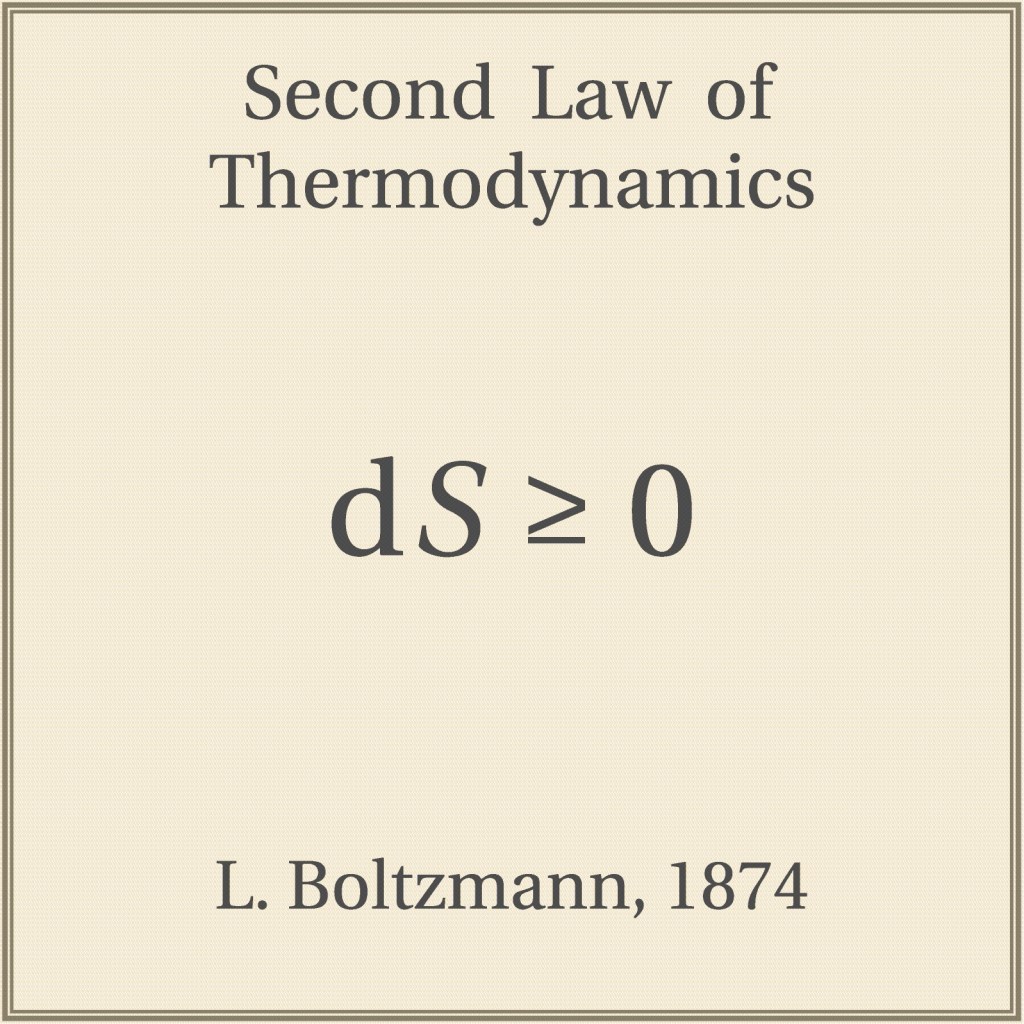
Second law of thermodynamics. S corresponds to entropy. Ludwig Boltzman’s formula from 1874
Second law of thermodynamics. S corresponds to entropy. Shutter Stock Vector ID: 2342031619 by Sasha701

It is very possible that the entropy of an organism is lower compared to a blob corresponding to all its molecules randomly distributed within a blob. However, that organism did not evolve in isolation inside a hermetically enclosed box without any energy from the outside. Life and evolution operate in an environment full of energy coming from the sun, the Earth, winds, oceans, geological forces, radiation, etc. Evolution does not take place in an isolated system.

It is also important to understand that within an isolated system, pockets of lower entropy can form if they are offset by increased entropy elsewhere within the system. That’s what the word “total” in total entropy means. Crystal formation is an example of creating local pockets of lower entropy (less “disorder”) within a system, but this is always accompanied by a greater increase in entropy in the surroundings. The Universe is an isolated system so the entropy within the Universe should always increase, but again the local pockets of lower entropy that evolution may create are accompanied by a greater increase of entropy elsewhere.

Crystal structure. This is model of a unique arrangement of atoms in a crystal.
Atoms in a crystal. The crystal represents a pocket of lower entropy. As this pocket of lower entropy forms there is equal of greater increase in entropy in the surroundings. What is true for the crystal is true for the molecules in living beings. Neither the formation of crystals nor the evolution of life contradicts the second law of thermodynamics. Asset id: 689181712 by BK_graphic.

Below is a YouTube video explaining how the second law of thermodynamics does not contradict evolution.


Entropy – Arrow of time

An interesting aspect of the second law of thermodynamics is that it makes entropy serve as an arrow of time. In general, the fundamental laws of physics are time reversible. The equations work the same forwards and backward in time. The equations for gravity, electromagnetism, and the strong nuclear force work the same regardless of time’s direction. An example is if you filmed a planet orbiting a star and played it backward, it would still follow the laws of motion the same way.

Throw a bunch of billiard balls on the floor and film them bouncing and hitting each other and the walls. If you then run the film backwards and forwards it would be far from obvious which is forward and which is backwards, except for the fact that the balls will slow down due to friction. However, balls slowing down due to friction is mechanical energy turning into heat, which is an example of the second law of thermodynamics. The fundamental laws of physics are time reversible, but the second law of thermodynamics is a notable exception. Entropy always increases in an isolated system (like the Universe). By measuring entropy, you can distinguish the past from the future, giving time a direction


Another evolution related post is: Evolution is a fact



To see the other Super Facts click here

Superfluid Liquids are Like Magic

Super fact 60 : Superfluids such as liquid Helium cooled below -455.58 Fahrenheit exhibit some very strange characteristics such as it flows right through many solids, it climbs walls, it has near zero viscosity, it exhibits circulating flows that never stop despite no energy being added. It is a Macroscopic Quantum Phenomenon.

When gases are cooled far enough, they will turn into liquids and eventually typically to solids. For example, Oxygen becomes a liquid when its temperature drops to -297 Fahrenheit, which is -183 Celsius, or 90 degrees Kelvin. Kelvin is 0 at absolute zero, the coldest possible temperature, and in addition it uses Celsius for the scale. So, 90 degrees Kelvin is 90 degrees Celsius above absolute zero or 162 degrees Fahrenheit above absolute zero. When Oxygen becomes a liquid, it turns into a pale blue liquid. Oxygen becomes a solid at 54 Kelvin, or −218.8 Celsius, and −361.8 Fahrenheit (at normal pressure). It becomes sky blue ice.

Helium stays a gas until very extreme temperatures. Helium becomes a liquid at 4.2 kelvin or -269 Celsius, or -452.11 Fahrenheit. If the temperature is reduced further by almost half to 2.17 Kelvin, or -270.98 Celsius, or -455.8 Fahrenheit, then Helium suddenly becomes a superfluid, exhibiting macroscopic quantum phenomena. It is so different from normal liquid Helium that it is called Helium II. Its heat conductivity (speed of heat/cold transfer) suddenly increases by one million, and the temperature will become the same throughout the liquid instantly. Even a big pool of liquid helium would almost instantly get the same temperature throughout, and the atoms will start behaving in unison. Regular bubbles can no longer exist (atom sized electron bubbles can exist though).

The liquid starts behaving in bizarre ways. If you place an open metal container of Helium II in a closed room the Helium II would climb out of the container and escape, and a thin film of Helium II would climb the walls and the ceiling. If the floor was made of metal or glazed tile the Helium II would remain on the floor. If the floor was made of unglazed tile or stone, it would leak right through the floor as if the floor was a sieve. If you get a whirlpool or fountain going it will keep going forever without any energy loss. In addition, it would also exhibit many quantum effects that are out of scope for this post.

Superfluid Liquids are Like Magic
Unlike ordinary liquids, helium II will creep along surfaces in order to reach an equal level; after a short while, the levels in the two containers will equalize. The Rollin film also covers the interior of the larger container; if it were not sealed, the helium II would creep out and escape. From : Hampel, Clifford A. (1968). The Encyclopedia of the Chemical Elements. New York: Van Nostrand Reinhold. pp. 256–268 (referenced by Wikipedia). Design: Aarchiba; SVG rendering: Júlio Reis, CC BY-SA 3.0 <https://creativecommons.org/licenses/by-sa/3.0&gt;, via Wikimedia Commons

I consider this a super fact because this is a strange, surprising and not a well-known phenomenon. It is a quantum effect that you can observe with your own eyes. It is important because the discovery of superfluidity and its twin effect superconductivity are very important for science and might lead to revolutionizing energy transport in the future. It is no doubt that the phenomenon is real  (true), and it has been documented by numerous experiments and papers. It is described in thousands of textbooks, and I’ve observed the phenomenon with my own eyes (that is next).

Our Experiment with Superfluid Helium

During my first class in Quantum Physics, we performed experiments with liquid Helium. We started out by cooling helium using liquid nitrogen (colder than -196 Celsius or -321 Fahrenheit). Then using vacuum pumps, we kept cooling the Helium until it became liquid. We continued cooling it and we could see lots of bubbles and boiling as we kept going, and then it boiled extra much, and then very quickly the bubbles vanished, and the content of the entire glass container settled down and then stood perfectly still.

As 2.17 Kelvin was reached the viscosity (flow resistance) was instantly lowered with about one million times, and non-microscopic bubbles could no longer exist. The heat conductivity (the speed with which temperature spreads) increased by one million times. It means that the heat of a drop falling in one end of a swimming pool of Helium II would spread throughout the swimming pool in a second. Except, we only had a glass container in which sameness reigned throughout the liquid.

We continued doing experiments such as watching the Helium II climb walls inside the experimental setup, and of course the famous fountain. Insert a little metallic straw and watch a Helium fountain start to flow, by itself. Without any energy or pressure added, it just kept going by itself because no energy was lost either.

I can add that it was more of a demonstration than an experiment that we actively participated in because playing with extreme temperatures high or low is dangerous. If you’ve read this blog for a while you might remember when I put a Cesium-137 sample (800 times more radioactive than Plutonium-239) in my jeans pocket instead of back into its lead brick container and walked around with it a whole day. Or that time when I replaced a fuse for a 380 volt three phase powered laser with my finger because I was curious what would happen if I put my finger in there, and I was shocked, and it hurt. Students shouldn’t play with dangerous stuff.

Below is a one minute and forty four second YouTube video of a Superfluid / Helium II experiment showing an eternal fountain.


Below is a four minute explanation of a superfluid / Helium II experiment.


I can add that Helium II (super cold helium) is not the only superfluid but the easiest one to achieve.

Other Physics Related Superfacts

To see the other Super Facts click here

Relativity Visualized by Lewis Carroll Epstein

The goal of this blog is to create a list of what I call super facts. Super facts are important and true facts that are nevertheless highly surprising to many or disputed or misunderstood by many. In a sense this is a myth busting blog regarding important information. However, I also make posts that are not super facts but feature other interesting information, such as this book review and book recommendation.

Relativity Visualized by Lewis Carroll Epstein

Lewis Carroll Epstein <<Link-1>> is a physicist, teacher and author who has written a number of physics books for layman. He is somewhat famous for coming up with ingenious ways of using diagrams, pictures and puzzles to explain complex matters without using mathematics. His approach is unorthodox but, in my opinion, quite successful. You still have to invest time in reading this 200-page long book and solving most of the puzzles to understand what is going on. The book features some math, notably regarding the derivation of the formula for energy-mass equivalency E = mc2. However, it is in a special section for “teachers only”.

It is an old book and the only version currently available on Amazon is the paperback version. The publisher of the paperback is Insight Press; First Edition (January 1, 1985), ASIN : 093521805X, ISBN-13 : 978-0935218053, 206 pages, item weight : 12.8 ounces, dimensions : 6.25 x 0.75 x 9 inches. It costs $48.99 on US Amazon. Click here to order it from Amazon.com.

The front cover features the title “Relativity Visualized” and the author’s name and in the background is the night sky with the milky way. At the bottom of the front cover is a train with a head lamp and a light beam | Relativity Visualized by Lewis Carroll Epstein
Front cover of the paperback version of Relativity Visualized by Lewis Carroll Epstein. Click on the image to go to the Amazon page for the paperback version of the book.

Amazon’s Description of the Relativity Visualized By Lewis Carroll Epstein

Perfect for those interested in physics but who are not physicists or mathematicians, this book makes relativity so simple that a child can understand it. By replacing equations with diagrams, the book allows non-specialist readers to fully understand the concepts in relativity without the slow, painful progress so often associated with a complicated scientific subject. It allows readers not only to know how relativity works, but also to intuitively understand it.

This is my five-star review for Relativity Visualized

Note, I wrote this review in 2016, so it is relatively old, pun intended. In my original Amazon review I used very large paragraphs. I have changed that by breaking up the paragraphs a bit but without changing the content in any way.

Relatively Intuitive

In my opinion the theories of relativity are among the most interesting intellectual achievements in human history. They revolutionized physics and changed the way we think about physics, space, time, mass, energy, electromagnetism and essentially everything in nature. Despite that fact, the theories of relativity are deterministic and possible to visualize, and unlike Quantum Physics they are not statistical in nature and they don’t have a big issue with interpretation.

I’ve been interested in this topic ever since I came across it as a high school student. Therefore, I did not learn a lot about relativity from this book. I was more interested in the approach to explaining it, and I think his approach is a very good one.

I’ve found that an explanation for relativity that lacks rigor and quantitative reasoning creates misconceptions. The reader may end up thinking he understands it when he doesn’t. I’ve also found that books that focus on deriving complex equations were not only unattainable to the layman but sometimes left the mathematically inclined student with a poor understanding of relativity as well.

Lewis Carroll Epstein’s book “Relativity Visualized” seems to succeed in making relativity accessible to both the layman and those who are mathematically inclined. He explains the special theory of relativity and the general theory of relativity using graphs, visual constructs, and logical puzzles that the reader solves for himself. In a sense he allows the reader to develop the theories of relativity on his own. He avoids equations and formulas, but the reader will still discover more exactly what is going on.

One thing that really impressed me with this book is its special focus on the difference between what you see/experience and what you measure. As an example, take two lights that flash at the same time (in your reference frame). They could appear to flash at different times if the distance between them is large. So, you will see them flash at different times. However, if you time the light flashes and take the distance into account you can measure that they flashed at the same time (non-relativistic situation).

In relativity the differences you measure between frames do not only arise from the distance the light travels or from Doppler Effects but also from the relativity of time and space as well, and Epstein explains the details without confusing the reader. He focuses a lot on simultaneity/non-simultaneity right from the very beginning, and in my opinion understanding relativistic non-simultaneity is crucial to understanding what is going on.

The book also discusses the General Theory of Relativity. The General Theory of Relativity is often seen as completely off limits to the layman. It is typically explained using complex tensor calculus, differential geometry, and topology, or alternatively in a non-technical vague way that leaves the reader clueless. General Relativity was born out of an enigma. Special relativity had shown that energy and mass are the same things, so light has mass. A light beam traveling through a gravitational field must thus bend.

However, that means that the side of the light closer to the mass will travel a shorter distance. From known properties of light (always a transverse/orthogonal wave) this means that the side of the light beam closer to the mass moves slower than the outer rim which would violate the constancy of the speed of light in vacuum.

To solve this enigma Einstein had to introduce a time warp in gravitational fields. Later he discovered that this time warp would cause objects to fall towards the masses that caused the time warp and the practical effect of this turned out to be essentially identical to Newton’s theory of gravity and thus the mysterious force of gravity could be removed. Einstein also discovered that there is a warp effect on space which is negligible unless the speed of the objects is large (like magnetism for electric forces). The book helps you visualize all of this without using complex math.

Lewis Carroll Epstein’s book contains unique pedagogic approaches, novel geometric representations of relativity, as well as engaging questions and answers. For this reason, the book is fiercely protected by copyright law. On the negative side, his writing style is somewhat rigid and old fashioned, the drawings and the graphics are sometimes of low quality, and the book might be quite a bit of work for the layman reader, so it requires that you are really interested. However, overall, this is a very rigorous, detailed, correct, and yet entertaining book that I highly recommend.

Good Myths

I also would like to mention another tool that Lewis Carroll Epstein use in his book, and that is the concept of a Good Myth. A Good Myth is a description that isn’t technical and maybe not exact but that isn’t wrong either. In a loose way it captures the truth of what is going on.

An example of one of these myths is that everything, including all of us, is always traveling through time and space at exactly the speed of light in vacuum. In other words, we are all traveling at the speed of c = 299,792,458 meters per second. If we are sitting still, then we are traveling through time at the speed of light. If we are traveling through space at the speed of light then we are not traveling through time at all, like photons, for which time does not exist.

If we are traveling through space at a high speed, then if we add, in a vector way (Pythagoras theorem), our speed in space to our speed in time, they together will add up to the speed of light in vacuum. But that means that we are traveling through time at a speed that is less than the speed of light. So, our clocks will run slower.

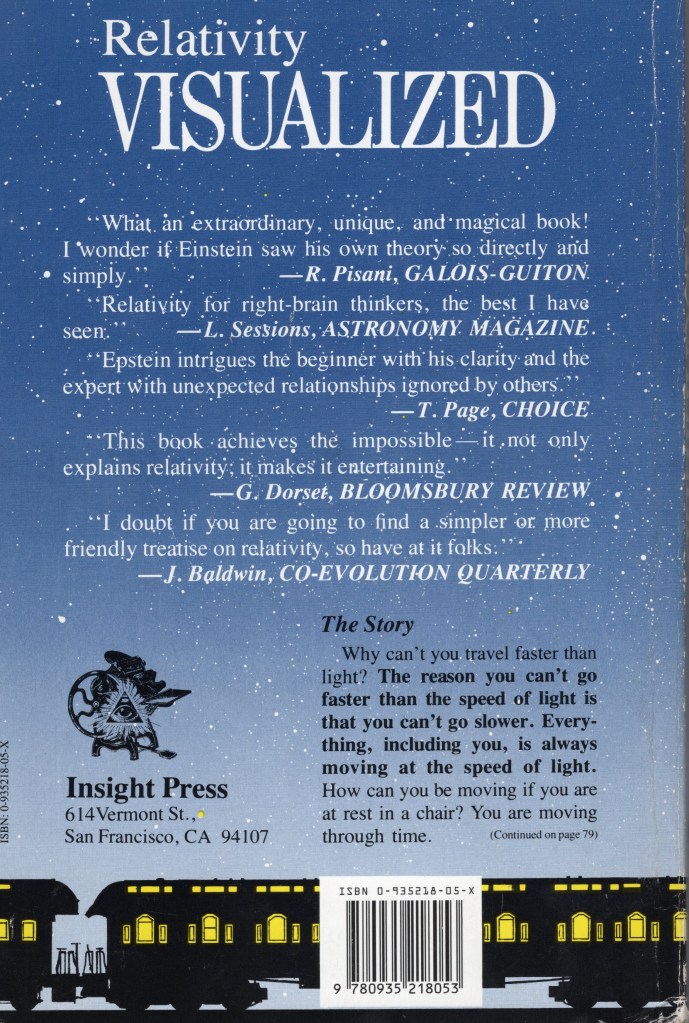
The back cover features the title of the book, praise for the book and very brief description | Relativity Visualized by Lewis Carroll Epstein
Back cover of the paperback version of Relativity Visualized by Lewis Carroll Epstein.

Other Posts on Relativity

Below is a list of other posts I made on Relativity

  • The Speed of Light In Vacuum Is a Universal Constant : to see post click here
  • Two events may be simultaneous for some but not for others : to see post click here
  • Time Dilation Goes Both Ways : to see post click here
  • The Pole-Barn Paradox and Solution : to see post click here
  • Book-Review : The Special Theory of Relativity by David Bohm : to see post click here

Do you feel that you are traveling through time at the speed of light?

To see the Super Facts click here

The Special Theory of Relativity by David Bohm

The goal of this blog is to create a list of what I call super facts. Super facts are important and true facts that are nevertheless highly surprising to many, disputed among the public, or unnecessarily misunderstood. They are special facts that we all can learn something important from. However, I also make posts that are not super facts but feature other interesting information, such as this book review and book recommendation.

The Special Theory of Relativity by David Bohm

David Bohm a close colleague of Albert Einstein was one of the most interesting theoretical physicists of the 20th century. This book “The Special Theory of Relativity” is one of the most interesting and thorough introductory books on the Special Theory of Relativity that I have come across. It is a series of lectures on the topic. It features algebra, equations, and a little bit of differentials but not too much.

You may want to have some math, physics and some relativity under your belt before you tackle this book. In my estimate it is written for those who have taken high school AP physics and AP algebra, maybe calculus as well, or one or two college level physics classes and math classes (or more). It is probably too basic for professional physicists, but it is not written for laymen. I bought the paperback version.

  • Hardback –  Routledge; 1st edition (October 10, 1996), ISBN-10 : 0415148081, ISBN-13 : 978-0415148085, 256 pages, item weight : 13.6 ounces, dimensions : ‎ 5.75 x 0.75 x 9 inches. It is out of stock, and it costs $75.60 – $144.00 on US Amazon. Click here to order it from Amazon.com.
  • Paperback –  Publisher : Routledge; 1st edition (September 4, 2006), ASIN : 0415404258, ISBN-13 : 978-0415404259, 304 pages, item weight : 12 ounces, dimensions : 5.08 x 0.69 x 7.8 inches. It is out of stock, and it costs $12.36 – $17.21 on US Amazon. Click here to order it from Amazon.com.
  • Kindle –  Published : Routledge; 1st edition (September 29, 2015), ASIN : B009W3W6MG, 306 pages, it costs $10.10 – $13.77 on US Amazon. Click here to order it from Amazon.com.
The front cover of “The Special Theory of Relativity by David Bohm.”
Front cover of the paperback version of The Special Theory of Relativity by David Bohm. Click on the image to go to the Amazon page for the paperback version of the book.

Amazon’s Description of the Book

In these inspiring lectures David Bohm explores Albert Einstein’s celebrated Theory of Relativity that transformed forever the way we think about time and space. Yet for Bohm the implications of the theory were far more revolutionary both in scope and impact even than this. Stepping back from dense theoretical and scientific detail in this eye-opening work, Bohm describes how the notion of relativity strikes at the heart of our very conception of the universe, regardless of whether we are physicists or philosophers.

This is my five-star review for The Special Theory of Relativity

Note, I wrote this review in 2014, so it is relatively old, pun intended.

Lorentz Electrodynamics, Special Relativity, and our Perception of Reality

This book is a thorough and well written introduction to the “Special Theory of Relativity”. In addition to the basics of special relativity it covers the history of Special Relativity and it includes 60-pages of Lorentz Electrodynamics. The book also discusses Minkowski Diagrams, the Twin Paradox, relativistic Doppler effects, K-Calculus, and philosophy related to relativity. The book does not discuss General Relativity.

Bohm does not derive many formulas for electrodynamics, optics, quantum physics, thermodynamics, etc., and therefore this book does not resemble a textbook. Bohm’s focus is on a deeper understanding of the special theory of relativity itself, and on time and space.

He discusses perception of reality and includes discussions on child development, psychology and neurology related to perception, the meaning of the relational concepts in relativity, the structure of scientific revolutions (T.S. Kuhn), our perceptions of time and space, philosophy, and other related topics that cannot be classified as physics.

In K Calculus you draw the world lines of light pulses sent at constant intervals between different observers. Then you calculate what is essentially the Doppler factor K and uses it to explain what is going in relativity. In contrast the Lorentz transform is concerned with the space-time coordinates that you measure after taking into account that light have to travel a certain distance and that this takes time. Basically, the “actual time and space coordinates”.

K Calculus on the other hand is including both relativistic effects and the distance and time it takes for light to travel. K Calculus is thus not what you “measure” but what you “observe”. K Calculus makes it very easy to explain special relativity to an audience that is not strong in math and it also adds a new understanding to the special theory of relativity.

However, I see an inherent risk with K-Calculus in that it can end up fooling the student into believing that he understands relativity, for example, if a student incorrectly comes to believe that time dilation is some form of Doppler Effect.

Except for the fact that some of the mathematical derivations were unnecessarily complex I thought this book presented relativity lucidly, the philosophical discussions were insightful, and it added to my understanding of the topic. It should probably not be your first book on Special Relativity but it is a very good second book. I highly recommend it for those who want to think through the concepts of relativity a little deeper.

The back cover of "The Special Theory of Relativity by David Bohm"
Back cover of the paperback version of The Special Theory of Relativity by David Bohm. Click on the image to go to the Amazon page for the kindle version of the book.

To see the Super Facts click here

The Giant Bubble of No Space

Cosmology is the science of the origin and development of the universe, and this post is about a book on Cosmology, “What’s Eating the Universe?: And Other Cosmic Questions” by Paul Davies.

What’s eating the Universe is one of the 30 questions answered in this book. It refers to the mysterious gigantic super-voids we’ve found. Could they be the result of collisions with other universes? Could they be the result of expanding giant bubbles with no space at all in them? That’s not just empty bubbles with empty space, but bubbles in which space itself is missing. Try to imagine that. Some of the 30 questions have answers, others just feature several guesses.

The goal of this blog is to create a list of what I call super facts. Important facts that we know to be true and yet they are surprising, shocking or disputed among non-experts. Super facts are special facts that a well-informed person may want to know.

However, I sometimes create posts that are not super facts but just interesting information, such as this one. What’s eating the Universe is a relatively short and easy read. I bought the hardback version of it.

  • Hardcover –  Publisher : University of Chicago Press; First Edition (September 22, 2021), ISBN-10 : 022681629X, ISBN-13 : 978-0226816296, 208 pages, item weight : 12.2 ounces, dimensions : ‎5.67 x 0.71 x 8.58 inches, it costs $19.84 on Amazon. Click here to order it from Amazon.com.
  • Paperback –  Publisher : University of Chicago Press; First Edition (September 30, 2022), ISBN-10 : 0226823873, ISBN-13 : 978-0226823874, 183 pages, item weight : 9.6 ounces, dimensions : ‎ ‏ : 5.5 x 0.46 x 8.5 inches, it costs $15.67 on Amazon. Click here to order it from Amazon.com.
  • eTextBook –  Publisher : University of Chicago Press; First edition (September 22, 2021), ASIN : B096L2WP51, 172 pages, it costs $14.89 on US Amazon. Click here to order it from Amazon.com.
Front cover of What's Eating the Universe | The Giant Bubble of No Space
Front cover of What’s Eating the Universe? Click on the image to go to the Amazon page for the hardcover version of the book.

Amazon’s description of the book

Combining the latest scientific advances with storytelling skills unmatched in the cosmos, an award-winning astrophysicist and popular writer leads us on a tour of some of the greatest mysteries of our universe.

In the constellation of Eridanus, there lurks a cosmic It’s as if something has taken a huge bite out of the universe. But what is the culprit? The hole in the universe is just one of many puzzles keeping cosmologists busy. Supermassive black holes, bubbles of nothingness gobbling up space, monster universes swallowing others—these and many other bizarre ideas are being pursued by scientists.

Due to breathtaking progress in astronomy, the history of our universe is now better understood than the history of our own planet. But these advances have uncovered some startling riddles. In this electrifying new book, renowned cosmologist and author Paul Davies lucidly explains what we know about the cosmos and its enigmas, exploring the tantalizing—and sometimes terrifying—possibilities that lie before us.

As Davies guides us through the audacious research offering mind-bending solutions to these and other mysteries, he leads us up to the greatest outstanding conundrum of Why does the universe even exist in the first place? And how did a system of mindless, purposeless particles manage to bring forth conscious, thinking beings? Filled with wit and wonder, What’s Eating the Universe? is a dazzling tour of cosmic questions, sure to entertain, enchant, and inspire us all.

This is my five-star review for What’s Eating the Universe?: And Other Cosmic Questions.

Cosmology explained the easy way

This book is organized into 30 cosmological questions that the author is answering or clarifying. His explanations are naturally not in depth but high level and easy to understand for anyone with an interest in the topic. He manages to keep the topic fascinating and the book is a real page turner. I read the book in a little bit more than one day.

The book discusses cosmology, relativity, the standard model, black holes, the big bang, the CMB, dark matter, dark energy, multiverses and the fate of our Universe, extraterrestrials, and much more, and he gives us insight into the very latest discoveries and views of cosmology.

I especially enjoyed reading chapter 20 & 21 “Can the Universe Come from Nothing” and “How Many Universes Are There”. He tells us that most cosmologists he knows believe there are infinitely many universes. One model is eternal inflation, a space/time mechanism beyond our universe that keeps causing new universes to bubble up and initially expand rapidly, but there are other models. I was surprised that he didn’t mention Roger Penrose’s model, cycles of time, with one Universe giving rise to another (after full expansion and heat death).

However, if there’s only one Universe and time came into existence with it (singularity) it doesn’t help those who want to insert a creation moment. If time didn’t exist before the big bang, the concept of a prior physical cause is meaningless. Asking what was before the big bang is like asking what lies north of the North Pole.

I also especially enjoyed reading chapter 30 “What’s New on the Cosmic Horizon” in which he lists mysteries and recent exciting discoveries, the cold patch in Eridanus (CMB), the mystery with the Hubble constant, what’s beyond the standard model, the prospect of top-down models, etc. Well, all the chapters were interesting.

This book is a quick and easy summary of what’s going on in cosmology. It’s accessible and engrossing writing and the straightforward organization make the book a great introduction to the topic. I highly recommend this book.

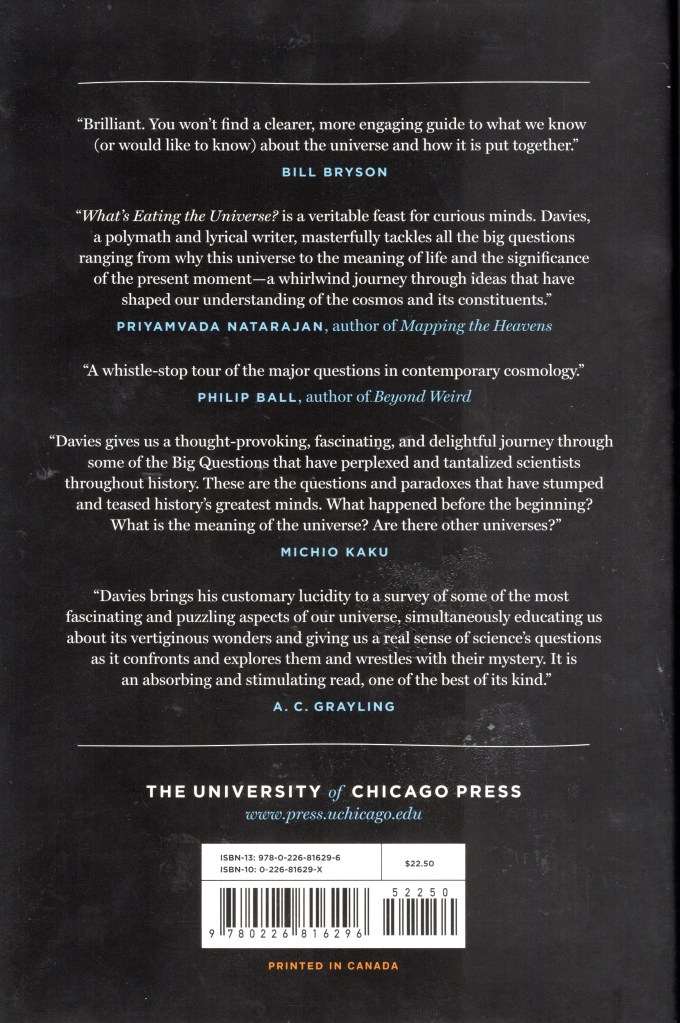
The back cover feature advanced praise for the book | Back cover of “What's Eating the Universe?”
Back cover of “What’s Eating the Universe?” Click on the image to go to the Amazon page for the paperback version of the book.

Finally, a list of the 30 questions

  • Journey from the Edge of Time
  • The search for the key to the Universe
  • Why is it dark at Night?
  • The Big Bang
  • Where is the Center of the Universe?
  • Why the Cosmos is Actually Fairly Simple?
  • What is the Speed of Space?
  • What is the Shape of Space?
  • Explaining the Cosmic Big Fix
  • Most of our Universe is Missing
  • What is Dark Energy
  • Where Does Matter Come From?
  • Gravity Conquers All
  • Warped Time and Black Holes
  • Is Time Travel Possible?
  • What is the Source of Time’s Puzzling Arrow?
  • The Black Hole Paradox
  • A Theory of Everything?
  • Fossils from the Cosmic Dawn
  • Can the Universe Come from Nothing?
  • How Many Universes Are There?
  • The Goldilocks Enigma
  • What’s Eating the Universe?
  • Is the Universe Actually a Botched Job?
  • Are We Alone?
  • Is ET in Our Backyard?
  • Why Am I Living Now?
  • The Fate of Our Universe
  • Is There a Meaning to It All?
  • What’s New on the Cosmic Horizon?

To see the Super Facts click here