There Are Scientific Facts

Super fact 62 : Facts exist in science; a scientific “fact” is an observation of a natural phenomenon that has been repeatedly confirmed by independent observers and is accepted as true for all practical purposes.

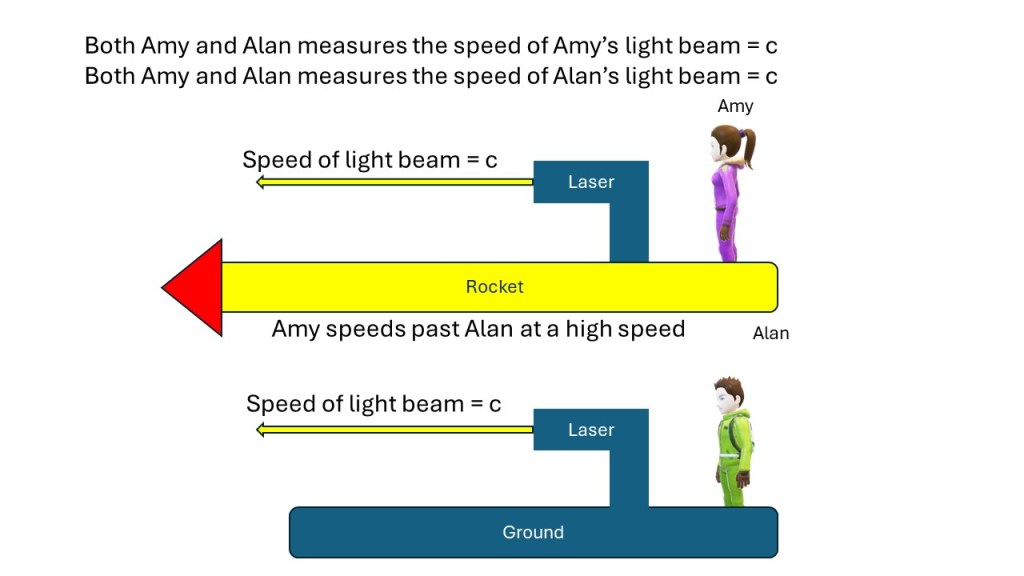
Outside of mathematics and logic nothing is ever the final truth, not in science, and not anywhere else. However, there are facts that have been so well confirmed and are so basic that there is no reason to doubt them. Earth is not flat like a pancake, and the sun is a star, are two examples of astronomical facts. Most dogs have four legs is another fact. The speed of light in vacuum is the same for all observers is a fact in physics that is surprising if you didn’t know it before. Scientific facts are verified by repeatable careful observation or measurement by experiments or other means. It is possible that we are all living in a virtual reality, like in the movie The Matrix, and that Earth is really flat like a pancake after all, because all of reality is a dream. However, for all practical purposes, it is not the case.

This blog, super facts, deal with facts that are surprising, strange, or disputed by non-experts, and yet true because they have been verified, for example, in the case of scientific facts, by repeatable careful observation. Anyone is free to object if you think I am wrong about a fact.

My next super fact is going to be “Evolution is a fact”. Evolution is also a scientific theory, but it means something different from when you say evolution is a fact. Moreover, a Scientific Theory is not a guess, as commonly but incorrectly assumed. I am bringing this up because many people who are typically unaware of the evidence behind a fact will use arguments such as “science does not know everything”, “it is just a theory”, etc., in efforts to dismiss a well-supported claim.

I should say that this post is inspired by a Facebook post by “The Credible Hulk”, a Facebook page managed by a group of anonymous scientists opposing misinformation around vaccines, global warming, evolution and GMOs. I did not save the post, but it went something like this:

One of the commentors said : “Calling evolution a “fact” defeats your argument. The Theory of Evolution is by definition a theory not a fact. It’s the currently agreed upon hypothesis but not a fact”

What the commentor did not realize is that “Theory” in the context of science does not mean what he thought it did. I am using past tense because he got “schooled”. To his credit he did not respond with insults and neither did the Credible Hulk, which does not seem to be standard on Facebook. However, his comment illustrates something that drives scientists like those who created “The Credible Hulk” nuts, and that is the widespread lack of understanding of the difference between a guess, a hypothesis, a scientific fact, theory as used in common language and used when talking about a scientific theory.

Rather than having this discussion over at my upcoming “Evolution is a fact” post, I am making a separate post about it. I consider “There are Scientific Facts” a super fact because it is true, and yet the confusion around it and what a Scientific Theory pertains is massive, and it is an important topic.

What is Science?

Science is the process of learning about the world through systematic observation and experimentation to gain knowledge about how things work. It involves observing phenomena, forming testable ideas (hypotheses), systematic studies, conducting experiments, and collecting evidence and facts that support or refute those ideas, ultimately leading to a deeper understanding of general truths and natural laws. If an idea/hypothesis correctly predicts and explains facts, it becomes a theory, which is something that is very different from a guess.

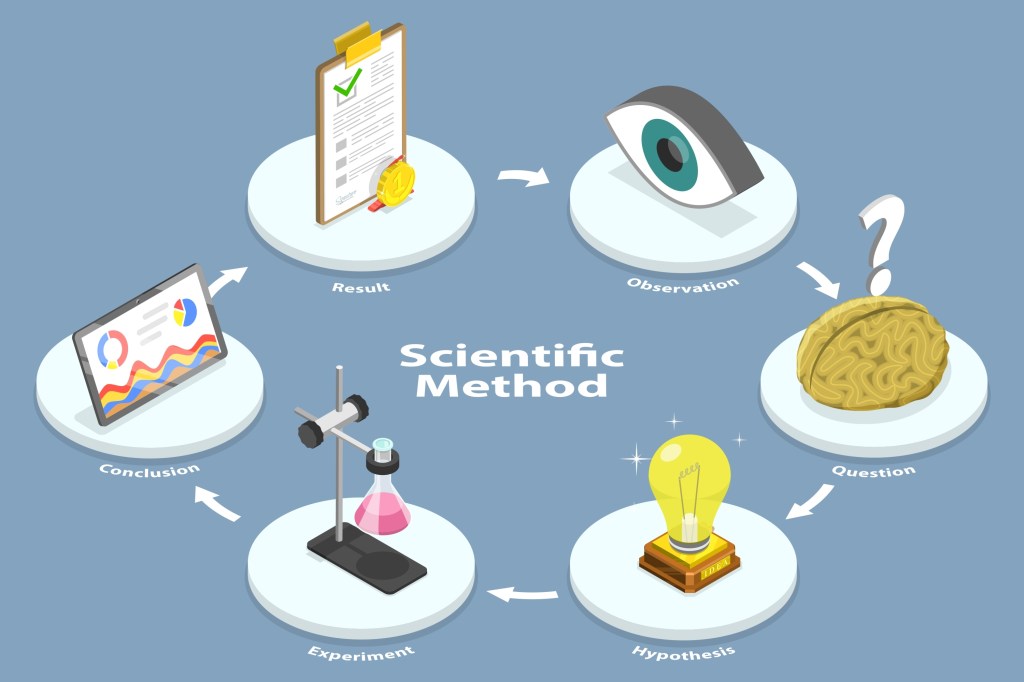
The process of making observations, formulating testable hypotheses, conducting experiments, analyzing data, and drawing conclusions to understand phenomena and solve problems is referred to as the scientific method, and there are different types of scientific methods. Some involve experiments, other involve analysis historical artifacts or existing data. Objectivity, reproducibility, falsifiability, and predictive power or problem solving are essential.

Banner research vector illustration concept with keywords and icons for Analysis, Data, Survey, Development, Fact, Knowledge, and Data Entry
Aspects of scientific research include analysis, data collection, sometimes surveys, development, establishing facts, creating knowledge, and data entry so that others can repeat it and verify results. Shutterstock Asset id: 1100776715 by Trueffelpix

What is a Scientific Theory?

When people hear the phrase “evolution is a theory,” many mistakenly assume it means evolution is just a guess or speculation. In science, however, a theory is far more than a guess. A scientific theory is an explanation of an aspect of the natural world that can be or that has been repeatedly tested and has corroborating evidence in accordance with the scientific method, using accepted protocols of observation, measurement, and evaluation of results. In other words, it is a well-tested, comprehensive explanation of natural phenomena, supported by an extensive body of evidence.

3D Isometric Flat Vector Conceptual Illustration of Scientific Method and Knowledge Acquiring. Icons organized in a circle, observation, question, hypothesis, experiment, conclusion, and result | There Are Scientific Facts
Conceptual Illustration of Scientific Method and Knowledge Acquiring. Notice, not all scientific methods necessarily include experiments. Some include surveys, or testing of ancient artifacts, etc. Shutterstock Asset id: 2139402875 by TarikVision

The evidence for evolution is both vast and compelling. It is not just the massive fossil record, it is in DNA, anatomy, there’s geographic evidence, and evidence from dozens of other scientific fields, not to mention that evolution is directly observable. There is a Theory of Evolution, that is the well supported explanation for evolution, or evolution by natural selection. There is also “Evolution is a fact” referring to, for example, the fact that we can directly observe it. It is true for all practical purposes, and that does not mean that evolution stops being a scientific theory as well as a fact.

Afterword

Even though science is constantly evolving and our knowledge is evolving and sometimes our understanding and scientific theories on a topic needs to be updated, scientific facts exist. Some scientific facts are extremely unlikely to change. For example, Jupiter has multiple moons, galaxies exist, global warming is real and is caused by us, and evolution is a fact. Before you decide to dismiss such a fact make sure you know what “theory” means in science, and most importantly educate yourself on the relevant evidence. There might be a whole lot more than you imagined, and you may discover that the evidence you thought was contrary is not evidence.

You often hear “science does not know everything”. That’s true. If science knew everything it would stop. However, the collective knowledge created by science is enormous and as individuals we know next to nothing. So be humble and learn from scientific evidence presented by reliable sources.


To see the other Super Facts click here

More Science Books for Babies

This is my second and last post covering books from the Baby University series. There are 44 of them. I think the Baby University series books are quite interesting for children. They may not really be for babies, but they appear to me to be great for young children. The point of the books is not to make young children understand complex scientific concepts but to introduce them to scientific vocabulary and build their curiosity. We bought 10 of these books for our soon to be born first grandchild (due date September 17). We also bought other books for him. If you want to see my post for the five first books, click here.

Below I am presenting five books in the series, Evolution for Babies, Nuclear Physics for Babies, Astrophysics for Babies, Quantum Entanglement for Babies, and Newtonian Physics for Babies. For each of the books I am providing my review for the book and a link to my review as well as a link to the book on Amazon and a photo of the front cover.

Evolution for Babies

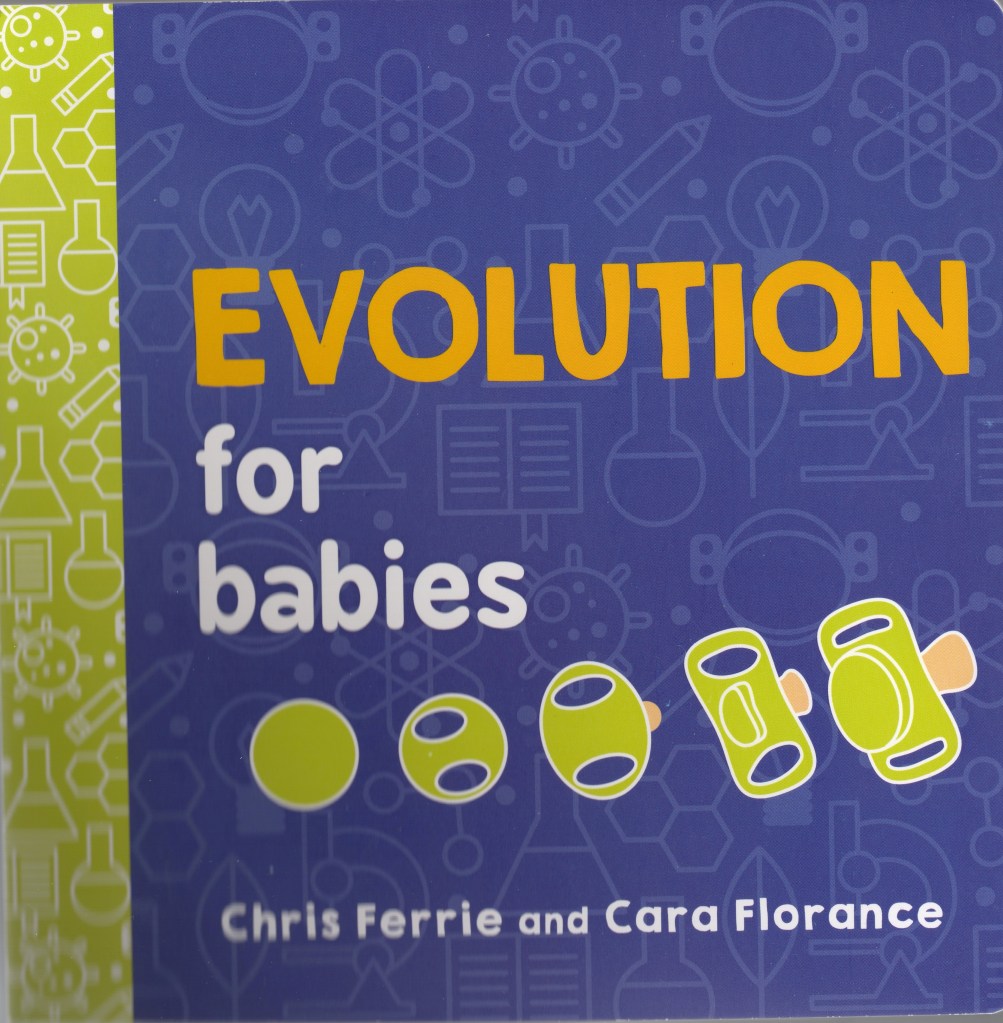
The front cover of Evolution for Babies is blue and features the title, author (Chris Ferrie) and a green illustration of evolving binkies | More Science Books for Babies
Front cover of Evolution for Babies.

This is the Amazon link for Evolution for Babies.

My Review for Evolution for Babies

Natural Selection as Simple as Possible

This simple board book just shows different kinds of balls falling through a hole until one ball doesn’t. It’s too big for the hole. That’s the surviving ball. Balls like that ball will be the survivors. That is Natural selection. It is very simple, but I guess it is to the point. I guess anyone can understand that. Even a baby.

Nuclear Physics for Babies

The front cover of Nuclear Physics for Babies is light blue and features the title, author (Chris Ferrie and Clara Florance) and a blue and red illustration showing protons and neutrons and a binky.
Front cover of Nuclear Physics for Babies.

This is the Amazon link for Nuclear Physics for Babies.

My Review for Nuclear Physics for Babies

The Blue Balls Keep the Red Balls Together

This book is about red balls called protons. They have a positive charge, and they repel each other. There are also blue balls called neutrons. If you put a blue ball between two red balls, the two red balls will not repel and will not fly apart. The more red balls there are, the more blue balls we need. The red and blue balls are at the center of the atom. If the number of red balls and blue balls is not right the nucleus becomes unstable, and it releases energy. That is radioactive decay. The book explains half-life. So that’s the story. It is simple and fun, and your baby can start working on his PhD in nuclear physics when he turns one years old.

Note: I would like to add one thing that I did not note in my review. The neutrons would not be able to hold together two protons just by being neutral. What the baby book is not mentioning is that neutrons (and protons) have a force that acts like glue, called the strong nuclear force. The strong force, color charges, quarks and gluons is what my previous post is about.

Astrophysics for Babies

The front cover of Astrophysics for babies is dark blue and features the title, author (Chris Ferrie and Julia Kregenow), and there is an illustration of the sun and a binky orbiting the sun | More Science Books for Babies
Front cover of Astrophysics for Babies.

This is the Amazon link for Astrophysics for Babies.

My Review for Astrophysics for Babies

Stars and Planets are Balls. The Sun is a Star

Earth is like a ball, and the sun is like a ball, and the earth orbits the sun. The sun is a star that looks big because it is close. Other stars look tiny because they are far away. Stars are heavy balls of hot gas. Inside stars atoms squeeze together. Smaller atoms squeeze together making bigger atoms and releasing energy in the process. The exploding stars spread bigger atoms across the Universe. The book is colorful and simple reading, but it features the Periodic table, which is not for babies, but ignoring that, this is a simple and fun book for young children.

Quantum Entanglement for Babies

The front cover of Quantum Entanglement for babies is red and features the title, author (Chris Ferrie) and an illustration of a two binkies supposedly entangled.
Front cover of Quantum Entanglement for Babies.

This is the Amazon link for Quantum Entanglement for babies.

My Review for Quantum Entanglement for Babies

Quantum Entanglement Using Balls

We bought this book for our future grandchild who will soon be born. It is a very short board book which takes one minute to read. It is about balls, like most of the “for babies” books. There are two red balls and two blue balls. Hide them in boxes. We know the colors, but Alice and Bob do not. However, in quantum physics the balls have a special bond. We put the tangled balls in two boxes. When the boxes are opened, both balls are blue or both balls red. What’s the point?

I am an adult who knows a little bit about Quantum Entanglement, and I did not understand what they meant. How is a baby going to understand it? It is a nice colorful board book but I wish they’ve taken a different approach.

Newtonian Physics for Babies

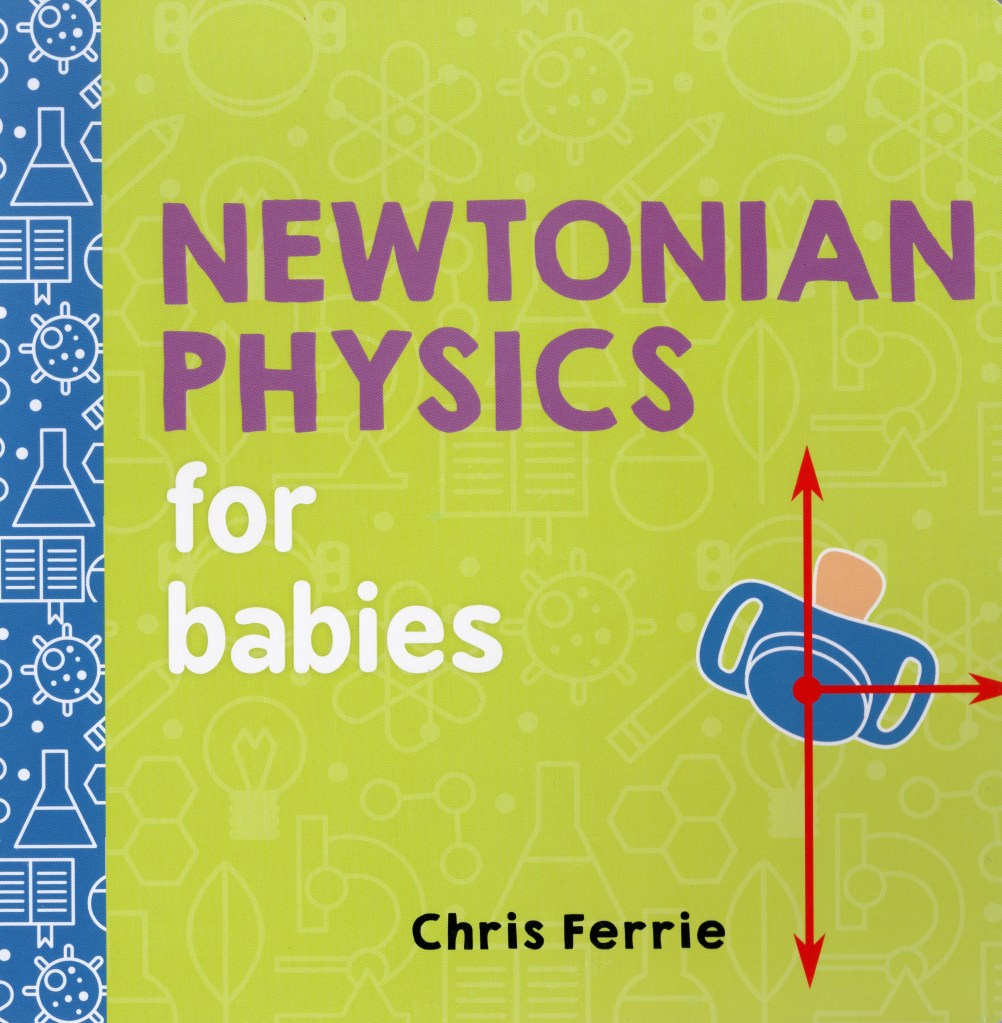
The front cover of Newtonian Physics for babies is green and features the title, author (Chris Ferrie) and an illustration of a binky with three red arrows representing forces | More Science Books for Babies
Front cover of Newtonian Physics for Babies.

This is the Amazon link for Newtonian Physics for Babies.

My Review for Newtonian Physics for Babies

Newtons Laws and a Ball Explained to the Very Young

We bought this book for our future grandchild who will soon be born. It is a very short board book which takes one minute to read. The book is about a ball. A ball feels the force of gravity, and it is pulling it down. When the ball is on the ground the ball still feels the force of gravity but the ground pushes back with an equal force and the ball is at rest. If there is a net force the ball moves.

At the end the book lists the three laws of motion. 1. If an object has zero net force, it does not change its motion. 2. The net force is equal to mass times acceleration. 3. For every force, there is an equal force in the opposite direction. It is very simply expressed, and the illustrations are fun, but I still think this book requires the child to be a bit older for him to understand, maybe 3-4 years old rather than a baby. However, I think the book can evoke an interest in science and physics at an earlier age. Despite it being one of the tougher books in the series, I think it seems to be a pretty good book.


To watch a woman read Astrohysics for Babies. Click on the YouTube video below.


To see the Super Facts click here

Science Books for Babies

I think that one of the most interesting series science books for beginners that I’ve come across is the Baby University series. I bought it for our soon to be born first grandchild Jack, but I couldn’t help but go through them myself. It is a great series for those who hope to put their one-year-old toddlers in a PhD program. But seriously, these books explain science concepts as simply as it is possible to do. The books may still be a little bit tough for babies, but I think 2–3-year-olds might get something out of them. The point of the books is not to make young children understand complex scientific concepts but to introduce the vocabulary and build curiosity.

Below I am presenting five books in the series, General Relativity for Babies, Electromagnetism for Babies, Artificial Intelligence for Babies, Quantum Physics for Babies, and Organic Chemistry for Babies. I am providing my review for the book and a link to my review as well as the book and a photo of the front cover.

General Relativity for Babies

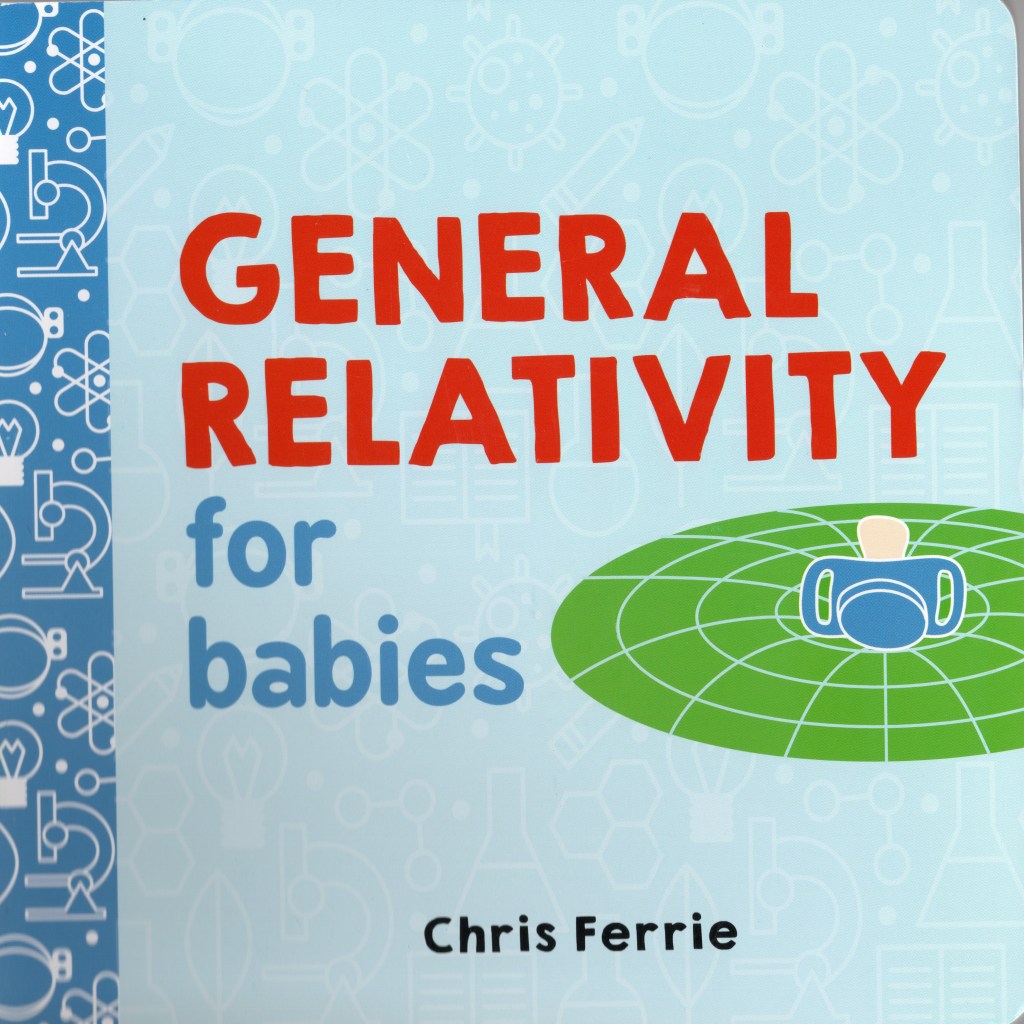
The front cover of General Relativity for Babies is light blue and features the title, author (Chris Ferrie) and a green illustration of warped space | Science Books for Babies
Front cover of General relativity for Babies.

This is the Amazon link for General Relativity for Babies.

My Review for General Relativity for Babies

General Relativity as Simplified as Possible

We bought this board book for our not yet born grandson. This book simplifies the General Theory of Relativity as far as you possibly can. It uses simple language and colorful illustrations to give the reader an idea of what is going on. Different sized masses are different sized balls, space-time curvature is illustrated using a distorted grid, and objects orbiting larger masses, such as a star, are shown as small balls having their paths curved by a warped grid. There are simple explanations for what a black hole is and what gravity waves are.

A baby would not understand this book but maybe someone who is 3-4 years old would. But your expectations need to be realistic. It should also be noted that even if you understand the book, the explanations are too simplistic for you to really understand General Relativity, but the explanations are not so simple that they are wrong. The book will just give you an idea of what is going on. However, I was impressed by the fact that the author and illustrator were able to present such an abstract theory in a way that makes it possible for a child to at least have a clue. I think that the most important aspect of the book is not whether the child understands General Relativity but the interest in science that it may evoke.

Electromagnetism for Babies

The front cover of Electromagnetism for Babies is light green and features the title, author (Chris Ferrie) and a light blue illustration of a binky surrounded by a field.
Front cover of Electromagnetism for Babies.

This is the Amazon link for Electromagnetism for Babies.

My Review for Electromagnetism for Babies

Electromagnetism Simplified for Young Children

We bought this short and colorfully illustrated board book for our not yet born grandson. I don’t think a baby will understand it but maybe when he is 2-3 years old. The book explains in simple terms and with colorful simple illustrations the basic concepts of charges, and attraction between negative and positive charges, and repulsion between two positive balls/charges and two negative balls. It explains about electrical and magnetic fields, and the fact that charges rotate around magnets. I believe this book can spur a child’s interest in science and engineering.

Artificial Intelligence for babies

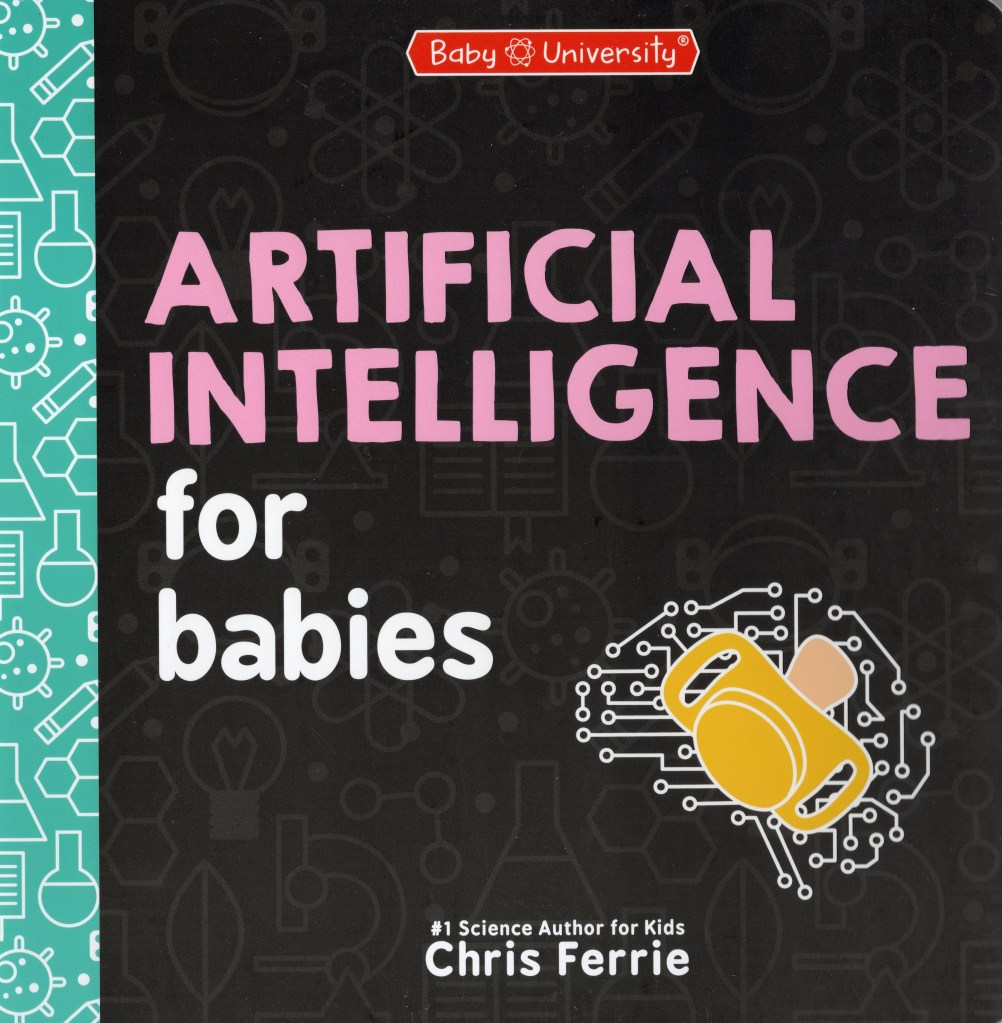
The front cover of Artificial Intelligence for babies is black and features the title, author (Chris Ferrie) and an illustration of a binky surrounded by an electronic network | Science Books for Babies
Front cover of Artificial Intelligence for babies.

This is the Amazon link for Artificial Intelligence for babies.

My Review for Artificial Intelligence for babies

Artificial Intelligence for Small Children

We bought this board book for our not yet born grandson. He will not be able to understand it until he is at least one years old, but that is OK. The book explains the difference between a dog, a live thing, and a computer. It does this in very simple terms that I believe a young child could understand. According to the book, a computer can do some things that are impressive, such as complex calculations, and you can teach it certain skills, but it is not adaptable like a dog. I think that is about what you can make a very young child understand. Naturally, there are no neural networks or AI algorithms in the book. However, I think it sells artificial intelligence short, since artificial intelligence is becoming increasingly adaptable.

Quantum Physics for babies

The front cover of Quantum Physics for babies is yellow and features the title, author (Chris Ferrie) and an illustration of a simplified Bohr Model of the Atom with a binky as a nucleus.
Front cover of Quantum Physics for babies.

This is the Amazon link for Quantum Physics for babies.

My Review for Quantum Physics for babies

Quantum Physics for Young Children and Adults who Detested Physics Class

We bought this board book for our not yet born grandson. We may need to wait until he is 2-3 years old before it makes sense to read it to him. In the meantime, it is also a good book for adults without a solid science education. The book talks about colorful balls with energy and presents a simplified version of the Bohr model of the atom. There are blue balls called electrons and red balls called protons in the middle (the nucleus). The electrons travel in circular orbits around the middle. Light can change the energy of electrons causing them to jump between the orbits.

My daughter made the comment that a baby is only going to understand that an electron is a blue ball and a proton is a red ball, which isn’t a correct description of electrons and protons. Protons and electrons don’t have specific colors, not to mention that a simplified Bohr model for the atom is quite different from the more realistic Schrödinger’s model of the atom with quantum waves and probabilistic electron clouds. However, I am still very impressed by how simple the author and the illustrator succeeded in making this abstract topic. It is a good start for budding physicists.

Organic Chemistry for babies

The front cover of Organic Chemistry for babies is red and features the title, author (Chris Ferrie and Cara Florance) and an illustration of a benzene ring made from binkies | Science Books for Babies
Front cover of Organic Chemistry for babies.

This is the Amazon link for Organic Chemistry for babies.

My Review for Organic Chemistry for babies

Your First Book on Organic Chemistry

We bought this board book for our not yet born grandson. We will read it to him when he is 1-3 years old. Right now, we can read it. This book simplifies Organic as far as you possibly can. It uses simple language and colorful illustrations to give the reader an idea of what organic chemistry is. Basically, atoms are balls of different kinds. Atoms make up everything. Atoms can stick to each other, and they can make different shapes. The balls we call carbon (in black) can stick to small white balls called hydrogen and other balls called oxygen. We call those organic molecules, and they make up plants, food, and medicines. I think this is simple enough for a 1–3-year-old to understand, but not a baby. In my opinion, a better name for this series would have been “for Big Boys or Girls” rather than babies, because young children don’t like being called babies.


To watch a woman read Quantum Physics for Babies. Click on the YouTube video below.


To see the Super Facts click here

Small Microscopic Subatomic and Strings

Esther’s writing prompt: 6th August : Small

Click here or Here to join in


Small Things

Fire ants are small. They average 1/8 inch to 1/4 inch in length, or 3 to 6 millimeters. Mites are very small arachnids that are less than 1 millimeters. They are so small that they are difficult to see with the naked eye unless they are on a white sheet. However, amoebas are typically even smaller than mites. Most amoebas range from 10 to 500 micrometers in diameter. 500 micrometers is the same as half a millimeter. You typically need a microscope to see an amoeba. I should say that there are some large amoebas that are 2 millimeters.

The photo shows six different types of amoebas | Small Microscopic Subatomic and Strings
Amoebas from Wikimedia commons. Attribution Respectively: NIAID, Cymothoa exigua, ja:User:NEON / User:NEON_ja, Jacob Lorenzo-Morales, Naveed A. Khan and Julia Walochnik, ja:User:NEON / User:NEON_ja, ja:User:NEON / User:NEON_ja, CC BY-SA 4.0 <https://creativecommons.org/licenses/by-sa/4.0&gt;, via Wikimedia Commons

Microscopic Things

If you want to go even smaller, much smaller, we can enter the microscopic world. Bacteria are microscopic, single-celled organisms with sizes typically ranging from 0.5 to 5 micrometers in length and 0.2 to 1 micrometer in width. That means that bacteria are around 100 times smaller than amoebas. Well, if you consider length. If you consider the volume that is a million times smaller. Comparing an amoeba to a bacterium is like comparing a horse to a small cicada. You certainly need a microscope to see bacteria.

If you think bacteria are small, I can tell you that viruses are even smaller. Viruses typically range in size from 20 to 300 nanometers in diameter. 1000 nanometers is 1 micrometer. A small corona virus (SARS-CoV-2) is 50 nanometers, which is 20 times smaller (in diameter) than a bacterium that is 1 micrometer in size and 100 times smaller (in diameter) than a bacterium that is 5 micrometers. Again, a horse to a medium size insect.

Illustration of Covid-19 Virus
Illustration of Covid-19 Virus (SARS-CoV-2) from Wikimedia Commons. Attribution: SPQR10, CC BY-SA 4.0 <https://creativecommons.org/licenses/by-sa/4.0&gt;, via Wikimedia Commons

Atoms Are Very Small

Atoms are much smaller than viruses. This reddit user calculated that there are roughly 52 million atoms in a normal sized covid virus (100 nanometers). Also keep in mind that there is a lot of space between atoms. The size of a hydrogen atom is 0.1 nanometer or 100 picometer. Comparing a hydrogen atom to a normal sized covid virus is like comparing a flea to a horse. If you consider volume, you could fill a normal sized covid virus with 1 billion hydrogen atoms.

You cannot see an atom using a regular microscope. You must use specialized microscopes that don’t rely on visible light to see atoms, such as scanning tunneling microscopes and electron microscopes. So, in summary, a hydrogen atom is to a normal sized covid virus like a flea is to a horse, and a normal sized covid virus is to a 100 micrometers amoeba (small sized amoeba) like a flea is to a horse.

Below is an illustration of a Helium atom, which is the next element after Hydrogen. A Hydrogen atom has one electron and one proton and possibly one or two neutrons. A stable Helium atom has two electrons and two protons and one or two neutrons.

Illustration of a Helium atom. A nucleus with protons and neutrons is surrounded by a grey fuzzy electrons cloud | Small Microscopic Subatomic and Strings
Illustration of a Helium atom. It has two electrons and a nucleus with two protons and two neutrons in the middle. The two electrons are depicted as clouds because they don’t have an exact position. Attribution : User:Yzmo, CC BY-SA 3.0 <http://creativecommons.org/licenses/by-sa/3.0/&gt;, via Wikimedia Commons

Subatomic Things

But let’s go smaller, much smaller. A hydrogen atom is gigantic in comparison to subatomic particles. Most of the mass in an atom is concentrated in the nucleus, which consists of protons, neutrons, quarks and gluons, and quark pairs called mesons. The size of an atomic nucleus varies, but it typically ranges from 1.6 femtometers (1.6 x 10⁻¹⁵ meters) for a proton to about 15 femtometers for the heaviest atoms.

I should say this is difficult to estimate so take this with a grain of salt. In any case that makes the hydrogen atom about 100,000 times wider than the nucleus in its middle. If the hydrogen atom was 100-meter giant ball the nucleus in the middle would be just 1 millimeter (half the size of a flea). That is despite the fact that the vast majority (+99.95%)  of the mass of the atom is in the nucleus. In this case, we are not comparing a flea to a horse, but a flea to a mountain. A mountain of mostly empty space with a super massive flea at its center. The YouTube video below explains the details.

Strings Are Extremely Small

However, the smallest things there are, might be strings. Strings, in the context of physics, are one-dimensional, extended objects that are thought to be the fundamental building blocks of the universe. These strings vibrate at different frequencies giving rise to elementary subatomic particles. Strings are thought to be about 10^-35 meters, which is 100,000,000,000,000,000,000 times smaller than the atomic nucleus described above. Comparing a string to a nucleus would be like comparing the hydrogen atom to a ball, or a giant star, containing one billion planet earths. I should mention that string theory has not been experimentally confirmed.

That is small, very small, extremely small, as small as it can get.

This post is not a super fact since it features a lot of facts and not all of them confirmed or exact.


To see the Super Facts click here