The End of Everything By Katie Mack

What will the end of everything be like? How will everything end? Will it be the Big Crunch as the Universe collapses back to a reverse Big Bang? Will it be the heat death, or what is better called the high-entropy death? Will it be the Big Rip as the Universe is ripped apart, or vacuum decay? Maybe it will be the Quantum Bubble of Death? Wouldn’t the Quantum Bubble of Death be a cool way to die?

The goal of this blog is to create a list of what I call super facts. Important facts that we know to be true and yet they are surprising, shocking or disputed among non-experts. Super facts are important facts that people get wrong. However, I sometimes create posts that are not super facts but other interesting information, such as this book review and book recommendation.

The End of Everything: (Astrophysically Speaking) by Katie Mack is a relatively easy book on cosmology. It features scientifically guided speculation on how the Universe will end. As in the previous book I reviewed the cosmic microwave background radiation (CMBR) is a major source for the information. It is amazing what it can tell you. I bought the hardback version of it. I can add that this book and my Amazon review was written in 2020, a good year for talking about the end of the world.

  • Hardcover –  Publisher : Scribner; Illustrated edition (August 4, 2020), ISBN-10 : 198210354X, ISBN-13 : 978-1982103545, 240 pages, item weight : 2.31 pounds, dimensions : ‎5.5 x 1 x 8.38 inches, it costs $19.14 on US Amazon. Click here to order it from Amazon.com.
  • Paperback –  Publisher : Scribner (May 4, 2021), ISBN-10 : 1982103558, ISBN-13 : 978-1982103552, 256 pages, item weight : 2.31 pounds, dimensions : ‎ ‏ : ‎5.5 x 0.6 x 8.38 inches, it costs $10.99 on Amazon. Click here to order it from Amazon.com.
  • Kindle –  Published : August 04, 2020, ASIN : B07Z41TTNK, 237 pages, it costs $14.89 on US Amazon. Click here to order it from Amazon.com.
  • Audiobook –  Publisher : Scribner (August 4, 2020), ASIN : B07Z8B5NZ8, it costs $13.12 on US Amazon. Click here to order it from Amazon.com.
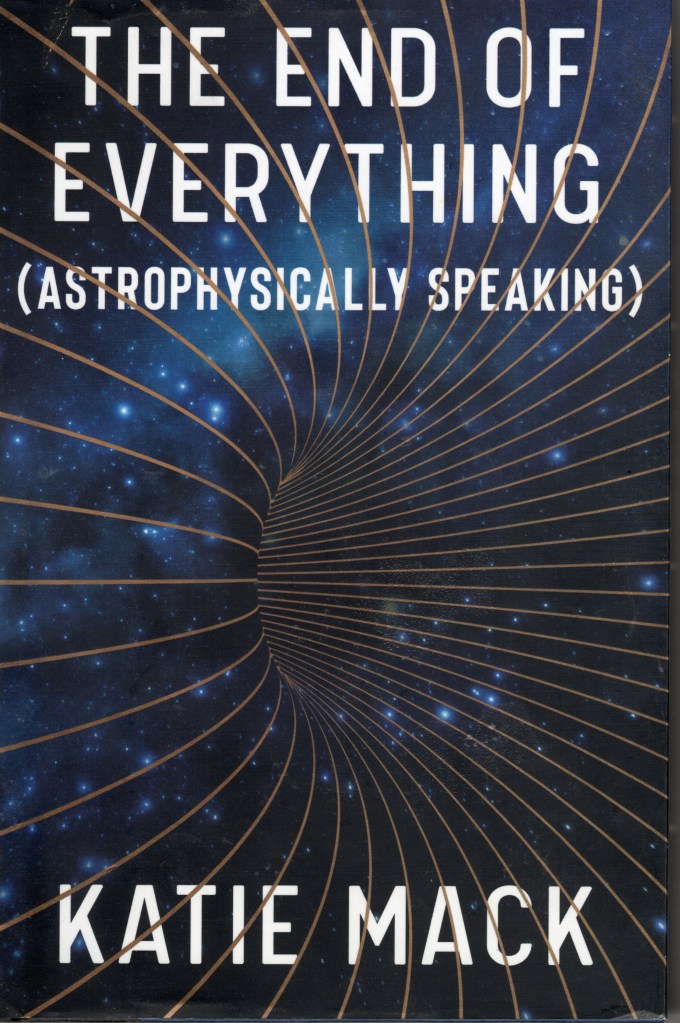
Front cover of The End of Everything By Katie Mack | The End of Everything
Front cover of The End of Everything? Click on the image to go to the Amazon page for the hardcover version of the book.

Amazon’s description of The End of Everything By Katie Mack

A NEW YORK TIMES NOTABLE BOOK OF 2020

NAMED A BEST BOOK OF THE YEAR BY * THE WASHINGTON POST * THE ECONOMIST * NEW SCIENTIST * PUBLISHERS WEEKLY * THE GUARDIAN

From one of the most dynamic rising stars in astrophysics, an “engrossing, elegant” (The New York Times) look at five ways the universe could end, and the mind-blowing lessons each scenario reveals about the most important concepts in cosmology.

We know the universe had a beginning. With the Big Bang, it expanded from a state of unimaginable density to an all-encompassing cosmic fireball to a simmering fluid of matter and energy, laying down the seeds for everything from black holes to one rocky planet orbiting a star near the edge of a spiral galaxy that happened to develop life as we know it. But what happens to the universe at the end of the story? And what does it mean for us now?

Dr. Katie Mack has been contemplating these questions since she was a young student, when her astronomy professor informed her the universe could end at any moment, in an instant. This revelation set her on the path toward theoretical astrophysics.

Now, with lively wit and humor, she takes us on a mind-bending tour through five of the cosmos’s possible finales: the Big Crunch, Heat Death, the Big Rip, Vacuum Decay (the one that could happen at any moment!), and the Bounce. Guiding us through cutting-edge science and major concepts in quantum mechanics, cosmology, string theory, and much more, The End of Everything is a wildly fun, surprisingly upbeat ride to the farthest reaches of all that we know.

This is my five-star review for The End of Everything

The End of the Universe can be a lot of fun

Katie Mack’s timely (it’s 2020 after all) survey of the various ways the Universe might end, based on current physics, was a delightful read. It is an interesting and fun book. We learn about the Big Crunch (the Universe shrinking back), the Heat Death, or rather the high-entropy death, the Big Rip, Vacuum decay, or the “quantum bubble of death” if you want to call it that, and the “bounce”. 

To understand where the various ideas regarding the end of the Universe come from, you need to understand some of the physics and the cosmology. We learn something about CMB, or the Cosmic Microwave Background, Big Bang, cosmic inflation, Planck Time, GUTs, Nucleosynthesis, the standard model, de Sitter Space, black holes, electroweak symmetry breaking, the Higgs Boson and the Higgs field, multiverses, and much more.

Perhaps most importantly, we learn about dark matter and dark energy, which are important concepts that have greatly changed cosmology over the last few years. Chapter 2 on the Big Bang reminded me a lot about an old book by Stephen Weinberg, the first 3 minutes. However, Katie Mack puts a modern spin on it and goes much further beyond our Universe. I was intrigued to hear that it might be possible to communicate between different Universes in a multiverse using gravity, or gravity waves.

The book is written for laymen, and I found it to be between Neil De Grasse Tyson / Carl Sagan and Stephen Hawking in difficulty level. The book covers a lot of concepts and theories but does so concisely, simply and not in a mathematical way. Not so simply though that it is misleading.

I am an Engineer with an undergrad degree in physics so I may not be the best person to judge whether this is an easy read for laymen, but I believe it is. I am very interested in these kinds of topics, and I read all popularized books on cosmology, modern physics, the standard model, that I can find. This was one of the most fun books that I’ve ever read.
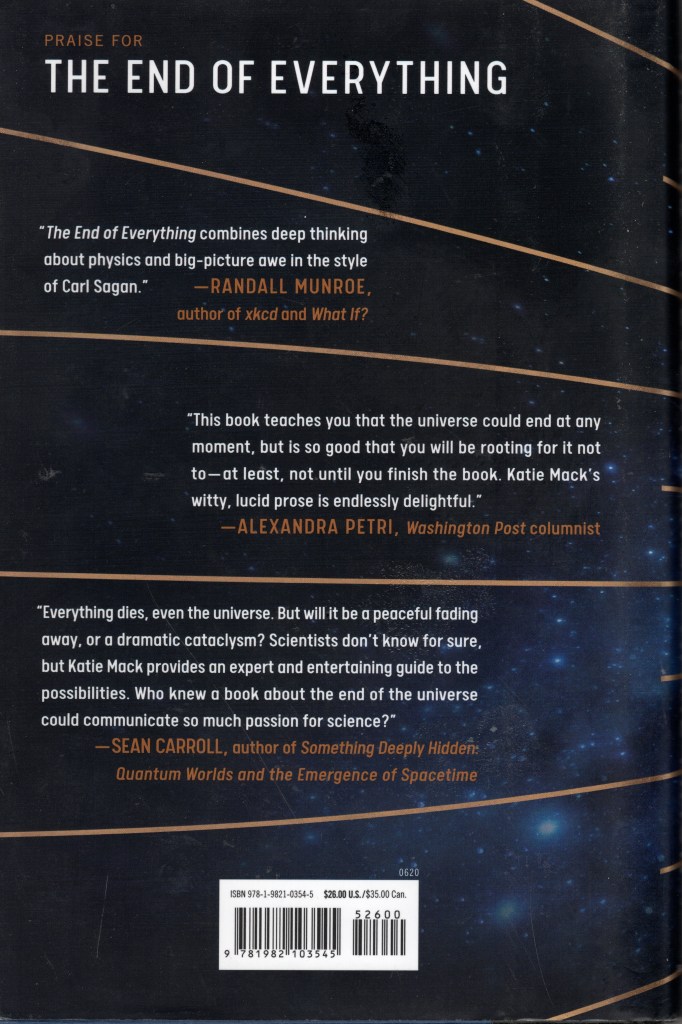
The back cover of The End of Everything by Katie Mack
Back cover of The End of Everything? Click on the image to go to the Amazon page for the hardcover version of the book.

Would you like to travel in time into the future to see the end of the Universe?


To see the Super Facts click here


The Little Book of Cosmology

Cosmology is the science of the origin and development of the universe, and this post is about a book on Cosmology, The Little Book of Cosmology by Lyman Page. This is a big and, in my opinion, interesting topic. A lot of cosmology is speculative, multiverses, what was before the big bang, has the universe always existed, has there been an infinite number of big bangs, what about conformal cyclic cosmology in which each cycle result in a new big bang (Roger Penrose), what is the future and end of the universe, is the Universe a hologram, is it self-aware, etc.

This book is not focused on scientific speculation but on what we know about the structure of the universe, the big bang and the expansion of the universe, the well understood basics. I think it is amazing how much we can learn from the Cosmic Microwave Background Radiation (CMB).

The goal of this blog is to create a list of what I call super facts. Important facts that we know to be true and yet they are surprising, shocking or disputed among non-experts. Super facts are special facts that a well-informed person may want to know. However, I sometimes create posts that are not super facts but just interesting information, such as this one. The Little Book of Cosmology is a relatively short and easy read. I bought the hardback version of it.

  • Hardcover –  Publisher : Princeton University Press; First Edition (April 7, 2020), ISBN-10 : 0691195781, ISBN-13 : 978-0691195780, 152 pages, item weight : 2.31 pounds, dimensions : 5.59 x 0.79 x 8.58 inches, it costs $15.39 on Amazon. Click here to order it from Amazon.com.
  • Kindle –  Publisher : Princeton University Press (April 7, 2020), ASIN : B07Z1DWB4P, 132 pages, it costs $9.99 on US Amazon. Click here to order it from Amazon.com.
The front cover features the title, the author, and geodesic lines forming a hyperbolic cone mesh | The Little Book of Cosmology by Lyman Page
Front cover of The Little Book of Cosmology. Click on the image to go to the Amazon page for the hardcover version of the book.

Amazon’s description of The Little Book of Cosmology by Lyman Page

The cutting-edge science that is taking the measure of the universe

The Little Book of Cosmology provides a breathtaking look at our universe on the grandest scales imaginable. Written by one of the world’s leading experimental cosmologists, this short but deeply insightful book describes what scientists are revealing through precise measurements of the faint thermal afterglow of the Big Bang—known as the cosmic microwave background, or CMB—and how their findings are transforming our view of the cosmos.

Blending the latest findings in cosmology with essential concepts from physics, Lyman Page first helps readers to grasp the sheer enormity of the universe, explaining how to understand the history of its formation and evolution in space and time. Then he sheds light on how spatial variations in the CMB formed, how they reveal the age, size, and geometry of the universe, and how they offer a blueprint for the formation of cosmic structure.

Not only does Page explain current observations and measurements, he describes how they can be woven together into a unified picture to form the Standard Model of Cosmology. Yet much remains unknown, and this incisive book also describes the search for ever deeper knowledge at the field’s frontiers—from quests to understand the nature of neutrinos and dark energy to investigations into the physics of the very early universe.

This is my five star review for The Little Book of Cosmology

What the Cosmic Microwave Background (CMB) can tell us

This is a short book describing the evolution of the Universe since the Big Bang and its composition. How do we know all this stuff? The Cosmic Microwave Background (CMB) can tell us a lot.

The CMB is a black body radiation remnant from the time (400,000 years after the Big Bang) when the Universe had cooled enough to allow the formation of hydrogen atoms and the decoupling of photons from electrons so that they could roam free.

CMB is in itself evidence for the Big Bang but in addition we get additional information from the minor anisotropy and polarization of the CMB, and add the composition of the elements (hydrogen, helium, lithium, and heavier elements), redshifts of galaxies, gravity lensing, and we can tell quite a bit about the evolution of the Universe and where it is heading.

It’s fascinating science detective work. This eventually leads to the Standard Model of Cosmology, which is something I’ve never heard of before, but it’s cool.

I found the facts about the size and age of the Universe, the early giant stars in the Universe, dark energy and dark matter, very interesting. The book is filled with basic and fascinating facts that I did not know. Because of the CMB (rather than particle accelerator experiments) we know roughly the mass (rest mass) of neutrinos.

We know why dark energy can’t be space dust, or rogue planetoids, or black holes or neutrinos, so what is it? The book explains why it can’t be any of those. There’s a lot we can know because of the CMB and other information, and some things we don’t know. Finding out what we do know was quite exciting and finding out what the mysterious “what we don’t know” was equally exciting. Again, the focus is on CMB and how it is measured, it tells us a lot.

The book is easy to read and require no degree in physics or mathematics. I admit I have a degree in Engineering Physics, and I am also interested in astronomy and cosmology, but I can tell it was light reading. It is a truly popular science book like those that Neil De Grasse Tyson writes, and it was short but very informative. There’s a lot of information you can extract from CMB. It was a fun short read for anyone interested in the mysteries of the Universe.

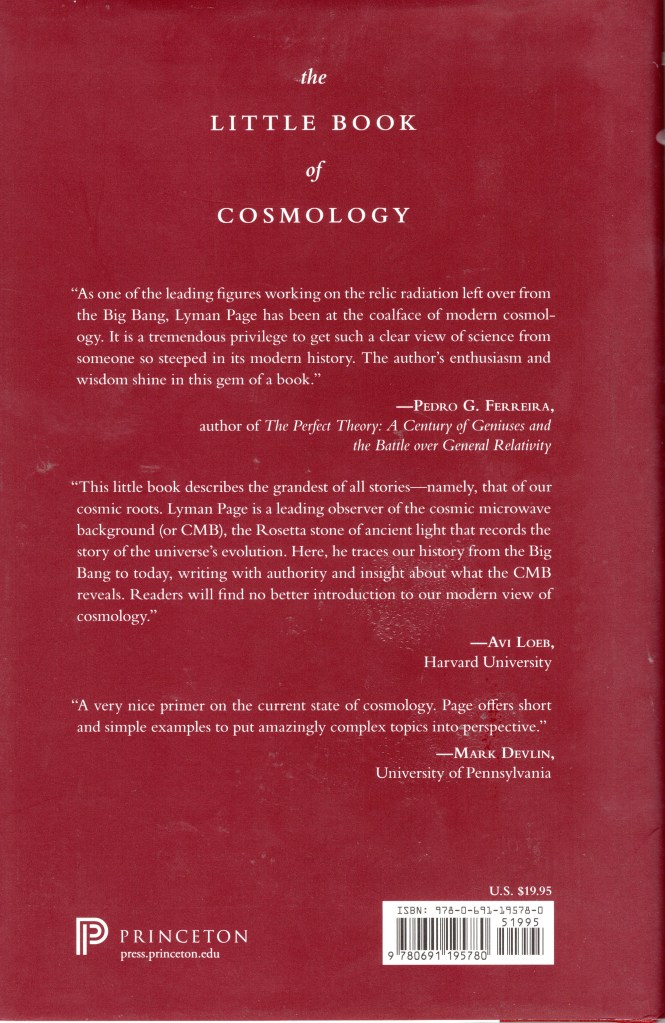
The back cover feature advanced praise for the book | The Little Book of Cosmology by Lyman Page
Back cover of The Little Book of Cosmology. Click on the image to go to the Amazon page for the kindle version of the book.

To see the Super Facts click here


The Betelgeuse Supernova

This is a submission for Kevin’s No Theme Thursday

The Betelgeuse Supernova
Image by Kevin from The Beginning at Last

Supernova

A supernova is an explosion of a star so violent that it can outshine an entire galaxy. It can occur when a super massive star’s core contracts (the death of the star) and as it reaches a critical point it triggers nuclear reactions that cause the star to explode. Alternatively, it can occur when a white dwarf star is triggered into runaway nuclear fusion by a collision with another star.

Depending on how far away the supernova is it can be as luminous as a bright new star, the moon, or a second sun. It occurs suddenly and lasts for several weeks or months before fading away. If a supernova shines bright enough, the other stars in the sky will vanish from view. We can’t see the stars during the day, not because of the blue sky, but because of the ambient light from the sun. 

This is also one major reason photos from space often lack stars in the black sky. If a supernova is close enough to earth it could destroy earth. Luckily there are no super massive stars close enough to earth to pose a risk.

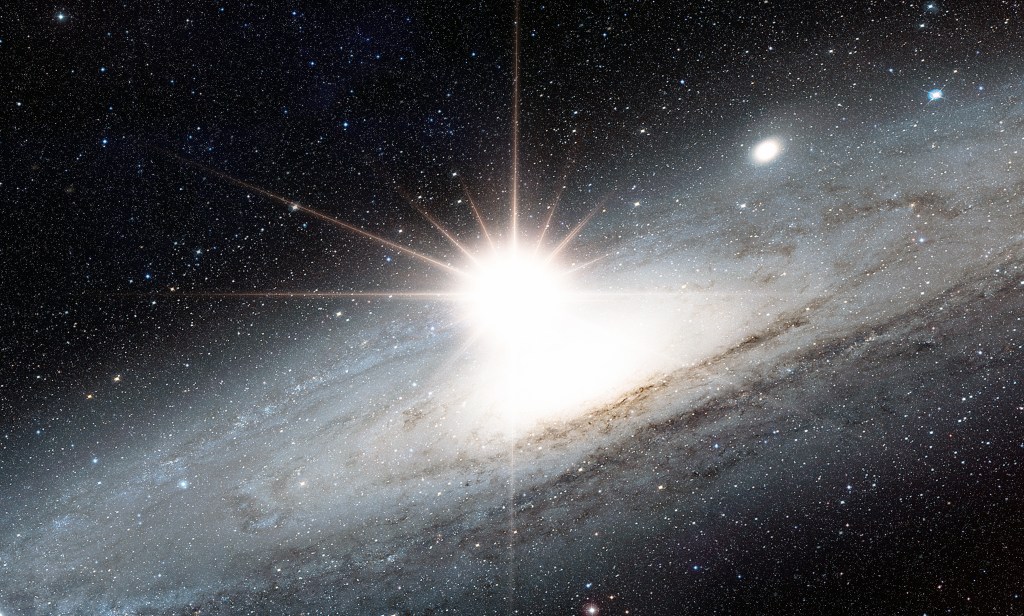
A picture of the Andromeda Galaxy with a bright white light near its center. The bright light is almost outshining the entire galaxy.
Supernova explosion in the center of the Andromeda galaxy “Elements of this image furnished by NASA” It is essentially an enhanced photo of a supernova explosion in a neighboring galaxy. Stock Photo ID: 2495486227 by muratart.

The Betelgeuse Supernova

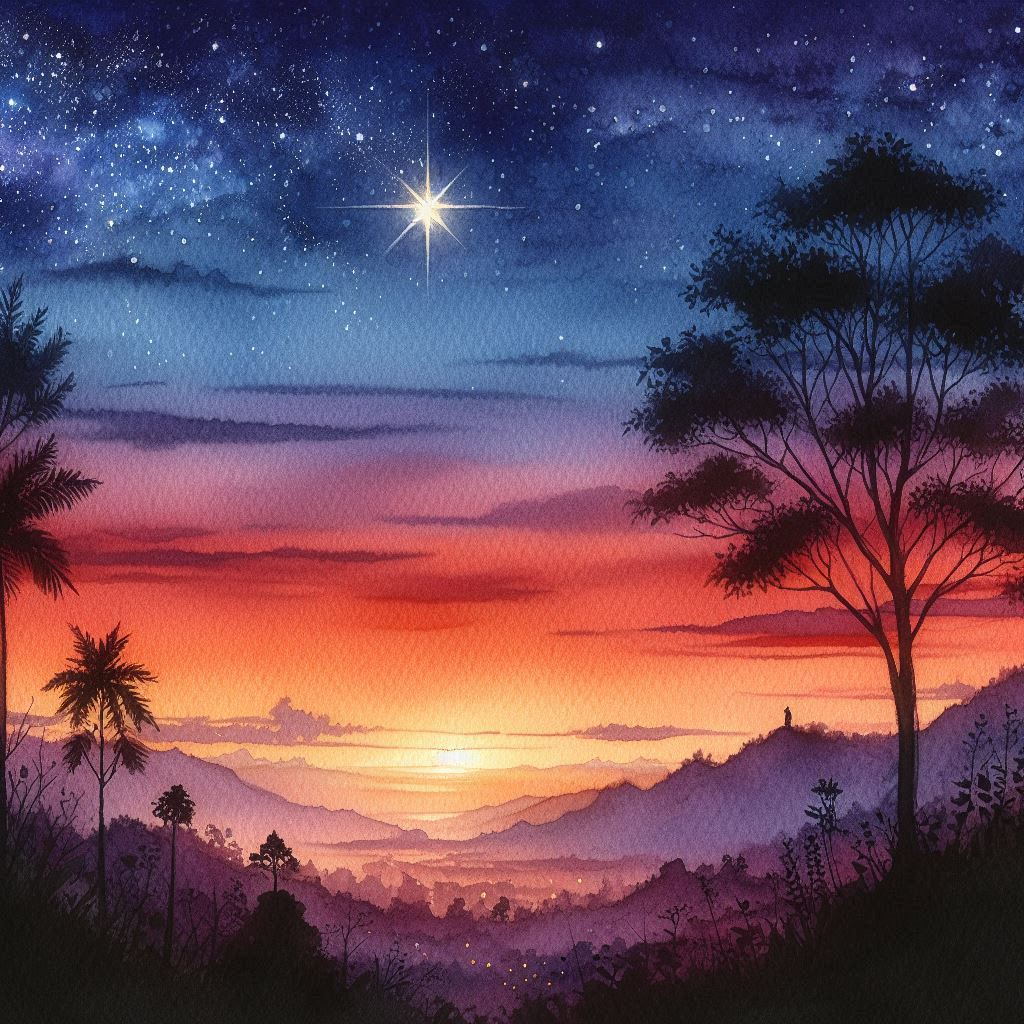
Betelgeuse the bright red star in the constellation Orion is thought to be close to going supernova, and when it does it will be about as bright as half a full moon in our sky but concentrated in a point. What does “close” mean? Some astronomers say within decades, some say within a few thousand years. Could Kevin’s beautiful picture above depict this future event?

This is a map of the Orion constellation showing Orion’s belt in the middle. Betelgeuse is a red star or dot up to the left | The Betelgeuse Supernova
Illustration of the Orion constellation. To find Betelgeuse, first find Orion’s belt, then look up to the left. The reddish star is Betelgeuse. It is visible at this time of year (on a clear night). Stock Vector ID: 1631025025 by Tedgun.

We are stardust

The first stars in the Universe were made of 75% hydrogen and 25% helium and trace amounts of Lithium, just like the entire Universe at the time. Heavier elements that could form rocky planets or other solid celestial bodies did not exist.

However, inside the cores of these stars, heavier elements such as carbon, oxygen, and iron were formed by fusion. These early stars are referred to as first generation stars. They tended to be large and ended their lives in massive supernova explosions. The dusty remains of these explosions became the building blocks of the second and third generation stars we see today as well as the planets, our bodies and all life. We are stardust.

The picture consists of two pie chart graphs representing stars. The left one is a first-generation star with one pie for the 75% hydrogen and one pie for the 25% helium.
The first-generation stars consisted of 75% hydrogen and 25% helium and trace amounts of Lithium. A second or third generation star like our sun is still mostly hydrogen and helium but also many other elements. The rocky planets circling the sun are mainly elements heavier than hydrogen and helium. Image credit NASA, ESA, CSA, STScI.

Finally, a 33 second YouTube video illustrating a Supernova (the creation of the Crab nebula)


Would you like to see Betelgeuse explode into a supernova in your lifetime?


To see the Super Facts click here

Black Holes Monsters in the Sky

“This”Black Holes Monsters in the Sky” is a submission for Kevin’s No Theme Thursday

Black Holes Monsters in the Sky
Image by Kevin from The Beginning at Last

Black holes, everyone has heard of them, no one understands them. They are inscrutable monsters in the sky. They are regions of spacetime wherein gravity is so strong that nothing can escape, not light, not anything. Some of them are small, only 15 kilometers across, and some have a diameter 27 billion times larger than that.

As you get close to a black hole your time will run slower. You won’t notice it, but others will see you move in slow motion. If you return from your close encounter an hour on your clock might correspond to years elsewhere. As you approach the event horizon, the boundary of no escape, you become invisible and time will stop, at least from an outside view.

Black holes are invisible. They are truly black. However, we can see them if they are consuming matter. The matter close to black holes will heat up and glow. The closer to the event horizon the redder it is. It is called an accretion disk as in the depiction above.

There are an estimated 100 million black holes in our galaxy, the Milky Way. At the center of the Milky Way is a super massive black hole called Sagittarius A-star. It is 4 million times more massive than our sun. There are supermassive black holes located at the center of most large galaxies. The supermassive black holes are considered to play a crucial role in the formation of galaxies.

I’ve looked up in the sky, and I’ve seen the spot where Sagittarius A-star is located. I’ve tried to look at it with my telescope, but I cannot see it. It is not possible to see it with a telescope, but it is there. The picture above may depict the view from a planet in the center of our galaxy. Three scientists received the Nobel prize in physics in 2020 for their research on black holes (Roger Penrose, Reinhard Genzel, and Andrea Ghez).

However, before them the tele evangelist Jack Van Impe won the 2001 Ig Nobel Prize in Astrophysics for his discovery that black holes meet all the technical requirements for Hell. The Ig Nobel prize is an alternative and less serious Nobel Prize. To find out more about Black Holes click here.

Below is an animation created by NASA that depicts what an observer falling into a black hole would see.


To see the Super Facts click here

Life Must Have Hydrogen Oxygen Carbon Nitrogen and Phosphorus

The goal of this blog is to create a list of what I call super facts. Important facts that we know to be true and yet they are surprising, shocking or disputed among non-experts. Special facts that any well-informed person should know. 

  • Paperback –  $18.95 on Amazon – future release March 25, 2025.
  • Hardcover –  Publisher : Princeton University Press; First Edition (September 12, 2023), ISBN-10 : 0691177295, ISBN-13 : 978-0691177298, 240 pages, item weight : 1 pounds, dimensions : 5.75 x 1 x 8.5 inches, it costs $18.95 on Amazon. Click here to order it from Amazon.com.
  • Kindle –  Publisher : Princeton University Press (September 12, 2023), ASIN : B0C5SBB26C, 229 pages, it costs $15.37 on US Amazon. Click here to order it from Amazon.com.
  • Audio –  Publisher : Princeton University Press (September 19, 2023), ASIN : B0CF6WHBVX, listening length 7 hours, narrator : Christopher Ragland, it costs $0.99 on US Amazon. Click here to order it from Amazon.com.
A picture of planet earth, the title and the subtitle “How Five Elements Changed Earth’s Past And Will Chape Our Future” The letters H, N, C, P, O are circled | Life Must Have Hydrogen Oxygen Carbon Nitrogen and Phosphorus
Front cover of Elemental. Click on the image to go to the Amazon page for the hardcover version of the book.

Amazon’s description of the book

It is rare for life to change Earth, yet three organisms have profoundly transformed our planet over the long course of its history. Elemental reveals how microbes, plants, and people used the fundamental building blocks of life to alter the climate, and with it, the trajectory of life on Earth in the past, present, and future.

Taking readers from the deep geologic past to our current era of human dominance, Stephen Porder focuses on five of life’s essential elements—hydrogen, oxygen, carbon, nitrogen, and phosphorus. He describes how single-celled cyanobacteria and plants harnessed them to wildly proliferate across the oceans and the land, only to eventually precipitate environmental catastrophes.

He then brings us to the present, and shows how these elements underpin the success of human civilization, and how their mismanagement threatens similarly catastrophic unintended consequences. But, Porder argues, if we can learn from our world-changing predecessors, we can construct a more sustainable future.

Blending conversational storytelling with the latest science, Porder takes us deep into the Amazon, across fresh lava flows in Hawaii, and to the cornfields of the American Midwest to illuminate a potential path to sustainability, informed by the constraints imposed by life’s essential elements and the four-billion-year history of life on Earth.

This is my five-star review for the book Elemental

The Story of HOCNP the Five Elements Essential to all Life

The author, a biogeochemist, explains why five elements, hydrogen (H), oxygen (O), carbon (C), nitrogen (N), and phosphorus (P) are essential to all life. As an example, in the sunlit waters of the central equatorial Pacific Ocean, a lack of Nitrogen creates a water desert with no life. Lifeforms that are able extract more of these elements have a competitive advantage.

This book focuses on three world-changing organisms that were able to extract unprecedented amounts of these elements from the environment also resulting in success and huge increases in the total mass of lifeforms, as well as consequences causing mass extinction eventually followed by an entirely new planet. Note this book is not about mass extinctions, which have happened at least five times, but something more profound. It is about planet-changing events.

During the first two billion years of earth’s history there had been no oxygen in the environment; oxygen was always bound to some other atom, such as hydrogen in water. There was life back then but in the form of primitive bacteria using a primitive form of photosynthesis involving sulfur. Then came cyanobacteria which had invented a more effective form of photosynthesis, as well as a way of extracting nitrogen using a process called nitrogen fixation. The two-atom nitrogen in the air is nearly inert and very difficult to use. This made cyanobacteria extremely successful.

However, one consequence was that the carbon dioxide was largely removed from the atmosphere, while the atmosphere was filled up by oxygen, which is a byproduct of the new form of photosynthesis. Carbon dioxide is a greenhouse gas that warms the planet, something scientists had already figured out in the 1850’s. With much less carbon dioxide, the earth got very cold, and a snowball earth disaster followed. However, in the long run the oxygen paved the way for the existence of multicellular life and animals. The planet changed.

About 400 million years ago plants was a new type organism that was able to extract water (hydrogen and oxygen) from land as well as phosphorus. Their success led to another depletion of carbon dioxide causing another ice period, but they paved the way for life on land. The planet changed again. Now humans, the third type of organism, are extracting all five elements in unprecedented amounts causing global warming and other unintended consequences.

Unlike cyanobacteria and plants, we are not doing this to primarily extract nutrients but for transportation, heating and consumer products and we can control and predict the consequences of our actions.

As evidence for global warming / climate change the author discusses the temperature measurement records of various organizations (NOAA etc.). That is the smoking gun.

However, he also mentions things like the fact that the vast majority of glaciers in the world are retreating or disappearing and the fact that anyone above the age of 50 who comes from a northern climate (that would be me) can attest to the fact that winters have gotten noticeably shorter snow seasons and warmer summers. That is true and it is a good thing to mention because there are those who are quick to dismiss temperature records as big hoaxes.

The second part of his global warming discussion, the evidence that we humans are the cause of the current warming, leaves something out in my opinion. He explains why the various climate models provide incontrovertible evidence that the chief cause for the current global warming is our burning of fossil fuels, despite the models being far from perfect. I totally agree with that, but once again there are those who are not willing to accept climate models as solid evidence, and therefore you should mention other evidence as well, which he does not do.

Examples of evidence that we are the cause and that does not involve complex models would be, no known natural cause can explain the current warming, the upper troposphere is cooling while the lower troposphere is warming, the arctic is warming much faster than average, nights are warming much faster than days, etc. Those are things that would not happen if the cause was a hotter sun (which we also kept a record of) or an orbital cycle.

In addition, spectral analysis shows the cause to be the adding of greenhouse gases to the atmosphere, and various isotope studies show that the carbon emissions come from the burning of hundreds of millions of years old carbon. Why not mention that as well? I know all this is baked into the models, but simple explanations appear more convincing to many. I am not taking off a star for it, but I felt it was a missed opportunity.

One environmental threat that you don’t hear much about is the depletion of phosphorus. This is something that may be far into the future but something that seems impossible to solve once it arrives and could evolve into an enormous food crisis. This was certainly a unpleasant surprise to me.

The book explains many processes and concepts, biogeochemistry, primitive photosynthesis using sulfur, photosynthesis using water (cyanobacteria) and releasing oxygen, nitrogen fixation, endosymbiosis, how plants extract phosphorus from the ground, the evolution of plants, the slow carbon cycles, the fast carbon cycle, the effect of volcanoes on climate, respiration, why can trust certain aspects of climate models, nitrogen fixation, nitrogenase, the immense effect fertilizers have had on food production, the Haber-Bosch process, earth’s climate history, why phosphorus is both finite and irreplaceable, the danger to aquifers, how we have changed ecosystems, and more.

Despite that the author makes himself understood. He explains complex concepts, so they are easy to understand and connects them all in a logical way that makes a lot of sense. So don’t be afraid that the book will be difficult to read. You may just learn a lot.

The author considers climate change / global warming to be our most serious environmental challenge, but he offers a lot of suggestions for a way forward. He discusses a lot of interesting technological solutions. I think he may be a bit gloomier than necessary but overall, what he says is very insightful and somewhat hopeful.

Again, I was very impressed by the organization of the book. It is easy to create a mess when you try to connect a lot of different concepts and complex science into a logical narrative, but he was very successful. It was a delight to read this book, it was interesting and full of facts, which were new to me, and I think are very important. I learned a lot and I think it is a very well written page turner.

The back cover advanced praise for the book.
Back cover of Elemental. Click on the image to go to the Amazon page for the kindle version of the book.

To see the Super Facts click here