There is strong evidence for the Big Bang

Super fact 37: There is strong evidence for the Big Bang, and we know a lot about how the Universe evolved through time since the Big Bang.

Considering the evidence that has accumulated throughout the years for the Big Bang it is hard to deny it happened. In my experience very few people are aware of this evidence, and they are surprised to find out how much evidence there is and how many details we know about the evolution of the universe. It is easy to believe that scientists are guessing when you don’t know much about the evidence yourself. But they are not guessing. That is why I call this a super fact.

In addition, there’s a lot of misconceptions around the Big Bang as well surprising facts. A few additional things that might surprise people are that the Big Bang was not like an explosion, the Universe did not expand into something. In addition, there might be multiverses and multiple Big Bangs, and there are cyclic models, and so-called eternal inflation. There are things we know and things we don’t know.

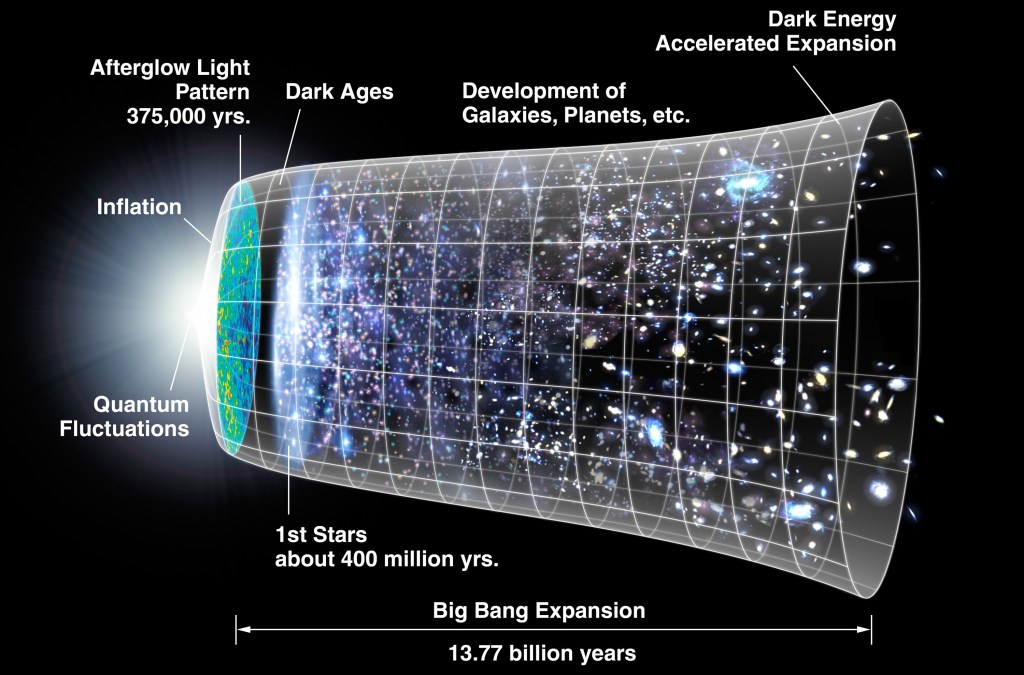
The pictures show an expanding Universe starting with quantum fluctuations followed by inflation, then an afterglow light pattern 375,000 after the Big Bang and then the so-called dark ages, the creation of stars and galaxies | There is strong evidence for the Big Bang
This file is in the public domain in the United States because it was solely created by NASA. (from Wikimedia commons

The Expansion of the Universe

It used to be believed that the Universe was static. In 1929 the astronomer Edwin Hubble discovered that the universe was expanding. He made this observation by analyzing the light from distant galaxies and noticing that their light was redshifted. I am going to explain what that means next.

Light emitted from elements, atoms and molecules have light absorption patterns that are unique to the atom/element in question. This is called a light spectrum. This makes it possible to identify the elements in a star and their proportions. Red shifted means that the absorption lines have moved towards red because the frequency of the light has been shifted due to the motion. This is called the doppler effect.

You can notice this phenomenon for the case of sound when an ambulance is coming towards you and then speeding by you. The sound changes. Hubble was using the redshift to the determine that further away the galaxy was the faster it was moving away from us.

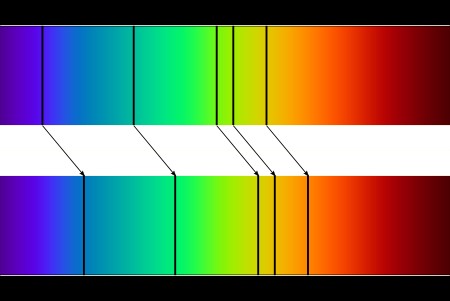
The top shows a colorful spectrum from blue to red with absorption lines in black. The bottom portion of the picture shows the same thing expect the black absorption lines have moved a bit to the right.
Visualization of redshifted absorption lines are redshifted due to velocity away from observer. Top lines are for an object at rest and in the bottom picture the object is moving away. Maxmath12, CC0, via Wikimedia Commons. This file is made available under the Creative Commons CC0 1.0 Universal Public Domain Dedication.

A natural explanation for this is that the universe is expanding, and that it once must have been much more compressed, but it is not the only explanation. However, there is more evidence.

The Cosmic Microwave Background Radiation

If you assume that the universe once was much more compact and much hotter than today, particles such as protons, neutrons and electrons would have been free and close together preventing light from freely moving around. However, as the universe kept expanding and cooling these particles eventually should have been able to form atoms allowing light or electromagnetic radiation to freely move around.

Some physicists, Alpher, Herman and Gamow predicted around 1950 that this should have left behind a detectable microwave background radiation. This radiation was detected by chance in 1964 by two physicists, Penzias and Wilson. This radiation had the expected properties and careful study of this Cosmic Microwave Background Radiation (CMBR or CMB) has given us a lot of information about our universe and may give us information about other universes (multiverses).

Its existence is strong evidence that the universe once was very compressed and much hotter, i.e., the Big Bang. An interesting fact is that in old TVs, between the channels (old people will remember this), you had this fuzz, or war of the ants as some people called it, and part of that TV fuzz is the CMBR.

A big sky map with varying colors, yellow, red, green and blue | There is strong evidence for the Big Bang
This is a sky map of the cosmic background radiation from when the universe was around 380,000 years old. It was created with the help of satellite (NASA) measurements. The colors are artificial and show tiny temperature variations. NASA / WMAP Science Team, Public domain, via Wikimedia Commons.

You can watch a 4-minute video about the discovery of the CMBR narrated by Neil DeGrass Tyson on this PBS web page by clicking here.

Abundances of Light Elements

Yet another piece of evidence is the relative abundance of hydrogen and helium compared to heavier elements. The physics at the beginning of the Universe under the Big Bang tells us that initially regular matter should have consisted of 75% hydrogen and 25% helium and hardly anything else, and that is composition the oldest stars had when they were new. In addition, the oldest stars we’ve found appear to have an age just under the 13.8 billion years that we get for our Universe assuming the Big Bang theory (that’s another piece of evidence).

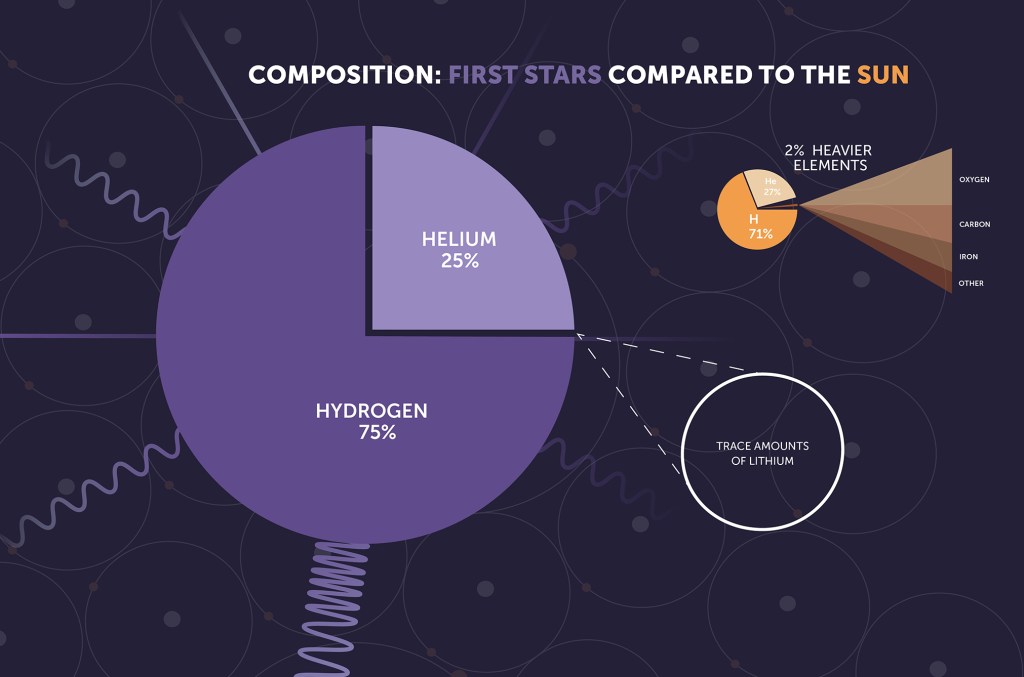
The picture consists of two pie chart graphs representing stars. The left one is a first-generation star with one pie for the 75% hydrogen and one pie for the 25% helium.
The first-generation stars consisted of 75% hydrogen and 25% helium and trace amounts of Lithium. A second or third generation star like our sun is still mostly hydrogen and helium but also many other elements. The rocky planets circling the sun are mainly elements heavier than hydrogen and helium. Image credit NASA, ESA, CSA, STScI

A Very Brief History of Time

So, it all started with a quantum fluctuation. The first 0.000000000000000000000000000000001 seconds is called the inflationary period characterized by super-fast expansion, much faster than the speed of light, as we know it today. At this time the strong nuclear force becomes distinct from the weak nuclear force.

I should point out that during the first 0.0000000000001 seconds the physics laws may not have applied in a normal sense. I should also point out that this was not an explosion. An explosion explodes into something but there was nothing else outside of the universe, so this is more like superfast growth.

At a fraction of a second protons and neutrons form from quarks and after one second neutrinos came into existence and if primordial black holes exist, they were formed at this time too. After two minutes nucleus consisting of neutrons and protons are formed, and the first elements hydrogen and helium formed. After 20 minutes an opaque hot plasma forms, after 100,000 years neutral helium atoms form, and after 375,000 years CMBR is created, etc.

This is just a small sample of everything that we know happened after the Big Bang, based on the known laws of physics. You can read about all the details in books like The First Three Minutes by Steven Weinberg or A Brief History of Time by Stephen Hawking.

vector illustration of up and down quarks in proton and neutron on white background. The proton (left) is a red and blue up quark and a green down quark. The neutron is a red and green down quark and a blue up quark | There is strong evidence for the Big Bang
The proton and neutron each consist of three quarks. They are formed at a fraction of a second after the Big Bang. Asset id: 2333679305 by KRPD.

Pre–Big Bang Cosmology

So, what was there before the Big Bang, if anything? Well, that part is speculation, but there are many good ideas. A popular hypothesis speaks of quantum fluctuations setting off the Big Bang. There are models in which the whole of spacetime is finite, including the Hartle–Hawking no-boundary condition. This means that time itself came into existence with the Big Bang and therefore nothing could have preceded it. This means that the Big Bang could not have been caused or created by anything else, just like a universe that has existed eternally could not have been caused or created by anything else.

In a sense, despite being 13.8 billion years old, the universe in this scenario would have always existed. Because the concept of “always” stops at 13.8 billion years ago. Stephen Hawking used the analogy of the north pole. You can’t go further north from the north pole.

There are other models that include multiverses, for example, eternal inflation, in which universal inflation ends locally here and there in a random fashion, each endpoint leading to a bubble universe, expanding from its own big bang. You can view this model as inflation being the river of time with the various universes popping up like bubbles in the stream.

In another model inflation is due to the movement of branes in string theory and Big Bangs are the result of colliding branes. There are cyclical models, such as Nobel Prize winner Roger Penrose’s Conformal cyclic cosmology in which one universe gives rise to another universe as it dies.

Notice that Pre-Big Bang Cosmology is speculative, but the reality of the Big Bang is backed by strong evidence.

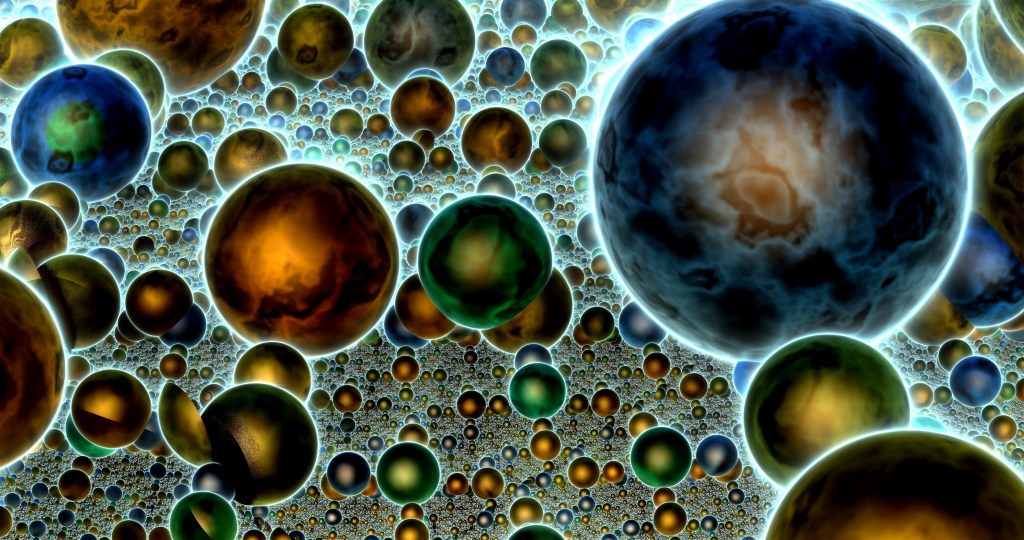
Thousands of universes represented as colorful balls | There is strong evidence for the Big Bang
The surface of a multiverse with a lot of universes 3d rendering Asset id: 2256998119 by Dr. Norbert Lange.

To see the other Super Facts click here

Scientists Agree that Global Warming is happening and that we are the Cause

Super fact 34: Climate Scientists agree that Global Warming or if you call it Climate Change is happening, and that it is caused by us primarily because of our burning of fossil fuels. There is a long-standing scientific consensus on these two facts because the evidence is conclusive. Typically, studies show an agreement of at least 97% or 98% among climate scientists.

This is a super fact because surveys show that this is not what the public believes and yet it is true. The public incorrectly believes that there is a large disagreement among scientists on this topic. A note, to understand why the evidence is conclusive as to why global warming is happening and is caused by us click here.

Note : I will use the term “global warming” in this review. Whether you call the phenomenon climate change, climate disruption, or global heating, is not important.

The Scientific Consensus

This extensive survey from 2013 of 12,000 climate papers (papers published over two decades) by Dana Nuccitelli and Cook, etc., concluded that 97.1% of climate scientists endorsed the consensus position that humans are causing global warming.

They also did a science author self-rating which concluded that 97.2% of climate scientists endorsed the consensus position that humans are causing global warming. Another conclusion from the survey was that the consensus had increased from around 90%, perhaps less, in the early 1990’s.

A later review of six independent, peer-reviewed studies examining the scientific consensus about global warming have concluded that between 90% and 100% of climate scientists are convinced human-caused global warming is happening. A more recent study (2021) found that as many as 98% of climate scientists are convinced global warming is happening and is human-caused. Numerous other surveys have concluded the same thing.

People’s Beliefs About Global Warming

This 2024 survey from Yale University show that most Americans (61%) understand that global warming is mostly human caused. By contrast, 28% think it is caused mostly by natural changes in the environment. Most Americans (58%) <<Link-6>> understand that most scientists think global warming is happening. This percentage has trended generally upward since this survey began in 2008. By contrast, about one in five (22%) think there is a lot of disagreement among scientists about whether global warming is happening.

The green graph is going up slightly starting from 46% in 2009 and ending in 58% in 2023. The black graph starts at 33% in 2009 and ends in 22% in 2023. The yellow graph starts at 2% in 2009 and ends in 2% in 2023 | Scientists Agree that Global Warming is happening and that we are the Cause
The green graph corresponds to “most scientists think global warming is happening (%).” The black graph corresponds to “there is a lot of disagreement among scientists (%)”. The yellow graph corresponds to “Most scientists think global warming is NOT happening (%)”. Graph taken from the Yale Program on Climate Change Communication.

However, only one in five Americans (20%) understand that nearly all climate scientists (more than 90%) think that human-caused global warming is happening. The aforementioned Dana  Nuccitelli refers to this in his book Climatology versus Pseudoscience as the consensus gap. Again, this large discrepancy between public perception and reality makes the consensus gap a super fact. Research has shown that this discrepancy has a large impact on people’s other beliefs regarding global warming.

This is bar graph. It shows that 2% believe the answer is 0-10%, 2% believe the answer is 11-20%, 3% believe the answer is 21-30%, 3% believe the answer is 31-40%, 8% believe the answer is 41-50%, 7% believe the answer is 51-60%, 7% believe the answer is 61-70%, 13% believe the answer is 71-80%, 13% believe the answer is 81-90%, 20% believe the answer is 91-100%, 22% don’t know | Scientists Agree that Global Warming is happening and that we are the Cause
The question was, To the best of your knowledge what percentage of climate scientists think that human-caused global warming is happening? Graph taken from the Yale Program on Climate Change Communication.

Why is there a Consensus Gap?

In his book Climatology versus Pseudoscience Dana Nuccitelli explains that a relatively small group of so-called climate skeptics, or more accurately called climate contrarians have received a lot of attention from media. Even though their science is bad, and they’ve published their error ridden papers in obscure or discredited journals, and the fact that their predictions have failed repeatedly many times over, they have had an enormous influence on public discourse. Conservative politicians, and many talk show hosts are blindly devoted to their falsehoods, whilst real scientists are being attacked.

It is not just rightwing media who are using them for their purposes, but mainstream media are giving the contrarians undue attention as well. Sensationalism is one issue. A science contrarian claiming that all the climate scientists are wrong, and that he is the only one who finally got it right is a lot more interesting of a story than a repeat of the consensus. Another issue is false balance. Journalist should not feel that they must give equal time to evidence-based science and nonsense, but that is often the case. To read my review of this book click here.

The Oregon Petition

I am mentioning the Oregon petition because I fell for it myself. The Oregon petition was an official looking petition circulated by climate contrarians, claiming that there is no evidence that human-caused global warming will cause catastrophic heating of earth’s atmosphere and disruption of earth’s climate, and that adding more carbon dioxide to the atmosphere would even be beneficial for plants and animals. It got an impressive number of signatures, 32,000 after some years.

However, it turned out that the signatories rarely had climate expertise, and were not scientists, and the survey listed many falsified names such as the names of the Spice Girls and several fictional characters. Less than 200 of the signatories were climate researchers.

It was a con, but it was touted in a lot of media as the truth. I saw it over and over and I believed it. I was later surprised to learn that it was a con and that a scientific consensus existed on global warming / climate change. Learning that I had been bamboozled on this matter was one of the red flags that prompted me to start doing some fact checking on the issue global warming.

To see the other Super Facts click here

Smallpox Killed 300 million People in the Last Century Before Eradication

Superfact 24: Smallpox killed 300 million people in the 20th century. However, there have been no naturally occurring cases of smallpox since 1977, and the world was declared free of smallpox on May 8, 1980, by the 33rd World Health Assembly.

Vial with smallpox vaccine and syringe against blurred doctor's face. 3D rendering | Smallpox Killed 300 million People in the Last Century Before Eradication
Smallpox vaccine Stock Illustration ID: 1782022109 by Novikov Aleksey

300 million people is an astonishing number. It is six times the 50 million people who died from the Spanish flu. It is about four times as many people as the 70 to 85 million people who died in World War II. It is close to the entire current population of the United States. That’s how many people died from this very dangerous disease. It was eradicated by a vaccination campaign.

I think this fact qualify as a super-fact, first of all because of the astonishingly huge number of deaths but also for the fact that it is gone. It is hard to believe that this happened. It is hard to believe that the world has changed so drastically for the better. It is a shocking but true fact. Thanks to the vaccination campaign we are living in a much better world.

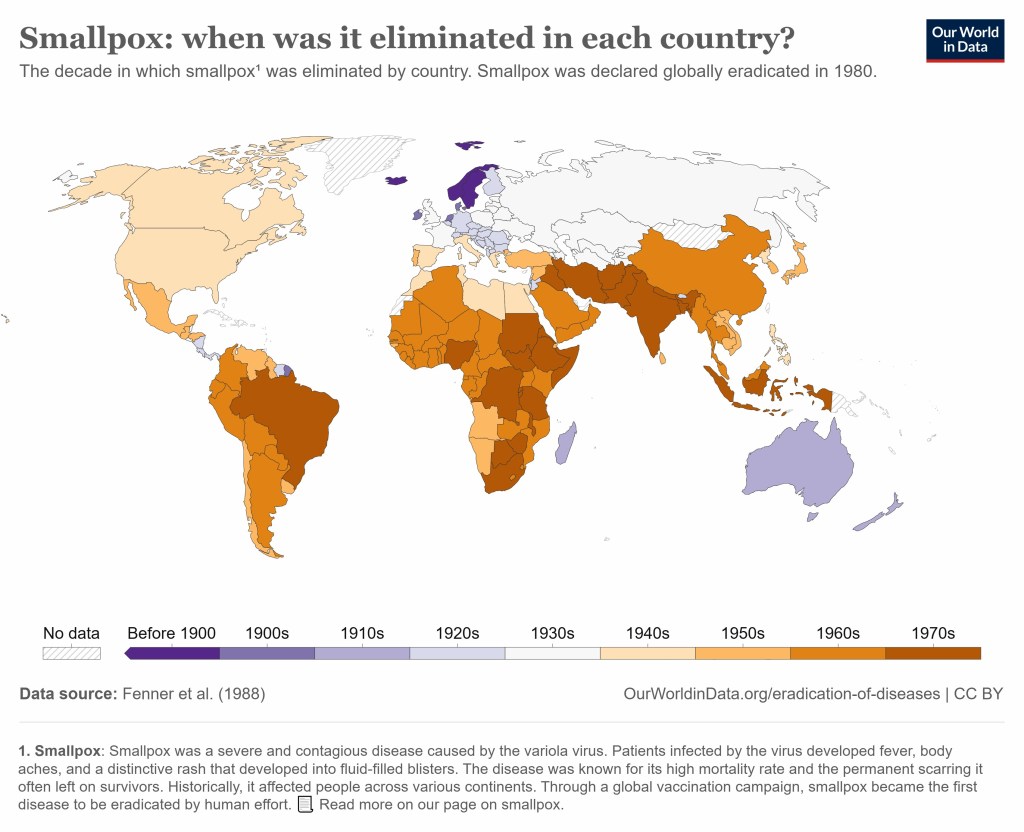
The picture is a world map showing countries in different colors. The colors indicated when smallpox was eradicated in that country. Dark blue indicates that it was before 1900 and that is Sweden and Norway. Light beige indicates it was eradicated in the 1940’s, which is true for the United States. Dark brown indicates that it was eradicated in the 1970’s and that represents, for example, India, Brazil and many African countries | Smallpox Killed 300 million People in the Last Century Before Eradication
This world map shows when smallpox was eradicated from different countries. The source is Our World in Data, originally Fenner et al. at CDC.

What is Smallpox?

Smallpox is an infectious disease caused by the variola virus<<Link-1>>. The last naturally occurring case was diagnosed in October 1977, and the World Health Organization (WHO) certified the global eradication of the disease in 1980.  The disease begins with fever and vomiting followed by the formation of ulcers in the mouth and a skin rash that later turns into fluid filled blisters with a dent in the middle. These blisters get scabbed and leave scars. The death rate was about 30%.

A child with covered by severe blisters.
Child with smallpox in Bangladesh 1975. Wikimedia commons photo by CDC/James Hicks.

The Eradication of Smallpox and Vaccines

The smallpox vaccine has a long history that begin in China where smallpox inoculation had existed long before it did in Europe. In 1796 the English physician Edward Jenner demonstrated the effectiveness of cowpox to protect humans from smallpox. Soon after several countries enacted mandatory vaccinations.

In 1807, Bavaria became the first country in the world to introduce compulsory vaccinations. In 1958 the World Health Assembly was called upon to eradicate smallpox. At this point 2 million people still died from smallpox every year. In 1967 the World Health Organization intensified the global smallpox eradication. As mentioned, smallpox was eradicated at the end of the 1970’s.

In 1998 & 2002 vaccination was dealt a blow by the Wakefield studies claiming that the MMR vaccine caused autism. Even though the studies were debunked, and several later studies showed no link between the MMR vaccines and autism, the fear of vaccines began to spread.  

For example, in 2024 the American Veterinary Medical Association reported 37% of the dog owners surveyed believe canine vaccination could cause autism in their dogs. Not only is there no link between vaccines and autism, but technically speaking, dogs cannot be autistic as the condition is unique to humans. Unfortunately, the unnecessary fear of vaccines causing autism seems to only be getting worse.


To see the other Super Facts click here


Are you vaccinated against smallpox?

The Surprising Monty Hall Problem

Superfact 22: Suppose you’re on a game show, and you’re given the choice between three doors: Behind one door is a car; behind the other two doors there are goats. You want to pick the car. You pick a door, and the host, who knows what’s behind the three doors, opens another door revealing a goat. Now the question is, is it to your advantage to switch door choice? The answer is yes. And that is the surprising Monty Hall Problem.

There is a blue door on the left, a red door in the middle, and a green door on the right | The Surprising Monty Hall Problem
The Monty Hall gameshow Three Doors Problem. There is a car behind one door, and goats behind the other two. You pick a door. Monty Hall, the gameshow host, opens one of the other doors and it has a goat. Should you change your choice of door? Yes, you should. But why? – Monty Hall Problem Stock Illustration ID: 1881849649 by SATYA94.

It is quite common to argue that it does not matter. You don’t know what is behind the two remaining doors so it should be 50/50 right? In a test involving 228 people only 13% chose to switch. However, you should switch.

Monty Hall, the gameshow host of the Let’s Make a Deal television game show, knows where the car is, so he never chooses the door with the car. And by curating the remaining two doors for you, he raises the odds that switching is always a good bet. By switching your choice, you have a 2/3 chance of winning the car but if you stay with your original choice, you only have a 1/3 chance of winning the car.

So why is this a super-fact? First, we know it is true. It is mathematically proven and experimentally verified that switching door is the best choice. Secondly, this was widely contested and is still surprising to people. Finally, probabilistic thinking is the key to being rational and making good decisions. This fact is true, important and disputed and thus a super fact.

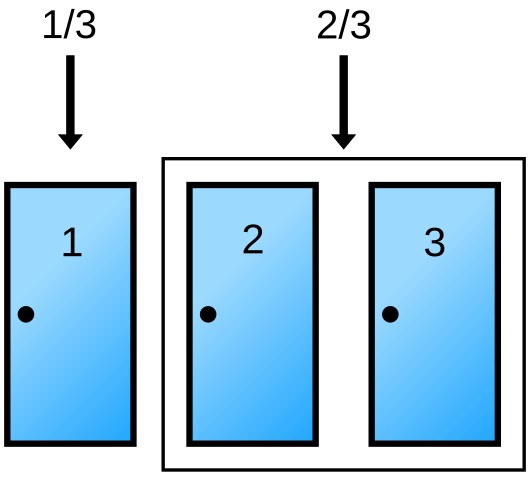
One way of viewing the situation is by noting that there is a 1/3 chance that the car is behind any door that the contestant picks and a 2/3 chance that the car is behind one of the other two doors.

The picture shows three doors, one marked 1/3 and two more grouped together under 2/3 | The Surprising Monty Hall Problem
The car has a 1/3 chance of being behind the contestant’s pick and a 2/3 chance of being behind the other two doors. Picture from Wikimedia commons public domain.

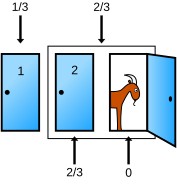
If Monty opens one of the two doors that the contestant did not pick there is still a 1/3 probability that the car is behind the door the contestant picked and a 2/3 chance that the car is behind one of the other two doors. However, one of the doors that the contestant did not pick is now known to feature a goat. Therefore, the probability that the car is behind the other door is 2/3.

The picture shows three doors, one marked 1/3 and two more grouped together under 2/3. The last door has a goat, and it is marked by 0. The door in the middle is marked by 2/3.
The host opens a door. The odds for the two sets don’t change but the odds become 0 for the open door and 2/3 for the closed door. Picture from Wikimedia commons public domain.

The table below is probably (no pun intended) a better way of illustrating the situation. In the table door 1 is the door designated to be the contestant’s first choice. Monty opens one of the remaining doors that has a goat behind it.

Behind door 1Behind door 2Behind door 3Result if staying at door 1Result if switching to door offered.
GoatGoatCarWins goatWins Car
GoatCarGoatWins goatWins Car
CarGoatGoatWins CarWins goat

There are various other ways of explaining the situation including Steven Pinker’s approach. It is easy to test this is real life and repeated experiments and simulations shown that if you switch you have a 2/3 chance of winning.

As an example of the controversy this probability puzzle caused was Marily Savant’s column in Parade Magazine. As a side note, Marilyn Vos Savant is the person who has the highest recorded intelligence quotient (IQ) as stated in the Guinness Book of Records. In response to a question regarding the Monty Hall game show problem she wrote that you should switch. She received letters from 10,000 readers disputing this, including 1,000 with PhDs. In the long run she prevailed.


To see the other Super Facts click here


Neutering or spaying a dog at 6 months old can be dangerous to their health

Superfact 21: Neutering or spaying a dog at 6 months old can be dangerous to their health depending on breed. It is often recommended that you should neuter or spay your dog by the age of 6 months even as early as 8 weeks. This may be OK for some smaller breeds but is dangerous to the health and longevity of many larger breeds.

Many dog welfare organizations, SPCA, ASCA, etc., recommend that dogs are neutered or spayed by the age of 6 months, or even as early as 8 weeks. It is also a common advice in dog books.

In addition, some veterinarians still hold onto this belief. It is easy to understand why. Dogs running loose and causing unwanted pregnancies resulting in puppies having to be euthanized is a sad problem we don’t want. 

Unfortunately, research has shown that neutering or spaying a dog at 6 months old can be dangerous to their health depending on the breed. You may need to wait 18 months or two years, and some breeds should not be neutered at all. In addition to the scientists in the relevant fields, professional and certified breeders, AKC and dog breed clubs and veterinarians who kept themselves informed on this issue are all aware of this.

In other words, we know this to be true, it is an important fact since so many of us own a dog, roughly half of all US households do, and yet this information is highly surprising to many. This is why I consider it a super fact.

Our yellow lab Baylor is on the left. Our brown-black German Shepherd Baby is on the right | Neutering or spaying a dog at 6 months old can be dangerous to their health depending on breed
This is our Labrador Baylor and German Shepherd Baby. Too early neutering and spaying can severely harm their health.

This less than a year-old article from the AKC states that “an age of six to nine months of age may be appropriate for neutering or spaying a toy breed puppy or small breed puppy but a larger or giant breed may need to wait until they are near or over 12-18 months of age.” The article also provides the following interesting information.

Research conducted by the University of California – Davis reveals that for some dog breeds, neutering and spaying may be associated with the increased risks of certain health conditions such as joint disorders including hip or elbow dysplasia, cranial cruciate rupture or tear, and some cancers, such as lymphoma, mast cell tumor, hemangiosarcoma, and osteosarcoma.

The research conclusions are not surprising. Sex hormones are important in the development of any animal.  We know they affect psychological development as well as the musculoskeletal, cardiovascular, and the immune system.

I believe this is the University of California – Davis article in question. It is from 2020. Notice that the suggested guidelines for age of neutering is beyond 23 months for several of the giant breeds in the table featuring 35 breeds.

Bronco, our Leonberger puppy is looking straight into the camera. He is wearing a red bandana | Neutering or spaying a dog at 6 months old can be dangerous to their health depending on breed
Our three months old Leonberger Bronco. The Leonberger is a giant breed you can neuter when they are older than two years old.

Recommended Ages for Neutering and Spaying

Below is a list of recommended ages for neutering and spaying for selected dog breeds.

  • Australian Shepherd, for neutering and spaying it is your choice.
  • Bernese Mountain Dog, you should neuter beyond the age of 23 months, but for spaying you have a free choice.
  • Boxer, neuter and spay beyond the age of 23 months.
  • Boston Terrier, neuter beyond 11 months, but for spaying you have a free choice.
  • Doberman Pincher, never neuter, and you need to spay beyond the age of 23 months.
  • German Shepherd, neuter and spay beyond the age of 23 months.
  • Labrador Retriever, neuter beyond 6 months and spay beyond 11 months.
  • Corgi, neuter beyond 6 months, but for spaying you have a free choice.
  • Great Dane, despite being a very large dog you have a free choice for both neutering and spaying.
  • Rottweiler, neuter beyond 11 months, but for spaying beyond 6 months.
A mini-Australian Shepherd puppy is peeking out behind a sofa chair.
Our mini-Australian Shepherd puppy Rollo. You can neuter this breed at an earlier age.

We used to own a male Leonberger dog, which is a giant breed. Our breeder told us to wait beyond two years before neutering him, for health reasons. This article from Hillhaven Leonbergers states the following “We recommend not neutering until at least 2 years of age…Some Vets would recommend from 6 months but this is NOT a good idea.” To read more about the neutering and spaying of Leonberger dogs click here.

Our Leonberger dog Bronco is standing on a red leather sofa. He is stretching to give me a hug.
Our Leonberger dog Bronco is giving me a hug. He was about one year old in the picture. That is still too early to neuter him.

This article from the Saint Bernard Club of America states that “above all, no giant breed puppy should be altered before the growth plates in the bones have matured and closed, usually between 15 and 24 months of age.” This Newfoundland dog magazine states : Currently, the recommended age that a Newfoundland dog should be neutered is 18 to 24 months due to the possible health problems that can arise from altering before that age.

A Saint Bernard dog carrying the typical cognac container. There are mountains in the background | Neutering or spaying a dog at 6 months old can be dangerous to their health depending on breed
According to the article above you should wait to neuter Saint Bernard Dogs until they are close to two years old. Saint Bernard Stock Photo ID: 1713912484 by fred12.
A dark brown Newfoundland dog standing on a stump in the forest.
According to the article above you should wait to neuter Newfoundland Dogs until they are between 18 to 24 months old. Newfoundland dog Stock Photo ID: 1925281937 by Marsan.

Even though the expert advice regarding the best age for neutering and spaying varies, it is clear that doing it at six months old is too early for many breeds and can harm their health.


To see the other Super Facts click here