The goal of this blog is to create a list of super facts. Important facts that are true with very high certainty and yet surprising, misunderstood, or disputed by many. This blog aims to be challenging, educational, and fun, without it being clickbait. I determine veracity using evidence, data from reputable sources and longstanding scientific consensus. Prepare to be challenged (I am). Intentionally seek the truth not confirmation of your belief.
Super fact 51 : In 1968 5,033 Americans died from a drug overdose. In 1978 5,506 Americans died from a drug overdose. In 1999 16,801 Americans died from a drug overdose. In 2022 107,941 Americans died from a drug overdose. 82,000 of those deaths involved opioids (about 76%). The number of people who died from an opioid overdose in 2022 was 10 times the number in 1999. More than half of all opioid deaths in the world were Americans despite being only 4.2% of the world population. The hardest hit demographic is white males.
Note the data in the super fact above is taken from Wikipedia, which in turn took it from CDC. However, the data across multiple sources look roughly the same (CDC / CDC, NIDA/NIH, Our world in Data, Wikipedia). I think this is a super fact. I should add that the statistics seem to have improved a little bit in 2023 and 2024.
I’ve posted about good super facts in this blog several times:
However, unfortunately there are also bad super facts, like this one.
The Severe Drug Overdose Epidemic in the US is a Super Fact
We recently went to the funeral for the young son (in his 20’s) of good friends of ours. He died from a drug overdose. The same thing happened to another friend of ours not too long ago. Despite all the talk about drugs, the war of drugs, and the “just say no campaign”, in the 1980’s I don’t remember this happening to people I knew when I was young, so I looked up the statistics. I knew we had an opioid epidemic with Fentanyl being the greatest culprit followed by Heroin. I just didn’t realize how severe it was and how American it was. This is important and shocking and the sources behind the data are reliable, which is why I consider this a super fact.
The United States Has by Far the Highest Death Rate from Opioids
If you play around with this graph from Our World in Data you will notice that the United States has a very high rate of deaths from drug overdoses, especially opioids, much higher than any other country. For example, take my home country Sweden, where 283 people died from opioid in 2021 (398 all drugs, data from IHME). Compare that with the United States, where 55,452 died from opioid in 2021 (70,893 all drugs, data from IHME). Adjust that for the population in each country you get a rate of 16.3 deaths per 100,000 inhabitants for the US and 2.7 deaths per 100,000 inhabitants for the Sweden. Sweden and the US are both open wealthy democracies in which certain opioids are legal for medical purposes but otherwise illegal. The graph below has slightly different numbers but notice that the year (2024) is different.
Data source : Institute for Health Metrics and Evaluation (IHME), Global Burden of Disease (2024). The graph is taken from Our World in Data .
Some illustrative Graphics on Drug Deaths
The graphs below illustrate both the sharp rise in drug related deaths, especially opioids, as well as how hard hit the United States is compared to the rest of the world.
The population of the United States is 340 million.The population of South America is 438 millionThe population of Europe is 744 million.The population of Asia is 4,800 million.This graph shows the contribution to US deaths from specific drugs including synthetic opioids (Fentanyl), Heroin, prescription opioids, and cocaine. Notice that the vertical axis shows the death rate per 100,000 people and not the total number of deaths. Data source : US Centers for Disease Control and Prevention WONDER. Note: Opioids include prescription pain relief drugs, synthetic opioids, excluding methadone and other opioids such as heroin. The graph is taken from Our World in Data.
This is my 100th post on my Superfactful blog. There are 50 super-fact posts. The other posts are posts about the blog, like this one, or posts featuring interesting information that I think is important, or book reviews of non-fiction books, travel posts with some information, posts about me, or mysteries.
However, the goal of this blog is to create a long list of facts that are important, not trivia, and that are known to be true and yet are either disputed by large segments of the public or highly surprising or misunderstood by many, perhaps shocking. Learning or accepting such a fact will change how you view the world. This makes these facts deserving of special attention, which is why I refer to them as super facts. You can also consider the super facts as a form of myth busting, major myth busting.
As mentioned, at the time of writing this I have come up with 50 super facts and made 50 posts about those super facts, but I am hoping to come up with hundreds. I am open to suggestions for super facts as well as critique of super facts. Tell me if you think it is trivia, not important, not surprising, or not an established fact. To see the first 50 super facts click here.
Smash your old beliefs with new surprising facts, super facts. Expand your mind. Shutterstock ID: 1685660680 by MattL_Images
Deciding on What is an Important Fact
Deciding what is an important fact or not is subjective, but for the same reason it also makes it an easy thing to decide. Ultimately, I decide what is important. It is difficult to compare the importance of facts, but my main concern is to avoid trivia. I also try to avoid facts that may be important to me but do not concern others very much.
For example, I am looking for facts that people discuss a lot, or are often mentioned in the mainstream media, or facts that people dispute fiercely despite a scientific consensus and overwhelming evidence telling us what is true. I am looking for facts from science that could change people’s perspective on nature, our world, or the universe, or facts that could change people’s view of the world, that are related to important historical events, such as the deaths of millions of people, etc.
Shocking Facts
Deciding whether a fact is highly surprising, misunderstood by many, shocking, or contentious and disputed is also not an exact science. In some cases, there are polls stating how common a certain belief is amongst the public but in most cases (that I consider) I have no polls to fall back on. I just have to use my judgment. In some cases, almost everyone I’ve spoken to about the subject is misinformed, bamboozled, or they misunderstand it. In other cases, I need to decide based on my impression. I have to guess.
Super facts can be surprising, shocking, or something you refuse to believe, and yet they are true. Photo by Andrea Piacquadio on Pexels.com
Finding the Truth
As I mentioned, deciding on what is important or highly surprising is not an exact science. I think that is OK. There’s going to be super facts that are impressive and some that are less so. However, the third criteria is the one thing that I need to get right, and that is whether the fact is true or not.
We humans are not very rational, and we often believe with intense conviction things which are false. I think that is true for all of us. We don’t know what those false beliefs are, otherwise, we wouldn’t have them. However, this is where the super facts can come in handy, as tools for personal growth if we are willing to change our minds in the face of new evidence. This is easier said than done since we are emotional beings embedded in our culture, our tribal attachments and favorite myths. We have biases, we jump to conclusions, we overestimate our understanding of subjects we don’t know much about (see the Dunning Kruger effect), and we tend to believe what we want to believe. That goes for me too.
Adding to the difficulty on deciding what is true is the fact that the internet and especially social media is full of misinformation. There are an enormous amount of YouTube videos, podcasts, and websites touting false claims, conspiracy theories, and pseudo-science. There are political think tanks deceiving the public and industry funded organizations spending billions of dollars on misinformation, as well as people claiming to have special insights and superior knowledge.
I see the most ridiculous claims on Facebook and Instagram on a daily basis and the amazing thing is that people fall for it. If it supports their pre-existing beliefs or opinions, they see it as proof or conclusive evidence and they don’t take the time to question the source. When I see this, I often point out that the source is not reliable, or it may even be a satirical site, and I often add something from Snopes to my comment assuming they’ve investigated it.
Sure, when I do this, I am raining on someone’s parade, and it is quite often not welcome. No matter how politely I try to explain the situation I end up getting insulted or blocked. I should say, I’ve also fallen for fake information myself, but I try to accept it when someone points it out to me using reliable sources. The point is, we humans are really bad at deciding what is true, and we underestimate how bad at it we are, and deciding what is true is often a quite challenging task.
Before I publish a super fact, I need to be fairly certain that it is true. Outside of mathematics and logic you cannot be 100% sure about anything, but some facts we can say with very high certainty are true. For example, the earth is not flat like a pancake, the Sun is bigger than the earth, the capital of the United States is Washington DC, the heart pumps the blood, we breathe oxygen, carbon dioxide is a greenhouse gas, the light speed in vacuum is a universal constant, time dilation is real, Cesium-137 is radioactive, etc. Most likely you only know a very tiny fraction of a percentage of the facts that we know to be true with very high certainty. Some of those facts will surprise you, shock you, or are facts you would like to dispute, and I call them super facts.
Determining What Facts Are True
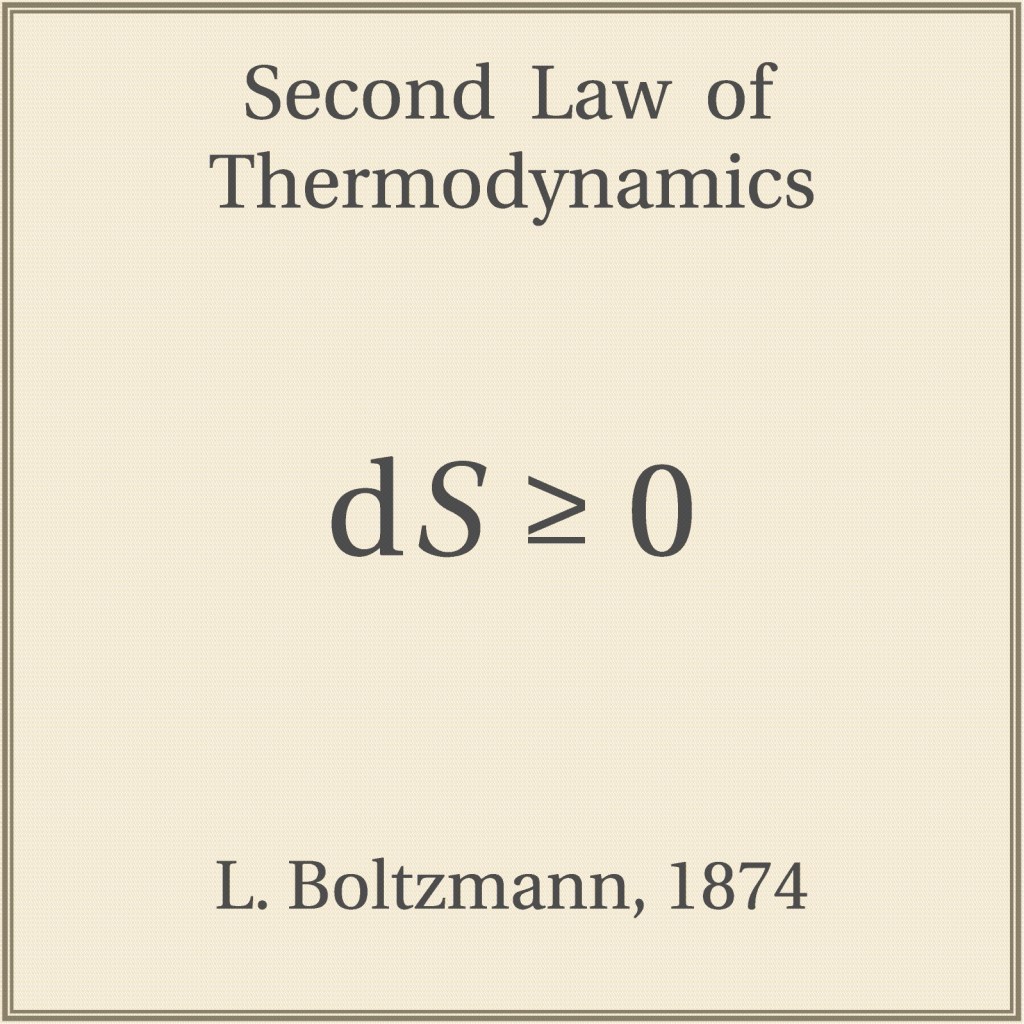
When I determine whether something is true with a high degree of certainty I start with my own expertise. For example, when someone claims that the second law of thermodynamics (entropy) contradict evolution I know that to be false because I have a degree in physics (master’s degree) and I’ve taken several classes in thermodynamics and statistical mechanics. In addition, I am very familiar with the faulty argumentation behind the claim because I’ve read dozens of creationist books. Yes, I was once bamboozled by creationism myself. Then I learned more about science, evolutionary biology, physics and thermodynamics.
Second law of thermodynamics Shutter Stock Vector ID: 2342031619 by Sasha701
However, my personal expertise is not enough. I also find out about scientific consensus or expert consensus and evidence from reliable sources. I should say that using scientific consensus as a reliable indicator that something is true does not fall under the “appeal to authority fallacy”. The “appeal to authority fallacy” refers to appealing to influential people or organizations who may not necessarily be experts, and regardless of the evidence. In science you don’t really have authorities, you have experts who often disagree with each other. In the event almost all experts agree on a certain fact that has been thoroughly vetted you can trust that fact with nearly 100% certainty, and that is not appeal to authority but a probability argument.
I typically select several reliable sources such as research papers published in respectable journals, national academies, government websites such as NASA, NOAA, EPA, FBI, respected research organizations such Our World in Data, Pew Research Center, and academic publications and books. I make sure that they various sites I find don’t contradict each other regarding my prospective super fact. If they all seem to agree I accept the super fact and include a few of the links in my post.
If I don’t have much personal expertise on a subject I start out by asking Google AI. I don’t ask ChatGPT because I believe it is less reliable with respect to information. Then I check Wikipedia and or another online encyclopedia such as encyclopedia Britannica. This is not to establish the truth but to get an idea. Wikipedia is not an academically acceptable source, but it is rarely wrong and serves as a good first filter to save time. Then I start focusing on the reliable sources above and I will make sure I understand the evidence.
So, in summary I will use my expertise, scientific consensus, reliable sources and better, agreement between reliable sources, to determine if I can say with confidence that something is true. I will also frequently include links from Wikipedia in my posts because Wikipedia typically feature good summaries that are easy to understand. Naturally, anyone is free to dispute any of my super facts. Just make sure you provide good evidence from an arguably reliable source, or I cannot take it seriously.
Fact or myth. Shutterstock Asset id: 2327968607
Sources I will not consider are claims from unreliable sources, political think tanks, talk show hosts, politicians, articles written by contrarians heavily funded by industry or political organizations, and random Reels or YouTube videos, and I will not entertain conspiracy theories for my purposes. Also, I will ignore, articles with click bait titles, sources making claims about a great swindle by the scientific community, articles claiming everyone is lying to you, articles purporting to reveal the hidden truth, articles insisting on presenting the truth that “they”/the-others won’t tell you, etc. Cults will tell you that everyone else is lying to you. I’ve learned not to fall for it at this point.
My Super Fact List
Finally, here are a few examples of my super facts.
So, on what subject(s) am I an authority? My understanding on what being an authority on a subject means is that it is being an expert with recognized credibility on that subject. However, the word “authority” has so many other meanings and it brings to mind the “appeal to authority fallacy”. The “appeal to authority fallacy” refers to appealing to influential people or organizations who may not necessarily be experts, and regardless of the evidence.
In science you don’t really have such authorities, you have experts who often disagree with each other. In the event almost all experts agree on a certain fact that has been thoroughly vetted you can trust that fact with nearly 100% certainty, and that is not appeal to authority but a probability argument. Therefore, I don’t really like the use of the word authority in this context. It is confusing. I would have preferred the question to be “In what subject(s) do you have recognized expertise?”
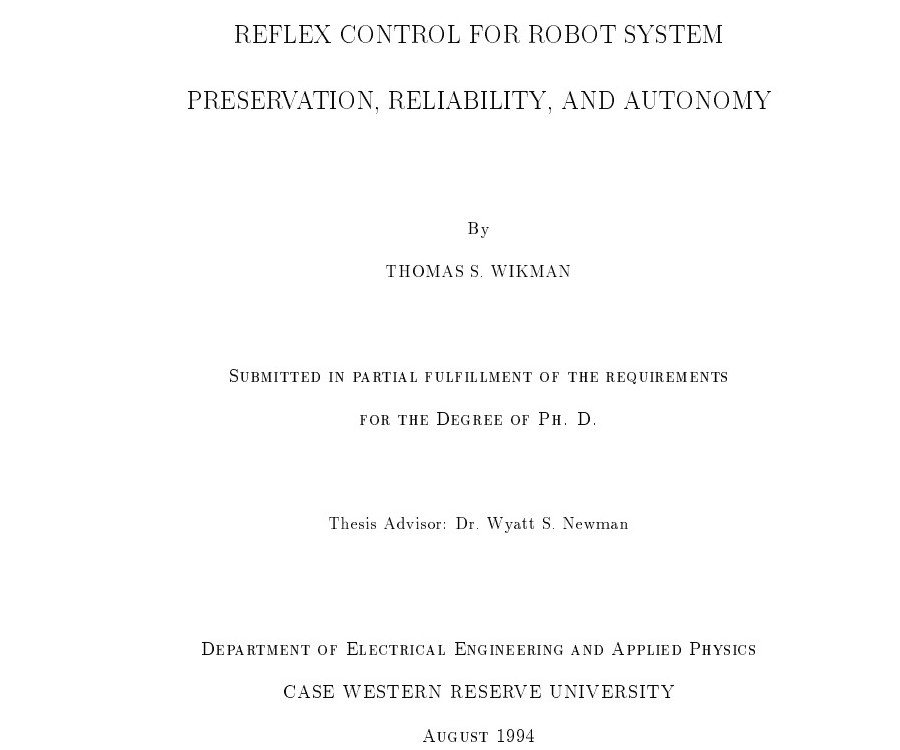
This is the front page of my PhD thesis “Reflex Control for Obstacle Avoidance and Self Preservation”.
Robotics
Reflex Control for Obstacle Avoidance and Self Preservation
My PhD thesis was in Robotics, specifically Reflex Control for Obstacle Avoidance and Self Preservation. Therefore, you can say that I am an expert on Reflex Control for Obstacle Avoidance and Self Preservation, Reflex Control (in Robotics) as well as Robotics. My expertise has been recognized through my published research papers, the citing of those papers, my PhD thesis, and my peers including Rodney Brooks.
Rodney Brooks is a former director of the MIT Computer Science and Artificial Intelligence Laboratory, founder of several robotics research companies, and he is arguably the most famous roboticist in the world. In the 1990’s he was featured on the front page in national magazines such as Time Magazine several times. During my internship at the Robotics Lab at Sandia National Laboratory in Albuquerque, New Mexico in 1993, I spoke to Rodney Brooks about my research, and he congratulated me on my research, which he liked.
Briefly, reflex control in Robotics refers to functionally simple, quick, and reliable behaviors that override whatever more complex algorithms or humans (joystick / telerobotics) are commanding in case those algorithms or humans execute dangerous motion. Take for example, a robot moving quickly among multiple objects and the path planning algorithm generates a faulty command that would result in a collision when executed. The reflex control layer would detect the problem (assuming it knows about the objects) and halt the robot before it collided with the object. This would need to happen quickly, in milliseconds, and always in a failsafe way. After the collision has been avoided the system or the human can figure out what went wrong and figure out a new path.
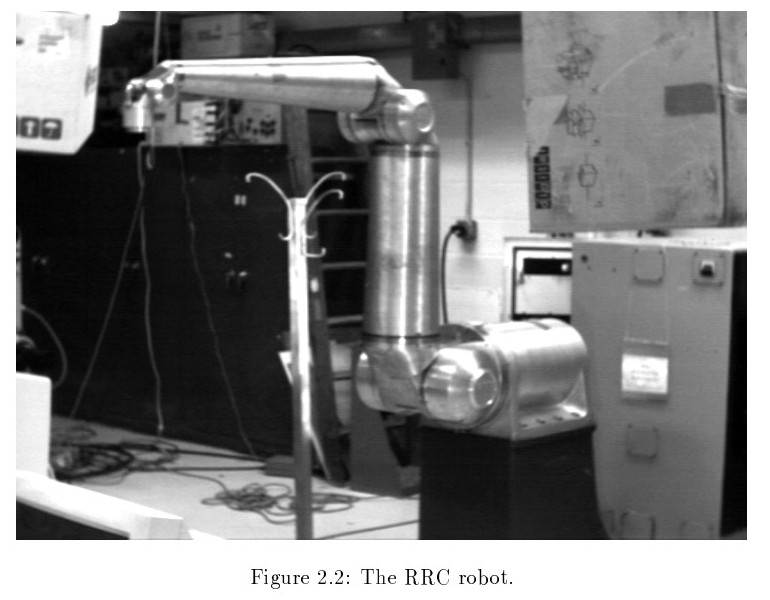
To do this the Reflex controller needs to be embedded with the motion controller, and know the characteristics of the motors, the robot configuration, and mechanical characteristics, such as mass, friction model, inertia, etc., exactly. The result is that when you drive a robot around among multiple objects such as boxes hanging from the ceiling, coat racks, and sombreros, and other robots it will avoid colliding with these objects regardless of input from people or high-level path planning algorithms. It looked like the objects were protected by an invisible force field.
This is an old black and white photo of the Robotics Research Corporation Robot surrounded by objects including boxes hanging in the ceiling, a coat rack, and a control cabinet. I took the photo, and I created the software for the robot and placed the objects in its workspace.
Robot Kinematics
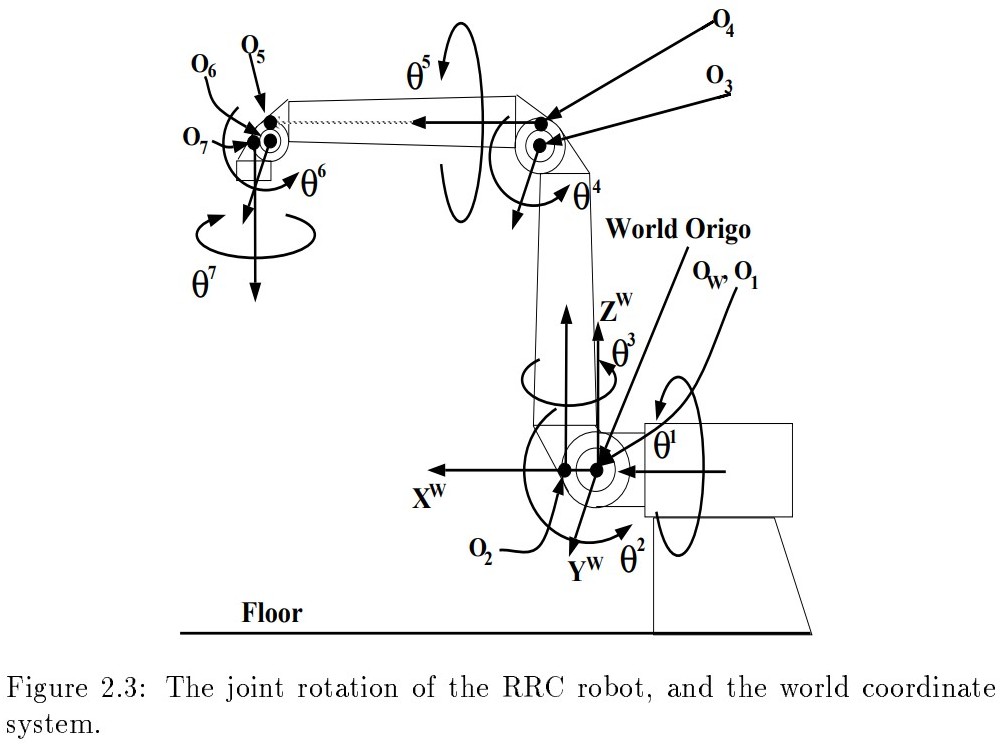
In addition, to “Reflex Control for Obstacle Avoidance and Self Preservation” or “Reflex Control for Robots”, which is very narrow field, I gained expertise in fields of robotics that are a bit wider. One such field is robot kinematics. That includes, for example, calculating the position, speed and acceleration of the tool tip (the end tip) of the robot from the position and motion of the joints of the robot. Or it could be calculating the possible joint angles from the position of the tool tip. The RRC robot was a seven-jointed robot so this could get complicated. I should say that when I worked for ABB Robotics (after my Ph.D) I created the kinematic models for 30+ of ABB Robotics robots. Therefore, I have expertise and recognized credibility in Robot Kinematics as well.
The drawing shows the seven joints, the seven possible rotations around those joints, the seven joint angles (the thetas), and the seven coordinate systems and their origos (the O’s) at each joint.
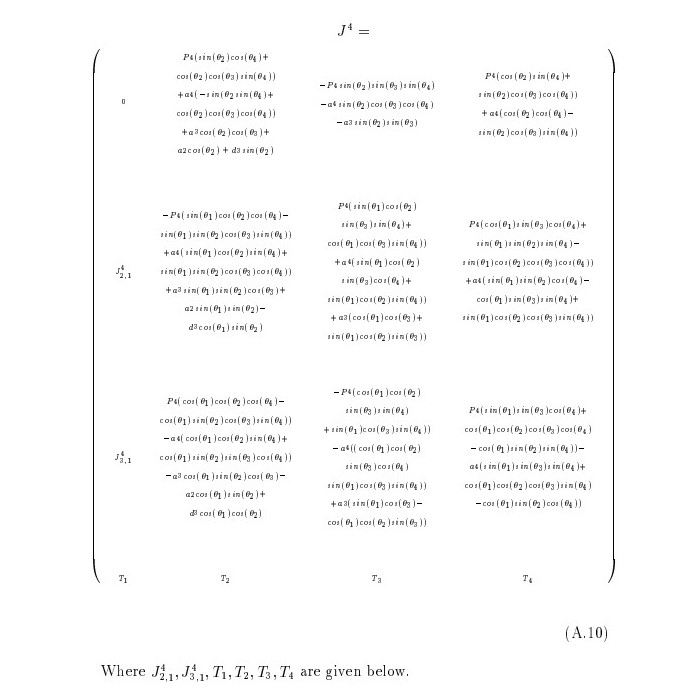
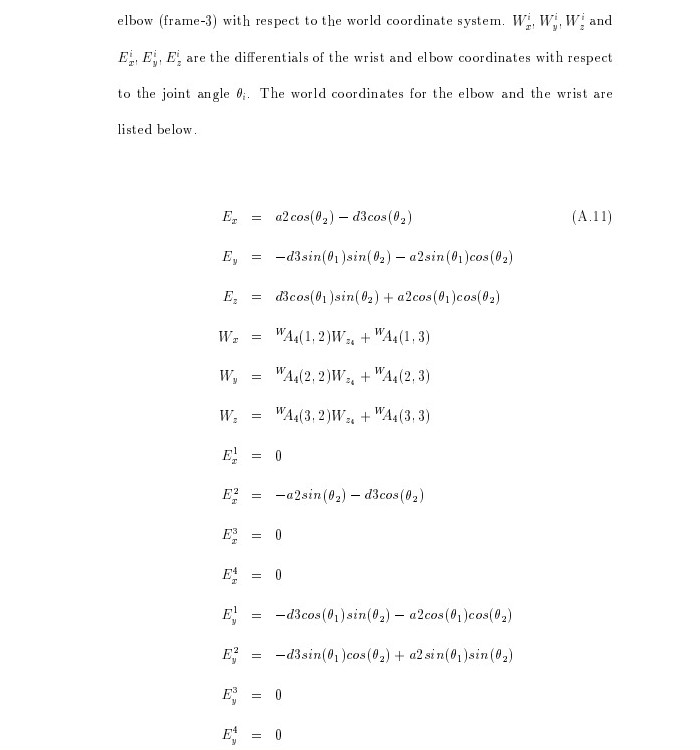
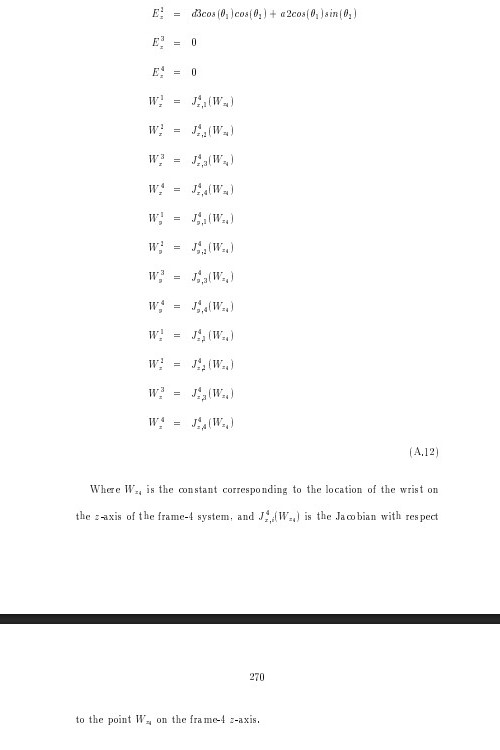
Robot kinematics can get complicated, at least for a seven-jointed robot like the RRC Robot. An example is the Jacobian, which is a matrix that relates joint velocities to end-effector / tool-tip velocities. The Jacobian is crucial for understanding and controlling robot motion, particularly for inverse kinematics and trajectory planning. Below is the Jacobian for the first four joints of the RRC robot. I spent an entire day deriving it. Depending on your eyesight it is difficult to read the scribbles, but it is a bunch of very long, mostly trigonometric equations. Don’t worry about understanding the matrix, it is just to show how complicated robot kinematics can get.
First part of the 4-dimensional (first four joints) Jacobian for the RRC Robot.Second part of the 4-dimensional (first four joints) Jacobian for the RRC Robot.Third part of the 4-dimensional (first four joints) Jacobian for the RRC Robot.Fourth part of the 4-dimensional (first four joints) Jacobian for the RRC Robot.
Configuration Space in Robotics
Another subject I gained a lot of expertise in is configuration space or so-called C-space. It is related to robot kinematics. C-space is a mathematical representation of all possible configurations a robot can take. In C-space for a robot arm (like the RRC Robot) the coordinates are the joint angles instead of X, Y and Z. For the seven-jointed RRC robot you have seven joint angles and C-space is thus seven dimensions. C-space is very useful if you succeed in representing obstacles in it. A point might become a curve, or multi-dimensional membrane in C-space, and a ball might become a multi-dimensional banana. I had a lot of fun creating algorithms for creating C-space with obstacles in it.
My Other Expertise
I also have a degree a master’s degree in engineering physics (Teknisk Fysik) from Uppsala University in Sweden. I should say that engineering physics in Uppsala was focused a lot on theoretical physics and modern physics as well as practical applications for physics. Case Western Reserve University later converted this degree to a master’s in electrical engineering. I loved physics and was a good student, but my special interest was the theory of relativity. Even though I had and still have a hard time with the General Theory of relativity and I studied the special theory of relativity way beyond what was required at school, and I read dozens of technical books on the subject. So, this is also sort of an area expertise for me.
Below are some links to topics related to the special theory of relativity on this website:
I spent at least 30 years working with software as a software engineer / robotics engineer and gained a lot of experience in software development. It was mostly embedded software but also graphical user interfaces, things you can see on a screen, and Networking Software Development. I worked a lot with Visual Studio, a powerful, expandable, and popular integrated development environment (IDE) from Microsoft.
I developed a lot of code using C++ and C#, .Net, WPF, but also other languages and libraries. I started with Visual Studio 97 (in 1997), then Visual Studio 6, Visual Studio .NET 2002, Visual Studio .NET 2003, Visual Studio 2005, Visual Studio 2008, Visual Studio 2010, Visual Studio 2012, Visual Studio 2015, Visual Studio 2017, but I never got around to Visual Studio 2019 and Visual Studio 2022. So, you can say that I am an expert on Visual Studio with C++ and C# and .NET (I am less of an expert on the other languages typically used with Visual Studio).
Later in life I also came to learn a lot about climate change / climate disruption / global warming / the greenhouse effect whatever you call it. I used to be skeptical about climate change, and I thought it might be politicized by the scientific community, but after some interesting red flags I took a deep dive into the subject, and I learned that climate change is very real and caused by us. I was politicized not the scientific community. There is a scientific consensus on the subject for very good reasons. I continued by reading dozens of climate science papers and several dozens of technical and non-technical books on the topic. Therefore, at this point I know more about it than a lot of people. Maybe expert is a strong word, but almost expert.
Least but not last
Being a Leonberger Dog Expert
I know a lot about Leonbergers because my family was lucky enough to live with one for thirteen years. His name was Le Bronco von der Löwenhöhle—but we called him “Bronco” for short. Bronco wasn’t our only dog, but our world wouldn’t have been the same without him. For instance, he once saved the life of our pug by fending off an attack from another dog. He probably saved our Labrador’s life, too, by sniffing out an impending insulin shock before it happened. Then there was the time he scared off a trespasser who’d been terrorizing my wife and other women in the neighborhood.
Bronco loved to dance and hug. Here he is giving me a hug (not yet fully grown).
Bronco is no longer with us, but even in his passing he was distinctive. Leonbergers tend to live less than nine years—but Bronco came very close to reaching his thirteenth birthday. In fact, he received an award for longevity called the “Grey Muzzle Award.” We already knew he was a special dog, but we sent his DNA to two labs for research anyway. I wrote a book about our amazing Bronco and his many amusing adventures and included helpful information on Leonbergers for new owners and interested dog lovers. I also have a Leonberger website.
In the process of writing my book about Bronco and Leonbergers I came to learn a lot about Leonberger dogs, the Leonberger breed standard, their history, health issues, Leonberger organizations, health and care, etc. I became a bit of a Leonberger expert. If you are interested in the book, check it out here or here. You can also get it from Amazon in many other countries, Barnes & Noble, Chapters Indigo and many other bookstores. For more information check here.
I recently read a very interesting book on the history of climate change politics; Glacial: The Inside Story of Climate Politics by Chelsea Henderson. Chelsea Henderson is a leader in the EcoRight movement, basically Republicans who care about the environment and climate change. She is a former senior advisor to Senator John Warner (Republican) and have held other positions in the US Congress. Her book is non-partisan. However, naturally she is accepting the reality of human caused global warming.
I should mention that the second last sentence of the seventh paragraph of my rather long review says this “As of very recently, a few days ago, those Tax Credits have been reversed.” Those few days ago have not yet happened. I thought Amazon would take longer to publish my review and I was predicting that the vote today/tomorrow on the Senate version of the Budget Reconciliation Bill (the Big Beautiful Bill) would allow it to pass. So those few days ago have not yet happened because Amazon was faster than I thought. Basically, the Budget Reconciliation Bill will roll back or phase out the clean energy tax credits enacted in 2022. For those who don’t know what a Budget Reconciliation Bill is, it is a bill that allows you to bypass the filibuster, and it is therefore typically a highly partisan bill.
Glacial The Book Formats
Glacial: The Inside Story of Climate Politics by Chelsea Henderson comes in four formats. I bought the hardback format.
Hardcover – Publisher : Turner (August 6, 2024), ISBN-10 : 1684429579, ISBN-13 : 978-1684429578, 432 pages, item weight : 1.45 pounds, dimensions : 6.25 x 1.25 x 9.25 inches, it costs $ 23.11 on US Amazon. Click here to order it from Amazon.com.
Paperback – Publisher : Turner (August 6, 2024), ISBN-10 : 1684429587, ISBN-13 : 978-1684429585, 432 pages, item weight : 1.34 pounds, dimensions : 6 x 0.96 x 9 inches, it costs $13.10 on US Amazon. Click here to order it from Amazon.com.
Kindle – Publisher : Turner (August 6, 2024), ASIN : B0CBQKTM46, ISBN-13 : 978-1684429592, 460 pages, it costs $12.44 on US Amazon. Click here to order it from Amazon.com.
Audio– Publisher : Tantor Audio (August 13, 2024), Listening Length : 9 hours and 50 minutes, ASIN : B0DCCWRMJS, it costs $0.00 with membership on US Amazon. Click here to order it from Amazon.com.
Front cover of hardback format of the book Glacial: The Inside Story of Climate Politics by Chelsea Henderson. Click on the image to go to the Amazon page for the hardcover version of the book.
Amazon’s Description of Glacial
It took nearly sixty years for a meaningful climate change bill to run the political gauntlet from Capitol Hill to the Oval Office. Why?
From mavericks to party standard-bearers, U.S. Senators, members of the House of Representatives, and presidential candidates have campaigned for four decades espousing their intentions to address the impacts of climate change.
Glacial: The Inside Story of Climate Politics is the first Inside-the-Beltway account to lay bare the machinations of what went wrong in Washington—how and why our leaders failed to act on climate change as mounting scientific evidence underscored the urgency to do so. Glacial tells a story of behind-the-scenes infighting and power struggles that blocked or derailed federal legislative progress on climate change, even in times of bipartisanship and with polls showing most Americans favored action.
The good news today is that public opinion is at its highest level of support for climate action, from corporate boardrooms embracing sustainability for business reasons to movements led by passionate younger generations who can’t afford to stand mute because it is they who will inherit the worst environmental catastrophes. If the missed opportunities in Washington are instructive, the path to doing so is clear. Our elected officials must use their offices not solely for the power and prestige it bestows upon them personally, but for the public good—and they must do so while there is still time.
This book recounts the history of the politics around climate change starting with the LBJ administration and ending with the Biden administration. LBJ was the first commander in chief to warn his fellow Americans of a steady increase in carbon dioxide from the burning of fossil fuels.
The author, Chelsea Henderson is a leader in the Eco-Right movement, basically Republicans for the Environment. Some well-known names in this movement are former secretary of state James Baker (under H.W. Bush), and the former secretary of state under Ronald Reagan, the late George Shultz, Bob Ingliss former Republican Congressman from South Carolina, the founders of RepublicEN, the Republican congressman Carlos Curbelo who founded the Climate Solutions Caucus in Congress together with Ted Deutch, Republican Utah Senator John Curtis, and George Mankiw a notable conservative economist.
It may come as a surprise to some that once upon a time the environment was not a divisive left versus right issue. Nixon signed into law the Clean Air Act, the Clean Water Act of 1972, the Endangered Species Act, and founded the Environmental Protection Agency. Ronald Reagan and Margaret Thatcher led the ratification of the Montreal Protocol in 1987 – 1989 to phase out the global use of CFCs due to their detrimental effect on the ozone layer. As a result, emissions of ozone-depleting gases have fallen by 99 percent, and it saves an estimated 2 million lives from skin cancer every year. This was one of Ronald Reagans greatest successes and yet it has been mocked by some subsequent Republican Presidents.
The book also talks about the history of acid rain and our fight against that. Margaret Thatcher, a chemist, was very concerned about the greenhouse effect, or global warming, and so was George H.W. Bush and Reagan to some degree. Unfortunately, the words climate change has grown to be deeply polarizing due to decades long disinformation campaigns funded by fossil fuel companies and far right think tanks and talk show hosts.
Another factoid that might surprise readers is that in 1957, scientists working for Humble Oil, later known as ExxonMobil, sounded the alarm on the greenhouse effect / global warming caused by burning fossil fuels. However, the executive leadership decided to deride the type of work its own scientists had done. The same thing happened on later occasions and Exxon funneled a lot of money into anti-climate change think tanks.
As the evidence that carbon dioxide was causing the greenhouse effect (or global warming or climate change) became increasingly indisputable in the 1990’s the fossil fuel industry and far right think tanks, and conservative talk show hosts, started to push back on the science very hard, by spreading misinformation, insulting and attacking scientists, environmentalists, and politicians taking a stand they did not like. Koch industries, the American Petroleum Institute and the Global Climate Coalition (GCC), which contrary to what the name seems to imply, opposed climate action, teamed up to fight climate action.
However, it was not only people on the right doing this. Democrat politicians from coal districts also opposed measures on global warming. Clinton and Gore tried make progress on the issue, but it became politically unworkable. The book explains what happened during the Contract with America episode, the Kyoto protocol, etc.
However, the issue of climate change was not purely a right versus left. Some Republican leaders such as Senator John McCain and Mitt Romney championed climate action (perhaps on and off and on again) and the George W. Bush administration contained both pro-fossil advocates such as Dick Cheney and those favoring action on climate change such as Treasury Secretary Paul O’Neill, Condoleezza Rice, Christine Todd Whitman, and Colin Powell.
Later during the Obama administration there was a climate change bill that was very close to passing, the Waxman-Markey bill. The bill passed the house but when it was going to be voted on in the Senate, Barbara Boxer (democrat) used her role as a committee chairman to change it and take it so far left that it became unpassable. She wasn’t against climate action, on the contrary, but she thought it would work.
I can add that the Tea Party, which had started out to oppose the national debt, but later focused on the culture war and opposed climate action made climate action more difficult. Well, it did not help that the oil and gas industry spent 175 million dollars lobbying against the bill in less than a year whilst environmental advocates spent only 22.4 million dollars lobbying for it, despite that being a record effort for environmental advocates.
The end of the book focuses on the Biden administration and the Clean Energy Tax Credits in the Inflation Reduction Act. This part of the book reads like a thriller because it was held up by one man, Joe Manchin, the Democrat Senator from West Virginia, who was pressured from all sides and kept changing his mind, until he finally decided to support it. As of very recently, a few days ago, those Tax Credits have been reversed. The history of action on climate change marches on.
By reading this book you will learn about a lot of people and their stories, politicians and scientists, who became embroiled in the climate change issue, for or against, George E. Brown, Dr. Roger Revelle, Dr. James Hansen, Katherine Hayhoe, Al Gore, Joe Lieberman, Rafe Pomerance, Speth, Shimberg, Senator John Chafee, John McCain, Mathew Stembridge, Rick Boucher, John Warner, Alex Bozmoski, Bob Ingliss, Lindsey Graham, John Sununu, Rahm Emmanuel, Congressman Joe Barton, Dick Cheney, Tom DeLay, Scott Pruitt, Lee Iacocca, Senator Inhofe, Rush Limbaugh, Harry Reid, Mitch McConnell, Myron Ebell, and many others. You will also learn about terms that relates to the American form of Democracy, the filibuster, budget reconciliation, appropriation, the parliamentarian, the various senate and house committees and caucuses, how bills are created and passed, an Omnibus bill, etc.
If you are interested in political history, the history of climate change politics, and the stories of the people involved, then this book is for you. The author explains all the terms used and it is not a complicated book. The book reads like a journey through political history, and you will learn thousands of facts and anecdotes. If you are a somewhat older reader, like me, you will be reminded of the events from the past and you will recognize people, and what they said, and the chaos, and the complexities, and all the hoopla, and you will think to yourself, what a crazy world politics is.
I also think that the book gives you a perspective of where the politics have been and where it might be going. Despite the many setbacks in the past, this book will give you reason for optimism. The younger generation both on the left and the right are more willing to accept the science and are more willing to embrace action on climate. Well, I guess it is their future. The world is moving forward, and it is decarbonizing, no matter what we do. Overall, I think the book is entertaining and fascinating and I highly recommend it.
Back cover of hardback format of the book Glacial: The Inside Story of Climate Politics by Chelsea Henderson. Click on the image to go to the Amazon page for the paperback version of the book.
Other Posts Related to Climate Change, Environment or Clean Energy
An update : The Senate version of the Budget Reconciliation Bill passed today (7/1 – 2025). The phase out of the clean energy tax credits stayed, as I predicted, but the excise tax on renewables that the Senate previously added to the bill was removed in the last minute, which is good news for those who care about the environment.
Super fact 50 : There are hundreds of types of beer but in general they fall into two main categories, ales and lagers, and these two categories are not differentiated based on color. The ales are not necessarily dark and lagers light. There are light colored ales and dark, even black ales. There are light colored lagers and dark and almost black lagers (Schwarzbier). The difference between ales and lagers is the type of yeast used and the fermentation temperature. Ales are typically made with top-fermenting yeast at warmer temperatures. This result is a wider range of flavors and aromas, often with fruity or spicy notes. Lagers, on the other hand, are made with bottom-fermenting yeast at cooler temperatures making them crisper and more subtle. Ales have been around for 6,000 years. The lager is a more recent invention.
I consider this a super fact, first, because even though beer is a well-known drink that a lot of us drink almost every day, a lot of people don’t know what the two basic kinds of beer are. They don’t know what an ale is or what a lager is. Even beer fans and many people who drink beer every day are often clueless about this, the most basic fact about beer. A lot of people say that they like light/blond beer or they like dark beer. In my native country Sweden, which I admit is not a true beer country, I often hear people say that they prefer “ljus öl” (light/blond beer) rather than “mörk öl” (dark beer), or the other way around, which is like saying that you like blond / light colored food rather than dark colored food. It doesn’t make sense.
This is a so called Schwarzbier that I drank some time ago. Das Schwarze a German Schwarzbier from Dinkelacker-Schwabenbräu, ABV 4.9%. Some roasted notes, sweet caramel, light flavor, a bit fizzy, somewhat thin but good enough. This is a Lager but notice a how dark it is, basically black. I did not put black dye in it. It is how they really look despite being Lagers.
I am in the process of learning Franch, and I’ve discovered that this confusion is even baked into the French language. Well as you might guess France is not a true beer country. If you use Google Translate and you type in “Lager” in the English edit box the answer you get in French is “Bière blonde”, even though French and Belgian beer that are labeled Blonde frequently are Ales not Lagers. I’ve read a lot of French language sites mentioning beer, and unless the author has some beer expertise, they make the same mistake as Google Translate. Blonde / light beer is not Lager, and dark beer is not necessarily Ale.
I had a discussion about this with one of my French teachers and despite me having talked a lot about beer in class and having previously shown him that I knew something about the topic, he had a very hard time accepting the truth. After a Google search he finally accepted the truth, but he was very surprised, perhaps even shocked.
The confusion is immense, it is worldwide, and the truth is surprising to some people. I should mention that Americans for the most part get this right. In general Americans know that Lager isn’t necessarily blonde and vice versa. They know that IPAs, which are not Lagers but Ales, typically are light colored. Perhaps because of the prominent craft beer industry in the US. I should also mention that there are also hybrid beer styles and beer styles that are hard to classify as lager or ale. More about that later.
This is Ba Ba Black Lager, an American Schwarzbier. I had sushi with this Schwarzbier.
Secondly, lagers, especially pale bland mass-produced lagers have become so common that when people taste an ale, especially if it is a little bit different, like fruity, tart, have chocolate or coffee flavors, etc., they don’t even consider it a real beer. In their minds real beer is a bland tasting lager. Never mind that we have had Ales for 6,000 years, and that Ales dominated beer drinking up to relatively modern times. Nowadays 90% of beer consumption worldwide is lagers (87% in the US), but throughout most of human history nearly 100% of beer consumption worldwide was ales.
This is an IPA called Cold War. IPAs are NOT Lagers. However, notice how light the color is. IPAs are popular in the US, which I think is one reason Americans are better educated on the difference between lagers and ales to countries that are not part of the European beer countries (Germany, Britain, Ireland, Belgium, the Czech Republic, etc.)
What is an Ale?
As mentioned, an Ale is a style of beer, brewed using a warm fermentation method. Ales are typically made with top-fermenting yeast at warmer temperatures. This result is a wider range of flavors and aromas, often with fruity or spicy notes. The word ale is an English word which in medieval England meant a drink brewed without hops (it is not what it means today). Some popular ales include IPA, Pale Ale, Stouts, Porter, Scotch Ale, and Barley Wine. Below is a more complete list of Ales. The list is from the beer advocate. Despite the 120 styles listed the list is not complete. It should be noted that I’ve added a few that were missing.
India Pale Ales : American IPA, Belgian IPA, Black IPA, Brut IPA, Cold IPA, English IPA, Imperial IPA, Milkshake IPA, New England IPA.
Pale Ales : American Amber / Red Ale, American Blonde Ale, American Pale Ale, Belgian Blonde Ale, Belgian Pale Ale, Bière de Garde, English Bitter, English Pale Ale, English, Pale Mild Ale, Extra Special / Strong Bitter (ESB), Grisette, Irish Red Ale, Kölsch, Saison.
Wild/Sour Beers : Berliner Weisse, Brett Beer, Faro, Flanders Oud Bruin, Flanders Red Ale, Fruit Lambic, Fruited Kettle Sour, Gose, Gueuze, Lambic, Wild Ale.
Wheat beers : American Dark Wheat Beer, American Pale Wheat Beer, Dunkelweizen, Grodziskie, Hefeweizen, Kristallweizen, Witbier.
Stouts : American Imperial Stout, American Stout, English Stout, Foreign / Export Stout, Irish Dry Stout, Oatmeal Stout, Russian Imperial Stout, Sweet / Milk Stout.
Porters : American Porter, Baltic Porter, English Porter, Imperial Porter, Robust Porter, Smoked Porter.
Dark Ales : Dubbel, Roggenbier, Scottish Ale, Winter Warmer.
Brown Ales : Altbier, American Brown Ale, Belgian Dark Ale, English Brown Ale, English Dark Mild Ale.
Strong Ales : American Barleywine, American Strong Ale, Belgian Dark Strong Ale, Belgian Pale Strong Ale, English Barleywine, English Strong Ale, Imperial Red Ale, Old Ale, Quadrupel (Quad), Scotch Ale / Wee Heavy, Tripel, Wheatwine.
Specialty Beers: Ancient Herbed Ale, Sahti.
Trappist Westvleteren from Brouwerij Westvleteren (Sint-Sixtusabdij van Westvleteren) a Belgian Quadruple might be the most renowned beer in the world. I’ve had it many times and it is heavenly. However, it is very difficult to get in the US. A Quadruple is a type of Ale.Plutonium-239 from the Manhattan Project Brewing Company in Dallas, Texas. It is a strong-tasting Porter with coconut flavors. (chocolate, coconut and coffee). There is no clear definition on the difference between porter and stout, other than porters are in general milder and not as strong as stouts. From that perspective Plutonium-239 is really a stout.
Wild Ales and Sour Beers often have fruity flavors. This can be achieved by adding fruits or berries to them but often fruit flavors emerge naturally from the fermentation process, which, at least if you use wild yeast, produce esters (fruit flavors). Wheat beers often have banana or pear notes and just as for Wild Ales these flavors emerge naturally from the fermentation process (esters again). Some of the IPAs also have distinct fruit flavors, especially the New England style IPAs, but in this case the fruit flavors come from the hops.
Jester King in Texas brews a Wild Ale called Atrial Rubicite. It is a Wild Ale infused with raspberries. The fermentation process uses “wild yeast” to create a tart and fruity base but raspberries are added to enhance the fruit flavor resulting in a thick full raspberry flavor which most people describe as heavenly.
What is a Lager?
As mentioned, lagers are made with bottom-fermenting yeast at cooler temperatures making them crisper and more subtle. The word lager (German) means to storage or storeroom and used to refer to beers stored at cold temperatures. Sometime in the 15th century cold fermentation yeast emerged, and people started using it to do fermentation at cold temperatures. As time went by this form of fermentation became more popular. It was brought to the US in 1840 and between 1860 and 1870 it became the most popular fermentation process in Bohemia. As mentioned, today 90% of beer consumption worldwide is lagers.
Below is a more complete list of Lagers. The list is from the beer advocate.
Pale Lagers: American Adjunct Lager, American Lager, Czech / Bohemian Pilsner, Czech Pale Lager, European / Dortmunder Export Lager, European Pale Lager, European Strong Lager, Festbier / Wiesnbier, German Pilsner, Helles, Imperial Pilsner, India Pale Lager (IPL), Kellerbier / Zwickelbier, Light Lager, Malt Liquor.
Dark Lagers : American Amber / Red Lager, Czech Amber Lager, Czech Dark Lager, European Dark Lager, Märzen, Munich Dunkel, Rauchbier, Schwarzbier, Vienna Lager.
Specialty Lagers : Japanese Rice Lager, Chile Beer
Paulaner is a so called Festbier (or Octoberfest), which is type of Lager made especially for Octoberfest in Germany.
Finally, there are also specialty beers that are hybrids, or neither or that can be both.
Hybrid (Ale/Lager): Bière de Champagne / Bière Brut, Braggot, California Common / Steam Beer, Cream Ale.
Neither lager or ale, or can be both : Fruit and Field Beer, Low-Alcohol Beer, Rye Beer, Smoked Beer, Herb and Spice Beer, Kvass, Gruit, Happoshu, Pumpkin Beer.
That’s 120 styles of beer. I’ve had 110 beer styles. How many have you had?













 Super Facts