
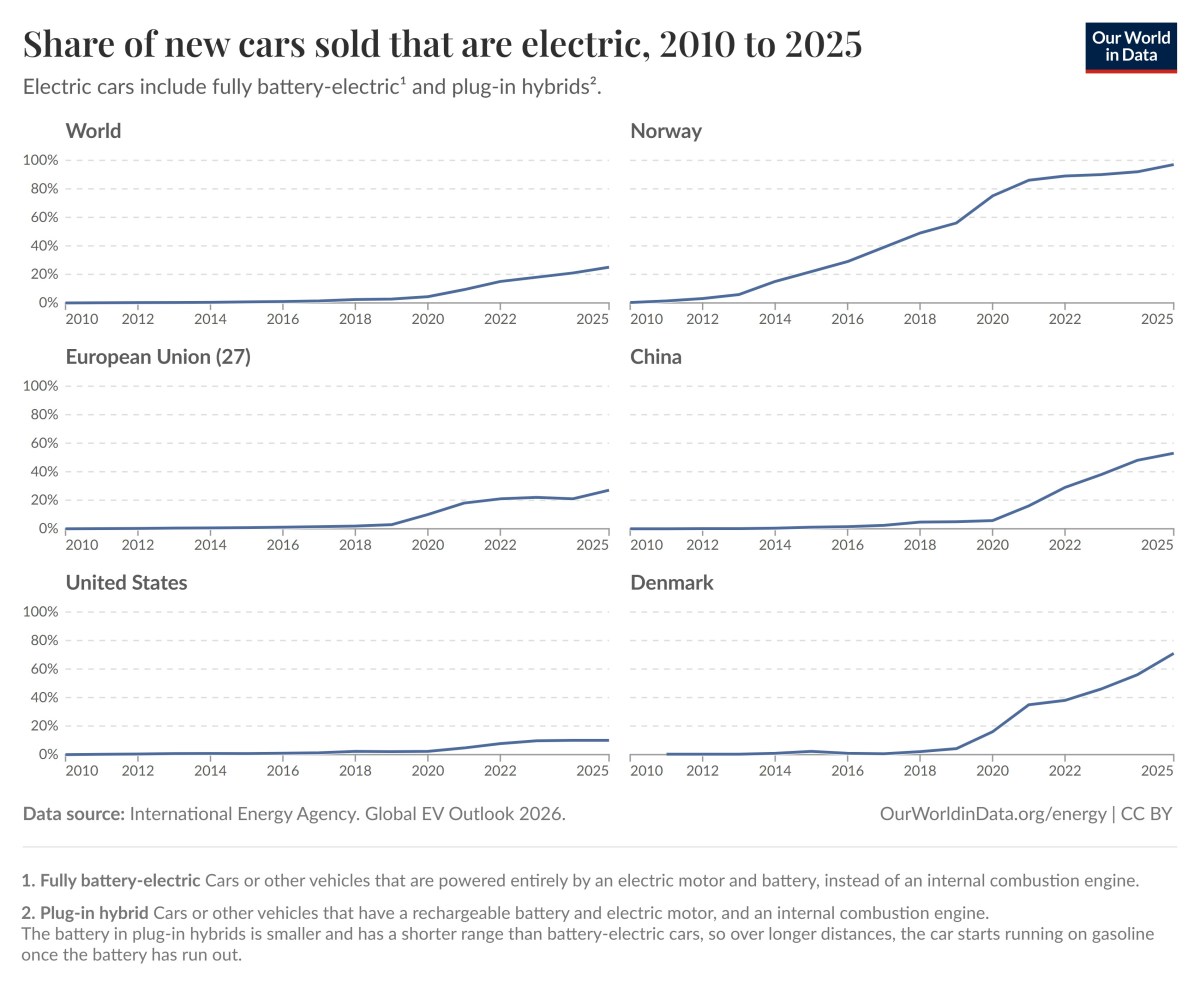
Superfact 107: Electric vehicles are rapidly replacing the internal combustion engine (ICE cars) and are becoming commonplace around the world. It is analogous to how cars once replaced the horse and buggy.
In Norway close to 100% of all new cars sold in 2025 were electric vehicles. Around the world a substantial percentage of new cars sold in 2025 were electric vehicles. This phenomenon is not as visible here in the US, where I live, but if you travel, you’ll notice.
The graphs below show that the share of new cars that were sold in 2025 that were EVs was substantial, but more importantly there is a sharp upward slope of the curve(s). The share of new cars sold in 2025 that were electric was in respective region or country: Norway 97%, Denmark 71%, China 53%, European Union 27%, World 25%, the United States 10%. The graphs are taken from this page on the Our World in Data web page. I encourage you to play around with the interactive graphs. You can read more about new cars sales in Norway here.
It should be noted that electric cars include fully battery-electric and plug-in hybrids. With battery-electric cars is meant cars or other vehicles that are powered entirely by an electric motor and battery, instead of an internal combustion engine. With plug-in hybrid is meant cars or other vehicles that have a rechargeable battery and electric motor, and an internal combustion engine. The battery in plug-in hybrids is smaller and has a shorter range than battery-electric cars, so over longer distances, the car starts running on gasoline once the battery has run out.
This is a fact that is important, and that likely comes as a surprise to people living in countries that are lagging in this transition, such as the United States. Therefore, I consider it a super fact.
The Share of EVs
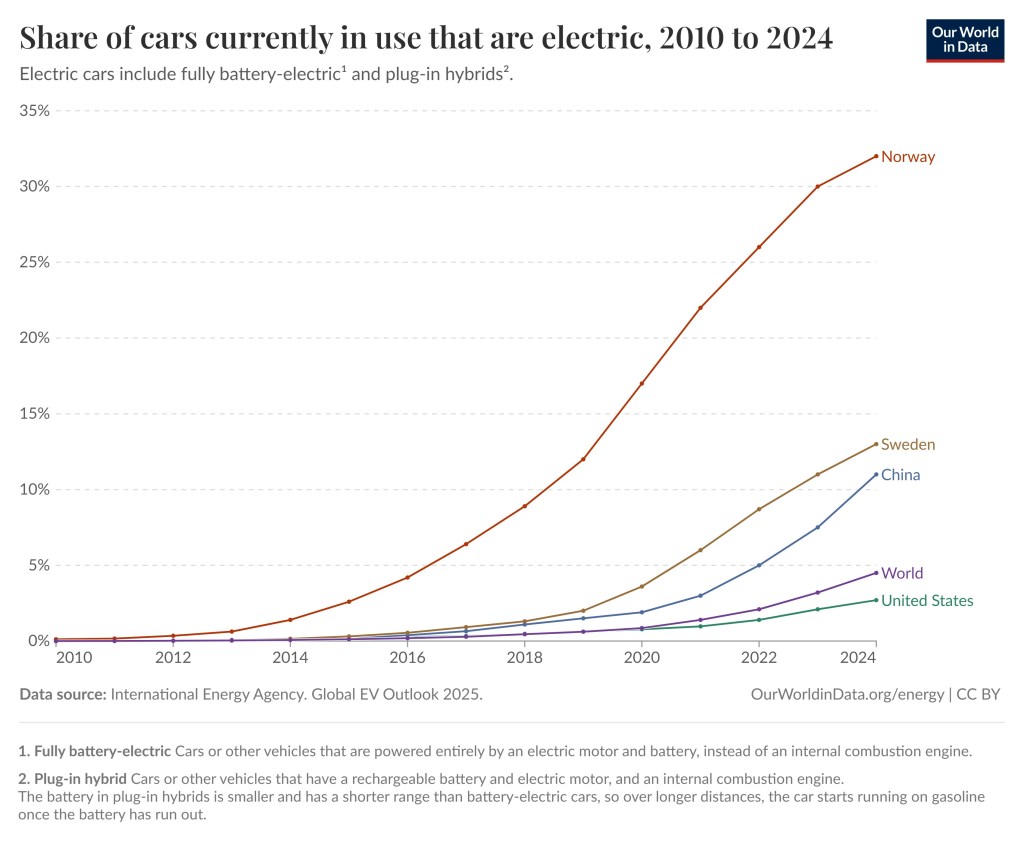
The sharp increase in the sale of electric cars is a recent phenomenon and therefore there are still a lot of ICE cars on the roads. Therefore, there is a significant difference between the share of electric vehicles on the road and the share of new cars sales being EVs. The share of electric cars on the roads in 2024 was in the United States 2.7%, in the world 4.5%, in China 11%, in Sweden 13% and in Norway 32%. See the graph below.
The graph below illustrates the sales of fully battery-electric cars versus plug-in hybrids.
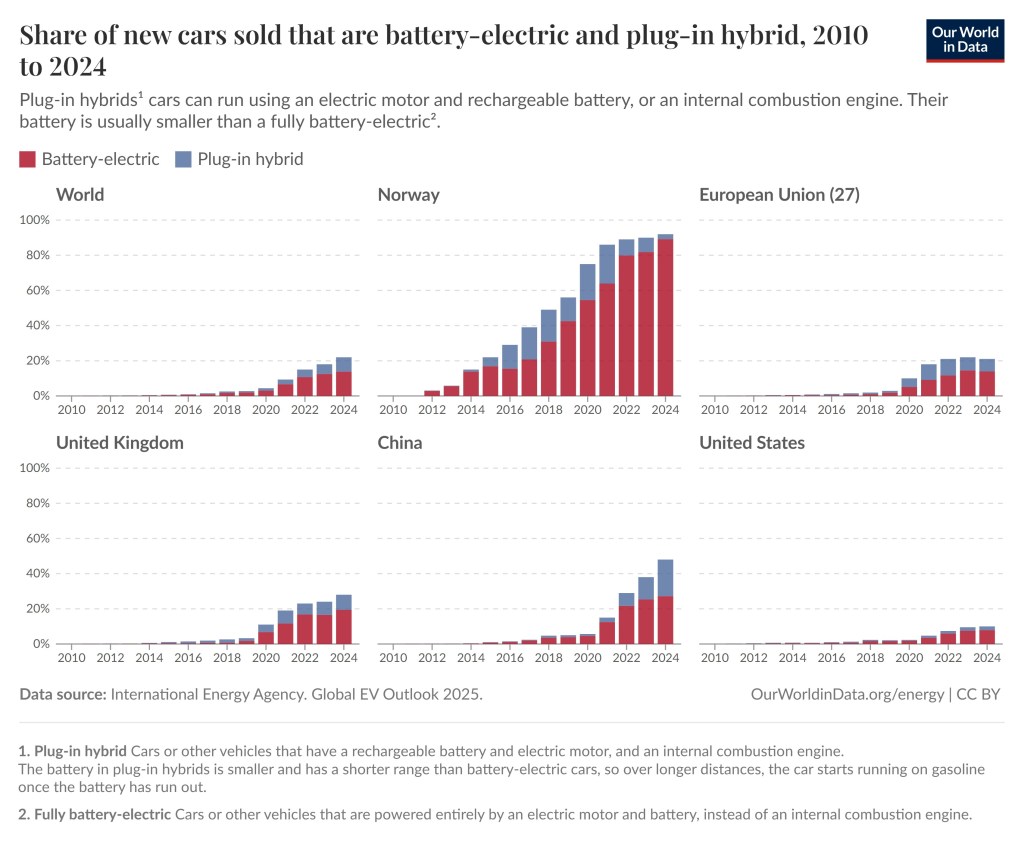
The bar graph below is an alternative illustration showing the share of new cars sold that are electric in 2024 for the world and 8 countries.
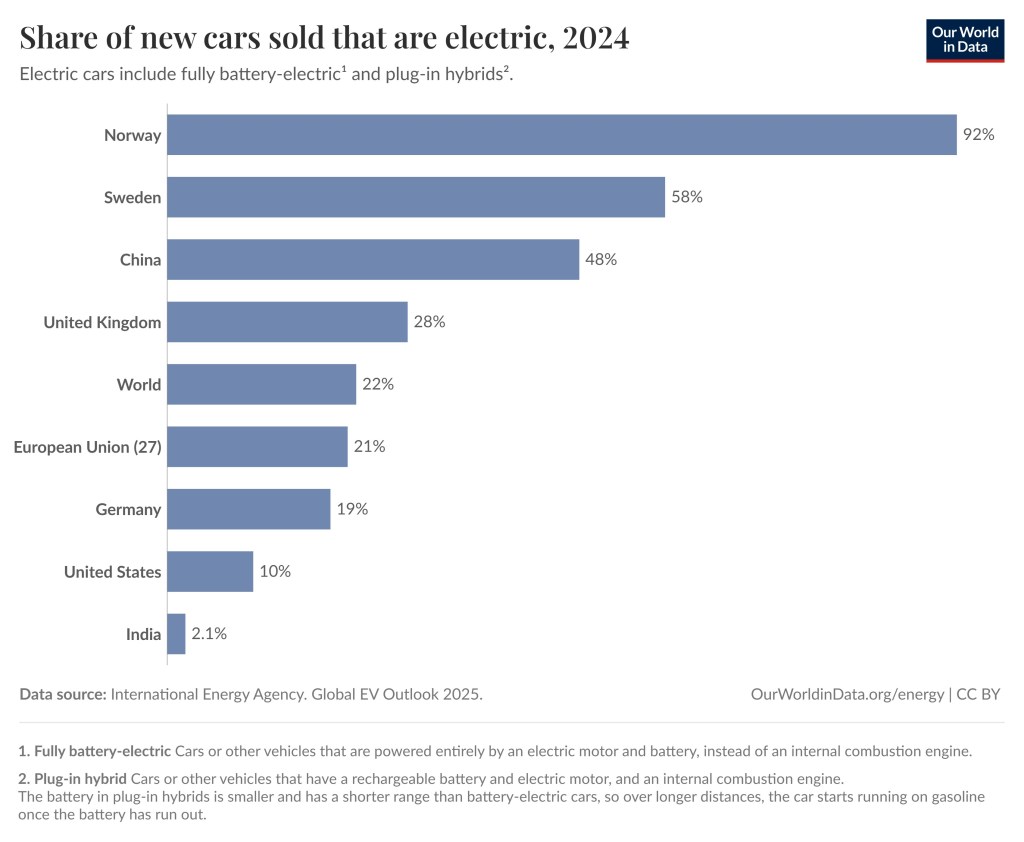
This article states that there are now more new electric cars sold in the EU than ICEs. However, it should be noted that they include hybrids (non-plug-in) in this number.
Are EVs cleaner than ICE cars ?
Yes, they are, for the most part. EV Cars emit less pollution than Internal Combustion Engine Cars, even considering manufacturing, disposal and EV Cars being charged by dirty grids. Basically, this is because burning oil to move a vehicle creates significantly more heat than motion.
It all depends on how dirty the grid is. This map shows the average EV as a gasoline MPG equivalent for the different grid networks in the United States in 2020. As you can see an average EV corresponds to a 76 mpg gas car in Texas (with the ERCOT) grid, which is much cleaner than almost any gasoline car. Also, the ERCOT grid has become cleaner since 2020. The average for the United States is 91 mpg. There are a couple of grids for which owning an EV may not be cleaner. I created another super fact post that explains the details called: super fact (29) EV Cars Indeed Emit Less Carbon Pollution. You can read more here.
There are concerns about the mining of minerals for EV cars, such as cobalt and lithium, which has an environmental impact. However, this environmental impact should be compared to the environmental impact caused by the drilling and transport of oil (and the burning of gas/oil). In general, the environmental impact of EVs is considered much less. In addition, EV batteries last a long time, and 95% to 98% of the valuable materials in EV batteries (lithium, cobalt, nickel, and copper.) can be recycled/recovered. You can read about other EV myths here. However, this is probably a topic for a future super-fact.
Craigavad a scientist and fellow blogger, wrote a very well balanced and insightful article on the issue of the carbon cost of electric vehicles. I encourage you to read it : “The Carbon Cost of Electric Cars: are they worth it?”
To see the other Super Facts click here


Good to see these figures. Guess we know when the US will start to catch up 😏
LikeLiked by 1 person
Thank you Animalcouriers, and I think you are right.
LikeLike
An important nuance on this is the degree of “greenness” or otherwise of the grid from which the electricity for electric cars comes from. For an effective 100%green grid such as Norway electric cars are fantastically green. Sadly if the grid is largely hydrocarbon electricity then not so much: one is merely moving the CO2 generation from one place to another. So electric cars are an important part of the solution but only if the electricity they use is green as well. I’m not arguing against EVs but rather highlighting the broader picture.
See https://craigavad.org/2026/04/25/the-true-carbon-cost-of-electric-cars/
LikeLiked by 1 person
I live on the island of Ireland. The grid is hybrid. Some renewables, some gas powered. Moreover the charging infrastructure is poor. While much of my driving is local, some is long distance. I don’t think I’ll move to an EV until (1) the charging infrastructure improves, (2) the EV range is consistently 600 miles plus per charge, and (3) charge times fall. All of this will happen…. Until then my super efficient Mercedes diesel power train (60mpg +, UK gallon) will stay in my garage. 🤷♂️
LikeLiked by 1 person
Craigavad I think that sounds quite reasonable. I’ll do the same.
LikeLike
Thank you Craigavad. I should say for an EV not to cause less emissions than an ICE car the grid has to be very dirty. In the US there are only a few states for which an EV is dirtier than a decent hybrid. I am referring to this map. For an average EV the emission corresponding to an ICE car with a specific mpg is: mpg 119 for California, 91 mpg is the average for the US, 76 mpg for Texas, and 37 mpg for Hawaii. So for Hawaii an EV is dirtier than a regular hybrid but still not dirtier than regular ICE. It is late and I am going to bed, but I will read your post tomorrow.
LikeLiked by 1 person
Craigavad, I read your article now and I am very impressed. It is full of very interesting information, very professionally written, and very well balanced. I had not paid much attention to the different ways an electric could be more or less clean, for example, considering the type of grid. I did better in another post that I made but I realized this one needed a little update. I think you article is great and I hope you don’t mind that I linked to it at the end of my post.
LikeLike
The battery tech continues to mature, offering better performance and lower risk (e.g., fire). I’m looking forward to maturation where the economics from mining to driving fulfill our hopes.
LikeLiked by 2 people
Yes you are right the “battery tech continues to mature”. It appears that it is still a bit inconvenient to own an EV at least here in the US. I might get one in the future but not yet.
LikeLiked by 1 person
Yes, few charging stations. Because of RC car hobby, I’m aware of the fire dangers (i.e., Lipo batteries). Not all fire stations have the equipment to put out battery fires.
LikeLiked by 1 person
Yes I guess some EVs use LiPo batteries but as I understand the vast majority of EVs use Lithium-ion (Li-ion) batteries, which are not a big fire hazard, less than gasoline cars and certainly less than LiPo batteries. But that sounds like a fun hobby.
LikeLiked by 1 person
Spot on with the statistics — thanks! I should have been more specific about how EV car fires are difficult to put out because lithium-ion batteries can enter thermal runaway, but a fraction of the risk compared to their gasoline equivalents.
Yes, RC cars are a fun hobby. Full of thrills with today’s 1/10 and 1/8 scale cars, running 40 to over 100 mph.
LikeLiked by 1 person
Thank you so much for the information Grant. RC cars running 100 mph. Just wow!
LikeLiked by 1 person
Brazil has quite a few electric cars , the brands are Chinese. The are great. I have been in a few. Quiet, smooth, comfortable. Very nice car and several dealers around.
LikeLiked by 2 people
Thank you Kevin. That is quite interesting. I’ve never been to Brazil but I’ve certainly been in Norway and Sweden recently, where I am from, and owning EVs there is both easier and cleaner. Most of them are Volkswagen and Teslas there.
LikeLike
The only ones I have seen are Chinese I think CBY is the insignia. I will note it and let you know the next time I get in one.
LikeLiked by 1 person
Yes I’ve read about CBY. I certainly know about them, but they are very rare in Scandinavia. I’ve read less than 1% of the EV market. However, that may change as the Chinese increase their market share.
LikeLiked by 1 person
What an interesting post, Thomas. My son was asking if we were planning on getting an electric car, but I said they were too expensive right now and we’d need to wait until we could buy one second-hand. Thanks for explaining the plug-in hybrids, as I wasn’t sure how these cars really worked!
LikeLiked by 2 people
Yes I agree Ada. They are still a bit expensive and not entirely convenient in the US, but things are changing. We just drive a hybrid, which I think is a good middle of the road solution. Plug-in hybrids seems to be a good middle of the road solution that can save you a lot of gas if you don’t take a lot of long road trips, but I have not seen many of those.
LikeLiked by 1 person
Great post! The comparison really shows how much cleaner EVs are even with the mining that’s needed for them.
LikeLiked by 1 person
Thank you so much Sara. I really appreciate it.
LikeLiked by 1 person
I think it’s easier to have an EV in a country where destinations are closer together, but in North America, the distances are a lot greater. I wouldn’t want to run out of “power” in the middle of nowhere, or have to wait for hours to recharge, if I were lucky enough to be near a charging station. That could be part of why the EV sales are higher in those small and crowded countries.
LikeLiked by 1 person
Yes that is a very good point, but it depends a lot on how extensive the infrastructure for EVs is built. Sweden where I come from is signficantly larger than California but has only 10 million people, far from crowded. However, it has 1,000 gas stations and 9,000 EV charging stations (with 58,000 charge points). So it is easier to drive an EV there from that perspective. I know, here in the US it is tougher, which is why we have a hybrid.
LikeLiked by 1 person
The hybrid is probably a good idea.
LikeLiked by 1 person
Interesting data. I don’t really care which I drive (didn’t care when the combustion engine replace horses either), just want it reliable.
LikeLiked by 1 person
That is a very good point. Here in the US the infrastructure with EV charging stations is not very extensive, and there are some other issues. Therefore, we have a hybrid instead.
LikeLiked by 1 person
I fear we will have to come up with a better idea for this to become mainstream in Alaska- the EV’s just are not as durable t -40 below.
LikeLiked by 1 person
Yes, it is somewhat of an issue in northern Sweden as well. However, there are some recent EVs that do better in the cold, but like you say it may not be a good idea to get an EV in Alaska. Not yet. We have a hybrid because the EV charging station infrastructure is not extensive in Texas. In Sweden, where I from, there are 1000 gas stations and 9,000 EV charging stations (with 58,000 charge points). That makes it a lot easier to own an EV.
LikeLiked by 1 person
And our gas is currently at $5.50 a gallon so we could really use a vehicle that would perform in our climate that is not gas dependent
LikeLiked by 1 person
We have a Toyota RAV4 Hybrid and it has low gas mileage, around 40 mpg, which is good for a car that size. I’ve read that it performs well in cold weather. I can’t test that here in Texas though.
LikeLiked by 1 person
Great post, Thomas. I keep waiting on buying a new car, I think we still have some bugs to get out of the electric cars, but plenty charging stations available here.
LikeLiked by 1 person
That is interesting. I did not know that there are plenty of charging stations where you are. I think it is California, right? In Sweden, where I from, there are 1000 gas stations and 9,000 EV charging stations (with 58,000 charge points), so in Sweden it is easy to own an EV. Here in Texas it is tougher and they are considering adding a large fee on all EVs. Therefore, we do the middleground. We have a hybrid.
LikeLiked by 1 person
This is a great post. I see electric cars everywhere when I travel to Europe. There are very few in South Africa but our grid is mega dirty so I don’t think it would help to get and electric car here.
LikeLiked by 1 person
Thank you so much Robbie. It is too bad that South African grid is so dirty.
LikeLike
I know 😱
LikeLiked by 1 person
Most interesting, Thomas. Sadly, like Robbie just said, there’s not much chance to get electric cars in RSA, like me too.
LikeLiked by 1 person
Oh I did not realize you live there too. Well, I hope the environment will be taken care of better.
LikeLiked by 1 person
We very much hope so.
LikeLiked by 1 person
Lulu: “And not a moment too soon!”
LikeLiked by 1 person
Yes you are right Lulu. It will probably take a couple or a few decades though.
LikeLike
Our next car will probably be electric. We got extra solar panels when we put in solar just to make sure they would be able to handle the load of charging a vehicle. Of course, Lord only knows when we’ll actually be able to afford to replace one of the cars …
LikeLiked by 2 people
That is great you are certainly ahead of us. We use wind power company for electricity and a hybrid car but we don’t have solar panels yet.
LikeLike
Europe is certainly far ahead of North America when it comes to EVs, but hopefully, we will get there, eventually. Hybrids are the best option here, but we still have our old gas guzzlers at this point. New cars aren’t cheap!
LikeLiked by 1 person
Yes you are right Debbie. It is very easy to own an electric in Norway and Sweden, with lots of infrastructure and clean electricity, but it is not so easy in Texas. We also have a hybrid.
LikeLiked by 1 person
This is a great post, Thomas. I was curious if you’ve seen any serious studies exploring why North America is lagging? I’m sure this is difficult because it would be a subject very intertwined with politics. That said, I’m starting to shop for a new car and I probably will buy a hybrid because I live in the southwest and about once a week I travel distances that are just a little longer than an EV’s range; a charge stop would extend my commute time considerably. So for me, it’s an issue of charging time and range, which I hope are problems the industry is working on improving.
LikeLiked by 1 person
Thank you so much for your kind words David. I don’t know why north America is lagging in EVs but it is definitely more difficult to own an EV here compared to let say Scandinavia where charging stations are everywhere and EVs are subsidized and exempt from the 25% value added tax (like sales tax) and there are other perks as well, not to mention that the grid is actually fossil fuel free. Congress is also discussing high registration fees to discourage people from buying EVs. Here I think Hybrid seems best. As for charge stops they are getting better. In China they have charging stations / EV batteries that take 5 minutes, like filling a tank of gas.
LikeLiked by 1 person