EVs are Replacing the Internal Combustion Engine

Superfact 107: Electric vehicles are rapidly replacing the internal combustion engine (ICE cars) and are becoming commonplace around the world. It is analogous to how cars once replaced the horse and buggy.

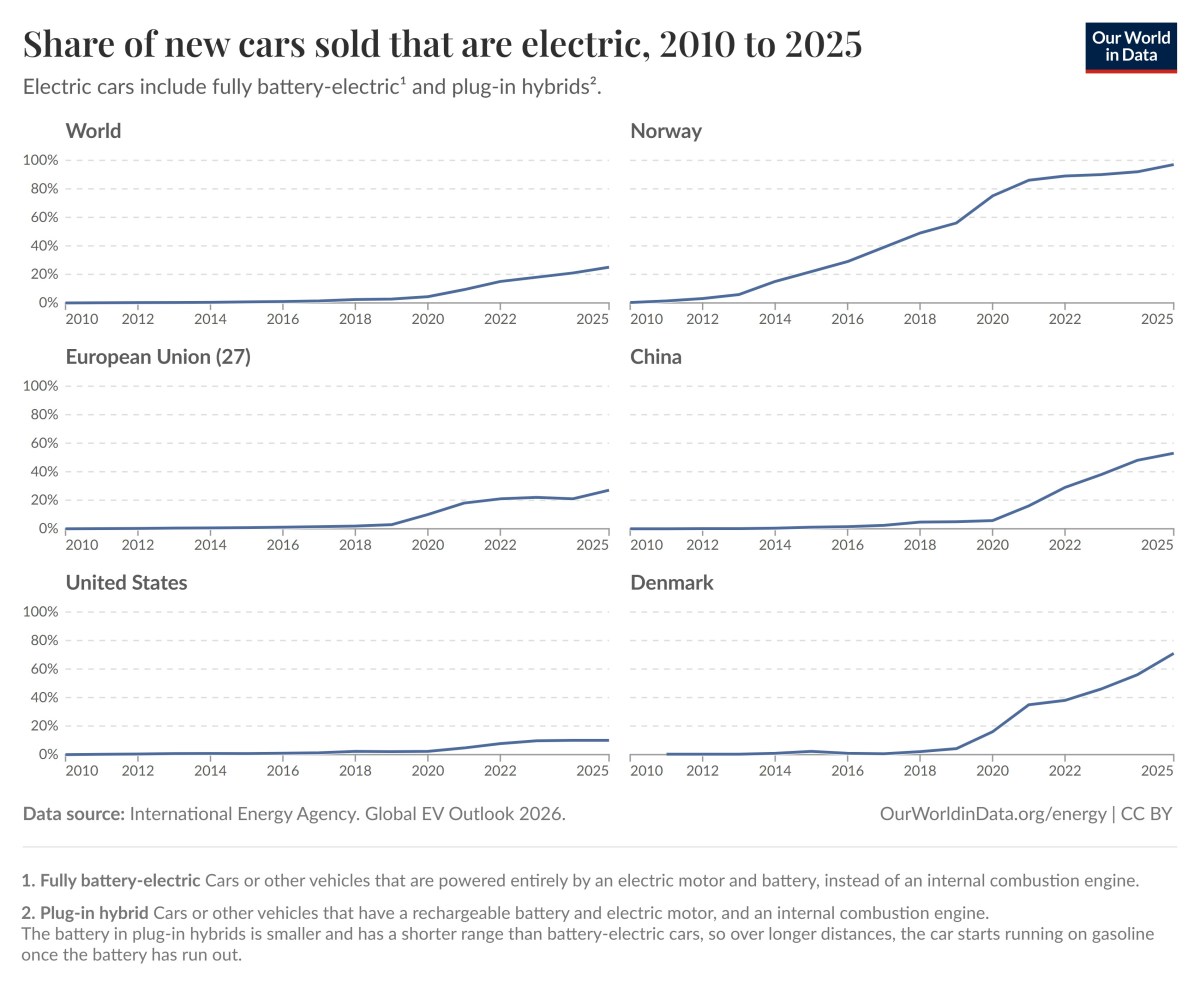
In Norway close to 100% of all new cars sold in 2025 were electric vehicles. Around the world a substantial percentage of new cars sold in 2025 were electric vehicles. This phenomenon is not as visible here in the US, where I live, but if you travel, you’ll notice.

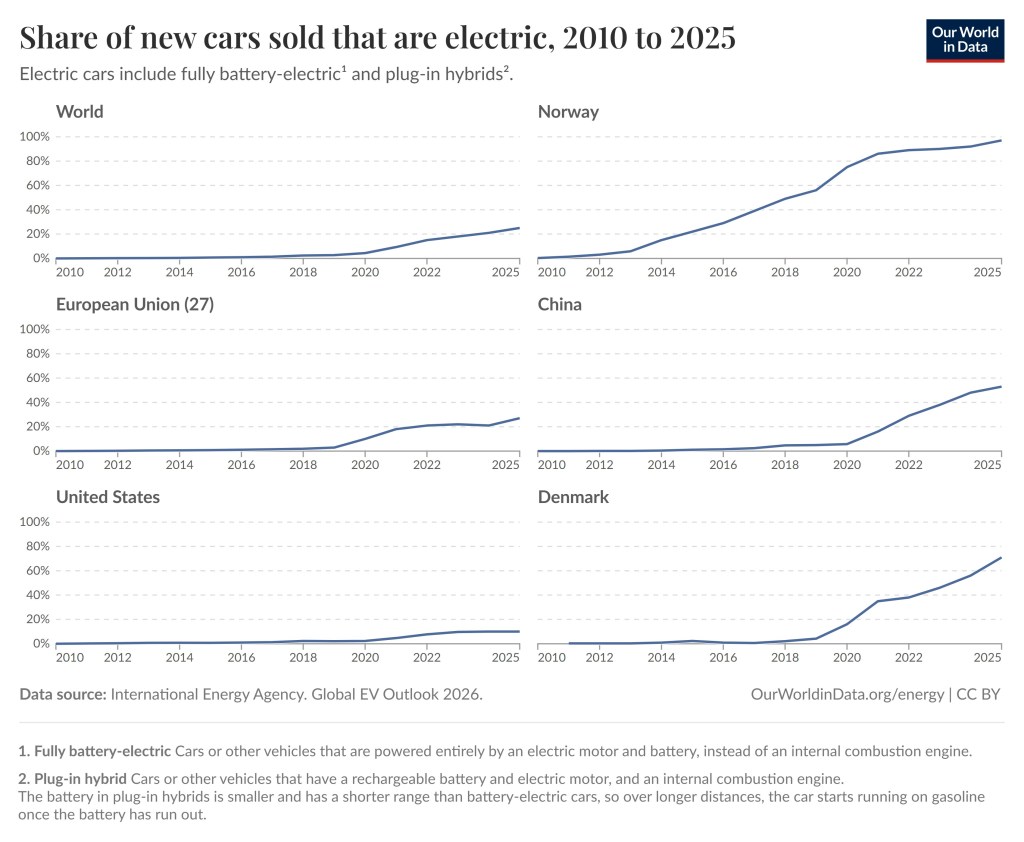
The graphs below show that the share of new cars that were sold in 2025 that were EVs was substantial, but more importantly there is a sharp upward slope of the curve(s). The share of new cars sold in 2025 that were electric was in respective region or country: Norway 97%, Denmark 71%, China 53%, European Union 27%, World 25%, the United States 10%. The graphs are taken from this page on the Our World in Data web page. I encourage you to play around with the interactive graphs. You can read more about new cars sales in Norway here.
EVs are Replacing the Internal Combustion Engine

It should be noted that electric cars include fully battery-electric and plug-in hybrids. With battery-electric cars is meant cars or other vehicles that are powered entirely by an electric motor and battery, instead of an internal combustion engine. With plug-in hybrid is meant cars or other vehicles that have a rechargeable battery and electric motor, and an internal combustion engine. The battery in plug-in hybrids is smaller and has a shorter range than battery-electric cars, so over longer distances, the car starts running on gasoline once the battery has run out.

This is a fact that is important, and that likely comes as a surprise to people living in countries that are lagging in this transition, such as the United States. Therefore, I consider it a super fact.

The Share of EVs

The sharp increase in the sale of electric cars is a recent phenomenon and therefore there are still a lot of ICE cars on the roads. Therefore, there is a significant difference between the share of electric vehicles on the road and the share of new cars sales being EVs. The share of electric cars on the roads in 2024 was in the United States 2.7%, in the world 4.5%, in China 11%, in Sweden 13% and in Norway 32%. See the graph below.
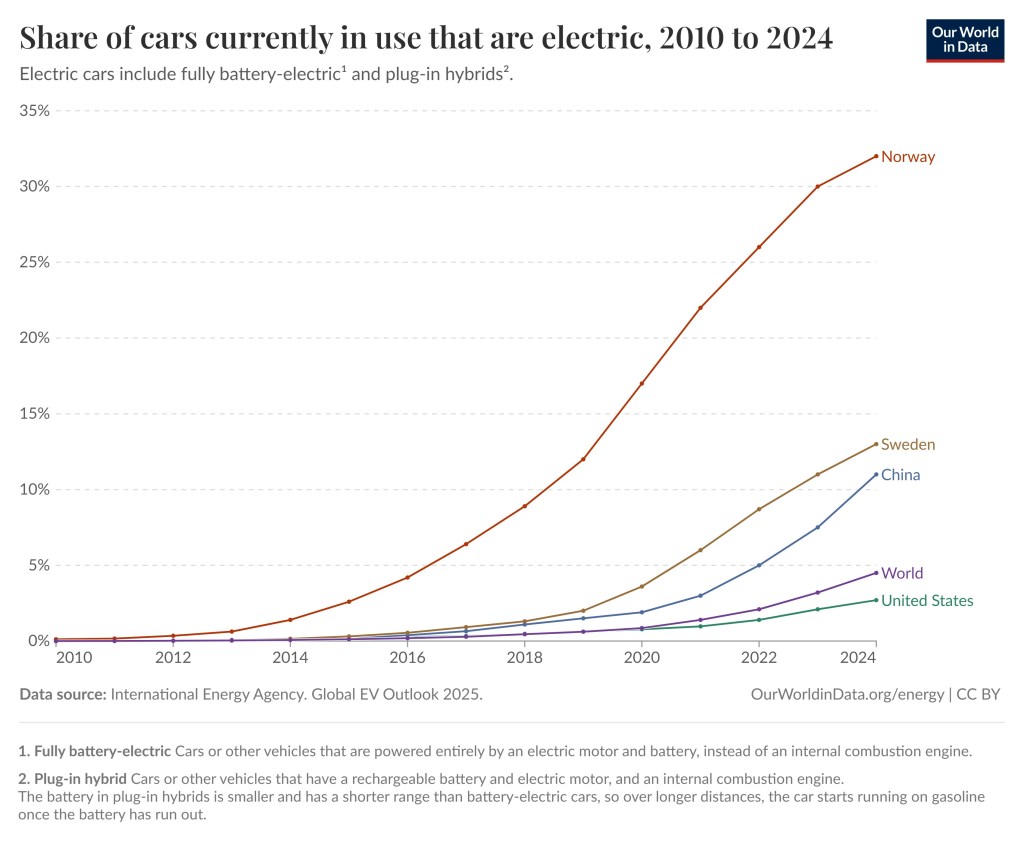
The graph shows the share of cars currently in use that are electric for the world, the United States, China, Sweden and Norway.
Share of cars currently in use that are electric, 2010 to 2024. Data source: International Energy Agency Global EV Outlook 2025.   OurWorldinData.org/energy | CC BY

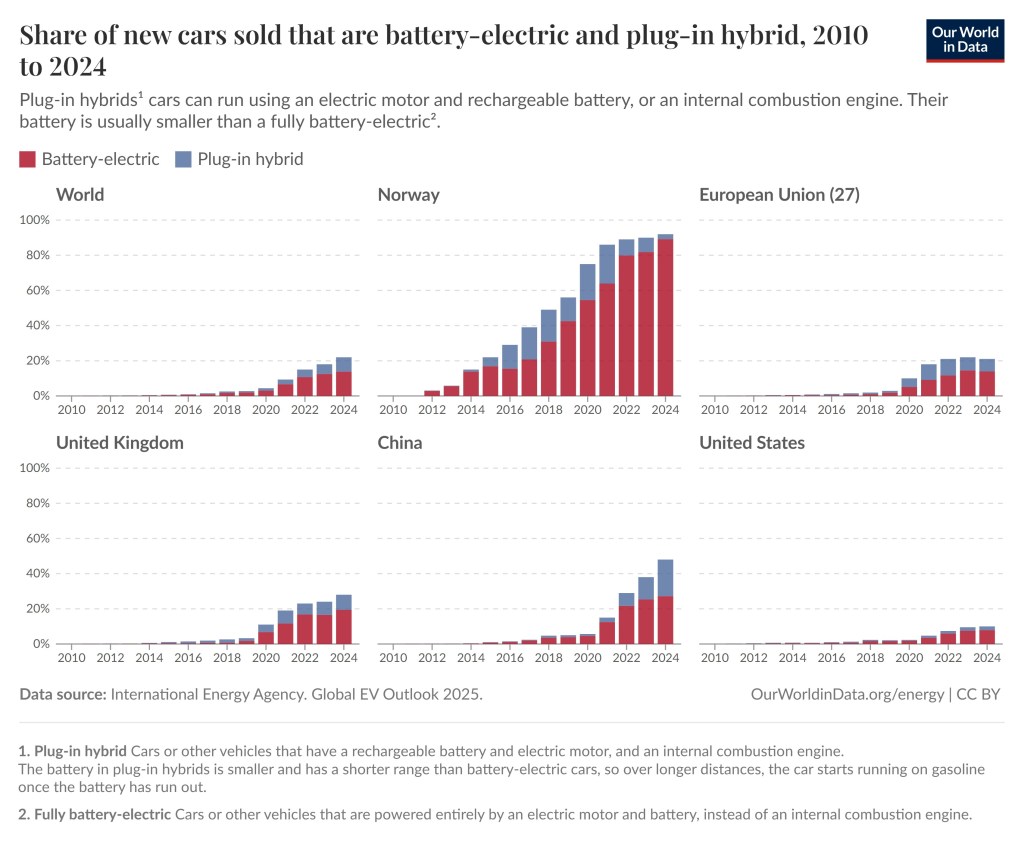
The graph below illustrates the sales of fully battery-electric cars versus plug-in hybrids.
EVs are Replacing the Internal Combustion Engine

The bar graph below is an alternative illustration showing the share of  new cars sold that are electric in 2024 for the world and 8 countries.
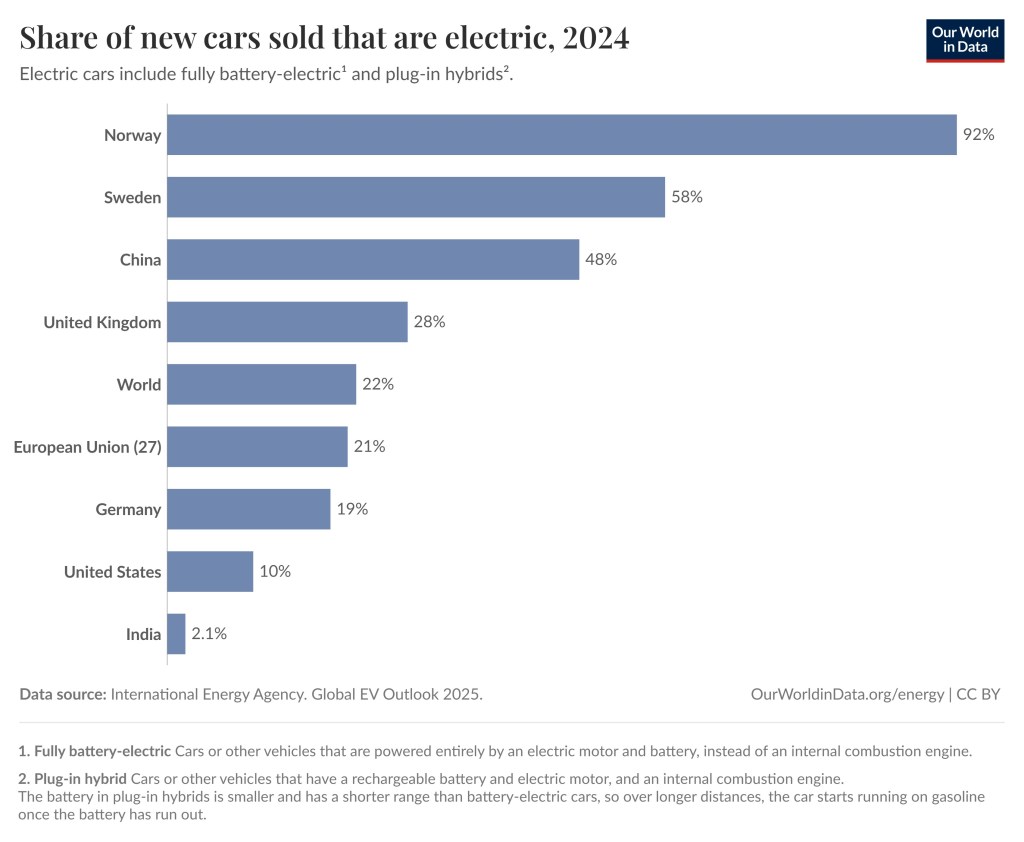
The bar graph shows the share of new cars sold that are electric in 2024 for the world and 8 countries. The numbers are India 2.1%, the United States 10%, Germany 19%, European Union 21%, United Kingdom 28%, China 48%. Sweden 58%, Norway 92%, and the World 22%
Share of new cars sold that are electric, 2024. Electric cars include fully battery-electric and plug-in hybrids. Data source: International Energy Agency  Global EV Outlook 2025.  OurWorldinData.org | CC BY

This article states that there are now more new electric cars sold in the EU than ICEs. However, it should be noted that they include hybrids (non-plug-in) in this number.

Are EVs cleaner than ICE cars ?

Yes, they are, for the most part. EV Cars emit less pollution than Internal Combustion Engine Cars, even considering manufacturing, disposal and EV Cars being charged by dirty grids. Basically, this is because burning oil to move a vehicle creates significantly more heat than motion.

It all depends on how dirty the grid is. This map shows the average EV as a gasoline MPG equivalent for the different grid networks in the United States in 2020. As you can see an average EV corresponds to a 76 mpg gas car in Texas (with the ERCOT) grid, which is much cleaner than almost any gasoline car. Also, the ERCOT grid has become cleaner since 2020. The average for the United States is 91 mpg. There are a couple of grids for which owning an EV may not be cleaner. I created another super fact post that explains the details called: super fact (29) EV Cars Indeed Emit Less Carbon Pollution. You can read more here.

There are concerns about the mining of minerals for EV cars, such as cobalt and lithium, which has an environmental impact. However, this environmental impact should be compared to the environmental impact caused by the drilling and transport of oil (and the burning of gas/oil). In general, the environmental impact of EVs is considered much less. In addition, EV batteries last a long time, and 95% to 98% of the valuable materials in EV batteries (lithium, cobalt, nickel, and copper.) can be recycled/recovered. You can read about other EV myths here. However, this is probably a topic for a future super-fact.


Craigavad a scientist and fellow blogger, wrote a very well balanced and insightful article on the issue of the carbon cost of electric vehicles. I encourage you to read it : “The Carbon Cost of Electric Cars: are they worth it?


To see the other Super Facts click here

Electrification

This is not one of the super fact posts. It is just a post related to an interest of mine that is informational. I volunteer for an organization called Citizens Climate Lobby, or CCL. CCL is a bipartisan organization that works with both Democrats and Republicans to create the political will for climate solutions. During the month of August CCL is promoting what is called electrification. Clean energy is taking the world with storm, but energy / electric power is not the only source of carbon emissions / greenhouse gases.

Take for example, transportation. Most cars still use gasoline and to move towards a fossil fuel free future we must move towards using transportation that uses less fossil fuels such as EV cars. We need to electrify transportation. Another aspect of electrification is replacing gas stoves with induction stoves, installing solar panels, as well as lowering the energy use of your house.

A picture of houses by a lake | Electrification
Lowering the energy consumption of your house lowers your emissions. Photo by Frans van Heerden on Pexels.com

EV Cars

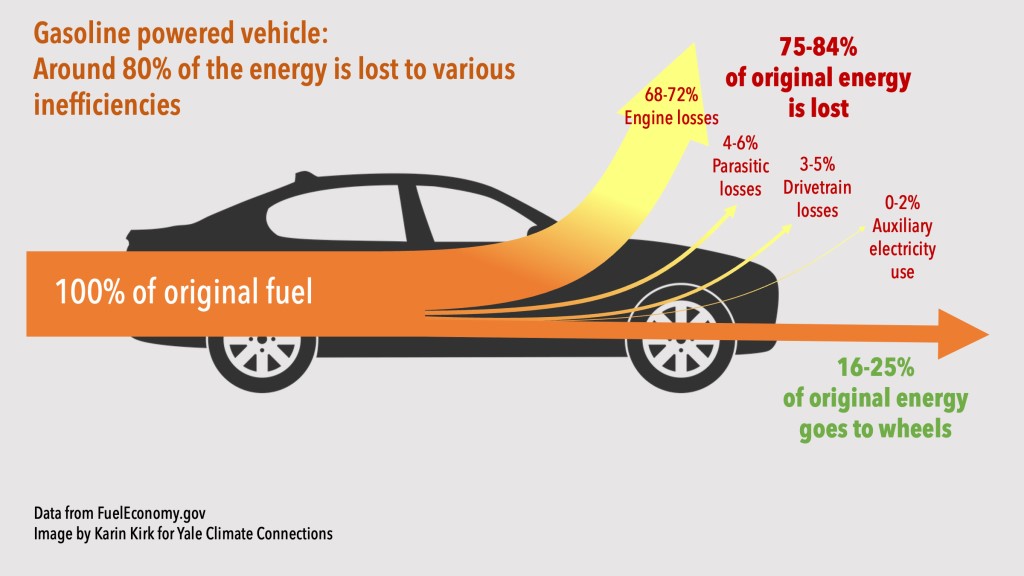
At least here in Texas it is quite common to believe that EV cars do not reduce emissions. After all EV cars use electricity from the dirty grid, right? Often this is said to environmentalists and people who care about fossil fuels emissions as if they don’t understand that the electricity for EV cars typically comes from the dirty grid. However, they do know that. In fact, they know a little bit more. EV cars are much more efficient than Internal Combustion Engine cars , or ICE, and therefore the emissions caused by EVs via the electrical grid, even a coal powered grid, is significantly less per mile. In fact, replacing gasoline-powered cars with EVs saves energy, regardless of the energy source used to recharge the EVs. For an ICE 16-25% of the original energy goes to the wheels whereas for an EV 87-91% of the original energy goes to the wheels.

Image showing an ICE car and its various losses | Electrification
16-25% of original energy goes to the wheels. Data from FuelEconomy.gov, Image by Karin Kirk for Yale Connections.
Image showing an EV car and its various losses | Electrification
87-91% of original energy goes to the wheels. Data from FuelEconomy.gov, Image by Karin Kirk for Yale Connections.

On the other hand, it takes more energy to manufacture an EV battery for an EV car than it does to produce a combustion engine. So, the production of an electric vehicle does emit more carbon than a petrol car. However, the lower emissions resulting from driving an EV means that an electric car quickly pays back its debt, so to speak. It is typically paid back within two years.

According to Hannah Richie at Our World in Data the statistics show that switching from an average ICE to an equally sized EV will save 1.2 tons of carbon emissions per person and year. That is a lot considering that the average carbon footprint per year is 4 tons worldwide and 14.4 tons per year for an American. Hannah Richie at Our World in Data also states that other environmental damages related to EVs such as mining for minerals are less than mining and extraction for fossil fuel cars, and she claims that the price of lithium-ion batteries has fallen by 98% over the last three decades.

Blonde woman pumping gas.
Photo by Andersen EV on Pexels.com

EVs are becoming increasingly common. According to Our World in Data in 2022, 88% of all cars sold in Norway were EVs and 54% of all cars in Sweden were EVs. The United States is lagging a bit at 7.5% but there is a tax credit $7,000.00 for new EVs and a $4,000.00 tax credit for buying used EVs. I should add that we have not yet bought an EV because after I took early retirement, I did not need a car. We just share my wife’s hybrid, which we hardly ever drive.

Induction Stoves

We bought an electric stove, an induction stove, a couple of years ago when our previous stove stopped working. They come with an $840.00 rebate. I’ve read that professional chefs prefer gas stoves. However, our induction stove provides everything we need for our cooking needs and my beer brewing needs and it is easier to clean. If you are a professional chef you may want to be able switch the high heat on and off quicker, but we are not professional chefs even though the food we cook is delicious.

Another downside of an induction stove is that if the power goes out you can’t cook, but that has not been a problem for us. Considering that we get our electricity from a power company, Green Mountain Energy, that utilizes renewable energy, wind and solar, you can claim that our stove is 100% fossil fuel free.

One cooking plate is red hot. The stove itself is made of granite.
Our induction stove with the lights in the kitchen turned off.

Heat Pumps

Air source heat pumps, which are the most common type of heat pumps, are a great, energy efficient choice for heating your home and water and as well as being low maintenance, they can help to cut your heating costs and lower your carbon footprint. An air source heat pump absorbs heat from the air outside a building and releases it inside. It uses the same vapor-compression refrigeration process and much the same equipment as an air conditioner, but in the opposite direction.

Air-to-air heat pumps provide hot or cold air directly to rooms. Heat pumps are the main way to phase furnaces but are also typically more efficient than other types of heaters and air conditioners and thus they reduce greenhouse gas emissions. There is an up to $8,000.00 upfront discount for heat pumps and a 30% tax credit up to $2,000.00. I should say we do not have a heat pump.

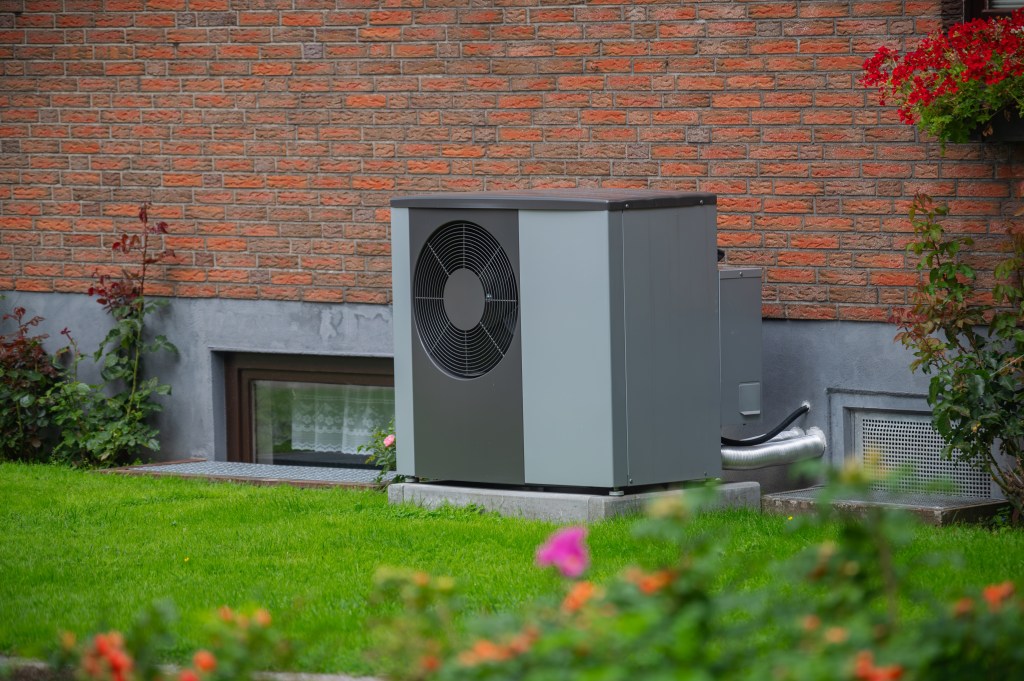
Grey heat pump standing towards the wall of an old red brick house.
Air heat pump installed on the exterior facade of the old house. Sustainable heating solutions for old construction. Stock Photo ID: 2349325553 by Snapshot freddy.

Rooftop solar

Another great thing that we have been thinking about but do not have yet is rooftop solar. Rooftop solar power system, or rooftop photo voltaic systems, consist of electricity-generating solar panels mounted on the rooftop of a residential or commercial building or structure. Residential rooftop solar power systems typically feature a capacity of about 5–20 kilowatts.

The average American household uses 1.2 kilowatts on average. Most rooftop solar systems are connected to the grid and can feed the extra power into the grid for compensation. I should add this is not entirely without difficulty. There are also hybrid systems which include any combination of wind turbines, diesel generators, and batteries for electricity on demand. There is a 30% tax credit for rooftop solar.

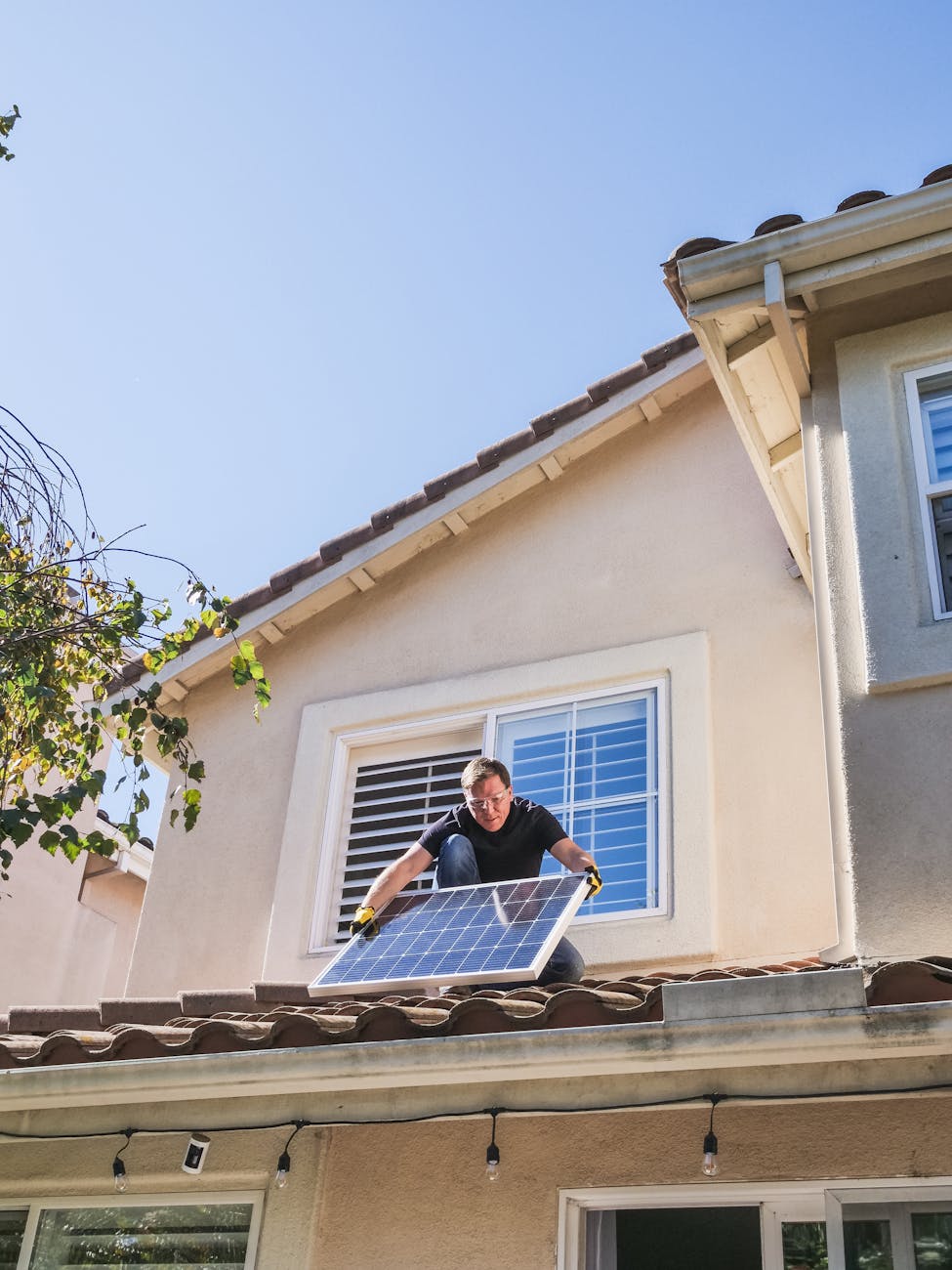
Solar panels being installed | Electrification
Photo by Kindel Media on Pexels.com

Miscellaneous Energy Savings

Saving energy is not exactly the same thing as electrification but it is a related topic. If you electrify your home and also reduce your energy needs, you are reducing emissions.

A few years ago, we changed the insulation in our house to reduce our energy needs and our electric bill. It made a difference. We also did weatherstripping, installed three pane windows and high security doors, that were well-insulated and reduced heat-loss. We received significant tax credits for doing this. I don’t remember how much, but it was several thousand dollars. I can add that you get a $150 tax credit for a home energy audit.

What do you think about electrification and energy savings?

Do you have additional ideas for electrification and energy savings?


To see the Super Facts click here