The goal of this blog is to create a list of super facts. Important facts that are true with very high certainty and yet surprising, misunderstood, or disputed by many. This blog aims to be challenging, educational, and fun, without it being clickbait. I determine veracity using evidence, data from reputable sources and longstanding scientific consensus. Prepare to be challenged (I am). Intentionally seek the truth not confirmation of your belief.
Category: Environment & Climate Change
Facts relating to Environment & Climate Change known to be true and yet often disputed amongst the public
Superfact 107: Electric vehicles are rapidly replacing the internal combustion engine (ICE cars) and are becoming commonplace around the world. It is analogous to how cars once replaced the horse and buggy.
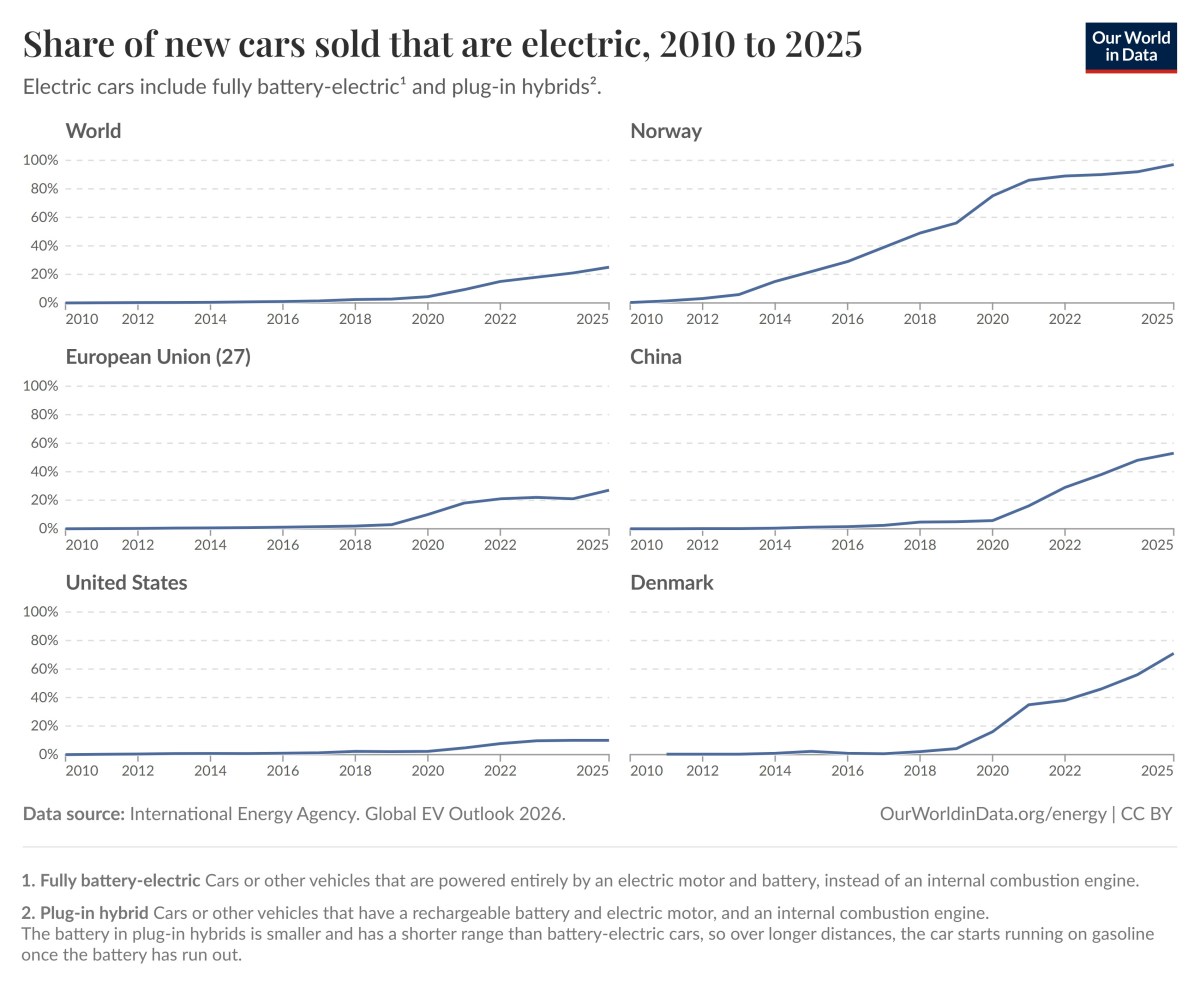
In Norway close to 100% of all new cars sold in 2025 were electric vehicles. Around the world a substantial percentage of new cars sold in 2025 were electric vehicles. This phenomenon is not as visible here in the US, where I live, but if you travel, you’ll notice.
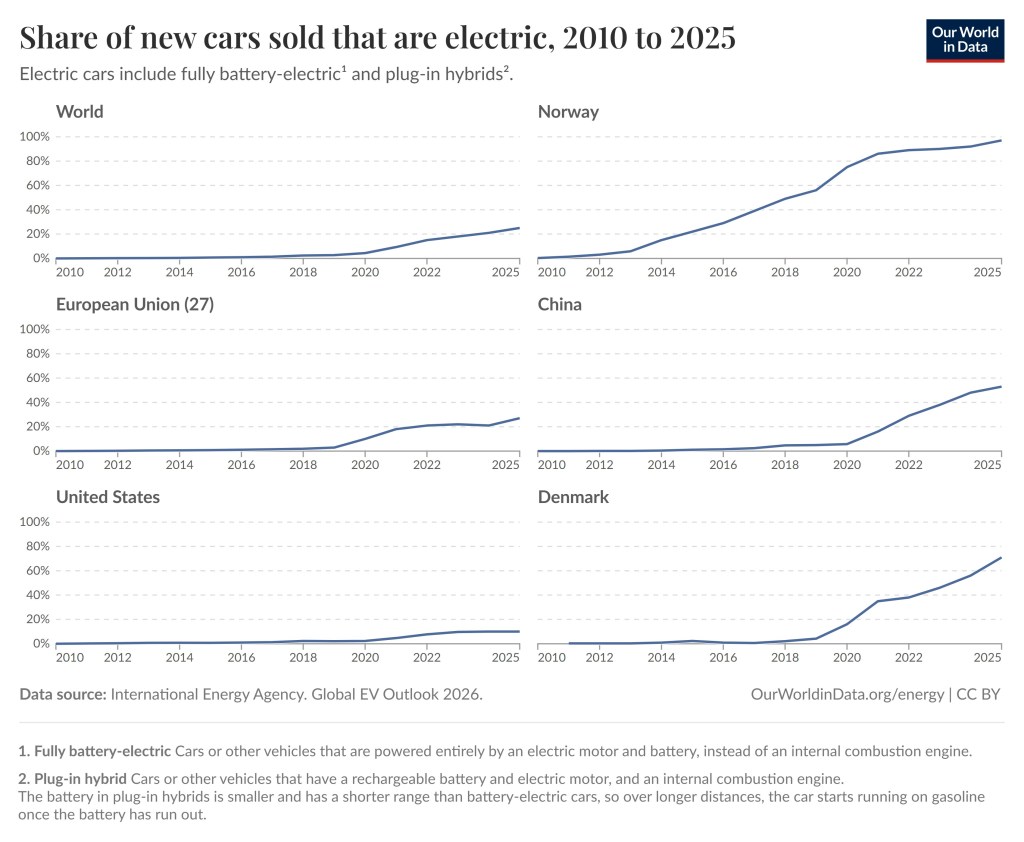
The graphs below show that the share of new cars that were sold in 2025 that were EVs was substantial, but more importantly there is a sharp upward slope of the curve(s). The share of new cars sold in 2025 that were electric was in respective region or country: Norway 97%, Denmark 71%, China 53%, European Union 27%, World 25%, the United States 10%. The graphs are taken from this page on the Our World in Data web page. I encourage you to play around with the interactive graphs. You can read more about new cars sales in Norway here.
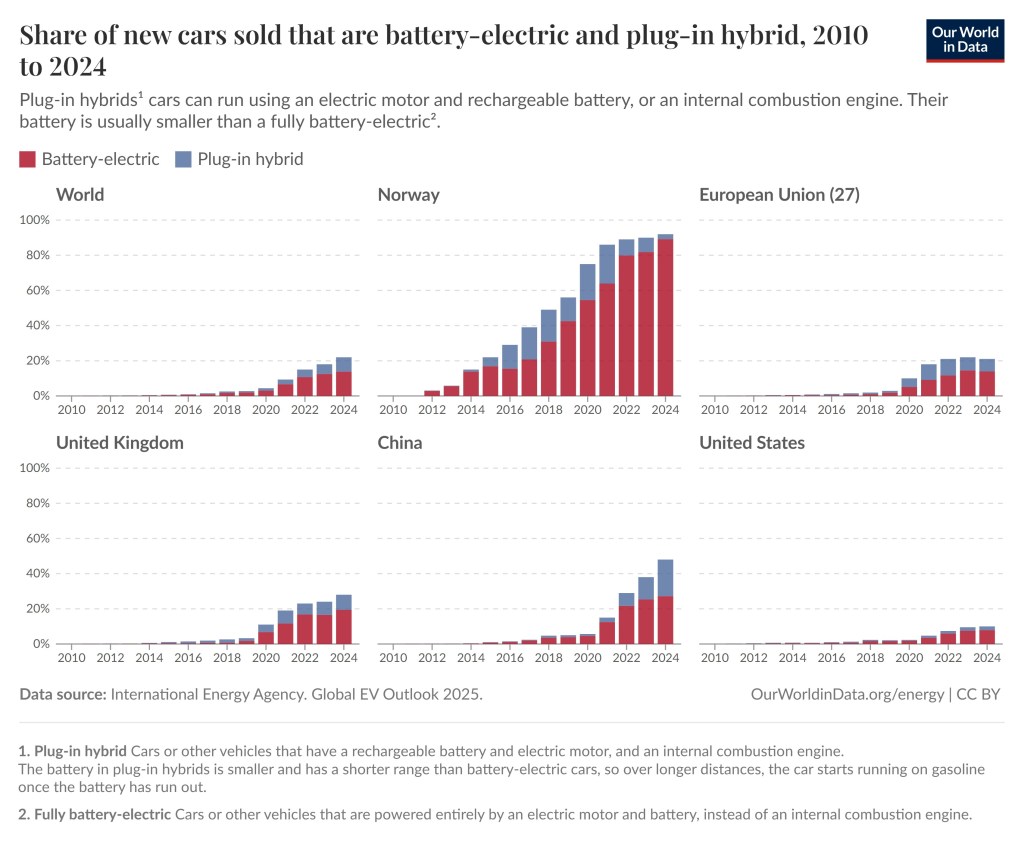
It should be noted that electric cars include fully battery-electric and plug-in hybrids. With battery-electric cars is meant cars or other vehicles that are powered entirely by an electric motor and battery, instead of an internal combustion engine. With plug-in hybrid is meant cars or other vehicles that have a rechargeable battery and electric motor, and an internal combustion engine. The battery in plug-in hybrids is smaller and has a shorter range than battery-electric cars, so over longer distances, the car starts running on gasoline once the battery has run out.
This is a fact that is important, and that likely comes as a surprise to people living in countries that are lagging in this transition, such as the United States. Therefore, I consider it a super fact.
The Share of EVs
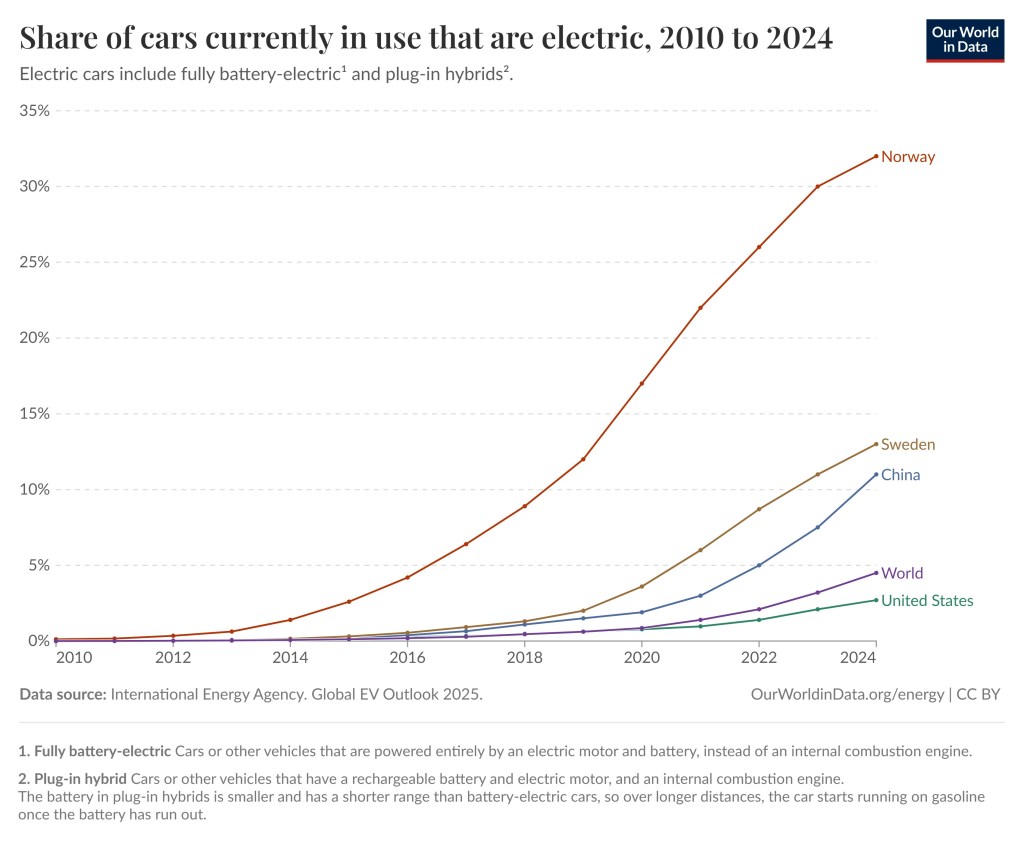
The sharp increase in the sale of electric cars is a recent phenomenon and therefore there are still a lot of ICE cars on the roads. Therefore, there is a significant difference between the share of electric vehicles on the road and the share of new cars sales being EVs. The share of electric cars on the roads in 2024 was in the United States 2.7%, in the world 4.5%, in China 11%, in Sweden 13% and in Norway 32%. See the graph below.
Share of cars currently in use that are electric, 2010 to 2024. Data source: International Energy Agency Global EV Outlook 2025. OurWorldinData.org/energy | CC BY
The graph below illustrates the sales of fully battery-electric cars versus plug-in hybrids.
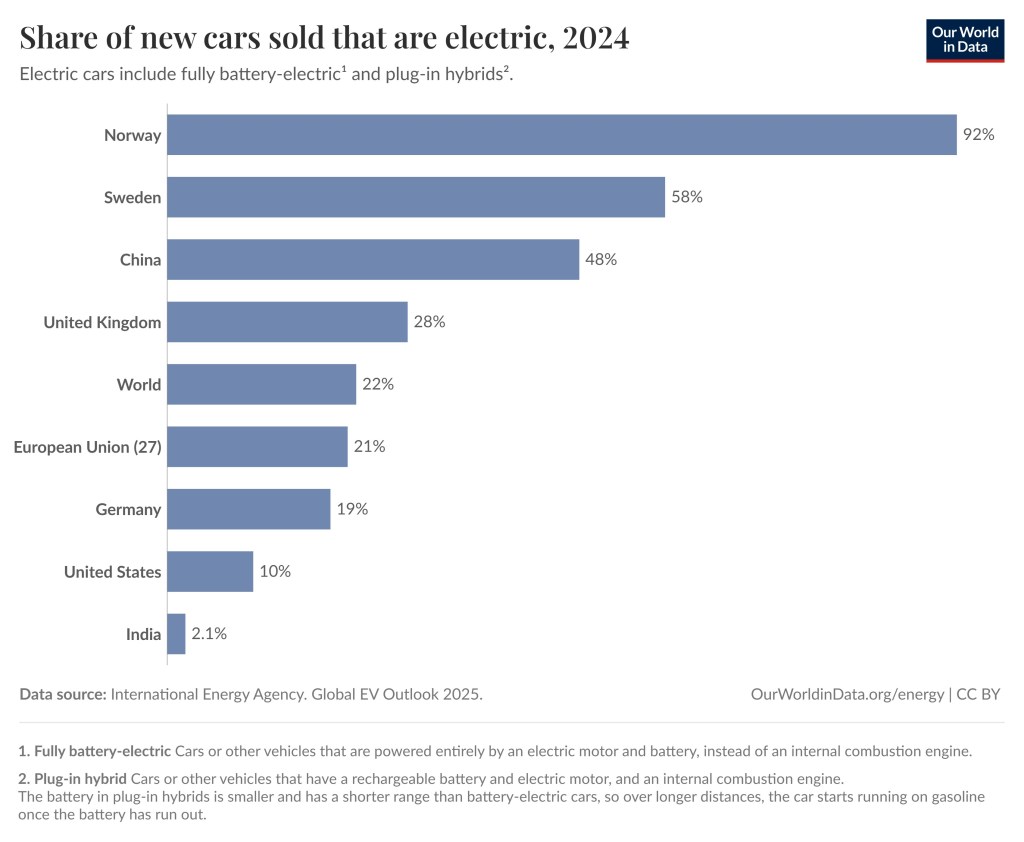
The bar graph below is an alternative illustration showing the share of new cars sold that are electric in 2024 for the world and 8 countries.
Share of new cars sold that are electric, 2024. Electric cars include fully battery-electric and plug-in hybrids. Data source: International Energy Agency Global EV Outlook 2025. OurWorldinData.org | CC BY
This article states that there are now more new electric cars sold in the EU than ICEs. However, it should be noted that they include hybrids (non-plug-in) in this number.
Are EVs cleaner than ICE cars ?
Yes, they are, for the most part. EV Cars emit less pollution than Internal Combustion Engine Cars, even considering manufacturing, disposal and EV Cars being charged by dirty grids. Basically, this is because burning oil to move a vehicle creates significantly more heat than motion.
It all depends on how dirty the grid is. This map shows the average EV as a gasoline MPG equivalent for the different grid networks in the United States in 2020. As you can see an average EV corresponds to a 76 mpg gas car in Texas (with the ERCOT) grid, which is much cleaner than almost any gasoline car. Also, the ERCOT grid has become cleaner since 2020. The average for the United States is 91 mpg. There are a couple of grids for which owning an EV may not be cleaner. I created another super fact post that explains the details called: super fact (29) EV Cars Indeed Emit Less Carbon Pollution. You can read more here.
There are concerns about the mining of minerals for EV cars, such as cobalt and lithium, which has an environmental impact. However, this environmental impact should be compared to the environmental impact caused by the drilling and transport of oil (and the burning of gas/oil). In general, the environmental impact of EVs is considered much less. In addition, EV batteries last a long time, and 95% to 98% of the valuable materials in EV batteries (lithium, cobalt, nickel, and copper.) can be recycled/recovered. You can read about other EV myths here. However, this is probably a topic for a future super-fact.
Craigavad a scientist and fellow blogger, wrote a very well balanced and insightful article on the issue of the carbon cost of electric vehicles. I encourage you to read it : “The Carbon Cost of Electric Cars: are they worth it?”
Superfact 106: IPCC likely retiring the RCP8.5 emissions scenario does not mean that the IPCC backtracked on any climate science. It does not mean that climate change does not remain a serious and dangerous problem, and it definitely does not mean that global warming is not human caused.
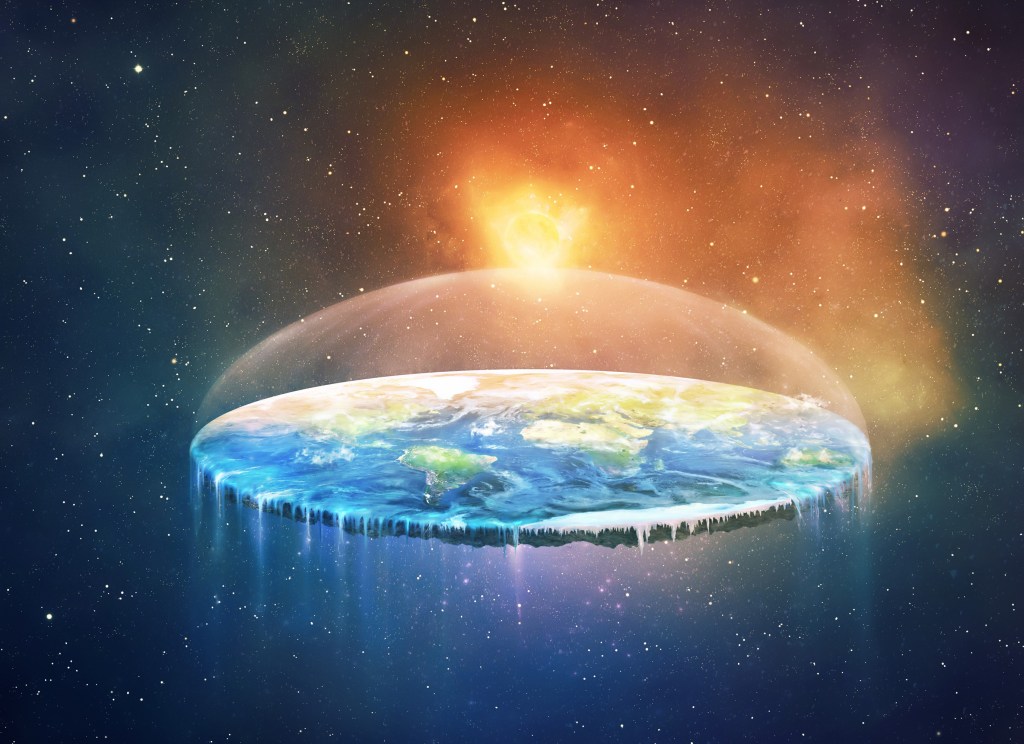
The photo below was recently taken by the International Space Station proving once and for all that Earth is flat like a pancake. NASA issued a statement on Thursday stating that Earth being closely spherical in shape is a long standing hoax created by leftwing extremists.
Digital illustration of flat Earth. Shutterstock asset id: 797857906 by Amanda Carden
OK, that isn’t true. It sounds like an April 1st joke, doesn’t it? It is a joke, except it isn’t April 1st. However, a fairly recent survey showed that 10% of the US population believe Earth is flat, not roundish. Imagine you not understanding any of the evidence for Earth being round and imagine that you’ve never stood on a tall hill watching ships disappearing below the horizon and imagine you being surrounded by a lot of people who claim that Earth is flat. It would be easy for you to believe that Earth is flat like a pancake. Wouldn’t it? Trying to understand evidence and science is crucial to understanding the world.
When I was young, I was bamboozled into thinking Earth was 6,000 years old and that evolution was a hoax. Then I got a science education, and I had to abandon those beliefs. Later as a young adult, I was bamboozled again, this time by rightwing media, into thinking that global warming wasn’t happening, well at least not very much of it, but then I learned something about the related evidence and about climate science, and I had to abandon that misconception too.
When you do not know about or understand the evidence, you are easy to fool, and that includes you fooling yourself by misunderstanding articles you are reading. Science is not a well understood topic despite its high importance in today’s world. Conspiracy theories, anti-vaccine propaganda, creationism, anti-climate-science, and other anti-science is spreading fast today, and it is easy to get bamboozled. Anti-science has become a cultural phenomenon.
To us who understand a little bit of the evidence that we are causing climate change, the evidence is conclusive enough that claims that it isn’t us causing it, sound just like the flat Earth claim above. It sounds like an April 1st joke to us because we know something. On the other hand, if you don’t know about the evidence, then you are easy to fool, and you might easily jump to false conclusions. Watch your biases and wishful thinking and pay attention to what the experts in the field are saying, not politicians, not influencers, not Facebook memes.
Examples of evidence that we humans are causing climate / global warming / climate disruption (pick your preferred moniker) include satellites having directly measured our greenhouse gases trapping heat, the upper troposphere cooling whilst the lower troposphere is warming, a phenomenon explained by greenhouse gas emissions, the unnatural speed of the warming, the manner in which the warming happens (explained only by greenhouse gas emissions), and that possible natural causes such as the sun, orbital cycles / Milankovitch cycles cannot explain the current warming. Add isotope studies that show that the added greenhouse gases originate from burning fossil fuels and that volcanoes emit less than 1% CO2 of what we emit.
IPCC (Intergovernmental Panel on Climate Change) being likely to drop the so called RCP8.5 (or SSP5-8.5) scenario in the upcoming Seventh Assessment Report upon the suggestion of the Scenario Model Intercomparison Project has set off a flood of misinformation and misinterpretation. Not the least by politicians, notably our President, who made some very bizarre and clueless statements on the issue.
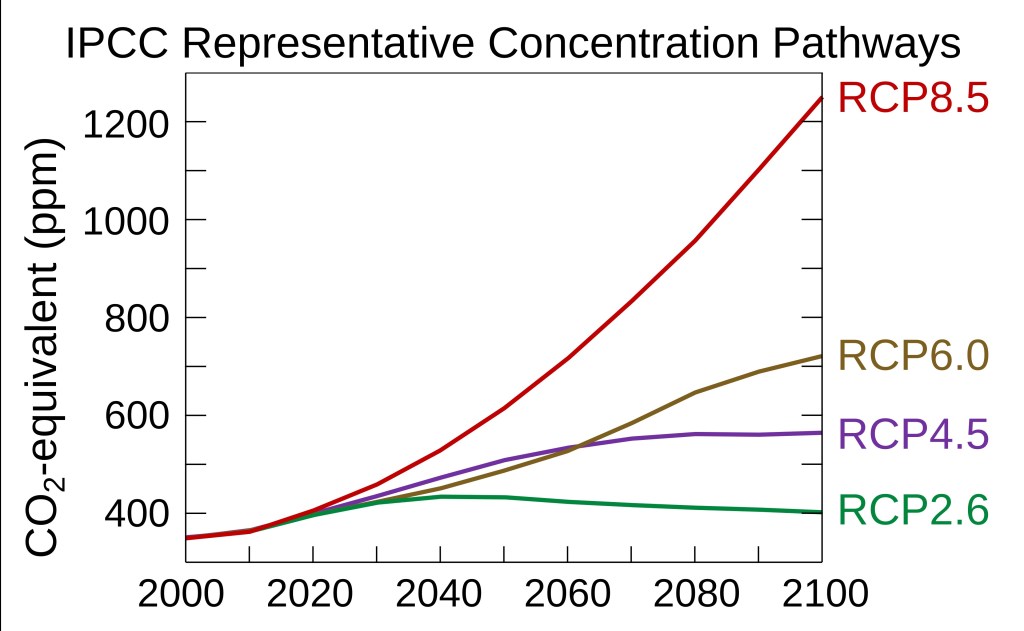
IPCC and the Scenario Model Intercomparison Project never stated that climate change is not caused by humans, or that climate change is not a serious problem. The Representative Concentration Pathways (RCPs) fundamentally depends on how much greenhouse gases we emit, as can be seen in the graph below. RCP8.5 corresponds to a very extreme scenario of burning enormous amount of coal. It was never a likely scenario to begin with, and it had become implausible due to the successful transitions to clean energy. That is why it makes sense to drop RCP8.5.
It was not because climate scientists were wrong about the climate science, or because environmentalists are exaggerating. In contrast to what many media outlets will tell you it is a vindication or victory for environmentalists. The global efforts to transition to clean energy have made it so that we can declare the worst of the worst scenario as implausible.
Different RCP scenarios result in different predicted greenhouse gas concentrations in the atmosphere (from 2000 to 2100). RCP8.5 would result in the highest greenhouse gas concentration (measured as CO2-equivalents). Efbrazil, CC BY-SA 4.0 https://creativecommons.org/licenses/by-sa/4.0, via Wikimedia Commons.
Since there are so much confusion, misinformation and hoopla surrounding this seemingly non-controversial event, I have reasons to consider the rectification of the misinformation a super-fact.
Official Statements on RCP8.5 by IPCC and the Scenario Model Intercomparison Project
It should also be noted that IPCC issues assessment reports based on research done by other organizations such as the Scenario Model Intercomparison Project. The IPCC does not conduct its own research. That is another common misrepresentation across media. It was not IPCC that decided to drop the RCP8.5 scenario, and the seventh assessment report has not yet been released. It was a suggestion by the Scenario Model Intercomparison Project published as a paper in Geoscientific Model Development, which stated “the CMIP6 high emission levels (quantified by SSP5-8.5) have become implausible, based on trends in the costs of renewables, the emergence of climate policy and recent emission trends”. You can read this paper here (and search for the quote).
Notice that the paper by the Scenario Model Intercomparison Project is NOT stating that global warming / climate change is not human caused. It does NOT state that it is not a serious problem. It does not in anyway imply anything like what the President and certain media outlets claim. There is additional reading from the Scenario Model Intercomparison Project here. You can read IPCC’s official comment on the issue here and its statement here. They were published May 20, 2026. The Washington Post and EOS provide some pretty accurate and easy to read explanations of what happened, for those wanting lighter reading.
Superfact 99: Carbon capture is the process of separating carbon dioxide from industrial emissions. Even though it works and could be helpful it isn’t used very much, at least not the right way.
If you have not heard about carbon capture before, its existence may be a surprise to you. If you do know about carbon capture it is likely to come as a surprise to you that it is a potentially promising technology that is underutilized and not used correctly. The facts around this technology are surprising, which is why I call it a super fact.
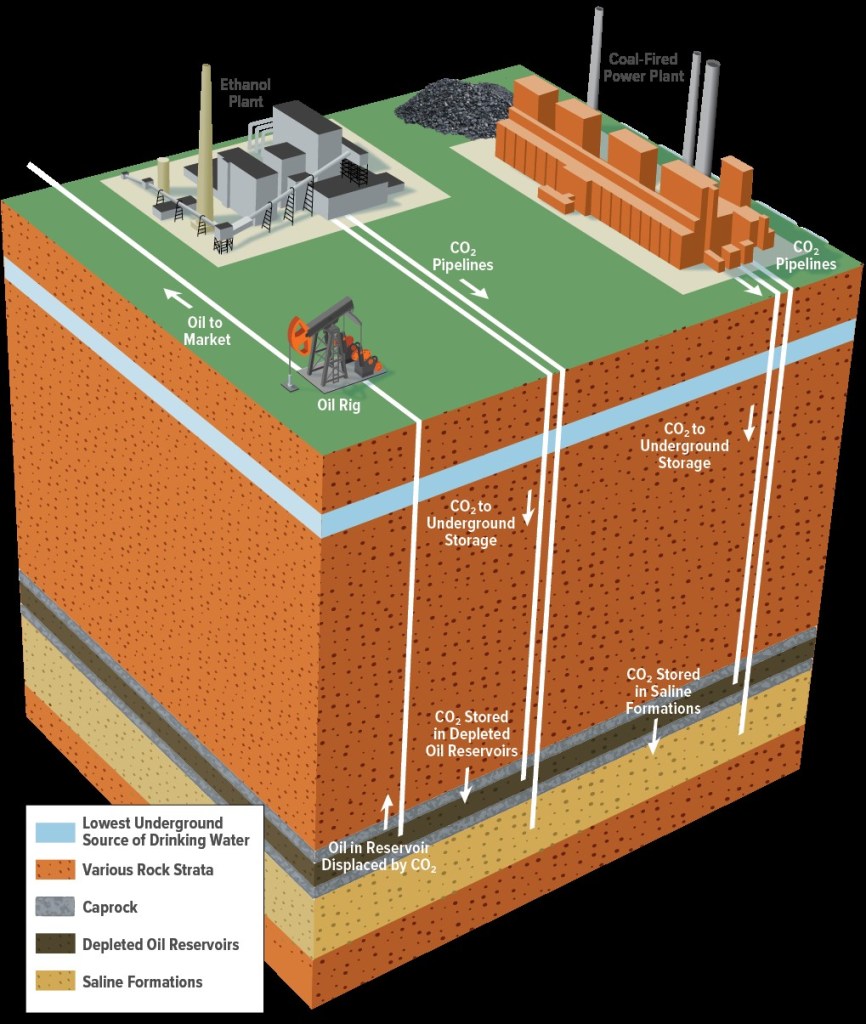
With CCS, carbon dioxide is captured from a point source, such as an ethanol refinery. It is usually transported via pipelines and then either used to extract oil or stored in a dedicated geologic formation. Congressional Budget Office, U.S. Federal Government, Public domain, via Wikimedia Commons.
Carbon dioxide and Global Warming
Global warming, or if you call it climate change, is happening and it is happening very fast. We also know that it is caused by us primarily as a result of our burning of fossil fuels. The primary culprit is carbon dioxide. There is a long-standing scientific consensus on these two/three facts because the evidence is conclusive. Some organizations and contrarians have successfully confused the public, but that does not mean there is a serious scientific discussion on the issue. To read more about this click here.
The damage caused by carbon dioxide to human health and the environment is difficult to assess, but you can get an idea, and you can put a dollar price on it. The economist William Nordhaus did this and got the Nobel Prize in economy for it in 2018. See my review for his book The Climate Casino. Now the question is what to do about it, and carbon capture and storage is one potential option.
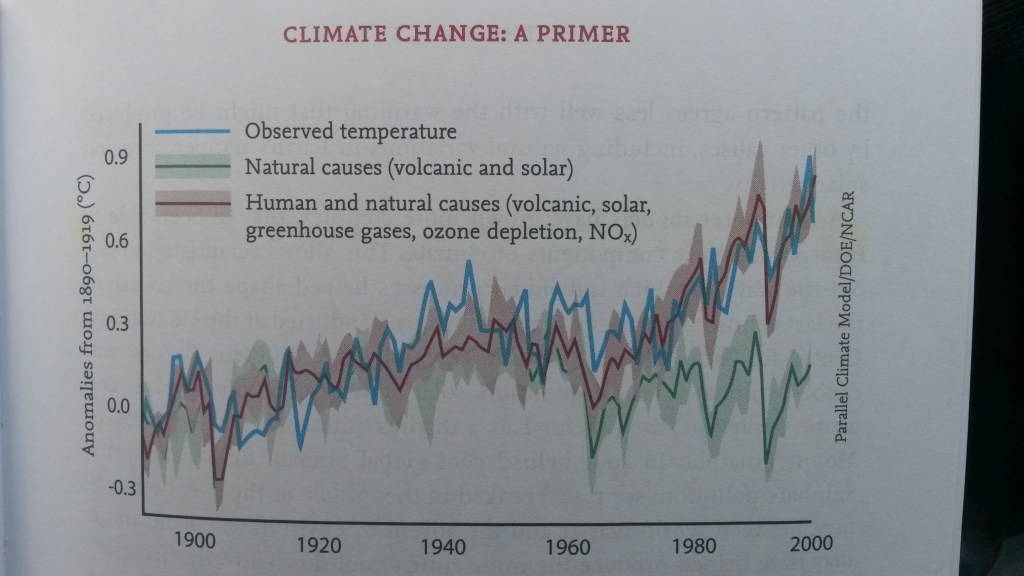
Natural causes for global warming / climate change would have cooled the planet, not warm it. Click here to visit this NASA web page regarding the causes behind global warming.
Carbon capture and storage an unfulfilled promise
The following is to a large degree my opinion, not just fact. Carbon capture and storage is a good idea. However, it adds costs to the production of energy, a cost someone must pay for. It seems like a no brainer that if carbon dioxide creates a social cost of several hundred dollars per ton, then paying much less than that to mitigate the emissions would be a good idea. However, the social cost that carbon dioxide imposes on all of us is imposed on all of us whether we are responsible for the emissions or not. Whereas the cost for carbon capture is a cost to a specific company or person responsible for the emissions.
Even though the cost for carbon capture may only be a few dollars added to the natural gas bill or a few cents per gallon on a gas tank it is a cost that is not incurred by your competitor who is not doing carbon capture. Unless the governments of the world either pay for carbon capture or put a price on carbon emissions, carbon capture isn’t going to be economically viable.
In addition, carbon capture and storage has been disappointing in other ways. It has been more difficult and expensive than expected. It has been used to extract more fossil fuels rather than removing carbon emissions. In addition, renewable energy has become so cheap that it is cheaper to use renewable energy instead of fossil fuels with carbon capture.
Superfact 96: Nuclear power is a relatively clean and safe energy source that produces no atmospheric emissions during operation. However, there are some problems with nuclear power, but they are often overblown.
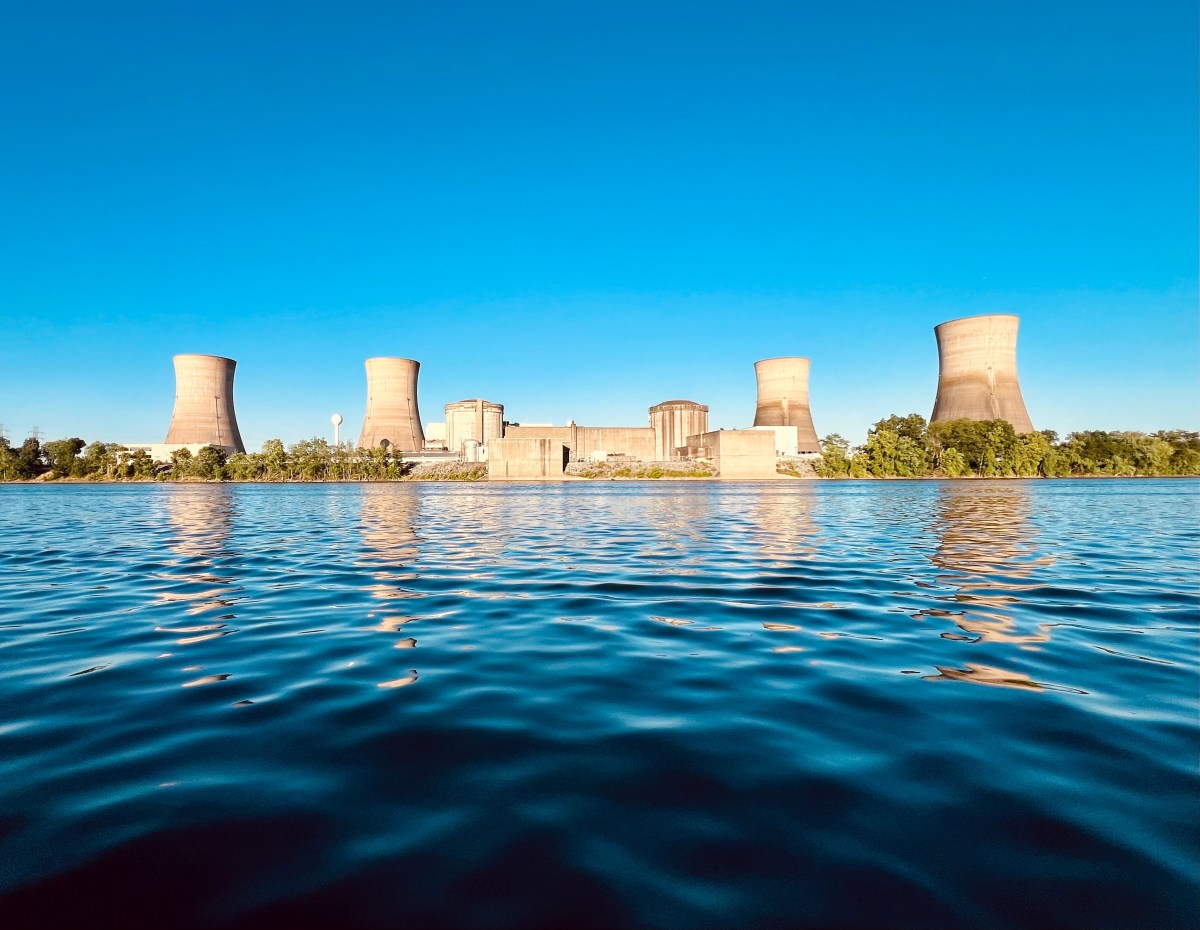
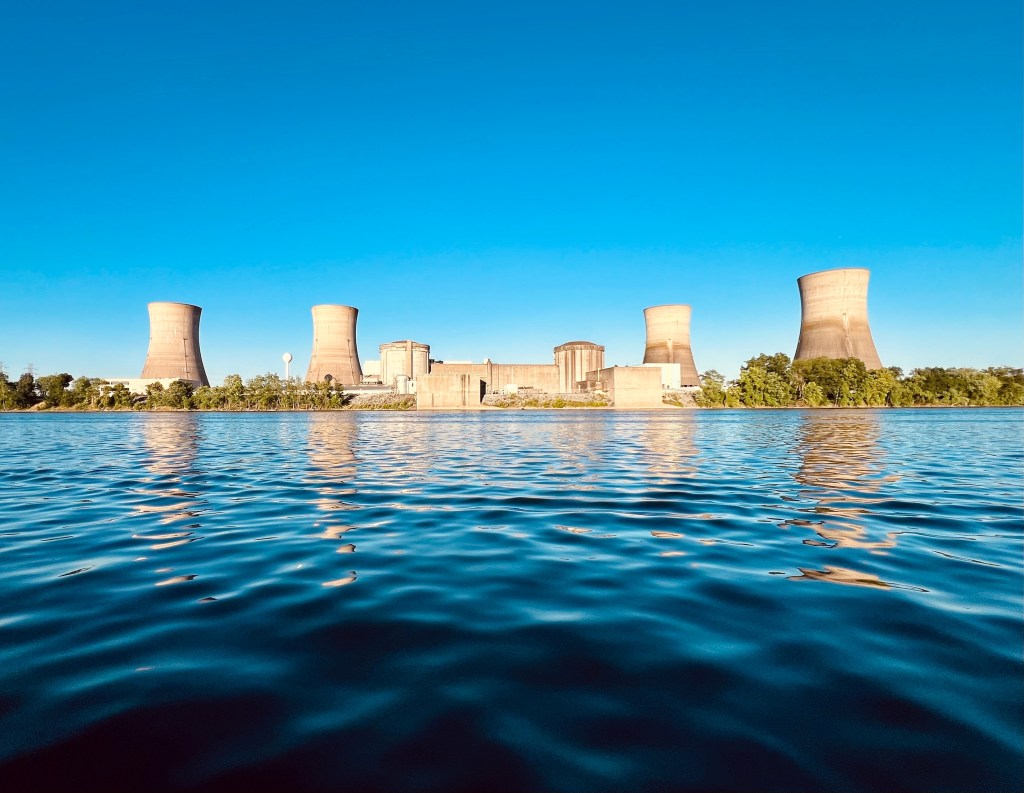
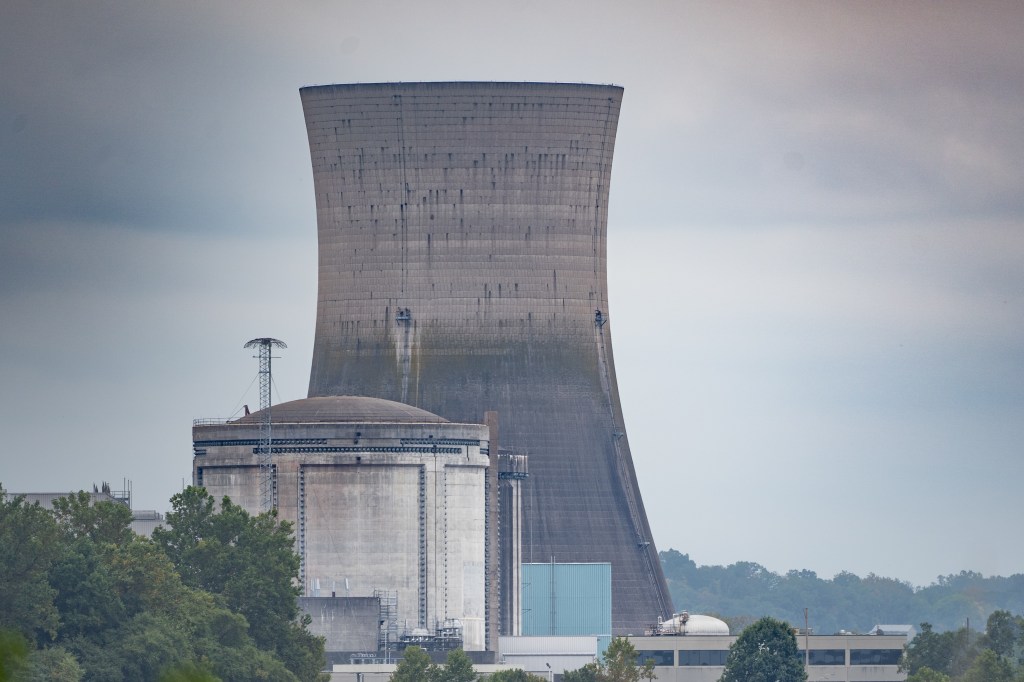
The Three Mile Island Nuclear Power Plant south of Harrisburg, Pennsylvania. March 28, 1979, a nuclear accident at the Three Mile Island nuclear power plant sent shockwaves across the world, raising fears about nuclear power. However, no one died, and no one was hurt. Shutterstock Asset id: 2512612545 by Aubrie K
Clean energy sources are often defamed by disinformation and misunderstandings. For example, wind power turbines are not bird killing machines. Contrary to what you often hear wind power is indeed a very clean, cheap and sustainable energy source. Nuclear power is another misunderstood energy source. Wind power, solar power, hydro, and nuclear power are all considered clean energy because they produce no greenhouse gases or air pollution during operation and they also have very low life-cycle emissions.
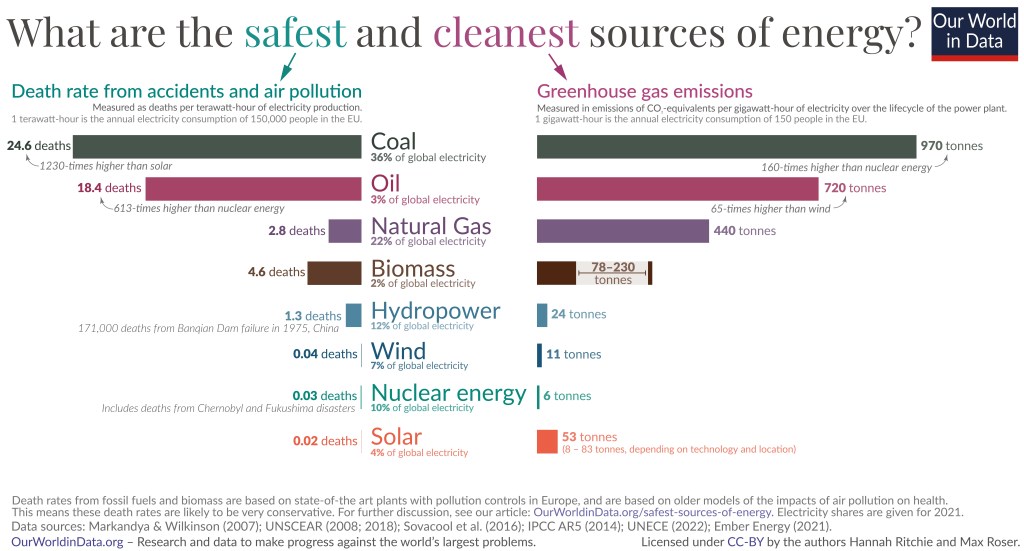
The graph below from Our World in Data depicting lifetime greenhouse gas emissions (construction, operation, disposal) and safety data for the European Union, show that the lifetime greenhouse gas emissions of coal power is 162 times higher than those of nuclear power and coal kill 820 times as many people as nuclear power. The lifetime greenhouse gas emissions of natural gas are 120 times higher than those of nuclear power and kill 613 times as many people as nuclear power. The difference is staggering.
Death rates from fossil fuels and biomass are based on state-of-the art plants with pollution control in Europe and are based on older models of the impacts of air pollution on health. This means that these death rates are likely to be very conservative. For further discussion see our article: OurWorldinData.org/safest-sources-of-energy. Electricity shares are given for 2021. Data sources: Markandya & Wilkinson (2007); UNSCEAR (2008: 2018); Sovacol et al. (2016); IPCC AR5 (2014); UNECE (2022); Ember Energy (2001). OurWorldinData.org – Research and data to make progress against the world’s largest problems. Licensed under CC-BY by the authors Hannah Ritchie and Max Roser. Citation : Hannah Ritchie (2020) – “What are the safest and cleanest sources of energy?” Published online at OurWorldinData.org. Retrieved from: ‘https://archive.ourworldindata.org/20260202-100556/safest-sources-of-energy.html’ [Online Resource] (archived on February 2, 2026).
In the graph above, greenhouse gas emissions are measured of CO2 equivalents per Gigawatt-hour of electricity over the lifecycle of the power plant. 1 Gigawatt-hour is the annual electricity consumption of 150 people in the EU. Death rate from accidents and air pollution is measured as deaths per Terawatt hour of electricity production. 1 terawatt hour is the annual electricity consumption of 150,000 people in the EU.
I should mention that there are problems with nuclear power that are not entirely covered by the graph above, including radioactive waste, a history of spectacular accidents, and a perceived connection to nuclear arms. However, as you will see later in this post, even though these problems get a lot of media attention, they are not as scary as one might think. However, it should be noted that nuclear power in its current form is not a cheap source of energy, but that is a different topic.
I consider this a super fact because nuclear power is often thought of as an extremely dangerous and dirty source of energy, which is not the case.
How Does Nuclear Power Work ?
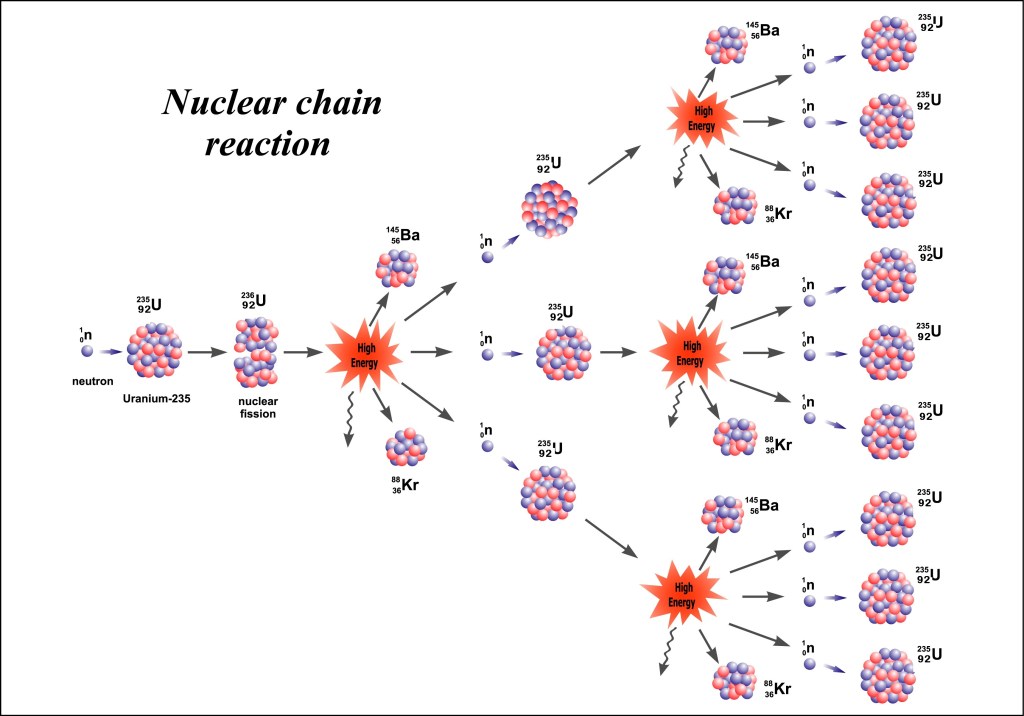
Illustration of nuclear chain reaction. Uranium-235 fission. Shutterstock asset id: 73714504 by Mpanchenko. Note I corrected an error in the picture.
The fuel (fuel rods) in a nuclear power station consists primarily of stacked ceramic pellets made of low enriched uranium dioxide housed inside sealed metal tubes. The uranium consists primarily of two uranium isotopes U-238, which has 92 protons and 146 neutrons and U-235, which has 92 protons and 143 neutrons. Uranium always has 92 protons. The isotope that is used for fission is U-235. Natural Uranium consists of 0.7% U-235, trace amounts of U-236 and the rest (99.3%) is U-238. The uranium in nuclear fuel rods is either natural (0.7% U-235) or a few percent of U-235 (low enriched uranium). This should be contrasted with a uranium atomic bomb which has at least 80% U-235 (highly enriched).
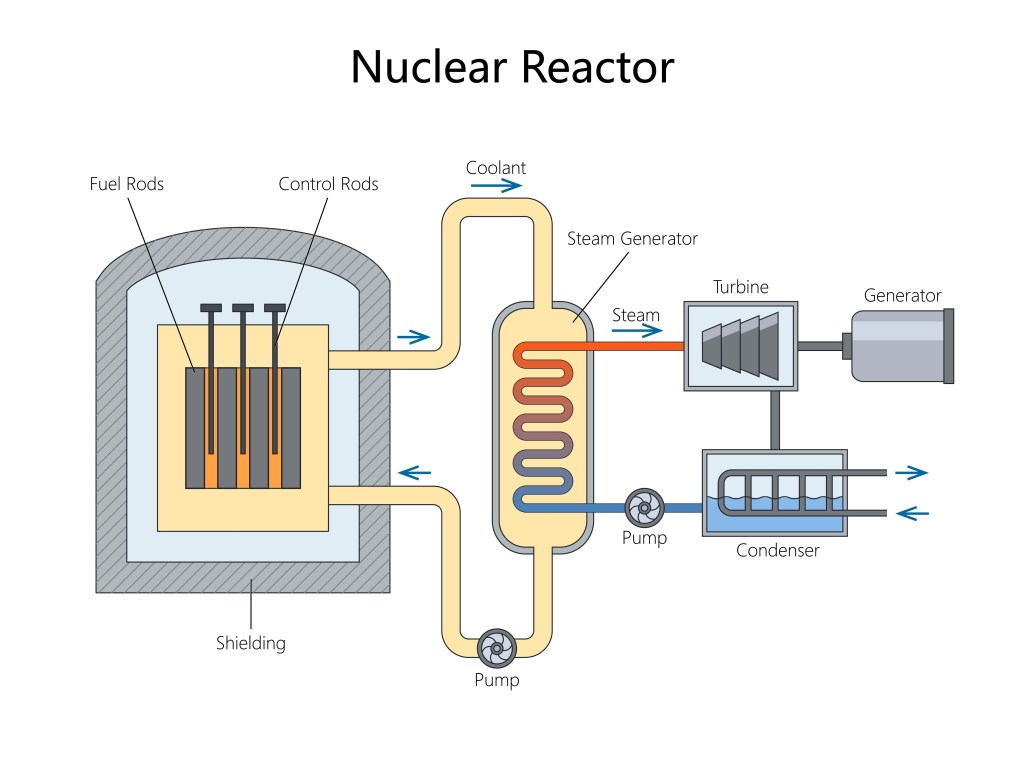
A nuclear power plant generates electricity using heat from nuclear reactions. Inside the reactor, atoms of fuel (uranium) undergo nuclear fission, where they split apart and release a large amount of heat. The fuel rods (see picture below) in a nuclear power station consist primarily of stacked ceramic pellets made of low enriched uranium dioxide housed inside sealed metal tubes. There are also control rods in a nuclear power station, which consist of materials with a high neutron absorption cross-section. The control rods are used to regulate the reaction. If they are fully inserted the reaction will stop. Also note that nuclear reactors have a containment shield (at least in western countries).
Fission generates heat, which generates high pressure steam, which pushes a turbine around, which turns a generator, which generates electricity, which is transformed to the right voltage and delivered to customers. Science educational illustration Shutterstock Asset id: 2658971563 by Alexander_P
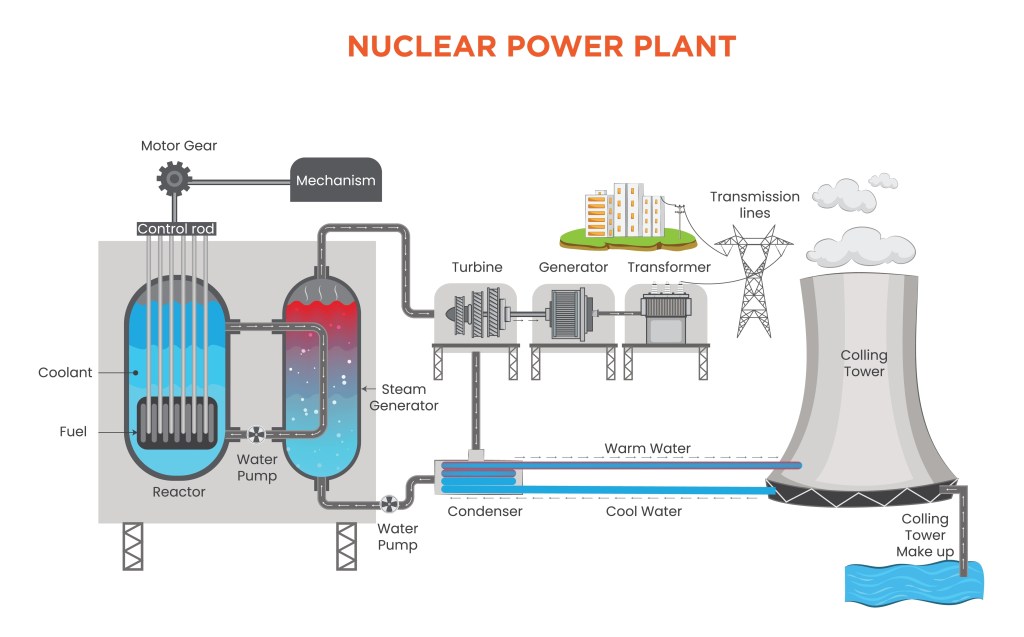
Below is an alternative illustration.
A nuclear power plant generates electricity by using heat from nuclear fission to produce steam, which drives turbines connected to electrical generators. This illustration also depicts the nuclear power plant’s use of water for cooling. Don’t worry, the water will not turn radioactive. It is a separate isolated loop. Shutterstock Asset id: 2525528665 by Papia Majumder.Three Mile Island Nuclear Plant, located in Pennsylvania, is known for a partial meltdown in 1979 Shutterstock. This photo shows the reactor as well as the cooling tower. Asset id: 2520903273 by Amy Lutz.
What about Chernobyl ?
The Chernobyl disaster, which occurred on April 26, 1986, was the worst nuclear disaster in history. 50 people died as a direct result of the disaster and an estimated 4,000, perhaps 10,000 future cancer deaths are predicted from the disaster. However, it should be noted that an estimated half million people died from coal pollution in the United States over the first two decades of the 21st century. You have to compare.
Another, thing to keep in mind is that the Chernobyl reactors were RBMK reactors (Reaktor Bolshoy Moshchnosti Kanalnyy), an extremely flawed, old and dangerous design that only exists in Russia (or the former Soviet Union). Above I mentioned that the control rods slow down the nuclear reaction when inserted between the fuel rods and stop the reaction when fully inserted. In an RBMK reactor, it is the other way around. The control rods speed up the reaction when inserted. Add the fact that the Chernobyl reactor did not have a containment shield designed to contain a major release of radioactivity, unlike Western reactors and that the Soviet Union was an authoritarian and secretive regime that made things much worse. A nuclear disaster similar to Chernobyl is highly unlikely to happen in the West.
The Fukushima nuclear disaster was caused by a severe earthquake and a 15 meter tsunami. Around 2,300 died from the evacuation, and 15,000 people died from the Earthquake, but it is estimated that no one, or perhaps one person died as a direct result from the nuclear disaster itself. As mentioned no one died from the Three Mile Island accident.
What about Radioactive Waste?
Radioactive waste stored on-site at nuclear power stations (spent fuel) is often millions of times more radioactive than long-term disposal waste. It is important to remember that highly radioactive isotopes decay fast (that’s why they are dangerous), which means that long-term disposal waste is not very dangerous. We are surrounded by radioactivity and our by far largest exposure to ionizing radiation comes from the radon in our basements.
Does nuclear power for energy generation increase the risk for nuclear weapons proliferation?
While commercial nuclear energy and weapons programs share technology, they are distinct processes. The historical data and studies show that national nuclear energy programs in general don’t lead to the development of nuclear weapons. No country officially developed nuclear weapons based on a pre-existing commercial nuclear power industry. Typically, nuclear-armed nations developed dedicated, military-focused, and often secret reactors to produce plutonium or facilities to enrich uranium for weapons. Also, the issue is mostly moot for countries that already have nuclear weapons, such as the United States.
Conclusion
Nuclear power is clean and safe. It might be our cleanest energy source that can provide baseload power. However, there are other concerns including the possibility of spectacular accidents, radioactive waste and the possibility that nuclear power for energy might aid nuclear weapons proliferation. Luckily, it appears that these concerns are overblown. It should be noted that nuclear power, as implemented today, is not cheap energy, but that is a different topic.
I came across a very interesting post about the science history of greenhouse effect: “The Greenhouse Effect: From Early Chemistry to the Keeling Curve” by Craigavad miscellany a science blog written by a retired academic. It is a very educational and interesting post related to this topic. Please take a look.
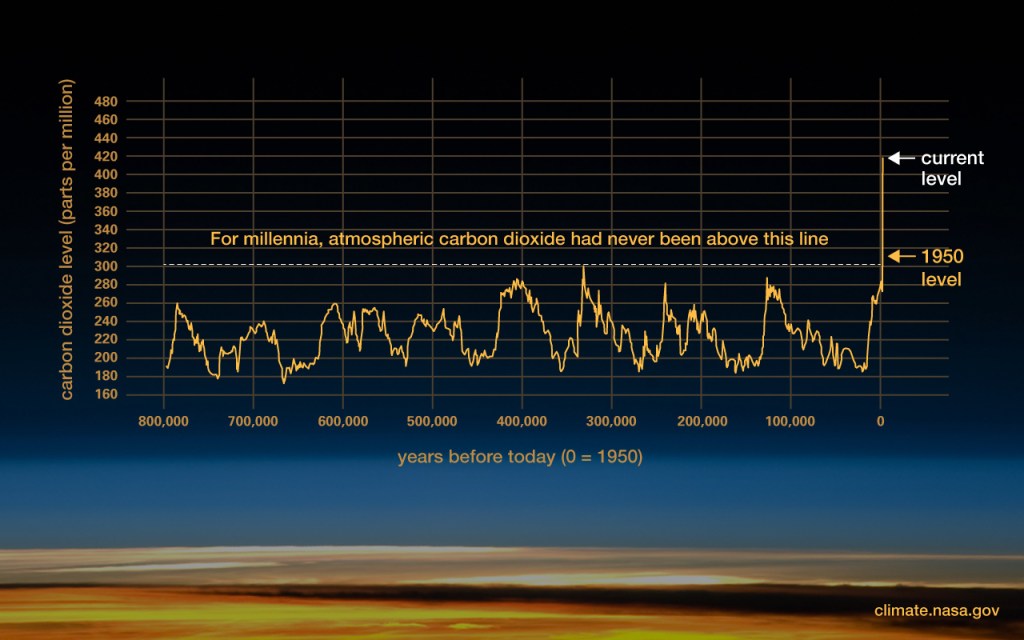
From Scripps institute. Keep two things in mind. First the warming from CO2 is delayed and may result in positive feedback that can manifest decades and centuries later. Secondly, human civilization developed during a period of stable climate. That CO2 levels and temperatures were higher millions of years ago is not much comfort.

 Super Facts