The US is the largest cumulative emitter of carbon

Super fact 43 : The United States has emitted more CO2 than any other country to date, around 400 billion tons since 1751. It is responsible for 25% of historical emissions. Click here.

But what about China? That is 12.7%, or around half. This is surprising information to many Americans, yet it is true, and therefore a super fact. In the US it is very common to blame China for our carbon emissions. In China they blame the US. In Europe they blame the US and China. Who is right? It turns out that the blame game is complicated and futile.

Carbon Emissions Around the World

Who should we blame the most for our carbon emissions?

In other words, if you want to blame another country for the carbon emissions, take your pick, well your cherry pick. Why should we do something about our carbon emissions when X is worse? Those who want no action on the global warming / climate change problem love the blame game. Like denial or despair, which are both irrational positions, the blame game hinders action. The blame game can also get very complicated and contentious.

The nine graphs are complex but show that among the nine countries/regions the United States currently has the highest emissions, followed by Canada, and the China, then South Africa, then the European Union, then comes the United Kingdom, and the World, and finally India and Kenya | The US is the largest cumulative emitter of carbon
The graph shows the fossil fuel emissions (in carbon dioxide equivalents) per capita from 1750 to 2023 for the World, the United States, Canada, China, European Union, India, South Africa, United Kingdom, and Kenya. Notice that the United Kingdom dominated the emissions in the 1700’s and 1800’s. Data source: Global Carbon Budget (2024); Population based on various sources (2024). The graph is from Our World in Data .

Note regarding the graph above: By clicking here you can find this graph and then select to display any set of countries or regions. Have fun experimenting.

Note regarding Fossil emissions: Fossil emissions measure the quantity of carbon emissions (CO2) emitted from the burning of fossil fuels, and directly from industrial processes such as cement and steel production. Fossil CO2 includes emissions from coal, oil, gas, flaring, cement, steel, and other industrial processes. Fossil emissions do not include land use change, deforestation, soils, or vegetation.

Overview of Cumulative Carbon Emissions

As you can see in the graph below the cumulative carbon emissions from 1751 to 2017 are 25% for the United States, 22% for the EU (28 countries), 12.7% for China, 6% for Russia, 4% for Japan, and 3% for India. If you count the entire continent of Europe, you get 33% for Europe.

The graph shows differently colored rectangles with the area of the rectangle corresponding to the cumulative carbon emissions. Each rectangle corresponds to a country or a region.
Figures for the 28 countries in the European Union have been grouped as the EU-28 since international targets and negotiations are typically set as a collaborative target between EU countries. Values may not sum up to 100% due to rounding. Data Source: Calculated by Our World in Data from the Global Carbon Project (GCP) and Carbon Dioxide Analysis Center (CDIAC). This is a visualization from Our World in Data, where you can find data and research on how the world is changing.
To see the other Super Facts click here

Emissions of ozone-depleting gases have fallen by 99 Percent

Super fact 41 : Largely thanks to the Montreal Protocol in 1987 the emissions of ozone-depleting gases have fallen by more than 99%, 99.7% to be exact, according to Our World in Data. This has resulted in halting the expansion of the ozone holes and the reduction in emissions of  ozone-depleting gases is saving millions of lives every year.

This is my good news for Earth Day, and it is a super fact. It is a super fact because a lot of people believe that the issue with ozone depleting gases and Montreal protocol is bunk. They take the fact that we are not talking about it much nowadays as evidence that there was nothing to it in the first place. However, they are wrong. We typically don’t talk much about environmental problems that have been addressed successfully. The Antarctic ozone hole that we used to worry about is still there, but its worrisome expansion has been halted.

The Reduction of Ozone-Depleting Gases

The ozone layer, located in the stratosphere, protects Earth from harmful UV radiation. Ozone (O3) is naturally created and destroyed in a balance, but ozone-depleting substances damage the ozone layer by releasing chlorine atoms that catalyze the destruction of ozone molecules.

This problem was discovered by Mario Molina and F. Sherwood Rowland in 1974. They were awarded the 1995 Nobel Prize in Chemistry, along with Paul Crutzen, for their work in atmospheric chemistry. Examples of ozone depleting gases are chlorofluorocarbons (CFCs), hydrochlorofluorocarbons (HCFCs), halons, methyl chloroform ,methyl bromide, carbon tetrachloride, hydrobromofluorocarbons, and chlorobromomethane.

The picture shows the sun radiating UV radiation to earth, which is protected by a blanket of ozone | By 2018 the emissions of ozone-depleting gases had fallen by 99.7 percent
Ozone layer depletion diagram. Earth’s sunscreen, shielding us from the sun’s harmful ultraviolet rays. UV A, B, C. UVA, UVB, UVC.

Ozone depletion causes a breakdown of the ozone layer around the world, including the famous Arctic and Antarctic ozone holes. This allows more UV radiation to reach Earth surface, increasing the exposure to harmful ultraviolet (UV) radiation, which can cause skin cancer, cataracts, and immune system damage.

It also harms plants and marine life, as well as climate. It should be noted that this is a different problem from climate change or if you call it global warming, even though ozone depletion to some degree influence climate change. You can read about climate change related super facts here, here and here.

The Reduction of Ozone-Depleting Gases

The good news is that we have been very successful in reducing ozone depleting gases. The Montreal protocol, a landmark international agreement signed in 1987 to protect the Earth’s ozone layer by phasing out ozone depleting gases, has been very successful.

As you can see in the diagram below from Our World in Data. We have had at least a 99% reduction in ozone depleting gases according to the NASA, the World Economic Forum and the UN Environment Program. More specifically, the reduction is 99.7% by 2018 according to Our World in Data.

Gases visualized in the diagram are CFCs, Halons, HCFCs, Carbon Tetrachloride, Methyl Bromide, Methyl Chloroform. The diagram shows a peak around the end of 1980’s | By 2018 the emissions of ozone-depleting gases had fallen by 99.7 percent
The phase out of six ozone depleting gases. Data source UN Environment Program (2023).

443 million Cases of Skin Cancer Prevented

The NIH estimate that the Montreal Protocol has prevented 443 million cases of skin cancer, 2.3 million skin cancer deaths, and 63 million cases of cataracts in the United States alone. Globally, it is estimated that the Protocol has saved an estimated 2 million people from dying from skin cancer each year.

Yes, you can read that again :

Worldwide the Montreal Protocol has saved an estimated 2 million people from dying from skin cancer each year.

To read more about the Montreal Protocol and the ultimate repair job click here.

The Antarctic Ozone Hole

What about the Arctic and Antarctic ozone holes? Well, they are not gone but they are retreating. When there is an environmental problem, it does not entirely disappear right away even if you remove the root cause. The same is true for global warming. If we succeeded to stop all carbon emissions tomorrow it would take decades for average temperatures to stop rising and hundreds of years for them to come down to “normal”. But remember it would have been much worse without the Montreal Protocol.

There are two graphs. The graph representing the annual mean Antarctic ozone hole is blue.  The graph representing the annual maximum Antarctic ozone hole is red. Both graphs are rising initially but after the year 2000 the graphs flatten and even go down a bit.
The graph is from Our World in Data and data comes from NASA Ozone watch 2024.
To see the other Super Facts click here

ERCOT Fuel Mix

This is not a super fact but just interesting information about ERCOT. ERCOT or the Electric Reliability Council of Texas is the organization that manages the state’s electricity grid, ensuring reliability and it operates the competitive wholesale electricity market for 90% of Texas’s electric load. There are a few things that are important to remember about ERCOT.

  • The ERCOT grid is located solely within the state of Texas and is not interconnected to the rest of the United States. In addition to Texans being independent, this is a way of avoiding federal regulation. ERCOT is regulated by the Texas Public Utility Commission while the rest of the country is regulated by the Federal Energy Regulatory Commission (FERC).
  • ERCOT is an ISO (independent system operator), meaning it’s a non-profit organization that manages the electricity grid independently of any single utility company.
  • When companies sell their energy (to ERCOT) it works like a continuous auction. The one with the lowest price is picked first and allowed to contribute with whatever they are able to and also, of course, considering what the grid-powerlines can carry safely.
A power grid. The sun is setting in the background | ERCOT Fuel Mix
The power grid carries the power and if not sufficient it can be a major bottle neck. Photo by Pixabay on Pexels.com

Renewables are successful in Texas

One thing that surprises many people is that renewable energy, for example, wind and solar, is quite successful in Texas. Fossil fuels is important in Texas, and there are many powerful oil and gas billionaires in Texas who fight the expansion of renewables. Texas politicians work hard to create laws that punish renewables with discriminatory permitting requirements.

For example, a recent bill in the Texas Senate SB819 adds a lot of requirements on renewables and battery storage that does not apply to fossil fuel-based energy sources. An example is the requirement in SB819 that wind turbines must be at least half a mile away from the property line of any neighboring property whilst, for example, oil rigs can be built up to the property line. There are a lot more regulations in SB819 that are discriminatory, contrary to free market principes, and even violations of private property rights.

Despite all the obstacles set up against renewable energy in Texas renewable energy is on the march in Texas. The reason is that ERCOT is ultimately a price competitive free market-based system and renewables are cheap. Solar and wind are the cheapest even considering subsidies and the cost of construction, land rent, disposal, and other costs not directly caused by electricity generation are taken into consideration disposal. Click here for details. The graph below shows the evolution of different energy sources in Texas. The graph is taken from this link provided by Dr. Joshua Rhodes, a research scientist at UT Austin.

The graph shows the average annual mix for natural gas, coal, wind, nuclear, solar, and other sources. Natural has roughly remained around 40-50%, coal has shrunk from 37% to 13%, wind has grown from 2% to 24%, nuclear has shrunk from 14% to 8%, and solar has grown from nothing to 10% over the last five years | ERCOT Fuel Mix
The ERCOT fuel mix from 2006 to 2024. Notice the expansion of wind power and notice that solar has gone from nothing to 10% of the average fuel mix in five years. The graph is taken from this link.

You can read more about the evolution of renewable energy in Texas by clicking here.

Watching the ERCOT Fuel Mix in Real Time

Finally, what I think is the most interesting portion of this post, the real-time ERCOT Fuel Mix. It includes a couple of energy sources not mentioned earlier in this post, hydro and power storage.

Hydro is very small in Texas and power storage is a new item that is not a true energy source but a feature that can be called upon when energy is suddenly needed somewhere. It is still not widely used but it reached 10% of the mix at one point in 2024. It is likely an energy source that will keep growing as it is instant and scalable. It is the most dispatchable energy source of all. I can add that there is a lot of misinformation spread about renewable energy, especially about wind power. To read more about that click here.

Last evening and today I took several screen shots of the real time ERCOT fuel mix (see below). A couple of things to note are that solar does not contribute at night and wind contributes more at night. It was a very cloudy and rainy day today so solar contributed less than normal during daytime, but not a lot less. It is not much less than the typical sunny day of 20%. It is true that wind and solar are intermittent, but it does not matter a whole lot because wind contributes more at night when solar does not contribute and battery storage, the most dispatchable energy source of all, is growing in importance.

Click here to watch the real-time ERCOT Fuel Mix minute by minute anytime you like. (highly recommended).

Wind is 40.5%, Natural Gas 38.8%, Power Storage 2.5% | ERCOT Fuel Mix
Fuel Mix on April 3rd 2025 at 8:00PM
Wind is 38.4%, Natural Gas 40.3%, Power Storage 0.7%
Fuel Mix on April 3rd 2025 at 10:00PM
Wind is 41.9%, Natural Gas 34.2%, Power Storage 0.4%
Fuel Mix on April 4th 2025, at 1:15AM
Wind is 43.7%, Natural Gas 32.7%, Power Storage 0.8% | ERCOT Fuel Mix
Fuel Mix on April 4th 2025, at 3:00AM
Wind is 31.5%, Natural Gas 31.0%, Power Storage 0.2%
Fuel Mix on April 4th 2025, at 12:35PM
Wind is 31.7%, Natural Gas 31.2%, Power Storage 0.2%
Fuel Mix on April 4th 2025, at 2:00PM
Wind is 32.7%, Natural Gas 34.3%, Power Storage 1.1%
Fuel Mix on April 4th 2025, at 4:00PM
Wind is 32.6%, Natural Gas 36.8%, Power Storage 0.8% | ERCOT Fuel Mix
Fuel Mix on April 4th 2025, at 5:30PM
Wind is 41.1%, Natural Gas 37.4%, Power Storage 0.2% | ERCOT Fuel Mix
Fuel Mix on April 4th 2025, at 9:30PM
Wind is 49.9%, Natural Gas 29.0%, Power Storage 0.0% | ERCOT Fuel Mix
Fuel Mix on April 4th 2025, at midnight
To see the Super Facts click here

Natural Disasters Kill Less People Now Than 100 Years Ago

Super fact 35: Natural disasters kill a lot less people now compared to 100 years ago. That is despite a larger population and despite the fact that climate change has increased the frequency and intensity of many types of natural disasters.

This is a super fact because surveys, such as this questionnaire from Gap Minder, show that the vast majority of the public (90%) believe that deaths from natural disasters have increased or stayed the same. Gap Minder is a Swedish highly respected non-profit founded by Hans Rosling that promotes increased use and understanding of statistics. Our World in Data (OWID), a renowned scientific online publication focusing on large global problems largely took its inspiration for Gap Minder and Hans Rosling.

The reason for the fewer deaths from natural disasters is not that there are fewer natural disasters, on the contrary, it is because we are now much better at predicting, handling and recovering from natural disasters. Our warnings systems, rescue systems and healthcare have improved significantly.

The graphics in this article from BBC show that the frequency of natural disasters has increased, and that the cost of natural disasters has increased, and yet the number of deaths has decreased.

The graph below comes from the Gap Minder article. It shows the annual deaths from natural disasters in ten-year intervals starting with 1930. In the 1930’s there were 971 thousand deaths per year from natural disasters and during the period 2010 to 2016 there were 72 thousand deaths per year from natural disasters, an improvement by more than 13 times.

However, it should be noted that there was a huge flood in China 1931 causing an estimated 3 million deaths, and it skews the numbers for the 1930’s interval.

Originally, I set the headline for this super fact to be “10 Times more people died from natural disasters a hundred years ago” but I changed it to “Natural Disasters Kill Less People Now Than 100 Years Ago” because I realized that the 1930’s peak is an outlier because of the 1931 flood. I don’t want my headlines to be click bait.

The graph shows 300 to 400 thousand annual deaths at the beginning of the 20th century, then 971 thousand annual deaths in the 1930’s, then it continuously gets lower until the annual deaths in the 2010 to 2016 period is 72 thousand deaths per year | Natural Disasters Kill Less People Now Than 100 Years Ago
This graph from the Gap Minder article shows the annual deaths from natural disasters in ten-year intervals starting with 1930. The trend is down.

This does not mean that we should not worry about the increase in frequency and intensity of natural disasters from climate change. First of all, there are no warning systems and healthcare available for Koalas and Elephants, secondly cost matters, and thirdly there is no guarantee that we can keep improving our ability of predicting, handling and recovering from natural disasters enough to match the accelerating risks for natural disasters.

What People Believe Regarding Disaster Deaths

The Gap Minder article above report on a question survey conducted by Gap Minder. They asked large groups of people in 14 countries the following multiple-choice question “How did the number of deaths per year from natural disasters change over the last hundred years?” The choices were:

  • A. More than doubled
  • B. Remained more or less the same
  • C. Decreased to less than half

Most people answered A, a lot

of people answered B, but only 10% got the correct answer C, decreased to less than half. In other words, if chimpanzees had answered this question by randomly picking an answer, they would have done better than people. This is why I consider this a super fact. Below is a graphics taken from the Gap Minder article that shows how people in different countries responded.

There are 16 bars divided into three colors, green for the correct answer – “decreased to less than half”, orange for “remained more or less the same”, and red for “more than doubled”.  The 16 bars correspond to 14 countries, one for the average (10%), and one for random answers by chimpanzees (all 33.3%). The 14 countries are Finland, Norway, Japan, Sweden, UK, Australia, US, Spain, Canada, South Korea, Germany, Belgium, Hungary, and France | Natural Disasters Kill Less People Now Than 100 Years Ago
The histogram graphics above show the answers to the question “How did the number of deaths per year from natural disasters change over the last hundred years?” The correct answer “decreased to less than half” (in green) was rarely picked. The graphics is taken from the Gap Minder article mentioned.

EF3 Tornado in Dallas

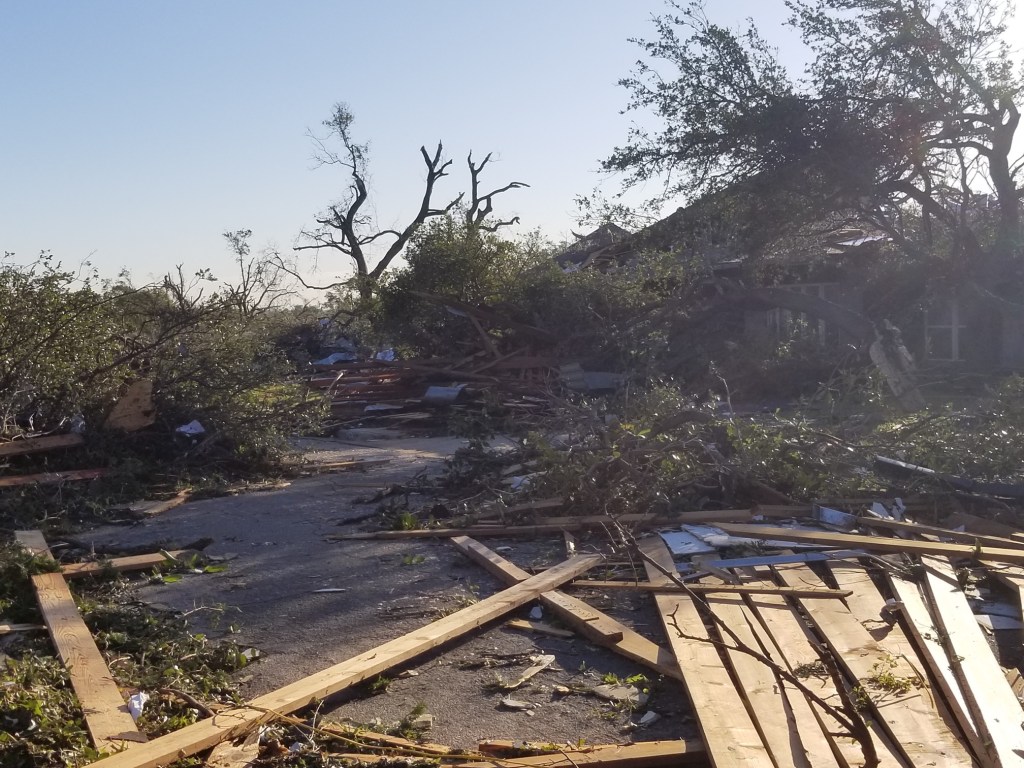
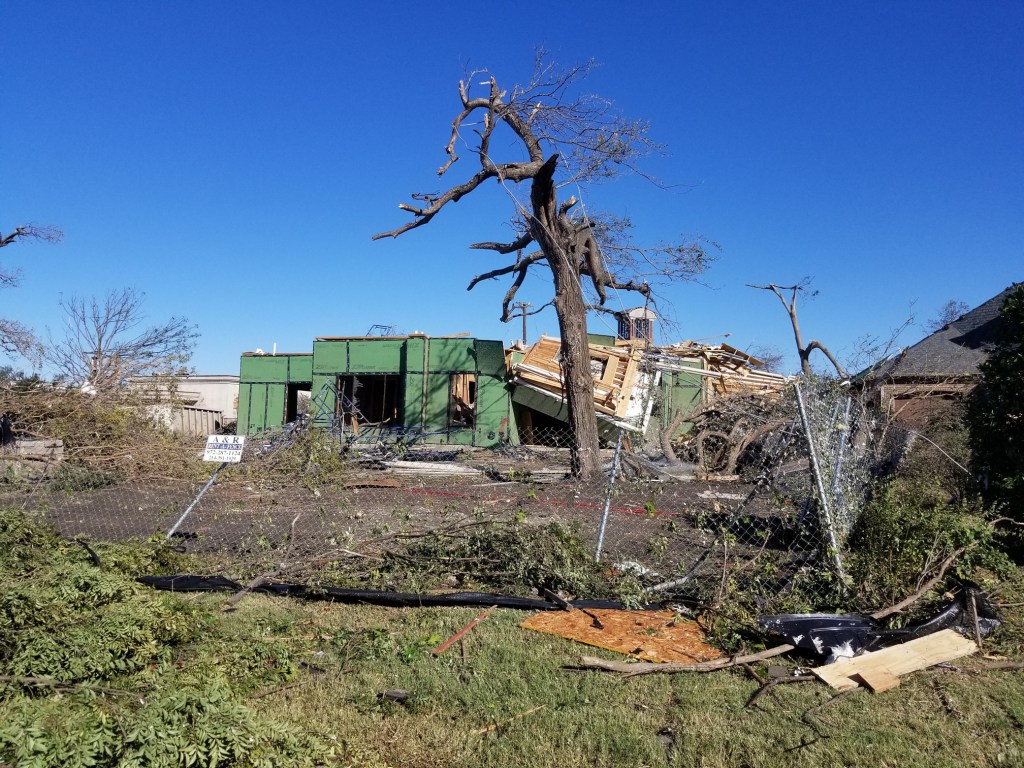
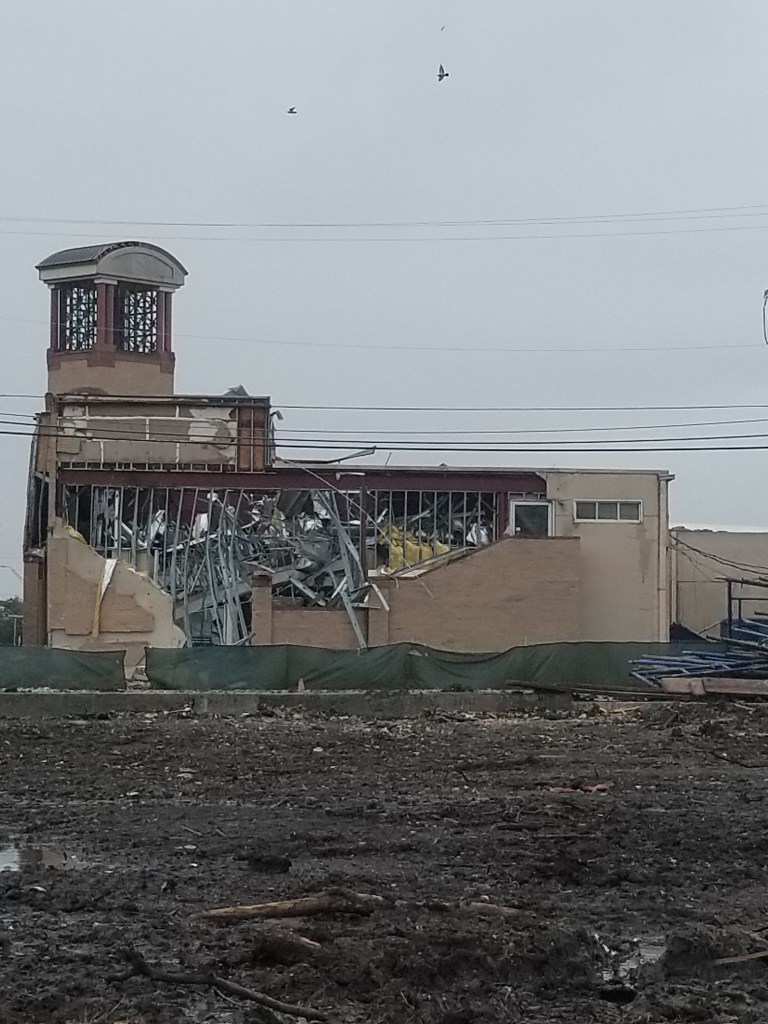
In October 2019 an EF3 tornado ripped through our neighborhood. It left a 2-3 miles long trail of destruction. Roofs were lifted off houses, cars and buses were flown around, hundreds of houses were destroyed, bricks were flying around in the wind, trees were uprooted, and tree branches were flying around, and pieces of concrete crashed into buildings and hit steel fences so forcefully that it bent even quarter inch thick steel fences.

Unlike many of our neighbor’s houses, our house stood, but our chimney was smashed by a piece of concrete coming off a neighbor’s house, we had to replace our roof, our garage door, the wiring in the attic, our fence and my grill flew around in the yard. The amazing thing was that no one in the neighborhood died.

Why did no one die? Was it maybe because no one was outside walking the dog, or driving around, because everyone had received the alarm on their mobile phone about the approaching tornado and was therefore sheltering inside in a safe place? Imagine the same thing happening in the 1930’s.

Below are a few photos from that day and here are two links with more photos, link-1 , link-2. On the five-year anniversary of this event NBC news interviewed me about this event. To see the interview click here . My interview is at one minute and ten seconds.

A neighbor’s house with the roof ripped off after the EF3 Tornado in Texas.
NBC used this photo. A neighbor’s house the morning of October 21st, 2019. Again, click on the image, or here, to see the interview. My interview is at one minute and ten seconds.
The photo shows a severely damaged house and lots of debris consisting of wood and trees and tree branches after the EF3 Tornado in Texas.
Another neighbor’s house. This house was about 100 yards from our house. It took a direct hit from the tornado.
This photo shows a house that is completely destroyed after the EF3 Tornado in Texas | Natural Disasters Kill Less People Now Than 100 Years Ago
Another house in our neighborhood.

My wife Claudia asked me to go check on her parents. I drove about 50-100 yards when a neighbor’s roof lying across the road stopped me. I turned around but this time I was stopped by a large pile of trees lying across the street. So, I started walking, but this time I was stopped by a group of firemen telling me that it was too dangerous to be outside. They told me to go back home, and I did. The next day we were able to visit her parents and below is what we saw.

The photo shows my wife Claudia walking into a house with debris everywhere after the EF3 Tornado in Texas.
Inside my wife Claudia’s parents’ house. This was the morning after. In the photo we are walking into their house to check on them (that’s my wife).
To see the other Super Facts click here

Scientists Agree that Global Warming is happening and that we are the Cause

Super fact 34: Climate Scientists agree that Global Warming or if you call it Climate Change is happening, and that it is caused by us primarily because of our burning of fossil fuels. There is a long-standing scientific consensus on these two facts because the evidence is conclusive. Typically, studies show an agreement of at least 97% or 98% among climate scientists.

This is a super fact because surveys show that this is not what the public believes and yet it is true. The public incorrectly believes that there is a large disagreement among scientists on this topic. A note, to understand why the evidence is conclusive as to why global warming is happening and is caused by us click here.

Note : I will use the term “global warming” in this review. Whether you call the phenomenon climate change, climate disruption, or global heating, is not important.

The Scientific Consensus

This extensive survey from 2013 of 12,000 climate papers (papers published over two decades) by Dana Nuccitelli and Cook, etc., concluded that 97.1% of climate scientists endorsed the consensus position that humans are causing global warming.

They also did a science author self-rating which concluded that 97.2% of climate scientists endorsed the consensus position that humans are causing global warming. Another conclusion from the survey was that the consensus had increased from around 90%, perhaps less, in the early 1990’s.

A later review of six independent, peer-reviewed studies examining the scientific consensus about global warming have concluded that between 90% and 100% of climate scientists are convinced human-caused global warming is happening. A more recent study (2021) found that as many as 98% of climate scientists are convinced global warming is happening and is human-caused. Numerous other surveys have concluded the same thing.

People’s Beliefs About Global Warming

This 2024 survey from Yale University show that most Americans (61%) understand that global warming is mostly human caused. By contrast, 28% think it is caused mostly by natural changes in the environment. Most Americans (58%) <<Link-6>> understand that most scientists think global warming is happening. This percentage has trended generally upward since this survey began in 2008. By contrast, about one in five (22%) think there is a lot of disagreement among scientists about whether global warming is happening.

The green graph is going up slightly starting from 46% in 2009 and ending in 58% in 2023. The black graph starts at 33% in 2009 and ends in 22% in 2023. The yellow graph starts at 2% in 2009 and ends in 2% in 2023 | Scientists Agree that Global Warming is happening and that we are the Cause
The green graph corresponds to “most scientists think global warming is happening (%).” The black graph corresponds to “there is a lot of disagreement among scientists (%)”. The yellow graph corresponds to “Most scientists think global warming is NOT happening (%)”. Graph taken from the Yale Program on Climate Change Communication.

However, only one in five Americans (20%) understand that nearly all climate scientists (more than 90%) think that human-caused global warming is happening. The aforementioned Dana  Nuccitelli refers to this in his book Climatology versus Pseudoscience as the consensus gap. Again, this large discrepancy between public perception and reality makes the consensus gap a super fact. Research has shown that this discrepancy has a large impact on people’s other beliefs regarding global warming.

This is bar graph. It shows that 2% believe the answer is 0-10%, 2% believe the answer is 11-20%, 3% believe the answer is 21-30%, 3% believe the answer is 31-40%, 8% believe the answer is 41-50%, 7% believe the answer is 51-60%, 7% believe the answer is 61-70%, 13% believe the answer is 71-80%, 13% believe the answer is 81-90%, 20% believe the answer is 91-100%, 22% don’t know | Scientists Agree that Global Warming is happening and that we are the Cause
The question was, To the best of your knowledge what percentage of climate scientists think that human-caused global warming is happening? Graph taken from the Yale Program on Climate Change Communication.

Why is there a Consensus Gap?

In his book Climatology versus Pseudoscience Dana Nuccitelli explains that a relatively small group of so-called climate skeptics, or more accurately called climate contrarians have received a lot of attention from media. Even though their science is bad, and they’ve published their error ridden papers in obscure or discredited journals, and the fact that their predictions have failed repeatedly many times over, they have had an enormous influence on public discourse. Conservative politicians, and many talk show hosts are blindly devoted to their falsehoods, whilst real scientists are being attacked.

It is not just rightwing media who are using them for their purposes, but mainstream media are giving the contrarians undue attention as well. Sensationalism is one issue. A science contrarian claiming that all the climate scientists are wrong, and that he is the only one who finally got it right is a lot more interesting of a story than a repeat of the consensus. Another issue is false balance. Journalist should not feel that they must give equal time to evidence-based science and nonsense, but that is often the case. To read my review of this book click here.

The Oregon Petition

I am mentioning the Oregon petition because I fell for it myself. The Oregon petition was an official looking petition circulated by climate contrarians, claiming that there is no evidence that human-caused global warming will cause catastrophic heating of earth’s atmosphere and disruption of earth’s climate, and that adding more carbon dioxide to the atmosphere would even be beneficial for plants and animals. It got an impressive number of signatures, 32,000 after some years.

However, it turned out that the signatories rarely had climate expertise, and were not scientists, and the survey listed many falsified names such as the names of the Spice Girls and several fictional characters. Less than 200 of the signatories were climate researchers.

It was a con, but it was touted in a lot of media as the truth. I saw it over and over and I believed it. I was later surprised to learn that it was a con and that a scientific consensus existed on global warming / climate change. Learning that I had been bamboozled on this matter was one of the red flags that prompted me to start doing some fact checking on the issue global warming.

To see the other Super Facts click here