The goal of this blog is to create a list of super facts. Important facts that are true with very high certainty and yet surprising, misunderstood, or disputed by many. This blog aims to be challenging, educational, and fun, without it being clickbait. I determine veracity using evidence, data from reputable sources and longstanding scientific consensus. Prepare to be challenged (I am). Intentionally seek the truth not confirmation of your belief.
Super fact 58 : In relativity, time is considered the fourth dimension, inseparable from the three spatial dimensions to form a four-dimensional continuum called spacetime. Adding time as a fourth dimension, not (x, y, z), but (x, y, z, t), results in spacetime measurements called spacetime intervals that all observers can agree on.
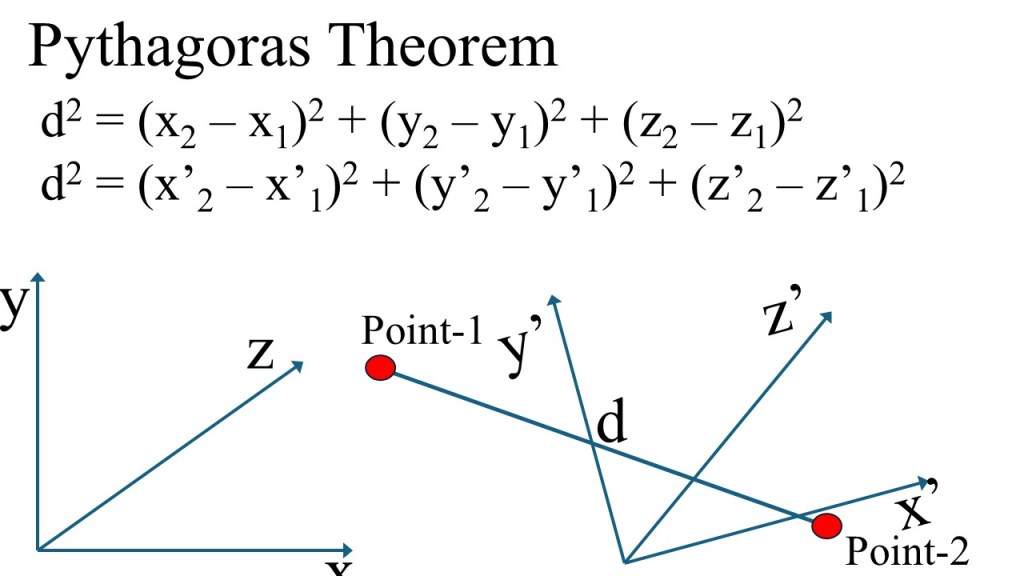
Before relativity the distance between two points was the same for all observers. The distance between points is calculated using the Pythagorean theorem: (d^{2}=x^{2}+y^{2}+z^{2}). You calculate the distance between two end points in a coordinate system using Pythagoras theorem because the points make right angled triangles along the x-axis, y-axis and z-axis. See the picture below.
Pythagoras theorem in two and three dimensions which also apply to the distance between two points. The points are indicated in red.
Let say you add another coordinate system (x’, y’, z’). The new coordinate system could be translated and rotated compared to the first one. The values of (x, y, z) and (x’, y’, z’) would be different and yet the distance between point-1 and point-2 would be the same. Well as long as you don’t change units, like using meters in one coordinate system and feet in the other. The distance between the points would be a so-called invariant. Now imagine that you forgot to include one coordinate in Pythagoras theorem, for example, y and y’ or x and x’, then your calculation for the distance would be different for the two coordinate systems. We need all coordinates, or all dimensions. See the picture below.
Pythagoras theorem is used to calculate the distance between two points from two different coordinate systems, with different coordinate values for the points. You still have the same distance for both coordinate systems. The points are indicated in red.
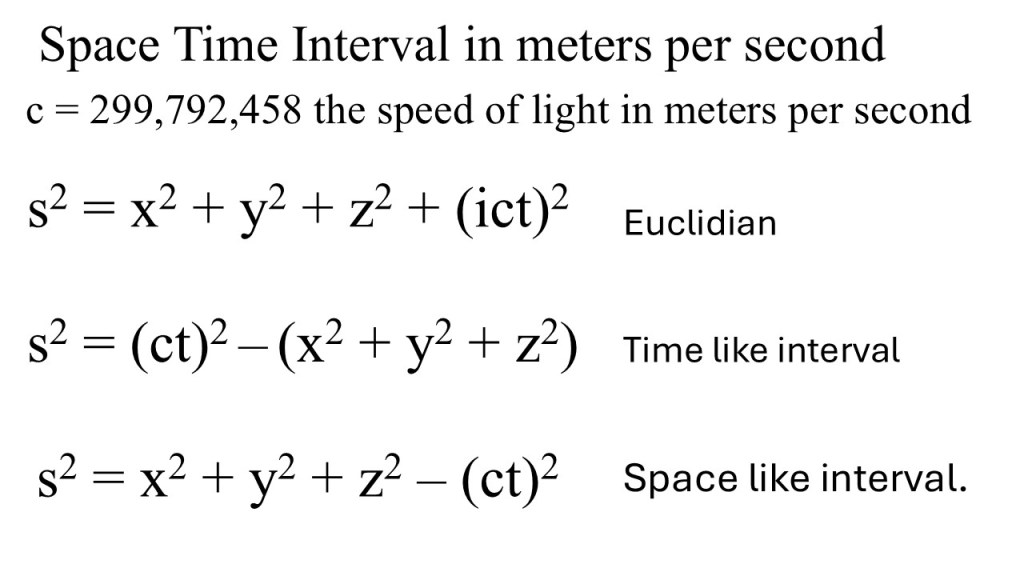
In relativity the length of objects, as well as the time between events is relative and varies from observer to observer. In other words, distance and time varies from coordinate system to coordinate system. However, if you add time to the three space dimensions and calculate the distance between events using the Pythagorean theorem for intervals (between two events): or (s^{2}= x^{2}+y^{2}+z^{2} – t^{2}) or (where the ‘t’ represents time in appropriate units), then the difference between different observers vanish. The interval is the same for all observers. It is a so-called invariant. The formula for the spacetime interval comes in a few different forms. One for distance like intervals (space distance bigger than time) (s^{2}= x^{2}+y^{2}+z^{2} – t^{2}), and one for time like intervals (time is bigger than the space distance) (s^{2}= t^{2} – (x^{2}+y^{2}+z^{2})). There is also one that includes the imaginary number (s^{2}= x^{2}+y^{2}+z^{2} + (it)^{2}). See below.
The three formulas for the spacetime interval above all assume that the unit used for time is the time it takes light in vacuum to travel the distance unit used. If that is meters, it would be the time it takes light to travel one meter. The top formula is the Euclidian form of spacetime. It contains only the ‘+’ operator at the expense of adding the imaginary number (square root of -1) in front of the time coordinate. The second form is typically used with time like intervals and considered the standard form. The third form is used when the distance between two events is larger than the time distance, or distance like intervals.
The interval concept was developed, not by Einstein, but by Hermann Minkowski (a few years after special relativity) and is often referred to as Minkowski space. Time is like a space coordinate but the opposite signs in the equation make it different. Based on articles I found it appears that the opposite signs (minus vs. plus) means that you cannot move “backwards” in time as you can in a space dimension.
I admit that this is a very abstract super fact, but it basically means that if you add time as an extra coordinate to the three space coordinates x, y, z you get something, the spacetime interval, that everyone regardless of speed, orientation, etc., agrees on, despite relativistic length contraction and despite time dilation and non-simultaneity.
Time Expressed in Appropriate Units
I would also like to explain what I mean by (where the ‘t’ represents time in appropriate units), as I stated in the above. For physical formulas to work they need to be expressed in consistent units. For example, you can’t use kilometers for the coordinate x, and miles for coordinate y, not without adding a constant to adjust for it. For the formula (s^{2}=x^{2}+y^{2}+z^{2}-t^{2}) to work you need to express time in a unit that corresponds the time light travels in one meter if x, y and z are expressed in meters. If you express x, y, and z in meters and express time in seconds you must adjust the formula with the constant c = 299,792,458, the speed of light in meters per second, so you get (s^{2}=x^{2}+y^{2}+z^{2}-(ct)^{2}). See the picture below.
If you measure the space coordinates in meters and the time in seconds you must adjust the units to match by inserting the speed of light in vacuum c = 299,792,458. The three forms of the space interval now have the constant c attached to the time coordinate.
Time Like Space Intervals
The formula for time like intervals is typically used for the situation where the time component is larger than the space component, which also means that it is possible to physically travel between the two events forming the space interval. As you can guess, that is a pretty normal situation. Let’s say you are watching TV and having a pizza. Your sofa is your coordinate system. You turn on the TV and 100 seconds later you move 2 meters to get a slice of pizza. Let’s calculate the spacetime distance between those two events.
The space component is easy, that’s 2 meters. However, if we express time in the time it takes light (in vacuum) to travel one meter we get 100 times 299,792,458. If you express time in seconds, you adjust it using the constant c = 299,792,458, and again you multiply 100 with 299,792,458, which is 29,979,245,800. So, the distance in time is almost 15 billion times larger. You really did not move far in space, but you moved very far in time. Now ask yourself. Are you spending your time well?
The Minus in Front of the Time Coordinate
There is one obvious difference between time and the space coordinates. In a coordinate system you can walk forward, along let’s say, the x-axis and then walk back the same way. You can walk back and forth as many times as you want, no problem, but you cannot do that with time. Time may be a space-time coordinate, but it is different from the other three coordinates in that way, and that’s where the opposite signs in the formula for the space-time interval comes in. This is beyond the scope of this super fact blog post, but you can read more about this here and here.
Fire ants are small. They average 1/8 inch to 1/4 inch in length, or 3 to 6 millimeters. Mites are very small arachnids that are less than 1 millimeters. They are so small that they are difficult to see with the naked eye unless they are on a white sheet. However, amoebas are typically even smaller than mites. Most amoebas range from 10 to 500 micrometers in diameter. 500 micrometers is the same as half a millimeter. You typically need a microscope to see an amoeba. I should say that there are some large amoebas that are 2 millimeters.
Amoebas from Wikimedia commons. Attribution Respectively: NIAID, Cymothoa exigua, ja:User:NEON / User:NEON_ja, Jacob Lorenzo-Morales, Naveed A. Khan and Julia Walochnik, ja:User:NEON / User:NEON_ja, ja:User:NEON / User:NEON_ja, CC BY-SA 4.0 <https://creativecommons.org/licenses/by-sa/4.0>, via Wikimedia Commons
Microscopic Things
If you want to go even smaller, much smaller, we can enter the microscopic world. Bacteria are microscopic, single-celled organisms with sizes typically ranging from 0.5 to 5 micrometers in length and 0.2 to 1 micrometer in width. That means that bacteria are around 100 times smaller than amoebas. Well, if you consider length. If you consider the volume that is a million times smaller. Comparing an amoeba to a bacterium is like comparing a horse to a small cicada. You certainly need a microscope to see bacteria.
If you think bacteria are small, I can tell you that viruses are even smaller. Viruses typically range in size from 20 to 300 nanometers in diameter. 1000 nanometers is 1 micrometer. A small corona virus (SARS-CoV-2) is 50 nanometers, which is 20 times smaller (in diameter) than a bacterium that is 1 micrometer in size and 100 times smaller (in diameter) than a bacterium that is 5 micrometers. Again, a horse to a medium size insect.
Atoms are much smaller than viruses. This reddit user calculated that there are roughly 52 million atoms in a normal sized covid virus (100 nanometers). Also keep in mind that there is a lot of space between atoms. The size of a hydrogen atom is 0.1 nanometer or 100 picometer. Comparing a hydrogen atom to a normal sized covid virus is like comparing a flea to a horse. If you consider volume, you could fill a normal sized covid virus with 1 billion hydrogen atoms.
You cannot see an atom using a regular microscope. You must use specialized microscopes that don’t rely on visible light to see atoms, such as scanning tunneling microscopes and electron microscopes. So, in summary, a hydrogen atom is to a normal sized covid virus like a flea is to a horse, and a normal sized covid virus is to a 100 micrometers amoeba (small sized amoeba) like a flea is to a horse.
Below is an illustration of a Helium atom, which is the next element after Hydrogen. A Hydrogen atom has one electron and one proton and possibly one or two neutrons. A stable Helium atom has two electrons and two protons and one or two neutrons.
Illustration of a Helium atom. It has two electrons and a nucleus with two protons and two neutrons in the middle. The two electrons are depicted as clouds because they don’t have an exact position. Attribution : User:Yzmo, CC BY-SA 3.0 <http://creativecommons.org/licenses/by-sa/3.0/>, via Wikimedia Commons
Subatomic Things
But let’s go smaller, much smaller. A hydrogen atom is gigantic in comparison to subatomic particles. Most of the mass in an atom is concentrated in the nucleus, which consists of protons, neutrons, quarks and gluons, and quark pairs called mesons. The size of an atomic nucleus varies, but it typically ranges from 1.6 femtometers (1.6 x 10⁻¹⁵ meters) for a proton to about 15 femtometers for the heaviest atoms.
I should say this is difficult to estimate so take this with a grain of salt. In any case that makes the hydrogen atom about 100,000 times wider than the nucleus in its middle. If the hydrogen atom was 100-meter giant ball the nucleus in the middle would be just 1 millimeter (half the size of a flea). That is despite the fact that the vast majority (+99.95%) of the mass of the atom is in the nucleus. In this case, we are not comparing a flea to a horse, but a flea to a mountain. A mountain of mostly empty space with a super massive flea at its center. The YouTube video below explains the details.
Strings Are Extremely Small
However, the smallest things there are, might be strings. Strings, in the context of physics, are one-dimensional, extended objects that are thought to be the fundamental building blocks of the universe. These strings vibrate at different frequencies giving rise to elementary subatomic particles. Strings are thought to be about 10^-35 meters, which is 100,000,000,000,000,000,000 times smaller than the atomic nucleus described above. Comparing a string to a nucleus would be like comparing the hydrogen atom to a ball, or a giant star, containing one billion planet earths. I should mention that string theory has not been experimentally confirmed.
That is small, very small, extremely small, as small as it can get.
This post is not a super fact since it features a lot of facts and not all of them confirmed or exact.
So, on what subject(s) am I an authority? My understanding on what being an authority on a subject means is that it is being an expert with recognized credibility on that subject. However, the word “authority” has so many other meanings and it brings to mind the “appeal to authority fallacy”. The “appeal to authority fallacy” refers to appealing to influential people or organizations who may not necessarily be experts, and regardless of the evidence.
In science you don’t really have such authorities, you have experts who often disagree with each other. In the event almost all experts agree on a certain fact that has been thoroughly vetted you can trust that fact with nearly 100% certainty, and that is not appeal to authority but a probability argument. Therefore, I don’t really like the use of the word authority in this context. It is confusing. I would have preferred the question to be “In what subject(s) do you have recognized expertise?”
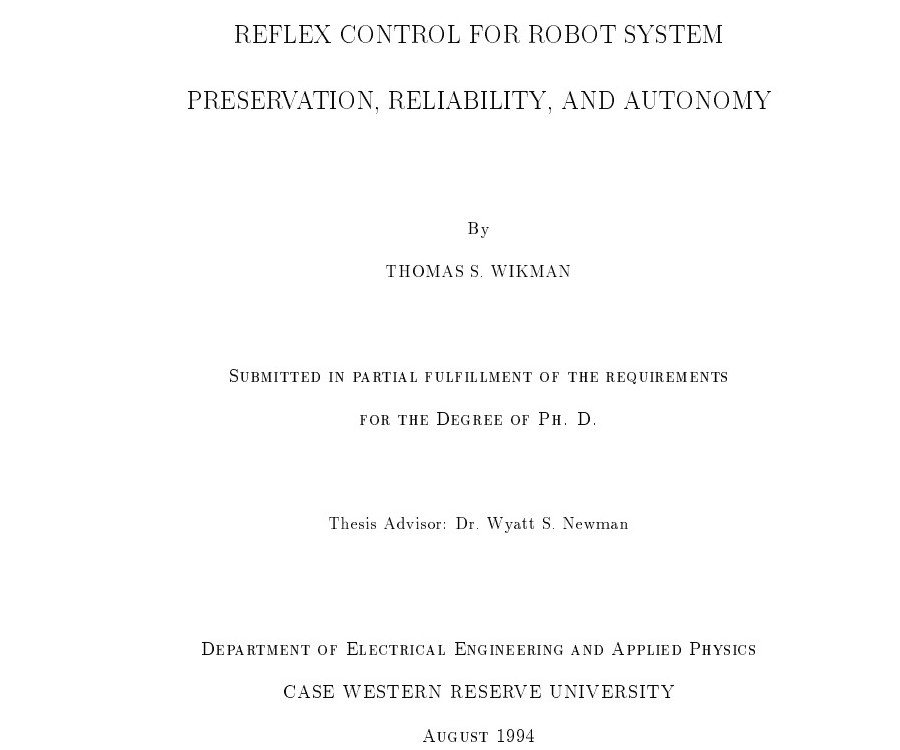
This is the front page of my PhD thesis “Reflex Control for Obstacle Avoidance and Self Preservation”.
Robotics
Reflex Control for Obstacle Avoidance and Self Preservation
My PhD thesis was in Robotics, specifically Reflex Control for Obstacle Avoidance and Self Preservation. Therefore, you can say that I am an expert on Reflex Control for Obstacle Avoidance and Self Preservation, Reflex Control (in Robotics) as well as Robotics. My expertise has been recognized through my published research papers, the citing of those papers, my PhD thesis, and my peers including Rodney Brooks.
Rodney Brooks is a former director of the MIT Computer Science and Artificial Intelligence Laboratory, founder of several robotics research companies, and he is arguably the most famous roboticist in the world. In the 1990’s he was featured on the front page in national magazines such as Time Magazine several times. During my internship at the Robotics Lab at Sandia National Laboratory in Albuquerque, New Mexico in 1993, I spoke to Rodney Brooks about my research, and he congratulated me on my research, which he liked.
Briefly, reflex control in Robotics refers to functionally simple, quick, and reliable behaviors that override whatever more complex algorithms or humans (joystick / telerobotics) are commanding in case those algorithms or humans execute dangerous motion. Take for example, a robot moving quickly among multiple objects and the path planning algorithm generates a faulty command that would result in a collision when executed. The reflex control layer would detect the problem (assuming it knows about the objects) and halt the robot before it collided with the object. This would need to happen quickly, in milliseconds, and always in a failsafe way. After the collision has been avoided the system or the human can figure out what went wrong and figure out a new path.
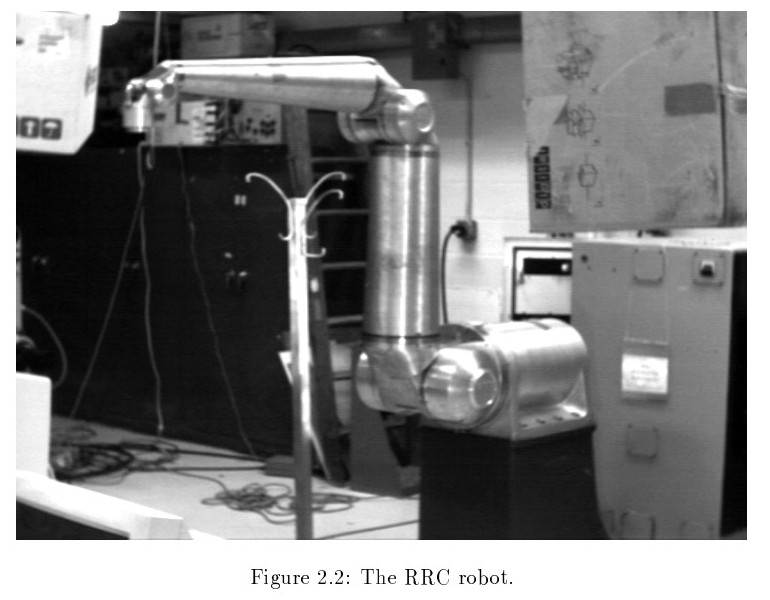
To do this the Reflex controller needs to be embedded with the motion controller, and know the characteristics of the motors, the robot configuration, and mechanical characteristics, such as mass, friction model, inertia, etc., exactly. The result is that when you drive a robot around among multiple objects such as boxes hanging from the ceiling, coat racks, and sombreros, and other robots it will avoid colliding with these objects regardless of input from people or high-level path planning algorithms. It looked like the objects were protected by an invisible force field.
This is an old black and white photo of the Robotics Research Corporation Robot surrounded by objects including boxes hanging in the ceiling, a coat rack, and a control cabinet. I took the photo, and I created the software for the robot and placed the objects in its workspace.
Robot Kinematics
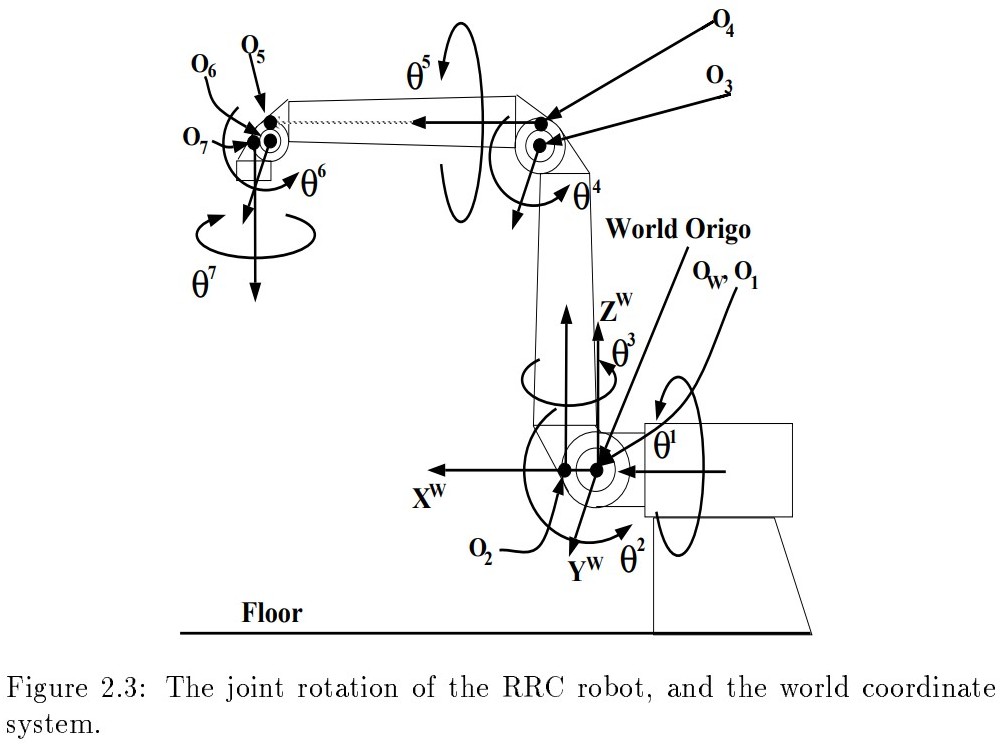
In addition, to “Reflex Control for Obstacle Avoidance and Self Preservation” or “Reflex Control for Robots”, which is very narrow field, I gained expertise in fields of robotics that are a bit wider. One such field is robot kinematics. That includes, for example, calculating the position, speed and acceleration of the tool tip (the end tip) of the robot from the position and motion of the joints of the robot. Or it could be calculating the possible joint angles from the position of the tool tip. The RRC robot was a seven-jointed robot so this could get complicated. I should say that when I worked for ABB Robotics (after my Ph.D) I created the kinematic models for 30+ of ABB Robotics robots. Therefore, I have expertise and recognized credibility in Robot Kinematics as well.
The drawing shows the seven joints, the seven possible rotations around those joints, the seven joint angles (the thetas), and the seven coordinate systems and their origos (the O’s) at each joint.
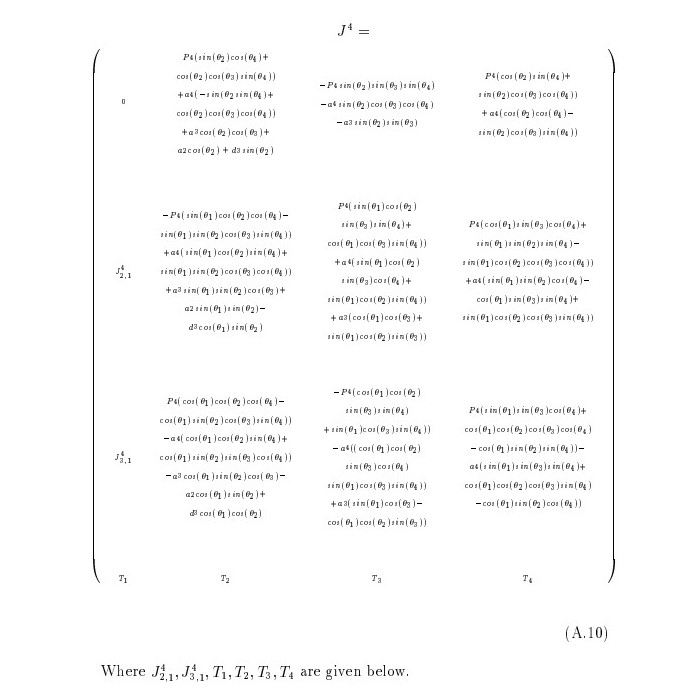
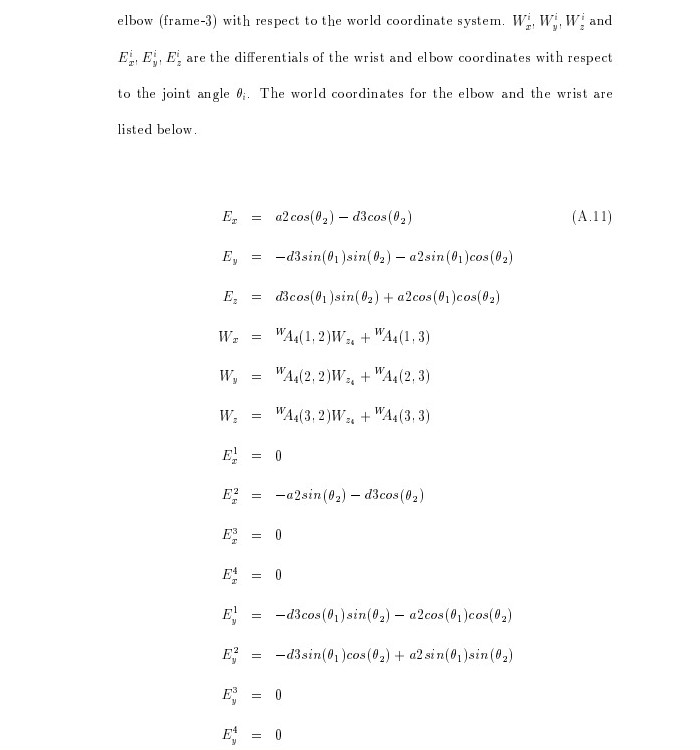
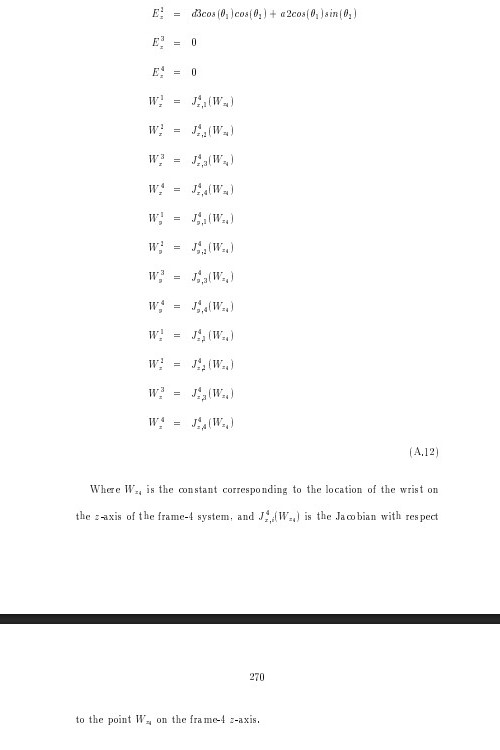
Robot kinematics can get complicated, at least for a seven-jointed robot like the RRC Robot. An example is the Jacobian, which is a matrix that relates joint velocities to end-effector / tool-tip velocities. The Jacobian is crucial for understanding and controlling robot motion, particularly for inverse kinematics and trajectory planning. Below is the Jacobian for the first four joints of the RRC robot. I spent an entire day deriving it. Depending on your eyesight it is difficult to read the scribbles, but it is a bunch of very long, mostly trigonometric equations. Don’t worry about understanding the matrix, it is just to show how complicated robot kinematics can get.
First part of the 4-dimensional (first four joints) Jacobian for the RRC Robot.Second part of the 4-dimensional (first four joints) Jacobian for the RRC Robot.Third part of the 4-dimensional (first four joints) Jacobian for the RRC Robot.Fourth part of the 4-dimensional (first four joints) Jacobian for the RRC Robot.
Configuration Space in Robotics
Another subject I gained a lot of expertise in is configuration space or so-called C-space. It is related to robot kinematics. C-space is a mathematical representation of all possible configurations a robot can take. In C-space for a robot arm (like the RRC Robot) the coordinates are the joint angles instead of X, Y and Z. For the seven-jointed RRC robot you have seven joint angles and C-space is thus seven dimensions. C-space is very useful if you succeed in representing obstacles in it. A point might become a curve, or multi-dimensional membrane in C-space, and a ball might become a multi-dimensional banana. I had a lot of fun creating algorithms for creating C-space with obstacles in it.
My Other Expertise
I also have a degree a master’s degree in engineering physics (Teknisk Fysik) from Uppsala University in Sweden. I should say that engineering physics in Uppsala was focused a lot on theoretical physics and modern physics as well as practical applications for physics. Case Western Reserve University later converted this degree to a master’s in electrical engineering. I loved physics and was a good student, but my special interest was the theory of relativity. Even though I had and still have a hard time with the General Theory of relativity and I studied the special theory of relativity way beyond what was required at school, and I read dozens of technical books on the subject. So, this is also sort of an area expertise for me.
Below are some links to topics related to the special theory of relativity on this website:
I spent at least 30 years working with software as a software engineer / robotics engineer and gained a lot of experience in software development. It was mostly embedded software but also graphical user interfaces, things you can see on a screen, and Networking Software Development. I worked a lot with Visual Studio, a powerful, expandable, and popular integrated development environment (IDE) from Microsoft.
I developed a lot of code using C++ and C#, .Net, WPF, but also other languages and libraries. I started with Visual Studio 97 (in 1997), then Visual Studio 6, Visual Studio .NET 2002, Visual Studio .NET 2003, Visual Studio 2005, Visual Studio 2008, Visual Studio 2010, Visual Studio 2012, Visual Studio 2015, Visual Studio 2017, but I never got around to Visual Studio 2019 and Visual Studio 2022. So, you can say that I am an expert on Visual Studio with C++ and C# and .NET (I am less of an expert on the other languages typically used with Visual Studio).
Later in life I also came to learn a lot about climate change / climate disruption / global warming / the greenhouse effect whatever you call it. I used to be skeptical about climate change, and I thought it might be politicized by the scientific community, but after some interesting red flags I took a deep dive into the subject, and I learned that climate change is very real and caused by us. I was politicized not the scientific community. There is a scientific consensus on the subject for very good reasons. I continued by reading dozens of climate science papers and several dozens of technical and non-technical books on the topic. Therefore, at this point I know more about it than a lot of people. Maybe expert is a strong word, but almost expert.
Least but not last
Being a Leonberger Dog Expert
I know a lot about Leonbergers because my family was lucky enough to live with one for thirteen years. His name was Le Bronco von der Löwenhöhle—but we called him “Bronco” for short. Bronco wasn’t our only dog, but our world wouldn’t have been the same without him. For instance, he once saved the life of our pug by fending off an attack from another dog. He probably saved our Labrador’s life, too, by sniffing out an impending insulin shock before it happened. Then there was the time he scared off a trespasser who’d been terrorizing my wife and other women in the neighborhood.
Bronco loved to dance and hug. Here he is giving me a hug (not yet fully grown).
Bronco is no longer with us, but even in his passing he was distinctive. Leonbergers tend to live less than nine years—but Bronco came very close to reaching his thirteenth birthday. In fact, he received an award for longevity called the “Grey Muzzle Award.” We already knew he was a special dog, but we sent his DNA to two labs for research anyway. I wrote a book about our amazing Bronco and his many amusing adventures and included helpful information on Leonbergers for new owners and interested dog lovers. I also have a Leonberger website.
In the process of writing my book about Bronco and Leonbergers I came to learn a lot about Leonberger dogs, the Leonberger breed standard, their history, health issues, Leonberger organizations, health and care, etc. I became a bit of a Leonberger expert. If you are interested in the book, check it out here or here. You can also get it from Amazon in many other countries, Barnes & Noble, Chapters Indigo and many other bookstores. For more information check here.
Super fact 49 : The top one-meter (3.3 feet) of a typical 10 meters (33 feet) by 40 meters (131 feet) garden contains 2 kilograms (4.4 pounds) of Uranium. For comparison, the Hiroshima bomb contained 64 kilograms (121 pounds) of Uranium. Certain rocks such as Granite and Shale contain much more Uranium than soil. Uranium also exists in the atmosphere and there is 4.5 billion tons of Uranium in the ocean.
The numbers above come from the IAEA (International Atomic Energy Agency) and Stanford University . I should mention that the numbers vary depending on Geography, type of soil, etc. For example, there is much less Uranium in the soil in Florida compared to the soil in the Midwest.
This may come as a surprise to many people. Isn’t Uranium radioactive? How come we are still alive? That’s why I call this a super fact. The answer is that even though Uranium is used in nuclear bombs and nuclear reactors, it is by itself not very radioactive. You can hold natural uranium in your hand without much risk. The radioactivity from, for example, nuclear explosions come mainly from the fission process and the radioactivity from nuclear reactor waste is mainly from other isotopes created by the fission process in the reactor rather than the uranium itself.
If Uranium is not very radioactive, how come a nuclear bomb spread so much radioactivity. The answer is that the radioactivity comes from the fission process and the resulting new isotopes, not the uranium.
What Are Isotopes?
Before I explain some facts about the radioactivity and decay rate of Uranium, I should explain what an isotope is. Atoms consist of a nucleus and electrons surrounding the nucleus. In the nucleus there are protons and neutrons (and some other stuff). Neutral atoms have an equal amount of electrons and protons, which determines what kind of element it is. Hydrogen has one electron and one proton. Helium has two electrons and two protons. Oxygen has eight electrons and eight protons, etc. The number of protons/electrons is called the atomic number of the element.
The number of protons plus the number of neutrons is called the mass number. Atoms of the same element but different number of neutrons are called isotopes. Uranium-235 or U-235 has 92 protons and 235 – 92 = 143 neutrons. The number if protons/electrons determine the chemical properties of the element. The number of neutrons determines nuclear properties such as the stability of the nucleus, radioactivity, etc., as well as the weight. Therefore U-238 and U-235 are identical chemically and look and feel the same, but U-235 is more radioactive, and you can use U-235 for fission but not U-238.
This is a simplified Bohr model of the Uranium atom. There are 92 little blue balls circling a nucleus in the middle of the atom. Those are electrons. In the nucleus there are 92 protons. Those are the red balls with plus signs. In addition, there is a yellowish smudge around the protons in the nucleus. Those are the neutrons. Depending on the isotope, there are 143 neutrons for U-235, 146 neutrons for U-238 and 142 neutrons for U-234. Shutterstock asset id: 1999370450 by Patricia F. Carvalho
The decay rate of Uranium
There are three main Uranium isotopes. Uranium-234, Uranium-235, and Uranium-238. Uranium-238 is the most common. 99.28% of natural Uranium is Uranium-238, 0.72% is Uranium-235 and 0.0057% is Uranium-234. Uranium-235 is the isotope we use for nuclear weapons.
The different isotopes have different decay rates and different levels of radioactivity. The half life of a radioactive isotope is the time it takes for an isotope to decay so that only half of it is left. The half-life of Uranium-238 is four and half billion years. That means that it will be around for a very long time, but since its decay rate is so slow, it is not very radioactive. The half-life of Uranium-235 is 710 million years, again it will be around for a very long time, but again, since its decay rate is so slow, it is not very radioactive. The half-life Uranium-234 is 247,000 years, a little bit faster but it still has a pretty slow decay rate.
This should be compared to Cesium-137, which has a half-life of roughly 30 years. In other words, it decays 150 million times faster than Uranium-238 and 23.7 million times faster than Uranium-235. Since Cesium-137 decays so much faster than the Uranium isotopes it means that each atom of Cesium-137 will send out radioactive particles much more often than a Uranium atom will, making it much more radioactive.
If you want to read about when I was walking around a whole day with a Cesium-137 sample in the back pocket of my jeans, click here. Radon-222, an extremely radioactive isotope of radon, which seeps into our basements from the inside of earth. It has a half-life of 3.82 days giving it a decay rate that is 430 billion times faster than Uranium-238 and 68 billion times faster than Uranium-235.
What makes it possible to make a nuclear bomb from Uranium-235 is not because it is very radioactive. It is not. It is because it has properties that make it perfect for bomb making. Each nucleus emits more than one neutron, in fact more than two on average, and the neutrons colliding with other Uranium-235 nucleuses can be made to travel at the correct speed to cause fission. In other words, it is fissile. It is a goldilocks situation. It is just right. Below is an illustration showing a chain reaction. Observe, the picture indicates that Uranium has 95 protons. This is wrong. Uranium has 92 protons. When I have the time, I will fix this picture.
This is an illustration of a chain reaction with fission of a Uranium-235 isotope. Notice the atomic number (number of protons) is incorrectly stated as 95 in the picture. It is 92. When I have time, I will fix that. Shutterstock Asset id: 73714504 by Mpanchenko.
I recently read a very interesting book on the history of nuclear power and its possible future, Atomic Awakening: A New Look at the History and Future of Nuclear Power by James Mahaffey. Something like 90% of the book was history, the history of physics, nuclear physics, the Manhattan project, the nuclear bombs, the nuclear tests, nuclear reactors, etc.
About 10% of the book examined the viability of nuclear power and discussed the public’s fear of it. His approach to that is something like; well, no wonder people are afraid of nuclear power, look at the history. However, that fear is still irrational. The awesome power of nuclear power can give us safe and clean energy, replace fossil fuels and fight global warming, and also take us to the stars. He points out that nuclear reactions are millions of times more powerful than chemical reactions.
What Are Isotopes?
I should explain what an isotope is. Atoms consist of a nucleus and electrons surrounding the nucleus. In the nucleus there are protons and neutrons (and some other stuff). Neutral atoms have an equal amount of electrons and protons, which determines what kind of element it is. Hydrogen has one electron and one proton. Helium has two electrons and two protons. Oxygen has eight electrons and eight protons, etc. The number of protons/electrons is called the atomic number of the element.
The number of protons plus the number of neutrons is called the mass number. Atoms of the same element but different number of neutrons are called isotopes. Uranium-235 or U-235 has 92 protons and 235 – 92 = 143 neutrons. The number if protons/electrons determine the chemical properties of the element. The number of neutrons determines nuclear properties such as the stability of the nucleus, radioactivity, etc., as well as the weight. Therefore U-238 and U-235 are identical chemically and look and feel the same, but U-235 is more radioactive, and you can use U-235 for fission but not U-238.
This is an illustration of a chain reaction with fission of a Uranium-235 isotope. Notice the atomic number (number of protons) is incorrectly stated as 95 in the picture. It is 92. When I have time, I will fix that. Shutterstock Asset id: 73714504 by Mpanchenko.
Cesium-137 in my Pocket
Before I continue with my review of the book I am going to tell a story about my crazy adventure with a Cesium-137, a very radioactive and dangerous isotope. In fact, Atomic Awakening claims that Cesium-137 and Strontium-90 are the two isotopes of the greatest concern with regards to nuclear waste.
Once when I was a young student of engineering physics, I was around 20 years old, we were doing experiments with radioactivity. We were using Cesium-137. There were signs on the walls warning about radioactivity and the Cesium-137 sample was enclosed in a little house built from lead bricks. We were supposed to quickly remove the lead bricks, take out the sample, do the experiment quickly, put the sample back and enclose it with the lead bricks. However, I got distracted by something and put the Cesium-137 sample in the back pocket of my jeans.
I walked around school with the Cesium-137 sample in my back pocket the whole day and after school I went shopping at the grocery store still having it in my back pocket. I discovered it once I got back to my room. I put in a drawer and stayed as far away from it as I could. The next day I woke up early, put the sample in my bag, went to the lab at school and when no one was looking I put the sample back in the lead brick house.
No, I don’t have any extra heads growing out of my buttocks, and I did not turn into the Hulk, but so much for nuclear safety.
Atomic Awakening Formats
Atomic Awakening: A New Look at the History and Future of Nuclear Power by James Mahaffey comes in four formats. I bought the hardback format.
Hardcover – Publisher : Pegasus Books (June 23, 2009), ASIN : 1605980404, ISBN-13 : 978-1605980409, 352 pages, item weight : 1.42 pounds, dimensions : 6.4 x 1.2 x 9.3 inches, it costs $49.29 on US Amazon. Click here to order it from Amazon.com.
Paperback – Publisher – Pegasus Books (October 15, 2010), ISBN-10 : 1605981273, ISBN-13 : 978-1605981277, 368 pages, item weight : 12.8 ounces, dimensions : 6 x 0.92 x 9 inches, it costs $15.63 on US Amazon. Click here to order it from Amazon.com.
Kindle – Publisher : Pegasus Books (October 15, 2010), ASIN : B004GUS68I, ISBN-13 : 978-1605982038, Item 369 pages, it costs $13.99 on US Amazon. Click here to order it from Amazon.com.
Audio– Publisher : Audible Studios (September 24, 2013), Listening Length : 11 hours and 44 minutes, ASIN : B00FBPGS78, it costs $21.83 on US Amazon. Click here to order it from Amazon.com.
Front cover of hardback format of the book Atomic Awakening: A New Look at the History and Future of Nuclear Power. Click on the image to go to the Amazon page for the hardcover version of the book.
Amazon’s Description of Atomic Awakening
Nuclear power is a paradox of danger and salvation―how is it that the renewable energy source our society so desperately needs is the one we are most afraid to use?
The American public’s introduction to nuclear technology was manifested in destruction and death. With Hiroshima and the Cold War still ringing in our ears, our perception of all things nuclear is seen through the lens of weapons development. Nuclear power is full of mind-bending theories, deep secrets, and the misdirection of public consciousness, some deliberate, some accidental. The result of this fixation on bombs and fallout is that the development of a non-polluting, renewable energy source stands frozen in time.
It has been said that if gasoline were first used to make napalm bombs, we would all be driving electric cars. Our skewed perception of nuclear power is what makes James Mahaffey’s new look at the extraordinary paradox of nuclear power so compelling. From medieval alchemy to Marie Curie, Albert Einstein, and the Manhattan Project, atomic science is far from the spawn of a wicked weapons program. The discovery that the atom can be split brought forth the ultimate puzzle of the modern age: Now that the energy of the universe is available to us, how do we use it? For death and destruction? Or as a fuel for our society that has a minimal impact on the environment and future generations?
Outlining nuclear energy’s discovery and applications throughout history, Mahaffey’s brilliant and accessible book is essential to understanding the astounding phenomenon of nuclear power in an age where renewable energy and climate change have become the defining concerns of the twenty-first century.
The book is divided into three parts with five chapters each. The first third of the book (titled the Fantasy) recounts the history of physics, electromagnetics, light, the Michelson-Morley experiment, relativity, the nonexistence of simultaneous events, Einstein’s miraculous year, atoms, spectrometry, atomic models, isotopes, the photoelectric effect, radioactivity, quantum physics, nuclear physics, nuclear decay, fission, fusion, and why nuclear reactions are millions of times more energetic than chemical reactions. I already knew a lot of this history having a degree in physics, but I did not know all of it and the way it was written made it very interesting.
The second third of the book (titled the Puzzle) describes the discovery of fission and fusion and it is explained why the isotopes Uranium-235 and Plutonium-239 (among 3000+ isotopes) were perfect for fission. The author provides an account of the Manhattan Project’s history, and he explains in a general sense how a nuclear reactor and a nuclear bomb work. This section reminded me of the movie Oppenheimer. He describes a bit about the various nuclear reactor designs and how the first nuclear submarine came into existence.
This part of the book is filled with interesting and surprising anecdotes about the various scientists. The first part of the book also contained many interesting anecdotes, but this part of the book really has some very interesting and crazy stories to tell. The author points out that because of Hitler there were many Jewish top scientist and other top scientists who had to flee Europe to the US, thus turning the United States into the scientific superpower it wasn’t before. He explains why the Germans did not have a chance creating a nuclear bomb. I found it interesting that the Soviets deduced that the US was working on a nuclear bomb from the fact that so many US. physicist stopped publishing in physics journals. Apparently, the Germans and the Japanese did not figure this out. However, silence is suspicious, very suspicious.
The third part of the book (titled the Paradox) is about what came after the Second World War. The author describes the development of better and safer nuclear reactors (BWR, PWR, CANDU, etc.) as well as giving us an overview of many nuclear accidents, one of them being the terrible Chernobyl accident, which largely happened because of the extremely dangerous and bad reactor design, a so called RBMK reactor. RBMK reactors are monsters that cannot be built in the West. He recounts the development of new nuclear bomb technology, such as thermonuclear bombs, more popularly called hydrogen bombs.
He also tells us about the large number of nuclear tests performed including the detonation of Tsar Bomba, the Soviet 50 Megaton bomb. It was 3,300 times more powerful than the Hiroshima bomb. He makes it clear that there were thousands of nuclear bomb tests, but he did not specify an exact number, but I looked it up. There’s been more than 2,000 nuclear tests corresponding to a yield of 42,000 Hiroshima bombs. Many of the tests were not military. For example, project plowshare was about making a bigger and deeper Panama Canal by blowing a series of deep holes through Panama using hydrogen bombs. There were 35 nuclear bombs tests to determine the feasibility of creating giant holes with hydrogen bombs. He also explains how a nuclear bomb driven spaceship works and how we could have used it for interstellar space travel (Project Orion).
Towards the end of the book, he successfully makes the case that modern Nuclear Power (not the RBMK of course) is safe and clean. We avoid pollution, and it can be used to fight global warming. The same is true for solar and wind. However, he argues that the base power source must be constantly running, high-output nuclear stations. He argues that the public got a very bad impression of anything nuclear because of how it all started with nuclear bombs, nuclear tests, bad reactor designs and accidents, and how misinformation and miscalculations added to the bad impression. We often ignore the many tens of millions of victims of fossil fuels, and the hundreds of thousands of deaths from hydro, while exaggerating the dangers of nuclear power.
However, in nuclear power we have an immense power source that we are eventually bound to start using. That’s the Atomic Awakening. One of the shocking statements in this part of the book is that “all the medical and industrial radioisotopes, used daily in impressive quantities in the United States, are made in one reactor in Canada”. He blamed this on irrational fear of nuclear power. I checked whether this scary situation still existed today. Luckily, it is not as bad. Medical and industrial radioisotopes are still all imported but they also come from Europe and Australia. It is not just one reactor in Canada. He states that “the Paradox of Nuclear Power is that far more people die each year of radiation-induced disease from standing out in the sun than have ever died from the application of nuclear power” (page 223).
There were a few things that I did not like about the book. The first is that the author often describes complex experimental setups, designs, or tools that really could be better understood with an illustration, or a picture, but there were none. I found a typo on page 308, where he refers to fission as fusion in the third sentence. I think he spent too little space on the feasibility of Nuclear Power in the modern world and maybe too much on the history of physics. Nuclear Power seems to be what the book should be about and yet this topic was concentrated to the last 10% of the book and I don’t think he made his case as well as he could have. The end of the book seems rushed. On the other hand, it was a fascinating journey before we got there. Overall, I think this book is extremely interesting, it was a fun to read, and it was fact filled and a great learning experience. I loved reading this book, so even though I have a few misgivings I still think it is a five-star book. I highly recommend it.
Back cover of hardback format of the book Atomic Awakening: A New Look at the History and Future of Nuclear Power. Click on the image to go to the Amazon page for the paperback version of the book.












 Super Facts