The goal of this blog is to create a long list of facts that are important, not trivia, and that are known to be true yet are either disputed by large segments of the public or highly surprising or misunderstood by many.
Super fact 45 : Deforestation peaked back in the 1980s, meaning that is when it was worst. Deforestation has not stopped but the rate of deforestation has slowed as a result of government policies, corporate initiatives, and international agreements.
The rate of global deforestation has slowed significantly since the 1980s. Overall we are still losing forests. We had a 47-million-hectare loss of forest in the last decade, which is very bad, but that is better than the 151-million-hectare loss of forest in the 1980s. For temperate forests we have succeeded in reversing deforestation and temperate forests are now gaining forest. To read more about how government policies, corporate initiatives, and international agreements have slowed the rate of deforestation you can click here, or here, or here.
Amazon rainforest illegal deforestation landscape. Aerial view of trees cut and burned to make land for agriculture and cattle pasture in Amazonas, Brazil. Asset id: 2471967219 by PARALAXIS
This is a super fact because we get a lot of bad news about deforestation, and we should, it is still a big problem. However, we are making progress and because of our negativity bias as well as that of the media, we tend to miss the story about the progress. Therefore, the fact that we are making progress comes as a surprise to many people.
Decadal losses in global forest over the last three centuries. Decadal forest loss is measured as the average net loss every ten years, in hectares. This deforestation minus increases in forest area through afforestation. There is no single dataset that applies consistent or transparent methodology for deforestation over centuries. Two different datasets are therefore shown: these still shown the overall development and transition of forestation from temperate to tropical areas, but magnitudes should not be combined at the crossover point. Data sources: Pre-1995 data from Williams (2006). The second series is based on data from UN FAO Global Forest Resources Assessments. The graph comes from Our World in Data – Research and data to make progress against the world’s largest problems.
Peak Agricultural Land
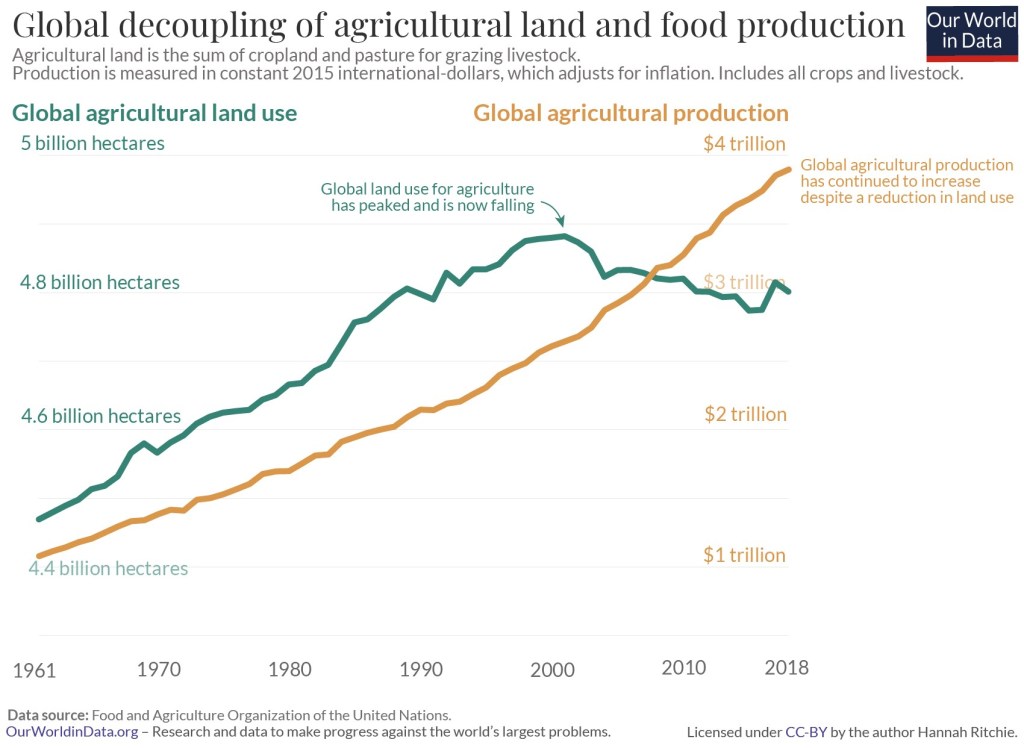
There is one aspect to this story which both explains part of the reduction in deforestation but also provides additional hope for the future and that is that even though the world produces more food than ever, the amount of land we use for doing that is falling. Global land use for agriculture has peaked and is now falling. There has been a global decoupling of agricultural land and food production. I should explain that agricultural land is the total amount of arable land that is used to grow crops, and pasture used to raise livestock. That global land use for agriculture has peaked is illustrated in the graph below.
Global decoupling of agricultural land and food production. Agricultural land is the sum of cropland and pasture for grazing livestock. Production is measured in constant 2015 international dollars, which adjusts for inflation. Includes all crops and livestock. Data source: Food and Agriculture Organization of the United Nations. Our World in Data – Research and data to make progress against the World’s largest problems.
There are more trees now than 35 years ago (there’s a catch)
Another related good news story is that there are more trees in the world today than there were 35 years ago. A lot of the losses of forest in tropical areas have been compensated for by gains in Europe, North America and Asia. For example, tree planting programs in places like China have added a lot of trees as well as forests. In addition to tree planting programs climate change resulting in northern latitudes warming has resulted in temperate forests expanding.
However, this story is not as good as it sounds. There is a huge catch and that is that there is an important distinction between tree cover and forest cover. Tree cover refers to the total area covered by trees, while forest cover specifically refers to areas where trees form a forest ecosystem. Tree cover has increased but as you can guess from the graph above depicting global deforestation, the forest cover continues to decrease.
In addition, a lot of trees were planted for industrial timber plantations, mature oil palm estates and other specifically planted forests. These add to the global tree cover but not necessarily to biodiversity. Not all tree planting is equal.
So even though having more trees compared to 35 years ago is a good thing, it may not be as great as it sounds and does not contradict the fact that deforestation continues. This is important to point out because there are those who attempt to use the fact that we now have more trees to make the case that the talk about deforestation is a hoax. Don’t fall for that.
Summary
The good news is that even though deforestation is still happening the rate of it has slowed down. It peaked in the 1980s. This slowdown is largely due to government policies, corporate initiatives, and international agreements. An additional circumstance that aids in slowing deforestation is that the amount of land we use for agriculture is falling and we have passed peak land use for agriculture. Another positive situation is that we now have more trees than 35 years ago.
However, it is important to point out that does not mean that deforestation has been reversed. Tree cover and forest cover are not the same thing. The benefit of this is limited even though it is still a good thing to have more trees.
Environmental Success Stories
Aside from the success in reducing the rate of deforestation there is additional surprising, as well as good news regarding the environment.
Natural Disasters Kill Less People Now Than 100 Years Ago. We have gotten much better at protecting lives in natural disasters and less people die in natural disasters despite the increase in frequency, severity and cost of certain natural disasters.
Many and strange are the universes that drift like bubbles in the foam upon the River of Time—first sentence of Wall of Darkness by Arthur C. Clarke, 1949.
What is Time? What is the arrow of time? Does entropy define an arrow of time? Is there a past and a future? Has time always existed as, for example, in the eternal inflation cosmological model in which universes continuously pop into existence via Big Bangs like the bubbles on the River of Time in the Arthur C. Clarke quote above. Does time have a beginning as a recent Big Bang model by Stephen Hawking imply. If time came into existence with the universe itself then there is no place for creation, just as in an infinitely existing universe. There cannot be anything north of the north pole, and there cannot be anything before time itself.
In the theories of relativity time is relative. The speed of clocks as well as the order of events differ from observer to observer. The presence of energy or mass will bend time. There is no universal flow of time. There is no universal time.
The goal of this blog is to create a list of what I call super facts. Important facts that we know to be true and yet they are surprising, shocking or disputed among non-experts. It is a type of myth busting. However, I also create posts that are not super facts but that feature other interesting information, such as this book review and book recommendation.
This picture reminded me of the mysteries of time. This is a submission for Kevin’s No Theme Thursday
About Time: Einstein’s Unfinished Revolution by Paul Davies
The book I am about to present focuses a lot on relativity. This is not strange since the theories of relativity shed a lot of light on time. Yes, pun intended. I’ve come across a lot of people who make various claims about time, and even consider themselves philosophers of time, and yet they do not even understand the special theory of relativity.
Because of this they say a lot of profound sounding things about time that ultimately are nonsensical. There is no way around it. If you want to say profound things about time and expand human knowledge on this topic you need to first have some understanding of relativity as well as other related physics such as thermodynamics and entropy. This book will provide that.
I should say that the book is somewhat outdated, being written in 1995 and 1996. However, most of it is still relevant and I know of no other book that approaches the topic in such an honest and rigorous way. The book comes in two formats hardcover and paperback. I bought the paperback version.
Hardcover – Publisher – Simon & Schuster; First Edition (March 13, 1995), ISBN-10 : 0671799649, ISBN-13 : 978-0671799649, 316 pages, item weight : 1.3 pounds, dimensions : 6.25 x 1.25 x 9.5 inches, it costs $18.09 on US Amazon. Click here to order it from Amazon.com.
Paperback – Publisher – Simon & Schuster; First Edition (April 9, 1996), ISBN-10 : 0684818221, ISBN-13 : 978-0684818221, 316 pages, item weight : 0.704 ounces according to Amazon but I think that should be 0.704 pounds, dimensions : 9.21 x 6.14 x 0.8 inches, it costs $12.28 on US Amazon. Click here to order it from Amazon.com.
Front cover of hardback version of the book About Time: Einstein’s Unfinished Revolution by Paul Davies. Click on the image to go to the Amazon page for the hardcover version of the book.
Amazon’s Description of About Time: Einstein’s Unfinished Revolution
An elegant, witty, and engaging exploration of the riddle of time, which examines the consequences of Einstein’s theory of relativity and offers startling suggestions about what recent research may reveal.
The eternal questions of science and religion were profoundly recast by Einstein’s theory of relativity and its implications that time can be warped by motion and gravitation, and that it cannot be meaningfully divided into past, present, and future.
In About Time, Paul Davies discusses the big bang theory, chaos theory, and the recent discovery that the universe appears to be younger than some of the objects in it, concluding that Einstein’s theory provides only an incomplete understanding of the nature of time. Davies explores unanswered questions such as:
* Does the universe have a beginning and an end?
* Is the passage of time merely an illusion?
* Is it possible to travel backward — or forward — in time?
About Time weaves physics and metaphysics in a provocative contemplation of time and the universe.
The link above will take you to my original review for About Time: Einstein’s Unfinished Revolution. Below is a slightly modified version of the review.
Our Evolving Concept of Time
Science, particularly physics, has revealed to us some profound insights about time, and yet it remains a mysterious topic. In the first chapter of the book “A Very Brief History of Time” the author describes how the concept of time has evolved throughout human history. The ancient philosophers had a very fuzzy notion of time, and they often dismissed both motion and time as illusions. The author tells us about “cyclic time”, and the “linear time” concept from Judeo-Christian thinking, and how it was incorporated into science as a “time variable”. This made it possible to solve the paradoxes created by such Greek thinkers as Zeno, who based on apparent paradoxes concluded that motion and time cannot really exist. Those “false” paradoxes were solved with the concept of linear physical time.
Physical time also made Calculus and Physics possible, and it became clear that there was a difference between physical time, which is a measurable entity used to sequence events, and experienced time, which is the subjective human feeling of a past, present, and a future.
Most of the rest of the book is focused on the Special Theory of Relativity and the General Theory of Relativity. The theories of relativity revolutionized how we view time, and they enabled a much deeper understanding of time. Special relativity refuted the concept of universal absolute time. Not only do clocks in different systems run at different speeds, but there is no universal “Now”.
However, the theories of relativity are not all there is to know about time, and we are not even done drawing conclusions about time based on the theories of relativity. This is why the book is called “About Time Einstein’s Unfinished Revolution”. The book also discusses quantum time, the arrow of time, worm holes, neuroscience and modern psychological experiments.
The book contains a lot of information and yet it scratches only on the surface. Time is a quite complex concept when you start digging into it. Take, for example, the discussion on the arrow of time. The conclusion of the books seems to be that there really is an arrow of time. Time has direction. The author is presenting both “sides” of the issue and to really get a grasp of the issue you need to clarify and look at the physics. Time certainly seems to have a direction if you look at the concept of entropy. The Cosmos is filled with irreversible processes. Our memory, which is essential for our experience of a self, is another example.
However, time has a direction even on the most fundamental level in subatomic particles. Kaon, a type of meson, decays in a way that is not time symmetric. The same may be true for the neutron. These particles “know” the difference between the past and the future. One could easily imagine how this chapter could be turned into a several thousand pages long book by just digging deeper into the related physics.
“About Time Einstein’s Unfinished Revolution” covers a lot of interesting topics related to time and it is often quite informative. The book is also well written, well organized, it has a good pace, and it is very interesting. It strikes a good balance between depth and breadth, and it does not overwhelm its readers. However, I do have some critique of the book, which prompted me to give the book four stars instead of five stars.
To understand some of the discussions in the book you should have a decent understanding of the theories of relativity, in my opinion. The author is explaining the theories of relativity to some degree, but the explanations did not seem to be that good. I did not have a problem with understanding these explanations since I already studied these topics, but I don’t think I would have understood what I needed to understand had I encountered the theories of relativity for the first time while reading this book.
Another criticism I have of the book is that he introduces ugh Everett’s many-worlds interpretation of quantum mechanics and in my opinion promotes it. This interpretation is in my opinion both strange and implausible and is not necessary for the discussions in the book.
In short, it proposes that every quantum measurement creates new universes, each corresponding to a different possible outcome of that measurement. In essence, our Universe is just one of many, and each quantum event splits the universe into multiple versions, where each version experiences a different outcome.
The problem with this interpretation is not so much that you get multiverses, but that you an infinite number of new fully evolved universes every nanosecond, which in turn create an infinite number of universes, which in turn create an infinite number of universes, and so on infinitely, and there is no way to empirically verify their existence. It is a so-called solution to a problem that is fictitious in my opinion and is derived from an old naïve interpretation of quantum waves. It is “hip” and “cool” interpretation, but I don’t see how it is useful. I should add that I have no problem with, for example, the multiverse idea stemming from string theory.
Anyway, except for my two complaints I think this is a pretty good book that I can recommend.
Front cover of paperback version of the book About Time: Einstein’s Unfinished Revolution by Paul Davies. Click on the image to go to the Amazon page for the paperback version of the book.
About Paul Davis
Paul Davies is an internationally acclaimed physicist, cosmologist, and astrobiologist at Arizona State University, where he runs the pioneering Beyond Center for Fundamental Concepts in Science. He also chairs the Search for Extraterrestrial Intelligence Post-Detection Taskgroup, so that if SETI succeeds in finding intelligent life, he will be among the first to know.
The asteroid 1992OG was officially renamed Paul Davies in his honor. In addition to his many scientific awards, Davies is the recipient of the 1995 Templeton Prize–the world’s largest annual prize–for his work on science and religion. He is the author of more than twenty books, including The Mind of God, About Time, How to Build a Time Machine, and The Goldilocks Enigma. He lives in Tempe, Arizona.
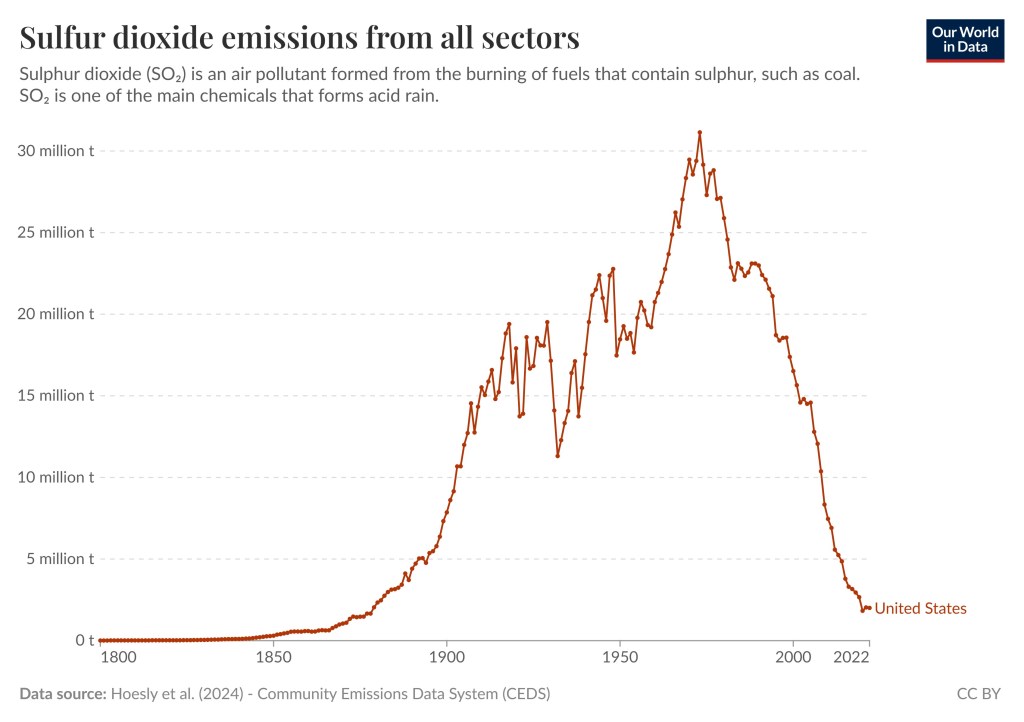
Super fact 44 : Sulfur dioxide pollution has fallen by approximately 95 percent in the USsince the 1970s. This significant reduction is primarily due to regulations like the Clean Air Act. Global sulfur dioxide pollution has also fallen but not as much.
Sulfur dioxide is a colorless gas with the formula SO2. It has a pungent smell, which you notice after using matches. It is released naturally by volcanic activity and is produced as a by-product of burning sulfur-bearing fossil fuels and from metals refining. Sulfur dioxide is somewhat toxic to humans and by reacting with water it creates acid rain, which is a serious environmental problem.
The good news is that the Clean Air Act has driven technological advancements and the adoption of cleaner practices in industries that produce sulfur dioxide emissions. This has resulted in a drop of sulfur dioxide pollution in the US by 95% according to EPA and Statista and 94% according to Our World In Data. Statista is a pay site, so I am not going to link to it. Below is a graph from Our World In Data showing the reduction in sulfur dioxide pollution in the US.
US sulfur dioxide pollution since 1800. Data Source: Hoesly et al (2024) – Community Emissions Data System (CEDS). This graph is taken this page in Our World In Data.<<Link-5>> US Emissions peaked in 1973.
I should mention that by clicking this link you can visit the graph above Our World in Data and select different countries and regions and play around with the settings.
Sulfur Dioxide Emissions Worldwide
The worldwide emissions peaked in 1979 and fell sharply after that even though the progress (reduction in sulfur dioxide emissions) has not been as spectacular as in the US. Worldwide reductions are around 48%. Again, by visiting the Our World In Data page you can play around with the graph and the settings and view different countries and regions. This is an additional source visualizing the data.
Sulfur dioxide pollution worldwide since 1800. Data Source: Hoesly et al (2024) – Community Emissions Data System (CEDS). This graph is taken this page in Our World In Data. Worldwide Emissions peaked in 1979.Sulfur dioxide pollution worldwide since 1800 with three major polluters included. The United States is in red, China in green and India in blue. The graph for India is the one corresponding to the least overall pollution but it has no reduction. Data Source: Hoesly et al (2024) – Community Emissions Data System (CEDS). This graph is taken this page in Our World In Data.
Good News with Respect to Pollution
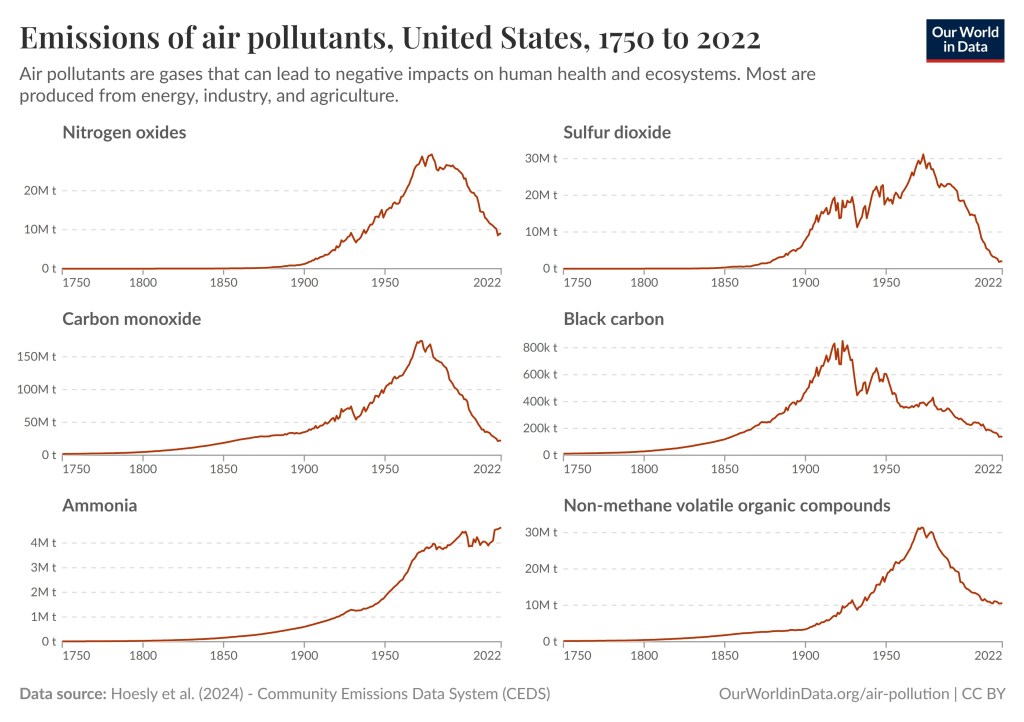
Sulfur dioxide emissions have gone down worldwide, which is good news. However, sulfur dioxide is not the only pollutant that we have succeeded in reducing. The graph below demonstrates that the US has also made great progress in reducing Nitrogen Oxides pollution, Carbon Monoxide, Black Carbon, and Non-methane volatile organic compounds. We have not been as successful with reducing Ammonia pollution.
However, according to Google AI sulfur dioxide, followed by Nitrogen Oxides pollution, Carbon Monoxide, and Black Carbon are the most serious pollutants. The graph below is taken from this page in Our World in Data.
US nitrogen oxide emissions, sulfur dioxide emissions, carbon monoxides, black carbon, ammonia and non-methane organic compounds pollution since 1750. Data Source: Hoesly et al (2024) – Community Emissions Data System (CEDS). This graph is taken from this page in Our World In Data.
The graphs for the world do not look as impressive. However, even in this case it looks like some progress has been made. Four graphs have peaked and are turning downwards, and one graph has flattened but unfortunately the graph for ammonia pollution is still heading upwards.
It should be noted that these pollutants are more or less local in the sense that they affect the polluting country and/or surrounding countries the most, whilst the climate change / global warming effect from carbon dioxide and other long lasting greenhouse gases tend to affect the entire planet.
Worldwide nitrogen oxides emissions, sulfur dioxide emissions, carbon monoxide emissions, black carbon, ammonia and non-methane organic compounds pollution since 1750. Data Source: Hoesly et al (2024) – Community Emissions Data System (CEDS). This graph is taken from this page in Our World In Data.
Aside from the success in reducing these pollutants there is more good news.
Natural Disasters Kill Less People Now Than 100 Years Ago. We have gotten much better at protecting lives in natural disasters and less people die in natural disasters despite the increase in frequency, severity and cost of certain natural disasters.
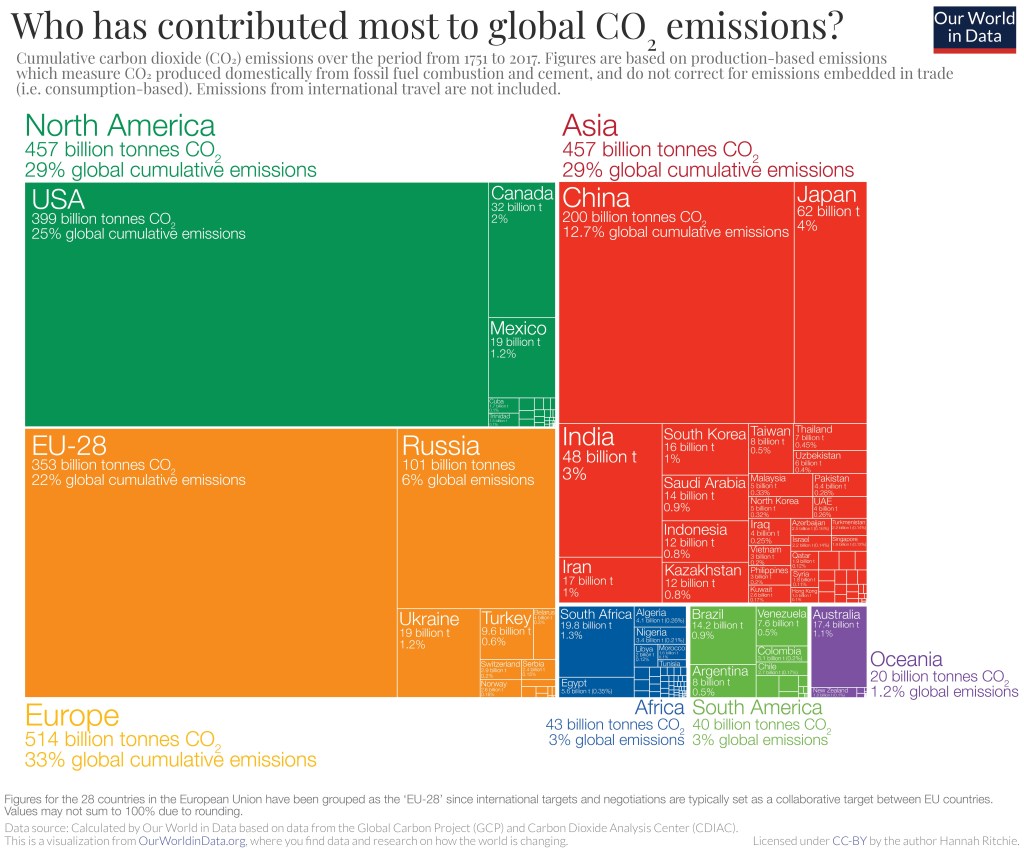
Super fact 43 : The United States has emitted more CO2 than any other country to date, around 400 billion tons since 1751. It is responsible for 25% of historical emissions. Click here.
But what about China? That is 12.7%, or around half. This is surprising information to many Americans, yet it is true, and therefore a super fact. In the US it is very common to blame China for our carbon emissions. In China they blame the US. In Europe they blame the US and China. Who is right? It turns out that the blame game is complicated and futile.
Carbon Emissions Around the World
Who should we blame the most for our carbon emissions?
On the other hand, the US carbon emissions per capita (14.3 ton) is considerably larger than that of China (8.4 ton). China has 1.4 billion people after all and the US only 340 million people.
On the other hand, China used to be very poor and is quickly catching up to our standard of living with the help of fossil fuels, just like the western world once did.
It should also be noted that the countries that are emitting the most carbon emissions per capita are several smaller developing (third world) countries including Palau, Qatar, Kuwait, Brunei, New Caledonia, Bahrain, United Arab Emirates, Trinidad and Tobago, Gibraltar, Saudi Arabia, Oman, etc.
On the other hand, according to this analysis presented in the Guardian, the Netherlands has the highest per capita historical emissions, followed by the UK in second place. The analysis calculates the national cumulative emissions from 1850 per person, based on today’s population, among countries with populations of at least 1 million.
In other words, if you want to blame another country for the carbon emissions, take your pick, well your cherry pick. Why should we do something about our carbon emissions when X is worse? Those who want no action on the global warming / climate change problem love the blame game. Like denial or despair, which are both irrational positions, the blame game hinders action. The blame game can also get very complicated and contentious.
The graph shows the fossil fuel emissions (in carbon dioxide equivalents) per capita from 1750 to 2023 for the World, the United States, Canada, China, European Union, India, South Africa, United Kingdom, and Kenya. Notice that the United Kingdom dominated the emissions in the 1700’s and 1800’s. Data source: Global Carbon Budget (2024); Population based on various sources (2024). The graph is from Our World in Data .
Note regarding the graph above: By clicking here you can find this graph and then select to display any set of countries or regions. Have fun experimenting.
Note regarding Fossil emissions: Fossil emissions measure the quantity of carbon emissions (CO2) emitted from the burning of fossil fuels, and directly from industrial processes such as cement and steel production. Fossil CO2 includes emissions from coal, oil, gas, flaring, cement, steel, and other industrial processes. Fossil emissions do not include land use change, deforestation, soils, or vegetation.
Overview of Cumulative Carbon Emissions
As you can see in the graph below the cumulative carbon emissions from 1751 to 2017 are 25% for the United States, 22% for the EU (28 countries), 12.7% for China, 6% for Russia, 4% for Japan, and 3% for India. If you count the entire continent of Europe, you get 33% for Europe.
Figures for the 28 countries in the European Union have been grouped as the EU-28 since international targets and negotiations are typically set as a collaborative target between EU countries. Values may not sum up to 100% due to rounding. Data Source: Calculated by Our World in Data from the Global Carbon Project (GCP) and Carbon Dioxide Analysis Center (CDIAC). This is a visualization from Our World in Data, where you can find data and research on how the world is changing.
Super fact 42 : The developed nations (rich countries) have reduced their carbon emissions since the 1990’s despite continued GDP growth, even if we take offshore production into account. In addition, many developing countries have succeeded in reducing their emissions as well. Other fast-growing developing countries have flattened or at least slowed their increase in carbon emissions. Many countries have decoupled economic growth from CO2 emissions. In other words, we do not need to increase carbon emissions or burn more fossil fuels to grow the economy.
This is good news as well as a surprise to many people who falsely believe that to grow the economy (grow GDP) you need to burn more fossil fuels and an increase in carbon emissions is inevitable if you want to grow the economy. The data shows otherwise. This is important news that is difficult to believe in for many people. It is a super fact.
Carbon Emissions and GDP
In the past carbon emissions were strongly correlated with national wealth. The wealthier a nation was the higher its carbon emissions were and as the economy grew so did the carbon emissions. This has not been true since the 1990’s. The developed nations of the world have continued growing their GDP whilst reducing their carbon emissions.
You may think that the reason is that we shipped much of our manufacturing overseas and that if you consider the consumers in the importing country responsible for the overseas emissions this decoupling of GDP and emissions would disappear. But you would be wrong. Even if you make the consumers in the importing country responsible for the emissions during production in the exporting country the emissions have gone down. One example taken from this article in Our World in Data is the United Kingdom.
In the graph below for the UK the GDP (adjusted for inflation) grew by 53.26% between 1990 and 2023 and the emissions were reduced by 57.66%. If make UK consumers 100% responsible for the emissions in China and India, etc., caused by the production of goods imported to the UK the reduction until 2022 was 38.59%. That is not as much but it is still impressive and demonstrates the decoupling between GDP growth and carbon emissions.
Data source: Data compiled from multiple sources by World Bank (2025); Global Carbon Budget (2024); Population based on various sources (2024). Note: GDP per capita is expressed in international dollars at 2021 prices. Graph taken from Our World in Data.
The text in the graph above is difficult to read so I’ve copied it below in larger text:
Consumption-based emissions: Consumption-based emissions are national or regional emissions that have been adjusted for trade. They are calculated as domestic (or ‘production-based’ emissions) emissions minus the emissions generated in the production of goods and services that are exported to other countries or regions, plus emissions from the production of goods and services that are imported. Consumption-based emissions = Production-based – Exported + Imported emissions.
Fossil emissions: Fossil emissions measure the quantity of carbon dioxide (CO2) emitted from the burning of fossil fuels, and directly from industrial processes such as cement and steel production. Fossil CO2 includes emissions from coal, oil, gas, flaring, cement, steel, and other industrial processes. Fossil emissions do not include land use change, deforestation, soils, or vegetation.
International dollars: International dollars are a hypothetical currency that is used to make meaningful comparisons of monetary indicators of living standards. Figures expressed in constant international dollars are adjusted for inflation within countries over time, and for differences in the cost of living between countries. The goal of such adjustments is to provide a unit whose purchasing power is held fixed over time and across countries, such that one international dollar can buy the same quantity and quality of goods and service no matter where or when it is spent. Read more in our article: What are Purchasing Power Parity adjustments and why do we need them?
Below is the same type of graphs for the United Kingdom as well as France, Germany, Sweden, United States and Finland. The numbers for these countries are as follows:
United Kingdom: GDP growth 53.26%, CO2 emissions reduction 57.66%, trade adjusted CO2 emissions reduction 38.59%.
France: GDP growth 39.74%, CO2 emissions reduction 40.64%, trade adjusted CO2 emissions reduction 28.82%.
Germany: GDP growth 49.04%, CO2 emissions reduction 46.72%, trade adjusted CO2 emissions reduction 33.95%.
Sweden: GDP growth 56.00%, CO2 emissions reduction 48.45%, trade adjusted CO2 emissions reduction 34.75%.
United States: GDP growth 68.05%, CO2 emissions reduction 29.25%, trade adjusted CO2 emissions reduction 17.04%.
Finland: GDP growth 45.69%, CO2 emissions reduction 50.54%, trade adjusted CO2 emissions reduction 42.79%.
Note these are emissions reduction numbers per capita (growth for GDP) not carbon emissions per capita. For example, the United States has three to four times larger carbon emissions per capita as, for example, Sweden or France.
Data source: Data compiled from multiple sources by World Bank (2025); Global Carbon Budget (2024); Population based on various sources (2024). Note: GDP per capita is expressed in international dollars at 2021 prices. Graph taken from Our World in Data.
Many Countries Have Reduced Their Carbon Emissions
However, the story does not end with these six countries or even with the developed world. The 30 graphs below all demonstrate significant reductions in carbon emissions as GDP is growing, demonstrating a decoupling between GDP growth and carbon emissions. Note that Azerbaijan’s GDP grew by 93% as its carbon emissions was reduced by 7% (all carbon emissions below are adjusted for trade).
Data sources: Global Carbon Project & World Bank. There are more countries that achieved the same, but only those countries for which data is available and for which each exceeded 5% are shown. The graphs are from Our World in Data <<Link-1>>. All carbon emissions in the graphs above are adjusted for trade.
The World’s Carbon Emissions Per Capita Has Flattened
World GDP per capita has increased by 83.54% since 1990 while carbon emissions per capita have grown by 9.48%. That may not be as impressive but note two things. That is still a decoupling between economic growth and if you look in the graph, you’ll see that carbon emissions were higher in 2008 to 2019. The curve has flattened and gone down a bit. Global Warming caused by our burning of fossil fuels may be the greatest environmental challenge in recorded history, but we are slowly and steadily turning things around. We are not doing it fast enough to avoid major damage to our eco systems and perhaps civilization, but we are still turning things around. If you have any doubts about global warming / climate change or that we are causing it click here for a summary of the evidence.
Data source: Data compiled from multiple sources by World Bank (2025); Global Carbon Budget (2024); Population based on various sources (2024). The graph is taken from Our World in Data <<Link-1>>.
China’s Carbon Emissions
One reason the world’s carbon emissions per capita have not been reduced much despite the fact that so many countries have reduced their emissions is that the world’s largest emitter China, has grown their carbon emissions steadily since 1990. Between 1990 and 2023 China’s GDP per capita (and adjusted for inflation) grew by 1,245.28% and their emissions grew by 288.43% per capita. Remember that China has 1.4 billion people so that is a big carbon blast for the world.
However, before you blame China too much remember that China’s carbon emissions per capita is less than that of the United States and that of many other developed countries, and the country with the largest cumulative carbon emissions is the United States. China’s economic growth has been immense, and its immense population of 1.4 billion people explains its huge impact on the world’s carbon emissions.












 Super Facts