The Universe has a Redshift and its Increasing

Super fact 79 : Distant galaxies appear redder (redshifted) because of the universe’s expansion. The farther away the galaxy, the redder it is. This cosmological redshift is also increasing because the Universe’s expansion is accelerating. Our Universe is getting more and more red every day.

Esther’s writing prompt: January 14 : Red

Click here or here  to join in.

Many people are aware that the Universe is expanding but may not know that this results in a measurable redshift. The faster a galaxy is moving away from us the redder it appears. This is called the cosmological redshift. Measuring these redshifts was how we discovered that our Universe is expanding.
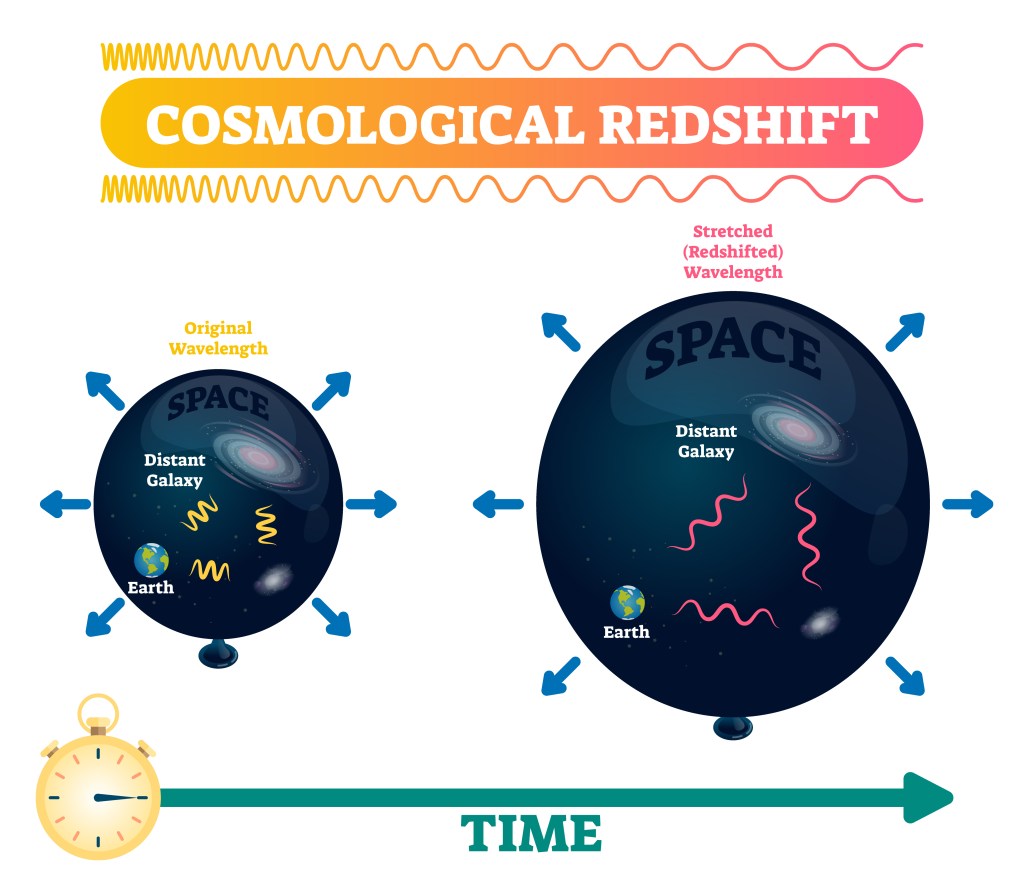
Cosmological redshift vector illustration. Stretched and original space wavelength with earth and distant galaxy. Doppler effect astronomical phenomenon distance example. | The Universe has a Redshift and its Increasing
As the Universe expands and galaxies are moving away from each other the light will be stretched. Stretched light with longer wavelengths are more red. The phenomenon is called redshift. Shutterstock Asset id: 1180828402 by VectorMine.

At the end of the 1990’s it was also discovered that the Universe’s expansion was accelerating. This discovery came from measuring the redshifts (and apparent dimness) of distant Type Ia supernovae. I should add that measuring the increase in the cosmological redshift directly is difficult. However, it is expected to be possible when the Extremely Large Telescope (ELT) starts gathering data in 2027. I can add that there are also other types of evidence showing that the Universe’s expansion is accelerating.

Another surprising aspect is, if the Big Bang was like an explosion, gravity would pull back the galaxies making the expansion slow down and perhaps eventually even reverse. However, the opposite is happening. A common explanation is that a repulsive force, a sort of anti-gravity, referred to as dark energy, is responsible for this acceleration.

I call this a super fact because this is an observed phenomenon, it is important knowledge for how we view the world, and it is surprising. Many people have heard bits and pieces of this but do not have the fuller picture.

The Doppler Effect

The cosmological redshift is an example of the so called doppler effect. The doppler effect is the change in the frequency or wavelength of a wave in relation to an observer if the origin of the wave and the observer are moving compared to each other. If an object is moving towards you, let say an ambulance, the frequency of its sound will be higher (wavelength shorter).

After it passes you and moves away from the frequency will be lower (wavelength longer). In other words, the sound changes when the ambulance passes you. The same is true for other kinds of waves, including waves on the water, and light. If a light is travelling towards you at a high speed, it will look bluer. If a light is travelling away from you at a high speed it will look redder. The latter is what is called a redshift, cosmological redshift in our case.
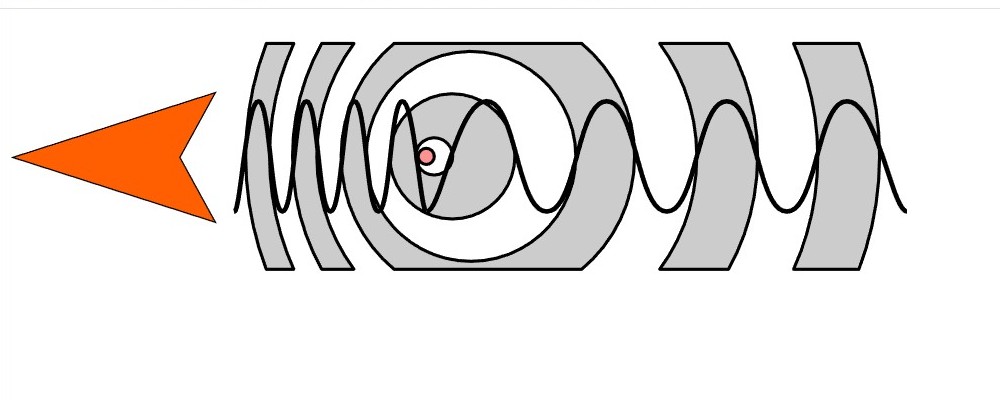
The object is indicated by a red dot, and a red arrow indicates the direction of motion.
Change of wavelength caused by motion of the source. When an object moves toward you the wavelengths get shorter and the frequency higher. When an object moves away from you the wavelengths get longer and the frequency lower. Original: Tkarcher Vector:  Tatoute, CC BY-SA 3.0 <http://creativecommons.org/licenses/by-sa/3.0/&gt;, via Wikimedia Commons
An animation illustrating how the Doppler effect causes a car engine or siren to sound higher in pitch when it is approaching than when it is receding. The red circles represent sound waves.
The Doppler effect causes a car engine or siren to sound higher in pitch when it is approaching than when it is receding. The red circles represent sound waves. Charly Whisky 18:20, 27 January 2007, CC BY-SA 3.0 <http://creativecommons.org/licenses/by-sa/3.0/&gt;, via Wikimedia Commons

Below is a three minute video explaining the doppler effect and redshift.


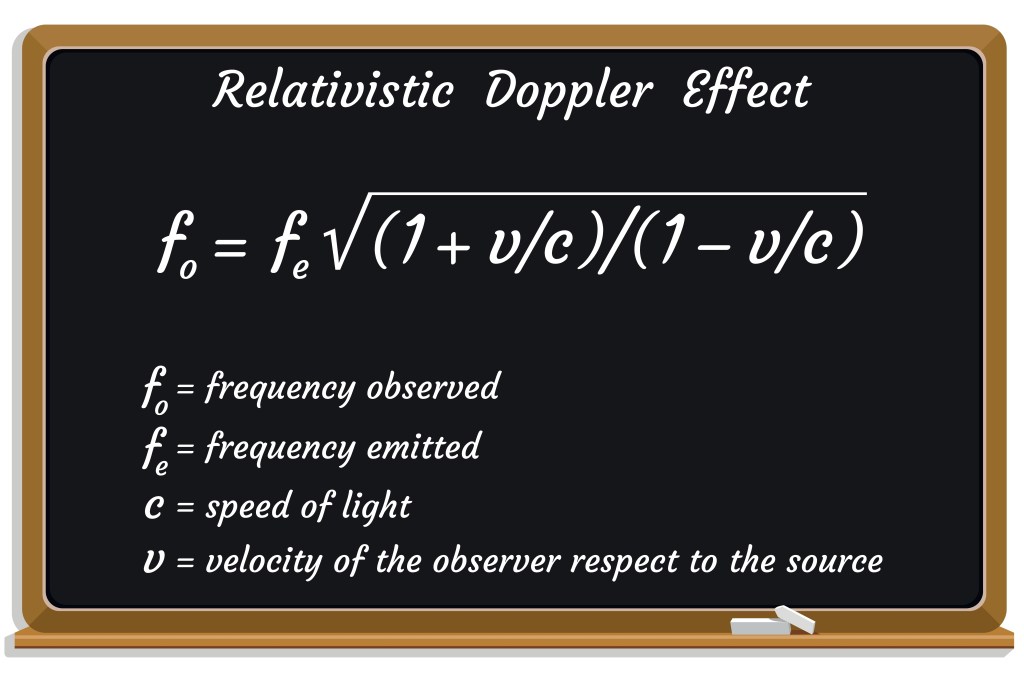
I can add that the constancy of the speed of light in vacuum changes the exact size of the doppler effect. The doppler effect remains as is for the most part but the formulas for the classical doppler effect, which you would use for sound, and the relativistic doppler effect, which you would use for light in space, are different. It is just to pick the right formula.

Doppler Effect Formula on a green chalkboard. Education. Science. Formula. Vector illustration. | The Universe has a Redshift and its Increasing
The classical formula for the doppler effect. There is a medium (air) but you don’t need to consider the constancy of the speed of light in vacuum. You use it for sound and water waves. Shutterstock Asset id: 2365938267 by Sasha701.
Relativistic Doppler Effect Formula on a black chalkboard. Education. Science. Formula. Vector illustration.
The relativistic formula for the doppler effect considers the constancy of the speed of light in vacuum but there is no medium to worry about. You use this formula for the doppler effect of light in space. Shutterstock Asset id: 2416786951 by Sasha701.

Measuring redshift

A common misconception is that astronomers take pictures of distant galaxies and somehow measure the “redness” of them, but that is not the case. When you take a spectrum of a heated element (such as hydrogen or helium in stars) it creates characteristic dark lines in the spectrum — like a fingerprint. Everything on the periodic table has its own characteristic fingerprint of lines at characteristic frequencies. In addition to measuring the cosmological redshift it makes it possible to identify the elements in a star and their proportions. See the picture below.
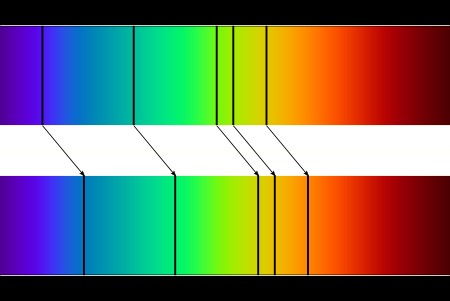
The top shows a colorful spectrum from blue to red with absorption lines in black. The bottom portion of the picture shows the same thing expect the black absorption lines have moved a bit to the right.
Visualization of redshifted absorption lines are redshifted due to velocity away from observer. Top lines are for an object at rest and in the bottom picture the object is moving away. Maxmath12, CC0, via Wikimedia Commons. This file is made available under the Creative Commons CC0 1.0 Universal Public Domain Dedication.

Expanding Universe Hazy IPA

Expanding Universe is a Hazy IPA, or a so called New England style IPA from First State Brewing, ABV 6.5%, IBU 25 (IBU = International Bitter Units). The fact that it is an IPA (India Pale Ale) means that it is Ale and therefore not a Lager. The fact that it is an IPA means that it is hop-forward and has an intense flavor and aroma. The fact that it is a Hazy / New England style IPA means that it is more fruity than bitter and looks cloudy, hazy, like juice. The flavor of Expanding Universe is mango, pineapple, and grapefruit. It has a low bitterness, it is fruity, juicy, and it is great if you like New England IPAs.

The picture shows a glass with yellow to light orange hazy liquid. There are green plants in the background.
Expanding Universe ABV 6.5%, IBU 25.

Related Posts


To see the Super Facts click here

The Great Sun and Moon Spectacle

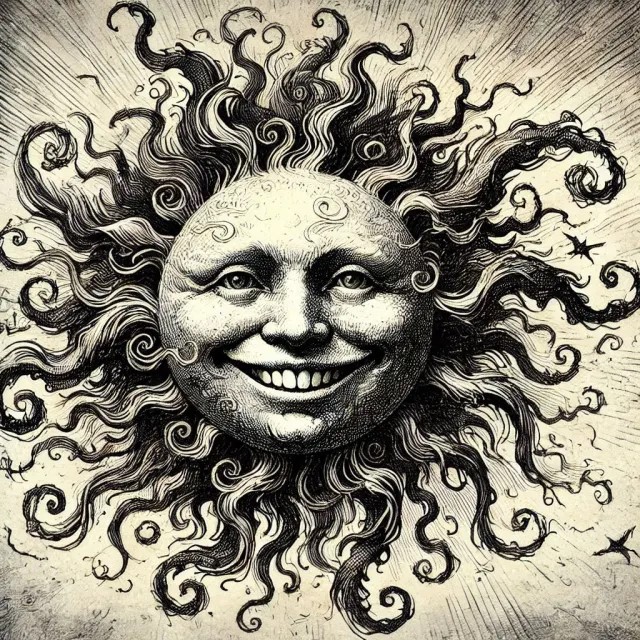
We are all in our places with sunshiny faces  ready to experience the astronomical event of the century, a spectacle that Mr. Sun, Sun, Golden Mr. Sun and the moon provided for us.

This is a submission for Kevin’s No Theme Thursday

The Great Sun and Moon Spectacle
Image by Kevin from The Beginning at Last

For us in Dallas, Texas, 2024 was the year when the sun and the moon put up an unforgettable spectacle for all of us to see. On April 8, 2024, the sun and the moon and earth lined up perfectly so that the moon fully covered the sun. We had a total solar eclipse, and we were lucky with the weather. I can add that experiencing a total solar eclipse is quite different from experiencing a partial or annular solar eclipse. I’ve experienced a partial solar eclipse as well and I can attest to the difference.

Unlike a partial eclipse, it gets dark during a total solar eclipse, the stars come out if the sky is clear like it was. The birds and the insects become quiet. It happens very suddenly, in just a few seconds. The total solar eclipse lasted four minutes.

The Motion of the Sun and the Moon

To understand what a solar eclipse is, the video below might help. What you see is the moon and the earth as seen from the sun’s viewpoint. We see earth all lit up by the sun, like a full moon, and we also see the moon lit up by the sun. 

In this situation, when the people on earth look up in the sky, they see the sun, but they don’t see the moon, even though it is there. It is a new moon, or a black moon if it happens twice in the same month. As the moon begins to partially cover the sun the shadows on the ground start looking different and if you use solar eclipse glasses you can see the sun disappearing and looking like a bright crescent, but it is still daylight and looking at the sun without eclipse glasses would just hurt your eyes.

Well, this is true until the sun is fully covered by the moon. When that happens, the light turns off and at that point it is safe to look at the sun without glasses. What you’ll see is a pitch-black circle in the sky surrounded by wispy faint lights. Those wispy faint lights are the sun’s corona.

Below is a youTube video showing an animation composed of actual satellite photos by NASA.


Solar Eclipse Preparation

I drank a very special beer for the occasion, a Trappist Belgian Strong Ale, or Quadruple, called Westvleteren 12 from Brouwerij Westvleteren (Sint-Sixtusabdij van Westvleteren).

A table set for five with a large parasol | The Great Sun and Moon Spectacle
Our patio table. The little brown packages contain AAS / ISO certified solar eclipse glasses.
My daughter holding a Westvleteren 12 glass with a bow. Grandpa and grandma sitting on chairs in the background | The Great Sun and Moon Spectacle
Our daughter holding a Westvleteren 12 glass with a bow. Grandpa and grandma in the background.
A mini-Australian Shepherd sitting on the patio floor | The Great Sun and Moon Spectacle
Rollo our mini-Australian Shepherd on the patio.

The Partial Eclipse Phase

It was partially cloudy during the partial eclipse, but we were able to get a good look at the eclipse as it progressed. As mentioned, to see the partial eclipse, you have to use good solar eclipse glasses. It is primarily for safety reasons, but it is also pointless to look at the sun during a partial eclipse. You won’t see the eclipse crescent because the powerful light from the sun overwhelms your view.

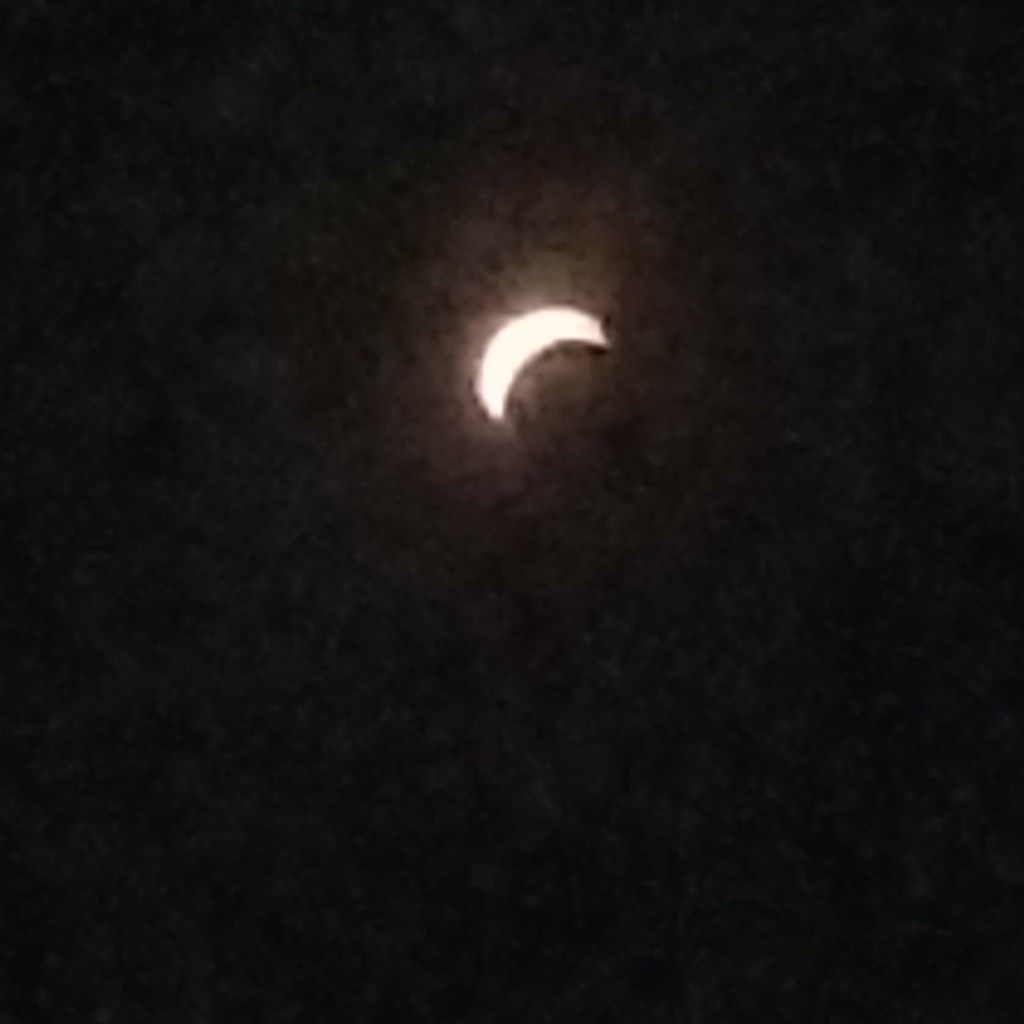
I had a little filter that was placed in front of my phone camera as I took a few pictures. Admittedly they were pretty bad. I have an old Samsung Galaxy S8+ but even using newer phones it is difficult to get decent photos of something like this.

The photo shows a shiny crescent on black background | The Great Sun and Moon Spectacle
Partial eclipse photo taken with my old Samsung Galaxy phone and a filter.

The Total Eclipse

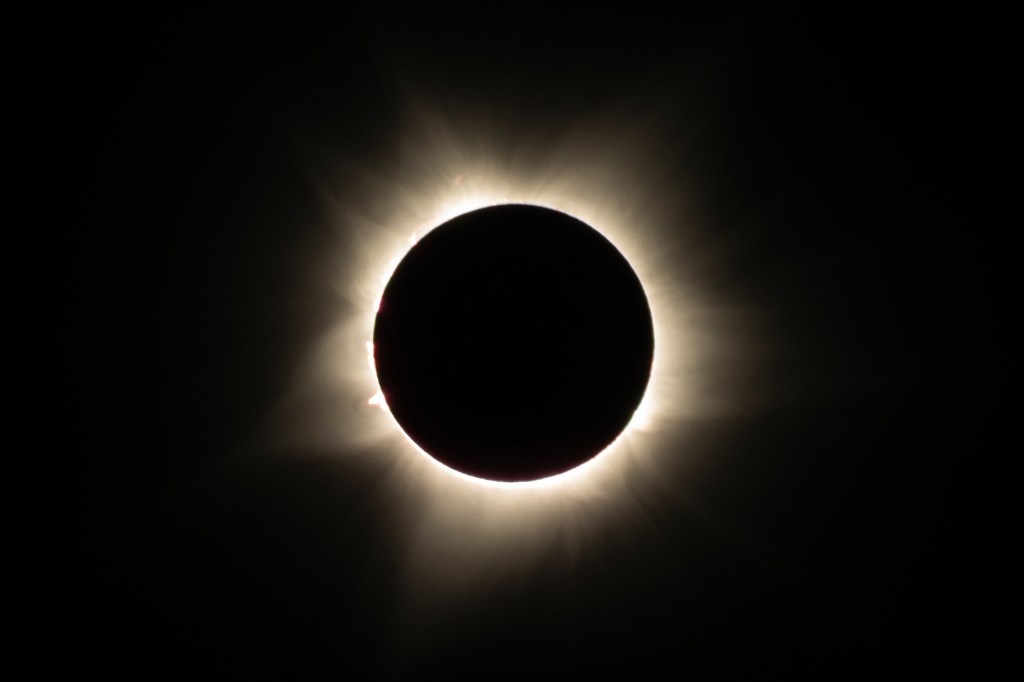
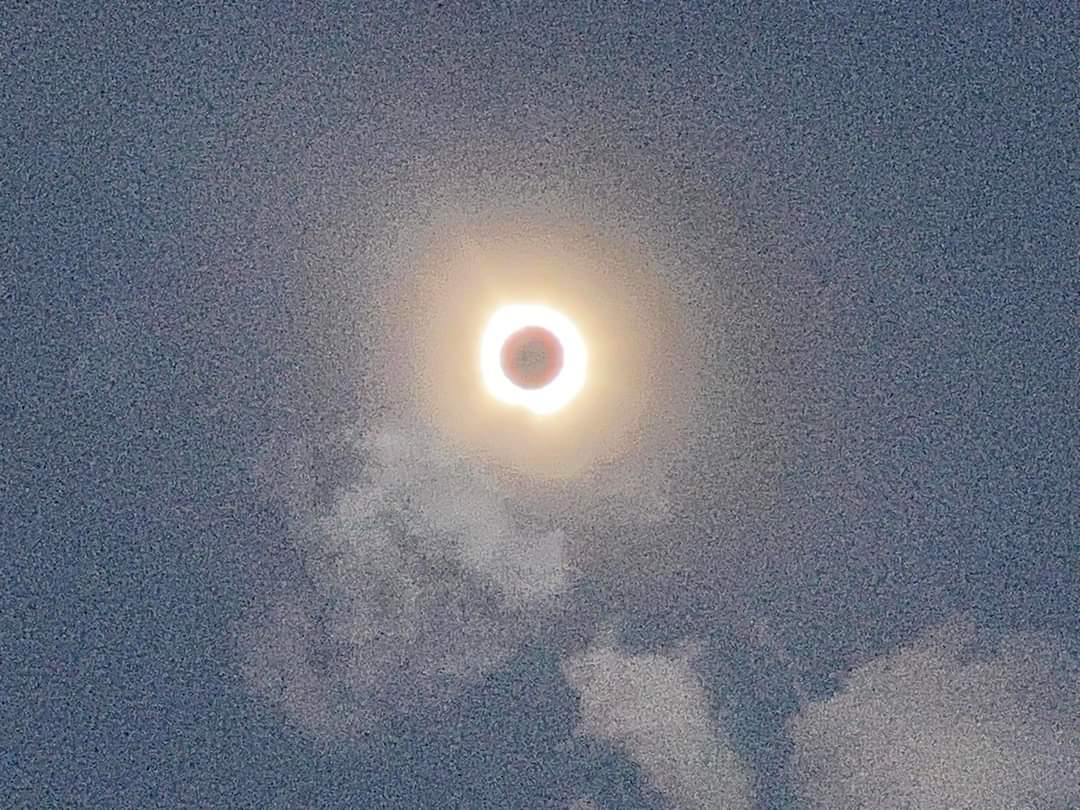
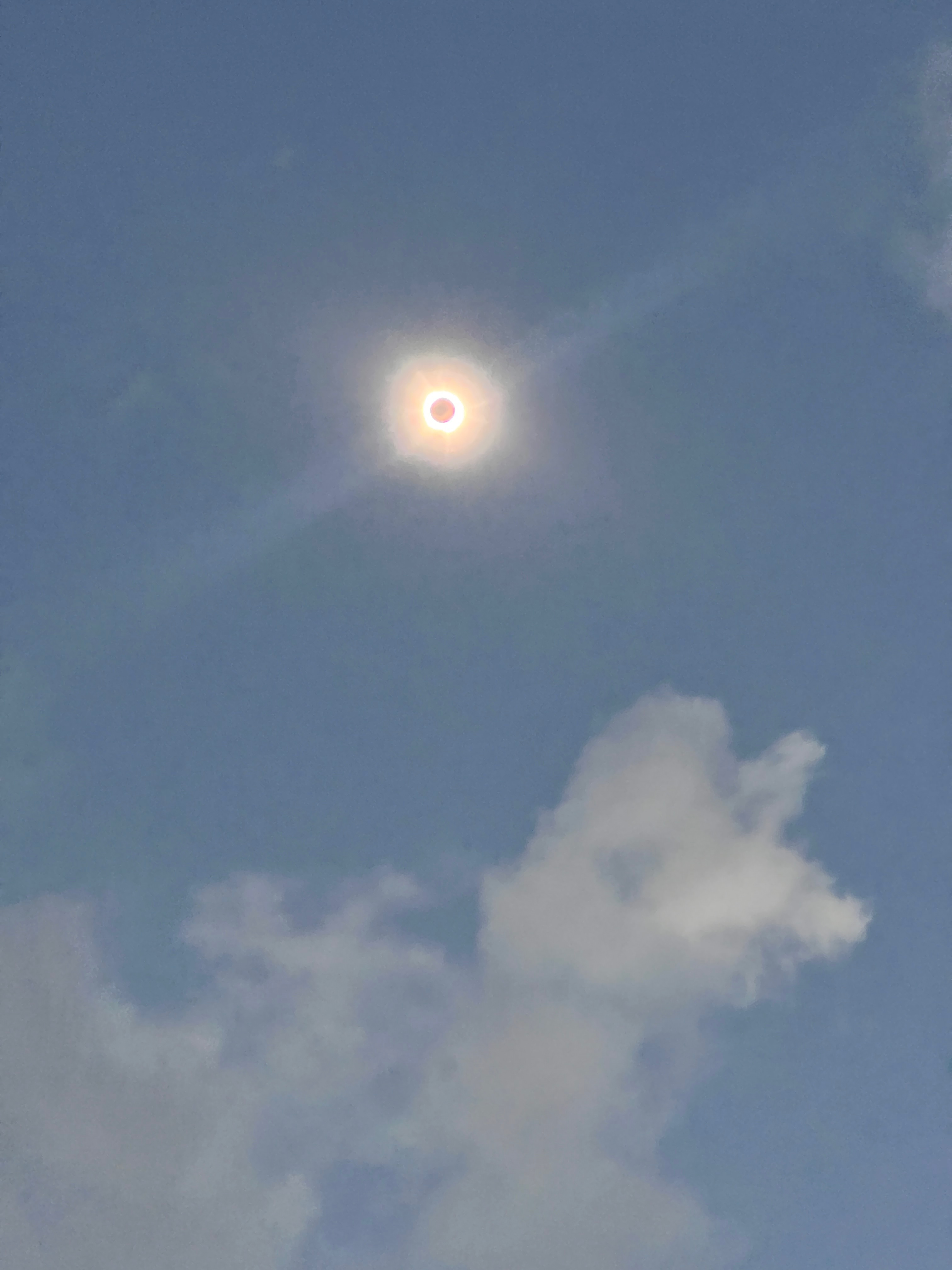
At 1:40PM Dallas time the total solar eclipse happened and luckily it was not covered by clouds. At this point it suddenly got dark and it was safe to look straight at the sun without using the eclipse glasses. The total eclipse lasted four minutes. I have included a shutter stock photo below which closely represents what we actually saw. We saw a black circle and around the black circle was a wispy white fog like light. This was the sun’s corona and it shone with about the same power as the full moon. It kind of looked like a black hole.

Black circle surrounded by a wispy white fog like light. That’s the sun’s corona | The Great Sun and Moon Spectacle
Except for the black background this looks like what we saw with our eyes. The sky we had was dark, like twilight, but not black. Solar Eclipse Stock Photo ID: 2344355767 by aeonWAVE

The Stars and the Planet Venus

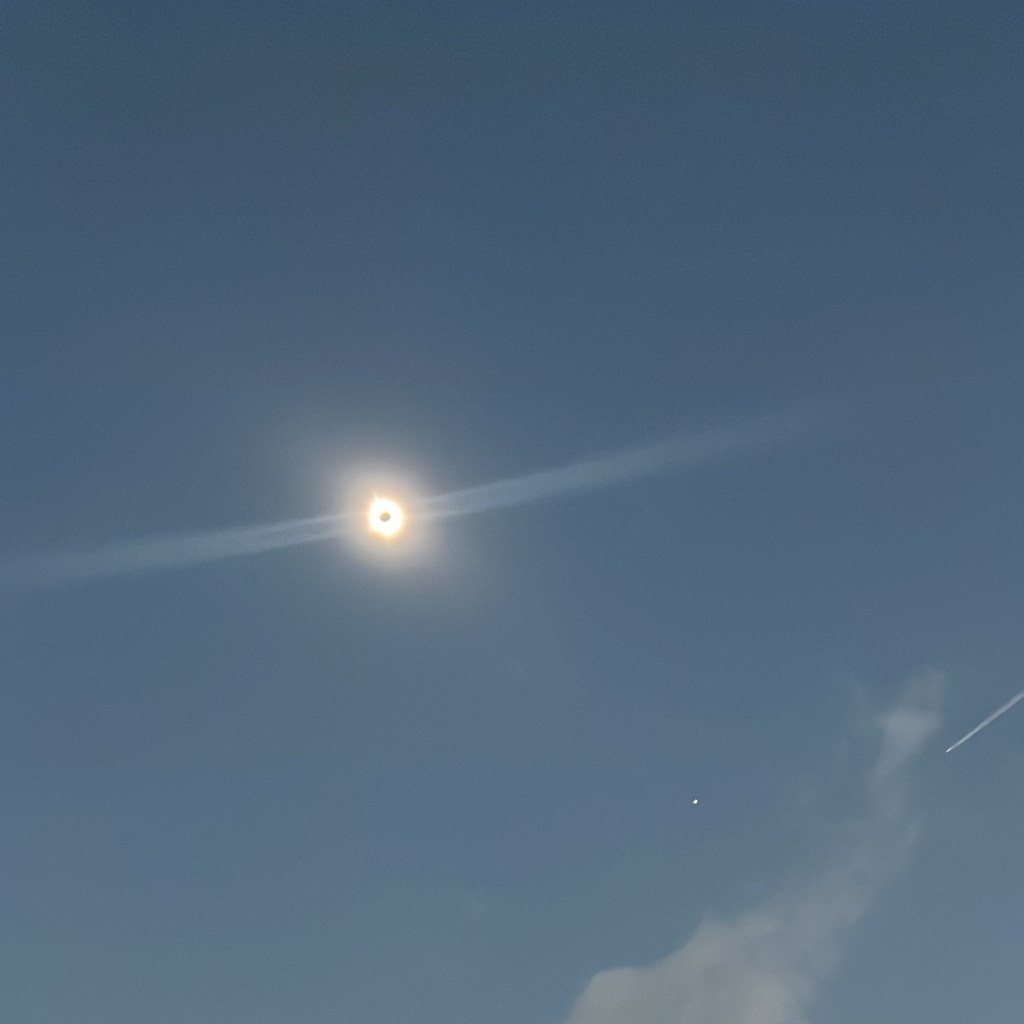
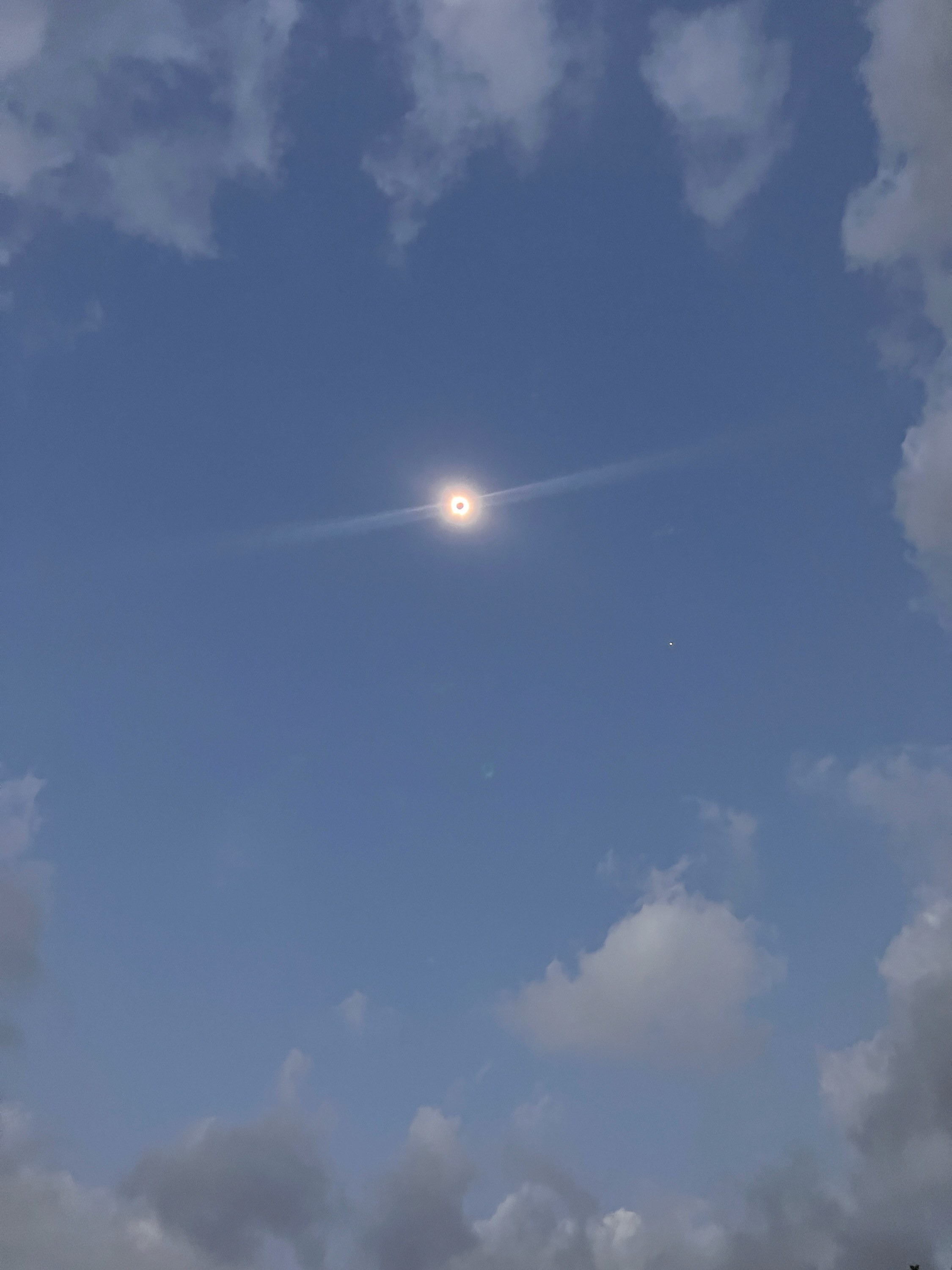
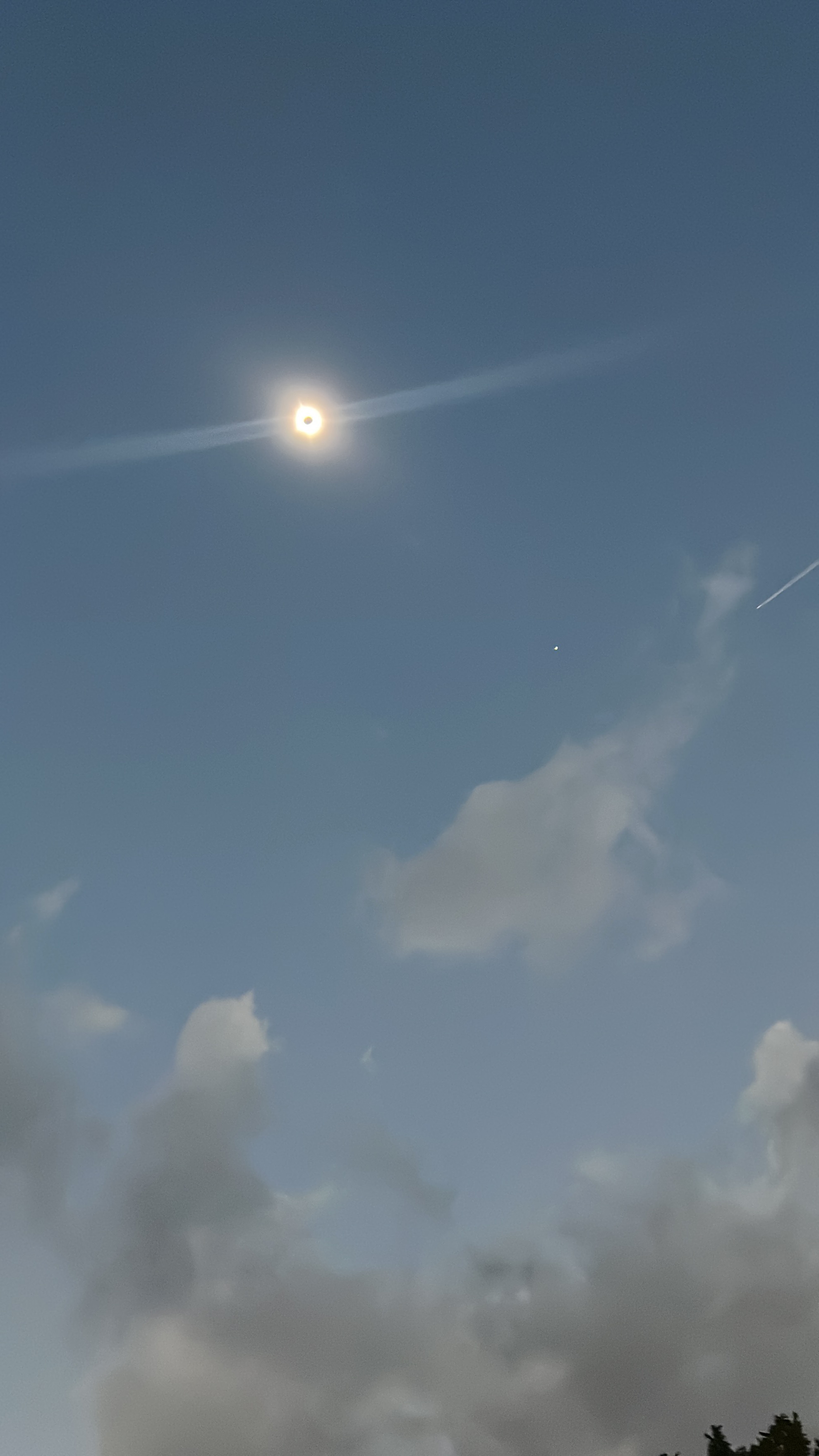
The photo shows the sun totally covered by the moon. It is very small in the photo. There is star like object, that’s Venus, a cloud and airplane contrail | The Great Sun and Moon Spectacle
Total solar eclipse photo that my daughter took. Can you find Venus?

Total Eclipse Photos

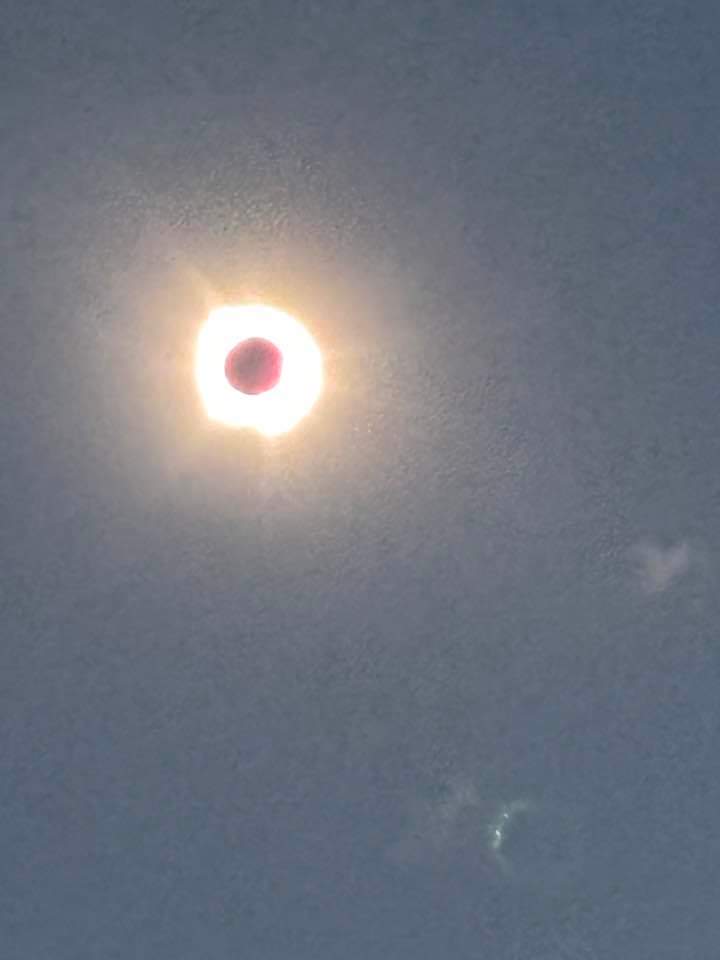
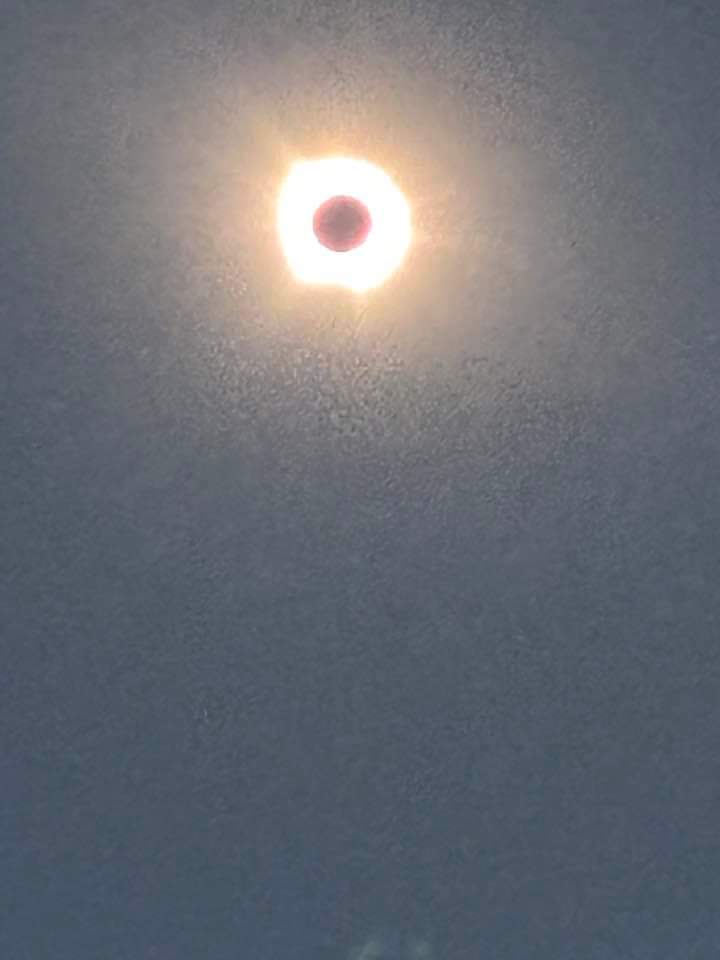
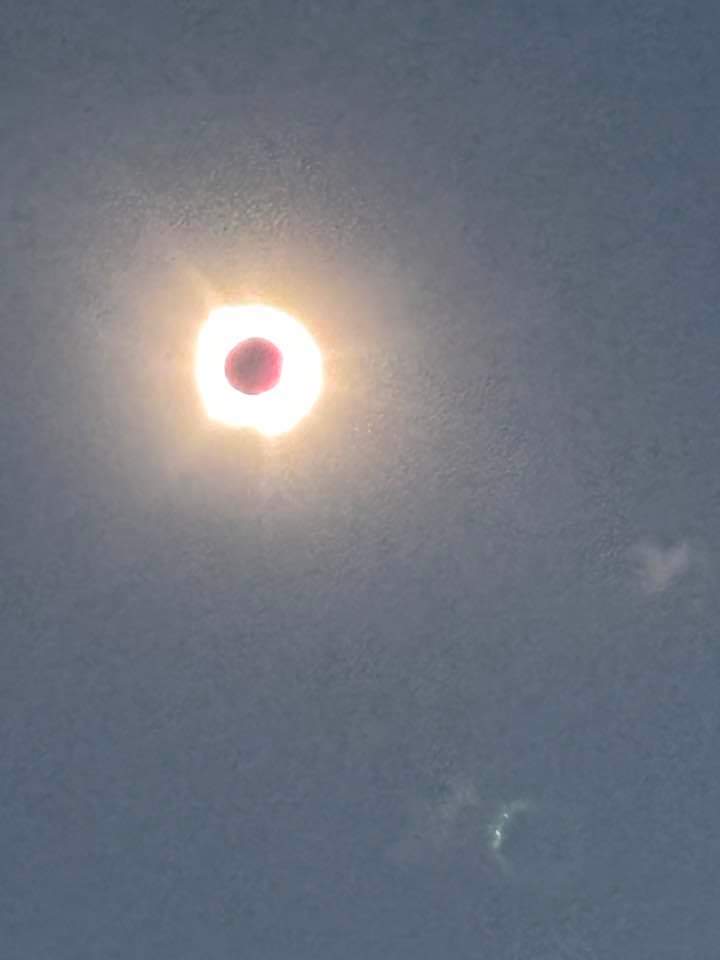
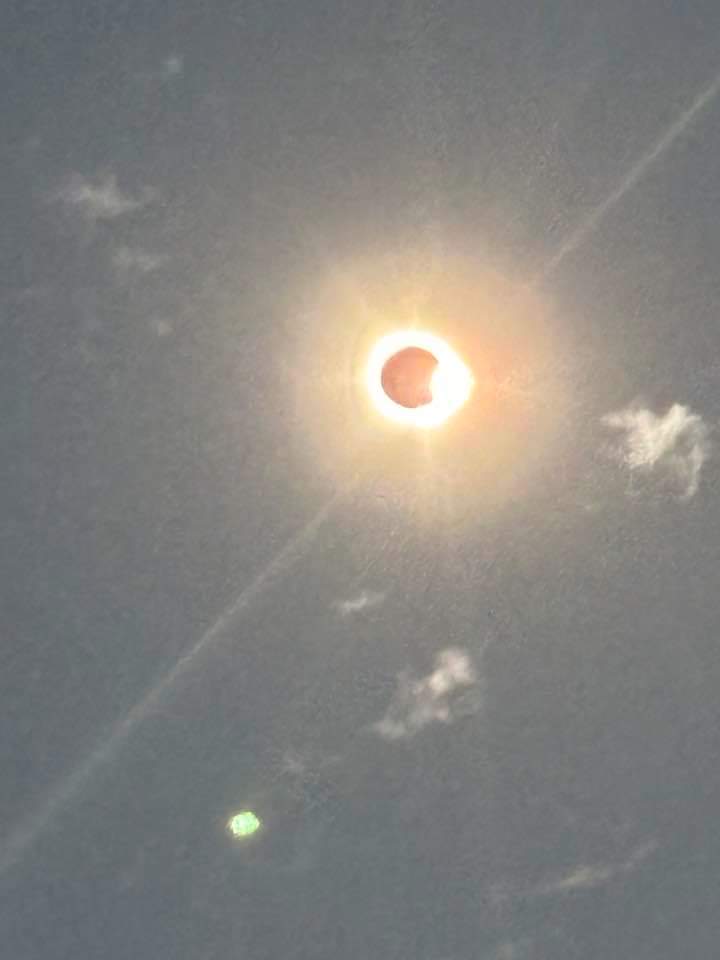
These eight pictures were taken with cell phones by my daughter Rachel, Denise Mosier-Wanken, and Margaret Weiss Bloebaum.

Did you see the total solar eclipse?


To see the Super Facts click here


The Little Book of Cosmology

Cosmology is the science of the origin and development of the universe, and this post is about a book on Cosmology, The Little Book of Cosmology by Lyman Page. This is a big and, in my opinion, interesting topic. A lot of cosmology is speculative, multiverses, what was before the big bang, has the universe always existed, has there been an infinite number of big bangs, what about conformal cyclic cosmology in which each cycle result in a new big bang (Roger Penrose), what is the future and end of the universe, is the Universe a hologram, is it self-aware, etc.

This book is not focused on scientific speculation but on what we know about the structure of the universe, the big bang and the expansion of the universe, the well understood basics. I think it is amazing how much we can learn from the Cosmic Microwave Background Radiation (CMB).

The goal of this blog is to create a list of what I call super facts. Important facts that we know to be true and yet they are surprising, shocking or disputed among non-experts. Super facts are special facts that a well-informed person may want to know. However, I sometimes create posts that are not super facts but just interesting information, such as this one. The Little Book of Cosmology is a relatively short and easy read. I bought the hardback version of it.

  • Hardcover –  Publisher : Princeton University Press; First Edition (April 7, 2020), ISBN-10 : 0691195781, ISBN-13 : 978-0691195780, 152 pages, item weight : 2.31 pounds, dimensions : 5.59 x 0.79 x 8.58 inches, it costs $15.39 on Amazon. Click here to order it from Amazon.com.
  • Kindle –  Publisher : Princeton University Press (April 7, 2020), ASIN : B07Z1DWB4P, 132 pages, it costs $9.99 on US Amazon. Click here to order it from Amazon.com.
The front cover features the title, the author, and geodesic lines forming a hyperbolic cone mesh | The Little Book of Cosmology by Lyman Page
Front cover of The Little Book of Cosmology. Click on the image to go to the Amazon page for the hardcover version of the book.

Amazon’s description of The Little Book of Cosmology by Lyman Page

The cutting-edge science that is taking the measure of the universe

The Little Book of Cosmology provides a breathtaking look at our universe on the grandest scales imaginable. Written by one of the world’s leading experimental cosmologists, this short but deeply insightful book describes what scientists are revealing through precise measurements of the faint thermal afterglow of the Big Bang—known as the cosmic microwave background, or CMB—and how their findings are transforming our view of the cosmos.

Blending the latest findings in cosmology with essential concepts from physics, Lyman Page first helps readers to grasp the sheer enormity of the universe, explaining how to understand the history of its formation and evolution in space and time. Then he sheds light on how spatial variations in the CMB formed, how they reveal the age, size, and geometry of the universe, and how they offer a blueprint for the formation of cosmic structure.

Not only does Page explain current observations and measurements, he describes how they can be woven together into a unified picture to form the Standard Model of Cosmology. Yet much remains unknown, and this incisive book also describes the search for ever deeper knowledge at the field’s frontiers—from quests to understand the nature of neutrinos and dark energy to investigations into the physics of the very early universe.

This is my five star review for The Little Book of Cosmology

What the Cosmic Microwave Background (CMB) can tell us

This is a short book describing the evolution of the Universe since the Big Bang and its composition. How do we know all this stuff? The Cosmic Microwave Background (CMB) can tell us a lot.

The CMB is a black body radiation remnant from the time (400,000 years after the Big Bang) when the Universe had cooled enough to allow the formation of hydrogen atoms and the decoupling of photons from electrons so that they could roam free.

CMB is in itself evidence for the Big Bang but in addition we get additional information from the minor anisotropy and polarization of the CMB, and add the composition of the elements (hydrogen, helium, lithium, and heavier elements), redshifts of galaxies, gravity lensing, and we can tell quite a bit about the evolution of the Universe and where it is heading.

It’s fascinating science detective work. This eventually leads to the Standard Model of Cosmology, which is something I’ve never heard of before, but it’s cool.

I found the facts about the size and age of the Universe, the early giant stars in the Universe, dark energy and dark matter, very interesting. The book is filled with basic and fascinating facts that I did not know. Because of the CMB (rather than particle accelerator experiments) we know roughly the mass (rest mass) of neutrinos.

We know why dark energy can’t be space dust, or rogue planetoids, or black holes or neutrinos, so what is it? The book explains why it can’t be any of those. There’s a lot we can know because of the CMB and other information, and some things we don’t know. Finding out what we do know was quite exciting and finding out what the mysterious “what we don’t know” was equally exciting. Again, the focus is on CMB and how it is measured, it tells us a lot.

The book is easy to read and require no degree in physics or mathematics. I admit I have a degree in Engineering Physics, and I am also interested in astronomy and cosmology, but I can tell it was light reading. It is a truly popular science book like those that Neil De Grasse Tyson writes, and it was short but very informative. There’s a lot of information you can extract from CMB. It was a fun short read for anyone interested in the mysteries of the Universe.

The back cover feature advanced praise for the book | The Little Book of Cosmology by Lyman Page
Back cover of The Little Book of Cosmology. Click on the image to go to the Amazon page for the kindle version of the book.

To see the Super Facts click here


The Betelgeuse Supernova

This is a submission for Kevin’s No Theme Thursday

The Betelgeuse Supernova
Image by Kevin from The Beginning at Last

Supernova

A supernova is an explosion of a star so violent that it can outshine an entire galaxy. It can occur when a super massive star’s core contracts (the death of the star) and as it reaches a critical point it triggers nuclear reactions that cause the star to explode. Alternatively, it can occur when a white dwarf star is triggered into runaway nuclear fusion by a collision with another star.

Depending on how far away the supernova is it can be as luminous as a bright new star, the moon, or a second sun. It occurs suddenly and lasts for several weeks or months before fading away. If a supernova shines bright enough, the other stars in the sky will vanish from view. We can’t see the stars during the day, not because of the blue sky, but because of the ambient light from the sun. 

This is also one major reason photos from space often lack stars in the black sky. If a supernova is close enough to earth it could destroy earth. Luckily there are no super massive stars close enough to earth to pose a risk.

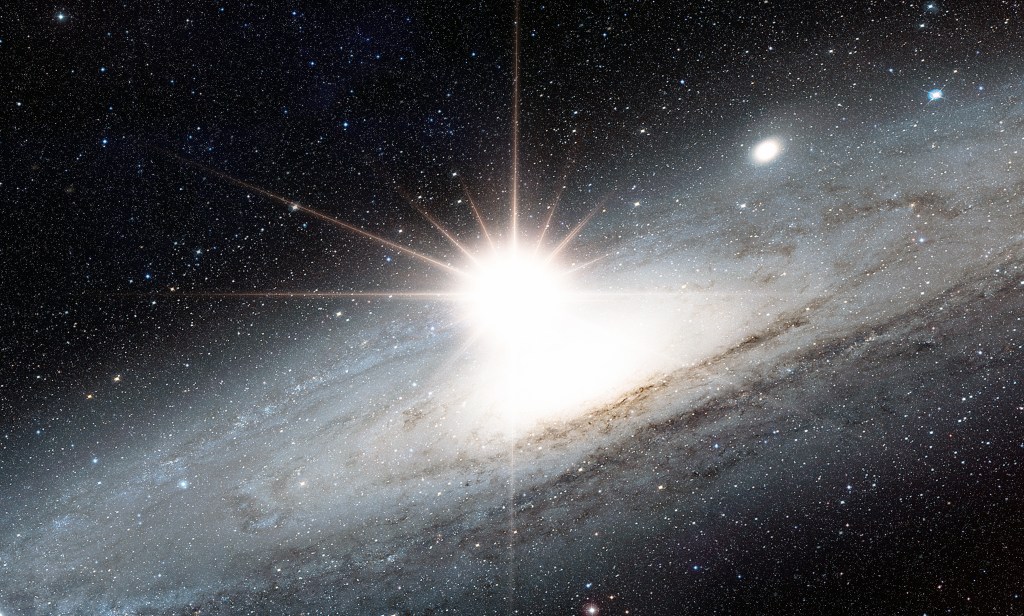
A picture of the Andromeda Galaxy with a bright white light near its center. The bright light is almost outshining the entire galaxy.
Supernova explosion in the center of the Andromeda galaxy “Elements of this image furnished by NASA” It is essentially an enhanced photo of a supernova explosion in a neighboring galaxy. Stock Photo ID: 2495486227 by muratart.

The Betelgeuse Supernova

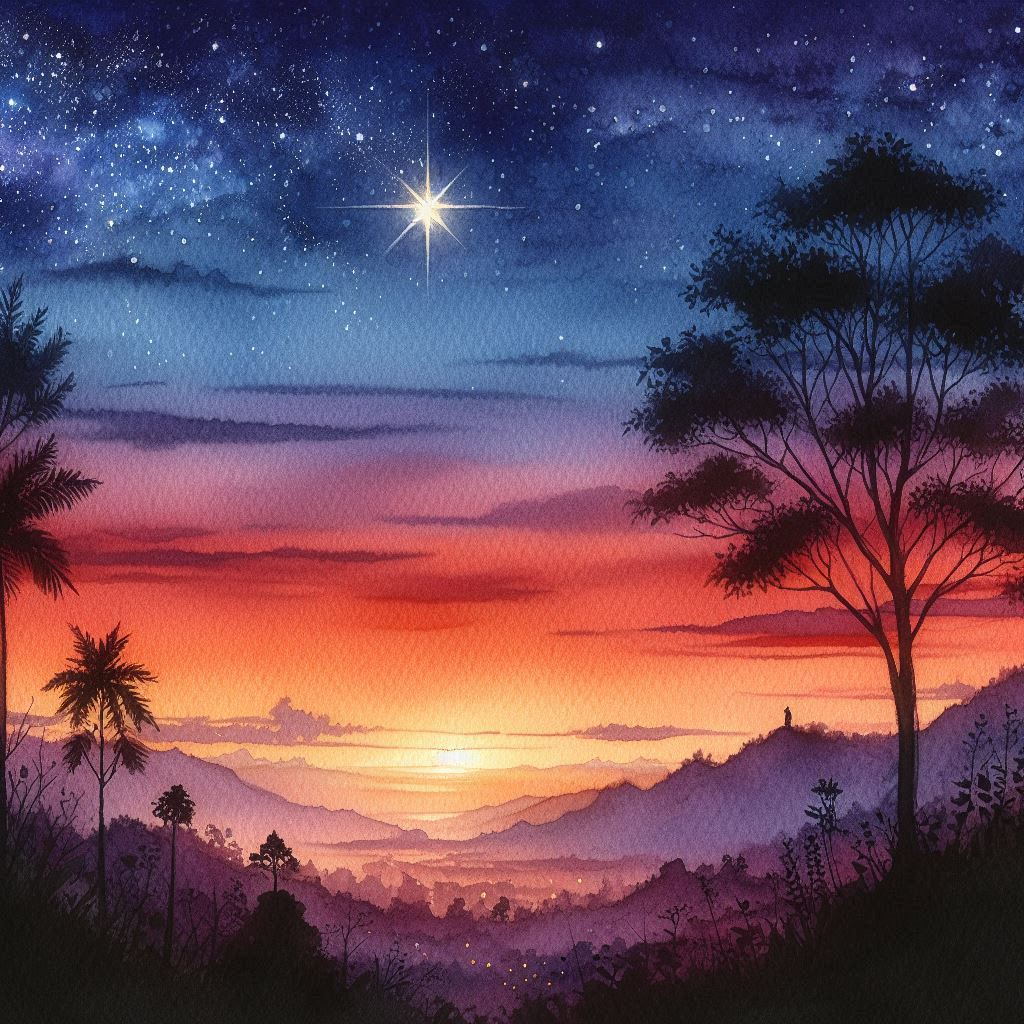
Betelgeuse the bright red star in the constellation Orion is thought to be close to going supernova, and when it does it will be about as bright as half a full moon in our sky but concentrated in a point. What does “close” mean? Some astronomers say within decades, some say within a few thousand years. Could Kevin’s beautiful picture above depict this future event?

This is a map of the Orion constellation showing Orion’s belt in the middle. Betelgeuse is a red star or dot up to the left | The Betelgeuse Supernova
Illustration of the Orion constellation. To find Betelgeuse, first find Orion’s belt, then look up to the left. The reddish star is Betelgeuse. It is visible at this time of year (on a clear night). Stock Vector ID: 1631025025 by Tedgun.

We are stardust

The first stars in the Universe were made of 75% hydrogen and 25% helium and trace amounts of Lithium, just like the entire Universe at the time. Heavier elements that could form rocky planets or other solid celestial bodies did not exist.

However, inside the cores of these stars, heavier elements such as carbon, oxygen, and iron were formed by fusion. These early stars are referred to as first generation stars. They tended to be large and ended their lives in massive supernova explosions. The dusty remains of these explosions became the building blocks of the second and third generation stars we see today as well as the planets, our bodies and all life. We are stardust.

The picture consists of two pie chart graphs representing stars. The left one is a first-generation star with one pie for the 75% hydrogen and one pie for the 25% helium.
The first-generation stars consisted of 75% hydrogen and 25% helium and trace amounts of Lithium. A second or third generation star like our sun is still mostly hydrogen and helium but also many other elements. The rocky planets circling the sun are mainly elements heavier than hydrogen and helium. Image credit NASA, ESA, CSA, STScI.

Finally, a 33 second YouTube video illustrating a Supernova (the creation of the Crab nebula)


Would you like to see Betelgeuse explode into a supernova in your lifetime?


To see the Super Facts click here

Black Holes Monsters in the Sky

“This”Black Holes Monsters in the Sky” is a submission for Kevin’s No Theme Thursday

Black Holes Monsters in the Sky
Image by Kevin from The Beginning at Last

Black holes, everyone has heard of them, no one understands them. They are inscrutable monsters in the sky. They are regions of spacetime wherein gravity is so strong that nothing can escape, not light, not anything. Some of them are small, only 15 kilometers across, and some have a diameter 27 billion times larger than that.

As you get close to a black hole your time will run slower. You won’t notice it, but others will see you move in slow motion. If you return from your close encounter an hour on your clock might correspond to years elsewhere. As you approach the event horizon, the boundary of no escape, you become invisible and time will stop, at least from an outside view.

Black holes are invisible. They are truly black. However, we can see them if they are consuming matter. The matter close to black holes will heat up and glow. The closer to the event horizon the redder it is. It is called an accretion disk as in the depiction above.

There are an estimated 100 million black holes in our galaxy, the Milky Way. At the center of the Milky Way is a super massive black hole called Sagittarius A-star. It is 4 million times more massive than our sun. There are supermassive black holes located at the center of most large galaxies. The supermassive black holes are considered to play a crucial role in the formation of galaxies.

I’ve looked up in the sky, and I’ve seen the spot where Sagittarius A-star is located. I’ve tried to look at it with my telescope, but I cannot see it. It is not possible to see it with a telescope, but it is there. The picture above may depict the view from a planet in the center of our galaxy. Three scientists received the Nobel prize in physics in 2020 for their research on black holes (Roger Penrose, Reinhard Genzel, and Andrea Ghez).

However, before them the tele evangelist Jack Van Impe won the 2001 Ig Nobel Prize in Astrophysics for his discovery that black holes meet all the technical requirements for Hell. The Ig Nobel prize is an alternative and less serious Nobel Prize. To find out more about Black Holes click here.

Below is an animation created by NASA that depicts what an observer falling into a black hole would see.


To see the Super Facts click here