The Little Book of Cosmology

Cosmology is the science of the origin and development of the universe, and this post is about a book on Cosmology, The Little Book of Cosmology by Lyman Page. This is a big and, in my opinion, interesting topic. A lot of cosmology is speculative, multiverses, what was before the big bang, has the universe always existed, has there been an infinite number of big bangs, what about conformal cyclic cosmology in which each cycle result in a new big bang (Roger Penrose), what is the future and end of the universe, is the Universe a hologram, is it self-aware, etc.

This book is not focused on scientific speculation but on what we know about the structure of the universe, the big bang and the expansion of the universe, the well understood basics. I think it is amazing how much we can learn from the Cosmic Microwave Background Radiation (CMB).

The goal of this blog is to create a list of what I call super facts. Important facts that we know to be true and yet they are surprising, shocking or disputed among non-experts. Super facts are special facts that a well-informed person may want to know. However, I sometimes create posts that are not super facts but just interesting information, such as this one. The Little Book of Cosmology is a relatively short and easy read. I bought the hardback version of it.

  • Hardcover –  Publisher : Princeton University Press; First Edition (April 7, 2020), ISBN-10 : 0691195781, ISBN-13 : 978-0691195780, 152 pages, item weight : 2.31 pounds, dimensions : 5.59 x 0.79 x 8.58 inches, it costs $15.39 on Amazon. Click here to order it from Amazon.com.
  • Kindle –  Publisher : Princeton University Press (April 7, 2020), ASIN : B07Z1DWB4P, 132 pages, it costs $9.99 on US Amazon. Click here to order it from Amazon.com.
The front cover features the title, the author, and geodesic lines forming a hyperbolic cone mesh | The Little Book of Cosmology by Lyman Page
Front cover of The Little Book of Cosmology. Click on the image to go to the Amazon page for the hardcover version of the book.

Amazon’s description of The Little Book of Cosmology by Lyman Page

The cutting-edge science that is taking the measure of the universe

The Little Book of Cosmology provides a breathtaking look at our universe on the grandest scales imaginable. Written by one of the world’s leading experimental cosmologists, this short but deeply insightful book describes what scientists are revealing through precise measurements of the faint thermal afterglow of the Big Bang—known as the cosmic microwave background, or CMB—and how their findings are transforming our view of the cosmos.

Blending the latest findings in cosmology with essential concepts from physics, Lyman Page first helps readers to grasp the sheer enormity of the universe, explaining how to understand the history of its formation and evolution in space and time. Then he sheds light on how spatial variations in the CMB formed, how they reveal the age, size, and geometry of the universe, and how they offer a blueprint for the formation of cosmic structure.

Not only does Page explain current observations and measurements, he describes how they can be woven together into a unified picture to form the Standard Model of Cosmology. Yet much remains unknown, and this incisive book also describes the search for ever deeper knowledge at the field’s frontiers—from quests to understand the nature of neutrinos and dark energy to investigations into the physics of the very early universe.

This is my five star review for The Little Book of Cosmology

What the Cosmic Microwave Background (CMB) can tell us

This is a short book describing the evolution of the Universe since the Big Bang and its composition. How do we know all this stuff? The Cosmic Microwave Background (CMB) can tell us a lot.

The CMB is a black body radiation remnant from the time (400,000 years after the Big Bang) when the Universe had cooled enough to allow the formation of hydrogen atoms and the decoupling of photons from electrons so that they could roam free.

CMB is in itself evidence for the Big Bang but in addition we get additional information from the minor anisotropy and polarization of the CMB, and add the composition of the elements (hydrogen, helium, lithium, and heavier elements), redshifts of galaxies, gravity lensing, and we can tell quite a bit about the evolution of the Universe and where it is heading.

It’s fascinating science detective work. This eventually leads to the Standard Model of Cosmology, which is something I’ve never heard of before, but it’s cool.

I found the facts about the size and age of the Universe, the early giant stars in the Universe, dark energy and dark matter, very interesting. The book is filled with basic and fascinating facts that I did not know. Because of the CMB (rather than particle accelerator experiments) we know roughly the mass (rest mass) of neutrinos.

We know why dark energy can’t be space dust, or rogue planetoids, or black holes or neutrinos, so what is it? The book explains why it can’t be any of those. There’s a lot we can know because of the CMB and other information, and some things we don’t know. Finding out what we do know was quite exciting and finding out what the mysterious “what we don’t know” was equally exciting. Again, the focus is on CMB and how it is measured, it tells us a lot.

The book is easy to read and require no degree in physics or mathematics. I admit I have a degree in Engineering Physics, and I am also interested in astronomy and cosmology, but I can tell it was light reading. It is a truly popular science book like those that Neil De Grasse Tyson writes, and it was short but very informative. There’s a lot of information you can extract from CMB. It was a fun short read for anyone interested in the mysteries of the Universe.
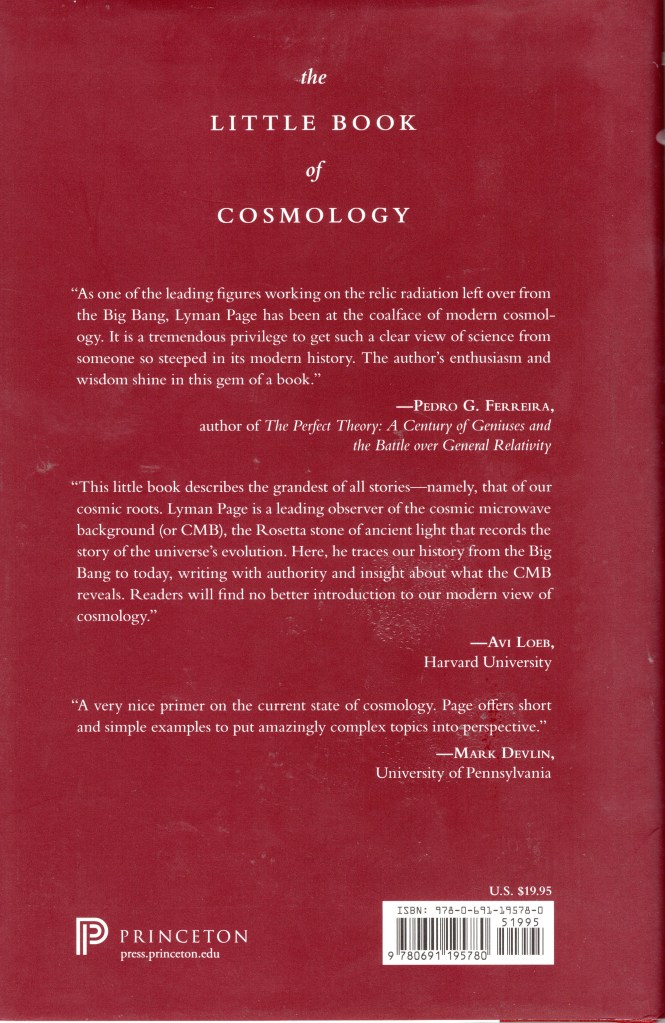

The back cover feature advanced praise for the book | The Little Book of Cosmology by Lyman Page
Back cover of The Little Book of Cosmology. Click on the image to go to the Amazon page for the kindle version of the book.

To see the Super Facts click here


The Betelgeuse Supernova

This is a submission for Kevin’s No Theme Thursday

The Betelgeuse Supernova
Image by Kevin from The Beginning at Last

Supernova

A supernova is an explosion of a star so violent that it can outshine an entire galaxy. It can occur when a super massive star’s core contracts (the death of the star) and as it reaches a critical point it triggers nuclear reactions that cause the star to explode. Alternatively, it can occur when a white dwarf star is triggered into runaway nuclear fusion by a collision with another star.

Depending on how far away the supernova is it can be as luminous as a bright new star, the moon, or a second sun. It occurs suddenly and lasts for several weeks or months before fading away. If a supernova shines bright enough, the other stars in the sky will vanish from view. We can’t see the stars during the day, not because of the blue sky, but because of the ambient light from the sun. 

This is also one major reason photos from space often lack stars in the black sky. If a supernova is close enough to earth it could destroy earth. Luckily there are no super massive stars close enough to earth to pose a risk.

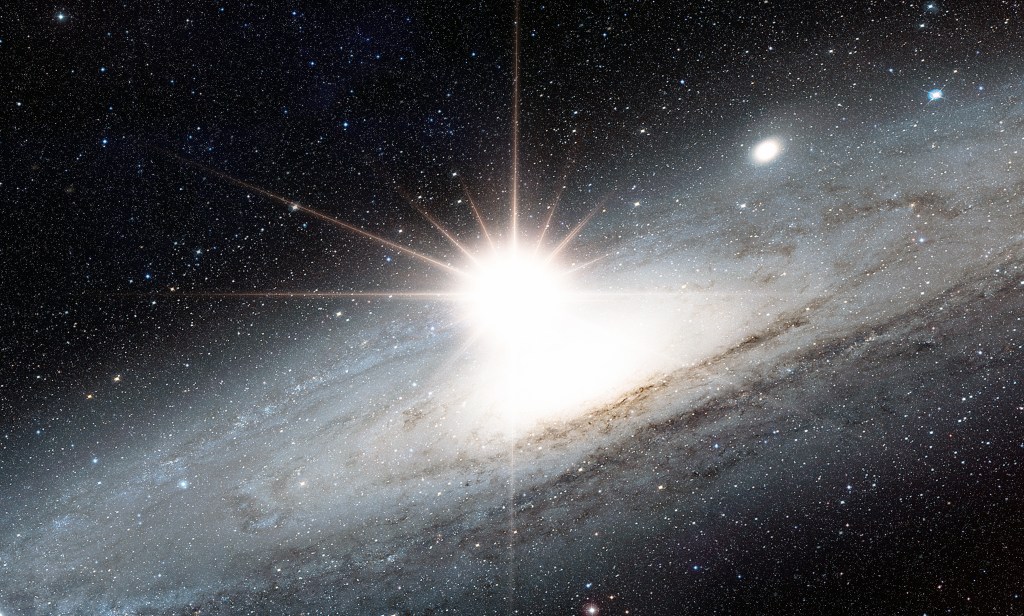
A picture of the Andromeda Galaxy with a bright white light near its center. The bright light is almost outshining the entire galaxy.
Supernova explosion in the center of the Andromeda galaxy “Elements of this image furnished by NASA” It is essentially an enhanced photo of a supernova explosion in a neighboring galaxy. Stock Photo ID: 2495486227 by muratart.

The Betelgeuse Supernova

Betelgeuse the bright red star in the constellation Orion is thought to be close to going supernova, and when it does it will be about as bright as half a full moon in our sky but concentrated in a point. What does “close” mean? Some astronomers say within decades, some say within a few thousand years. Could Kevin’s beautiful picture above depict this future event?

This is a map of the Orion constellation showing Orion’s belt in the middle. Betelgeuse is a red star or dot up to the left | The Betelgeuse Supernova
Illustration of the Orion constellation. To find Betelgeuse, first find Orion’s belt, then look up to the left. The reddish star is Betelgeuse. It is visible at this time of year (on a clear night). Stock Vector ID: 1631025025 by Tedgun.

We are stardust

The first stars in the Universe were made of 75% hydrogen and 25% helium and trace amounts of Lithium, just like the entire Universe at the time. Heavier elements that could form rocky planets or other solid celestial bodies did not exist.

However, inside the cores of these stars, heavier elements such as carbon, oxygen, and iron were formed by fusion. These early stars are referred to as first generation stars. They tended to be large and ended their lives in massive supernova explosions. The dusty remains of these explosions became the building blocks of the second and third generation stars we see today as well as the planets, our bodies and all life. We are stardust.

The picture consists of two pie chart graphs representing stars. The left one is a first-generation star with one pie for the 75% hydrogen and one pie for the 25% helium.
The first-generation stars consisted of 75% hydrogen and 25% helium and trace amounts of Lithium. A second or third generation star like our sun is still mostly hydrogen and helium but also many other elements. The rocky planets circling the sun are mainly elements heavier than hydrogen and helium. Image credit NASA, ESA, CSA, STScI.

Finally, a 33 second YouTube video illustrating a Supernova (the creation of the Crab nebula)


Would you like to see Betelgeuse explode into a supernova in your lifetime?


To see the Super Facts click here

Black Holes Monsters in the Sky

“This”Black Holes Monsters in the Sky” is a submission for Kevin’s No Theme Thursday

Black Holes Monsters in the Sky
Image by Kevin from The Beginning at Last

Black holes, everyone has heard of them, no one understands them. They are inscrutable monsters in the sky. They are regions of spacetime wherein gravity is so strong that nothing can escape, not light, not anything. Some of them are small, only 15 kilometers across, and some have a diameter 27 billion times larger than that.

As you get close to a black hole your time will run slower. You won’t notice it, but others will see you move in slow motion. If you return from your close encounter an hour on your clock might correspond to years elsewhere. As you approach the event horizon, the boundary of no escape, you become invisible and time will stop, at least from an outside view.

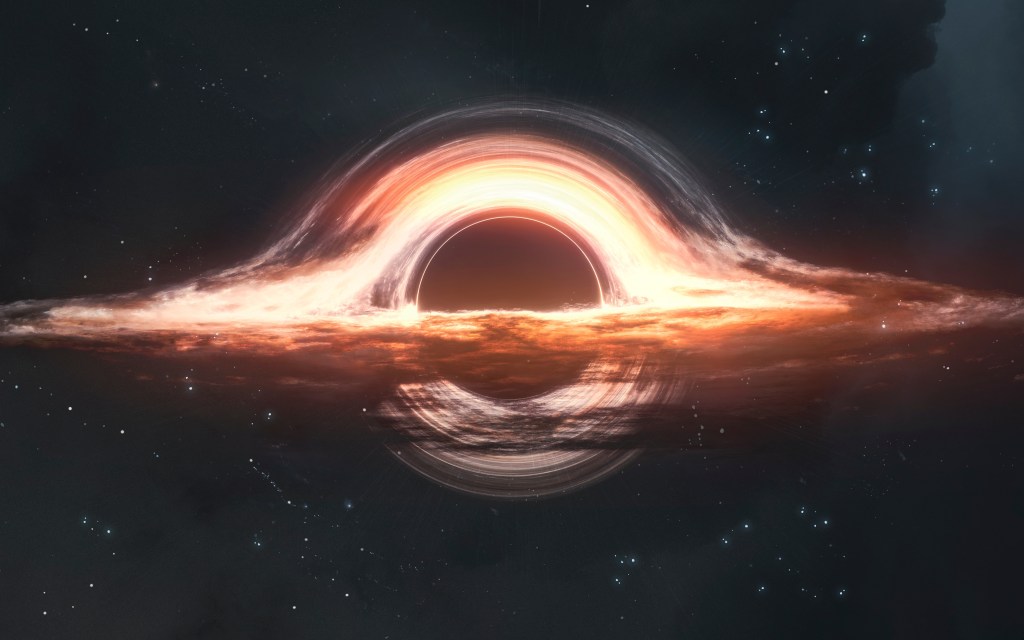
Black holes are invisible. They are truly black. However, we can see them if they are consuming matter. The matter close to black holes will heat up and glow. The closer to the event horizon the redder it is. It is called an accretion disk as in the depiction above.

There are an estimated 100 million black holes in our galaxy, the Milky Way. At the center of the Milky Way is a super massive black hole called Sagittarius A-star. It is 4 million times more massive than our sun. There are supermassive black holes located at the center of most large galaxies. The supermassive black holes are considered to play a crucial role in the formation of galaxies.

I’ve looked up in the sky, and I’ve seen the spot where Sagittarius A-star is located. I’ve tried to look at it with my telescope, but I cannot see it. It is not possible to see it with a telescope, but it is there. The picture above may depict the view from a planet in the center of our galaxy. Three scientists received the Nobel prize in physics in 2020 for their research on black holes (Roger Penrose, Reinhard Genzel, and Andrea Ghez).

However, before them the tele evangelist Jack Van Impe won the 2001 Ig Nobel Prize in Astrophysics for his discovery that black holes meet all the technical requirements for Hell. The Ig Nobel prize is an alternative and less serious Nobel Prize. To find out more about Black Holes click here.

Below is an animation created by NASA that depicts what an observer falling into a black hole would see.


To see the Super Facts click here

The Bizarre Reality of Black Holes

A black hole with a large bright accretion disk | The Bizarre Reality of Black Holes
3D illustration of giant Black hole in deep space. High quality digital space art in 5K – realistic visualization. Stock Illustration ID: 2476711459 by Vadim Sadovski.

Superfact 15: A black hole is a region of spacetime wherein gravity is so strong that nothing can escape it, not light, not anything. There are different kinds of black holes. We don’t fully understand black holes, which makes them very interesting to science. The boundary of no escape is called the event horizon.  Black holes are invisible. They are truly black. However, we can see what they do to their environment as they consume surrounding matter. Below are some bizarre facts about black holes.

  • Time runs much slower closer to a black hole.
  • An object falling towards a black hole will become redder, faint, then infrared, then invisible and all its movements and clocks will freeze.
  • From the perspective of an outside observer, time appears to stop for someone reaching the event horizon of a black hole. Time will continue for someone falling in.
  • At the center of a black hole may lie a gravitational singularity, a region where the spacetime curvature becomes infinite. However, since we cannot peer into a black hole we cannot know.
  • The largest known black hole (TON 618) is more than 287 million times more massive than the most massive known star (R136a1).
  • If our planet earth collapsed into a black hole, it’s diameter would  be 1.75 centimeters or 0.69 inches in diameter. The diameter of the largest known black hole (TON 618) is 242 billion miles, which is more than one million times larger than the distance from the earth to moon.
  • There are supermassive black holes located at the center of most large galaxies, including our Milky Way. The Milky Way’s black hole is about 4 million times the mass of the Sun.
  • Astronomers estimate that there are around 100 million black holes in our Milky Way.
  • When an object (maybe a spaceship, or a person) approaches or falls into a black hole the difference between the gravity on the parts closer to the black hole and those further away will be so large that the object is stretched and ripped apart. This is called spaghettification.
  • Stretching from the event horizon and out another half radius of the black hole is a region called the photon sphere. In the photon sphere light will travel in a non-stable circular orbit around the black hole. Light will go around and around for a while. If you are in the photon sphere you might be able to see the back of your head.
  • Above is just a small sample of weird black hole facts.
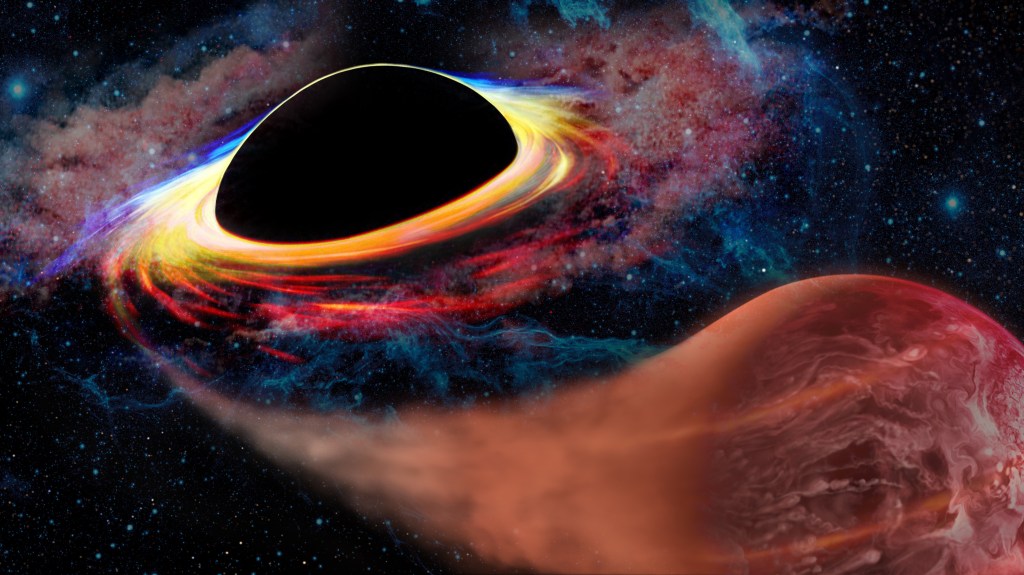
A black hole sucking in a planet
The understanding of black holes requires the General Theory of Relativity, and it is still a lot we don’t understand about them. Stock Photo ID: 2024419973 by Elena11

The Bizarre Reality of Black Holes

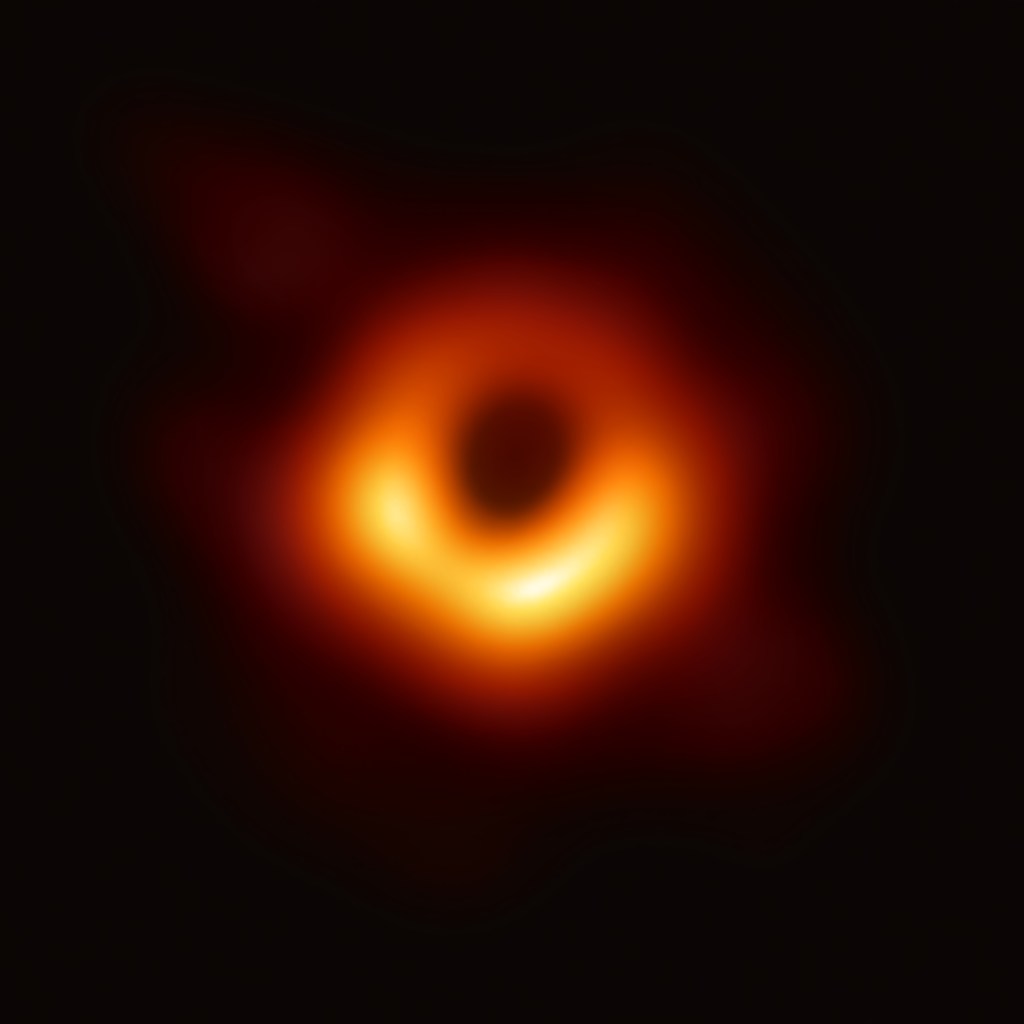
I chose the Bizarre Reality of Black Holes as a super-fact and included the ten facts above because these facts are shocking and yet not well known. Below is a photograph of a supermassive black hole at the center of the galaxy M87 taken by the event horizon telescope in 2017. To create the picture below image processing was needed. It is the first photograph of a black hole. This supermassive black hole is an estimated 6.5 billion times as massive as our sun, and 28 million times as massive as the largest known star.

The supermassive black hole at the center of the galaxy M87 taken by the event horizon telescope in 2017 | The Bizarre Reality of Black Holes
The photo of the supermassive black hole at the center of the galaxy M87 taken by the event horizon telescope in 2017. Uploader cropped and converted TIF to JPG – This file has been extracted from another file, CC BY 4.0, https://commons.wikimedia.org/w/index.php?curid=77925953.

Below is an animation created by NASA that depicts what an observer falling into a black hole would see.

The fact that from the perspective of an outside observer, time appears to stop for someone reaching the event horizon of a black hole seems to prevent anything from falling into a black hole from an outside perspective. How does anything ever get inside the black hole if it freezes up at the event horizon? Black holes grow, they collide and merge, so clearly things can get inside, right? But how? As I tried to find the answer to this question, I found that I was far from the only one asking this question.

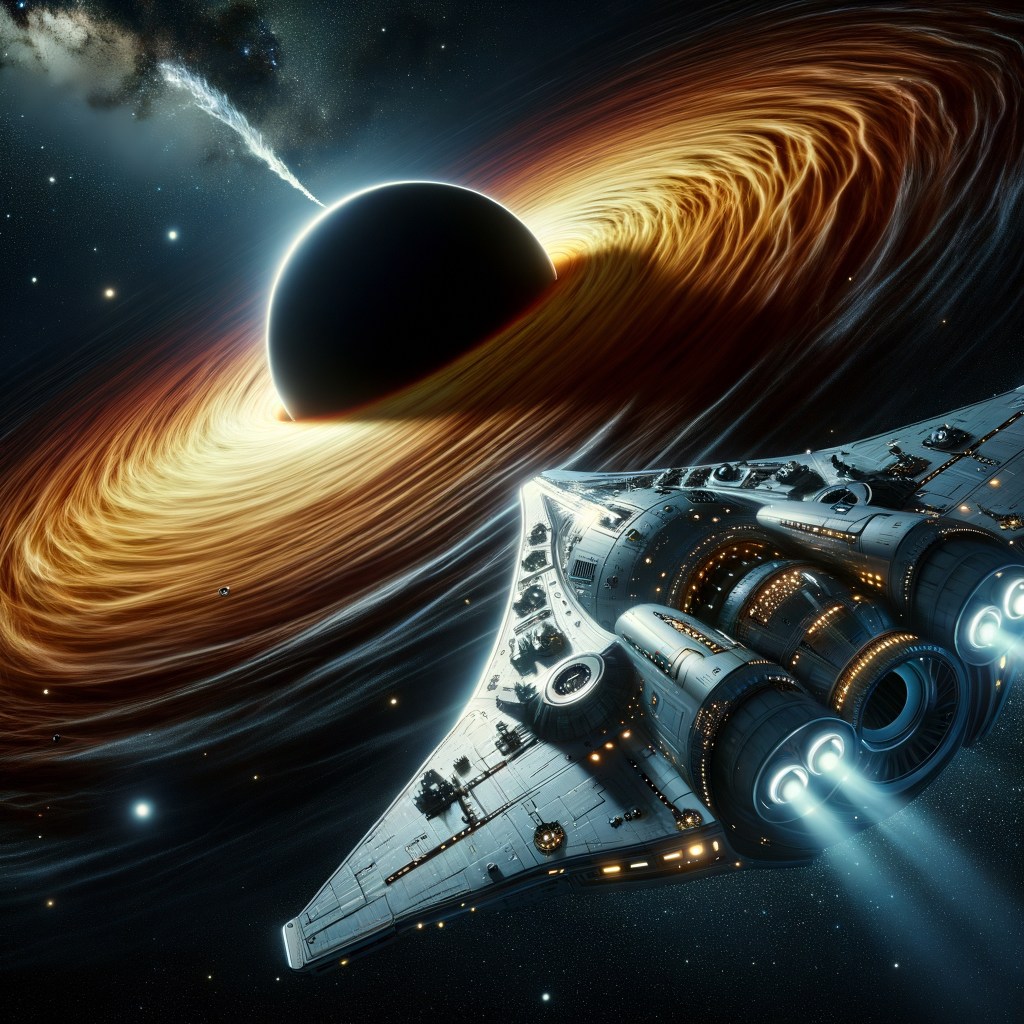
A black hole with an orange accretion disk is approached by futuristic starship.
Realistic spaceship approaching a black hole. This content was generated by an Artificial Intelligence (AI) system. Stock AI-generated image ID: 2448481683 AI-generated image Contributor Shutterstock AI Generator.

I searched physics forums trying to find the answer to this question. There were a lot of discussions but no clear answers. Some said, nothing falls into a black hole. Everything accumulates on the event horizon from the outside perspective and that’s how the event horizon and the black hole grows. The observer crossing the horizon essentially jumps infinitely far into the future, or into a different universe, that’s how he can pass through the event horizon.

Others said that the black hole is not static, it grows, and it shrinks from Hawking radiation, and this complicates the equations so that objects can enter the black hole even from an outside perspective. I have a few physics books on black holes that I have not finished reading. If I learn something better, I will update this post.

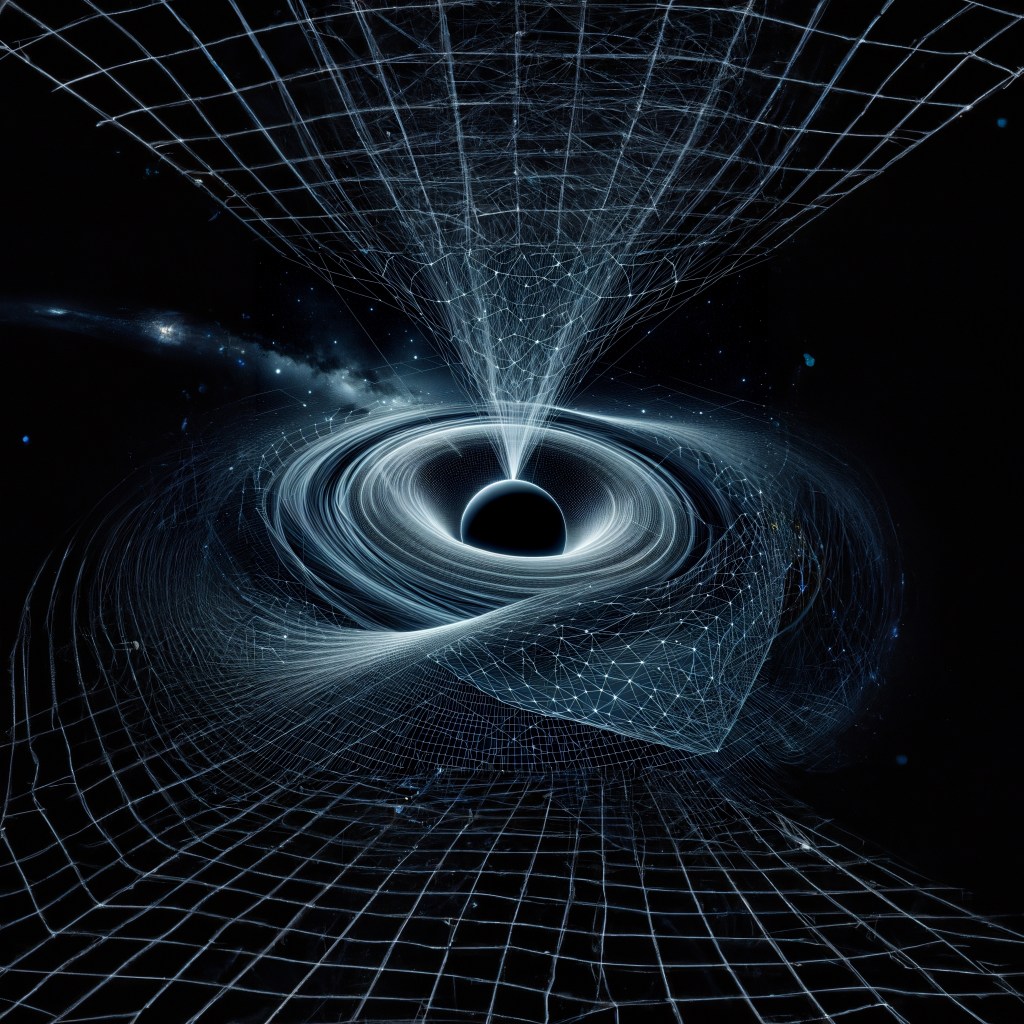
A depiction of a black hole surrounded by a space-time geometric grid that is bending due to gravity | The Bizarre Reality of Black Holes
AI-generated image Description : Space Black Hole Blue Illustration Gravity Geometry Vast Line. Stock AI-generated image ID: 2457551367 by AI-generated image Contributor Shutterstock.AI

In the image above the grid demonstrates how a black hole is distorting space-time. Other strange facts about black holes are that they are slowly evaporating through what is called Hawking radiation.

They come in different sizes. The smallest known black hole (XTE J1650-500) has a diameter of approximately 15 miles. Perhaps scariest of all, black holes are nearly undetectable unless they are feeding on star dust or tugging on nearby stars. That means one hungry black hole could be zipping right through our solar system without us knowing. Considering there are an estimated 100 million black holes in our Milky Way space travel might be scary.

Addressing a Good Question

After posting this post I received a question via email regarding this fact “If our planet earth collapsed into a black hole, its diameter would  be 1.75 centimeters or 0.69 inches in diameter. The diameter of the largest known black hole (TON 618) is 242 billion miles, which is more than one million times larger than the distance from the earth to moon.” The person who asked thought that 1.75 centimeters was pretty tiny and was wondering how a black hole could be that small.

To create a black hole, you need extremely strong gravity and one way to increase the force of gravity at the surface of a planet is to compress all its mass into a smaller volume.

If you compressed all of earth’s gravity so its diameter was only half of what it is, it would be more compact, and the gravity would be four times stronger at earth’s surface. If you compressed it further so that the earth’s diameter would only be a fourth of its original diameter the gravity at the surface would now be 16 times stronger. If you keep compressing the earth until its diameter is only 1.75 centimeters the force of gravity at the surface would be 132,000 trillion times greater than it currently is according to Newtonian physics, and you would get a black hole.

I should say that it comes out differently with General Relativity and that number is different for different sized black holes. However, this calculation is for demonstrative purposes. For relatively small masses like a planet, you would have to compress so much that it becomes tiny before gravity becomes large enough to make a black hole.


To see the other Super Facts click here


If you were an astronaut on an interstellar journey, would you be afraid of falling into a black hole?

Astronomer

Daily writing prompt
What alternative career paths have you considered or are interested in?

So I am trying out the Daily writing prompt for the first time, answering the question “What alternative career paths have you considered or are interested in?”.

I’ve always been interested in astronomy and astrophysics, and I studied engineering physics, later electrical engineering. I did not think astronomer or astrophysicist was an easily attainable career and perhaps not very well paid either, but I think it would have been a fun job to have.

Astronomer
Photo by Lucas Pezeta on Pexels.com

Celestron Powerseeker 70EQ

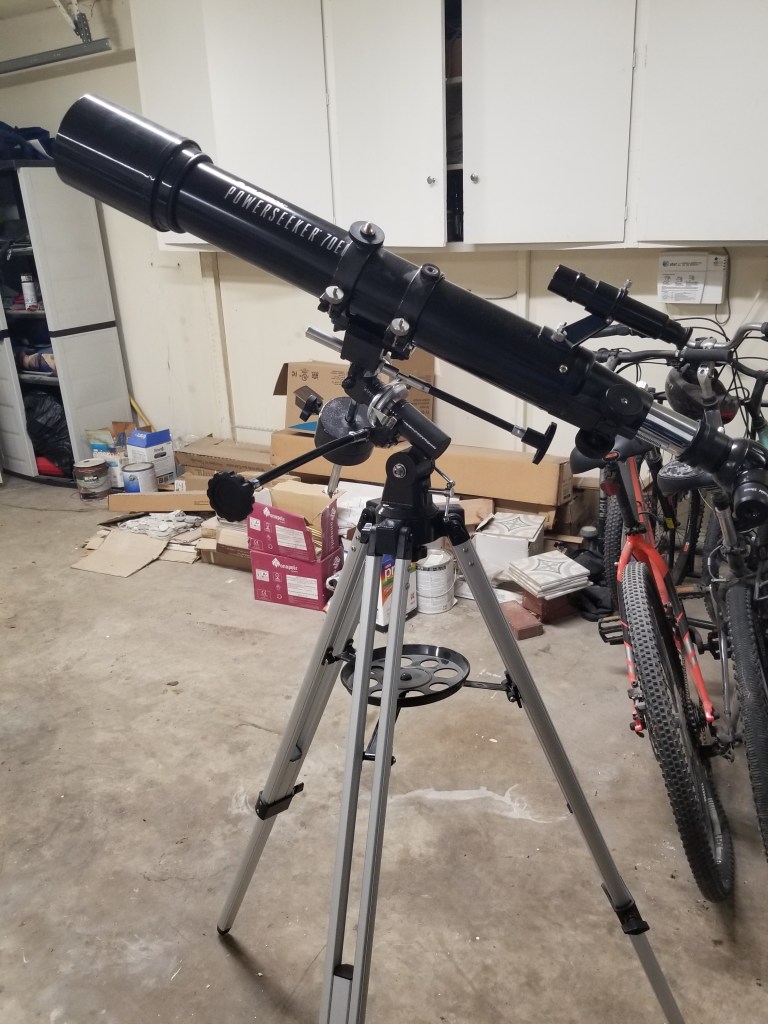
I am a bit of an amateur astronomer, and I own a basic telescope for amateurs, a Celestron Powerseeker 70EQ. It is not a great telescope, but it is good enough for observing objects such as Saturn and its rings, Jupiter and its four Galilean moons, Mars, Venus (the crescent), the moon and its craters. Those objects you can see from inside a big city like Dallas. Naturally you can do much better if you leave the city and especially if you visit a dark spot. I am a member of TAS, Texas Astronomical Society and they own a dark spot in Oklahoma. Below is a photo of my Celestron Powerseeker 70EQ standing in my garage.

Black Telescope standing in front of bicycles in a garage
Celestron Powerseeker 70EQ

What Does an Astronomer Do?

Astronomers study the universe, including galaxies, stars, planets, and other celestial objects, using telescopes and other instruments to observe and analyze them. They observe and analyze celestial objects. Depending on their specific area, astronomers have different duties.

  • They observe celestial objects using telescopes.
  • They conduct research, analyze data and test hypothesis.
  • They use and develop models including complex mathematical models and computer simulations to understand complex astrophysical phenomena.
  • They collaborate with peers, they teach, and they do mentoring and public outreach.

Types of Astronomers

  • Observational Astronomers use telescopes and other observational instruments to collect data from celestial objects.
  • Theoretical Astrophysicists use mathematical models and computer simulations to understand the physical processes in the universe. They may study stellar evolution, galaxy formation, cosmology, and black holes.
  • Planetary Scientists study planets, moons, and other objects within our solar system. They use data collected by space missions, telescopes, and remote sensing techniques.
  • Stellar Astronomers study stars, their properties, and their life cycles. They may study variable stars, binary star systems, massive stars, stellar remnants such as white dwarfs, neutron stars, or black holes.
  • Galaxies and Cosmology researchers study galaxies and the large-scale structures in the universe.
  • Radio Astronomers study celestial objects using radio waves instead of visible light. They may study radio galaxies, cosmic microwave background radiation, and the structure of the Milky Way.
  • Exoplanet Astronomers study and discover planets orbiting stars outside our solar system. They use techniques such as transit photometry and radial velocity measurements to detect and characterize exoplanets.

Famous Astronomers

  • Nicolaus Copernicus 1473–1543, discovered the heliocentric model putting the sun at the center of our solar system.
  • Johannes Kepler 1571–1630, revolutionized our understanding of how planets orbit the Sun. He used the Copernicus heliocentric model and very careful measurements to show that the planets moved in elliptical orbits around the sun and he came with additional laws to describe the speed of the planets in their orbits.
  • Galileo Galilei, 1564–1642, or Galileo di Vincenzo Bonaiuti de’ Galilei, was an Italian astronomer, physicist and engineer who greatly improved the optical telescope and discovered the four primary moons of Jupiter and the rings of Jupiter. He proved that all falling bodies fall at the same rate, regardless of mass, and developed the first pendulum clock. He got in trouble for defending Nikolai Copernicus idea.
  • Edmund Halley, 1656–1742,  investigated and discovered many things including the nature of comets’ orbits.
  • Edwin Powell Hubble, United States, 1889–1953. Hubble proved that many objects previously thought to be clouds of dust and gas and classified as “nebulae” were galaxies beyond the Milky Way. He showed that these galaxies were moving away from us and each other leading to the conclusion that the universe was expanding.
  • Vera Rubin, 1928–2016,  studied the rotation of galaxies and uncovered the discrepancy between the predicted and observed angular motion. This led to the discovery of dark matter.

What about you? What alternative career paths have you considered or are interested in?


To see the Super Facts click here