The goal of this blog is to create a list of super facts. Important facts that are true with very high certainty and yet surprising, misunderstood, or disputed by many. This blog aims to be challenging, educational, and fun, without it being clickbait. I determine veracity using evidence, data from reputable sources and longstanding scientific consensus. Prepare to be challenged (I am). Intentionally seek the truth not confirmation of your belief.
Super fact 57 : Half the World’s Population live within a circle that covers 2% of the world’s surface, or 10% of earth’s land area. This circle is often referred to as the “Valeriepieris Circle” or Yuxi Circle, and it is centered on southeast Asia.
This circle, has a radius of a bit more than 2,000 miles, and encompasses densely populated areas of East and South Asia, including major population centers like China, India, and Indonesia. The original Valeriepieris Circle was created by a teacher named Ken Myers in 2013 and was larger (radius 2,500 miles) than the more optimized circle created in 2015. In 2015, Singaporean professor Danny Quah—with the aid of an intern named Ken Teoh created a significantly smaller circle (radius 2,050 miles) that included half the world’s population. 4.2 billion people live in the Valeriepieris Circle, which is 5.6 times as many people as in Europe and 12.4 times as many people as in the Unites States.
I consider this a super fact because it is true, it is an important fact, and it is a surprising fact to those of us who have not come across this information before. It is an important fact because it impacts how we view our world. The circle is located far away from Europe and North America, in a part of the world that is rising quickly economically. The people in this highly populated circle have different cultures, music, literature and religions from the US and Europe. They speak different languages, and they play different sports, well soccer (the real football) is international but not as common in the Valeriepieris Circle as in Europe or South America.
Those among us who live outside of this circle, for example, in the United States or Europe, probably need to pay more attention to this half of world. Especially, if you live in the United States, it is easy to believe that the world is about us. The existence of this circle demonstrates that this view is not a realistic view.
The original 2013 map by Ken Myers, with the interior of the circle. Half as many people live inside the circle as outside the circle. However, it is larger and less optimized compared to the circle from 2015 below. This circle is NASA, Public domain, via Wikimedia CommonsDanny Quah’s 2015 circle, on a Lambert azimuthal equal-area projection. It should be noted that the fraction of the area of the circle to that of the globe is equal to its equivalent on Earth. Again, half as many people live inside the circle as outside the circle. From Wikipedia cmglee, jimht at shaw dot ca, CC BY-SA 4.0 <https://creativecommons.org/licenses/by-sa/4.0>, via Wikimedia Commons.
Population of Southeast Asia
The countries that are part of the Valeriepieris Circle are, for example,
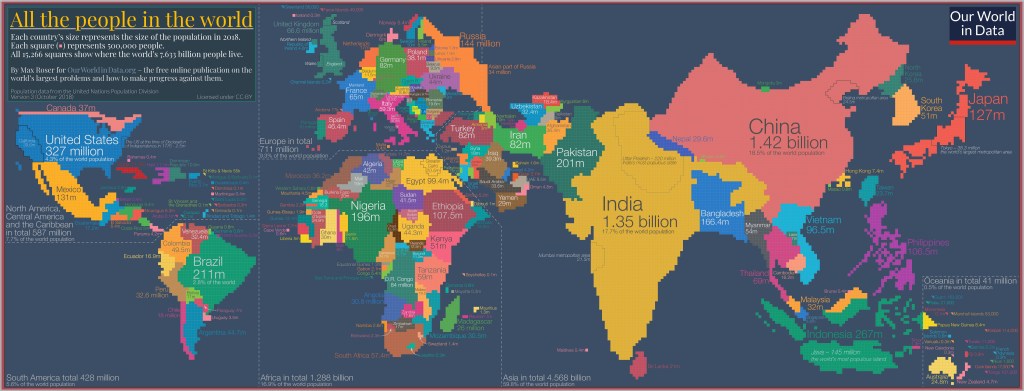
Each country’s size represents the size of the population in 2018. Each little square represents 500,000 people. All 15,266 squares show where the world’s 7,633 billion peopls lived in 2018 (now the world population is 8,244 billion people). Image from our World in Data. By Max Roser for OurWorldinData.org – the free online publication on the world’s largest problems and how to make progress against them.
Population Statistics
Most people know that in recent centuries the world population has grown almost exponentially but is now projected to level off sometime around the middle of this century. Europe is an interesting example. A thousand years ago Europe’s share of the world population was around 14.5%. Then came the scientific revolution and the industrial revolution and by 1900 it was 25%. As other countries around the world became industrialized Europe’s share of the world population shrunk, even though the population of Europe kept increasing, just slower. Now Europe’s share of the world population is 9%.
As countries become wealthier their population growth tends to slow down, not just in Europe, but around the world. The world’s population growth is illustrated by the image from Our World in Data below (starting 5,000 years ago, ending the year 2000) and the six minute YouTube video below from the American Museum of Natural History (starting 100,000 years ago and ending the year 2100). The YouTube video also shows the projected population decline beyond the year 2050.
Population per square kilometer. Source of the original visualization Klein Goldewijk, Beusen and Janssen (2010). Long term dynamic modeling of global population and built-up area in a spatially explicit way: HYDE 3.1. In the Holocene 20(4) 565-573. The original visualization was adapted by OurWorldinData.org
Super fact 56 : The Bermuda Triangle mystery is a myth. There is not a higher risk of disappearances in the Bermuda Triangle. To be specific, disappearances do not occur in the so-called Bermuda Triangle, or Devils Triangle, with any higher frequency than in other comparable regions of the ocean. The “mystery” of the Bermuda Triangle is largely a manufactured one, perpetuated by sensationalized accounts that often misrepresent the facts and downplay the role of natural hazards like storms.
The number of ships and aircraft reported missing in the Bermuda Triangle is not significantly greater, proportionally speaking, than in any other part of the ocean. The U.S. Coast Guard, along with NOAA, the U.S. Navy, Lloyds of London who pays out insurance for ships and aircraft lost/missing at sea, and other organizations do not recognize the Bermuda Triangle as a unique or mysterious geographic hazard. They emphasize that this is a highly traveled area where the losses are consistent with natural phenomena such as strong storms, the Gulf Stream, human error, and poor navigation, rather than any mysterious forces.
Considering all this, the number of disappearances and accidents is what you’d expect. The Bermuda Triangle isn’t any more mysterious than the Greenland square, the New Zeeland circle, or the Azores Octagon, that I just made up. I consider this a super fact because it is very likely true, and yet surprising to many people who are convinced that there really is a mystery. Furthermore, it is important because it is such a well-known myth.
The Bermuda Triangle: It is approximately defined as a triangle Florida, Bermuda, and Puerto Rico. There is no exact definition. Alphaiosderivative work: -Majestic-, Public domain, via Wikimedia Commons.
Bermuda Triangle Mysteries
Just because the risk of disappearances of planes and ships is not higher in the Bermuda Triangle, does not mean that there aren’t mysterious disappearances and mysterious phenomenon occurring in the Bermuda Triangle. Some notable disappearances are USS Cyclops (1918), Flight 19 (1945), Star Tiger and Star Ariel (1948–1949), and the Witchcraft (1967). However, there are mysteries and mysterious phenomena occurring all around the world.
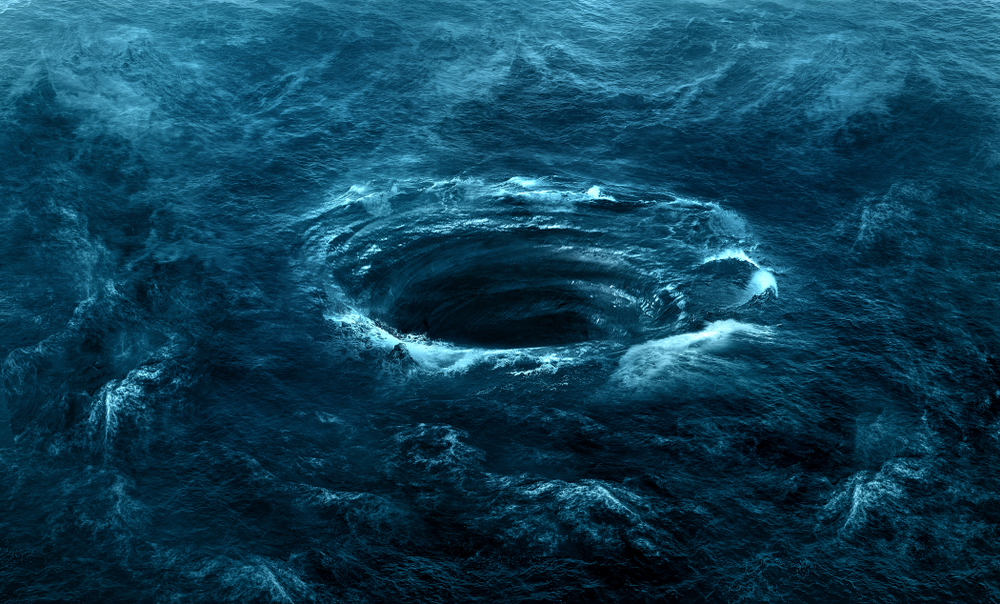
One of the mysterious phenomena occurring in the Bermuda Triangle is ocean swirls, and rogue waves, and methane burps might be another problem, but it is far from unique to the Bermuda triangle, and there are no magnetic anomalies in the Bermuda triangle as often alleged.
Ocean swirls frequently occur all over the world with some famous hotspots for ocean swirls by the coasts of Japan, Norway, Italy, Scotland, and Maine, USA. The ocean swirls in the Bermuda triangle might be due to movement of water between landmasses and/or the Gulf stream, but this is under investigation. There are no known giant or permanent ocean swirls in the Bermuda triangle.
Ocean swirl allegedly in the Bermuda Triangle Asset id: 1158148882 by PHOTO JUNCTION
As mentioned, another mysterious phenomenon is methane bubbling to the surface of the ocean. However, as can be seen in the maps in this National Geographic blog post the source of these methane burps of death aren’t typical to the Bermuda triangle. The methane hydrate field in the first map of the National Geographic blog post is mostly outside of the Bermuda triangle stretching from Cuba and up along the Florida coast. The second map, the world map, shows that these methane hydrate fields exist all around the world.
Our Honeymoon in Bermuda
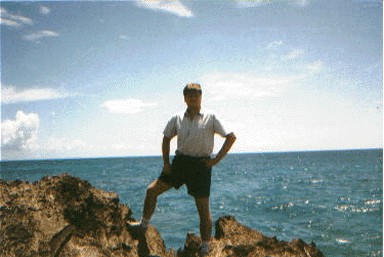
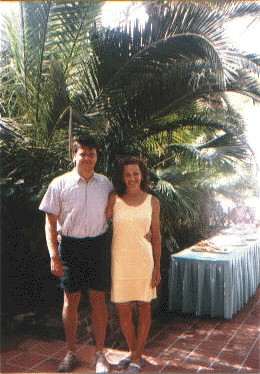
Below are some old photos from our honeymoon in Bermuda in August of 1991.
Super fact 54 : Satellites currently handle a very small percentage of global internet traffic, estimated at about 1%. The vast majority of internet traffic is carried by undersea cables.
I consider this a super fact because it is surprising, true and not trivia. It is an important fact since most of us use internet every day. It is a very common belief that satellites handle most of the global internet traffic, or at least a very large portion of it. I should say that a few years ago I thought so myself.
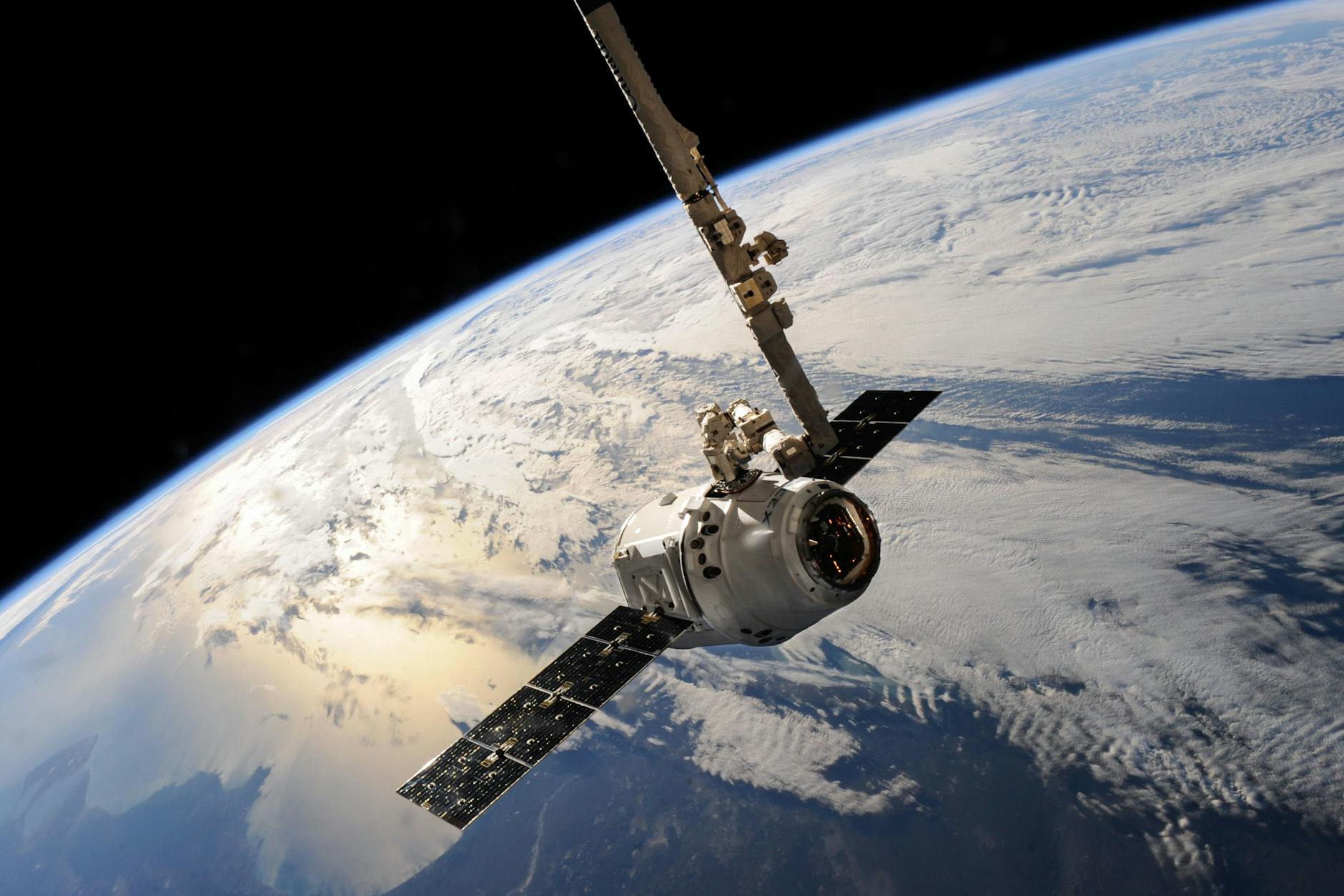
Stock Illustration ID: 1372134458 by Boris RabtsevichSubmarine underwater communication fiber optic cable on deep seabed. Asset id: 2175977719 by Dragon Claws
How Much Internet Traffic is Handled by Satellites
I should say that I did not find a lot of sites that answered this question, but all of the sites that I found gave similar answers such as, less than 1%, 1.5%, 1-2%, very little, etc.
I started out by asking ChatGPT this question “How much of internet communication does Satellites handle?” The answer I got was that Satellites handle a relatively small percentage of global internet traffic — typically less than 1–2% — with most of the world’s internet communication carried through undersea fiber optic cables and terrestrial infrastructure (like cell towers and wired broadband). Wikipedia states that satellites handle less than 5% – to an estimate of even 0.5%. I should add I do not rely on ChatGPT, SGE or Gemini, or Wikipedia for this blog but I take hints from them.
The reason satellite internet is used less is because satellite internet is significantly more expensive to use than traditional wired connections. In addition, satellites have higher latency (delay) compared to fiber optic cables, and less bandwidth (data capacity). Satellite internet is primarily used in remote areas where other forms of internet access are unavailable. Satellite internet is also used for military and government operations, as well as maritime and aviation connectivity. However, satellite internet is improving so this may change in the future. This is a comparison between satellite internet and optical fiber.
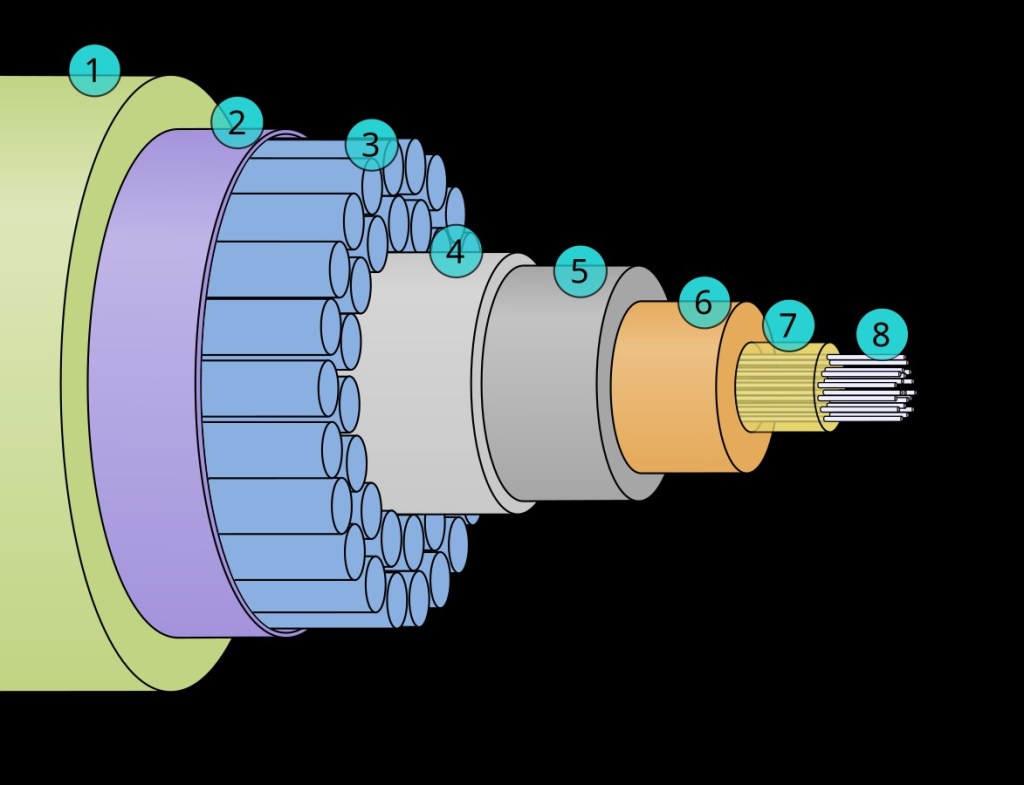
Photo by SpaceX on Pexels.comThis is a cross section of submarine fiber optic cable. Picture by Oona Räisänen (User:Mysid), Public domain, via Wikimedia Commons.
The layers in the picture of the submarine communications cable above are (from outside to inside): (1) Polyethylene (2) Mylar tape (3) Stranded steel wires (4) Aluminum water barrier (5) Polycarbonate (6) Copper or aluminum tube (7) Petroleum jelly (8) Optical fibers.
Super fact 53 : The Euler number denoted e, is an irrational number, which like the number pi is extremely important in mathematics. In addition, the relationship between the Euler number and pi; seemingly unrelated numbers, is quite amazing, especially if you throw the imaginary number: i = square root of -1 into the mix. Euler’s formula e^ix = cos(x) + isin(x), where x is degrees expressed in radians, is mind blowing to say the least. Radians means that 180 degrees is replaced by pi, and 90 degrees is replaced by pi/2, etc. A simpler special case, but equally amazing is Euler’s identity e^ix = -1, or e^ix + 1 =0. This is amazing math assuming you understand it.
As I said all this is amazing, mind blowing if you will, if you understand it, which is why I will try to explain it. Why I consider this a super fact is because when you first encounter the Euler number and the Euler formula, and you somewhat understand what it means, it is likely to be a mind-blowing experience. Those among you who have studied higher math, AP math classes in high school, or college level math are probably familiar with what I am about to describe, so your mind may not be blown. By the way you pronounce Euler like “Oiler”.
Euler’s formula in cyber space with grid 3d illustration, Asset id: 1636161301 by Giggle2000
Euler’s Number and Pi Two Irrational Numbers
Pi is the number you get when you divide the distance around a circle (the circumference) by the distance across the middle (the diameter). The Euler number is a bit more complicated to explain. I will do that next. Both pi and the Euler number are irrational numbers, which means that when written as a decimal, the number neither terminates nor repeats. As I mentioned, both pi and the Euler number are extremely important numbers in math. Perhaps the Euler should have its own day, just like pi has its own day (March 14). Maybe we should start celebrating Euler number day on February 7.
The first 20 decimals of pi and of the Euler number.
Exponents
Before I explain what, the Euler number is, I need to explain what an exponent is. If you multiply a number by itself x number of times, then x is the exponent. If you multiply two by itself four times 2*2*2*2, called 2 raised to 4, then 4 is the exponent. By the way the answer is 2^4 = 16 (called 2 raised to 4 is 16). I hope the illustration below will explain it.
Overview of exponents.
And finally, before explaining what the Euler number is I should also mention what a factorial is. The factorial of a number is the product of all positive integers less than or equal to that number. The factorial of 5 is denoted 5! and is 1*2*3*4*5 = 120. Also, the factorial of 0 or 0! = 1 (per definition).
Definition of the Euler Number
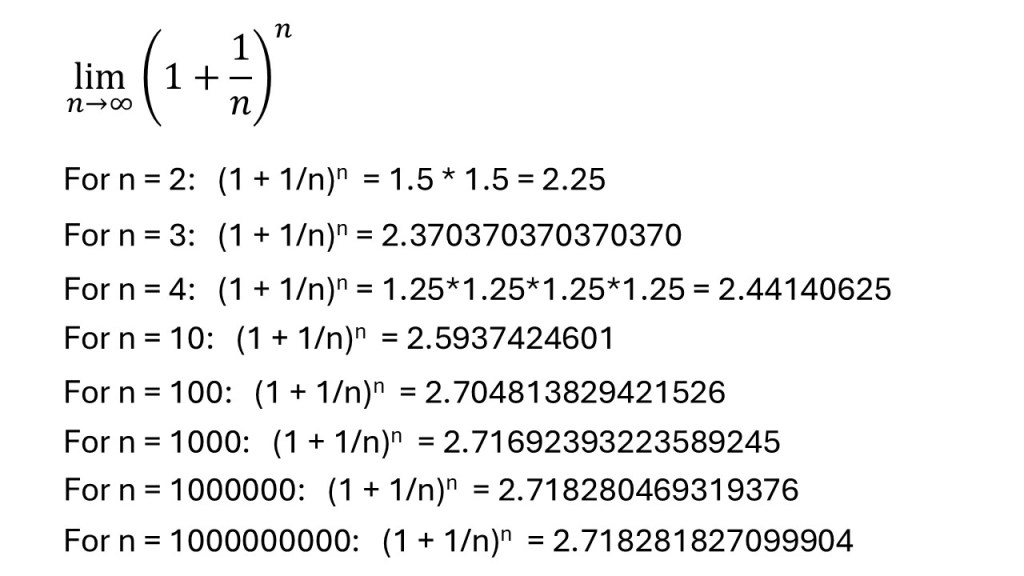
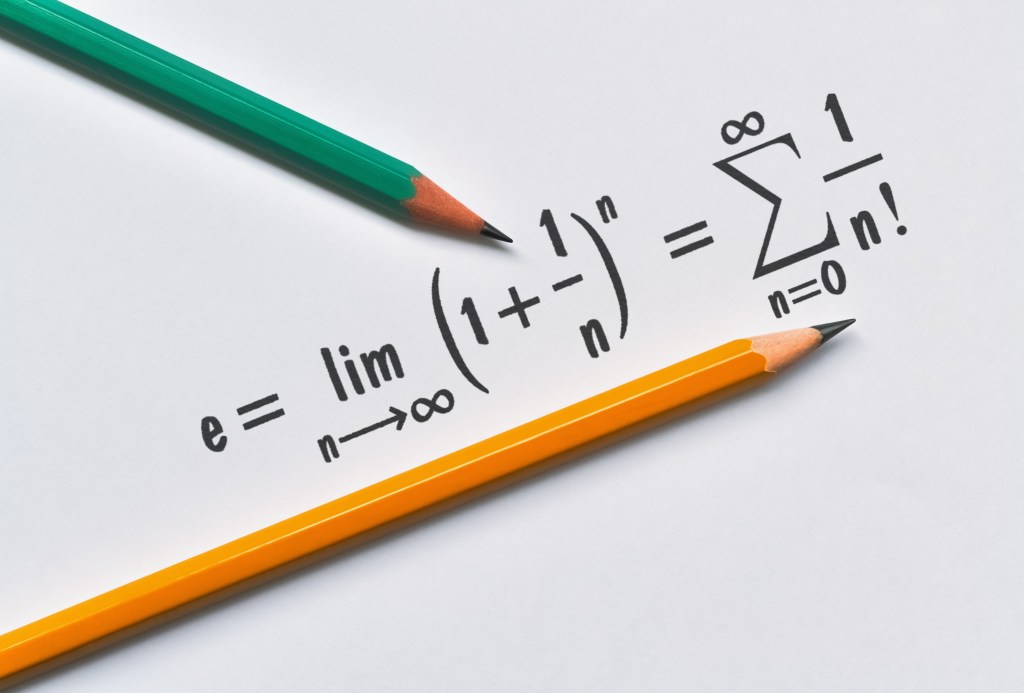
One more thing I need to explain before I go ahead with the definition for the Euler number is what is meant by allowing a number n in a formula to go towards infinity (limit –> infinity). Let’s say you have a formula that contains the number n. If the value of the formula does not change much as n becomes very large than it might be approaching a specific number as n approaches infinity. You say that it approaches a limit. I am trying to illustrate this in the picture below.
As the number n gets bigger the formula stops getting bigger and instead approaches a limit. When n approaches infinity that will be a very specific number. Which number do you think it is?The definition of Euler’s number plus an infinite series sum that is also the same as Euler’s number.Definition of the Euler’s constant in two different ways, Asset id: 1227561829, by benjaminec.
Euler’s Number in Calculus
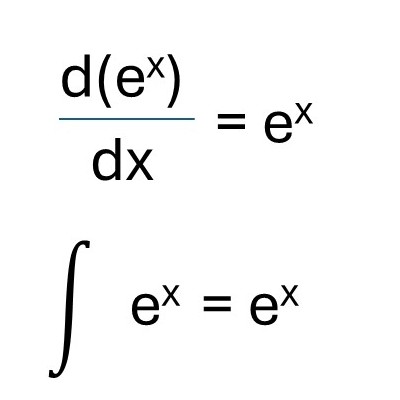
As I mentioned, Euler’s number shows up in mathematics in a lot of places. It is an extremely useful number with some amazing properties and that includes calculus. However, explaining functions and calculus may be going a bit too far, so I am just going to simply state that the derivate of e^x is just e^x and the indefinite integral, or the anti-derivative of e^x is e^x. In other words, differentiation / integration does not change this function. It also means that the slope of the curve is the same as the curve itself. Among all the infinite number of functions this is only true for e^x.
Differentiation and integration does not change the function e^x.
Trigonometric Functions
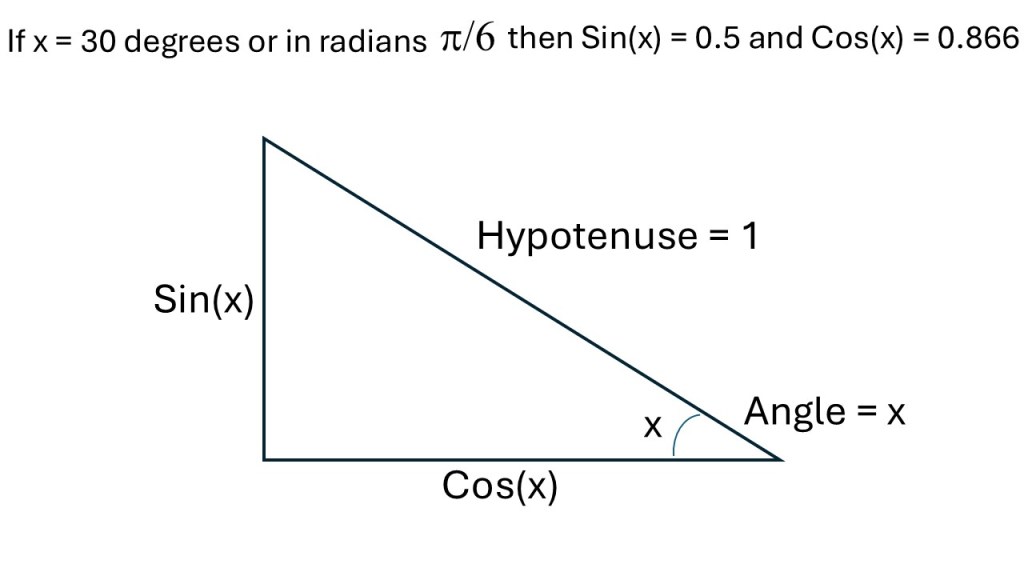
Next, I would like to launch into Euler’s formula. However, before I do that, I need to explain what trigonometric functions and imaginary numbers are. The trigonometric function sin(x) is the ratio of the length of the side opposite to a given angle to the length of the hypotenuse. In other words, if the hypotenuse is equal to 1, then sin(x) is the length of the opposite side to the given angle. The trigonometric function cos(x) is the ratio of the side of the triangle adjacent to the angle divided by the hypotenuse. In other words, if the hypotenuse is equal to 1, then cos(x) is the length of the adjacent side to the given angle.
Sin and cos are always between 1 and -1. ‘x’ is often expressed in degrees going from 0 to 360 (or 0 to 90 in a right-angled triangle). However, there is another way to express angles in triangles and that is radians. In this case the number pi corresponds to 180 degrees, pi/2 corresponds to 90 degrees, pi/4 corresponds to 45 degrees, etc. Euler’s formula uses trigonometric functions, but it only works if you use pi instead of degrees. Pi and Euler’s number have a special relationship. Sin and cos are illustrated in the picture below.
Illustration of the trigonometric functions sin(x) and cos(x).
Imaginary Numbers
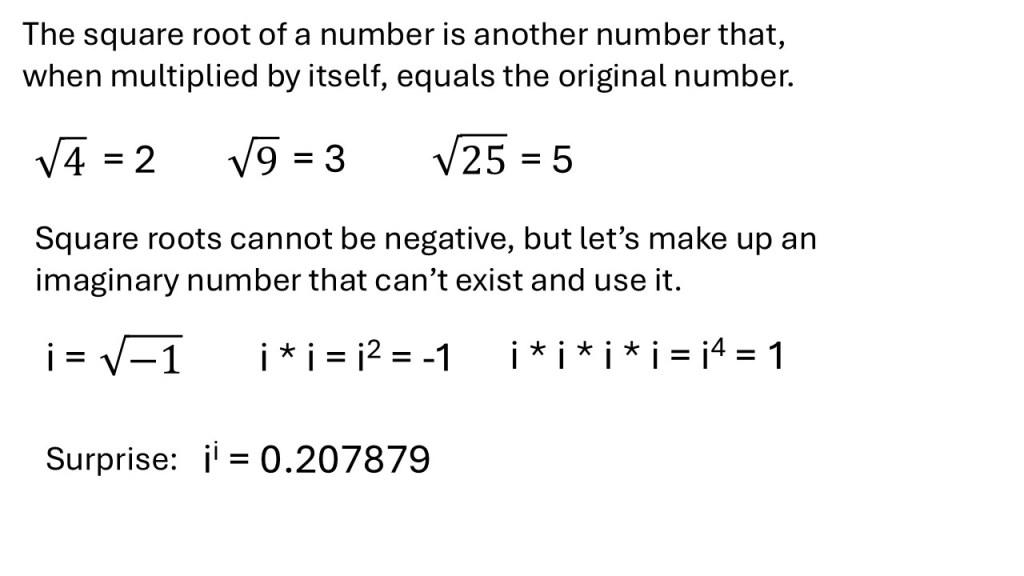
The last thing I need to explain before demonstrating Euler’s formula is imaginary numbers. The square root of a number is another number that, when multiplied by itself, equals the original number. For example, the square root of 4 is 2, because 2 * 2 = 4. The square root of 9 is 3, because 3 * 3 = 9. As long as you deal with real numbers, square roots must be positive numbers because you cannot multiply two numbers and get a negative number. -2 * -2 is 4, not -4.
However, that did not stop some mathematicians from making up a square root that was negative. This imaginary number is the square root of -1 and is referred to as i, yes just i, for imaginary. So, what’s the point of making up numbers that can’t exist? Well, it turned out to be quite useful and you can manipulate imaginary numbers to result in real numbers. For example, if you multiply the imaginary number i by itself i*i you get -1. If you multiply i by itself four times, in other words i^4, or i raised to 4, you get 1. Even more impressively, i raised to i, or i^i, is a real number. i^i = 0.207879… This is illustrated in the picture below.
Imaginary numbers illustrated
Eulers Formula
Without giving the proof, or any detailed explanations, below is Euler’s identity and Euler’s Formula (e^ix = cos(x) + isin(x)). Notice the mix of Euler’s number, pi, the trigonometric functions using radians (based on pi), and the imaginary number. Well, likely mind-blown, if you have not seen it already and you understood this post up to here.
Euler’s identity and Euler’s formula.Euler’s formula illustrated in the complex plane. Asset id: 2345669209 by Sasha701
If you want to see how you prove Euler’s Formula check out this youTube video.
If you want to learn more about the importance of Euler’s number in sommon and useful mathematics, check out this youTube video.
This is my 100th post on my Superfactful blog. There are 50 super-fact posts. The other posts are posts about the blog, like this one, or posts featuring interesting information that I think is important, or book reviews of non-fiction books, travel posts with some information, posts about me, or mysteries.
However, the goal of this blog is to create a long list of facts that are important, not trivia, and that are known to be true and yet are either disputed by large segments of the public or highly surprising or misunderstood by many, perhaps shocking. Learning or accepting such a fact will change how you view the world. This makes these facts deserving of special attention, which is why I refer to them as super facts. You can also consider the super facts as a form of myth busting, major myth busting.
As mentioned, at the time of writing this I have come up with 50 super facts and made 50 posts about those super facts, but I am hoping to come up with hundreds. I am open to suggestions for super facts as well as critique of super facts. Tell me if you think it is trivia, not important, not surprising, or not an established fact. To see the first 50 super facts click here.
Smash your old beliefs with new surprising facts, super facts. Expand your mind. Shutterstock ID: 1685660680 by MattL_Images
Deciding on What is an Important Fact
Deciding what is an important fact or not is subjective, but for the same reason it also makes it an easy thing to decide. Ultimately, I decide what is important. It is difficult to compare the importance of facts, but my main concern is to avoid trivia. I also try to avoid facts that may be important to me but do not concern others very much.
For example, I am looking for facts that people discuss a lot, or are often mentioned in the mainstream media, or facts that people dispute fiercely despite a scientific consensus and overwhelming evidence telling us what is true. I am looking for facts from science that could change people’s perspective on nature, our world, or the universe, or facts that could change people’s view of the world, that are related to important historical events, such as the deaths of millions of people, etc.
Shocking Facts
Deciding whether a fact is highly surprising, misunderstood by many, shocking, or contentious and disputed is also not an exact science. In some cases, there are polls stating how common a certain belief is amongst the public but in most cases (that I consider) I have no polls to fall back on. I just have to use my judgment. In some cases, almost everyone I’ve spoken to about the subject is misinformed, bamboozled, or they misunderstand it. In other cases, I need to decide based on my impression. I have to guess.
Super facts can be surprising, shocking, or something you refuse to believe, and yet they are true. Photo by Andrea Piacquadio on Pexels.com
Finding the Truth
As I mentioned, deciding on what is important or highly surprising is not an exact science. I think that is OK. There’s going to be super facts that are impressive and some that are less so. However, the third criteria is the one thing that I need to get right, and that is whether the fact is true or not.
We humans are not very rational, and we often believe with intense conviction things which are false. I think that is true for all of us. We don’t know what those false beliefs are, otherwise, we wouldn’t have them. However, this is where the super facts can come in handy, as tools for personal growth if we are willing to change our minds in the face of new evidence. This is easier said than done since we are emotional beings embedded in our culture, our tribal attachments and favorite myths. We have biases, we jump to conclusions, we overestimate our understanding of subjects we don’t know much about (see the Dunning Kruger effect), and we tend to believe what we want to believe. That goes for me too.
Adding to the difficulty on deciding what is true is the fact that the internet and especially social media is full of misinformation. There are an enormous amount of YouTube videos, podcasts, and websites touting false claims, conspiracy theories, and pseudo-science. There are political think tanks deceiving the public and industry funded organizations spending billions of dollars on misinformation, as well as people claiming to have special insights and superior knowledge.
I see the most ridiculous claims on Facebook and Instagram on a daily basis and the amazing thing is that people fall for it. If it supports their pre-existing beliefs or opinions, they see it as proof or conclusive evidence and they don’t take the time to question the source. When I see this, I often point out that the source is not reliable, or it may even be a satirical site, and I often add something from Snopes to my comment assuming they’ve investigated it.
Sure, when I do this, I am raining on someone’s parade, and it is quite often not welcome. No matter how politely I try to explain the situation I end up getting insulted or blocked. I should say, I’ve also fallen for fake information myself, but I try to accept it when someone points it out to me using reliable sources. The point is, we humans are really bad at deciding what is true, and we underestimate how bad at it we are, and deciding what is true is often a quite challenging task.
Before I publish a super fact, I need to be fairly certain that it is true. Outside of mathematics and logic you cannot be 100% sure about anything, but some facts we can say with very high certainty are true. For example, the earth is not flat like a pancake, the Sun is bigger than the earth, the capital of the United States is Washington DC, the heart pumps the blood, we breathe oxygen, carbon dioxide is a greenhouse gas, the light speed in vacuum is a universal constant, time dilation is real, Cesium-137 is radioactive, etc. Most likely you only know a very tiny fraction of a percentage of the facts that we know to be true with very high certainty. Some of those facts will surprise you, shock you, or are facts you would like to dispute, and I call them super facts.
Determining What Facts Are True
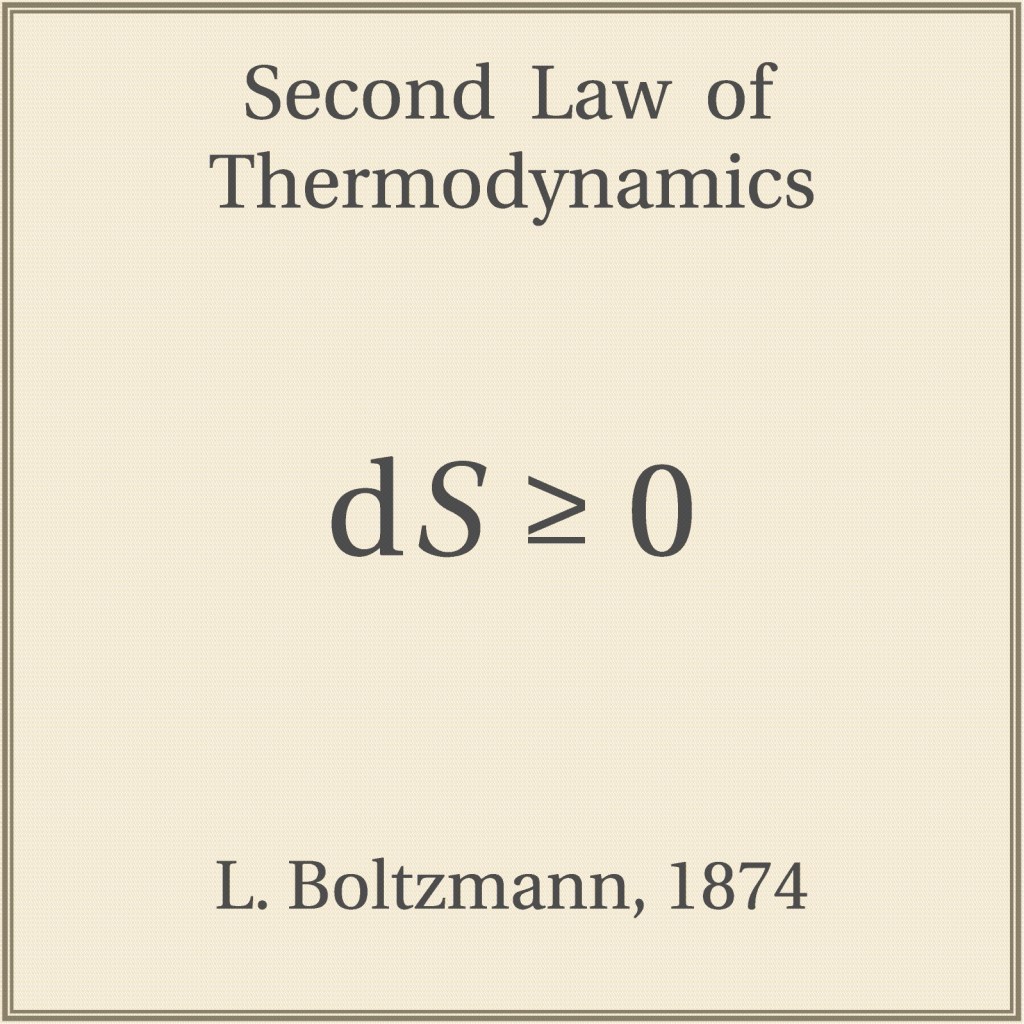
When I determine whether something is true with a high degree of certainty I start with my own expertise. For example, when someone claims that the second law of thermodynamics (entropy) contradict evolution I know that to be false because I have a degree in physics (master’s degree) and I’ve taken several classes in thermodynamics and statistical mechanics. In addition, I am very familiar with the faulty argumentation behind the claim because I’ve read dozens of creationist books. Yes, I was once bamboozled by creationism myself. Then I learned more about science, evolutionary biology, physics and thermodynamics.
Second law of thermodynamics Shutter Stock Vector ID: 2342031619 by Sasha701
However, my personal expertise is not enough. I also find out about scientific consensus or expert consensus and evidence from reliable sources. I should say that using scientific consensus as a reliable indicator that something is true does not fall under the “appeal to authority fallacy”. The “appeal to authority fallacy” refers to appealing to influential people or organizations who may not necessarily be experts, and regardless of the evidence. In science you don’t really have authorities, you have experts who often disagree with each other. In the event almost all experts agree on a certain fact that has been thoroughly vetted you can trust that fact with nearly 100% certainty, and that is not appeal to authority but a probability argument.
I typically select several reliable sources such as research papers published in respectable journals, national academies, government websites such as NASA, NOAA, EPA, FBI, respected research organizations such Our World in Data, Pew Research Center, and academic publications and books. I make sure that they various sites I find don’t contradict each other regarding my prospective super fact. If they all seem to agree I accept the super fact and include a few of the links in my post.
If I don’t have much personal expertise on a subject I start out by asking Google AI. I don’t ask ChatGPT because I believe it is less reliable with respect to information. Then I check Wikipedia and or another online encyclopedia such as encyclopedia Britannica. This is not to establish the truth but to get an idea. Wikipedia is not an academically acceptable source, but it is rarely wrong and serves as a good first filter to save time. Then I start focusing on the reliable sources above and I will make sure I understand the evidence.
So, in summary I will use my expertise, scientific consensus, reliable sources and better, agreement between reliable sources, to determine if I can say with confidence that something is true. I will also frequently include links from Wikipedia in my posts because Wikipedia typically feature good summaries that are easy to understand. Naturally, anyone is free to dispute any of my super facts. Just make sure you provide good evidence from an arguably reliable source, or I cannot take it seriously.
Fact or myth. Shutterstock Asset id: 2327968607
Sources I will not consider are claims from unreliable sources, political think tanks, talk show hosts, politicians, articles written by contrarians heavily funded by industry or political organizations, and random Reels or YouTube videos, and I will not entertain conspiracy theories for my purposes. Also, I will ignore, articles with click bait titles, sources making claims about a great swindle by the scientific community, articles claiming everyone is lying to you, articles purporting to reveal the hidden truth, articles insisting on presenting the truth that “they”/the-others won’t tell you, etc. Cults will tell you that everyone else is lying to you. I’ve learned not to fall for it at this point.
My Super Fact List
Finally, here are a few examples of my super facts.














 Super Facts