The goal of this blog is to create a long list of facts that are important, not trivia, and that are known to be true yet are either disputed by large segments of the public or highly surprising or misunderstood by many.
Author: thomasstigwikman
My name is Thomas Wikman. I am a software/robotics engineer with a background in physics. I am currently retired. I took early retirement. I am a dog lover, and especially a Leonberger lover, a home brewer, craft beer enthusiast, I’m learning French, and I am an avid reader. I live in Dallas, Texas, but I am originally from Sweden. I am married to Claudia, and we have three children. I have two blogs. The first feature the crazy adventures of our Leonberger Le Bronco von der Löwenhöhle as well as information on Leonbergers. The second blog, superfactful, feature information and facts I think are very interesting. With this blog I would like to create a list of facts that are accepted as true among the experts of the field and yet disputed amongst the public or highly surprising. These facts are special and in lieu of a better word I call them super-facts.
“Supermoon October 2024” is not a super-fact post but some fun facts about the Moon. It is a super-moon post instead.
As many of you probably have read, we currently have a so-called supermoon (October 17 & October 18). The moon’s orbit around earth is not a perfect circle but slightly elliptical. Therefore, the moon’s distance to earth varies.
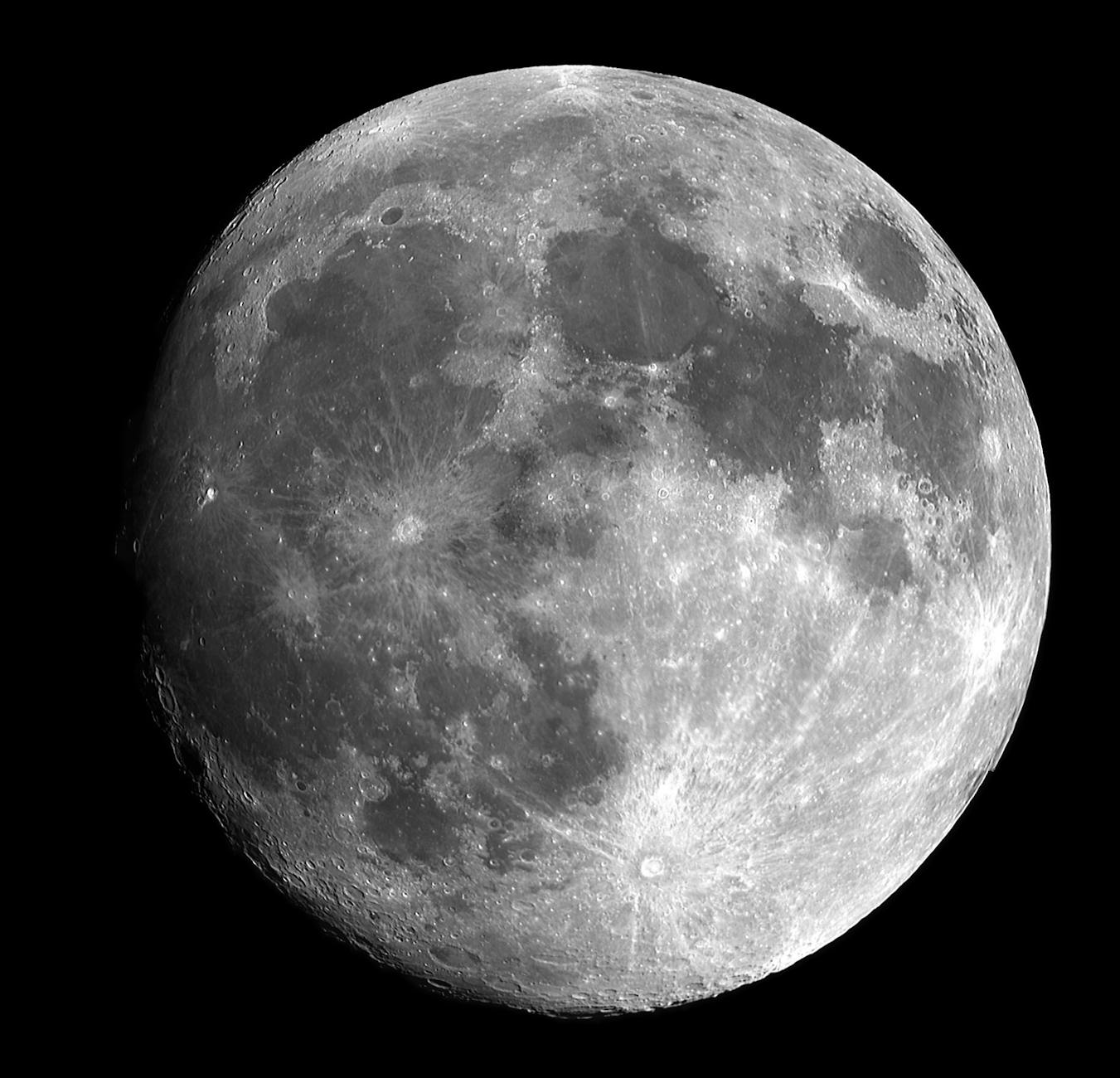
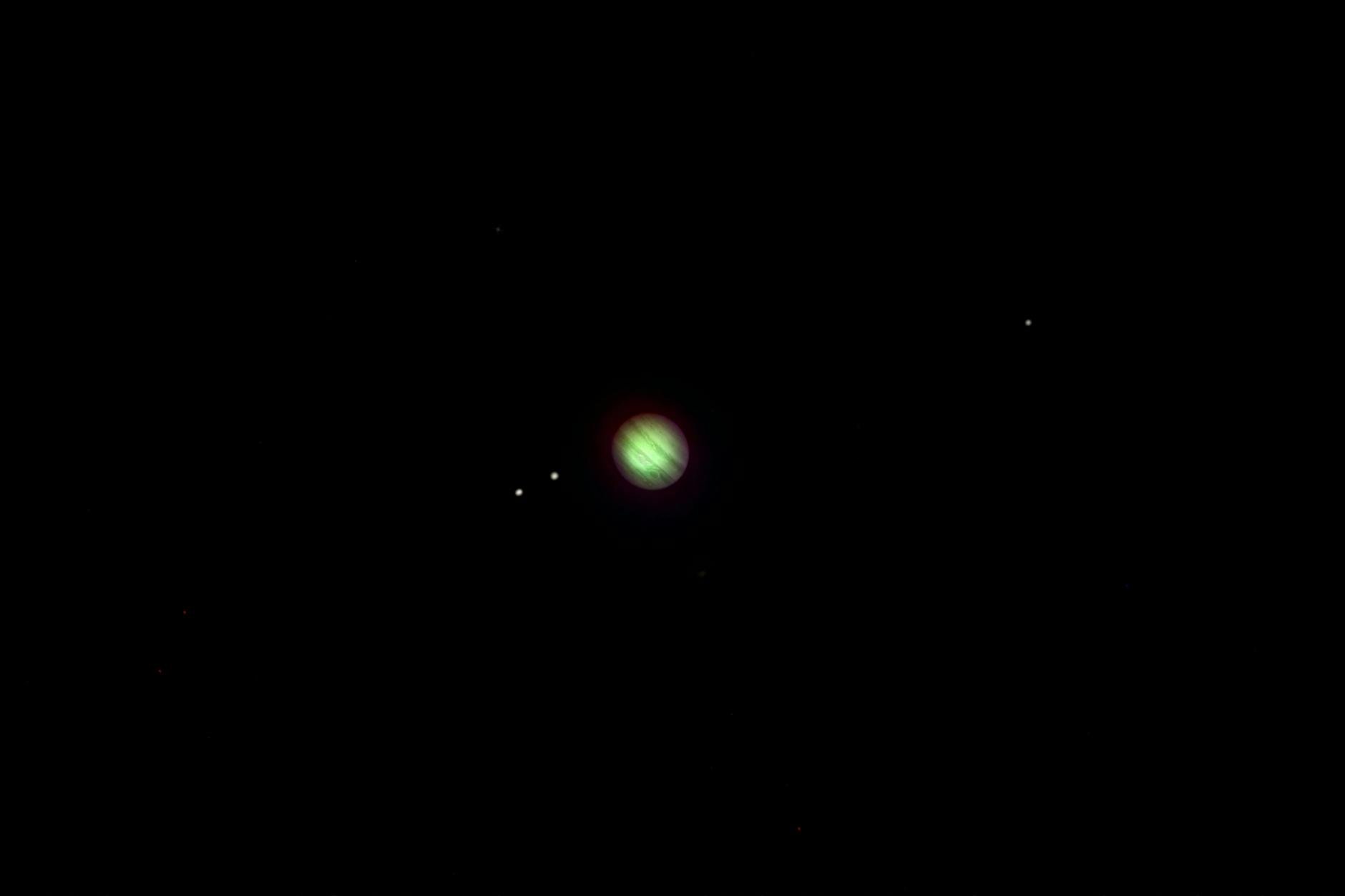
A supermoon is when a full moon occurs when the moon is at its closest point to Earth, called perigee, making it appear larger and brighter than usual. Or more correctly, the term supermoon is usually used to describe a full moon that comes within at least 90% of the perigee. Since this is a special moon event, I took out my little telescope and looked at the moon and its craters. I also took a look at Jupiter, and I saw three of the four Galilean moons.
Photo by Pixabay on Pexels.comThe green speck is Jupiter. The three little dots are three of the four Galilean Moons. I roughly saw this in my telescope an hour ago, but it is not my photo. Photo by Raoni Aldrich Dorim on Pexels.com
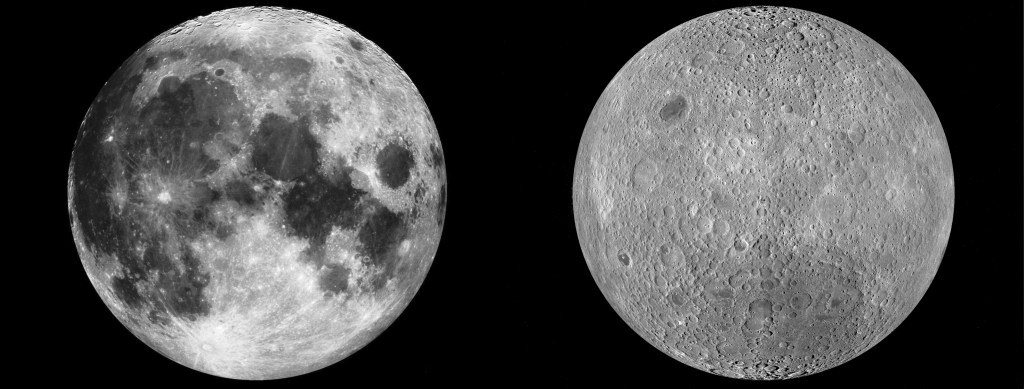
This is a very common misunderstanding. The moon is always showing the same side towards us (or almost exactly the same side). When there is a full moon the backside, or far side, of the moon is dark, but that is not the case when the moon is half, or a crescent, etc. When the moon is new, the far side / backside is “full” from sunlight. If you wondered, NASA and other space agencies have photographed the far side of the moon.
The near side of the Moon and the far side of the Moon. Comparison between the two hemispheres of the Moon. Elements of this image were furnished by NASA. Stock Photo ID: 2157518223 by Claudio Caridi.
Below is a youTube video showing an animation composed of actual satellite photos by NASA.
A few comments about this animation. You see no stars because the sun is shining, and the earth is also quite bright. The reason you don’t easily see stars during the day is not because the sky is blue but because there is too much light to see them. The sun ruins the starry sky. In addition, stars are not easily captured by cameras when there is ambient light. And again, of course, contrary to the belief of some, the backside of the moon is not always dark.
The far side of the moon is different
As you can see in the YouTube video and the enhanced photo above, the far side looks different from the nearside and it is different in appearance and terrain. The near side of the moon has large, dark, flat-lying basins called maria. They look like oceans. The far side is a lot more rugged and covered by lots of craters. Another difference is that the far side of the moon has a much thicker crust compared to the near side.
The moon is drifting away from earth at about 3.8 centimeters per year
The moon is moving away from earth due to the gravitational forces between the moon and earth, which also causes tidal bulges in the Earth’s oceans and the moon. Back in high school I took a physics test on which you had to calculate how much the moon was moving away from earth based on the size of the tidal waves on earth. I did not solve that one, but not many did. The calculation made perfect sense though and some geniuses got it.
NASA found water on the moon
In 2020, NASA announced the discovery of water on the sunlit surface of the Moon. You can read about it here.
The moon was likely created by a celestial collision : The most widely accepted explanation for the existence of the moon is that the Moon was created when a planet-like object, the size of Mars slammed into Earth, soon after the solar system began forming. That was about 4.5 billion years ago.
“Nonsense and Rumors About Wind Power” is not a super-fact post but just what I consider interesting information regarding nonsense and rumors about wind power.
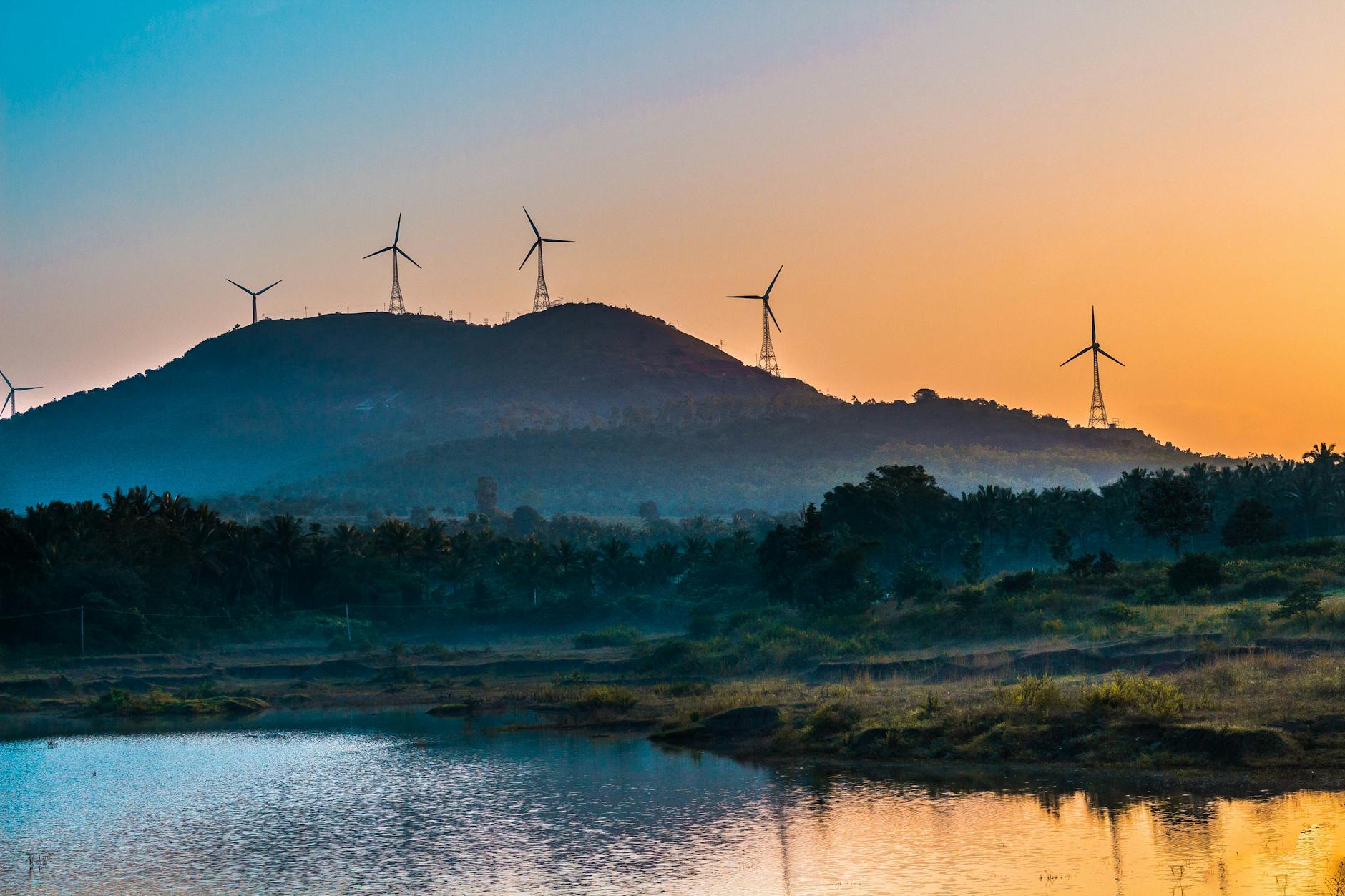
Wind power has been on the receiving end of false claims, nonsense, and strange rumors for a while. It is not the only energy source maligned by false information. Another example is Nuclear Power. However, this post is about some of the incorrect claims about wind power that I have come across. I am starting out with three bizarre claims.
False claim : Wind Power requires an additional power source to operate (like a diesel engine)
This bizarre claim is akin to saying that sailboats need a diesel motor to sail. If you get something to rotate (a turbine), whether it is pushed by running water, wind, or an engine, and you connect it to a coil in a magnetic field (generator), you get electricity. This is high school physics. You don’t need anything else. It is the principle behind hydro power, nuclear power, coal power, gas power, and wind power.
For a wind power station, the moving air rotates the wind turbine’s blades. That turning motion spins a generator just downwind from the blades (or rotor) in the nacelle, which also stores all the other working parts of a turbine. The generator produces electricity. When you read about how wind power works it says nothing about an additional power source needed (or click here).
For fun let’s also ask Google AI : Does wind power use other energy sources while operating?
Google AI: No, wind power itself does not use any other energy sources while operating; it solely harnesses the kinetic energy from the wind to generate electricity, meaning it only relies on wind to function as its primary energy source.
However, it should be noted that wind power is intermittent, so if it is part of a power grid other power sources or energy storage/batteries may need to be used more when wind speeds are too low to generate electricity.
Also, as is true with any power source, energy is needed when constructing wind power plants. In addition, a small amount of external electricity may be needed for startup and maintenance. It is possible that these facts were misunderstood and turned into “Wind Power requires an additional power source to operate” by confused listeners.
False claim : Wind Power generates less power than it consumes
This is another bizarre claim made by confused politicians (here in Texas). If wind power generated less power than it consumed, why would anyone invest in it?
The Institute of Environmental Management and Assessment (IEMA) states that the average wind farm will pay back the energy that was used in its manufacture within 3-5 months of operation. This article in the journal Renewable Energy found that the average windfarm produces 20-25 times more energy during its operational life than was used to construct and install its turbines. It included data from 119 turbines across 50 sites going back 30 years.
For fun let’s ask ChatGPT this question : Does wind Power generate less power than it consumes?
ChatGPT : Wind power does not consume more energy than it generates. In fact, wind power is one of the most efficient and sustainable energy sources available. The energy required to manufacture, install, and maintain wind turbines is small compared to the energy they produce over their lifespan. This is known as their energy return on investment (EROI), which is quite favorable for wind energy.
False claim : The sound from wind power stations cause cancer
Donald Trump stated on April 2, 2019, in a speech to the National Republican Congressional Committee that “The noise (from windmills) causes cancer.” A poll was conducted in Iowa, a state where wind power is thriving and only 1% of registered voters agreed with Trump that wind turbines cause cancer, 84% disagreed and 15% did not know. So, it is not a widespread belief, but it does exist. The claim was quickly debunked by the American Cancer Society.
On the contrary, the pollution from the fossil fuel power plants that wind power will likely replace causes cancer.
Just for fun let’s ask ChatGPT this question : Does windpower cause cancer?
ChatGPT : No, wind power does not cause cancer. There is no scientific evidence to support the claim that wind turbines or wind energy have any connection to causing cancer. This misconception might stem from misinformation or misunderstandings about how wind turbines work. Wind power is a clean and renewable energy source, and studies have shown that it does not pose significant health risks.
Some people have raised concerns about possible health effects from wind turbines, such as “wind turbine syndrome,” which includes symptoms like headaches or sleep disturbances attributed to the noise or vibrations of turbines. However, extensive studies have not found conclusive evidence to support these claims either. The noise levels and vibrations from wind turbines are generally well within safety limits set by health and environmental standards.
Next, I am going to focus on three claims which are partially true but that are greatly exaggerated and need to be understood in context.
False claim : Wind power kills an enormous amount of birds causing an environmental disaster
Wind power killing birds is often presented as if it is a huge environmental problem and only a problem for wind power. When presented this way it is false. A study made in 2012 claimed that fossil fuels killed 24 million birds per year in the US, which correspond to 35 times more birds per GWh than wind power kills. That means that wind power saves the life of birds as it replaces fossil fuels.
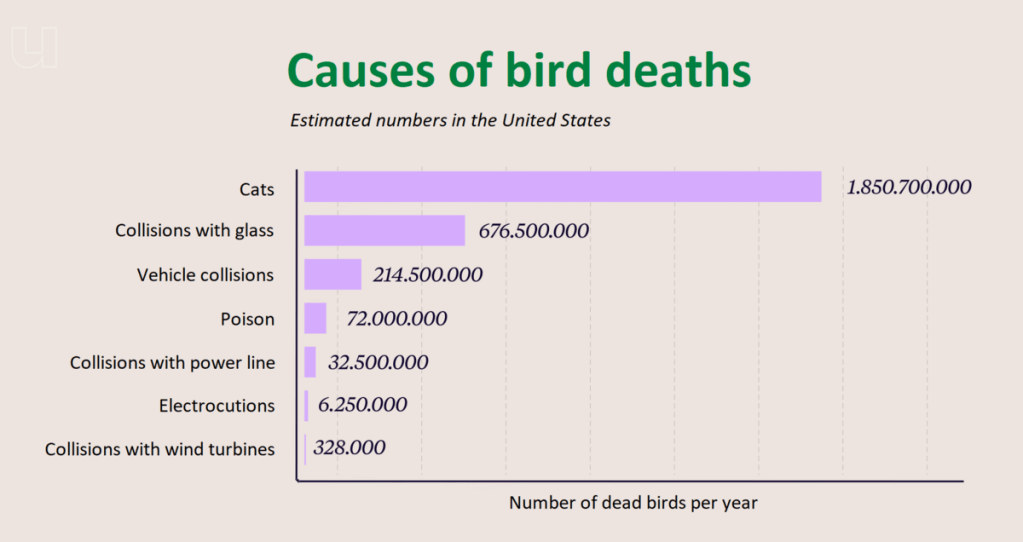
In addition, the biggest bird killer is not fossil fuels but cats. Cats kill 5,600 times more birds than wind power stations and 77 times more birds than fossil fuels. See the graph from Wikipedia below. The problem with wind power plants killing birds should be addressed (and has been addressed) but let’s be honest about the scale of the problem.
False claim : Wind power is only a marginal energy source
Wind power currently accounts for around 7.8% of the world’s electricity up from 3.5% in 2015 and 1.63% in 2010. Wind power accounts for 10% of US electricity and 57.7% of Denmark’s electricity. It may also some as a surprise to some that in the fossil fuel capital of the world, the great state of Texas, where I live, wind represented 28.6 percent of the energy generation in 2023, second only to natural gas (41.8 percent). That is not a marginal energy source.
I can add that Texans are in general not favorable towards wind, and the local politicians are hostile towards wind. Fossil fuel is after all our bread and butter. Why wind power is so prominent in Texas is because of the Texas ERCOT system in which energy sources compete on price and the cheapest always goes first. In practice that means wind goes first.
Wind power used to be expensive. It has been and still is subsidized by the government, but that is basically true for all energy sources, not just wind. Below is the average unsubsidized levelized cost of energy according to Lazard (from Wikipedia). Notice that the light blue line indicates that wind power is pretty cheap.
“The Nobel Prize in Physics and Neural Networks” is not a super-fact but just what I consider interesting information
The Nobel Prizes are in the process of being announced. The Nobel Prize in Physiology or Medicine, Chemistry, Physics and Literature have been announced and the Nobel Prize in Peace will be coming up at any minute. The Nobel Prize in Economics will be announced October 14.
The Nobel Prize in Peace tends to get the most attention but personally I focus more on the Nobel Prizes in the sciences. That may be because of my biases, but those prizes also tend to be more clearcut and rarely politized. Nobel Prize in Peace is announced and given in Oslo, Norway, and all the other prizes are announced and given in Stockholm, Sweden.
Nobel Prize In Physics
What I wanted to talk about here is the Nobel Prize in Physics given to John J. Hopfield and Geoffrey J. Hinton. They made a number of important discoveries in the field of Artificial Intelligence, more specifically neural networks. This is really computer science, not physics. However, they used tools and models from physics to create their networks and algorithms, which is why the Nobel committee deemed it fit to give them the Nobel Prize in Physics.
Perhaps we need another Nobel Prize for computer science. It is also of interest to me because I’ve created and used various Neural Networks myself. It was not part of my research or part of my job, so I am not an expert. For all of you who are interested in ChatGPT, it consists of a so-called deep learning neural network (multiple hidden layers) containing 176 billion neurons. By the way that is more than the 100 billion neurons in the human brain. But OK, they aren’t real neurons.
So, what is an artificial neural network?
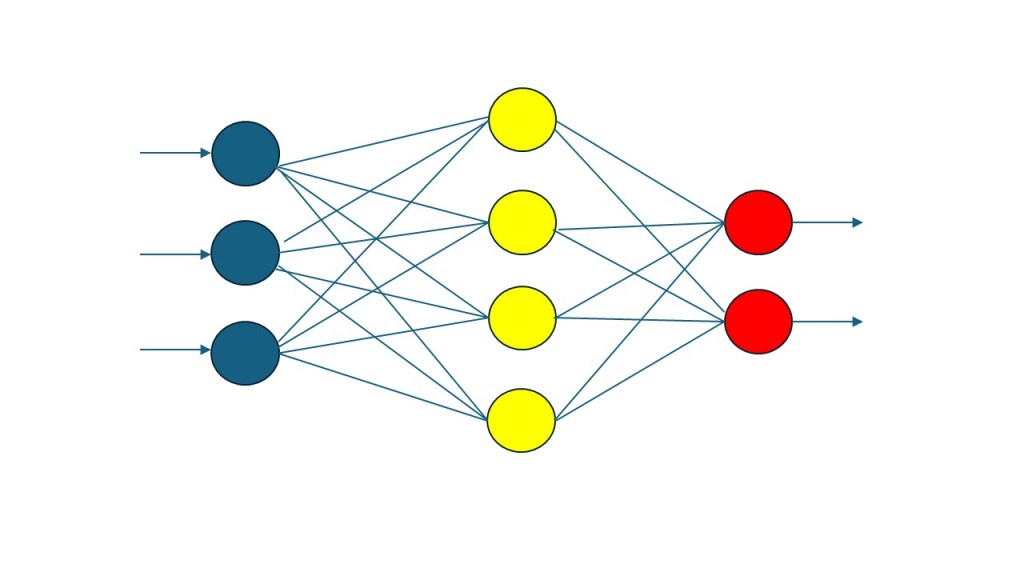
A simple old-style 1950’s Neural Network (my drawing)
The first neural networks created by Frank Rosenblatt in 1957 looked like the one above. You had input neurons and output neurons connected via weights that you adjusted using an algorithm. In the case above you have three inputs (2, 0, 3) and these inputs are multiplied by the weights to the outputs. 3 X 0.2 +0 + 2 X -0.25 = 0.1 and 3 X 0.4 + 0 + 2 X 0.1 = 1.4 and then each output node has a threshold function yielding outputs 0 and 1.
To train the network you create a set of inputs and the output that you want for each input. You pick some random weights and then you can calculate the total error you get, and you use the error to calculate a new set of weights. You do this over and over until you get the output you want for the different inputs. The amazing thing is that now the neural network will often also give you the desired output for an input that you have not used in the training. Unfortunately, these neural networks weren’t very good, and they often failed and could not even be trained.
In 1985/1986, Geoffrey Hinton, David Rumelhart and Ronald J. Williams presented an algorithm applied to a neural network featuring a hidden layer that was very successful. It was effective and guaranteed to learn patterns that were possible to learn. It set off a revolution in Neural Networks. The next year, in 1987, when I was a college student, I used that algorithm on a neural network featuring a hidden layer to do simple OCR (optical character recognition).
Note that a computer reading an image with a letter is very different from someone typing it on a keyboard. In the case of the image, you must use OCR, a complicated and smart algorithm for the computer to know which letter it is.
A multiple layer neural network with one hidden layer. This set-up and the associated backpropagation algorithm set off the neural network revolution. My drawing.
In the network above you use the errors in a similar fashion to the above to adjust the weights to get the output you want, but the algorithm, the backpropagation algorithm is very successful.
Below I am showing two 10 X 10 pixel images containing the letter F. The neural network I created had 100 inputs, one for each pixel, a hidden layer and then output neurons corresponding to each letter I wanted to read. I think I used about 10 or 20 versions of each letter during training, by which I mean running the algorithm to adjust the weights to minimize the error until it is almost gone.
Now if I used an image with a letter that I had never used before, the neural network typically got it right even though the image was new. Note, my experiment took place in 1987. OCR has come a long way since then.
Two examples of the letter F in a 10 X 10 image. You can use these images (100 input neurons) to train a neural network to recognize the letters F.
At first, it was believed that adding more than one hidden layer did not add much. That was until it was discovered that by applying the backpropagation algorithm differently to different layers created a better / smarter neural network and so at the beginning of this century the deep learning neural network was born (or just deep learning AI). Our Nobel Prize winner Geoffrey J. Hinton was a pioneer in deep learning neural networks.
My drawing of a deep learning neural network (deep learning AI). There are three hidden layers.
I should mention that there are many styles of neural networks, not just the ones I’ve shown here. Below is a network called a Hopfield network (it was certainly not the only thing he discovered).
In a Hopfield network all neurons are input, and output neurons and they are all connected to each other.
For your information, ChatGPT-3.5 is a deep learning neural network like the one in my colorful picture above, but instead of 3 hidden layers it has 96 hidden layers in its neural network and instead of 19 neurons it has a total of 176 billion neurons. Congratulations to John J. Hopfield and Geoffrey J. Hinton.
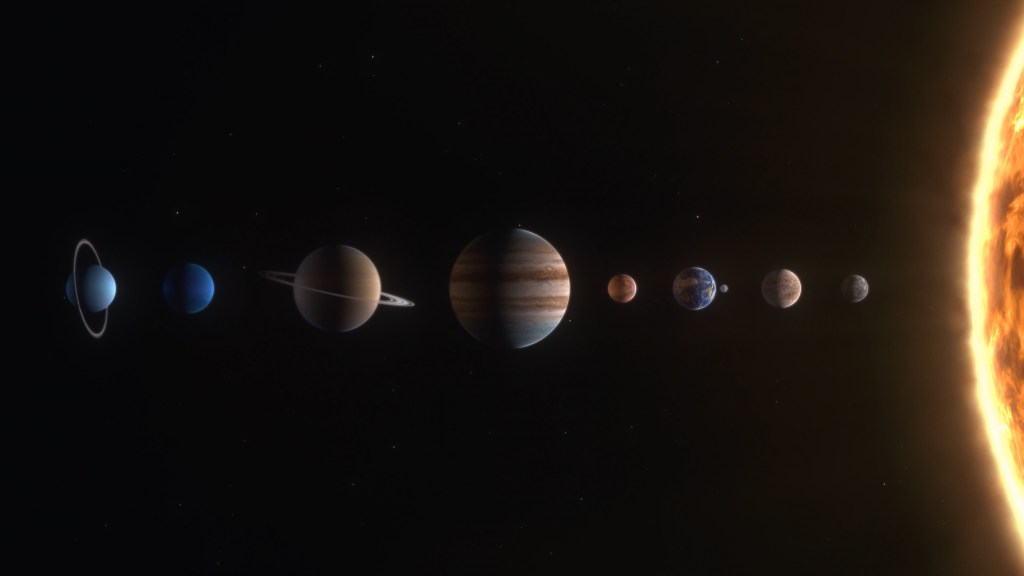
Our sun is a star, and it has 8 planets Mercury, Venus, Earth, Mars, Jupiter, Saturn, Uranus, and Neptune (as well as comets, asteroids, dwarf planets, etc.). The stars you see when you look up in the sky also have planets. We have identified 5,765 exoplanets (as of July 24th, 2024) but there are billions more in our galaxy. Some exoplanets are similar to Earth, and some are very different from any of the planets in our solar system.
Exoplanets
We know that exoplanets exist, we know some of them are in the so-called habitable zone and that some of them are very strange and interesting. This is certainly important knowledge for how we view our world and the Universe and yet many people who have not paid attention to astronomy news are very surprised to hear this information.
I’ve met many people who aren’t sure about the difference between a planet and a star, so being confronted with the news about exoplanets can be dizzying. That is why I am referring to the Strange Worlds of Exo Planets as a super-fact.
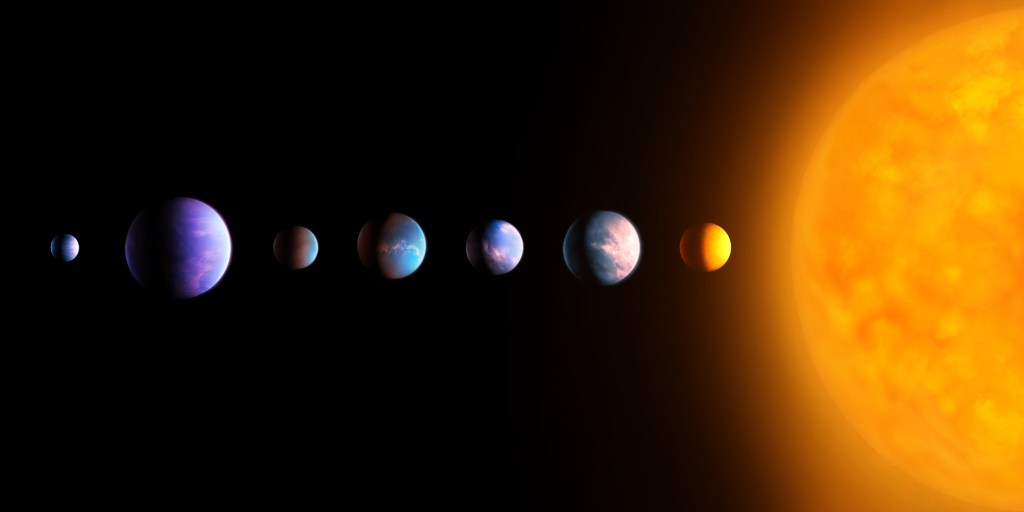
Our solar system. From right to left, the Sun, Mercury, Venus, Earth, Mars, Jupiter, Saturn, Uranus, and Neptune. In the image the planets are lined up in a straight line and they are very close to each other. That is, of course, not realistic. Stock Photo ID: 2504532389 by ibnallahdin.This is an imagined star/solar system. Notice that this solar system has seven planets, one less than our solar system. We would refer to these planets as exoplanets, if they were real. Stock Photo ID: 2466463165 by Nazarii_Neshcherenskyi
Most known exoplanets orbit stars roughly similar to the Sun but a lot of exoplanets have been seen orbiting red dwarf stars. It is estimated that there are 11 billion potentially habitable Earth-sized planets in the Milky Way. 40 billion if planets orbiting the numerous red dwarfs are included.
An imagined Earth like exoplanet. Stock Illustration ID: 1440413666 by Dotted Yeti.
Habitable Zones
About 1 in 5 Sun-like stars have an “Earth-sized planet in the habitable zone. The definition of “habitable zone” is the distance from a star at which liquid water could exist on orbiting planets’ surfaces. Habitable zones<<Link-2>> are also known as Goldilocks’ zones, where conditions might be just right – neither too hot nor too cold – for life. The habitable zone for our solar system goes from the orbit of Venus to orbit of Mars with Earth in the middle.
It may seem strange that Venus is borderline in the habitable zone considering it’s hellish 870 degrees Fahrenheit. However, being in the habitable zone is no guarantee that the planet is habitable, and Venus got unlucky with its greenhouse gases (beginning about 2 billion years ago). Below you can watch a NASA video explaining about habitable zones.
Planets are extremely faint compared to their parent stars. For example, a Sun-like star is about billion times brighter than the reflected light from any exoplanet orbiting it. It is difficult to detect such a faint light source, and furthermore, the parent star causes a glare that tends to wash it out.
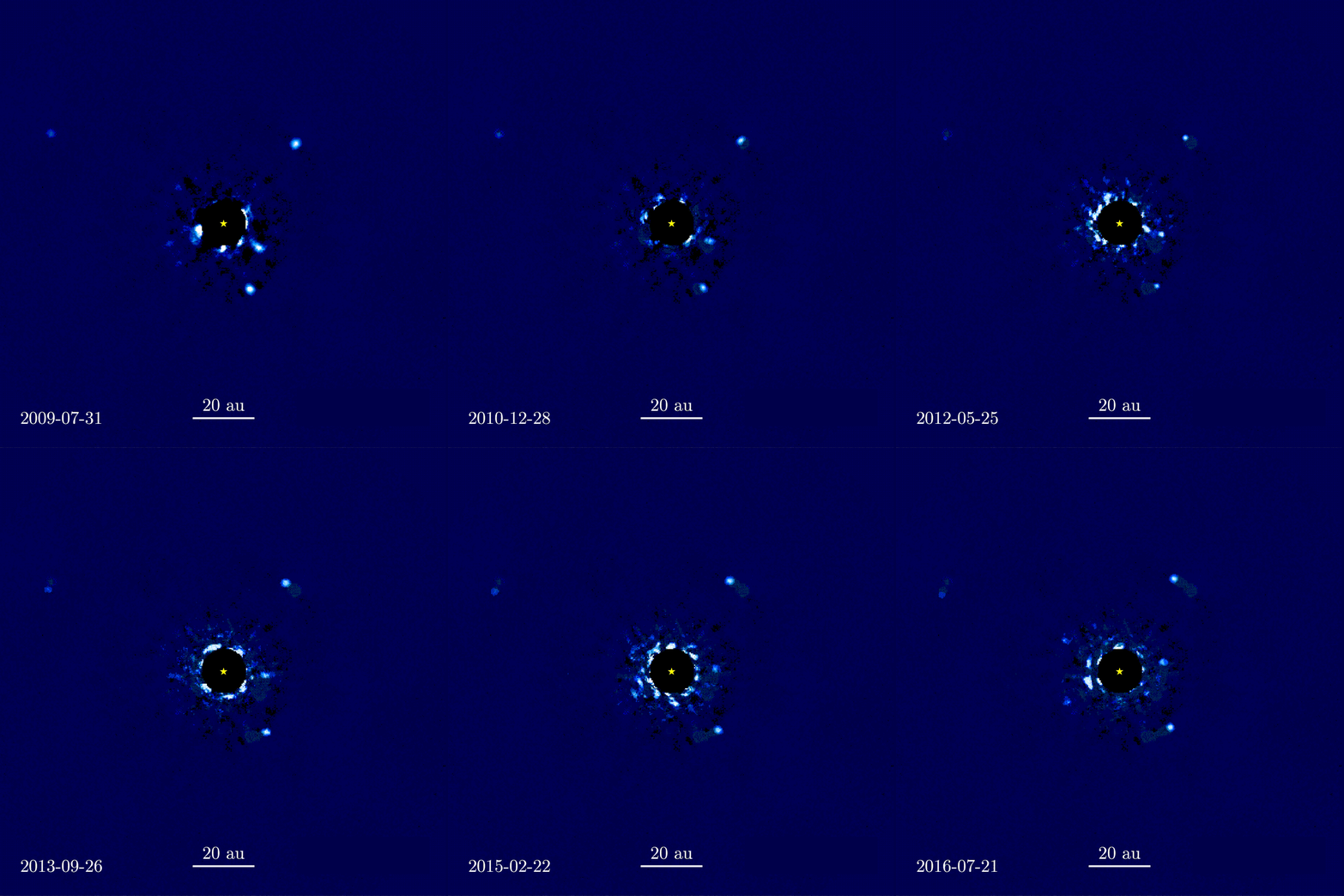
Just think about why you don’t see many stars during the day. They are still there and why you can’t see them is not because the sky is blue, but because the sun’s powerful light washes them out. Therefore, it is necessary to block the light from the parent star to reduce the glare while leaving the light from the planet detectable; doing so is a major technical challenge. All exoplanets that have been directly imaged are both large (more massive than Jupiter) and widely separated from their parent stars.
The vast majority have been detected through indirect methods, such as the transit method. It should be noted that the official definition of the term planet used by the International Astronomical Union (IAU) (since they booted Pluto) only covers our Solar System and thus does not apply to exoplanets. My opinion : we may need another update on the definition of what a planet is as we continue making exoplanet discoveries.
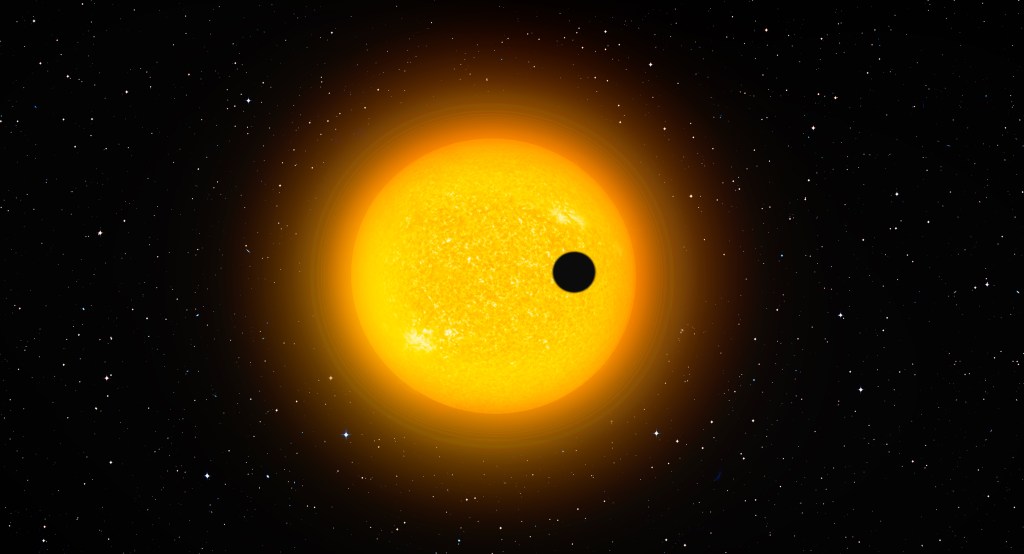
Exoplanet transiting in front of its star: Stock Photo ID: 2315686527 by muratartOne example of exoplanets that has been directly observed is the HR 8799 system. This system harbors four super-Jupiters orbiting with periods that range from decades to centuries. The footage below consists of 7 images of HR 8799 taken with the Keck Telescope over 7 years. The video was made by Jason Wang, data reduced by Christian Marois, and orbits were fit by Quinn Konopacky. Bruce Macintosh, Travis Barman, and Ben Zuckerman assisted in the observations.
Exoplanets Are Very Strange
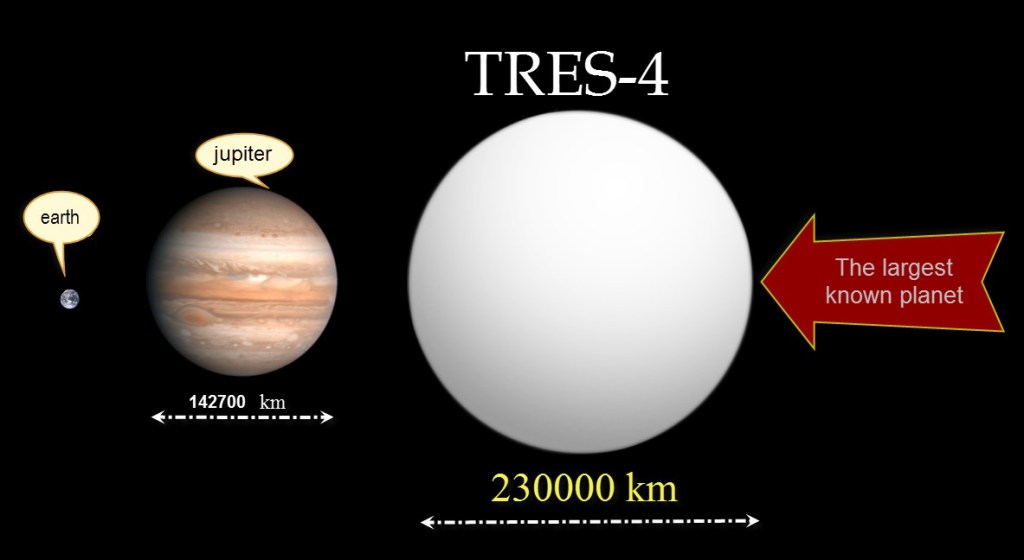
Many of the exoplanets are very strange. Gliese 581 is about 20 light-years away from Earth and is very similar to earth, but it doesn’t rotate. The orbit of WASP-17b is the opposite of the rotation of its star (unlike our planets, and most exoplanets). Its radius is 1.9 times larger than Jupiter’s radius. In other words, its volume is 6.86 times larger than Jupiter’s and yet its mass is only half the mass of Jupiter making it a big light puff ball. Like giant cotton candy.
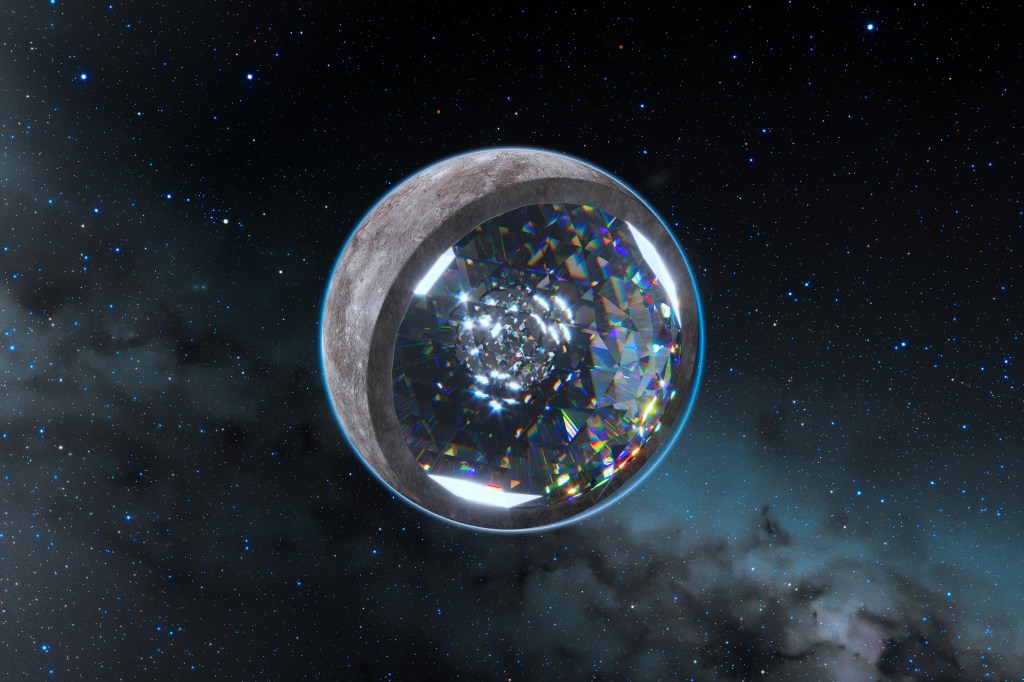
Gliese 436b, this planet has a core made up of ice (yes ice formed from water) that is as hot as fire. TrES-2b or Kepler-1b reflects less than 1% of the light it receives. It is darker than coal. 55 Cancri-e is believed to have an interior of diamond. In addition, the side facing its star/sun is extremely hot (1,700°C or 3,100°F).
A planet being cut in half, revealing a magnificent diamond inside. 55 Cancri e planet. The surreal world of cosmic gemstones. Stock Photo ID: 2381787311 by Dabarti CGI.
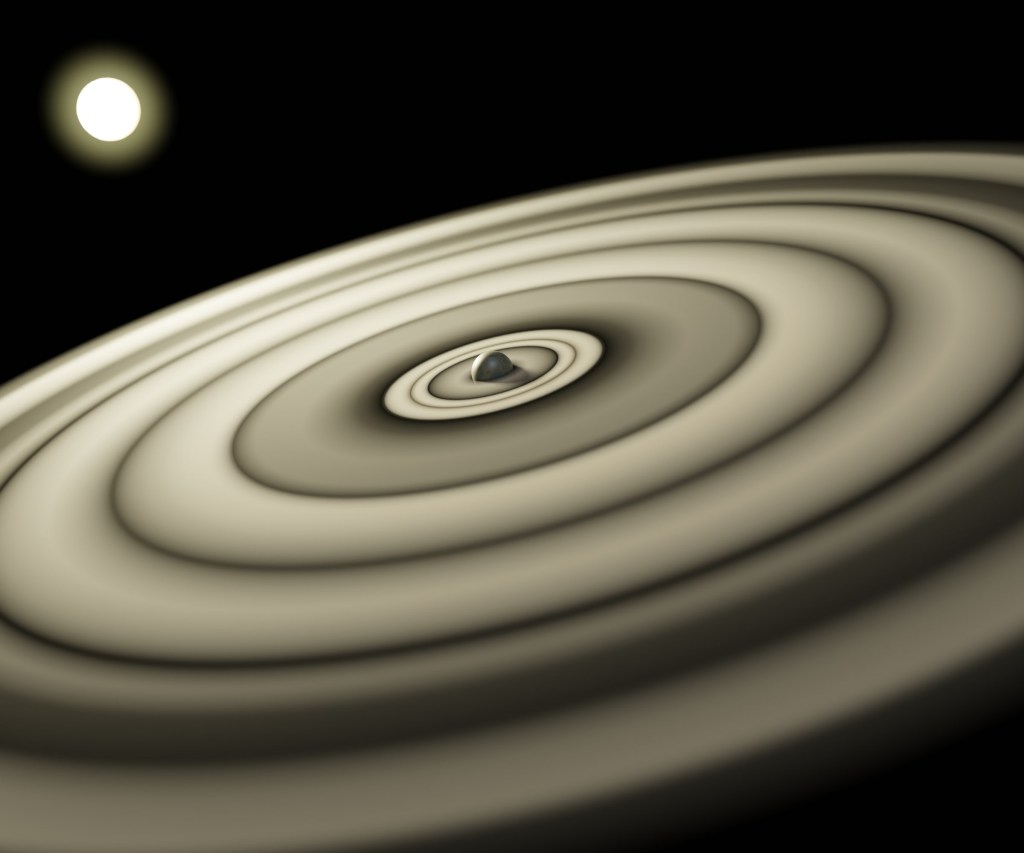
Then we also have J1407b, an exoplanet six times as massive as Jupiter and 20 times as massive as Saturn but with a ring system that outshines that of Saturn by far. J1407b is often referred to as Super Saturn.
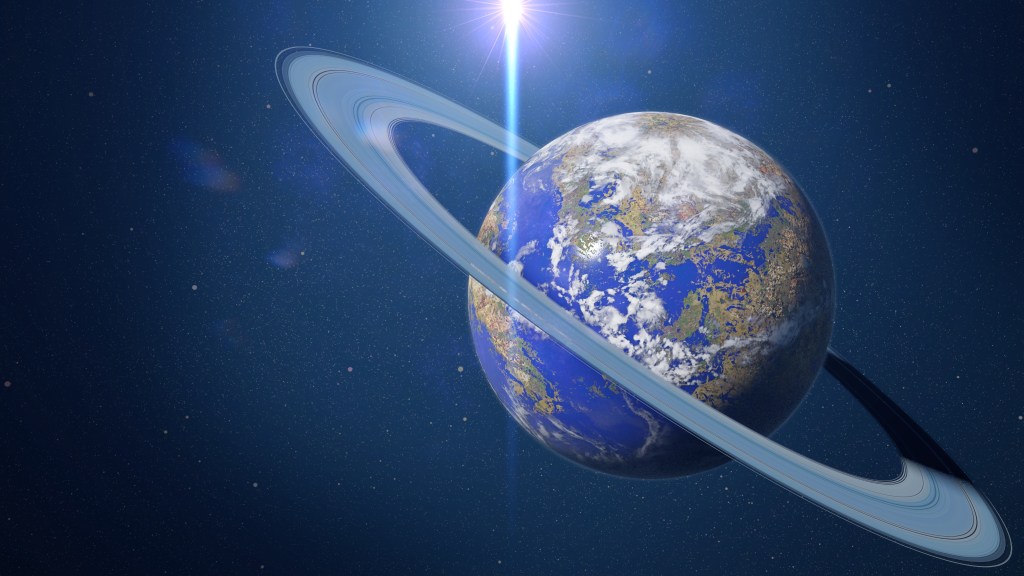
The rings of Super Saturn. J1407b is an exoplanet 20 times more massive than Saturn. Stock Illustration ID: 2329821675 by Love Employee.
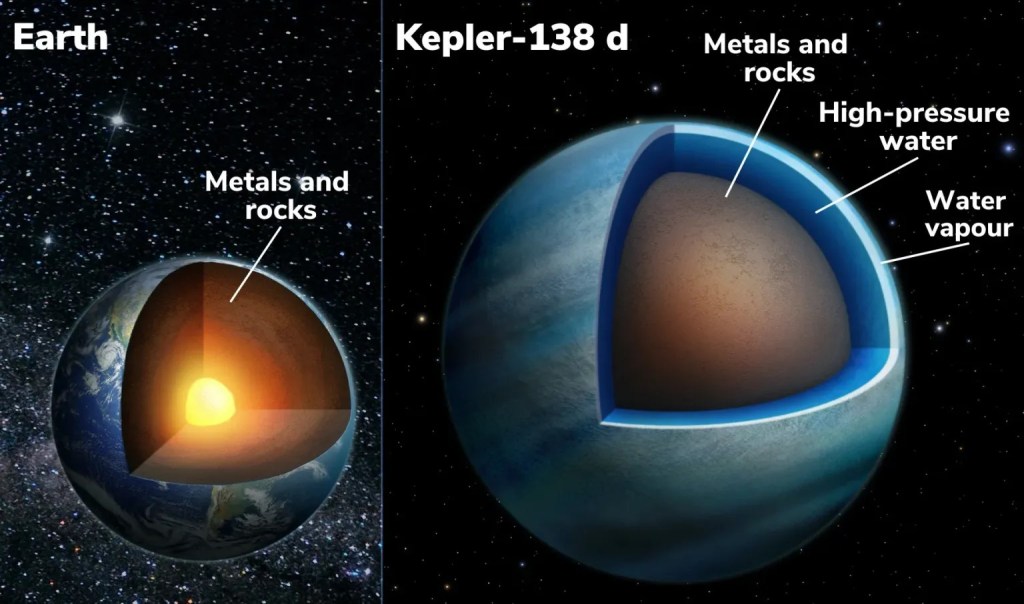
Determining what materials exoplanets consist of is very difficult but NASA believe they’ve found water planets. Check out this video from NASA and the illustration below.
This is an artist’s illustration showing a cross-section of the Earth (left) and the exoplanet Kepler-138 d (right). Like the Earth, this exoplanet has an interior composed of metals and rocks (brown portion), but Kepler-138 d also has a thick layer of high-pressure water in various forms: supercritical and potentially liquid water deep inside the planet and an extended water vapor envelope (shades of blue) above it. These water layers make up more than 50% of its volume, or a depth of about 1,243 miles (2,000 kilometers). The Earth, in comparison, has a negligible fraction of liquid water with an average ocean depth of less than 2.5 miles (4 kilometers).
NASA also believe they have found water vapor in a small exoplanet’s atmosphere, GJ 9827d. Check out the video below.
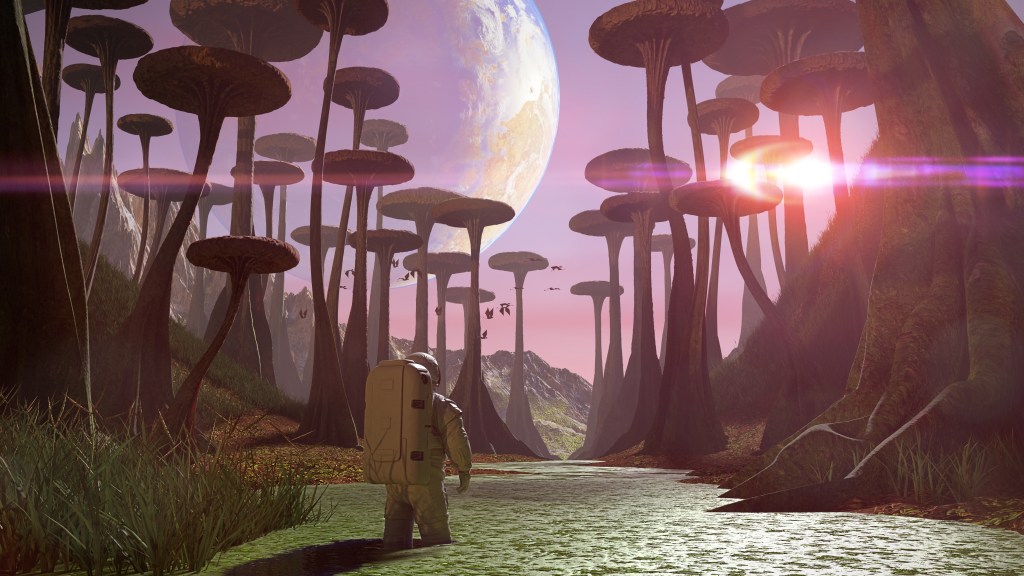
Below is an imagined exoplanet with mushroom like life
Exoplanet with life Stock Illustration ID: 1524001694 by Dotted Yeti
So, it is estimated that there are 11 billion potentially habitable Earth-sized planets orbiting stars roughly the same size as the sun in the Milky Way. It is estimated that there are an additional 40 billion potentially habitable Earth-sized planets orbiting red dwarf stars in the Milky Way.
The NEID Spectrometer
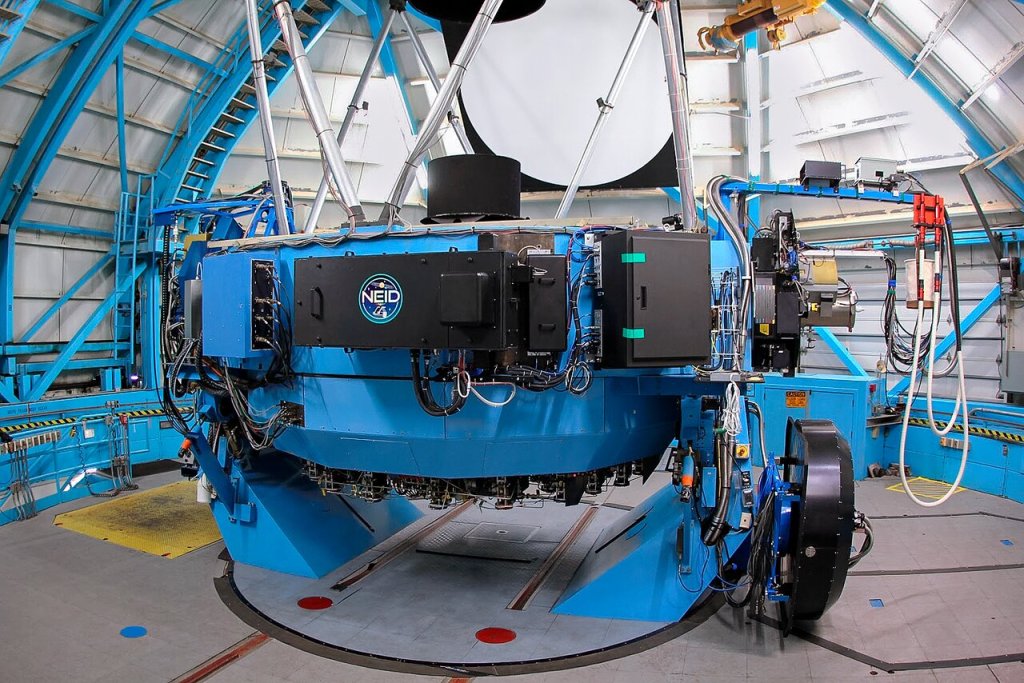
As you can see in the comment section below, a fellow blogger and on-line friend David Lee Summers mentioned that looking at exoplanets is his “day” job! He spent the last three nights helping to take spectra of exoplanet systems with the WIYN telescope at Kitt Peak. They work with the NASA-funded NEID spectrometer.
A spectrometer is a scientific instrument that measures the distribution of light wavelengths, or the spectral components of a physical phenomenon It is amazing what you can find out from star light, the weight of exoplanets, the size of stars, the elements and substances in stars and planets. Below is the extreme-precision radial-velocity spectrograph mounted on the WIYN 3.5-meter Telescope at Kitt Peak National Observatory. That is the instrument David works with.
David wrote a blog post about his work which I will re-blog in the near future.
Image of the NEID fiber feed (Port Adaptor) mounted on the WIYN telescope obtained during commissioning of the instrument. The Port Adaptor feeds light from the telescope to the NEID instrument, which is located on another floor of the building, below the telescope. The WIYN 3.5-meter Telescope at Kitt Peak National Observatory is located near Tucson, Arizona. Click on the image to visit the NOIR lab and read about the NEID spectrograph.
Thank you so much David.
Do you believe there’s intelligent life on any of them? If you do, why haven’t we heard from them?
Superfact 12: The United States is both a Republic and a Democracy
I believe that most people do not find that statement surprising in the least. When I became a citizen of the United States, through naturalization (I am originally from Sweden), I had to learn about the US government, and I was told by the US government officials that the United States is both a Republic and a Democracy.
However, I’ve come across a lot of people who state something like “The United States is a Republic and therefore not a Democracy” as if being a Republic and a Democracy are mutually exclusive. Well, as this article explains it is not. To be very specific, the United States is a “federal constitutional representative democracy.” Because the United States is indeed both a Republic and a Democracy and yet many would dispute that fact, I consider this to be a super-fact.
This is an article from the United States Citizenship and Immigration Services on the topic that confirms that the United States is a Republic and a Democracy. This is an article from NPR on the topic. This is what the Wikipedia entry on the United States says under the headline “Government and politics” “It is a liberal representative democracy “in which majority rule is tempered by minority rights protected by law.””
The United States is a representative democracy. Photo by Brett Sayles on Pexels.com
It should be noted that United States is not a Direct Democracy, like ancient Greece, but it features some aspects of it in referendums. Just like most democracies around the world. Another thing to note is that the Economists Intelligence Unit downgraded the United States from a full democracy to a flawed democracy in 2016. But it is still a democracy.
Is the United States a democracy?
If you ask google / AI this question “Is the United States a democracy?”. The answer you get is:
The United States is a representative democracy. This means that our government is elected by citizens. Here, citizens vote for their government officials. These officials represent the citizens’ ideas and concerns in government.
When I asked ChatGPT the same question (Is the United States a democracy?) I got this answer:
Yes, the United States is considered a democracy, but more specifically, it is a representative democracy or democratic republic. In a pure democracy, citizens directly vote on all laws and policies. In a representative democracy, like in the U.S., citizens elect officials (such as members of Congress, the president, and local representatives) who make decisions and pass laws on their behalf.
The U.S. system is also based on the principles of constitutional democracy, where the rule of law, individual rights, and the separation of powers (between the executive, legislative, and judicial branches) are foundational. The Constitution guarantees these principles, which are designed to protect minority rights while allowing majority rule through democratic elections.
In summary, the U.S. combines democratic elements with a framework that ensures checks and balances to prevent abuses of power.
The United States Capitol Building in Washington DC. Photo by Patrick Morris on Pexels.com
Partisan politics aside, the consensus seems to be that the United States is both a Republic and a Democracy.











 Super Facts