How Our Planet Came to Life

I recently read a very interesting book on the history of our Planet Earth, Becoming Earth: How Our Planet Came to Life by Ferris Jabr. Life of various forms, microbes, fungi, plants, animals, etc., has had a large impact on climate, earth’s crust, the composition of the atmosphere, the oceans, and still do. This fact filled book is about this four and half billion history. Below is my review of the but first something about the book formats.

Becoming Earth Book Formats

Becoming Earth: How Our Planet Came to Life by Ferris Jabr comes in four formats. I bought the hardback format.

  • Hardcover –  Publisher : Random House (June 25, 2024), ISBN-10 : 0593133978, ISBN-13 : 978-0593133972, 304 pages, item weight : 2.31 pounds: ‎ 6.3 x 1.1 x 9.55 inches, it costs $16.68 on US Amazon. Click here to order it from Amazon.com.
  • Paperback –  Publisher : Random House Trade Paperbacks (April 1, 2025), ISBN-10 : 0593133994, ISBN-13 : 978-0593133996, 320 pages, item weight : 4.8 ounces, dimensions : ‎ 5.15 x 0.75 x 7.97 inches, it costs $ 13.57 on US Amazon. Click here to order it from Amazon.com.
  • Kindle –  Publisher : Random House (June 25, 2024), ASIN : B0CJTLBCDX, ISBN-13 : 978-0593133989, 423 pages, it costs $5.99 on US Amazon. Click here to order it from Amazon.com.
  • Audio–  Publisher : Random House Audio (June 25, 2024), Listening Length : 9 hours and 27 minutes, ASIN : B0CKM3P33F, it costs $0.99 on US Amazon with membership. Click here to order it from Amazon.com.
Front cover of Becoming Earth: How Our Planet Came to Life by Ferris Jabr.
Front cover of Becoming Earth: How Our Planet Came to Life by Ferris Jabr. Click on the image to go to the Amazon page for the hardcover version of the book.

Amazon’s Description of Becoming Earth

NEW YORK TIMES BESTSELLER • A vivid account of a major shift in how we understand Earth, from an exceptionally talented new voice. Earth is not simply an inanimate planet on which life evolved, but rather a planet that came to life.

“Glorious . . . full of achingly beautiful passages, mind-bending conceptual twists, and wonderful characters. Jabr reveals how Earth has been profoundly, miraculously shaped by life.”—Ed Yong, Pulitzer Prize winner and bestselling author of An Immense World

FINALIST FOR THE LOS ANGELES TIMES BOOK PRIZE • FINALIST FOR THE OREGON BOOK AWARD • AN AMERICAN LIBRARY ASSOCIATION NOTABLE BOOK OF THE YEAR

A BEST BOOK OF THE YEAR: Smithsonian, Chicago Public Library, Booklist, Scientific American, Nature

A BEST BOOK OF THE SUMMER: The Atlantic and NPR’s Science Friday

One of humanity’s oldest beliefs is that our world is alive. Though once ridiculed by some scientists, the idea of Earth as a vast interconnected living system has gained acceptance in recent decades. We, and all living things, are more than inhabitants of Earth—we are Earth, an outgrowth of its structure and an engine of its evolution. Life and its environment have coevolved for billions of years, transforming a lump of orbiting rock into a cosmic oasis—a planet that breathes, metabolizes, and regulates its climate.

Acclaimed science writer Ferris Jabr reveals a radical new vision of Earth where lush forests spew water, pollen, and bacteria to summon rain; giant animals engineer the very landscapes they roam; microbes chew rock to shape continents; and microscopic plankton, some as glittering as carved jewels, remake the air and sea.

Humans are one of the most extreme examples of life transforming Earth. Through fossil fuel consumption, agriculture, and pollution, we have altered more layers of the planet in less time than any other species, pushing Earth into a crisis. But we are also uniquely able to understand and protect the planet’s wondrous ecology and self-stabilizing processes. Jabr introduces us to a diverse cast of fascinating people who have devoted themselves to this vital work.

Becoming Earth is an exhilarating journey through the hidden workings of our planetary symphony—its players, its instruments, and the music of life that emerges—and an invitation to reexamine our place in it. How well we play our part will determine what kind of Earth our descendants inherit for millennia to come.

My five-star review for Becoming Earth

A Page Turner for People with a Curious Mind

This book gives us a brief overview of the natural history of Earth, emphasizing that not only is life impacted by geological forces, but life is influencing and even creating the composition of the atmosphere, impacting climate and even affecting geological forces. The author explains how microbes, plants, and animals transformed the planet. He is explaining how humans are transforming planet Earth and its climate through fossil fuel consumption, agriculture, and pollution. He is noting that we have altered more layers of the planet in less time than any other species, pushing Earth into a crisis. The author promotes the idea that Earth itself is a living organism (Gaia hypothesis). I am not sure if I entirely buy that idea, but he makes a good case for it.

The book covers a lot of history. Earth is four and half billion years old and a lot has happened. As a result, there are no deep dives into topics. However, the book is filled with hundreds of interesting facts and information, which makes the book a page turner to anyone with a curious mind. One major example of this is that about three billion years ago Cyanobacteria evolved a new type of photosynthesis that used sunlight, water, and carbon dioxide to create energy, while releasing oxygen as a waste product. This transformed the atmosphere and enabled complex life by allowing aerobic respiration to evolve. This invention turned the sky blue, gave us the protective ozone layer, but also caused climate change (snowball Earth) resulting in massive extinctions.

However, there is much more. Another example is that microbes helped transform Earth’s crust. During the first half billion years of Earth’s history, Earth was a water world save for volcanic islands. Trees communicate and assist each other via fungi (Mycorrhizas). Phytoplankton produces 50% of all oxygen, the invention of the Haber-Bosch process more than doubled the world’s crop harvest, there once was 30-60 million Bison roaming the plains, humans now emit 60 to 120 times more carbon dioxide each year than all the world’s volcanoes.

As I mentioned there are hundreds more interesting facts. He also presents a lot of facts and information regarding the destruction of the environment, which may not sit well with everyone. However, I think it is important information. The book includes a large number of references for further reading.

The book is well written and well organized and included fun personal anecdotes. It was easy and entertaining reading and like I said, it is a page turner to people with a curious mind. I loved this book and I highly recommend it.
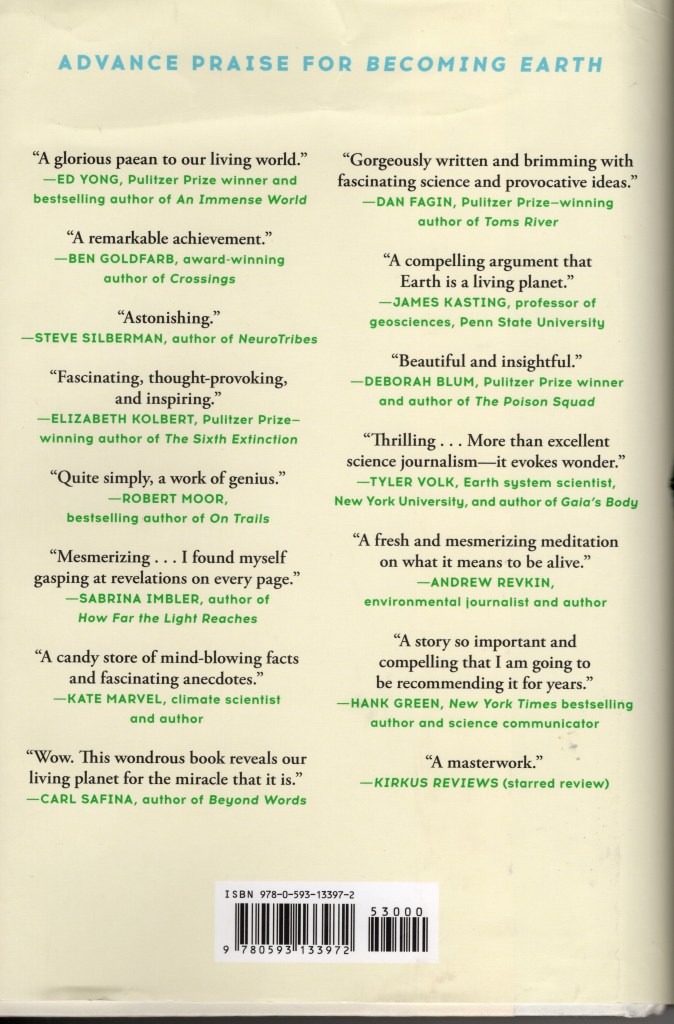
Back cover of Becoming Earth: How Our Planet Came to Life by Ferris Jabr.
Back cover of Becoming Earth: How Our Planet Came to Life by Ferris Jabr. Click on the image to go to the Amazon page for the paperback version of the book.


To see the Super Facts click here

Oxygen Blue Sky and Complex Life Exist Because of a Bacteria

Super fact 72 : About three billion years ago Cyanobacteria evolved a new type of photosynthesis that used sunlight, water, and carbon dioxide to create energy, while releasing oxygen as a waste product. This transformed the atmosphere and enabled complex life by allowing aerobic respiration to evolve. This invention turned the sky blue, gave us the protective ozone layer, but also caused climate change resulting in massive extinctions.

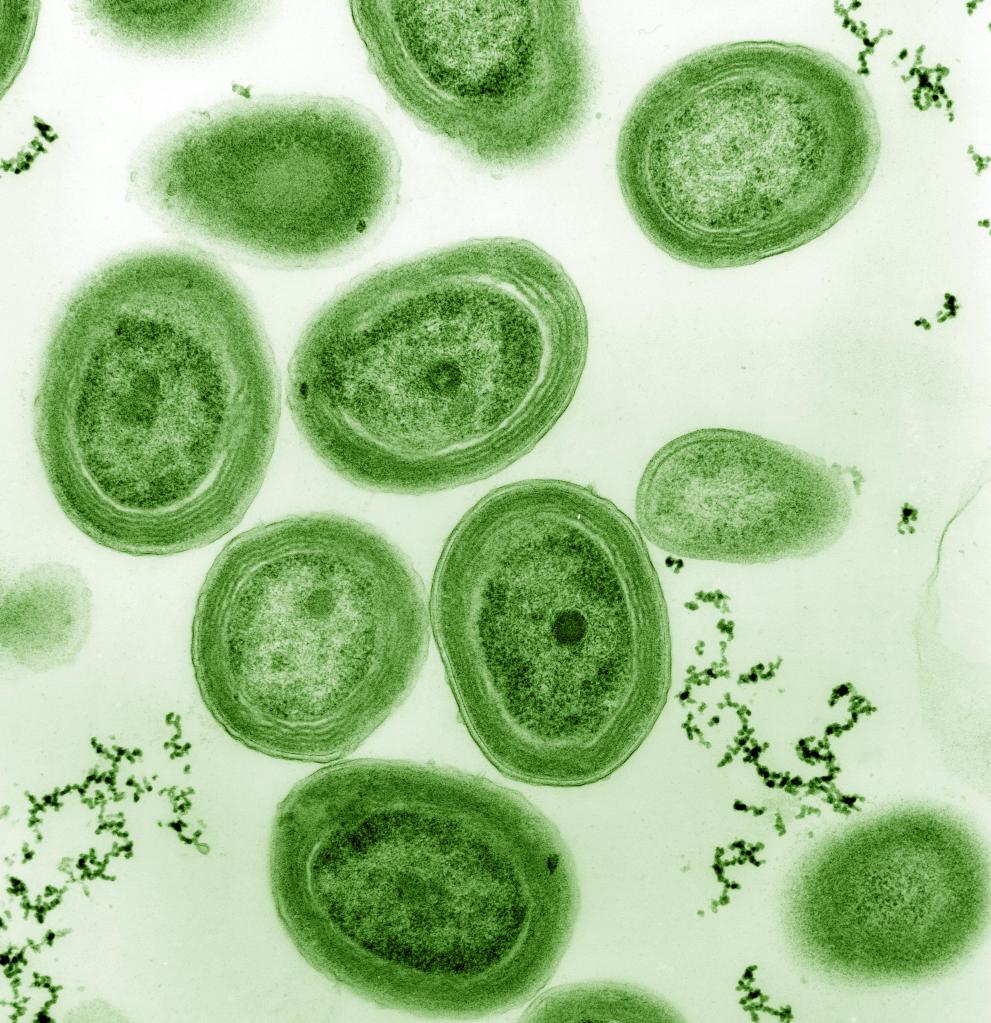
A microscopic photo of Cyanobacteria. They look like green blobs with small nucleuses. | Oxygen Blue Sky and Complex Life Exist Because of a Bacteria
An example of a Cyanobacteria. From Wikipedia. Luke Thompson from Chisholm Lab and Nikki Watson from Whitehead, MIT, CC0, via Wikimedia Commons

Cyanobacteria, also known as blue-green algae, are bacteria capable of oxygenic photosynthesis. Between 3.4 and 2.5 billion years ago they developed a new and very effective form of photosynthesis, which took advantage of highly abundant resources, using sunlight, water, and carbon dioxide turning it into sugar and releasing oxygen as byproduct. This is referred to as the Great Oxidation Event. You can read more about this event here, here, here, here, here, or in the book Becoming Earth by Ferris Jabr.

The atmosphere prior to the Great Oxidation Event was primarily composed of volcanic gases including nitrogen, carbon dioxide, water vapor, methane and ammonia, but almost no free oxygen. The Great Oxidation Event changed all this, but it likely took at least 200 million years.

Labeled educational bacteria internal structure scheme.
Cyanobacteria vector illustration. Biological blue green algae diagram with carboxysome, thylakoid and phycobilisome parts location inside cell. Asset id: 1687712761 by VectorMine

A Microbial Great Extinction and Snowball Earth

Oxygen was a toxic gas to many early microbes forcing them to adapt or perish. In addition, the change in the atmospheres composition changed the climate, resulting in a severe global cooling referred to as Snowball Earth. This caused a great extinction, perhaps the most severe extinction in Earth’s history. It is not included among the five mass extinction events in Earth’s history because it happened very early in Earth’s history when only primitive microbial life existed and fossil evidence from that time is nearly non-existent. The definition of a mass extinction event is that at least 75% of the world’s species are lost during a short period of time – geologically speaking. This period is not clearly defined but often defined to be two million years. It is very difficult to determine whether the great extinction following the Great Oxidation Event qualifies as a mass extinction event. To read about mass extinctions click here.

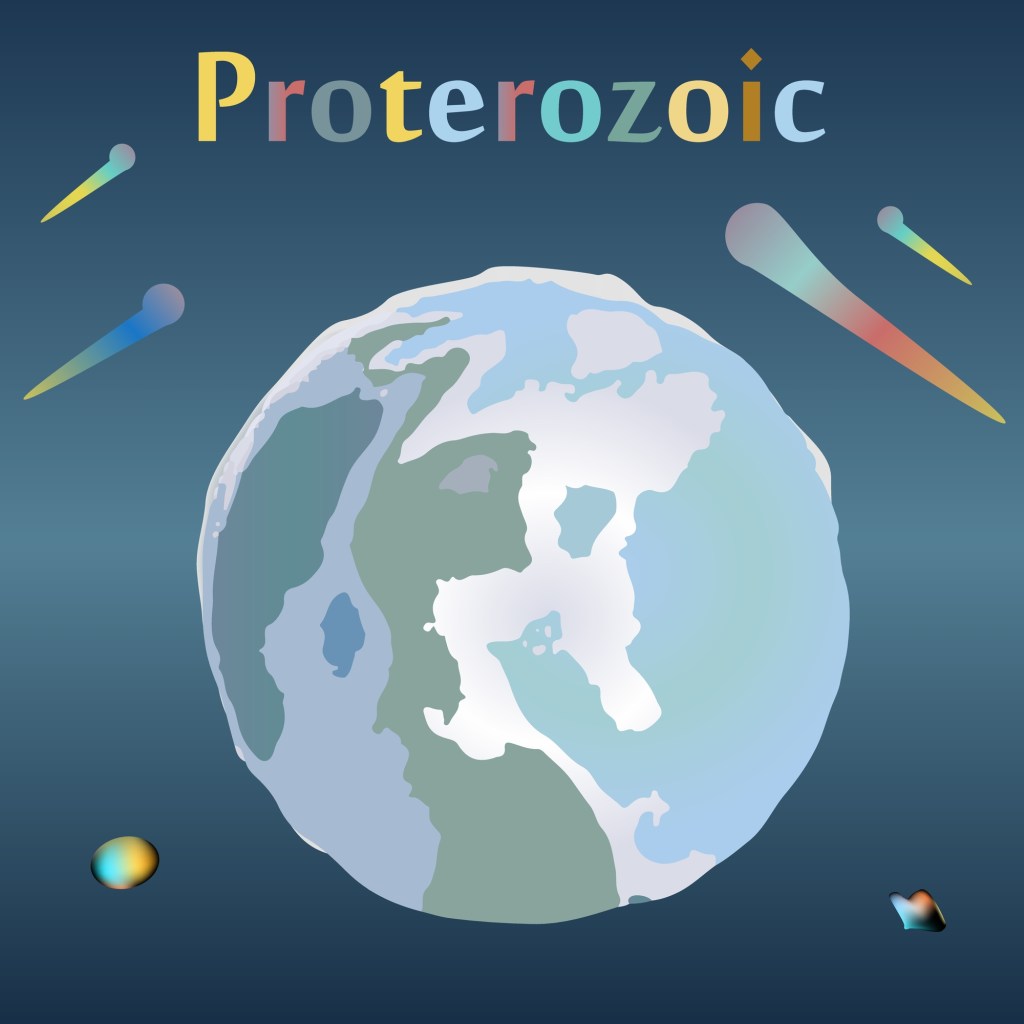
Ancient Earth almost entirely covered by ice and white snow. | Oxygen Blue Sky and Complex Life Exist Because of a Bacteria
Proterozoic era in the history of the Earth. Snowball earth. Global glaciation of the Earth. Asset id: 2010272753 by Elena Kelman

The Ozone Layer and the Blue Sky

Oxygen is also responsible for formation of the ozone layer in the atmosphere. The UV radiation from the sun split oxygen molecules, which consist of two oxygen atoms, into two separate atoms of oxygen, which then reacted with another oxygen molecule to generate ozone, and oxygen molecule consisting of three oxygen atoms. Ozone acts as a natural sunscreen to prevent harmful UV radiation from reaching the earth. Therefore, oxygen not only enables land dwelling complex multicell organisms to exist by allowing aerobic respiration to evolve, but also by protecting life from too much UV radiation.

As mentioned above, the atmosphere prior to the Great Oxidation Event was primarily composed of volcanic gases and almost no free oxygen. The color of the sky was likely orange, brown. As oxygen replaced the existing gases the sky slowly turned blue. Oxygen molecules along with Nitrogen molecules scatter blue light from the sun through a process called Rayleigh scattering, making the sky appear blue.

Cyanobacteria and The Great Oxygenation Event

It should be noted that there were other geological and biological processes that were responsible for this permanent shift in the Earth’s system, including changes in the composition of volcanic emissions and chemical reactions that allowed atmospheric hydrogen to escape to space, leaving behind an excess of oxygen molecules. However, whatever the exact mix of mechanisms, cyanobacteria were undoubtedly a critical source of accumulating oxygen. It is possible that tectonic activity altered the cycling and distribution of phosphorus and other nutrients essential for cyanobacteria. To read more see the book Becoming Earth by Ferris Jabr.


To see the other Super Facts click here

Life Must Have Hydrogen Oxygen Carbon Nitrogen and Phosphorus

The goal of this blog is to create a list of what I call super facts. Important facts that we know to be true and yet they are surprising, shocking or disputed among non-experts. Special facts that any well-informed person should know. 

  • Paperback –  $18.95 on Amazon – future release March 25, 2025.
  • Hardcover –  Publisher : Princeton University Press; First Edition (September 12, 2023), ISBN-10 : 0691177295, ISBN-13 : 978-0691177298, 240 pages, item weight : 1 pounds, dimensions : 5.75 x 1 x 8.5 inches, it costs $18.95 on Amazon. Click here to order it from Amazon.com.
  • Kindle –  Publisher : Princeton University Press (September 12, 2023), ASIN : B0C5SBB26C, 229 pages, it costs $15.37 on US Amazon. Click here to order it from Amazon.com.
  • Audio –  Publisher : Princeton University Press (September 19, 2023), ASIN : B0CF6WHBVX, listening length 7 hours, narrator : Christopher Ragland, it costs $0.99 on US Amazon. Click here to order it from Amazon.com.
A picture of planet earth, the title and the subtitle “How Five Elements Changed Earth’s Past And Will Chape Our Future” The letters H, N, C, P, O are circled | Life Must Have Hydrogen Oxygen Carbon Nitrogen and Phosphorus
Front cover of Elemental. Click on the image to go to the Amazon page for the hardcover version of the book.

Amazon’s description of the book

It is rare for life to change Earth, yet three organisms have profoundly transformed our planet over the long course of its history. Elemental reveals how microbes, plants, and people used the fundamental building blocks of life to alter the climate, and with it, the trajectory of life on Earth in the past, present, and future.

Taking readers from the deep geologic past to our current era of human dominance, Stephen Porder focuses on five of life’s essential elements—hydrogen, oxygen, carbon, nitrogen, and phosphorus. He describes how single-celled cyanobacteria and plants harnessed them to wildly proliferate across the oceans and the land, only to eventually precipitate environmental catastrophes.

He then brings us to the present, and shows how these elements underpin the success of human civilization, and how their mismanagement threatens similarly catastrophic unintended consequences. But, Porder argues, if we can learn from our world-changing predecessors, we can construct a more sustainable future.

Blending conversational storytelling with the latest science, Porder takes us deep into the Amazon, across fresh lava flows in Hawaii, and to the cornfields of the American Midwest to illuminate a potential path to sustainability, informed by the constraints imposed by life’s essential elements and the four-billion-year history of life on Earth.

This is my five-star review for the book Elemental

The Story of HOCNP the Five Elements Essential to all Life

The author, a biogeochemist, explains why five elements, hydrogen (H), oxygen (O), carbon (C), nitrogen (N), and phosphorus (P) are essential to all life. As an example, in the sunlit waters of the central equatorial Pacific Ocean, a lack of Nitrogen creates a water desert with no life. Lifeforms that are able extract more of these elements have a competitive advantage.

This book focuses on three world-changing organisms that were able to extract unprecedented amounts of these elements from the environment also resulting in success and huge increases in the total mass of lifeforms, as well as consequences causing mass extinction eventually followed by an entirely new planet. Note this book is not about mass extinctions, which have happened at least five times, but something more profound. It is about planet-changing events.

During the first two billion years of earth’s history there had been no oxygen in the environment; oxygen was always bound to some other atom, such as hydrogen in water. There was life back then but in the form of primitive bacteria using a primitive form of photosynthesis involving sulfur. Then came cyanobacteria which had invented a more effective form of photosynthesis, as well as a way of extracting nitrogen using a process called nitrogen fixation. The two-atom nitrogen in the air is nearly inert and very difficult to use. This made cyanobacteria extremely successful.

However, one consequence was that the carbon dioxide was largely removed from the atmosphere, while the atmosphere was filled up by oxygen, which is a byproduct of the new form of photosynthesis. Carbon dioxide is a greenhouse gas that warms the planet, something scientists had already figured out in the 1850’s. With much less carbon dioxide, the earth got very cold, and a snowball earth disaster followed. However, in the long run the oxygen paved the way for the existence of multicellular life and animals. The planet changed.

About 400 million years ago plants was a new type organism that was able to extract water (hydrogen and oxygen) from land as well as phosphorus. Their success led to another depletion of carbon dioxide causing another ice period, but they paved the way for life on land. The planet changed again. Now humans, the third type of organism, are extracting all five elements in unprecedented amounts causing global warming and other unintended consequences.

Unlike cyanobacteria and plants, we are not doing this to primarily extract nutrients but for transportation, heating and consumer products and we can control and predict the consequences of our actions.

As evidence for global warming / climate change the author discusses the temperature measurement records of various organizations (NOAA etc.). That is the smoking gun.

However, he also mentions things like the fact that the vast majority of glaciers in the world are retreating or disappearing and the fact that anyone above the age of 50 who comes from a northern climate (that would be me) can attest to the fact that winters have gotten noticeably shorter snow seasons and warmer summers. That is true and it is a good thing to mention because there are those who are quick to dismiss temperature records as big hoaxes.

The second part of his global warming discussion, the evidence that we humans are the cause of the current warming, leaves something out in my opinion. He explains why the various climate models provide incontrovertible evidence that the chief cause for the current global warming is our burning of fossil fuels, despite the models being far from perfect. I totally agree with that, but once again there are those who are not willing to accept climate models as solid evidence, and therefore you should mention other evidence as well, which he does not do.

Examples of evidence that we are the cause and that does not involve complex models would be, no known natural cause can explain the current warming, the upper troposphere is cooling while the lower troposphere is warming, the arctic is warming much faster than average, nights are warming much faster than days, etc. Those are things that would not happen if the cause was a hotter sun (which we also kept a record of) or an orbital cycle.

In addition, spectral analysis shows the cause to be the adding of greenhouse gases to the atmosphere, and various isotope studies show that the carbon emissions come from the burning of hundreds of millions of years old carbon. Why not mention that as well? I know all this is baked into the models, but simple explanations appear more convincing to many. I am not taking off a star for it, but I felt it was a missed opportunity.

One environmental threat that you don’t hear much about is the depletion of phosphorus. This is something that may be far into the future but something that seems impossible to solve once it arrives and could evolve into an enormous food crisis. This was certainly a unpleasant surprise to me.

The book explains many processes and concepts, biogeochemistry, primitive photosynthesis using sulfur, photosynthesis using water (cyanobacteria) and releasing oxygen, nitrogen fixation, endosymbiosis, how plants extract phosphorus from the ground, the evolution of plants, the slow carbon cycles, the fast carbon cycle, the effect of volcanoes on climate, respiration, why can trust certain aspects of climate models, nitrogen fixation, nitrogenase, the immense effect fertilizers have had on food production, the Haber-Bosch process, earth’s climate history, why phosphorus is both finite and irreplaceable, the danger to aquifers, how we have changed ecosystems, and more.

Despite that the author makes himself understood. He explains complex concepts, so they are easy to understand and connects them all in a logical way that makes a lot of sense. So don’t be afraid that the book will be difficult to read. You may just learn a lot.

The author considers climate change / global warming to be our most serious environmental challenge, but he offers a lot of suggestions for a way forward. He discusses a lot of interesting technological solutions. I think he may be a bit gloomier than necessary but overall, what he says is very insightful and somewhat hopeful.

Again, I was very impressed by the organization of the book. It is easy to create a mess when you try to connect a lot of different concepts and complex science into a logical narrative, but he was very successful. It was a delight to read this book, it was interesting and full of facts, which were new to me, and I think are very important. I learned a lot and I think it is a very well written page turner.

The back cover advanced praise for the book.
Back cover of Elemental. Click on the image to go to the Amazon page for the kindle version of the book.

To see the Super Facts click here