How Our Planet Came to Life

I recently read a very interesting book on the history of our Planet Earth, Becoming Earth: How Our Planet Came to Life by Ferris Jabr. Life of various forms, microbes, fungi, plants, animals, etc., has had a large impact on climate, earth’s crust, the composition of the atmosphere, the oceans, and still do. This fact filled book is about this four and half billion history. Below is my review of the but first something about the book formats.

Becoming Earth Book Formats

Becoming Earth: How Our Planet Came to Life by Ferris Jabr comes in four formats. I bought the hardback format.

  • Hardcover –  Publisher : Random House (June 25, 2024), ISBN-10 : 0593133978, ISBN-13 : 978-0593133972, 304 pages, item weight : 2.31 pounds: ‎ 6.3 x 1.1 x 9.55 inches, it costs $16.68 on US Amazon. Click here to order it from Amazon.com.
  • Paperback –  Publisher : Random House Trade Paperbacks (April 1, 2025), ISBN-10 : 0593133994, ISBN-13 : 978-0593133996, 320 pages, item weight : 4.8 ounces, dimensions : ‎ 5.15 x 0.75 x 7.97 inches, it costs $ 13.57 on US Amazon. Click here to order it from Amazon.com.
  • Kindle –  Publisher : Random House (June 25, 2024), ASIN : B0CJTLBCDX, ISBN-13 : 978-0593133989, 423 pages, it costs $5.99 on US Amazon. Click here to order it from Amazon.com.
  • Audio–  Publisher : Random House Audio (June 25, 2024), Listening Length : 9 hours and 27 minutes, ASIN : B0CKM3P33F, it costs $0.99 on US Amazon with membership. Click here to order it from Amazon.com.
Front cover of Becoming Earth: How Our Planet Came to Life by Ferris Jabr.
Front cover of Becoming Earth: How Our Planet Came to Life by Ferris Jabr. Click on the image to go to the Amazon page for the hardcover version of the book.

Amazon’s Description of Becoming Earth

NEW YORK TIMES BESTSELLER • A vivid account of a major shift in how we understand Earth, from an exceptionally talented new voice. Earth is not simply an inanimate planet on which life evolved, but rather a planet that came to life.

“Glorious . . . full of achingly beautiful passages, mind-bending conceptual twists, and wonderful characters. Jabr reveals how Earth has been profoundly, miraculously shaped by life.”—Ed Yong, Pulitzer Prize winner and bestselling author of An Immense World

FINALIST FOR THE LOS ANGELES TIMES BOOK PRIZE • FINALIST FOR THE OREGON BOOK AWARD • AN AMERICAN LIBRARY ASSOCIATION NOTABLE BOOK OF THE YEAR

A BEST BOOK OF THE YEAR: Smithsonian, Chicago Public Library, Booklist, Scientific American, Nature

A BEST BOOK OF THE SUMMER: The Atlantic and NPR’s Science Friday

One of humanity’s oldest beliefs is that our world is alive. Though once ridiculed by some scientists, the idea of Earth as a vast interconnected living system has gained acceptance in recent decades. We, and all living things, are more than inhabitants of Earth—we are Earth, an outgrowth of its structure and an engine of its evolution. Life and its environment have coevolved for billions of years, transforming a lump of orbiting rock into a cosmic oasis—a planet that breathes, metabolizes, and regulates its climate.

Acclaimed science writer Ferris Jabr reveals a radical new vision of Earth where lush forests spew water, pollen, and bacteria to summon rain; giant animals engineer the very landscapes they roam; microbes chew rock to shape continents; and microscopic plankton, some as glittering as carved jewels, remake the air and sea.

Humans are one of the most extreme examples of life transforming Earth. Through fossil fuel consumption, agriculture, and pollution, we have altered more layers of the planet in less time than any other species, pushing Earth into a crisis. But we are also uniquely able to understand and protect the planet’s wondrous ecology and self-stabilizing processes. Jabr introduces us to a diverse cast of fascinating people who have devoted themselves to this vital work.

Becoming Earth is an exhilarating journey through the hidden workings of our planetary symphony—its players, its instruments, and the music of life that emerges—and an invitation to reexamine our place in it. How well we play our part will determine what kind of Earth our descendants inherit for millennia to come.

My five-star review for Becoming Earth

A Page Turner for People with a Curious Mind

This book gives us a brief overview of the natural history of Earth, emphasizing that not only is life impacted by geological forces, but life is influencing and even creating the composition of the atmosphere, impacting climate and even affecting geological forces. The author explains how microbes, plants, and animals transformed the planet. He is explaining how humans are transforming planet Earth and its climate through fossil fuel consumption, agriculture, and pollution. He is noting that we have altered more layers of the planet in less time than any other species, pushing Earth into a crisis. The author promotes the idea that Earth itself is a living organism (Gaia hypothesis). I am not sure if I entirely buy that idea, but he makes a good case for it.

The book covers a lot of history. Earth is four and half billion years old and a lot has happened. As a result, there are no deep dives into topics. However, the book is filled with hundreds of interesting facts and information, which makes the book a page turner to anyone with a curious mind. One major example of this is that about three billion years ago Cyanobacteria evolved a new type of photosynthesis that used sunlight, water, and carbon dioxide to create energy, while releasing oxygen as a waste product. This transformed the atmosphere and enabled complex life by allowing aerobic respiration to evolve. This invention turned the sky blue, gave us the protective ozone layer, but also caused climate change (snowball Earth) resulting in massive extinctions.

However, there is much more. Another example is that microbes helped transform Earth’s crust. During the first half billion years of Earth’s history, Earth was a water world save for volcanic islands. Trees communicate and assist each other via fungi (Mycorrhizas). Phytoplankton produces 50% of all oxygen, the invention of the Haber-Bosch process more than doubled the world’s crop harvest, there once was 30-60 million Bison roaming the plains, humans now emit 60 to 120 times more carbon dioxide each year than all the world’s volcanoes.

As I mentioned there are hundreds more interesting facts. He also presents a lot of facts and information regarding the destruction of the environment, which may not sit well with everyone. However, I think it is important information. The book includes a large number of references for further reading.

The book is well written and well organized and included fun personal anecdotes. It was easy and entertaining reading and like I said, it is a page turner to people with a curious mind. I loved this book and I highly recommend it.

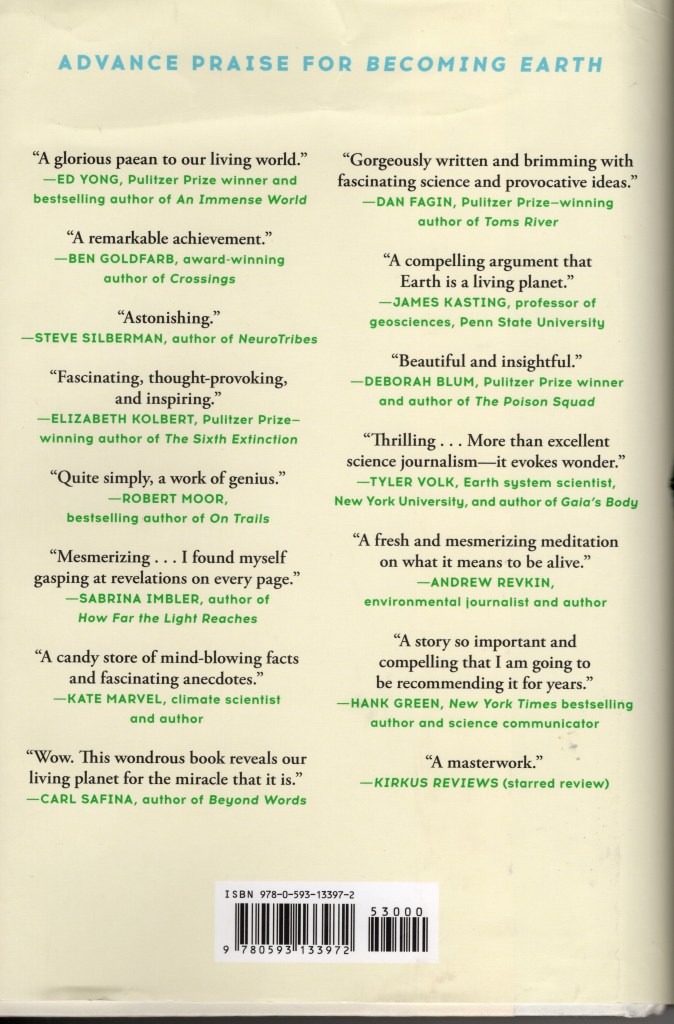
Back cover of Becoming Earth: How Our Planet Came to Life by Ferris Jabr.
Back cover of Becoming Earth: How Our Planet Came to Life by Ferris Jabr. Click on the image to go to the Amazon page for the paperback version of the book.


To see the Super Facts click here

Review of Glacial by Chelsea Henderson

I recently read a very interesting book on the history of climate change politics; Glacial: The Inside Story of Climate Politics by Chelsea Henderson. Chelsea Henderson is a leader in the EcoRight movement, basically Republicans who care about the environment and climate change. She is a former senior advisor to Senator John Warner (Republican) and have held other positions in the US Congress. Her book is non-partisan. However, naturally she is accepting the reality of human caused global warming.

I should mention that the second last sentence of the seventh paragraph of my rather long review says this “As of very recently, a few days ago, those Tax Credits have been reversed.” Those few days ago have not yet happened. I thought Amazon would take longer to publish my review and I was predicting that the vote today/tomorrow on the Senate version of the Budget Reconciliation Bill (the Big Beautiful Bill) would allow it to pass. So those few days ago have not yet happened because Amazon was faster than I thought. Basically, the Budget Reconciliation Bill will roll back or phase out the clean energy tax credits enacted in 2022. For those who don’t know what a Budget Reconciliation Bill is, it is a bill that allows you to bypass the filibuster, and it is therefore typically a highly partisan bill.

Glacial The Book Formats

Glacial: The Inside Story of Climate Politics by Chelsea Henderson comes in four formats. I bought the hardback format.

  • Hardcover –  Publisher : Turner (August 6, 2024), ISBN-10 : 1684429579, ISBN-13 : 978-1684429578, 432 pages, item weight : 1.45 pounds, dimensions : ‎ 6.25 x 1.25 x 9.25 inches, it costs $ 23.11 on US Amazon. Click here to order it from Amazon.com.
  • Paperback –  Publisher : Turner (August 6, 2024), ISBN-10 : 1684429587, ISBN-13 : 978-1684429585, 432 pages, item weight : 1.34 pounds, dimensions : ‎ 6 x 0.96 x 9 inches, it costs $13.10 on US Amazon. Click here to order it from Amazon.com.
  • Kindle –  Publisher : Turner (August 6, 2024), ASIN : B0CBQKTM46, ISBN-13 : 978-1684429592, 460 pages, it costs $12.44 on US Amazon. Click here to order it from Amazon.com.
  • Audio–  Publisher : Tantor Audio (August 13, 2024), Listening Length : 9 hours and 50 minutes, ASIN : B0DCCWRMJS, it costs $0.00 with membership on US Amazon. Click here to order it from Amazon.com.
Front cover of hardback format of the book Glacial: The Inside Story of Climate Politics by Chelsea Henderson | Review of Glacial
Front cover of hardback format of the book Glacial: The Inside Story of Climate Politics by Chelsea Henderson. Click on the image to go to the Amazon page for the hardcover version of the book.

Amazon’s Description of Glacial

It took nearly sixty years for a meaningful climate change bill to run the political gauntlet from Capitol Hill to the Oval Office. Why?

From mavericks to party standard-bearers, U.S. Senators, members of the House of Representatives, and presidential candidates have campaigned for four decades espousing their intentions to address the impacts of climate change.

Glacial: The Inside Story of Climate Politics is the first Inside-the-Beltway account to lay bare the machinations of what went wrong in Washington—how and why our leaders failed to act on climate change as mounting scientific evidence underscored the urgency to do so. Glacial tells a story of behind-the-scenes infighting and power struggles that blocked or derailed federal legislative progress on climate change, even in times of bipartisanship and with polls showing most Americans favored action.

The good news today is that public opinion is at its highest level of support for climate action, from corporate boardrooms embracing sustainability for business reasons to movements led by passionate younger generations who can’t afford to stand mute because it is they who will inherit the worst environmental catastrophes. If the missed opportunities in Washington are instructive, the path to doing so is clear. Our elected officials must use their offices not solely for the power and prestige it bestows upon them personally, but for the public good—and they must do so while there is still time.

My five-star review for Glacial

The Glacial Pace of Climate Policy

This book recounts the history of the politics around climate change starting with the LBJ administration and ending with the Biden administration. LBJ was the first commander in chief to warn his fellow Americans of a steady increase in carbon dioxide from the burning of fossil fuels.

The author, Chelsea Henderson is a leader in the Eco-Right movement, basically Republicans for the Environment. Some well-known names in this movement are former secretary of state James Baker (under H.W. Bush), and the former secretary of state under Ronald Reagan, the late George Shultz, Bob Ingliss former Republican Congressman from South Carolina, the founders of RepublicEN, the Republican congressman Carlos Curbelo who founded the Climate Solutions Caucus in Congress together with Ted Deutch, Republican Utah Senator John Curtis, and George Mankiw a notable conservative economist.

It may come as a surprise to some that once upon a time the environment was not a divisive left versus right issue. Nixon signed into law the Clean Air Act, the Clean Water Act of 1972, the Endangered Species Act, and founded the Environmental Protection Agency. Ronald Reagan and Margaret Thatcher led the ratification of the Montreal Protocol in 1987 – 1989 to phase out the global use of CFCs due to their detrimental effect on the ozone layer. As a result, emissions of ozone-depleting gases have fallen by 99 percent, and it saves an estimated 2 million lives from skin cancer every year. This was one of Ronald Reagans greatest successes and yet it has been mocked by some subsequent Republican Presidents.

The book also talks about the history of acid rain and our fight against that. Margaret Thatcher, a chemist, was very concerned about the greenhouse effect, or global warming, and so was George H.W. Bush and Reagan to some degree. Unfortunately, the words climate change has grown to be deeply polarizing due to decades long disinformation campaigns funded by fossil fuel companies and far right think tanks and talk show hosts.

Another factoid that might surprise readers is that in 1957, scientists working for Humble Oil, later known as ExxonMobil, sounded the alarm on the greenhouse effect / global warming caused by burning fossil fuels. However, the executive leadership decided to deride the type of work its own scientists had done. The same thing happened on later occasions and Exxon funneled a lot of money into anti-climate change think tanks.

As the evidence that carbon dioxide was causing the greenhouse effect (or global warming or climate change) became increasingly indisputable in the 1990’s the fossil fuel industry and far right think tanks, and conservative talk show hosts, started to push back on the science very hard, by spreading misinformation, insulting and attacking scientists, environmentalists, and politicians taking a stand they did not like. Koch industries, the American Petroleum Institute and the Global Climate Coalition (GCC), which contrary to what the name seems to imply, opposed climate action, teamed up to fight climate action.

However, it was not only people on the right doing this. Democrat politicians from coal districts also opposed measures on global warming. Clinton and Gore tried make progress on the issue, but it became politically unworkable. The book explains what happened during the Contract with America episode, the Kyoto protocol, etc.

However, the issue of climate change was not purely a right versus left. Some Republican leaders such as Senator John McCain and Mitt Romney championed climate action (perhaps on and off and on again) and the George W. Bush administration contained both pro-fossil advocates such as Dick Cheney and those favoring action on climate change such as Treasury Secretary Paul O’Neill, Condoleezza Rice, Christine Todd Whitman, and Colin Powell.

Later during the Obama administration there was a climate change bill that was very close to passing, the Waxman-Markey bill. The bill passed the house but when it was going to be voted on in the Senate, Barbara Boxer (democrat) used her role as a committee chairman to change it and take it so far left that it became unpassable. She wasn’t against climate action, on the contrary, but she thought it would work.

I can add that the Tea Party, which had started out to oppose the national debt, but later focused on the culture war and opposed climate action made climate action more difficult. Well, it did not help that the oil and gas industry spent 175 million dollars lobbying against the bill in less than a year whilst environmental advocates spent only 22.4 million dollars lobbying for it, despite that being a record effort for environmental advocates.

The end of the book focuses on the Biden administration and the Clean Energy Tax Credits in the Inflation Reduction Act. This part of the book reads like a thriller because it was held up by one man, Joe Manchin, the Democrat Senator from West Virginia, who was pressured from all sides and kept changing his mind, until he finally decided to support it. As of very recently, a few days ago, those Tax Credits have been reversed. The history of action on climate change marches on.

By reading this book you will learn about a lot of people and their stories, politicians and scientists, who became embroiled in the climate change issue, for or against, George E. Brown, Dr. Roger Revelle, Dr. James Hansen, Katherine Hayhoe, Al Gore, Joe Lieberman, Rafe Pomerance, Speth, Shimberg, Senator John Chafee, John McCain, Mathew Stembridge, Rick Boucher, John Warner, Alex Bozmoski, Bob Ingliss, Lindsey Graham, John Sununu, Rahm Emmanuel, Congressman Joe Barton, Dick Cheney, Tom DeLay, Scott Pruitt, Lee Iacocca, Senator Inhofe, Rush Limbaugh, Harry Reid, Mitch McConnell, Myron Ebell, and many others. You will also learn about terms that relates to the American form of Democracy, the filibuster, budget reconciliation, appropriation, the parliamentarian, the various senate and house committees and caucuses, how bills are created and passed, an Omnibus bill, etc.

If you are interested in political history, the history of climate change politics, and the stories of the people involved, then this book is for you. The author explains all the terms used and it is not a complicated book. The book reads like a journey through political history, and you will learn thousands of facts and anecdotes. If you are a somewhat older reader, like me, you will be reminded of the events from the past and you will recognize people, and what they said, and the chaos, and the complexities, and all the hoopla, and you will think to yourself, what a crazy world politics is.

I also think that the book gives you a perspective of where the politics have been and where it might be going. Despite the many setbacks in the past, this book will give you reason for optimism. The younger generation both on the left and the right are more willing to accept the science and are more willing to embrace action on climate. Well, I guess it is their future. The world is moving forward, and it is decarbonizing, no matter what we do. Overall, I think the book is entertaining and fascinating and I highly recommend it.

Advance Praise for Glacial: The Inside Story of Climate Politics by Chelsea Henderson on a blue and red background. The praise for the book is by former South Carolina Congressman Bob Ingliss and environmentalist and author C.K. Westbrook.
Back cover of hardback format of the book Glacial: The Inside Story of Climate Politics by Chelsea Henderson. Click on the image to go to the Amazon page for the paperback version of the book.

Other Posts Related to Climate Change, Environment or Clean Energy


An update : The Senate version of the Budget Reconciliation Bill passed today (7/1 – 2025). The phase out of the clean energy tax credits stayed, as I predicted, but the excise tax on renewables that the Senate previously added to the bill was removed in the last minute, which is good news for those who care about the environment.


To see the Super Facts click here

There are many environmental success stories

Super fact 46 : There are many serious threats to the environment that we need to take seriously. However, there are also many environmental success stories that we tend to forget about.

It is important to remember the environmental success stories because if we forget about them, it breeds despair, which in turn discourages people from acting and doing the right thing. Denial and Despair are two seemingly opposite emotional reactions that both hinder action on problems. I consider the existence of the many important environmental success stories a super fact because even though it is undeniably true that there are many environmental success stories, some truly amazing, it comes as a surprise to many.

Below I am listing six environmental success stories that I previously chose to be super facts. Super facts are important and true facts that are surprising and perhaps even shocking to many, or widely misunderstood, or disputed amongst the public, but not seriously disputed amongst the experts/scientists. Super facts are facts that are very special and that I think we should be aware of these facts. I should add that this is just a sample of environmental success stories. There are many more.

Super Fact 29:

EV Cars Indeed Emit Less Carbon Pollution

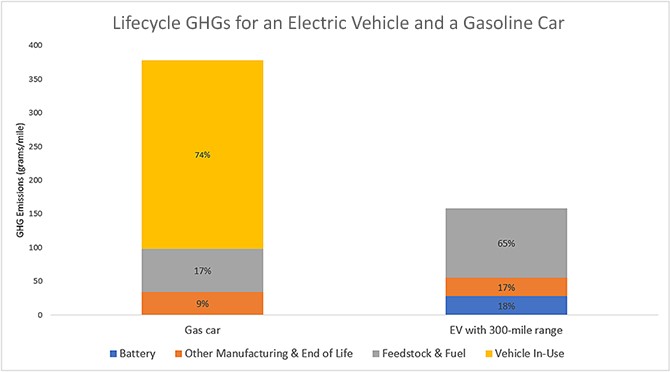
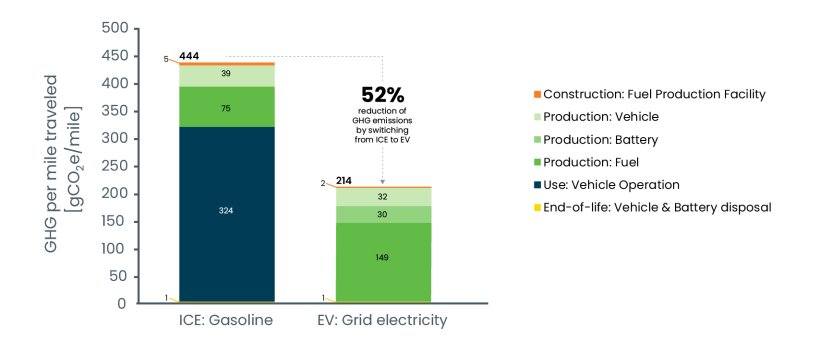
EV Cars emit less pollution than Internal Combustion Engine Cars, even considering manufacturing, disposal and many EV Cars being charged by dirty grids. The basic reason for this is the much higher efficiency of EV cars. EV cars emit significantly less greenhouse gases than internal combustion engines even considering construction of fuel production facilities, production of the car, the battery, and the fuel, vehicle operation and disposal. For more information click here.

The histogram graph shows that if you consider construction of facilities, manufacturing of vehicle and battery, production of fuel, vehicle operation as well as disposal the total average greenhouse gas emissions from EV cars is 52% less | There are many environmental success stories
Lifecycle greenhouse gas emissions comparison of average gasoline car and average EV. This graph is taken from the US Department of Energy.

Super Fact 35:

Natural Disasters Kill Less People Now Than 100 Years Ago

Natural disasters kill a lot less people now compared to 100 years ago. That is despite a larger population and despite the fact that climate change has increased the frequency and intensity of many types of natural disasters. Surveys by Gap Minder show that this fact is quite surprising to people and therefore it is a super fact. To read more about this super fact click here.

The reason for the fewer deaths from natural disasters is not that there are fewer natural disasters. It is because we are now much better at predicting, handling and recovering from natural disasters. Our warnings systems, rescue systems and healthcare have improved significantly. The graph below from Gap Minder illustrates the decline in deaths from natural disasters.

The graph shows 300 to 400 thousand annual deaths at the beginning of the 20th century, then 971 thousand annual deaths in the 1930’s, then it continuously gets lower until the annual deaths in the 2010 to 2016 period is 72 thousand deaths per year.
This graph from the Gap Minder article shows the annual deaths from natural disasters.

Super Fact 41:

Emissions of ozone-depleting gases have fallen by 99 Percent

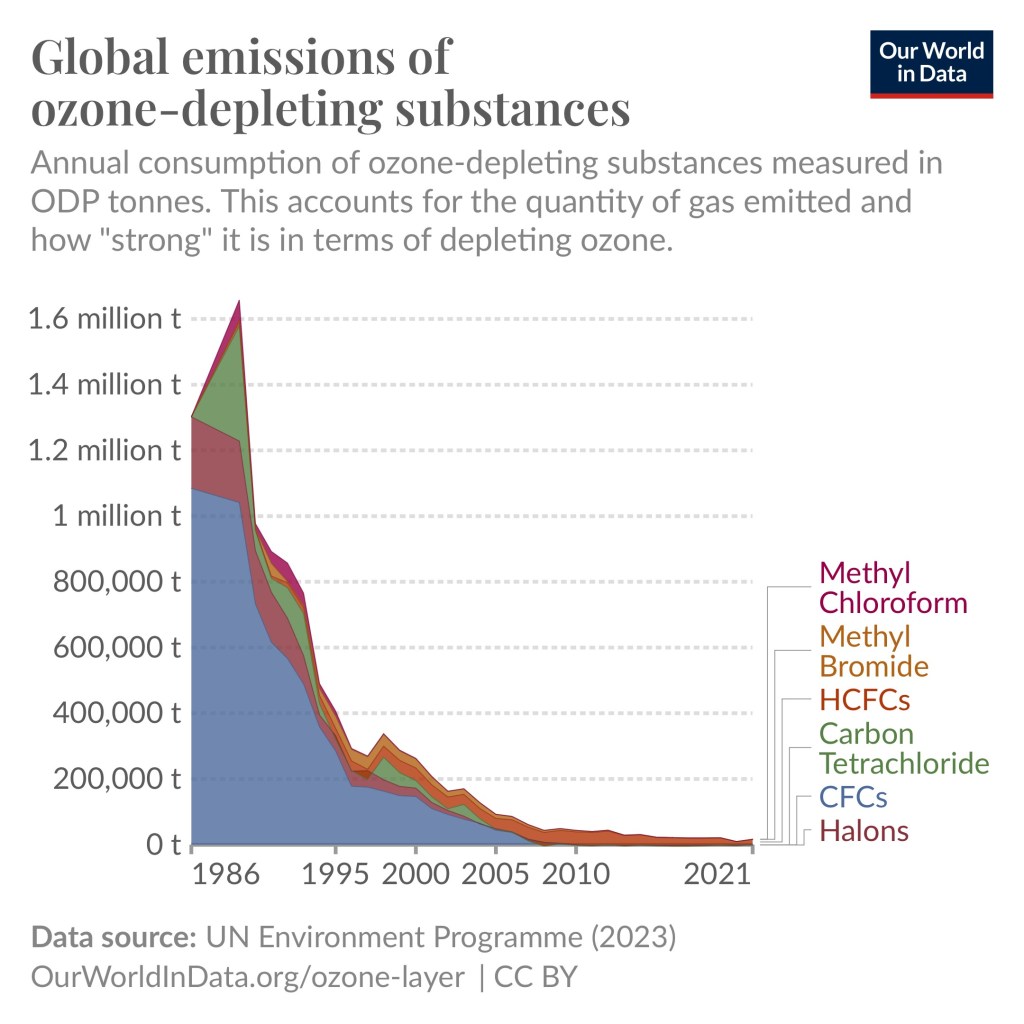
Largely thanks to the Montreal Protocol in 1987 the emissions of ozone-depleting gases have fallen by more than 99%, 99.7% to be exact, according to Our World in Data. This has resulted in the halt of the expansion of the ozone holes. The reduction in emissions of  ozone-depleting gases is saving millions of lives every year. To read more about this astounding success click here.

The NIH estimate that the Montreal Protocol has prevented 443 million cases of skin cancer worldwide, 2.3 million skin cancer deaths, and 63 million cases of cataracts in the United States alone. Globally, it is estimated that the Protocol has saved an estimated 2 million people from dying from skin cancer each year. The graph below is taken from Our World in Data.

Gases visualized in the diagram are CFCs, Halons, HCFCs, Carbon Tetrachloride, Methyl Bromide, Methyl Chloroform. The diagram shows a peak around the end of 1980’s | There are many environmental success stories
The phase out of six ozone depleting gases. Data source UN Environment Program (2023).

Super Fact 42:

Developed nations have successfully reduced carbon emissions

The developed nations (rich countries) have reduced their carbon emissions since the 1990’s despite continued GDP growth, even if we take offshore production into account. In addition, many developing countries have succeeded in reducing their emissions as well. Other fast-growing developing countries have flattened or at least slowed their increase in carbon emissions. Many countries have decoupled economic growth from CO2 emissions.

In other words, we do not need to increase carbon emissions or burn more fossil fuels to grow the economy. To read more about this promising development click here.

The graph shows three plotted graphs, a dark blue one showing GDP per capita, a light blue one showing UK carbon emissions per capita and a red one showing trade adjusted carbon emissions per capita. The GDP graph is increasing by more than 50% over 33 years and the CO2 emissions per capita graph is decreasing by almost 60% and the trade adjusted carbon emissions decline by almost 40%.
Data source: Data compiled from multiple sources by World Bank (2025); Global Carbon Budget (2024); Population based on various sources (2024). Note: GDP per capita is expressed in international dollars at 2021 prices. Graph taken from Our World in Data.

Super Fact 44:

Sulfur dioxide pollution has fallen by 95 percent in the US

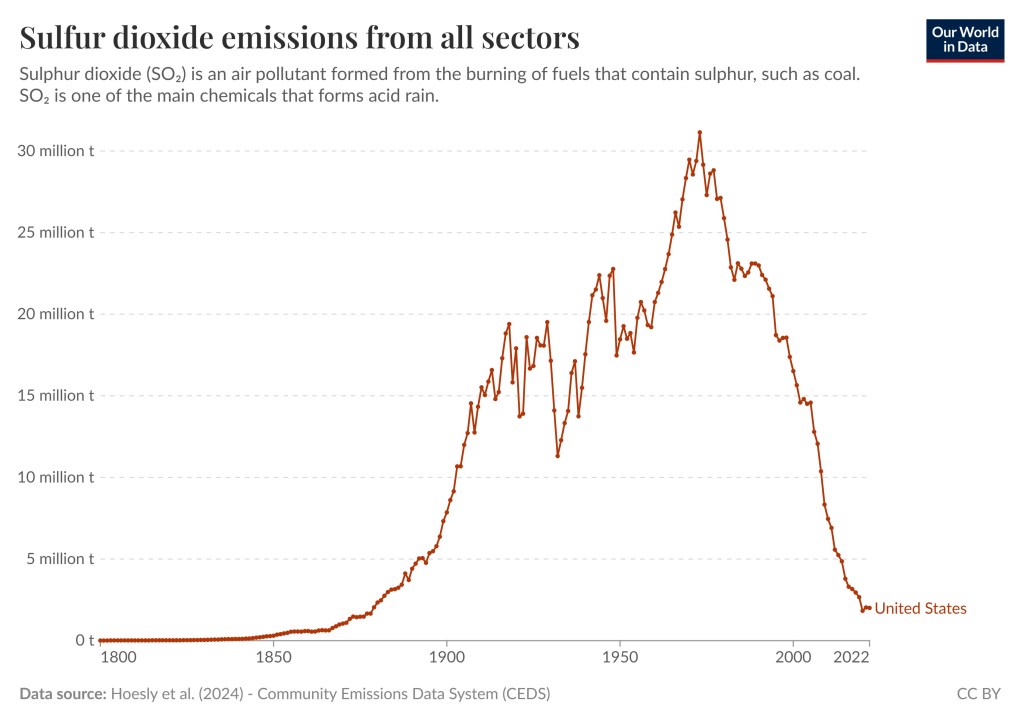
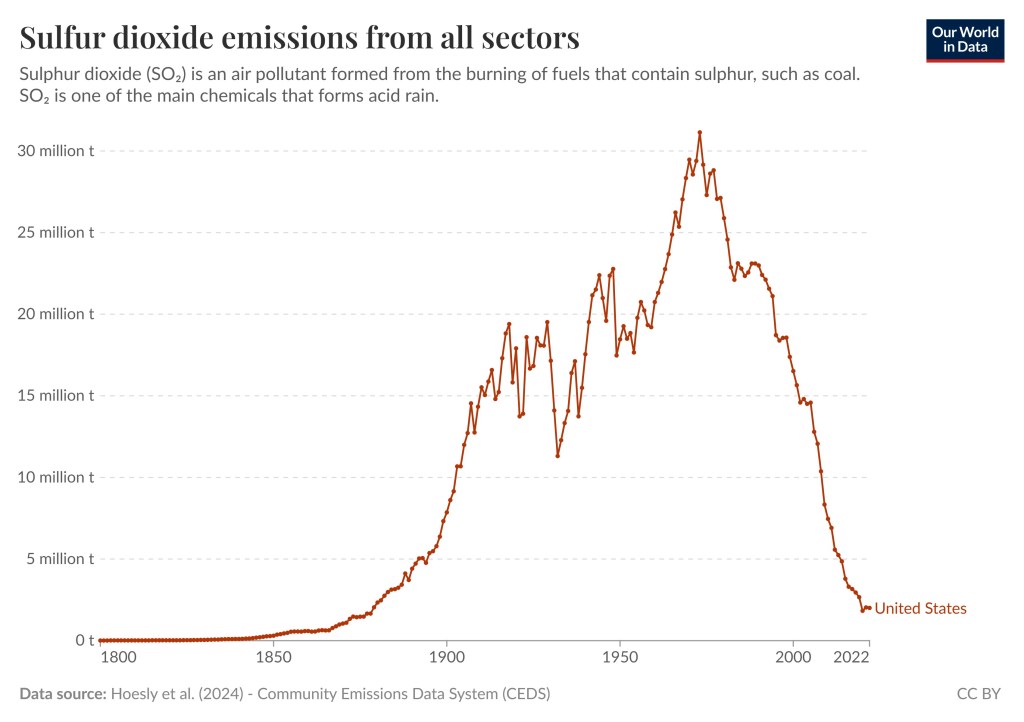
Sulfur dioxide pollution has fallen by approximately 95 percent in the US since the 1970s. This significant reduction is primarily due to regulations like the Clean Air Act. Global sulfur dioxide pollution has also fallen but not as much. To read more about this success story click here. If you visit the aforementioned link you will also see that there are many other pollutants that we have successfully curtailed.

The graph shows a steep increase towards the end of the 19th century with a peak in 1973, followed by a steep decline |There are many environmental success stories
US sulfur dioxide pollution since 1800. US Emissions peaked in 1973. Data Source: Hoesly et al (2024) – Community Emissions Data System (CEDS). This graph is taken from this page in Our World In Data.

Super Fact 45:

Deforestation has peaked

Deforestation peaked back in the 1980s, meaning that is when it was worst. Deforestation has not stopped but the rate of deforestation has slowed as a result of government policies, corporate initiatives, and international agreements.

Overall, we are still losing forests. We had a 47-million-hectare loss of forest in the last decade, which is very bad, but that is better than the 151-million-hectare loss of forest in the 1980s. For temperate forests we have succeeded in reversing deforestation, which means that temperate forests are now gaining forest. To read more about this topic and how government policies, corporate initiatives, and international agreements have slowed the rate of deforestation you can click here. This change in deforestation rate is illustrated by the graph below, which is taken from Our World in Data.

The graphs show that during the 1700’s and the first half of the 1800’s the loss of forests was 19 million acres per decade. From the mid-1800’s to 1920 it was roughly 30 million acres per decade and from the 1920 and on it was 115 million acres per decade until the 1980s and the first half of the 1990s when it was 151 million acres per decade. Since then, it has fallen and in the last decade forest loss was 47 million acres | There are many environmental success stories
Decadal losses in global forest over the last three centuries. Decadal forest loss is measured as the average net loss every ten years, in hectares. This deforestation minus increases in forest area through afforestation. There is no single dataset that applies consistent or transparent methodology for deforestation over centuries. Two different datasets are therefore shown: these still shown the overall development and transition of forestation from temperate to tropical areas, but magnitudes should not be combined at the crossover point. Data sources: Pre-1995 data from Williams (2006). The second series is based on data from UN FAO Global Forest Resources.

Note : I am going on a trip with family and will return next Tuesday (5/27). During this time will not do any blogging. I love comments but I will respond to comments when I come back.

To see the other Super Facts click here

Sulfur dioxide pollution has fallen by 95 percent in the US

Super fact 44 : Sulfur dioxide pollution has fallen by approximately 95 percent in the US since the 1970s. This significant reduction is primarily due to regulations like the Clean Air Act. Global sulfur dioxide pollution has also fallen but not as much.

Sulfur dioxide is a colorless gas with the formula SO2. It has a pungent smell, which you notice after using matches. It is released naturally by volcanic activity and is produced as a by-product of burning sulfur-bearing fossil fuels and from metals refining. Sulfur dioxide is somewhat toxic to humans and by reacting with water it creates acid rain, which is a serious environmental problem.

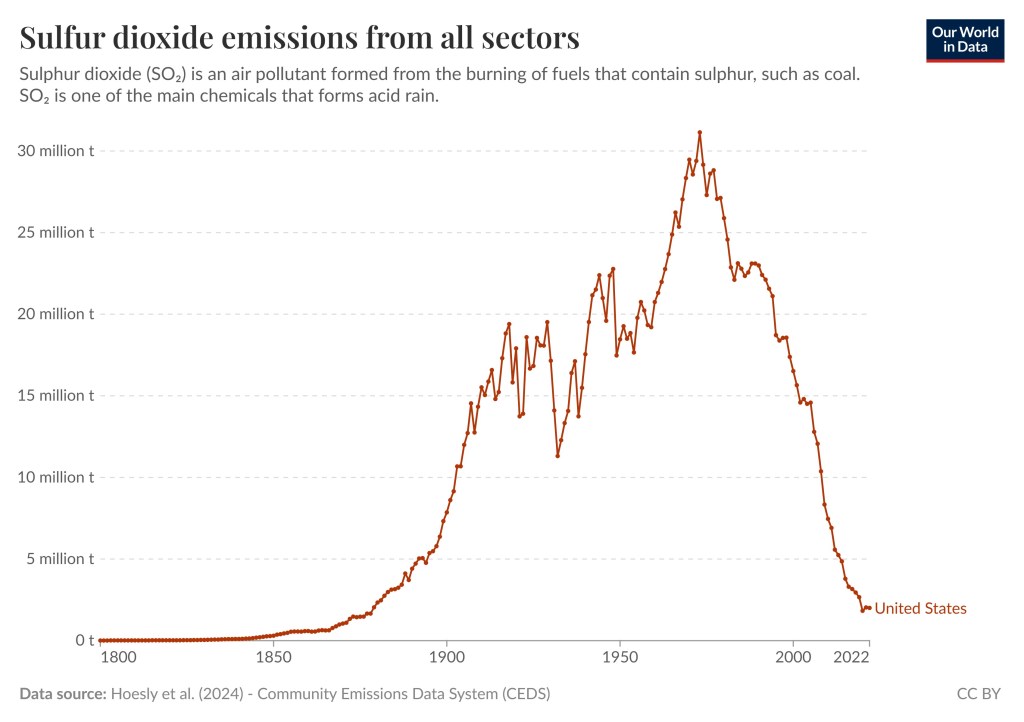
The good news is that the Clean Air Act has driven technological advancements and the adoption of cleaner practices in industries that produce sulfur dioxide emissions. This has resulted in a drop of sulfur dioxide pollution in the US by 95% according to EPA and Statista and 94% according to Our World In Data. Statista is a pay site, so I am not going to link to it. Below is a graph from Our World In Data showing the reduction in sulfur dioxide pollution in the US.

The graph shows a steep increase towards the end of the 19th century with a peak in 1973, followed by a steep decline | Sulfur dioxide pollution has fallen by 95 percent in the US
US sulfur dioxide pollution since 1800. Data Source: Hoesly et al (2024) – Community Emissions Data System (CEDS). This graph is taken this page in Our World In Data.<<Link-5>> US Emissions peaked in 1973.

I should mention that by clicking this link you can visit the graph above Our World in Data and select different countries and regions and play around with the settings.

Sulfur Dioxide Emissions Worldwide

The worldwide emissions peaked in 1979 and fell sharply after that even though the progress (reduction in sulfur dioxide emissions) has not been as spectacular as in the US. Worldwide reductions are around 48%. Again, by visiting the Our World In Data page you can play around with the graph and the settings and view different countries and regions. This is an additional source visualizing the data.

The graph shows a steep increase in sulfur dioxide emissions around 1950 with a peak in 1979, followed by a steep decline, but not as dramatic as for the US
Sulfur dioxide pollution worldwide since 1800. Data Source: Hoesly et al (2024) – Community Emissions Data System (CEDS). This graph is taken this page in Our World In Data. Worldwide Emissions peaked in 1979.
This graph shows the sulfur dioxide emissions for the world as well as for China and India. China follows the world wide emissions but on a smaller scale whilst India has steady increase in emissions that stabilized/peaked in 2023 | Sulfur dioxide pollution has fallen by 95 percent in the US
Sulfur dioxide pollution worldwide since 1800 with three major polluters included. The United States is in red, China in green and India in blue. The graph for India is the one corresponding to the least overall pollution but it has no reduction. Data Source: Hoesly et al (2024) – Community Emissions Data System (CEDS). This graph is taken this page in Our World In Data.

Good News with Respect to Pollution

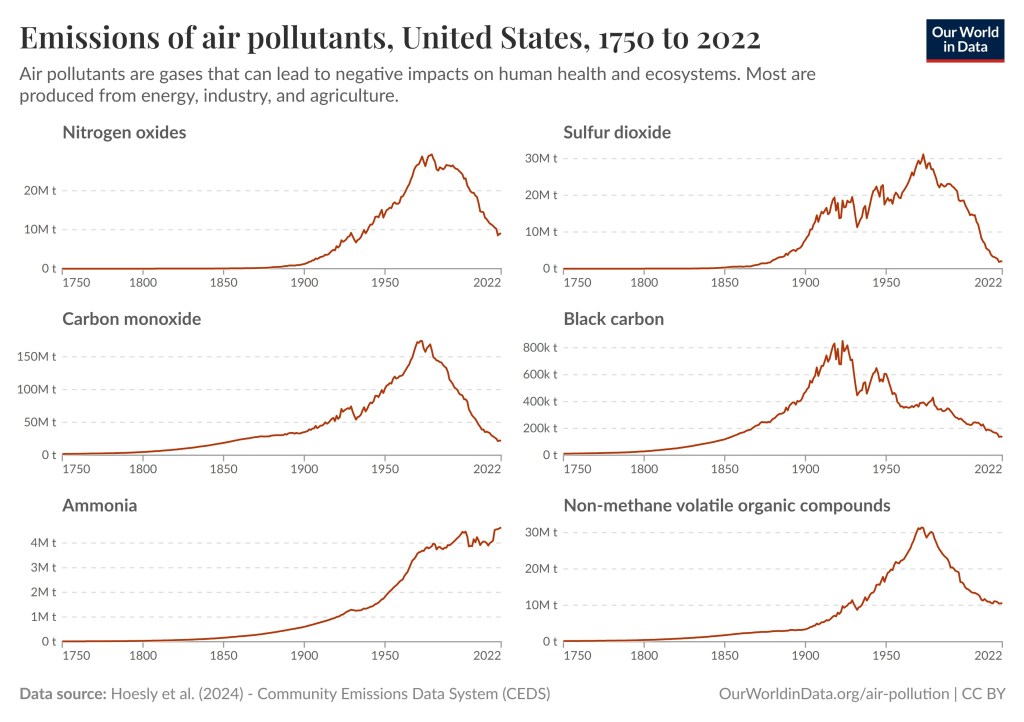
Sulfur dioxide emissions have gone down worldwide, which is good news. However, sulfur dioxide is not the only pollutant that we have succeeded in reducing. The graph below demonstrates that the US has also made great progress in reducing Nitrogen Oxides pollution, Carbon Monoxide, Black Carbon, and Non-methane volatile organic compounds. We have not been as successful with reducing Ammonia pollution.

However, according to Google AI sulfur dioxide, followed by Nitrogen Oxides pollution, Carbon Monoxide, and Black Carbon are the most serious pollutants. The graph below is taken from this page in Our World in Data.

The graphs for nitrogen oxide emissions, sulfur dioxide emissions , carbon monoxide and non-methane organic compounds pollution peak around 1970’s and then show a sharp downturn. The graph for black carbon peak around 1920 and then show a sharp downturn whereas the graph for ammonia does not peak. All graphs are in red.
US nitrogen oxide emissions, sulfur dioxide emissions, carbon monoxides, black carbon, ammonia and non-methane organic compounds pollution since 1750. Data Source: Hoesly et al (2024) – Community Emissions Data System (CEDS). This graph is taken from this page in Our World In Data.

The graphs for the world do not look as impressive. However, even in this case it looks like some progress has been made. Four graphs have peaked and are turning downwards, and one graph has flattened but unfortunately the graph for ammonia pollution is still heading upwards.

It should be noted that these pollutants are more or less local in the sense that they affect the polluting country and/or surrounding countries the most, whilst the climate change / global warming effect from carbon dioxide and other long lasting greenhouse gases tend to affect the entire planet.

The graphs for nitrogen oxide emissions, sulfur dioxide emissions , carbon monoxide peak around 1970’s and then show a small downturn. The graph for black carbon peak around 2020 and then shows a small downturn. The graph for non-methane organic compounds pollution flattened around 2020 whereas the graph for ammonia keeps growing. All graphs are in blue | Sulfur dioxide pollution has fallen by 95 percent in the US
Worldwide nitrogen oxides emissions, sulfur dioxide emissions, carbon monoxide emissions, black carbon, ammonia and non-methane organic compounds pollution since 1750. Data Source: Hoesly et al (2024) – Community Emissions Data System (CEDS). This graph is taken from this page in Our World In Data.

Aside from the success in reducing these pollutants there is more good news.


To see the other Super Facts click here

Scientists Agree that Global Warming is happening and that we are the Cause

Super fact 34: Climate Scientists agree that Global Warming or if you call it Climate Change is happening, and that it is caused by us primarily because of our burning of fossil fuels. There is a long-standing scientific consensus on these two facts because the evidence is conclusive. Typically, studies show an agreement of at least 97% or 98% among climate scientists.

This is a super fact because surveys show that this is not what the public believes and yet it is true. The public incorrectly believes that there is a large disagreement among scientists on this topic. A note, to understand why the evidence is conclusive as to why global warming is happening and is caused by us click here.

Note : I will use the term “global warming” in this review. Whether you call the phenomenon climate change, climate disruption, or global heating, is not important.

The Scientific Consensus

This extensive survey from 2013 of 12,000 climate papers (papers published over two decades) by Dana Nuccitelli and Cook, etc., concluded that 97.1% of climate scientists endorsed the consensus position that humans are causing global warming.

They also did a science author self-rating which concluded that 97.2% of climate scientists endorsed the consensus position that humans are causing global warming. Another conclusion from the survey was that the consensus had increased from around 90%, perhaps less, in the early 1990’s.

A later review of six independent, peer-reviewed studies examining the scientific consensus about global warming have concluded that between 90% and 100% of climate scientists are convinced human-caused global warming is happening. A more recent study (2021) found that as many as 98% of climate scientists are convinced global warming is happening and is human-caused. Numerous other surveys have concluded the same thing.

People’s Beliefs About Global Warming

This 2024 survey from Yale University show that most Americans (61%) understand that global warming is mostly human caused. By contrast, 28% think it is caused mostly by natural changes in the environment. Most Americans (58%) <<Link-6>> understand that most scientists think global warming is happening. This percentage has trended generally upward since this survey began in 2008. By contrast, about one in five (22%) think there is a lot of disagreement among scientists about whether global warming is happening.

The green graph is going up slightly starting from 46% in 2009 and ending in 58% in 2023. The black graph starts at 33% in 2009 and ends in 22% in 2023. The yellow graph starts at 2% in 2009 and ends in 2% in 2023 | Scientists Agree that Global Warming is happening and that we are the Cause
The green graph corresponds to “most scientists think global warming is happening (%).” The black graph corresponds to “there is a lot of disagreement among scientists (%)”. The yellow graph corresponds to “Most scientists think global warming is NOT happening (%)”. Graph taken from the Yale Program on Climate Change Communication.

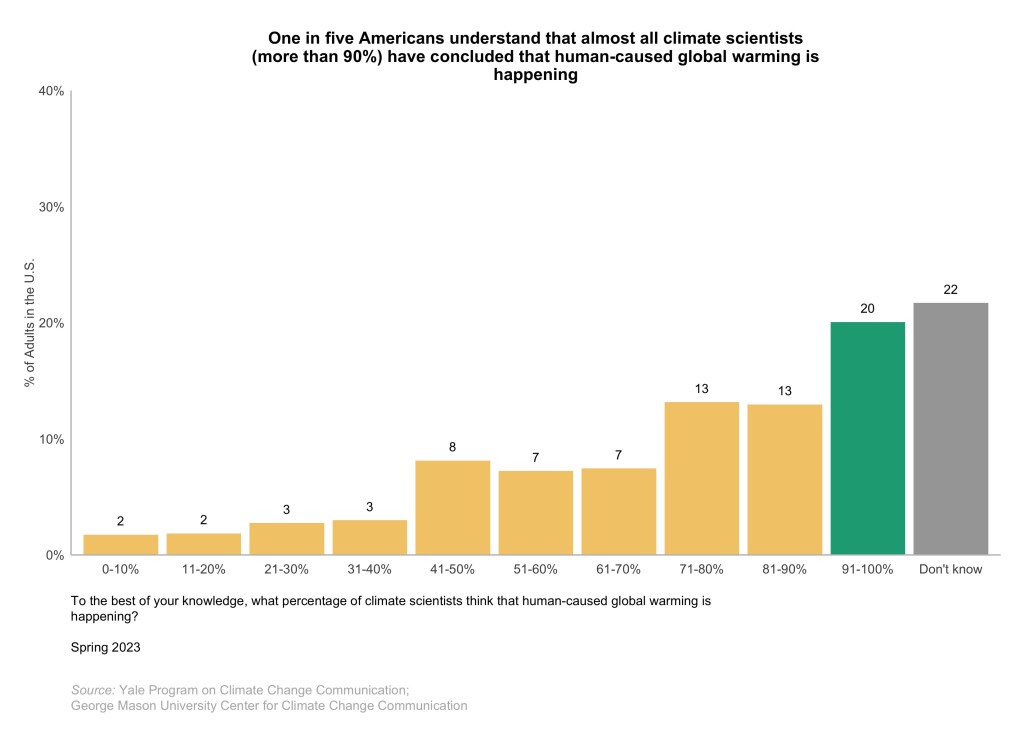
However, only one in five Americans (20%) understand that nearly all climate scientists (more than 90%) think that human-caused global warming is happening. The aforementioned Dana  Nuccitelli refers to this in his book Climatology versus Pseudoscience as the consensus gap. Again, this large discrepancy between public perception and reality makes the consensus gap a super fact. Research has shown that this discrepancy has a large impact on people’s other beliefs regarding global warming.

This is bar graph. It shows that 2% believe the answer is 0-10%, 2% believe the answer is 11-20%, 3% believe the answer is 21-30%, 3% believe the answer is 31-40%, 8% believe the answer is 41-50%, 7% believe the answer is 51-60%, 7% believe the answer is 61-70%, 13% believe the answer is 71-80%, 13% believe the answer is 81-90%, 20% believe the answer is 91-100%, 22% don’t know | Scientists Agree that Global Warming is happening and that we are the Cause
The question was, To the best of your knowledge what percentage of climate scientists think that human-caused global warming is happening? Graph taken from the Yale Program on Climate Change Communication.

Why is there a Consensus Gap?

In his book Climatology versus Pseudoscience Dana Nuccitelli explains that a relatively small group of so-called climate skeptics, or more accurately called climate contrarians have received a lot of attention from media. Even though their science is bad, and they’ve published their error ridden papers in obscure or discredited journals, and the fact that their predictions have failed repeatedly many times over, they have had an enormous influence on public discourse. Conservative politicians, and many talk show hosts are blindly devoted to their falsehoods, whilst real scientists are being attacked.

It is not just rightwing media who are using them for their purposes, but mainstream media are giving the contrarians undue attention as well. Sensationalism is one issue. A science contrarian claiming that all the climate scientists are wrong, and that he is the only one who finally got it right is a lot more interesting of a story than a repeat of the consensus. Another issue is false balance. Journalist should not feel that they must give equal time to evidence-based science and nonsense, but that is often the case. To read my review of this book click here.

The Oregon Petition

I am mentioning the Oregon petition because I fell for it myself. The Oregon petition was an official looking petition circulated by climate contrarians, claiming that there is no evidence that human-caused global warming will cause catastrophic heating of earth’s atmosphere and disruption of earth’s climate, and that adding more carbon dioxide to the atmosphere would even be beneficial for plants and animals. It got an impressive number of signatures, 32,000 after some years.

However, it turned out that the signatories rarely had climate expertise, and were not scientists, and the survey listed many falsified names such as the names of the Spice Girls and several fictional characters. Less than 200 of the signatories were climate researchers.

It was a con, but it was touted in a lot of media as the truth. I saw it over and over and I believed it. I was later surprised to learn that it was a con and that a scientific consensus existed on global warming / climate change. Learning that I had been bamboozled on this matter was one of the red flags that prompted me to start doing some fact checking on the issue global warming.

To see the other Super Facts click here