The Hockey Stick Graph is not Wrong

Superfact 26: The disputed Hockey Stick Graph showing that recent global warming is unprecedented in the context of the past thousand years has been shown to be correct.

The Mann, Bradley, and Hughes hockey stick curve published in 1998 in Nature and showing a sharp upturn in global temperatures in recent years as well as relatively flat temperatures in the previous 1,000 years, ignited a firestorm.

Initially some scientists criticized it for being wrong, and the rightwing media and think tanks, and especially politicians criticized the graph and even attacked the scientists involved accusing them of being frauds. Al Gore was harshly criticized for using the hockey stick in his documentary “an inconvenient truth”. There were congressional hearings, politicians intimidating scientists, fake scandals, threats, and lawsuits.

The propaganda campaign against the hockey stick graph succeeded in winning over the public and that included me. I was for the longest time convinced that the hockey stick graph was wrong and perhaps a fraud. I was wrong. I had been bamboozled just like large segments of the American public.

The scandal around the hockey stick curve and the related climate-gate (fake scandal) was used to question the entire concept of global warming / climate change. As you may know, the evidence clearly shows that global warming is happening and is caused by us.

It should be noted that the way Mann, Bradley, and Hughes implemented their statistical analysis was not 100% correct, but the discrepancy was very small and did not make a big difference. However, this discrepancy was very useful for their detractors.

The controversy led to an investigation resulting in the so-called North Report. The 2006 North Report published by the United States National Academy of Sciences endorsed the MBH studies with a few reservations.

Subsequent research has resulted in more than two dozen reconstructions, using various refined statistical methods and combinations of proxy records. They are not identical to the original hockey-stick graph but closely resemble it and consistently show a slow long-term cooling trend changing into relatively rapid warming in the 20th century.

Since there is now a scientific consensus supporting the hockey stick graph, it is important news, and a lot of people still have not gotten the memo or are refusing to believe it, I consider it a super fact.

Before The Hockey Stick Graph

Before the hockey stick curve there was a lot of talk about the medieval warm period and the little ice age. Many people used these periods to cast doubt on global warming claims by scientists. I should say that the climate scientists claim about global warming was not based on the temperature record for the last 1,000 years. It was because the observed recent uptick in average global temperatures was not expected naturally.

Their worries were based on the fact that our greenhouse gas emissions could explain the uptick whilst there was no climate cycle or natural phenomenon that could explain it. That combined with the fact that the manner in which the warming was happening (it’s fingerprint if you will) showed that it was our greenhouse gases causing it.

So, the comparably high temperatures during the medieval warm period and the very cold temperatures during the little ice age should not have mattered much. But as you can see in the graph below, the old temperature graphs could be used by global warming skeptics.

It should be noted that previous estimates for the temperatures during the medieval warm period and the little ice age were based insufficient data and guesstimates.

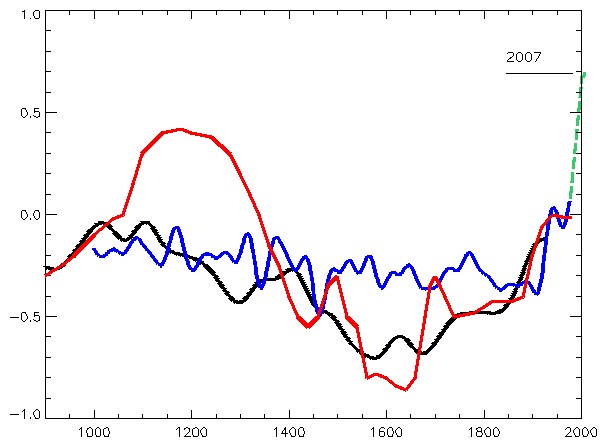
The graph below from the 1990 IPCC report shows three curves, a red, a blue and a black one, and a green extension to the blue from 1998 to 2007. The red graph shows a large bulge corresponding to the medieval warm period, a significant drop corresponding to the little ice age, and a minor uptick in recent temperatures. The blue curve shows a flattened medieval warm period with only a minor little ice age and sharper uptick in recent temperatures. The green extension stretching from 1998 to 2007 shows a significantly sharper uptick in temperatures. The black curve is an alternative temperature curve by Moberg.

As you can see the estimates for the average global temperatures during the medieval warm period and little ice age were too large. When the hockey stick curve came along (next graph), a propaganda tool was diminished, which led to the media storm.

The graph below from the 1990 IPCC report shows three curves, a red, a blue and a black one, and a green extension to the blue from 1998 to 2007 | The Hockey Stick Graph is not Wrong
The red line is from the 1990 IPCC report and shows what was believed at the time about temperatures during the last 1,000 years. The blue line is the (MBH) hockey stick graph from 1998. Graph taken from this page. William M. Connolley derivative work: Dave souza, CC BY-SA 3.0 <http://creativecommons.org/licenses/by-sa/3.0/&gt;, via Wikimedia Commons
Hockey stick curve going back 1,000 years. The recent uptick in global temperature is very sharp and very sudden | The Hockey Stick Graph is not Wrong
The so-called hockey stick curve depicting the last 1,000 years. The blue line is the first hockey stick curve ever created (by Michael Mann). He used proxy measurements such as tree rings, green-dots 30-year average, red temperature measurements. Wikimedia commons <<https://creativecommons.org/licenses/by-sa/4.0/deed.en>>. This graph is taken from this page.

Multiple Hockey Stick Graphs

As mentioned, various refined statistical methods and combinations of proxy records, has resulted in another couple of dozen hockey stick curves that largely agree with the original MBH hockey curve. Below are a few examples taken from various sources. The first two graphs below are taken from the real climate website, a website created by climate scientists.

IPCC 3rd Assessment Report

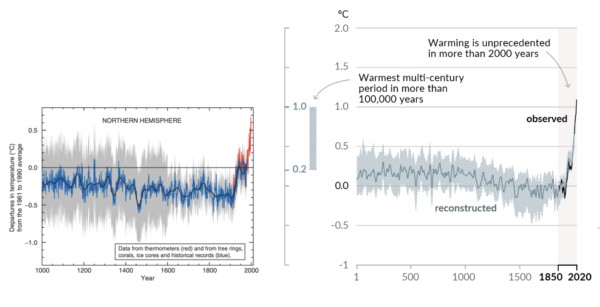
On the left is the original MBH 1998/1999 hockey stick curve extending back 1,000 years and, on the right, a more recent reconstruction extending back 2,000 years. The curves look like each other but the more recent one looks even more like a hockey stick | The Hockey Stick Graph is not Wrong
Side-by-side comparison of the (left) original Mann et al (1999) “Hockey Stick” reconstruction as featured in the Summary for Policy Makers of the IPCC 3rd Assessment report (2001) and the (right) longer, sharper “Hockey Stick” as featured in the Summary for Policy Makers of the IPCC 6th Assessment report (2021).

Eight Hockey Sticks by New Scientist

The graphics below are focused on the northern hemisphere. The top graph shows the 2001 IPCC hockey stick curve with data from thermometers (in red). Below that graph are eight more hockey stick curves plus a red dotted line corresponding to the instrumental record. This was compiled for New Scientist by Rob Wilson of the University of Edinburgh, UK.

The IPCC curve is at the top and below it is another graph containing eight hockey stick curves, Jones 1998 (red), Crowley 2000 (yellow), Briffa 2001 (black), Esper 2002 (purple), Huang 2004 (light blue), Moberg 2005 (black), Oerlemans 2995 (black), D'Arrigo 2006 (green).
The top graph shows the 2001 IPCC version of the hockey stick curve stretching back 1,000 years. The error bars (in grey) show the 95% confidence range. The blue line is from tree rings, corals, ice cores and historical records. All curves correspond to the departures in temperatures in centigrade from the 1961 to the 1990 average.

The Hockey Stick Wars

I also wanted to add a few examples related to the propaganda wars against the first hockey stick graph and its author Dr. Michael Mann and climate science in general. If you haven’t followed this topic, I can add that it did get intense.

On April 23, 2010, Virginia Attorney General Ken Cuccinelli issued a Civil Investigative Demand (CID) to the University of Virginia (UVA). The CID demanded that UVA provide every email, record, or document it had related to Dr. Mann from his time there from 1999 to 2005. This resulted in a strong reaction from the scientific community.

On 2 March 2012 the Supreme Court ruled that Cuccinelli as Attorney General had no legal authority to demand the records from the university. Dr. Mann was also severely harassed and received chilling death threats against himself as well as his family, as documented in his book “The Hockey Stick and the Climate Wars: Dispatches from the Front Lines”.

In February 2024, Michael Mann won a defamation lawsuit against conservative writers Rand Simberg and Mark Steyn (Mann v. Competitive Enterprise Institute). The jury awarded Mann $1 million in punitive damages and $1 in compensatory damages. The lawsuit was over blog posts written by Simberg and Steyn that accused Mann of manipulating data in his famous “hockey stick” graph. It was not so much about questioning the science but rather about the fact that they intentionally tried to ruin his reputation using false information.

For example, they were comparing him to the infamous pedophile Jerry Sandusky. Jerry Sandusky was a football coach at Penn State University and Dr. Michael Mann is a distinguished Professor of Atmospheric Science at Penn State.

To see the other Super Facts click here

Wind power is not a major cause of bird death

Superfact 17: Fossil fuels kill a lot more birds per gigawatt hour than wind power does. Cats, windows, cars, poison and powerlines are examples of things that kill a lot more birds than wind power does. Wind power killing birds is not the huge environmental problem it is often made out to be.

Wind power killing birds is often mentioned as a slam dunk environmentally based argument against wind power and evidence for the hypocrisy of environmentalists. This is misguided. Wind power killing birds is a real problem and it should be addressed, and it is being addressed. No energy source comes without environmental problems. However, wind turbines account for only a small fraction of overall bird deaths compared to other human causes. It is not a good argument against wind power, and it does not demonstrate any hypocrisy by environmentalists. In fact, a study made in 2012 (overview here) concluded that fossil fuels killed 24 million birds per year in the US, which correspond to 35 times more birds per GWh than wind power kills according to this study. Even though this study and other similar studies are estimates based on assumptions that are far from perfect, they are good indicators that replacing fossil fuels with wind power likely saves birds rather than kills them.

Photo by Pixabay on Pexels.com

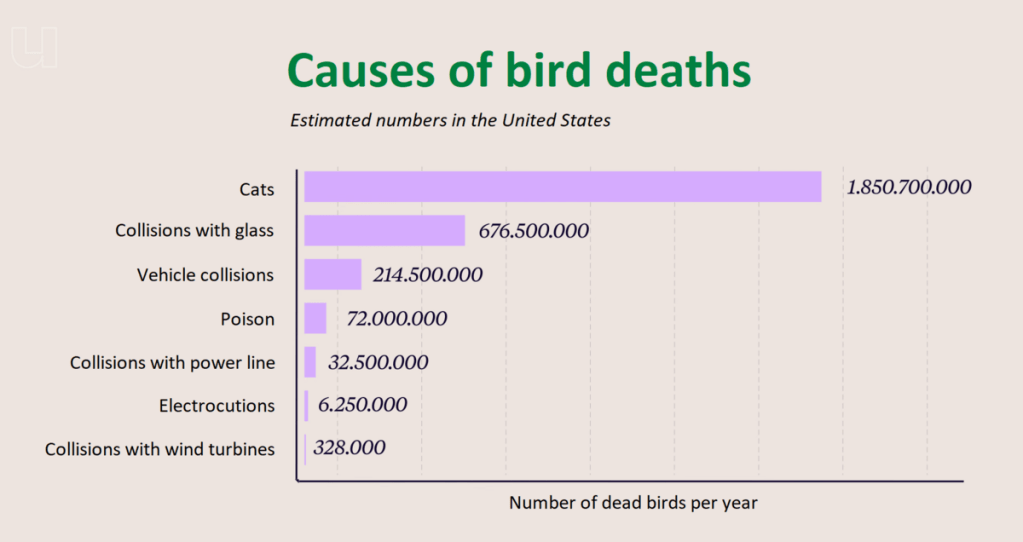
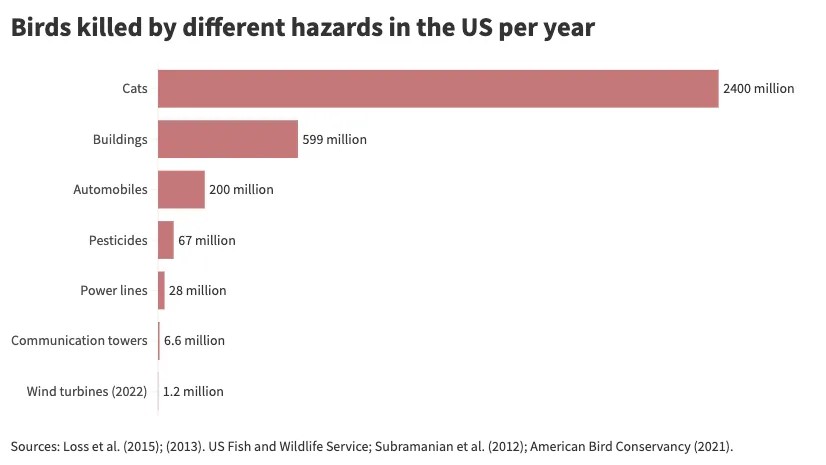
In any case, as this Wikipedia article states, collisions with wind turbines are a minor source of bird mortality compared to other human causes. According to the graph below cats kill 5,600 times more birds than wind power and collisions with powerlines kills 99 times more birds than wind power, and yet we rarely discuss these problems. Even though these numbers are estimates they are mostly confirmed by other studies and analysis, as this overview from MIT and this analysis by Hannah Richie shows. The numbers aren’t the same, but they make the same point. FYI Hannah Richie is the deputy editor and lead researcher at Our World in Data. Our World in Data is a scientific online publication that focuses on large global problems. They are associated with Oxford University and is one of the most respected statistics, analysis and research organizations in the world.

The graph shows that Wind Turbines kill 328,000 birds per year in the US, Electrocutions kill 6,250,000 birds, Collisions with powerlines kill 32,500,000 birds, Poison kills 72,000,000 birds, Vehicle collisions kill 214,500,000 birds, Collisions with glass kill 676,500,000 birds, and cats kill 1,850,700,000 birds per year in the US.
From Wikipedia: Universiteit van Nederland, CC BY 3.0 <https://creativecommons.org/licenses/by/3.0&gt;, via Wikimedia Commons
Bar graph showing cats killing an estimated 2,400 million birds per year, buildings killing an estimated 599 million birds per year, automobiles killing an estimated 200 million birds per year, pesticides killing an estimated 67 million birds per year, powerlines killing an estimated 28 million birds per year, communication towers killing an estimated 6.6 million birds per year, and wind turbines killing an estimated 1.2 million birds per year.
An alternative graph taken from Hannah Richie / Our World in Data, using alternative sources essentially showing the same thing. Sources: Loss et al. (2015), (2013), US Fish and Wildlife Service; Subramnayan et al. (2012), American Bird Conservancy (2021).

Wind power has been on the receiving end of false claims, nonsense, and strange rumors for quite some time. It is not the only energy source maligned by false information, but it is an interesting case study in misinformation regarding energy sources. To read about nonsense and rumors about wind power click here.

Photo by Athena Sandrini on Pexels.com


To see the other Super Facts click here


Life Must Have Hydrogen Oxygen Carbon Nitrogen and Phosphorus

The goal of this blog is to create a list of what I call super facts. Important facts that we know to be true and yet they are surprising, shocking or disputed among non-experts. Special facts that any well-informed person should know. 

  • Paperback –  $18.95 on Amazon – future release March 25, 2025.
  • Hardcover –  Publisher : Princeton University Press; First Edition (September 12, 2023), ISBN-10 : 0691177295, ISBN-13 : 978-0691177298, 240 pages, item weight : 1 pounds, dimensions : 5.75 x 1 x 8.5 inches, it costs $18.95 on Amazon. Click here to order it from Amazon.com.
  • Kindle –  Publisher : Princeton University Press (September 12, 2023), ASIN : B0C5SBB26C, 229 pages, it costs $15.37 on US Amazon. Click here to order it from Amazon.com.
  • Audio –  Publisher : Princeton University Press (September 19, 2023), ASIN : B0CF6WHBVX, listening length 7 hours, narrator : Christopher Ragland, it costs $0.99 on US Amazon. Click here to order it from Amazon.com.
A picture of planet earth, the title and the subtitle “How Five Elements Changed Earth’s Past And Will Chape Our Future” The letters H, N, C, P, O are circled | Life Must Have Hydrogen Oxygen Carbon Nitrogen and Phosphorus
Front cover of Elemental. Click on the image to go to the Amazon page for the hardcover version of the book.

Amazon’s description of the book

It is rare for life to change Earth, yet three organisms have profoundly transformed our planet over the long course of its history. Elemental reveals how microbes, plants, and people used the fundamental building blocks of life to alter the climate, and with it, the trajectory of life on Earth in the past, present, and future.

Taking readers from the deep geologic past to our current era of human dominance, Stephen Porder focuses on five of life’s essential elements—hydrogen, oxygen, carbon, nitrogen, and phosphorus. He describes how single-celled cyanobacteria and plants harnessed them to wildly proliferate across the oceans and the land, only to eventually precipitate environmental catastrophes.

He then brings us to the present, and shows how these elements underpin the success of human civilization, and how their mismanagement threatens similarly catastrophic unintended consequences. But, Porder argues, if we can learn from our world-changing predecessors, we can construct a more sustainable future.

Blending conversational storytelling with the latest science, Porder takes us deep into the Amazon, across fresh lava flows in Hawaii, and to the cornfields of the American Midwest to illuminate a potential path to sustainability, informed by the constraints imposed by life’s essential elements and the four-billion-year history of life on Earth.

This is my five-star review for the book Elemental

The Story of HOCNP the Five Elements Essential to all Life

The author, a biogeochemist, explains why five elements, hydrogen (H), oxygen (O), carbon (C), nitrogen (N), and phosphorus (P) are essential to all life. As an example, in the sunlit waters of the central equatorial Pacific Ocean, a lack of Nitrogen creates a water desert with no life. Lifeforms that are able extract more of these elements have a competitive advantage.

This book focuses on three world-changing organisms that were able to extract unprecedented amounts of these elements from the environment also resulting in success and huge increases in the total mass of lifeforms, as well as consequences causing mass extinction eventually followed by an entirely new planet. Note this book is not about mass extinctions, which have happened at least five times, but something more profound. It is about planet-changing events.

During the first two billion years of earth’s history there had been no oxygen in the environment; oxygen was always bound to some other atom, such as hydrogen in water. There was life back then but in the form of primitive bacteria using a primitive form of photosynthesis involving sulfur. Then came cyanobacteria which had invented a more effective form of photosynthesis, as well as a way of extracting nitrogen using a process called nitrogen fixation. The two-atom nitrogen in the air is nearly inert and very difficult to use. This made cyanobacteria extremely successful.

However, one consequence was that the carbon dioxide was largely removed from the atmosphere, while the atmosphere was filled up by oxygen, which is a byproduct of the new form of photosynthesis. Carbon dioxide is a greenhouse gas that warms the planet, something scientists had already figured out in the 1850’s. With much less carbon dioxide, the earth got very cold, and a snowball earth disaster followed. However, in the long run the oxygen paved the way for the existence of multicellular life and animals. The planet changed.

About 400 million years ago plants was a new type organism that was able to extract water (hydrogen and oxygen) from land as well as phosphorus. Their success led to another depletion of carbon dioxide causing another ice period, but they paved the way for life on land. The planet changed again. Now humans, the third type of organism, are extracting all five elements in unprecedented amounts causing global warming and other unintended consequences.

Unlike cyanobacteria and plants, we are not doing this to primarily extract nutrients but for transportation, heating and consumer products and we can control and predict the consequences of our actions.

As evidence for global warming / climate change the author discusses the temperature measurement records of various organizations (NOAA etc.). That is the smoking gun.

However, he also mentions things like the fact that the vast majority of glaciers in the world are retreating or disappearing and the fact that anyone above the age of 50 who comes from a northern climate (that would be me) can attest to the fact that winters have gotten noticeably shorter snow seasons and warmer summers. That is true and it is a good thing to mention because there are those who are quick to dismiss temperature records as big hoaxes.

The second part of his global warming discussion, the evidence that we humans are the cause of the current warming, leaves something out in my opinion. He explains why the various climate models provide incontrovertible evidence that the chief cause for the current global warming is our burning of fossil fuels, despite the models being far from perfect. I totally agree with that, but once again there are those who are not willing to accept climate models as solid evidence, and therefore you should mention other evidence as well, which he does not do.

Examples of evidence that we are the cause and that does not involve complex models would be, no known natural cause can explain the current warming, the upper troposphere is cooling while the lower troposphere is warming, the arctic is warming much faster than average, nights are warming much faster than days, etc. Those are things that would not happen if the cause was a hotter sun (which we also kept a record of) or an orbital cycle.

In addition, spectral analysis shows the cause to be the adding of greenhouse gases to the atmosphere, and various isotope studies show that the carbon emissions come from the burning of hundreds of millions of years old carbon. Why not mention that as well? I know all this is baked into the models, but simple explanations appear more convincing to many. I am not taking off a star for it, but I felt it was a missed opportunity.

One environmental threat that you don’t hear much about is the depletion of phosphorus. This is something that may be far into the future but something that seems impossible to solve once it arrives and could evolve into an enormous food crisis. This was certainly a unpleasant surprise to me.

The book explains many processes and concepts, biogeochemistry, primitive photosynthesis using sulfur, photosynthesis using water (cyanobacteria) and releasing oxygen, nitrogen fixation, endosymbiosis, how plants extract phosphorus from the ground, the evolution of plants, the slow carbon cycles, the fast carbon cycle, the effect of volcanoes on climate, respiration, why can trust certain aspects of climate models, nitrogen fixation, nitrogenase, the immense effect fertilizers have had on food production, the Haber-Bosch process, earth’s climate history, why phosphorus is both finite and irreplaceable, the danger to aquifers, how we have changed ecosystems, and more.

Despite that the author makes himself understood. He explains complex concepts, so they are easy to understand and connects them all in a logical way that makes a lot of sense. So don’t be afraid that the book will be difficult to read. You may just learn a lot.

The author considers climate change / global warming to be our most serious environmental challenge, but he offers a lot of suggestions for a way forward. He discusses a lot of interesting technological solutions. I think he may be a bit gloomier than necessary but overall, what he says is very insightful and somewhat hopeful.

Again, I was very impressed by the organization of the book. It is easy to create a mess when you try to connect a lot of different concepts and complex science into a logical narrative, but he was very successful. It was a delight to read this book, it was interesting and full of facts, which were new to me, and I think are very important. I learned a lot and I think it is a very well written page turner.

The back cover advanced praise for the book.
Back cover of Elemental. Click on the image to go to the Amazon page for the kindle version of the book.

To see the Super Facts click here


Electrification

This is not one of the super fact posts. It is just a post related to an interest of mine that is informational. I volunteer for an organization called Citizens Climate Lobby, or CCL. CCL is a bipartisan organization that works with both Democrats and Republicans to create the political will for climate solutions. During the month of August CCL is promoting what is called electrification. Clean energy is taking the world with storm, but energy / electric power is not the only source of carbon emissions / greenhouse gases.

Take for example, transportation. Most cars still use gasoline and to move towards a fossil fuel free future we must move towards using transportation that uses less fossil fuels such as EV cars. We need to electrify transportation. Another aspect of electrification is replacing gas stoves with induction stoves, installing solar panels, as well as lowering the energy use of your house.

A picture of houses by a lake | Electrification
Lowering the energy consumption of your house lowers your emissions. Photo by Frans van Heerden on Pexels.com

EV Cars

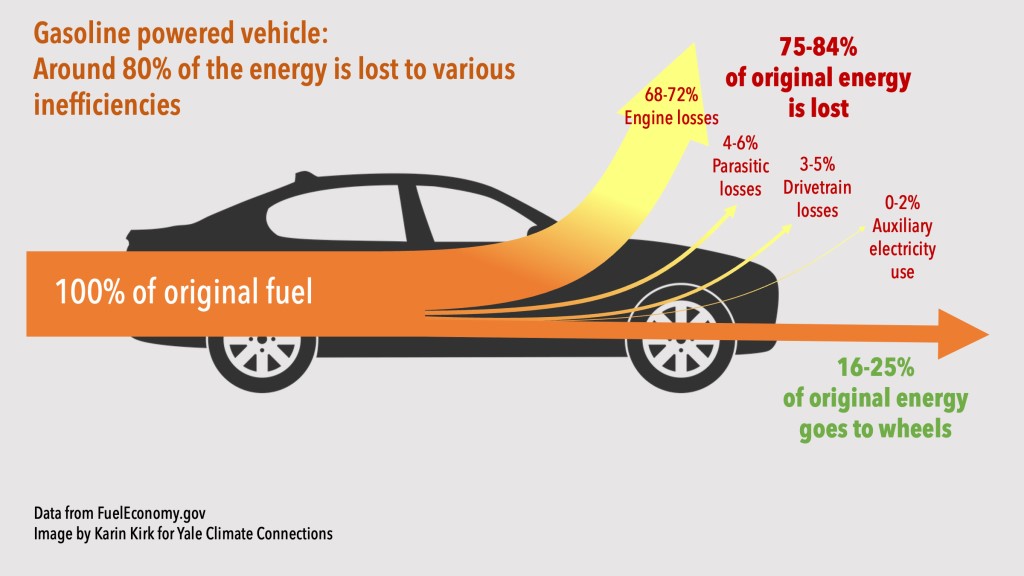
At least here in Texas it is quite common to believe that EV cars do not reduce emissions. After all EV cars use electricity from the dirty grid, right? Often this is said to environmentalists and people who care about fossil fuels emissions as if they don’t understand that the electricity for EV cars typically comes from the dirty grid. However, they do know that. In fact, they know a little bit more. EV cars are much more efficient than Internal Combustion Engine cars , or ICE, and therefore the emissions caused by EVs via the electrical grid, even a coal powered grid, is significantly less per mile. In fact, replacing gasoline-powered cars with EVs saves energy, regardless of the energy source used to recharge the EVs. For an ICE 16-25% of the original energy goes to the wheels whereas for an EV 87-91% of the original energy goes to the wheels.

Image showing an ICE car and its various losses | Electrification
16-25% of original energy goes to the wheels. Data from FuelEconomy.gov, Image by Karin Kirk for Yale Connections.
Image showing an EV car and its various losses | Electrification
87-91% of original energy goes to the wheels. Data from FuelEconomy.gov, Image by Karin Kirk for Yale Connections.

On the other hand, it takes more energy to manufacture an EV battery for an EV car than it does to produce a combustion engine. So, the production of an electric vehicle does emit more carbon than a petrol car. However, the lower emissions resulting from driving an EV means that an electric car quickly pays back its debt, so to speak. It is typically paid back within two years.

According to Hannah Richie at Our World in Data the statistics show that switching from an average ICE to an equally sized EV will save 1.2 tons of carbon emissions per person and year. That is a lot considering that the average carbon footprint per year is 4 tons worldwide and 14.4 tons per year for an American. Hannah Richie at Our World in Data also states that other environmental damages related to EVs such as mining for minerals are less than mining and extraction for fossil fuel cars, and she claims that the price of lithium-ion batteries has fallen by 98% over the last three decades.

Blonde woman pumping gas.
Photo by Andersen EV on Pexels.com

EVs are becoming increasingly common. According to Our World in Data in 2022, 88% of all cars sold in Norway were EVs and 54% of all cars in Sweden were EVs. The United States is lagging a bit at 7.5% but there is a tax credit $7,000.00 for new EVs and a $4,000.00 tax credit for buying used EVs. I should add that we have not yet bought an EV because after I took early retirement, I did not need a car. We just share my wife’s hybrid, which we hardly ever drive.

Induction Stoves

We bought an electric stove, an induction stove, a couple of years ago when our previous stove stopped working. They come with an $840.00 rebate. I’ve read that professional chefs prefer gas stoves. However, our induction stove provides everything we need for our cooking needs and my beer brewing needs and it is easier to clean. If you are a professional chef you may want to be able switch the high heat on and off quicker, but we are not professional chefs even though the food we cook is delicious.

Another downside of an induction stove is that if the power goes out you can’t cook, but that has not been a problem for us. Considering that we get our electricity from a power company, Green Mountain Energy, that utilizes renewable energy, wind and solar, you can claim that our stove is 100% fossil fuel free.

One cooking plate is red hot. The stove itself is made of granite.
Our induction stove with the lights in the kitchen turned off.

Heat Pumps

Air source heat pumps, which are the most common type of heat pumps, are a great, energy efficient choice for heating your home and water and as well as being low maintenance, they can help to cut your heating costs and lower your carbon footprint. An air source heat pump absorbs heat from the air outside a building and releases it inside. It uses the same vapor-compression refrigeration process and much the same equipment as an air conditioner, but in the opposite direction.

Air-to-air heat pumps provide hot or cold air directly to rooms. Heat pumps are the main way to phase furnaces but are also typically more efficient than other types of heaters and air conditioners and thus they reduce greenhouse gas emissions. There is an up to $8,000.00 upfront discount for heat pumps and a 30% tax credit up to $2,000.00. I should say we do not have a heat pump.

Grey heat pump standing towards the wall of an old red brick house.
Air heat pump installed on the exterior facade of the old house. Sustainable heating solutions for old construction. Stock Photo ID: 2349325553 by Snapshot freddy.

Rooftop solar

Another great thing that we have been thinking about but do not have yet is rooftop solar. Rooftop solar power system, or rooftop photo voltaic systems, consist of electricity-generating solar panels mounted on the rooftop of a residential or commercial building or structure. Residential rooftop solar power systems typically feature a capacity of about 5–20 kilowatts.

The average American household uses 1.2 kilowatts on average. Most rooftop solar systems are connected to the grid and can feed the extra power into the grid for compensation. I should add this is not entirely without difficulty. There are also hybrid systems which include any combination of wind turbines, diesel generators, and batteries for electricity on demand. There is a 30% tax credit for rooftop solar.

Solar panels being installed | Electrification
Photo by Kindel Media on Pexels.com

Miscellaneous Energy Savings

Saving energy is not exactly the same thing as electrification but it is a related topic. If you electrify your home and also reduce your energy needs, you are reducing emissions.

A few years ago, we changed the insulation in our house to reduce our energy needs and our electric bill. It made a difference. We also did weatherstripping, installed three pane windows and high security doors, that were well-insulated and reduced heat-loss. We received significant tax credits for doing this. I don’t remember how much, but it was several thousand dollars. I can add that you get a $150 tax credit for a home energy audit.

What do you think about electrification and energy savings?

Do you have additional ideas for electrification and energy savings?


To see the Super Facts click here