Developed nations have successfully reduced carbon emissions

Super fact 42 : The developed nations (rich countries) have reduced their carbon emissions since the 1990’s despite continued GDP growth, even if we take offshore production into account. In addition, many developing countries have succeeded in reducing their emissions as well. Other fast-growing developing countries have flattened or at least slowed their increase in carbon emissions. Many countries have decoupled economic growth from CO2 emissions. In other words, we do not need to increase carbon emissions or burn more fossil fuels to grow the economy.

This is good news as well as a surprise to many people who falsely believe that to grow the economy (grow GDP) you need to burn more fossil fuels and an increase in carbon emissions is inevitable if you want to grow the economy. The data shows otherwise. This is important news that is difficult to believe in for many people. It is a super fact.

Carbon Emissions and GDP

In the past carbon emissions were strongly correlated with national wealth. The wealthier a nation was the higher its carbon emissions were and as the economy grew so did the carbon emissions. This has not been true since the 1990’s. The developed nations of the world have continued growing their GDP whilst reducing their carbon emissions.

You may think that the reason is that we shipped much of our manufacturing overseas and that if you consider the consumers in the importing country responsible for the overseas emissions this decoupling of GDP and emissions would disappear. But you would be wrong. Even if you make the consumers in the importing country responsible for the emissions during production in the exporting country the emissions have gone down. One example taken from this article in Our World in Data is the United Kingdom.

In the graph below for the UK the GDP (adjusted for inflation) grew by 53.26% between 1990 and 2023 and the emissions were reduced by 57.66%. If make UK consumers 100% responsible for the emissions in China and India, etc., caused by the production of goods imported to the UK the reduction until 2022 was 38.59%. That is not as much but it is still impressive and demonstrates the decoupling between GDP growth and carbon emissions.

The graph shows three plotted graphs, a dark blue one showing GDP per capita, a light blue one showing UK carbon emissions per capita and a red one showing trade adjusted carbon emissions per capita. The GDP graph is increasing by more than 50% over 33 years and the CO2 emissions per capita graph is decreasing by almost 60% and the trade adjusted carbon emissions decline by almost 40% | Developed nations have successfully reduced carbon emissions
Data source: Data compiled from multiple sources by World Bank (2025); Global Carbon Budget (2024); Population based on various sources (2024). Note: GDP per capita is expressed in international dollars at 2021 prices. Graph taken from Our World in Data.

The text in the graph above is difficult to read so I’ve copied it below in larger text:

  • Consumption-based emissions: Consumption-based emissions are national or regional emissions that have been adjusted for trade. They are calculated as domestic (or ‘production-based’ emissions) emissions minus the emissions generated in the production of goods and services that are exported to other countries or regions, plus emissions from the production of goods and services that are imported. Consumption-based emissions = Production-based – Exported + Imported emissions.
  • Fossil emissions: Fossil emissions measure the quantity of carbon dioxide (CO2) emitted from the burning of fossil fuels, and directly from industrial processes such as cement and steel production. Fossil CO2 includes emissions from coal, oil, gas, flaring, cement, steel, and other industrial processes. Fossil emissions do not include land use change, deforestation, soils, or vegetation.
  • International dollars: International dollars are a hypothetical currency that is used to make meaningful comparisons of monetary indicators of living standards. Figures expressed in constant international dollars are adjusted for inflation within countries over time, and for differences in the cost of living between countries. The goal of such adjustments is to provide a unit whose purchasing power is held fixed over time and across countries, such that one international dollar can buy the same quantity and quality of goods and service no matter where or when it is spent. Read more in our article: What are Purchasing Power Parity adjustments and why do we need them?

Below is the same type of graphs for the United Kingdom as well as France, Germany, Sweden, United States and Finland. The numbers for these countries are as follows:

  • United Kingdom: GDP growth 53.26%, CO2 emissions reduction 57.66%, trade adjusted CO2 emissions reduction 38.59%.
  • France: GDP growth 39.74%, CO2 emissions reduction 40.64%, trade adjusted CO2 emissions reduction 28.82%.
  • Germany: GDP growth 49.04%, CO2 emissions reduction 46.72%, trade adjusted CO2 emissions reduction 33.95%.
  • Sweden: GDP growth 56.00%, CO2 emissions reduction 48.45%, trade adjusted CO2 emissions reduction 34.75%.
  • United States: GDP growth 68.05%, CO2 emissions reduction 29.25%, trade adjusted CO2 emissions reduction 17.04%.
  • Finland: GDP growth 45.69%, CO2 emissions reduction 50.54%, trade adjusted CO2 emissions reduction 42.79%.

Note these are emissions reduction numbers per capita (growth for GDP) not carbon emissions per capita. For example, the United States has three to four times larger carbon emissions per capita as, for example, Sweden or France.

All these graphs show the same trends as the UK graph.
Data source: Data compiled from multiple sources by World Bank (2025); Global Carbon Budget (2024); Population based on various sources (2024). Note: GDP per capita is expressed in international dollars at 2021 prices. Graph taken from Our World in Data.

Many Countries Have Reduced Their Carbon Emissions

However, the story does not end with these six countries or even with the developed world. The 30 graphs below all demonstrate significant reductions in carbon emissions as GDP is growing, demonstrating a decoupling between GDP growth and carbon emissions. Note that Azerbaijan’s GDP grew by 93% as its carbon emissions was reduced by 7% (all carbon emissions below are adjusted for trade).

This is 30 small graphs featuring a blue and red line. The blue line shows GDP growth since 1990 and the red line carbon emissions since 1990. All blue lines point up and all red lines point down | Developed nations have successfully reduced carbon emissions
Data sources: Global Carbon Project & World Bank. There are more countries that achieved the same, but only those countries for which data is available and for which each exceeded 5% are shown. The graphs are from Our World in Data <<Link-1>>. All carbon emissions in the graphs above are adjusted for trade.

The World’s Carbon Emissions Per Capita Has Flattened

World GDP per capita has increased by 83.54% since 1990 while carbon emissions per capita have grown by 9.48%. That may not be as impressive but note two things. That is still a decoupling between economic growth and if you look in the graph, you’ll see that carbon emissions were higher in 2008 to 2019. The curve has flattened and gone down a bit. Global Warming caused by our burning of fossil fuels may be the greatest environmental challenge in recorded history, but we are slowly and steadily turning things around. We are not doing it fast enough to avoid major damage to our eco systems and perhaps civilization, but we are still turning things around. If you have any doubts about global warming / climate change or that we are causing it click here for a summary of the evidence.

The graph shows two graphs. The dark blue one shows GDP growth per capita and the light blue the carbon emissions per capita.
Data source: Data compiled from multiple sources by World Bank (2025); Global Carbon Budget (2024); Population based on various sources (2024). The graph is taken from Our World in Data <<Link-1>>.

China’s Carbon Emissions

One reason the world’s carbon emissions per capita have not been reduced much despite the fact that so many countries have reduced their emissions is that the world’s largest emitter China, has grown their carbon emissions steadily since 1990. Between 1990 and 2023 China’s GDP per capita (and adjusted for inflation) grew by 1,245.28% and their emissions grew by 288.43% per capita. Remember that China has 1.4 billion people so that is a big carbon blast for the world.

However, before you blame China too much remember that China’s carbon emissions per capita is less than that of the United States and that of many other developed countries, and the country with the largest cumulative carbon emissions is the United States. China’s economic growth has been immense, and its immense population of 1.4 billion people explains its huge impact on the world’s carbon emissions.

Fortunately, it now appears that China’s emissions have finally peaked.

To see the other Super Facts click here

Electrification

This is not one of the super fact posts. It is just a post related to an interest of mine that is informational. I volunteer for an organization called Citizens Climate Lobby, or CCL. CCL is a bipartisan organization that works with both Democrats and Republicans to create the political will for climate solutions. During the month of August CCL is promoting what is called electrification. Clean energy is taking the world with storm, but energy / electric power is not the only source of carbon emissions / greenhouse gases.

Take for example, transportation. Most cars still use gasoline and to move towards a fossil fuel free future we must move towards using transportation that uses less fossil fuels such as EV cars. We need to electrify transportation. Another aspect of electrification is replacing gas stoves with induction stoves, installing solar panels, as well as lowering the energy use of your house.

A picture of houses by a lake | Electrification
Lowering the energy consumption of your house lowers your emissions. Photo by Frans van Heerden on Pexels.com

EV Cars

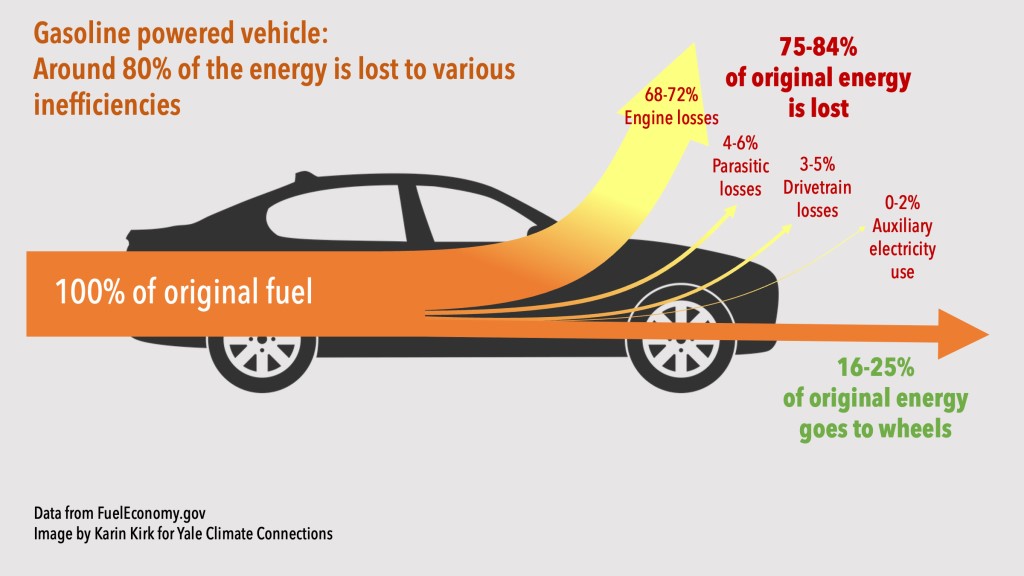
At least here in Texas it is quite common to believe that EV cars do not reduce emissions. After all EV cars use electricity from the dirty grid, right? Often this is said to environmentalists and people who care about fossil fuels emissions as if they don’t understand that the electricity for EV cars typically comes from the dirty grid. However, they do know that. In fact, they know a little bit more. EV cars are much more efficient than Internal Combustion Engine cars , or ICE, and therefore the emissions caused by EVs via the electrical grid, even a coal powered grid, is significantly less per mile. In fact, replacing gasoline-powered cars with EVs saves energy, regardless of the energy source used to recharge the EVs. For an ICE 16-25% of the original energy goes to the wheels whereas for an EV 87-91% of the original energy goes to the wheels.

Image showing an ICE car and its various losses | Electrification
16-25% of original energy goes to the wheels. Data from FuelEconomy.gov, Image by Karin Kirk for Yale Connections.
Image showing an EV car and its various losses | Electrification
87-91% of original energy goes to the wheels. Data from FuelEconomy.gov, Image by Karin Kirk for Yale Connections.

On the other hand, it takes more energy to manufacture an EV battery for an EV car than it does to produce a combustion engine. So, the production of an electric vehicle does emit more carbon than a petrol car. However, the lower emissions resulting from driving an EV means that an electric car quickly pays back its debt, so to speak. It is typically paid back within two years.

According to Hannah Richie at Our World in Data the statistics show that switching from an average ICE to an equally sized EV will save 1.2 tons of carbon emissions per person and year. That is a lot considering that the average carbon footprint per year is 4 tons worldwide and 14.4 tons per year for an American. Hannah Richie at Our World in Data also states that other environmental damages related to EVs such as mining for minerals are less than mining and extraction for fossil fuel cars, and she claims that the price of lithium-ion batteries has fallen by 98% over the last three decades.

Blonde woman pumping gas.
Photo by Andersen EV on Pexels.com

EVs are becoming increasingly common. According to Our World in Data in 2022, 88% of all cars sold in Norway were EVs and 54% of all cars in Sweden were EVs. The United States is lagging a bit at 7.5% but there is a tax credit $7,000.00 for new EVs and a $4,000.00 tax credit for buying used EVs. I should add that we have not yet bought an EV because after I took early retirement, I did not need a car. We just share my wife’s hybrid, which we hardly ever drive.

Induction Stoves

We bought an electric stove, an induction stove, a couple of years ago when our previous stove stopped working. They come with an $840.00 rebate. I’ve read that professional chefs prefer gas stoves. However, our induction stove provides everything we need for our cooking needs and my beer brewing needs and it is easier to clean. If you are a professional chef you may want to be able switch the high heat on and off quicker, but we are not professional chefs even though the food we cook is delicious.

Another downside of an induction stove is that if the power goes out you can’t cook, but that has not been a problem for us. Considering that we get our electricity from a power company, Green Mountain Energy, that utilizes renewable energy, wind and solar, you can claim that our stove is 100% fossil fuel free.

One cooking plate is red hot. The stove itself is made of granite.
Our induction stove with the lights in the kitchen turned off.

Heat Pumps

Air source heat pumps, which are the most common type of heat pumps, are a great, energy efficient choice for heating your home and water and as well as being low maintenance, they can help to cut your heating costs and lower your carbon footprint. An air source heat pump absorbs heat from the air outside a building and releases it inside. It uses the same vapor-compression refrigeration process and much the same equipment as an air conditioner, but in the opposite direction.

Air-to-air heat pumps provide hot or cold air directly to rooms. Heat pumps are the main way to phase furnaces but are also typically more efficient than other types of heaters and air conditioners and thus they reduce greenhouse gas emissions. There is an up to $8,000.00 upfront discount for heat pumps and a 30% tax credit up to $2,000.00. I should say we do not have a heat pump.

Grey heat pump standing towards the wall of an old red brick house.
Air heat pump installed on the exterior facade of the old house. Sustainable heating solutions for old construction. Stock Photo ID: 2349325553 by Snapshot freddy.

Rooftop solar

Another great thing that we have been thinking about but do not have yet is rooftop solar. Rooftop solar power system, or rooftop photo voltaic systems, consist of electricity-generating solar panels mounted on the rooftop of a residential or commercial building or structure. Residential rooftop solar power systems typically feature a capacity of about 5–20 kilowatts.

The average American household uses 1.2 kilowatts on average. Most rooftop solar systems are connected to the grid and can feed the extra power into the grid for compensation. I should add this is not entirely without difficulty. There are also hybrid systems which include any combination of wind turbines, diesel generators, and batteries for electricity on demand. There is a 30% tax credit for rooftop solar.

Solar panels being installed | Electrification
Photo by Kindel Media on Pexels.com

Miscellaneous Energy Savings

Saving energy is not exactly the same thing as electrification but it is a related topic. If you electrify your home and also reduce your energy needs, you are reducing emissions.

A few years ago, we changed the insulation in our house to reduce our energy needs and our electric bill. It made a difference. We also did weatherstripping, installed three pane windows and high security doors, that were well-insulated and reduced heat-loss. We received significant tax credits for doing this. I don’t remember how much, but it was several thousand dollars. I can add that you get a $150 tax credit for a home energy audit.

What do you think about electrification and energy savings?

Do you have additional ideas for electrification and energy savings?


To see the Super Facts click here


Poverty and child mortality has been sharply reduced worldwide

Superfact 7 : Poverty and child mortality has been sharply reduced worldwide.

Extreme poverty as well as child mortality has been sharply reduced the world over. The countries that are the worst-off today are still better off than the countries that were doing the best at the beginning of the 19th century. Over the last 20 years extreme poverty and child mortality has continued to decline sharply.

In Hans Rosling’s book Factfulness, “Ten Reasons We’re are Wrong About the World – and Why Things Are Better Than You Think”, the author presented a quiz that he wanted the reader to take before reading the book. Below is the third question of the quiz. I should say that Hans Rosling posed this and other questions to thousands of people around the world.

In the last 20 years, the proportion of the World population living in extreme poverty has…

  • A. Almost doubled
  • B. Remained more or less the same
  • C. Almost halved

The correct answer is C. Almost halved. Around 7% of the quiz takers got the right answer. Around 5% in the United States got it right. That the proportion of the World population living in extreme poverty halved in 20 years is a true fact. This is also an important fact about the world. Despite that most people got it wrong. In fact, monkeys randomly picking answers would do better (33%). I did pretty well on this quiz, but since I was reading the book and the book’s title is “Ten Reasons We’re are Wrong About the World – and Why Things Are Better Than You Think”,  I got some help just looking at the front cover. In any case, I think this fact qualifies as a super fact, as do the other fact below (There has been a steep decline in child mortality).

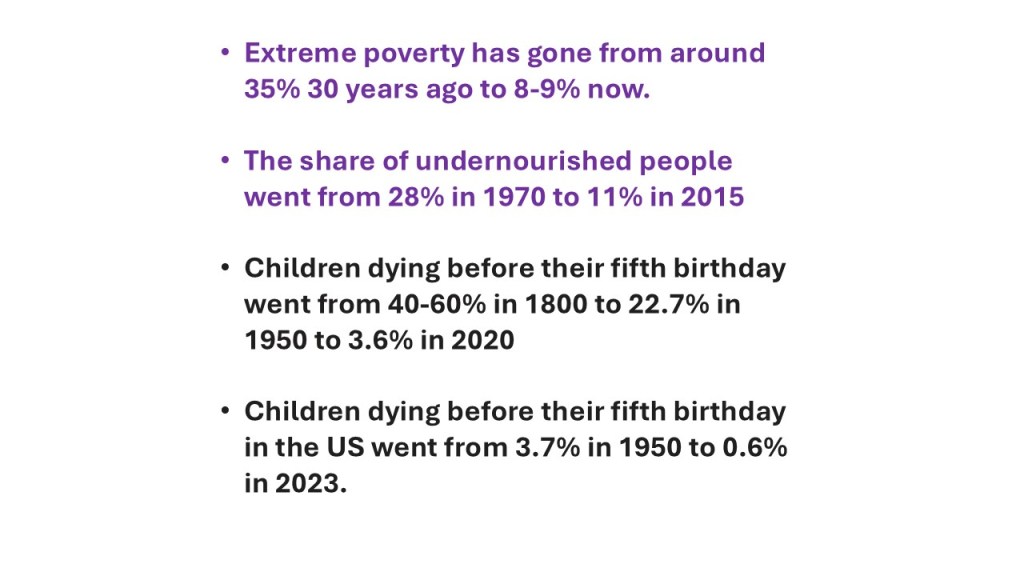
This picture feature five statements (1) Extreme poverty has gone from around 35% 30 years ago to 8-9% now. (2) The share of undernourished people went from 28% in 1970 to 11% in 2015. (3) Children dying before their fifth birthday went from 40-60% in 1800 to 22.7% in 1950 to 3.6% in 2020. (4) Children dying before their fifth birthday in the US went from 3.7% in 1950 to 0.6% in 2023.
These are selected facts from the data.

There has been a steep decline in extreme poverty

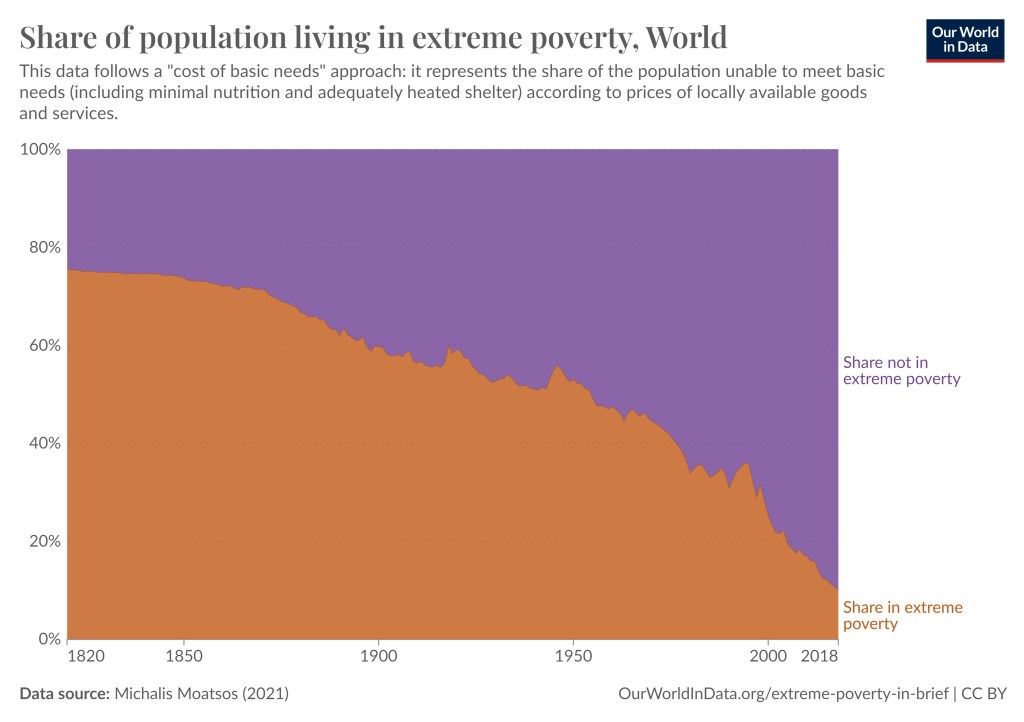
According to the World Bank and Our Data World in Data, an organization which makes data in databases easily accessible to public, extreme poverty went from almost 80% 200 years ago, 60% 100 years ago, about 45% 50 years ago, 34.3% 30 years ago, 23.6%  20 years ago, 8.4% in 2019, then it went up to 9% during the covid epidemic but it seems to be back down to a bit above 8% again. See the graph below as well as the two linked articles in this paragraph.

I should say that extreme poverty is (by the UN, World Bank, etc.) “a condition characterized by severe deprivation of basic human needs, including food, safe drinking water, sanitation facilities, health, shelter, education and information” and is currently defined to be below $2.15. In 2011 it was below $1.90.

The graph shows share living in extreme poverty in brown and share not living in extreme poverty in purple. The graph begins in 1820 at ends in 2018.
This graph from Our World In Data shows a steep decline in extreme poverty over time. Click on the picture to visit the original article.

Other related statistics mentioned in Hans Rosling’s book is that the share of undernourished people went from 28% in 1970 to 11% in 2015. That is despite the earth’s growing population. Related to this is that cereal yield per hectare went from 1.4 ton in 1961 to 4 ton in 2014. This is due to modern agricultural techniques. The share of people with water from protected sources went from 58% in 1980 to 88% in 2015. This statistic was taken from WHO, UNICEF, the World Bank and FAO (the UN Food and Agriculture Organization).

There has been a steep decline in child mortality

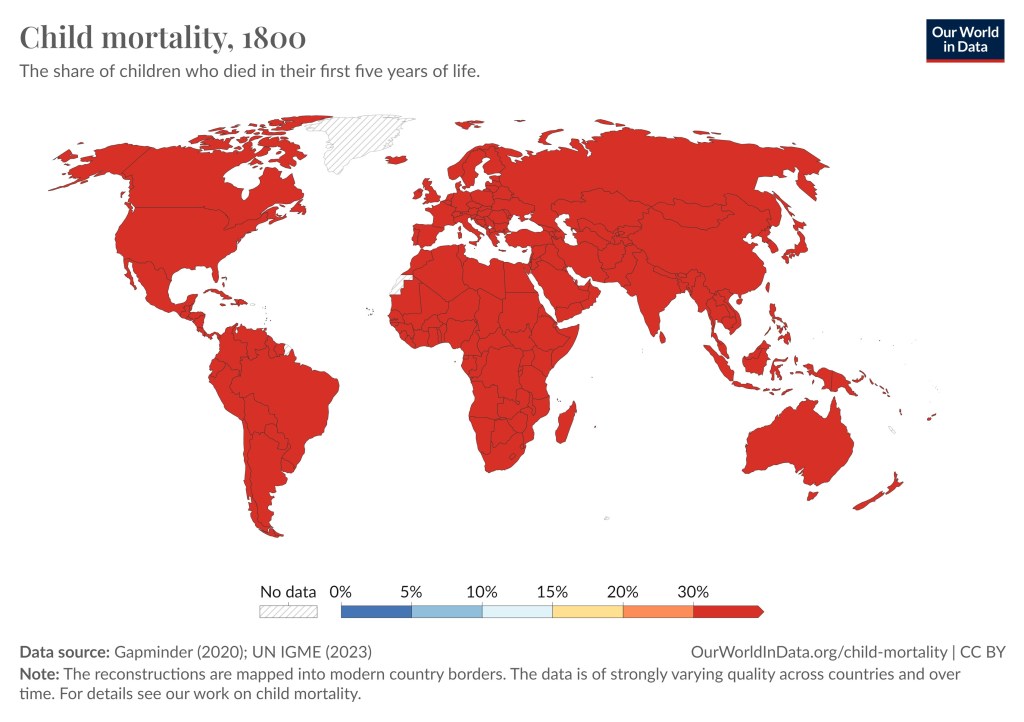
According to Hans Rosling’s book the percent of children dying before their fifth birthday went from 44% in 1800 to 4% in 2016. To get a more complete picture see these articles from Our World In Data, article1, article2, as well as the graph below. For most of humanities existence virtually all societies suffered a child mortality rate between 40% and 60%, but that changed drastically over the last 100 years.

This graph is a world map showing the child mortality rate in different countries as indicated by colors. All countries are red, meaning it is above 30%.
Child mortality rate worldwide in 1800. Some of the data are estimates and may not be reliable. Data sources are UN IGME and Gapminder (an organization similar to Our World In Data).
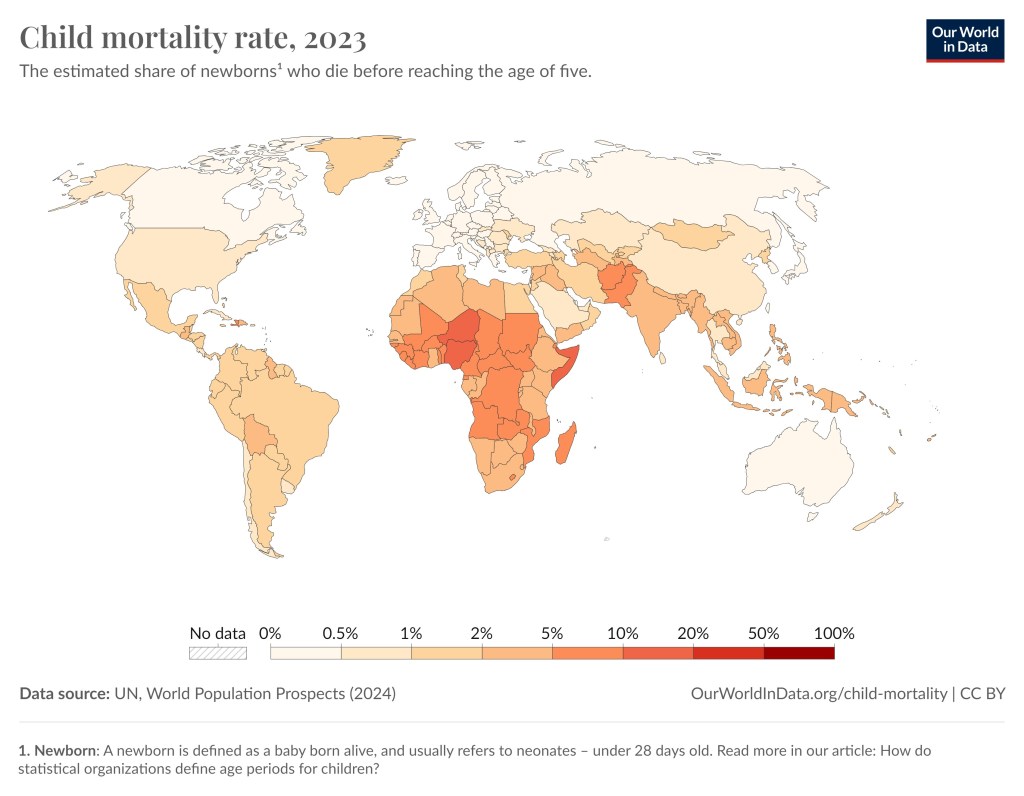
This graph is a world map showing the child mortality rate in different countries as indicated by colors. Niger has the highest child mortality rate of 11.6% and Iceland the lowest at 0.2%.
Child mortality rate worldwide in 2023. Niger has the highest child mortality rate of 11.6% and Iceland the lowest at 0.2%.
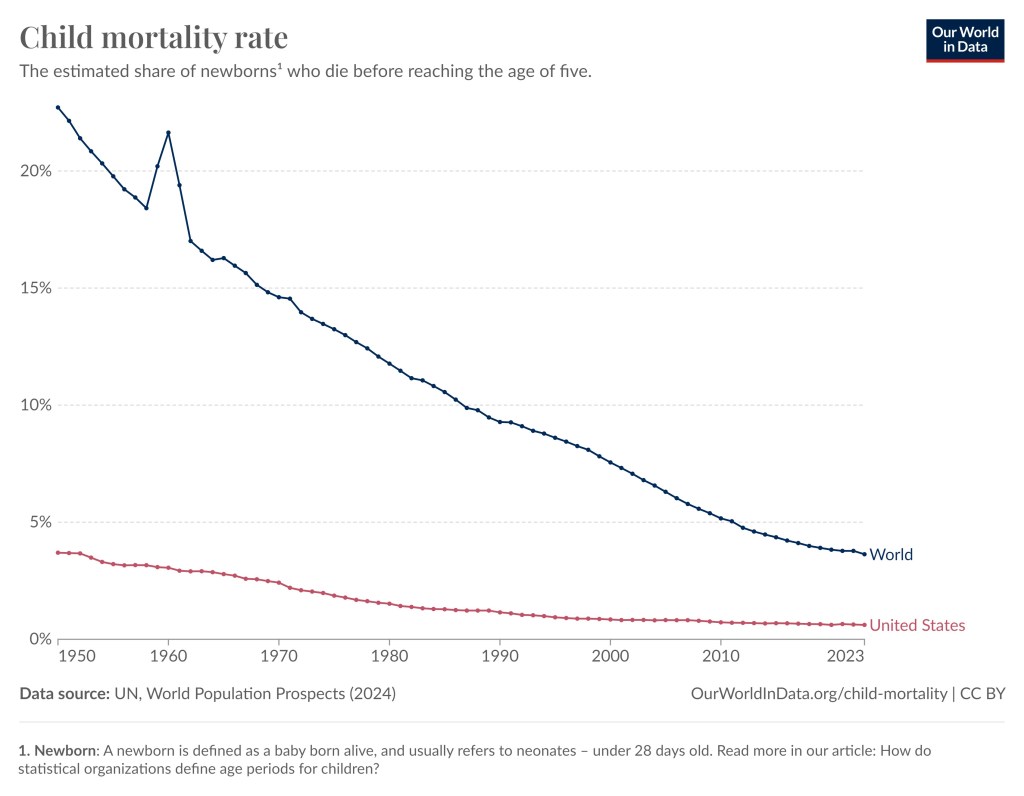
This graphics contain two graphs one for the world (blue) and for the United States (red) | Poverty and child mortality has been sharply reduced worldwide
Child mortality in in the world since 1950. The spike you see around the end of 1950 to 1960 is the great leap forward famine in China. In 1950 the child mortality rate was 22.7% and 2023 the child mortality rate was 3.6%.

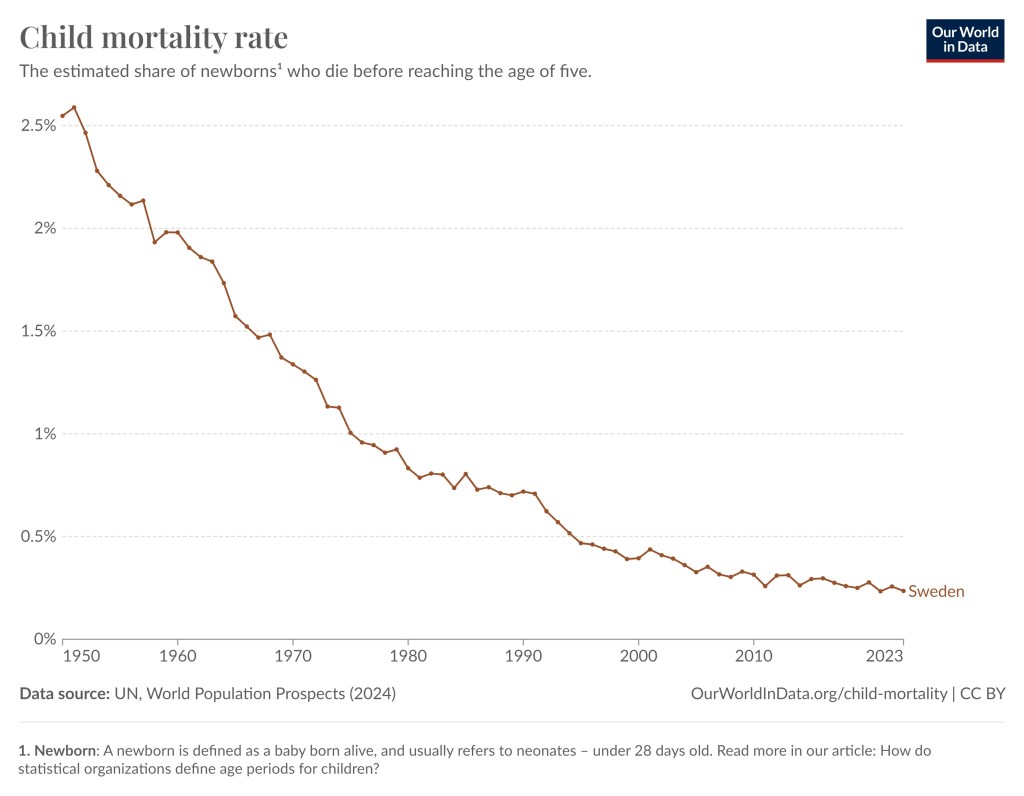
Below is the child mortality rate since 1950 for a few selected countries.

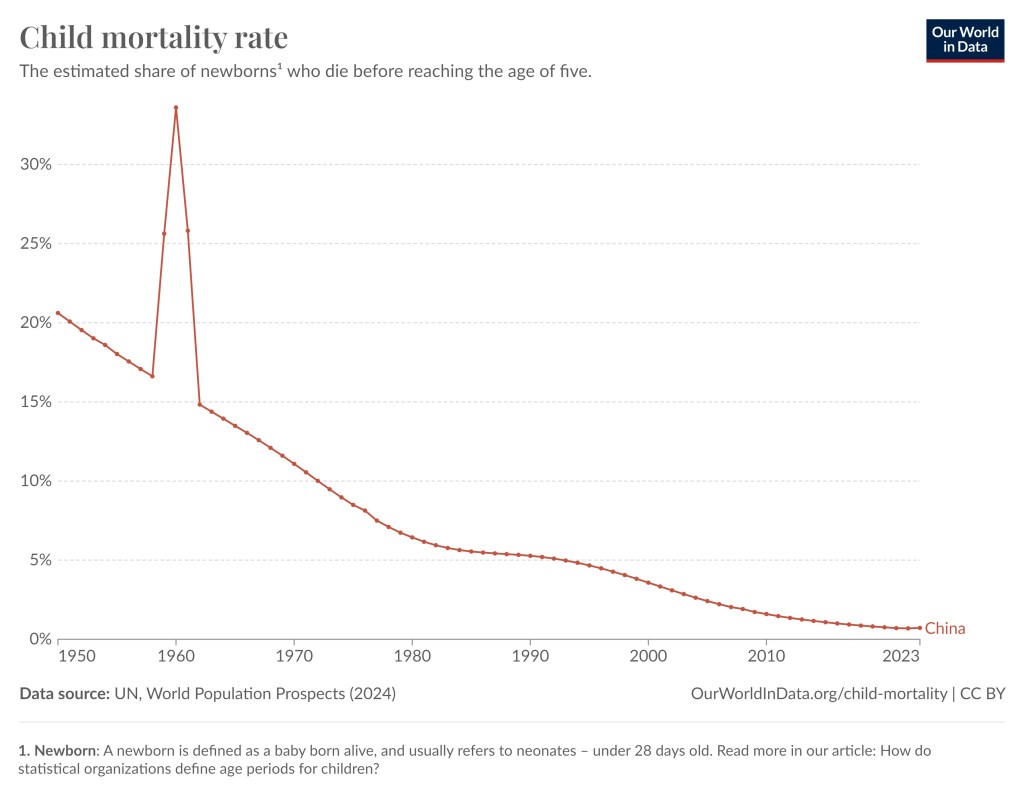
The red graph is showing a decline from 20% in 1950 to 0.7% in 2023 with a spike of almost 40% around 1960 | Poverty and child mortality has been sharply reduced worldwide
Child mortality in China since 1950. The large spike you see around the end of 1950 to 1960 is the great leap forward famine. 15 to 55 million died from starvation. In 2023 the child mortality rate was 0.7%.
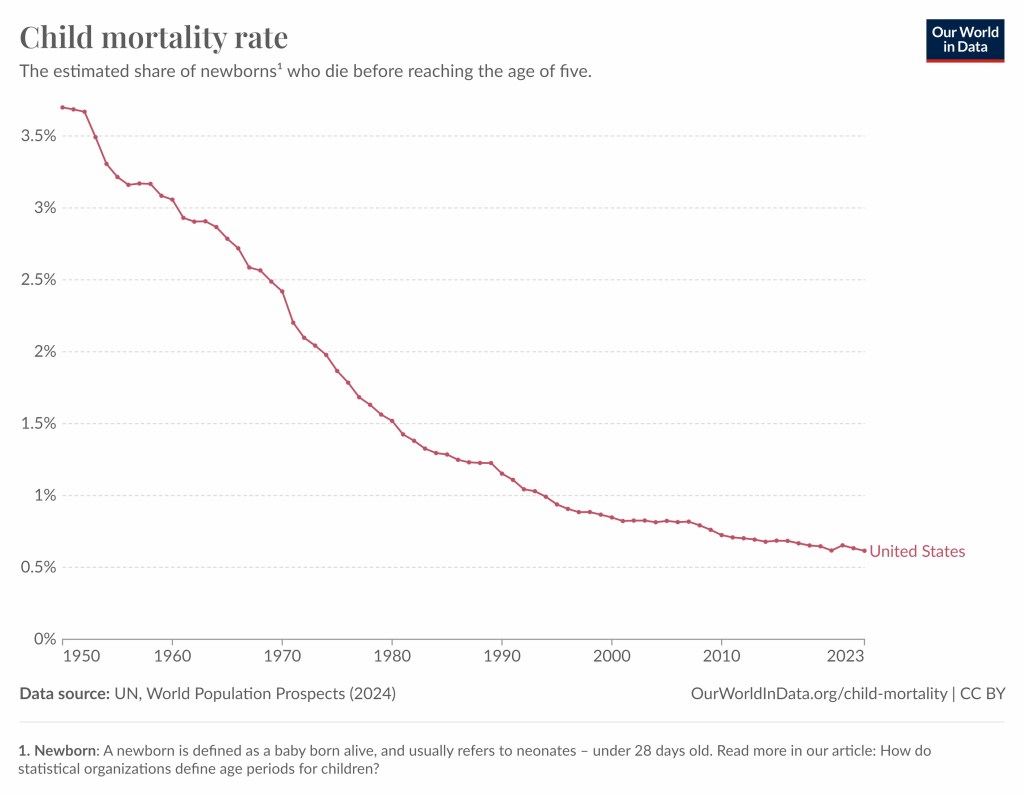
The graph shows a steady decline from 3.7% in 1950 to 0.6% in 2023. The decline of the graph is slower towards the end | Poverty and child mortality has been sharply reduced worldwide
Child mortality in the United States since 1950 (3.7%). In 2023 the child mortality rate was 0.6%.
The graph shows a steady decline from 2.6% in 1950 to 0.2% in 2023 | Poverty and child mortality has been sharply reduced worldwide
Child mortality in Sweden since 1950 (2.6%). In 2023 the child mortality rate was 0.2%.


To see the other Super Facts click here