There is Strong Evidence for Macroevolution

Superfact 89: There is overwhelming scientific evidence supporting so called macroevolution. Evidence for macroevolution includes the fossil record, molecular biology and DNA, biogeography, comparative anatomy, embryology, suboptimality, vestigial structures, etc.

It is difficult to deny that so called microevolution is happening since it can be directly observed. However, it is quite common to come across claims that there is no evidence for macroevolution or that macroevolution is impossible and unscientific. These claims do not come from mainstream scientists but from creationists. There is no magical barrier between microevolution and macroevolution. Rather, macroevolution is just an accumulation of microevolutionary steps, and it is a fact that those changes have been slowly accumulating over millions and billions of years.
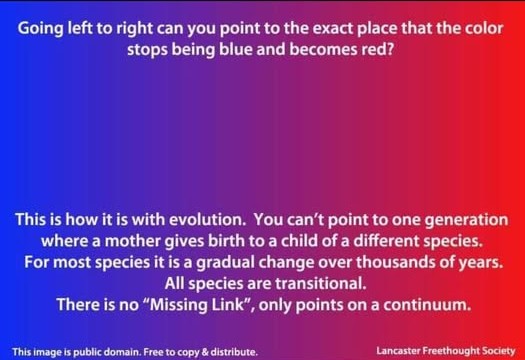
Blue color on the left slowly fading into the red color on the right. | There is Strong Evidence for Macroevolution
Microevolution is small changes resulting in large changes over time. There is no magical wall stopping multiple microevolution changes from turning into macroevolution.

It is often said that macroevolution is when a species evolves into another and that this represents a special barrier, impossible to breach. The existence of fuzzy boundaries between species and the existence of ring species demonstrate that this idea is faulty. See the next section for more information on this. Next after that, I am listing 10 selected types of evidence for macro evolution. If you wish to see an overview of 29+ Evidences for Macroevolution, click here. I can add that scientists do not like to use the terms microevolution and macroevolution since they are nebulous. These terms are more of a creationist thing. That’s why I been prefixing microevolution and macroevolution with “so called”.

Roughly a third of Americans believe the creationist claim that macroevolution is not possible, or that there is no evidence for it, even though we know that there is Strong evidence for macroevolution. Therefore, I consider this a super fact. Note, 97% of scientists support the theory of evolution. This is a brief Wikipedia article on evolution.

Note, this post is long, but if you are interested in it, you could just read a few instead of the evidences instead of all ten.

Speciation is considered relative

It is often said that two animals belong to the same species if they can interbreed in nature and produce viable, fertile offspring. However, it is not that simple.

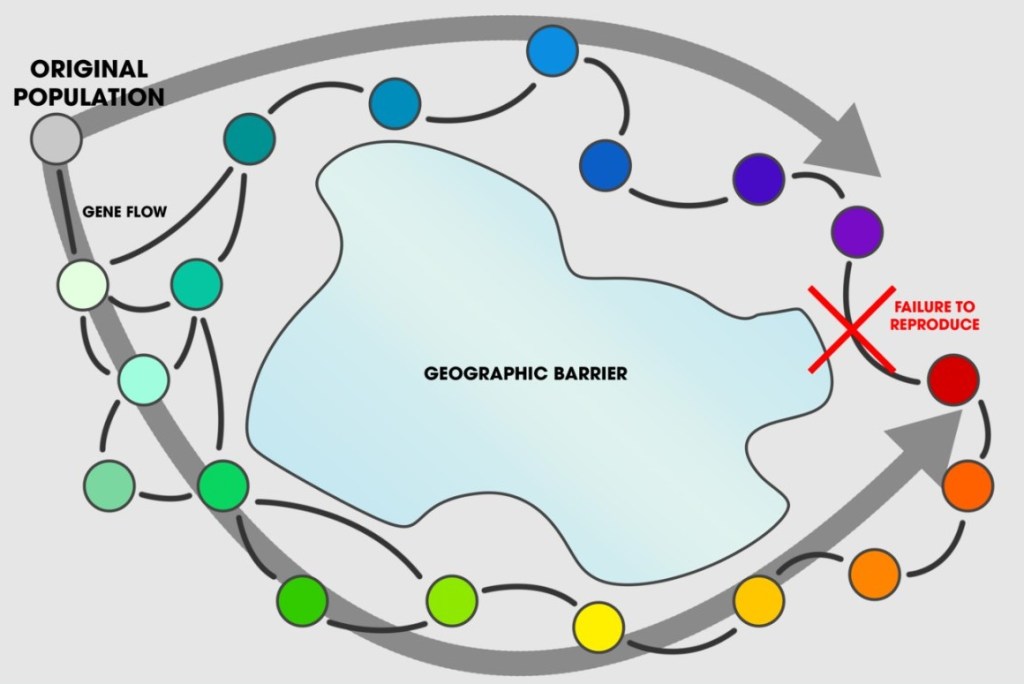
An animal A may be able to successfully interbreed with an animal B, and that animal B may be able to successfully interbreed with an animal C, but animal A and C cannot interbreed. Animal A could be said to be a different species relative to animal C, but animal B could be said to be the same species as both animal A & C using the definition above. A great geography related example of this is ring species. In a ring species, gene flow occurs between neighboring populations of a species, but at the ends of the ring the populations don’t interbreed.

The picture depicts different subspecies as little colored circles centered around a big lake. The color changes a little bit at the time. All the circles next to each other can interbreed. | There is Strong Evidence for Macroevolution
Illustration of ring species, an example of how speciation can be relative. All the circles next to each other can interbreed but at the end it no longer works. Andrew Z. Colvin, CC BY-SA 4.0 https://creativecommons.org/licenses/by-sa/4.0, via Wikimedia Commons.

Next up are ten selected types of evidence for Macroevolution in no particular order.

The Fossil Record Show an Evolution from Simple to Complex Species

The fossil record is quite extensive and represents 250,000 different species, but it is very far from complete. That is expected. Fossilization is an extremely rare event, and fossils are hard to find. Among the 250,000 fossils from different species there are no Precambrian rabbits or Mesozoic human fossils. If there were, that would have falsified evolution and been evidence for a creator. This example shows first of all that the theory of evolution is falsifiable (all scientific theories have to be falsifiable) contrary to some creationist claims and it constitutes a form of evidence for evolution.

If evolution is true then a scan through the entire sequence of rock strata should show early life to be quite simple, with more complex species appearing only after some time. In addition, the youngest fossils should be those that are most similar to living species. The fact that this is the case is strong evidence for evolution, specifically macroevolution. You can read more about this in this relatively short book, The Evidence for Evolution, by Alan R. Rogers.
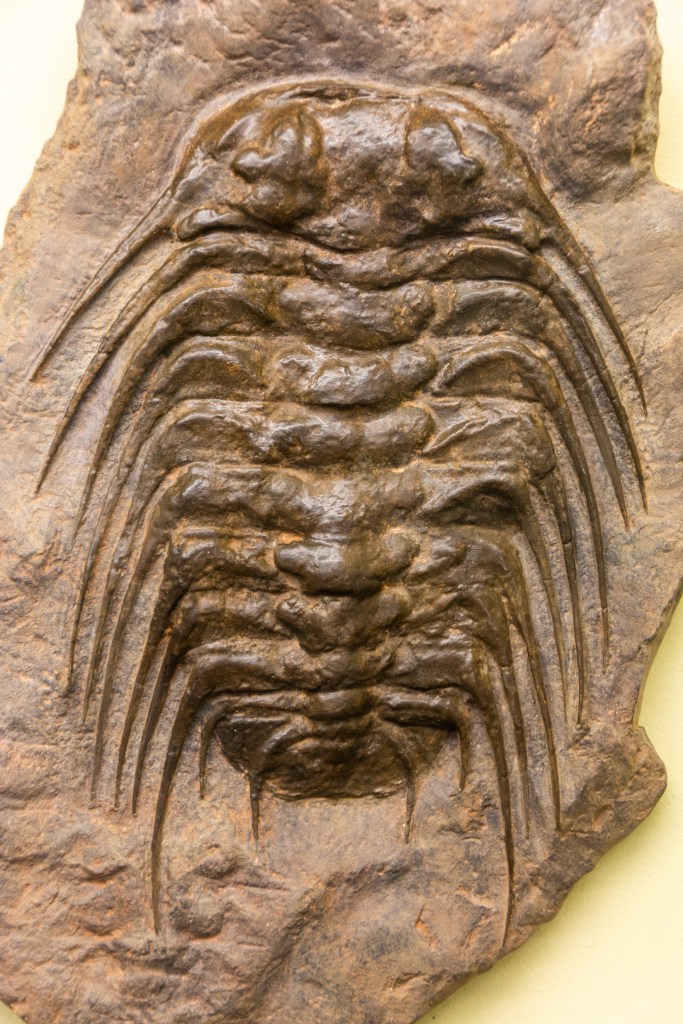
A photo of a trilobite fossil.
The fossil record is a lot more solid and much less problematic than the creationist books I have read claimed. Shutter Stock Photo ID: 1323000239 by Alizada Studios

We can Follow Lineages in the Fossil Record

In the fossil record we can also follow lineages; species of animals and plants changing into something different over time. The fossil records show fish changing into amphibians, reptiles changing into mammals, dinosaurs into birds, artiodactyl like mammals into whales, apes into humans, etc. Creationists used to mock the fact that there were no transitional fossils between land mammals and whales and then they found Pakicetus in 1983 and then a lot more. As time passes the more transitional fossils we find.
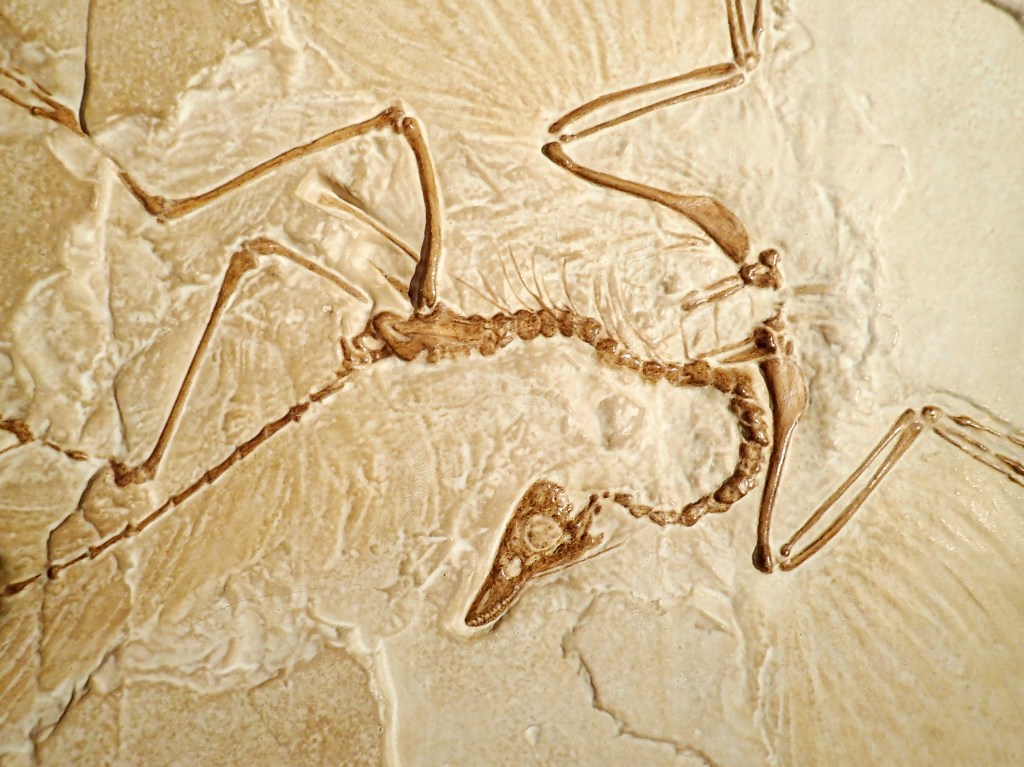
The Archaeopteryx is embedded in stone with details of the skeleton with skull and bones.
Closeup of fossilized scary petrified Archaeopteryx transitional fossil between dinosaur and modern birds remains. Shutterstock Asset id: 1913076019 by Natalia van D.

The fact that we can follow lineages and that they are consistent with the various dating methods is powerful evidence for evolution. Dating methods include radiometric dating methods (uranium-lead, potassium-argon, carbon-14), and sequencing and superposition, and conditions encoded in fossils such as the length of the day (varied throughout natural history) and more. To read more about dating methods and how we know Earth is billions of years old click here. The picture below illustrates the skull changes of hominids by time.
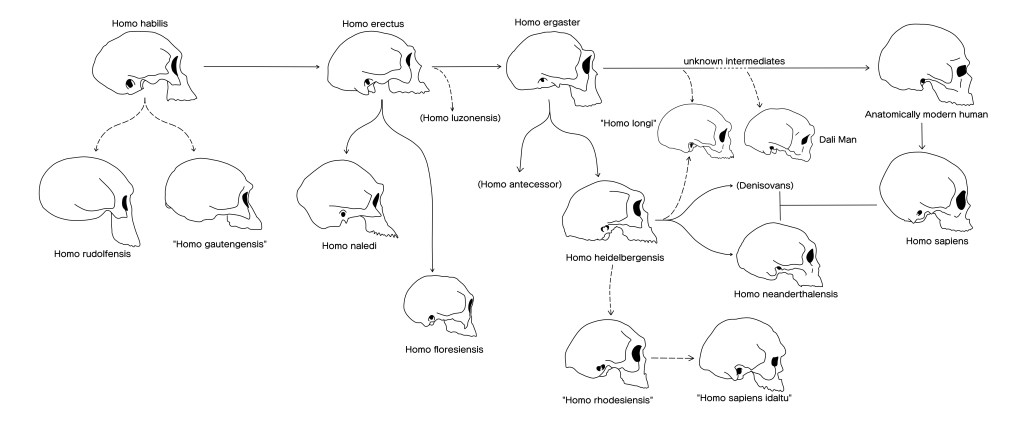
15 skulls for different hominid species are shown as well as the relations between the species. | There is Strong Evidence for Macroevolution
Homo skull changes of hominids from Wikipedia<>. SimplisticReps, CC BY-SA 4.0 https://creativecommons.org/licenses/by-sa/4.0, via Wikimedia Commons.

Molecular Biology and DNA

Molecular biology and DNA may be our best evidence for macroevolution. Our understanding of DNA has greatly increased over the last couple of decades. The human genome has been sequenced along with that of many other species, and we are able to compare the DNA and the genes of various species, and trace origins.

Man geneticist. Doctor sits at table in genetic laboratory. Chains of DNA or RNA. Sequencing human genome. Doctor studies DNA. Geneticist conducts scientific experiments Geneticist looks at test tubes. | There is Strong Evidence for Macroevolution
Geneticist sequencing human genome Asset id: 2479929725 by FOTOGRIN

Of special interest are pseudo genes, the millions of transposable elements (transposons and retroelements) as well as useless sequences, introns. These segments are especially interesting because they are unaffected by natural selection and therefore mutations pile up in them at a fairly constant rate. By comparing two such segments in two species we can tell how far the species are apart and even how far back in time their common ancestor lived.

Based on the similarity in transposons we know that the closest related living animals to whales and dolphins (outside their order) are Hippopotamus, which confirms what we know from the fossil record of whales and the mammals that whales evolved from. Whales and Hippopotamus have a common ancestor and since we’ve found dozens of intermediate fossils between land mammals and whales, the evolution of whales is no longer a mystery.

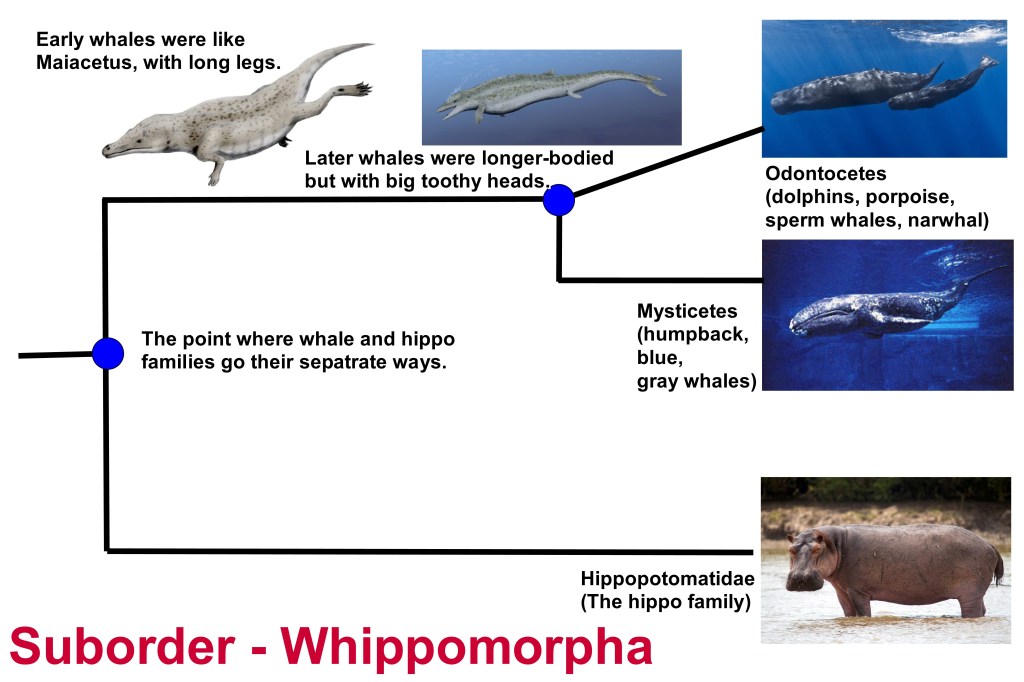
This graph shows pictures of a sperm whale, gray whale and hippopotamus on the right, and two whale ancestors at the top and they are connected via lines ultimately showing the common connection point on the far left.
All living cetaceans including whales, dolphins, porpoises, sperm whales and hippopotamids / hippopotamus belong to a suborder of artiodactyls called whippomorpha. Hippopotamus and whales have a common ancestor. Note: I created this image by inserting a few pictures from Wikipedia commons including a mother sperm whale and her calf off the coast of Mauritius, a gray whale in captivity, a hippopotamus and two pre-historic whales (from the section Evolution of Whales – Intermediate Fossils).

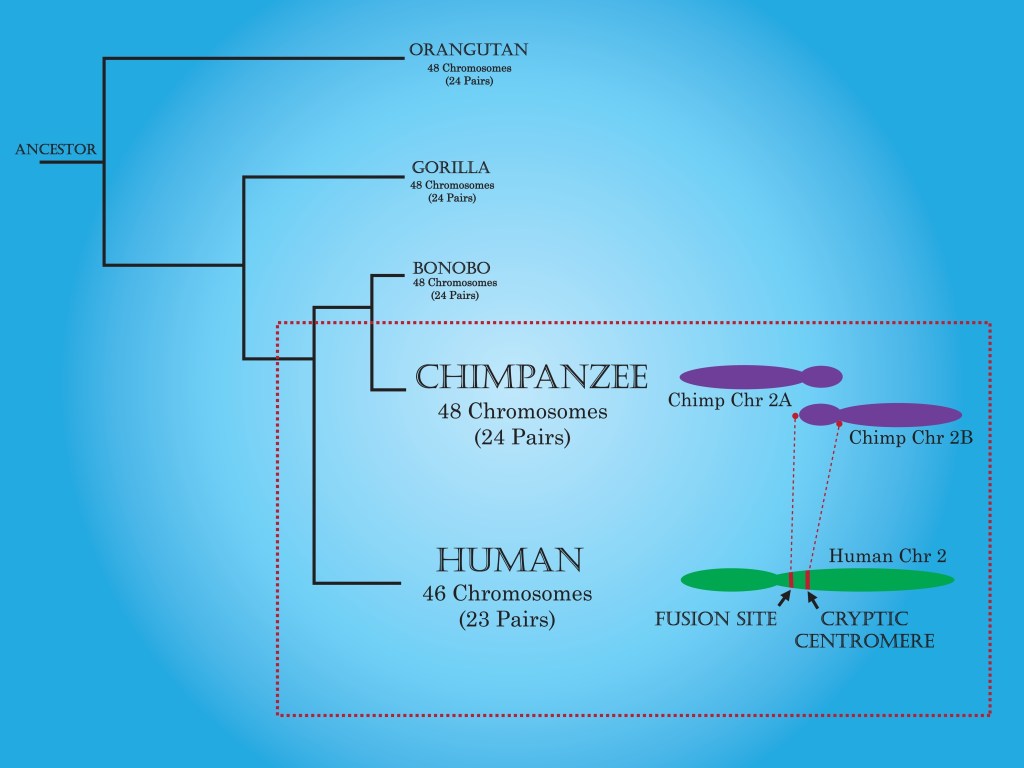
Based on the similarity in transposons, pseudo genes, and genes in general (all of the genome) we know that the closest related living animals to humans are chimpanzees and bonobos. In fact, chimpanzees and humans are more closely related than chimpanzees and the other great apes. Based on the genetic record chimpanzees are no longer classified as great apes but as Hominini together with humans. Also based on the genetic record we know that chimpanzees and humans had a common ancestor that lived about six million years ago. The fossil for this common ancestor has not been found, but the information in the DNA can often tell us more than the fossil record.
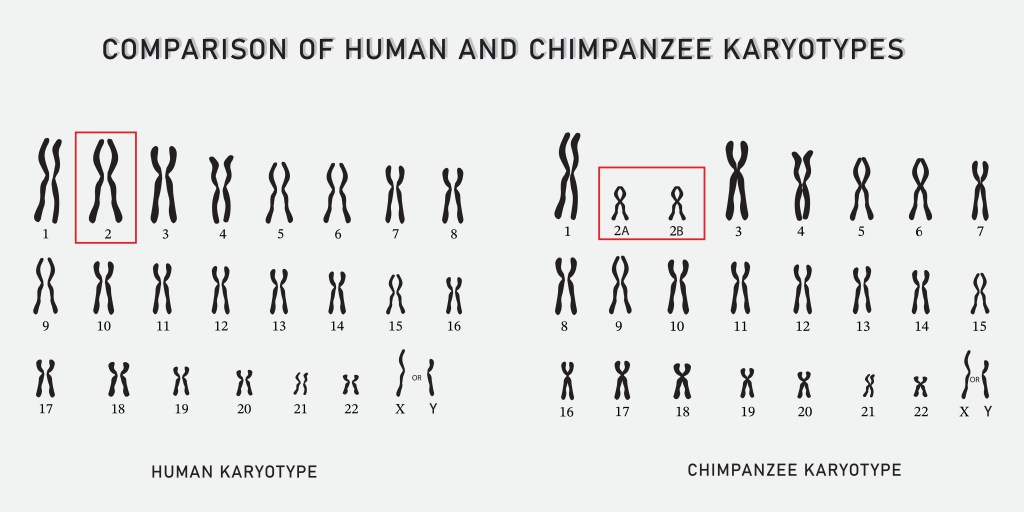
The pictures show the set of the human 46 chromosomes on the left and the set of the chimpanzee 48 chromosomes on the right. The chromosomes look very similar between the two species, except human chromosome 2 which is split into chromosome 2A and 2B in the chimpanzee.
Comparison between human and chimpanzee karyotypes isolated on background. Shutterstock Asset id: 2432966649 by kanyanat wongsa.
The picture is a graph that shows that gorillas, chimpanzees and humans share a common ancestor with orangutans. In turn bonobos, chimpanzees and humans share a common ancestor with gorillas and finally chimpanzees and bonobos share a common ancestor with humans. | There is Strong Evidence for Macroevolution
Evolution of humans via phylogenetics and differentiation between humans, chimpanzees, and other primates. Shutterstock Asset id: 2448150743 by kanyanat wongsa.
At the bottom of the cladogram is a box that says “hominin ancestor. A tree branches off from this box. On the left is a chimpanzee and the right a tree for seven hominin species including modern humans.”
Simple cladogram showing evolution of modern man from Hominid Ancestor Shutterstock Asset id: 2093535535 by CLOUD-WALKER.

The book Relics of Eden, the powerful evidence of evolution in human DNA by Daniel Fairbanks is good fairly in depth book on this topic.

Biogeography

Biogeographic evidence for evolution / macroevolution is among the oldest types of evidence (Charles Darwin used it) and yet it is very powerful. Biogeographic evidence for evolution shows that species’ geographic distributions result from descent with modification and environmental adaptation, rather than just similar habitats. Key types of biogeographic evidence for macroevolution include species existing only on a certain island, adaptive radiation (e.g., Galápagos finches), tectonic-driven species distribution (e.g., marsupials), and convergent evolution of unrelated species in similar environments.
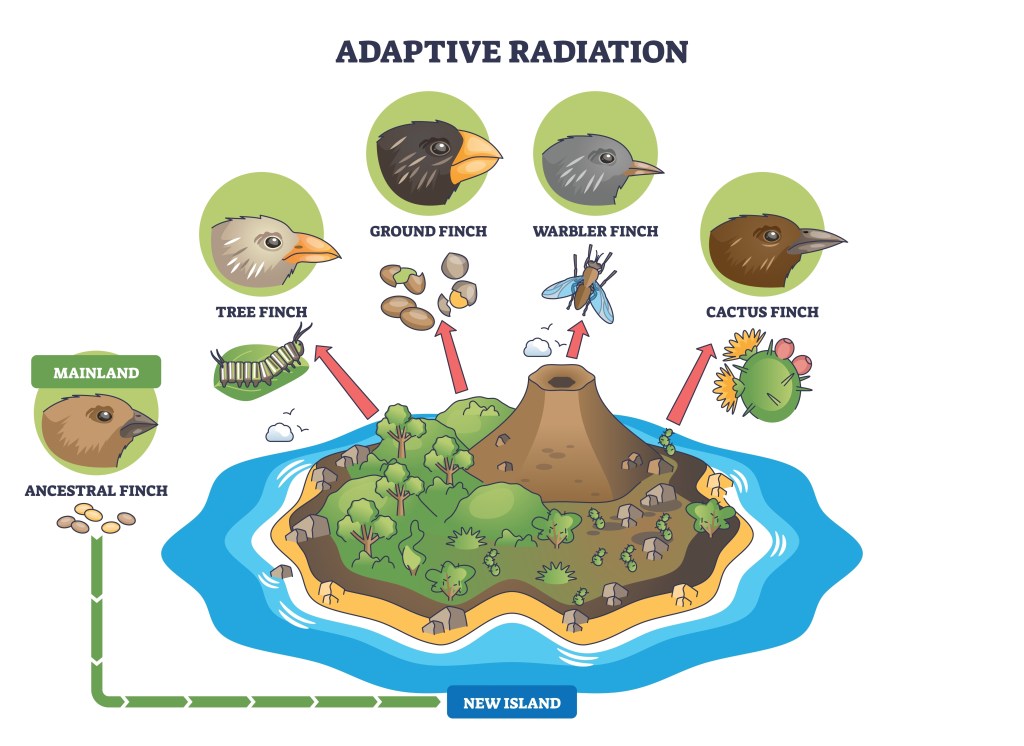
The picture shows an island with an ancestral finch on the left and multiple other species of finch on the right all feeding on different things.
Adaptive radiation is a rapid evolutionary process where an ancestral species diversifies into a multitude of new species (or subspecies) to fill vacant ecological niches. Shutterstock Asset id: 2707584123 by VectorMine.

One example of biogeographical evidence for macroevolution is with so called oceanic islands. Oceanic islands are not part of a continent but are formed from the sea bottom typically through volcanic activity. Oceanic islands lack native freshwater fish and amphibians, and they rarely harbor native mammals and reptiles. However, freshwater fish, amphibians, mammals and reptiles thrive when introduced to oceanic islands. It’s just that they have to get there in the first place.

Instead, oceanic islands typically feature birds, insects, and plants that can more easily spread long distances. In addition, the species on oceanic islands are typically closely related and appear in relatively few groups. Add the fact that the species on oceanic islands resemble species on nearby continents but they are not the same. This strongly supports the narrative that some species from nearby continents migrated to newly formed oceanic islands and evolved.

The evidence gets even better if you look in more detail. For example, the Hawaiian Islands (oceanic islands) were formed in chronological order from west to east, as the divide between the continental shelves moved. The species on the different islands show a gradual transition in their physical properties and in their DNA as you go from west to east. This supports the narrative that the species hopped from one island to the next as the islands emerged, and then they evolved.

Comparative Anatomy

Similar anatomical structures in different species, such as the similar bone structure in a human arm, a bat wing, and a whale flipper indicate shared ancestry. Another is the heart structures in fish, amphibians, reptiles, birds, and mammals which show a homologous progression of development.

Embryology

Different species share similar developmental stages. For example, early embryos of reptiles, birds, and mammals, including humans, develop pharyngeal pouches that are similar to fish gills. Baleen whale embryos have teeth that are lost by birth, human embryos develop a tail that are later lost, and human fetuses develop hair around week 16-20 that is usually lost but remain on premature babies. The development of embryos goes through stages of similar embryos of fish, then amphibians, reptiles, and then mammals.

Suboptimality

There is a lot of evidence based on so called suboptimality. Our bodies and that of other animals are full of imperfections that make perfect sense from an evolutionary perspective but not much sense if we were created by a creator. One example is the “vas deference”, which follow a circuitous route from the testis up and around the ureter and back down to the penis, instead of going straight to the penis. As the testis gradually moved from inside our bodies (as it was in fish) to the outside, vas deference got stuck around the ureter like a water hose can get stuck around a tree. This makes perfect sense from an evolutionary perspective.

Vestigial Structures

Vestigial structures are non-functional anatomical features, organs, or behaviors that were functional in a species’ ancestors but have lost most or all of their original purpose through evolution. Examples include the whale hind legs, flightless bird wings, the human appendix, the tailbone, wisdom teeth, and goosebumps in humans.

Atavisms

Atavisms are rare reappearances of a lost ancestral trait in an individual. This could happen because ancestral genes are preserved but suppressed but, for example, a mutation allows the gene to be expressed. Examples include a human baby born with a tail, a snake with limbs or a chicken with teeth, dolphins with back flippers, or teeth in chickens. It is rare but evidence for evolution.

Traces of Common Descent

Traces of common descent in species, for example, homologous anatomical structures, similar embryological development, shared genetic codes, and phylogenetic mapping allows the construction of the tree of life. Phylogenetic mapping suggests that organisms inherited fundamental traits from a common ancestor. All life except viruses can be traced back to a common ancestor that lived 4.2 billion years ago. This also constitutes evidence for evolution / macroevolution.

The picture shows how the three domains of life bacteria, archaea, eukaryote, and the relationships between the different phylum in each domain leads back to LUCA (Last Universal Common Ancestor). | There is Strong Evidence for Macroevolution
User: Crion, CC BY 3.0 https://creativecommons.org/licenses/by/3.0, via Wikimedia Commons.

Other Evolution Related Super Fact Posts

I can add that when I was young, I read a lot of creationists books. I was totally sold on creationism but as I started learning about science that changed. One thing all the creationist books that I read had in common was that they avoided discussing the evidence for evolution and they did not provide evidence for creationism. Instead, they focused on trying to discredit evolution. As I learned more about science I came to realize that not even one of those objections were valid. An example is super fact #73 below.


To see the Other Super Facts click here

Early Homo Sapiens lived at the same time as many other human species
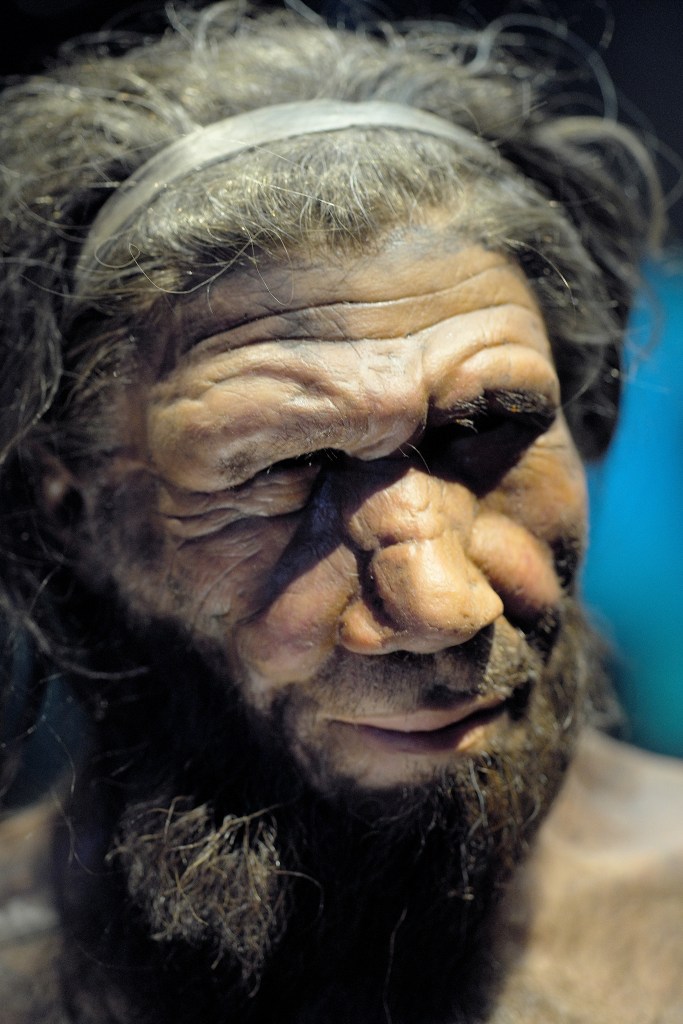
Super fact 86 : Early humans, early homo sapiens, lived at the same time as many other human species including Neanderthals, Denisovans, Homo floresiensis, Homo naledi, Homo luzonensis. Homo heidelbergensis, Homo erectus, and maybe other species as well.

Photo of a reconstruction of a Neanderthal man. | Early Homo Sapiens lived at the same time as many other human species
Reconstruction of a Neanderthal by Natural History Museum. Werner Ustorf, CC BY-SA 2.0 https://creativecommons.org/licenses/by-sa/2.0, via Wikimedia Commons.

Homo sapiens co-existed with several other Homo species. Homo erectus and Homo heidelbergensis are direct ancestors to Homo sapiens that survived long enough to exist at the same time as Homo sapiens.

Homo sapiens emerged around 300,000 years ago in Africa and Homo erectus died out around 100,000 years ago and Homo heidelbergensis died out around 200,000 years ago. Homo floresiensis died out 50,000 years ago, the most recent Homo luzonensis is 50,000 years old but they may have survived longer, Homo naledi existed approximately 335,000 to 236,000 years ago, Neanderthals interbred with homo sapiens and died out around 40,000 years ago, the Denisovans also interbred with homo sapiens and died out around 30,000 to 50,000 years ago. You can read more here and here.

You may wonder how different species can interbreed with each other. More on that later in this post.

I consider this a super fact because it is true, surprising to those who did not know this, and ancient human history is kind of important. Even if you knew that homo sapiens lived along other homo species the fact that the world used to be so crowded with different homo species may come as a surprise. Where did they all go?

Direct Ancestors of Homo Sapiens

Homo heidelbergensis is widely considered a pivotal common ancestor to Homo sapiens, Neanderthals, and Denisovans. Since Homo Erectus is a direct ancestor to Homo heidelbergensis it is also a direct ancestor to Homo sapiens, Neanderthals, and Denisovans. Homo Erectus is also a direct ancestor to Homo floresiensis but Homo heidelbergensis is not considered an ancestor to Homo floresiensis. The picture below shows the direct ancestors to Homo Sapiens.

The skulls are from left to right Australopithecus africanus 3.3 - 2 million years ago, Homo habilis 2.4 to 1.5 million years ago, Homo erectus 1.6 to 600 thousand years ago, Homo heidelbergensis 700 thousand to 200 thousand years ago, early homo sapiens 300 thousand to 45 thousand years ago, anatomically modern human 130 thousand years ago until now.
Skulls of successive (or near-successive, depending on the source) human evolutionary ancestors, up until ‘modern’ Homo sapiens. Mya – million years ago, kya – thousand years ago. SimplisticReps, CC BY-SA 4.0 <https://creativecommons.org/licenses/by-sa/4.0&gt;, via Wikimedia Commons.

Geographic spread of Homo Sapiens and other Homo Species

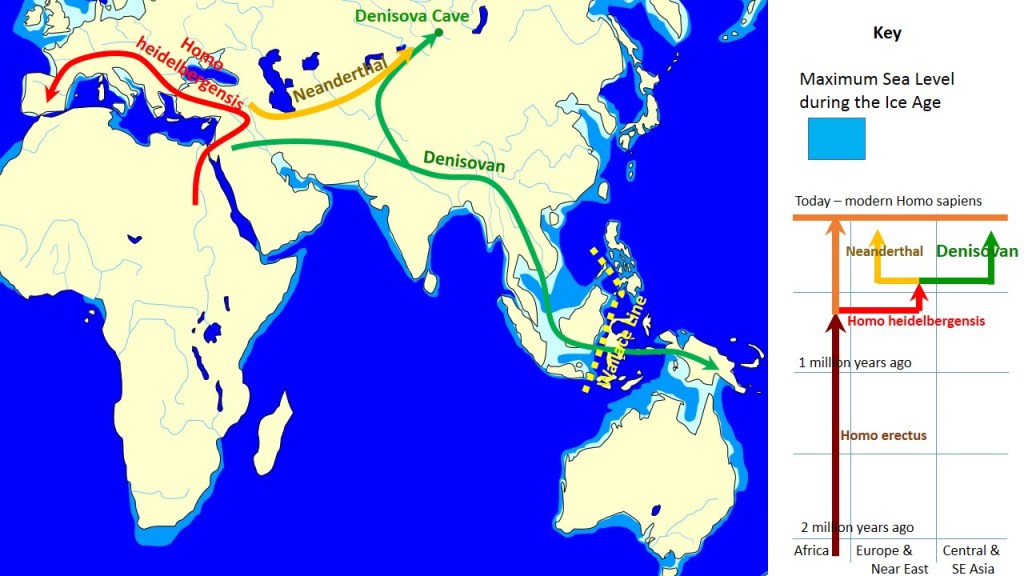
Homo heidelbergensis is an ancestor to Neanderthals, Denisovans and Homo sapiens (and Homo erectus is an ancestor to Homo heidelbergensis). However, whilst Neanderthals emerged in Europe and Asia, Denisovans evolved in Asia, and Homo sapiens emerged in Africa.

The map shows the movement of Homo heidelbergensis originating in Africa and moving into Europe and Asia with Neanderthals (in yellow) emerging in Europe and moving into Asia. The Denisovans emerged in Asia and spread further east. | Early Homo Sapiens lived at the same time as many other human species
The evolution and geographic spread of Denisovans as compared with Neanderthals, Homo heidelbergensis and Homo erectus. John D. Croft at English Wikipedia, CC BY-SA 3.0 https://creativecommons.org/licenses/by-sa/3.0, via Wikimedia Commons.

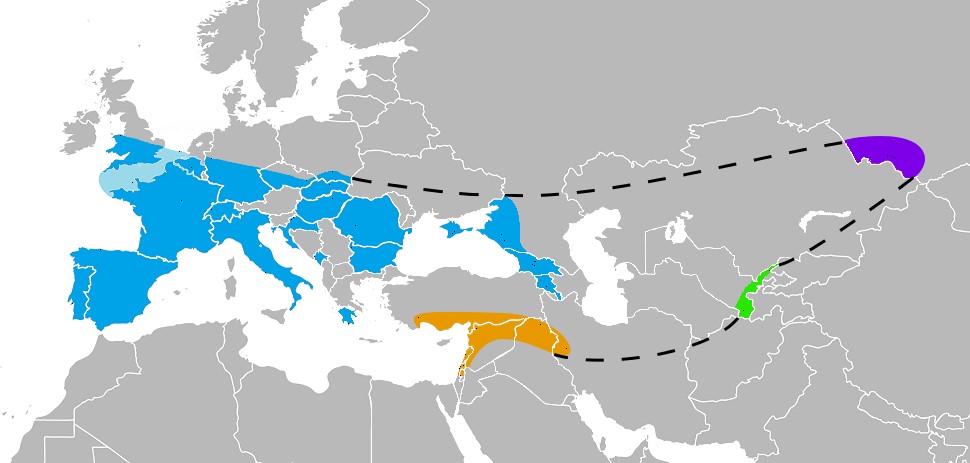
The map below indicates where skeleton remains of Neanderthals had been found as of 2017.

This map of Europe and West Asia shows the region where Neanderthals have been found.
Known Neanderthal range in Europe (blue), Southwest Asia (orange), Uzbekistan (green), and the Altai mountains (violet), as inferred by their skeletal remains (not stone tools). There were 165 such places by 2017. Nilenbert, N. Perrault, auteur du guide complet du canotageI, CC BY-SA 3.0 <http://creativecommons.org/licenses/by-sa/3.0/&gt;, via Wikimedia Commons.

Interbreeding and Defining a Species

Homo Neanderthalensis and Homo Sapiens (or Homo Sapiens Sapiens) interbred, and so did Homo Denisova and Homo Sapiens, and Homo Neanderthalensis interbred with Homo Denisova. What a mess! Homo Neanderthalensis and Homo Sapiens were different species, so it may seem strange that they could interbreed. However, species is a complex concept.

Speciation is considered relative. It is often said that two animals belong to the same species if they can interbreed in nature and produce viable, fertile offspring. However, it is not that simple. An animal A may be able to successfully interbreed with an animal B, and that animal B may be able to successfully interbreed with an animal C, but animal A and C cannot interbreed. Animal A could be said to be a different species relative to animal C but animal B could be said to be the same species as both animal A & C. A great geography related example of this is ring species. In a ring species, gene flow occurs between neighboring populations of a species, but at the ends of the ring the populations don’t interbreed.

The picture depicts different subspecies as little colored circles centered around a big lake. The color changes a little bit at the time. All the circles next to each other can interbreed.
Illustration of ring species, an example of how speciation can be relative. All the circles next to each other can interbreed but at the end it no longer works. Andrew Z. Colvin, CC BY-SA 4.0 <https://creativecommons.org/licenses/by-sa/4.0&gt;, via Wikimedia Commons.

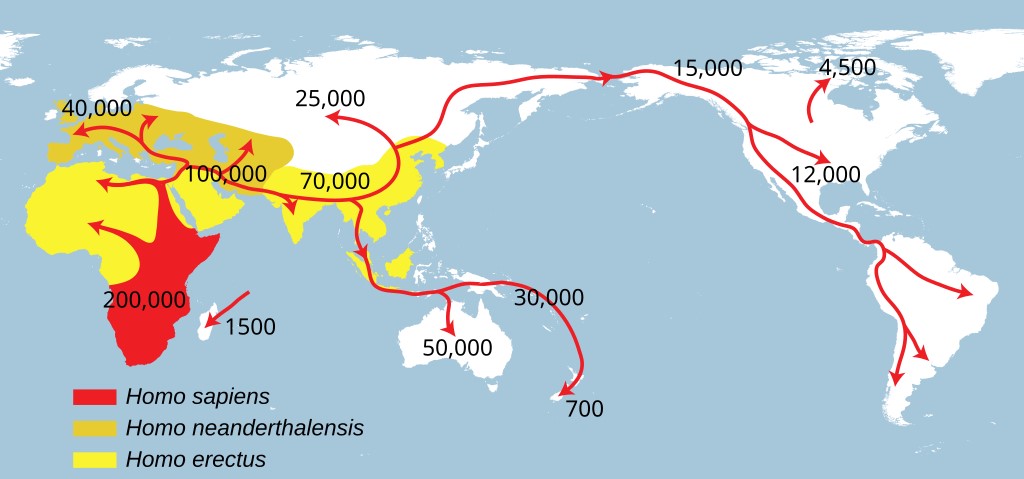
For the case of Neanderthals and Homo sapiens (and Denisovans); at certain points in history, you could consider Homo Neanderthalensis and Homo Sapiens to be different subspecies rather than different species. That is why you sometimes hear the terms Homo Sapiens Neanderthalensis and Homo Sapiens Sapiens. I can add that Homo sapiens certainly got around, as you can see on the map below.

A world map showing portions of Africa being yellow and red, and portions of Asia being yellow and dark yellow with red arrows representing migrating Homo Sapiens. The map features several time markers representing the arrival of Homo Sapiens. | Early Homo Sapiens lived at the same time as many other human species
The spread of Homo Erectus (yellow), Homo Sapiens (red) and Homo Neanderthalensis (dark yellow). NordNordWest, Public domain, via Wikimedia Commons.

Is Thomas Wikman a Neanderthal ?

I can add that genetic testing can reveal how much Neanderthal DNA you have. I took a test with 23AndMe to find out about my ancestry (it was 98% Scandinavian and Finnish) and to find out about my risk for genetic illnesses. 23AndMe also told me that I was in the 99 percentiles with respect to carrying Neanderthal genes, meaning that I had unusually many Neanderthal genes. I joined the 23AndMe Neanderthal club (you had to be in the 98 percentile).

However, I quit after people in the club started saying that we should demand reparations from those with less Neanderthal genes because they exterminated us. It might have been a bizarre joke, but I decided not to stay around to find out. Later, after 23AndMe went bankrupt, I deleted mine and my wife’s data and quit. I was afraid 23AndMe might sell the DNA data to health insurance companies.

Man geneticist. Doctor sits at table in genetic laboratory. Chains of DNA or RNA. Sequencing human genome. Doctor studies DNA. Geneticist conducts scientific experiments Geneticist looks at test tubes
Geneticist sequencing human genome Asset id: 2479929725 by FOTOGRIN

This is some other evolution and natural history related posts


To see the other Super Facts click here

The Evolution of Whales is No Longer a Mystery

Super fact 85 : Scientists recognized that whales descended from land animals already in the 19th century. However, it was not until the 1980’s that intermediate fossils for whale evolution were found. In addition, molecular and genetic / DNA studies showed that Hippopotamus and whales were closely related. Until then the evolution of whales was a bit of a mystery and creationists frequently mocked the lack of intermediate fossils for whale evolution.

This graph shows pictures of a sperm whale, gray whale and hippopotamus on the right, and two whale ancestors at the top and they are connected via lines ultimately showing the common connection point on the far left. | The Evolution of Whales is No Longer a Mystery
All living cetaceans including whales, dolphins, porpoises, sperm whales and hippopotamids / hippopotamus belong to a suborder of artiodactyls called whippomorpha. Just like humans and chimpanzees have a common ancestor hippopotamus and whales have a common ancestor. Note: I created this image by inserting a few pictures from Wikipedia commons including a mother sperm whale and her calf off the coast of Mauritius, a gray whale in captivity, a hippopotamus and two pre-historic whales (from the section Evolution of Whales – Intermediate Fossils). All pictures are shown below.
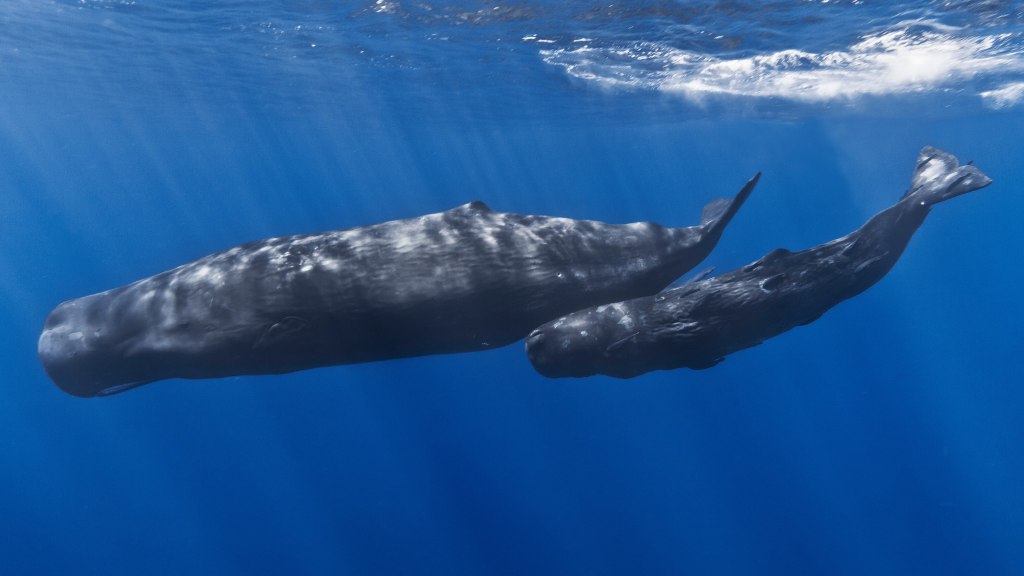
The picture shows a mother and  calf sperm whale swimming in the ocean.
Sperm whales from Wikimedia commons. A mother sperm whale and her calf off the coast of Mauritius. The calf has remoras attached to its body.
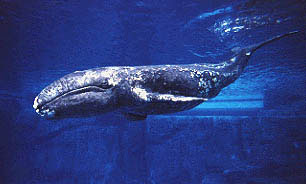
The picture shows a gray whale in water. | The Evolution of Whales is No Longer a Mystery
A gray whale in captivity. Marine Mammal Commission, Public domain, via Wikimedia Commons.
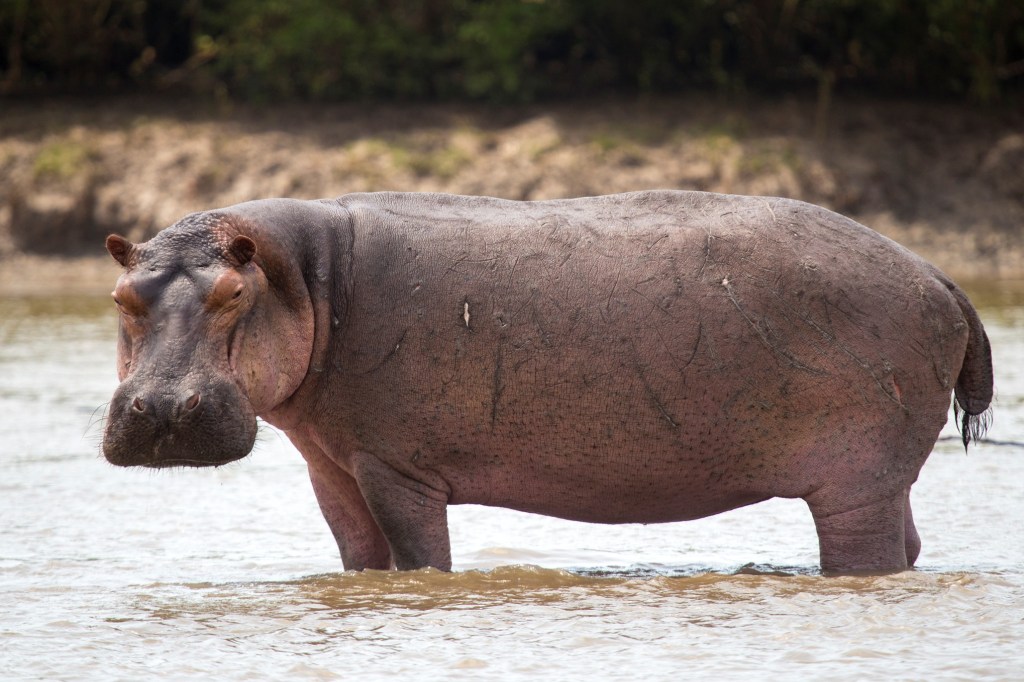
Portrait of a Hippopotamus in water in Saadani National Park. Muhammad Mahdi Karim, CC BY-SA 4.0 <https://creativecommons.org/licenses/by-sa/4.0&gt;, via Wikimedia Commons.

Scientists realized hundreds of years ago that whales were a lot more like mammals than fish, in fact they were mammals. However, the fact that no intermediate fossils between land dwelling mammals and whales had been found presented a mystery and attracted the mockery by creationists. It was said that there was a missing link. Then intermediate fossils were found, and then a lot more of them.

In addition, DNA analysis of modern whales and hippopotamus showed that they were related and had a common ancestor. Just like chimpanzees and humans have a common ancestor, but chimpanzees are not an ancestor to humans, hippopotamus and whales have a common ancestor, but whales did not evolve from hippopotamus. To read more about the evolution of whales click here, or here, or here, or here, or here, or here, or here.

The thing with gaps in the fossil record or so called missing links is that as they are filled out new gaps are created, smaller gaps. Therefore, you can always claim that there are gaps. So be careful when you hear creationists speaking of missing links or gaps in the fossil record. Instead focus on the intermediate fossils that we have found and keep finding.

The fact that we’ve found a lot of intermediate fossils for the evolution of whales and that DNA tells us that Hippos and Whales are related and have a common ancestor probably comes as a surprise to many. It was certainly a surprise to me when I heard it the first time. It is true and kind of important to know. Therefore, I consider this a super fact.

Evolution of Whales – Intermediate Fossils

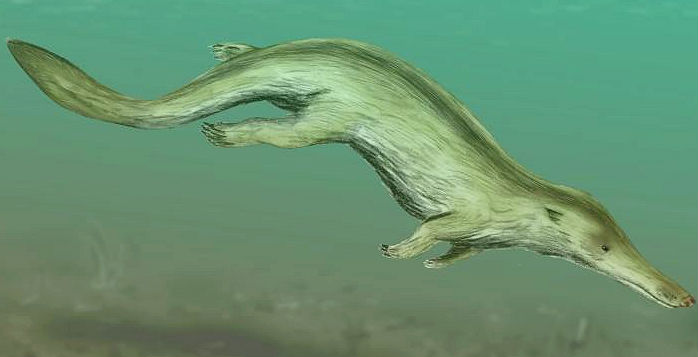
The first intermediate fossil found between land mammals and whales was Pakicetus found in Pakistan in 1983. You may wonder how we know that Pakicetus was related to whales. This evidence includes its fossilized ear bone (auditory bulla), which possesses a unique, thickened shape called an involucrum that is found only in cetaceans. Pakicetus also shares whale-like teeth, an ankle bone and a skull structure similar to other early whale like creaturs. Since the discovery of Pakicetus a lot more whale ancestors (intermediate fossils) have been found. Below is a list with illustrations of the various intermediate fossils.

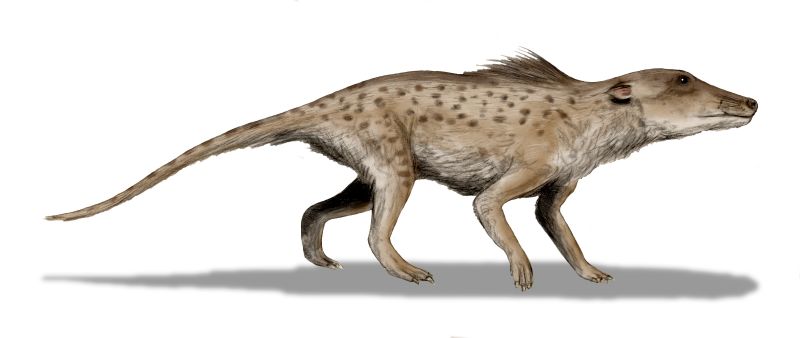
Pakicetus: The illustration shows a four legged carnivorous mammal with a tail and an elongated snout.
Pakicetus inachus, a whale ancestor from the Early Eocene of Pakistan, after Nummelai et al., (2006), pencil drawing, digital coloring. It lived 48-49 million years ago. Nobu Tamura (http://spinops.blogspot.com), CC BY 3.0 <https://creativecommons.org/licenses/by/3.0&gt;, via Wikimedia Commons.
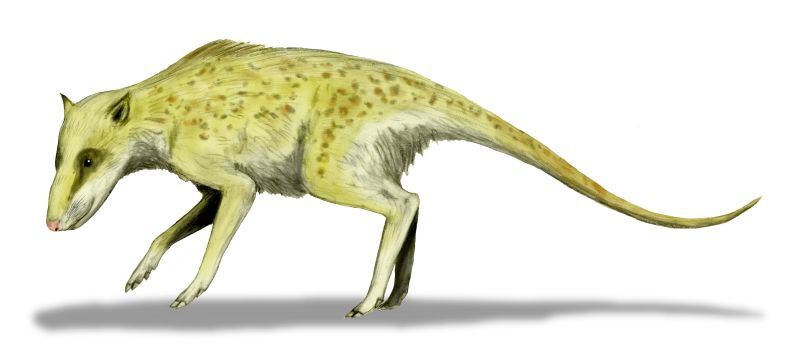
Indohyus: The illustration shows a four legged carnivorous mammal with a tail and an elongated snout. | The Evolution of Whales is No Longer a Mystery
Indohyus major, a herbivorous whale ancestor from the Middle Eocene of Kashmir, pencil drawing, digital coloring. It lived 48-49 million years ago. Nobu Tamura (http://spinops.blogspot.com), CC BY 3.0 <https://creativecommons.org/licenses/by/3.0&gt;, via Wikimedia Commons.
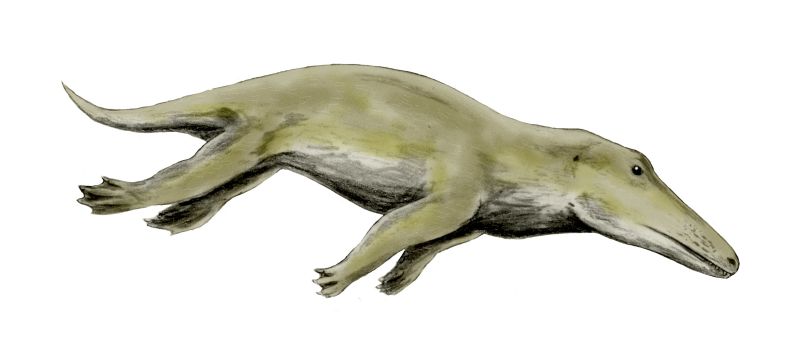
Ambulocetus: The illustration shows a four legged carnivorous mammal with a tail and an elongated snout.
Ambulocetus natans, a primitive whale from the Early Eocene of Pakistan, pencil drawing, digital coloring. It lived 48-49 million years ago. Nobu Tamura (http://spinops.blogspot.com), CC BY 3.0 https://creativecommons.org/licenses/by/3.0, via Wikimedia Commons.
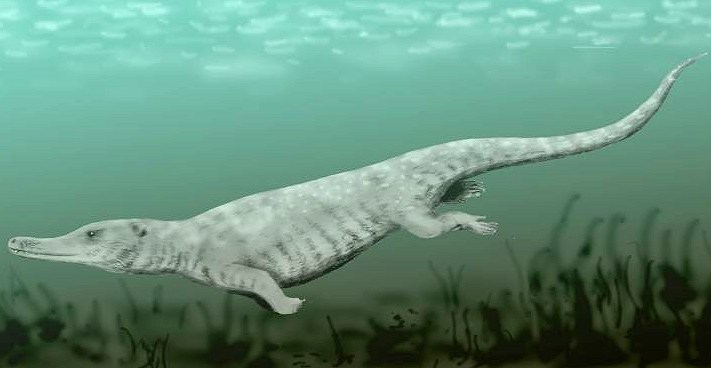
Kutchicetus: The illustration shows a carnivorous mammal with short legs, a tail and an elongated snout. It is swimming in the ocean.
Kutchicetus minimus, an early whale from the middle Eocene of India. Pencil drawing, digital coloring. It lived 48 million years ago. Nobu Tamura, CC BY 3.0 https://creativecommons.org/licenses/by/3.0, via Wikimedia Commons.
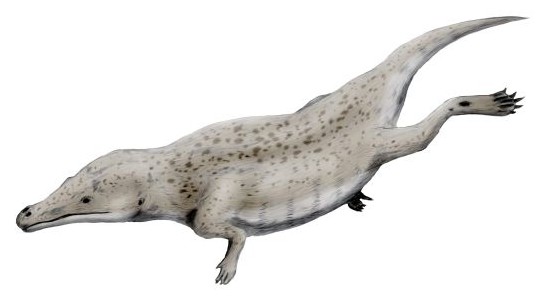
Remingtonocetus: The illustration shows a carnivorous mammal with short legs, a tail and an elongated snout. It is swimming in the ocean.
Remingtonocetus harudiniensis, an archaeocete whale from the Middle Eocene of India, pencil drawing, digital coloring. It lived 48 million years ago. Nobu Tamura (http://spinops.blogspot.com), CC BY 3.0 https://creativecommons.org/licenses/by/3.0, via Wikimedia Commons.
Maiacetus. It lived 47.5 million years ago. | The Evolution of Whales is No Longer a Mystery
Maiacetus. It lived 47.5 million years ago. Nobu Tamura (http://spinops.blogspot.com), CC BY-SA 3.0 https://creativecommons.org/licenses/by-sa/3.0, via Wikimedia Commons.
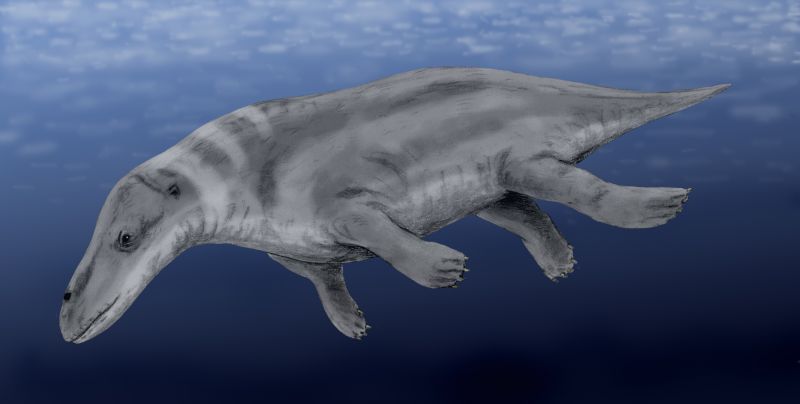
Rodhocetus: The illustration shows a mammal with short legs swimming in the ocean. It has flat feet, a tail and an elongated snout. It looks even more like a sea creature now.
Rodhocetus kasrani, an archaeoceti whale from the late Eocene of Pakistan, digital. It lived 45 million years ago. Nobu Tamura, CC BY 3.0 <https://creativecommons.org/licenses/by/3.0&gt;, via Wikimedia Commons.
Dorudon: The illustration shows a mammal with fins swimming in the ocean. It has flat feet, a tail and an elongated snout. It looks even more like a sea creature now.
Dorudon atrox, an ancestral whale from the Late Eocene of Egypt, pencil drawing, digital coloring. It lived 35 million years ago. Nobu Tamura, CC BY 3.0 https://creativecommons.org/licenses/by/3.0, via Wikimedia Commons.
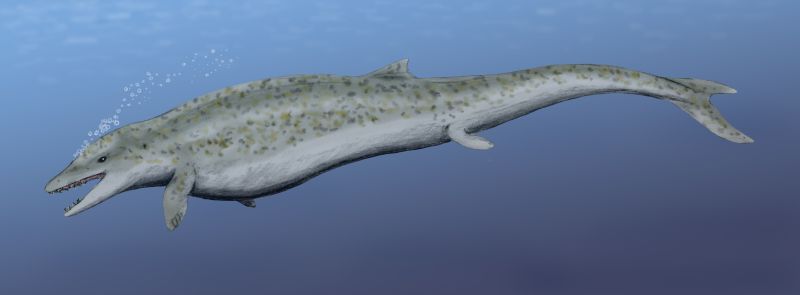
Aetiocetu: The illustration shows a fish or whale looking creature swimming in the ocean.
Aetiocetus cotylalveus, an early baleen whale from the Late Oligocene of Oregon, pencil drawing, digital coloring. It lived 27 million years ago. Nobu Tamura (http://spinops.blogspot.com), CC BY 3.0 https://creativecommons.org/licenses/by/3.0, via Wikimedia Commons.
Squalodon: The illustration shows a fish or dolphin looking creature swimming in the ocean. | The Evolution of Whales is No Longer a Mystery
Squalodon calvertensis, a toothed whale from the Late Miocene of North America, pencil drawing, digital coloring. It lived 25 million years ago. Nobu Tamura, CC BY 3.0 <https://creativecommons.org/licenses/by/3.0&gt;, via Wikimedia Commons.
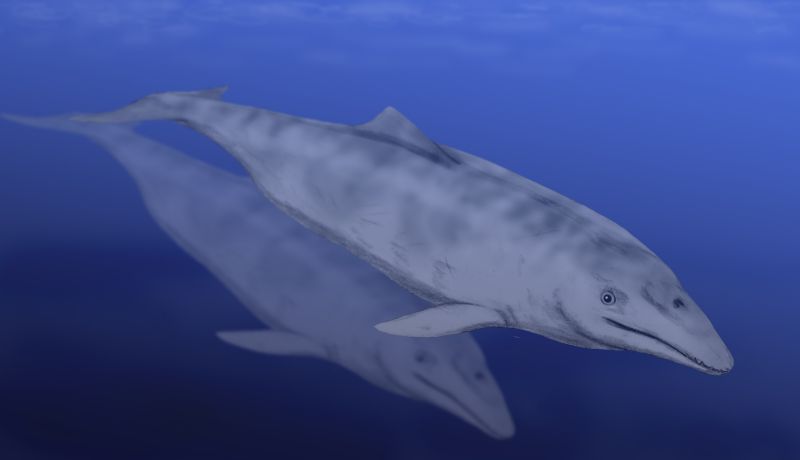
Janjucetus: The illustration shows a fish or whale looking creature swimming in the ocean.
Janjucetus hunderi, a Mysticeti whale from the Oligocene of Australia, digital work. It lived 25 million years ago.  Nobu Tamura   email:nobu.tamura@yahoo.com   http://www.palaeocritti.comderivative work: Niusereset, CC BY 3.0 <https://creativecommons.org/licenses/by/3.0&gt;, via Wikimedia Commons.
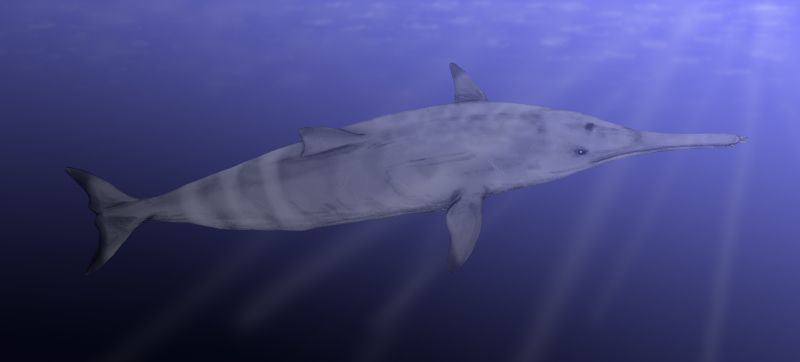
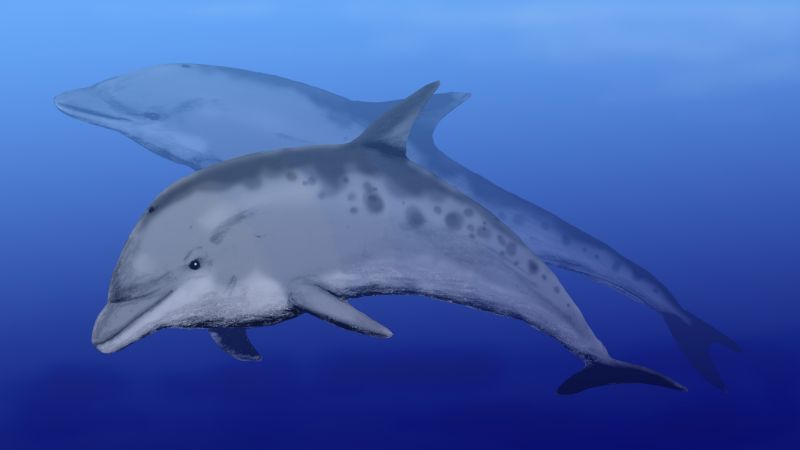
Kentriodon: The illustration shows a dolphin looking creature swimming in the ocean.
Kentriodon pernix, an odontocete dolphin-like whale from the Miocene, pencil drawing, digital coloring. It lived 20 million years ago. Nobu Tamura (http://spinops.blogspot.com/2012/06/kentriodon-pernix.html?q=Kentriodon), CC BY 3.0 https://creativecommons.org/licenses/by/3.0, via Wikimedia Commons.
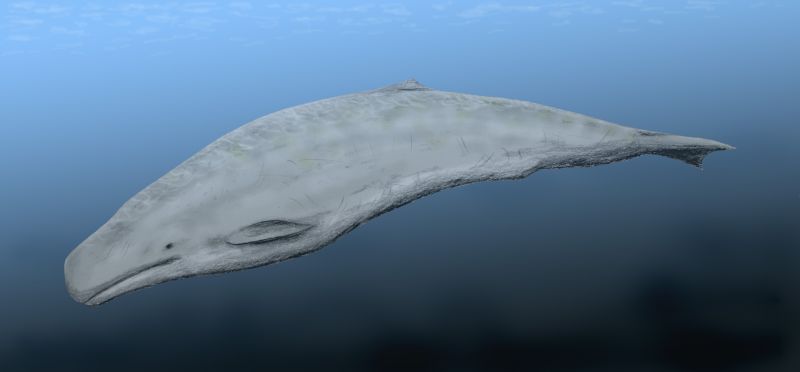
Aulophyseter: The illustration shows a creature that looks a bit like a sperm whale swimming in the ocean. | The Evolution of Whales is No Longer a Mystery
Aulophyseter morricei, a sperm whale from the Middle Miocene of California. It lived 20 million years ago. Nobu Tamura, CC BY 3.0 <https://creativecommons.org/licenses/by/3.0&gt;, via Wikimedia Commons.
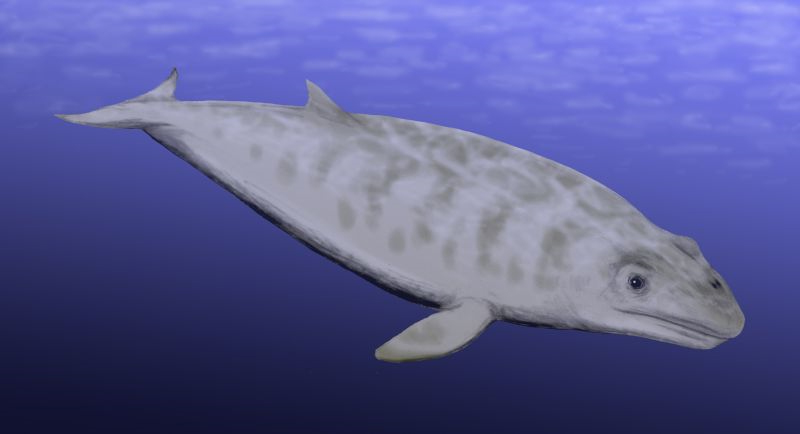
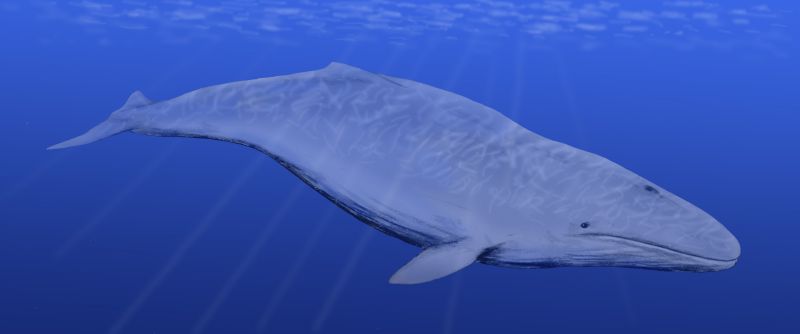
Cetotherium: The illustration shows a creature that looks like a modern gray whale swimming in the ocean.
Cetotherium furlongi, a baleen whale from the mid-Late Miocene of Europe, Russia and North America, digital. It lived 18 million years ago. Nobu Tamura (http://spinops.blogspot.com), CC BY 3.0 <https://creativecommons.org/licenses/by/3.0&gt;, via Wikimedia Commons.
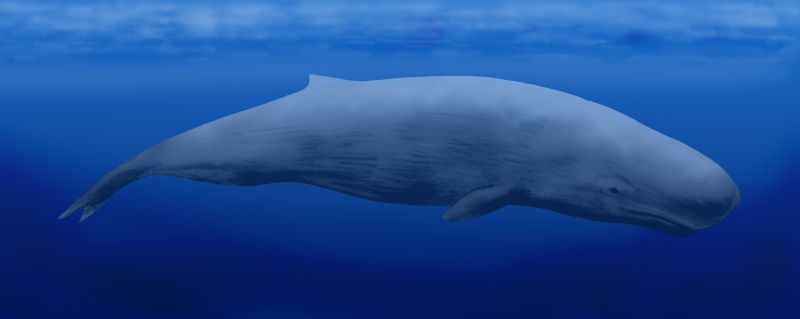
Brygmophyseter: The illustration shows a creature that looks like a sperm whale swimming in the ocean.
Brygmophyseter shigensis (aka as Nagacetus shigensis), a sperm whale from the Mid Miocene of Japan. Digital. It lived 15 million years ago. Nobu Tamura (http://spinops.blogspot.com), CC BY 3.0 https://creativecommons.org/licenses/by/3.0, via Wikimedia Commons.


To see the other Super Facts click here

Birds are Avian Dinosaurs

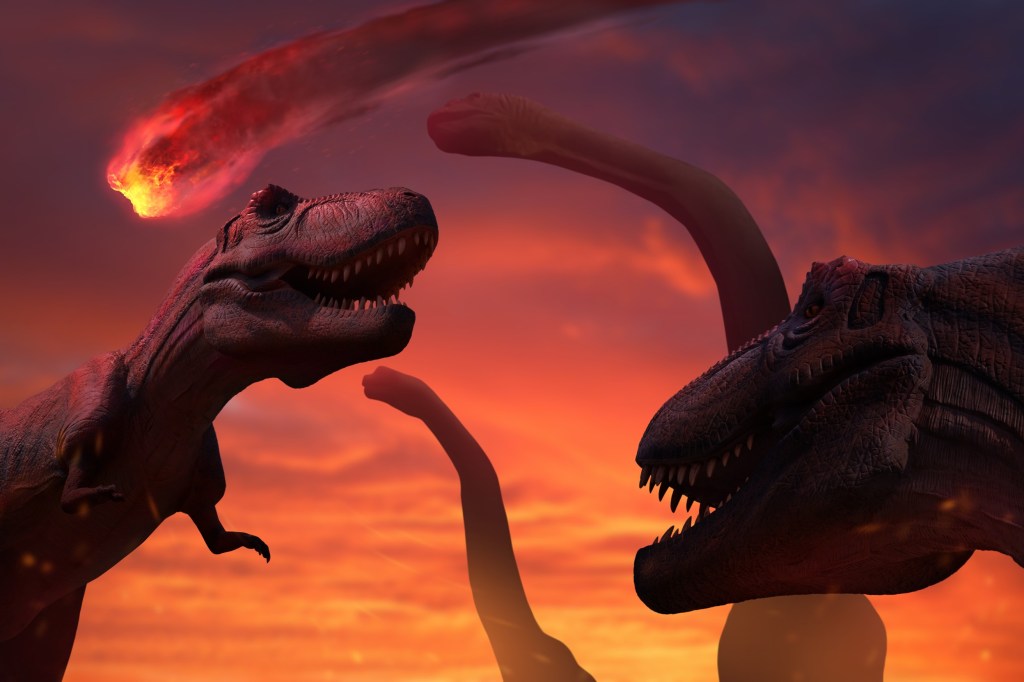
Super fact 84 : Modern birds are classified as part of the clade Dinosauria. They are direct descendants of small, feathered maniraptoran dinosaurs that survived the Cretaceous-Paleogene extinction event 66 million years ago. Maniraptoran dinosaurs in turn are a major subgroup of coelurosaurian theropod dinosaurs. In other words, birds are avian dinosaurs.

3D illustration showing two carnivorous dinosaurs and two large herbivores looking up at a burning asteroid. | Birds are Avian Dinosaurs
Some dinosaurs survived the Cretaceous-Paleogene extinction event 66 million years ago. Shutterstock Asset id: 2196200279 by funstarts33

Birds are descendants of specialized maniraptoran theropod dinosaurs that survived the extinction event that killed most dinosaurs 66 million years ago. Maniraptoran dinosaurs in turn are a major subgroup of Tyrannoraptora, which include the well-known Tyrannosaurus Rex. Tyrannoraptora  in turn is a major subgroup of coelurosaurian theropod dinosaurs. Both the well-known dinosaur called velociraptor, and birds belong to the group Maniraptora. Even though the velociraptor was not a bird they shared many bird-like features, including feathers, wishbones, hollow bones, and similar wrist joints.

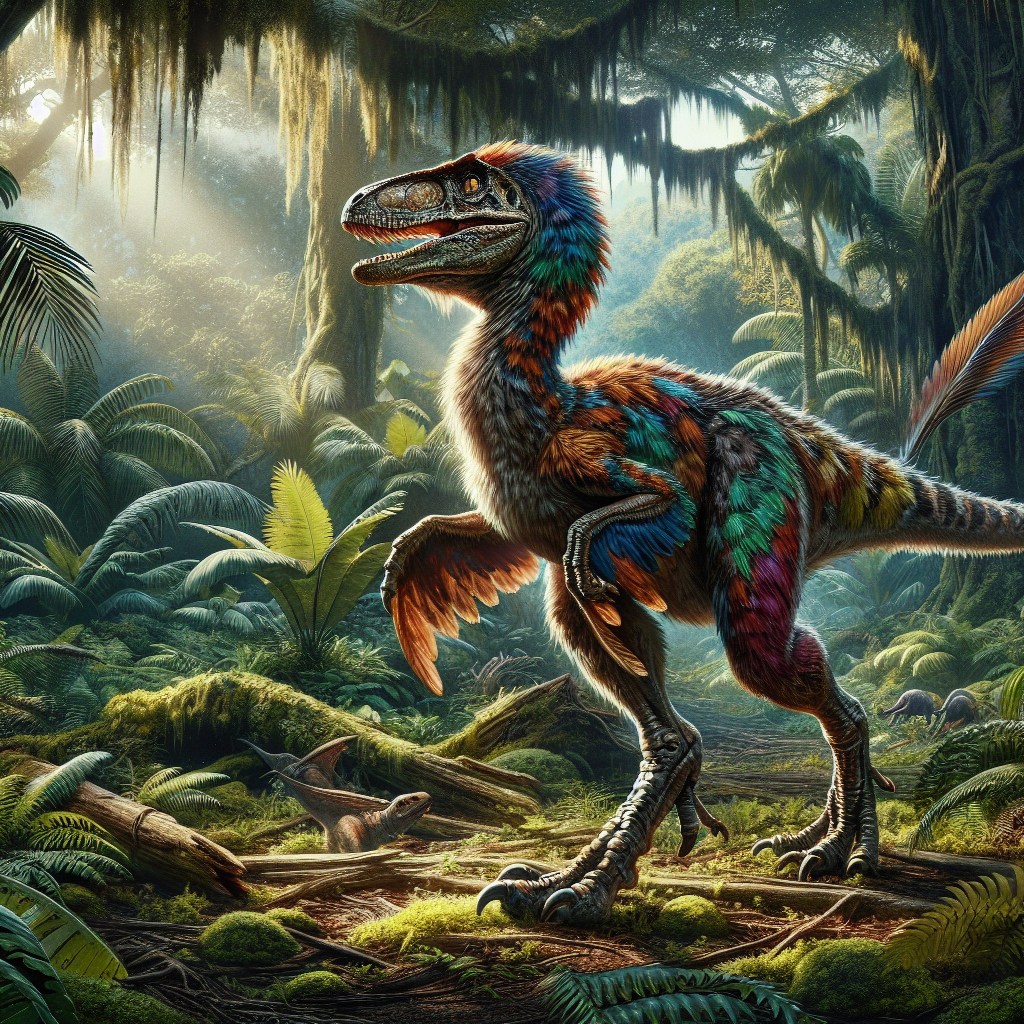
A colorful velociraptor covered in feather. It does not look like it could fly.
Velociraptor with feathers (well a little bit). Shutterstock Asset id: 2636534673 by Shutterstock AI Generator

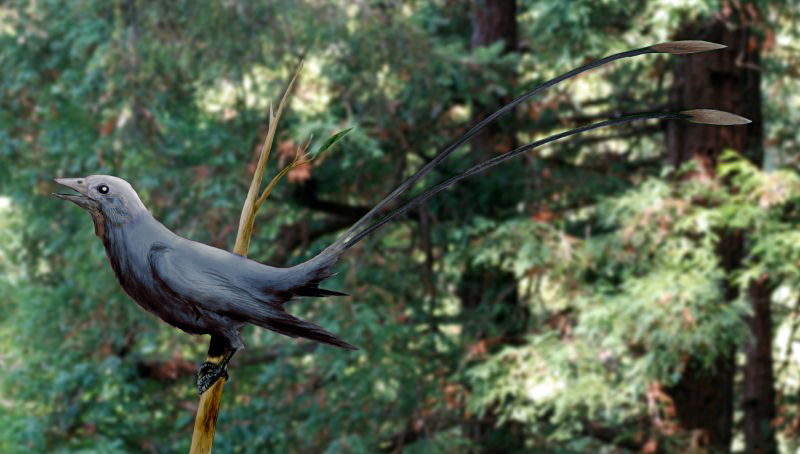
Birds evolved during the Jurassic period from two-legged, carnivorous, and often feathered dinosaurs, and are the only surviving dinosaurs. They have been classified as avian dinosaurs since the 1980’s. In other words, they are dinosaurs. Initially feathers evolved among dinosaurs for insulation, sexual display, and camouflage rather than flight. One of the early birds was Eoconfuciusornis. It lived 131 million years ago, long before the Cretaceous-Paleogene extinction event 66 million years ago. Eoconfuciusornis could fly and it had colorful feathers.

A black bird with a long retrix / tail sitting on a tree. | Eoconfuciusornis 130 million years ago. | Birds are Avian Dinosaurs
Eoconfuciusornis 130 million years ago. Nobu Tamura, CC BY 3.0 https://creativecommons.org/licenses/by/3.0, via Wikimedia Commons

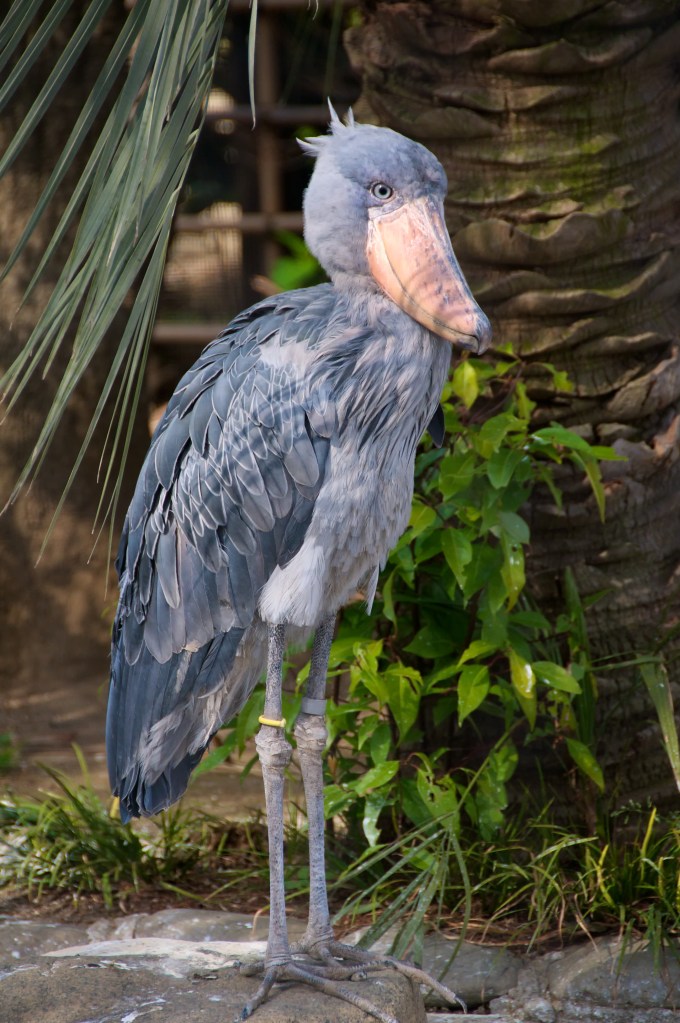
I brought up this fact in a recent post and I hinted that it was a super fact. It is true, surprising and kind of important. After all birds are all around us. In this post I am exploring the fact that birds are dinosaurs a little bit more than I did in my previous post. Below are a couple of modern birds.

A shoebill stork is a large gray-blue bird with a huge beak.
A shoebill stork standing at Ueno Zoo, Tokyo, five feet tall. Bob Owen, CC BY 2.0 https://creativecommons.org/licenses/by/2.0, via Wikimedia Commons
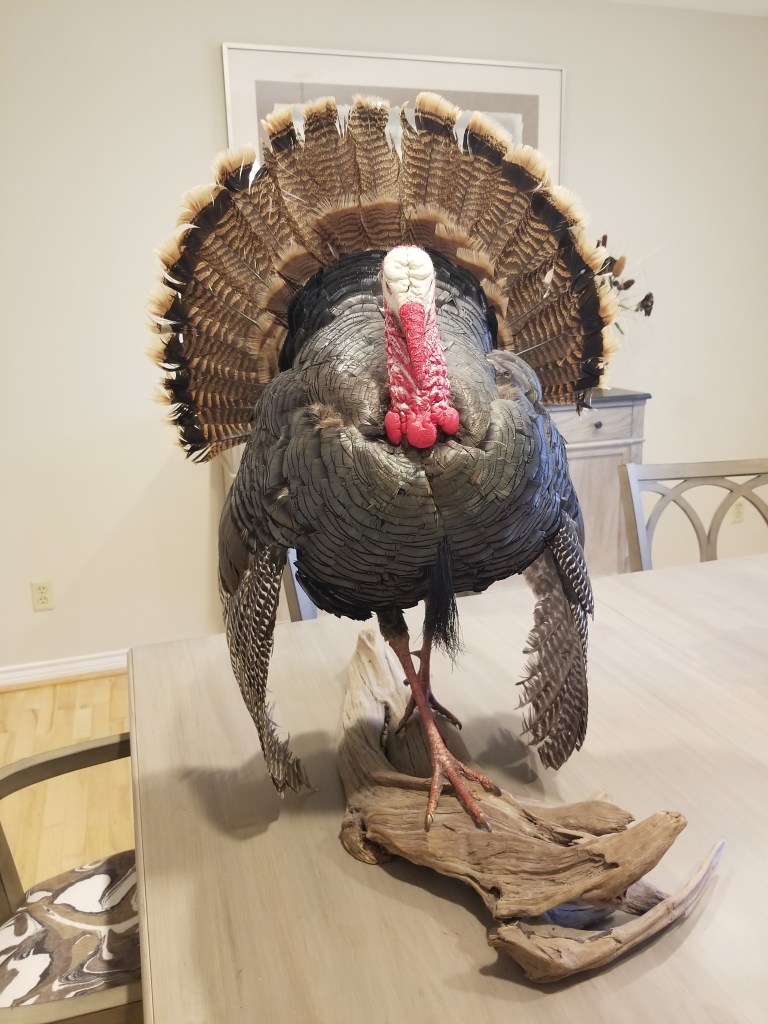
A taxidermy mount of a turkey standing on our dining room table. | Birds are Avian Dinosaurs
A wild turkey in our dining room.

Feathered Dinosaurs

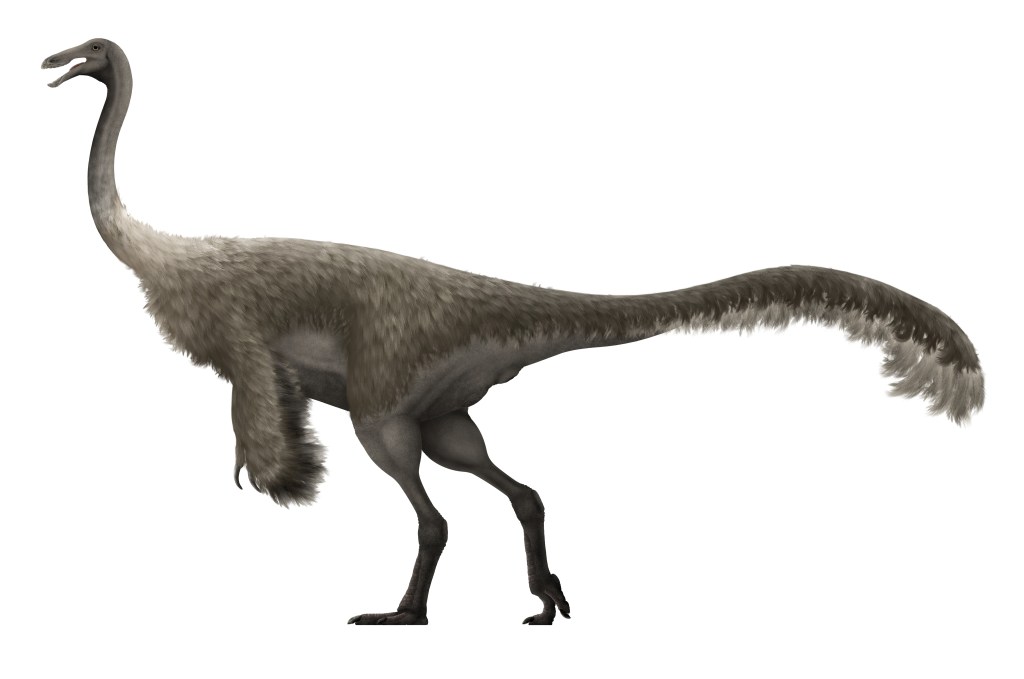
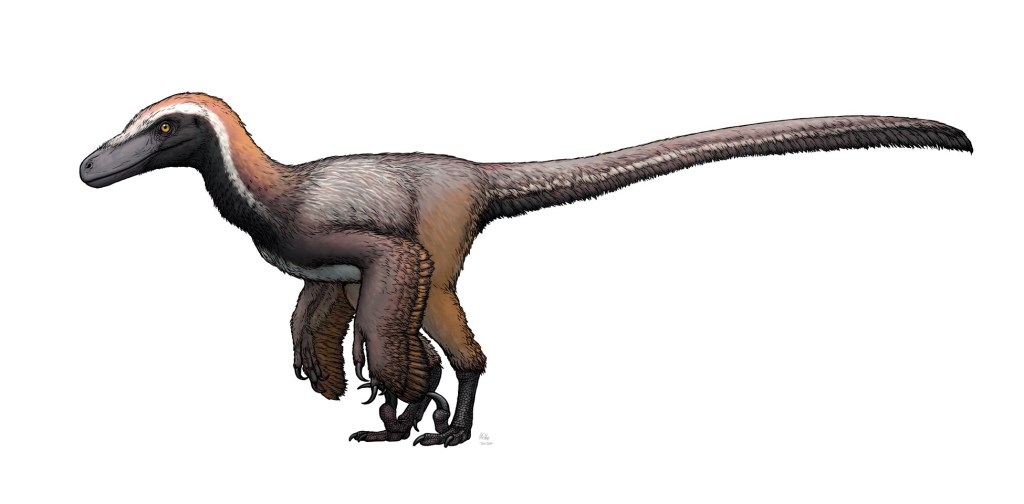
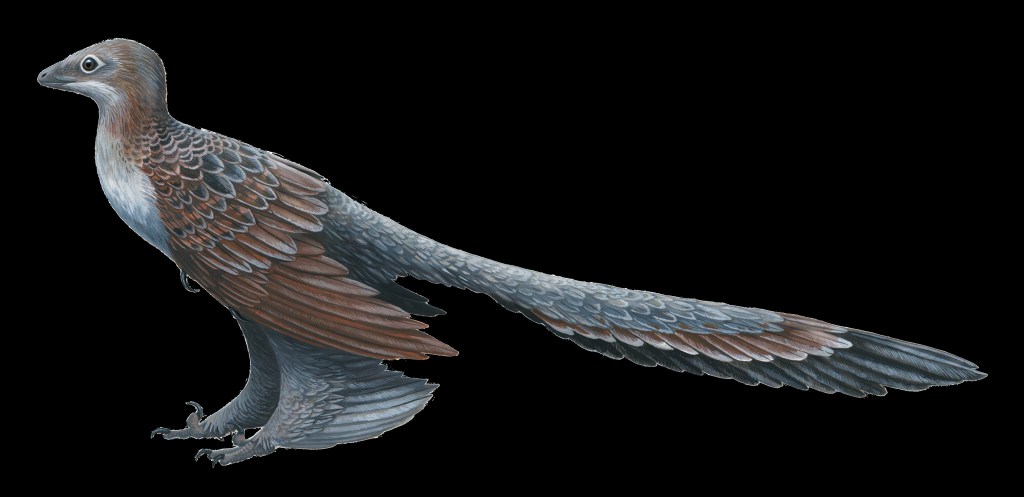
A lot of dinosaurs had feathers, and some could fly. That included many types of dinosaurs other than birds. Dinosaurs with feathers include, for example, Velociraptor, Deinonychus, Archaeopteryx (could fly), Microraptor (could fly), Rahonavis (could fly), Gallimimus, Ornithomimus, Yutyrannus huali, Psittacosaurus, Psittacosaurus, Sinosauropteryx, Sinornithosaurus, Eoconfuciusornis, Wulong, Psittacosaurus, Sciurumimus, Kulindadromeus, Caudipteryx, Utahraptor, Deinonychus, and even young T-Rex and many others. We know that at least some dinosaurs had feathers as well as colors based on fossil finds. Below are some illustrations.

A Gallimimus dinosaur covered in hair and feathers.
Life restoration showing an adult with feathers, based on those known from the related Ornithomimus. Picture is from here. PaleoNeolitic, CC BY 4.0 https://creativecommons.org/licenses/by/4.0, via Wikimedia Commons
A bird like dinosaur with feathers. It has huge claws.
Life restoration of Pyroraptor olympius. Picture is from here. Mette Aumala, CC BY-SA 4.0 https://creativecommons.org/licenses/by-sa/4.0, via Wikimedia Commons.
Birds are Avian Dinosaurs | Reconstruction of the 2014 microraptorine dromaeosaur dinosaur, Changyuraptor yangi. This is a dinosaur with four wings.
Reconstruction of the 2014 microraptorine dromaeosaur dinosaur, Changyuraptor yangi. This is a dinosaur with four wings. The picture is taken from here. Emily Willoughby (e.deinonychus@gmail.com, http://emilywilloughby.com), CC BY-SA 4.0 <https://creativecommons.org/licenses/by-sa/4.0&gt;, via Wikimedia Commons
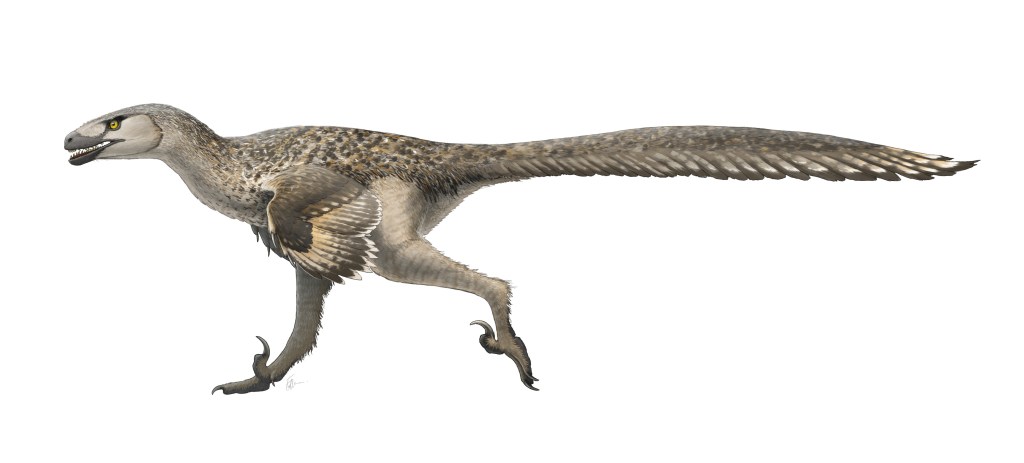
Greyish bird like creature with a reptile like head.
Artistic restoration of D. albertensis Artistic restoration of D. albertensis. Picture from here. Fred Wierum, CC BY-SA 4.0 <https://creativecommons.org/licenses/by-sa/4.0&gt;, via Wikimedia Commons
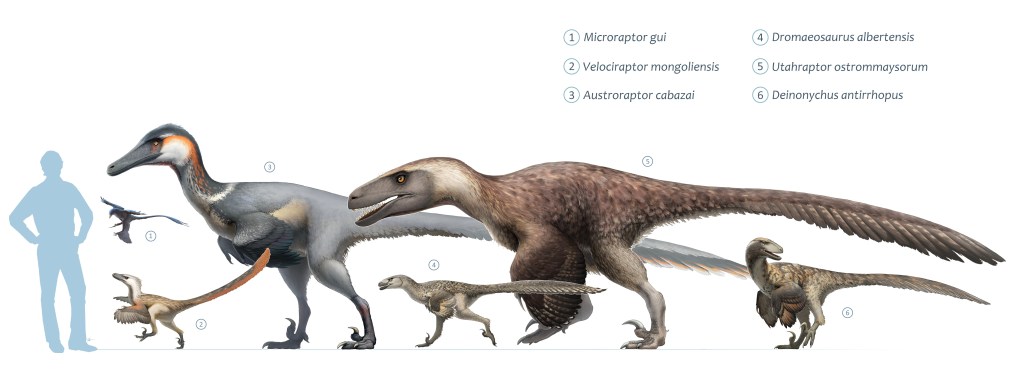
Six dromaeosaurs are shown, all covered with feathers. Microraptor gui (flying), Velociraptor mongoliensis, Austroraptor cabazai, Dromaeosaurus albertensis, Utahraptor ostrommaysorum, Deinonychus antirrhopus. A human is shown on the left. Most of the dinosaurs are bigger than the human.
Size of Utahraptor (5) compared with other dromaeosaurs and a human. It is the biggest one in the picture. The picture is from here. Fred Wierum, CC BY-SA 4.0 <https://creativecommons.org/licenses/by-sa/4.0&gt;, via Wikimedia Commons.

Terror Birds and Other Giant Birds

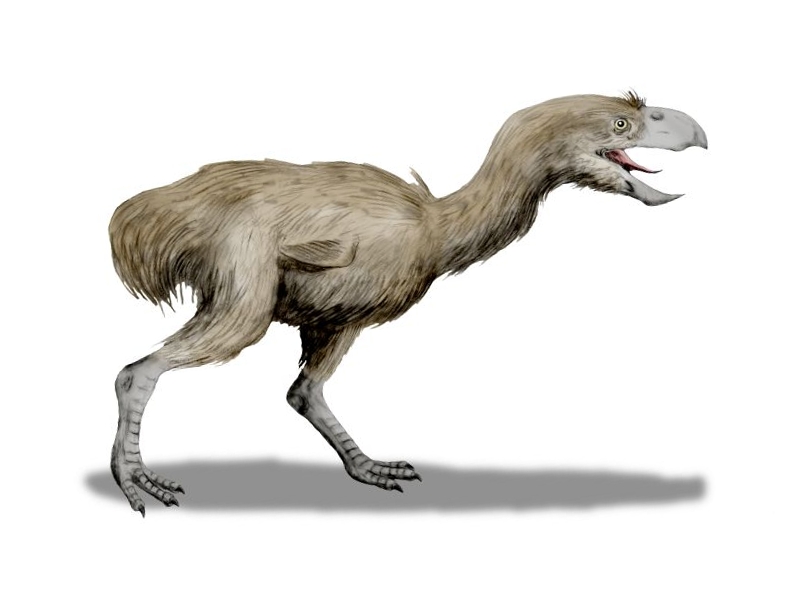
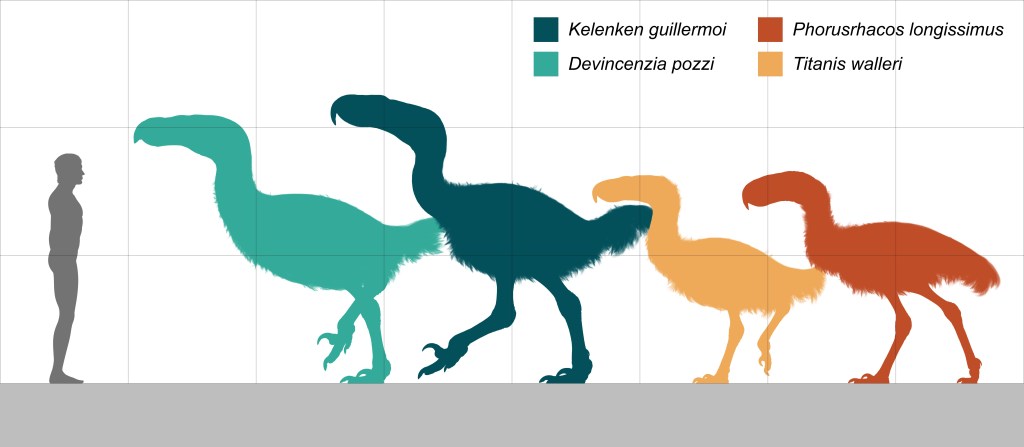
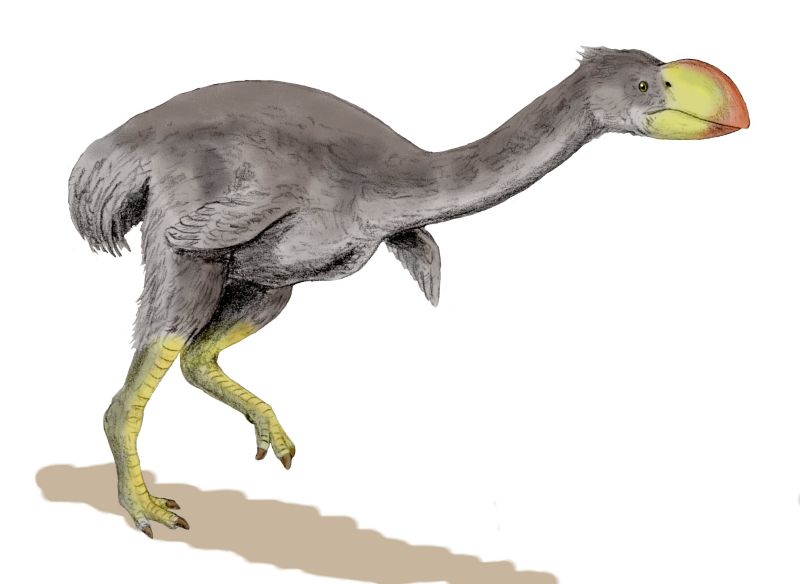
After the Cretaceous-Paleogene extinction event 66 million years ago birds continued evolving. Some of them became large standing 1 – 3 meters (3-10 feet) and weighing hundreds or even thousands of pounds. From about 53 million years ago until 100,000 years ago there were large birds that we refer to as Terror Birds. They lived at the same time as humans. However, there were other large and scary birds. Dromornis stirtoni was a flightless bird that lived 7-8 million years ago, it was over three meters in height (10 feet) and weighed 500-600 kilograms (1,100 to 1,300 pounds). Below are some illustrations.

pencil drawing, digital coloring of Paraphysornis brasiliensis, a Terror Bird. | Birds are Avian Dinosaurs
Paraphysornis brasiliensis, a Terror Bird, 8 feet tall weighing 400–530 pounds, this is a terror bird from the Early Miocene of Brazil,: Snowmanradio (talk)Paraphysornis_BW.jpg:  Nobu Tamura (http://spinops.blogspot.com), CC BY 3.0 <https://creativecommons.org/licenses/by/3.0&gt;, via Wikimedia Commons.
The Kelenken, Devincenzia, Phorusrhacos, and Titanis birds are all larger than the human standing on the left hand side. Kelenken guillermoi is the largest.
Size comparison of some phorusrhacids (Terror Birds), including Kelenken, Devincenzia, Phorusrhacos, and Titanis. Picture taken from here. PaleoNeolitic, CC BY 4.0 <https://creativecommons.org/licenses/by/4.0&gt;, via Wikimedia Commons.
A flightless bird with huge yellow beak. | Birds are Avian Dinosaurs
A pencil-drawn reconstruction of Dromornis stirtoni. Picture is taken from here. Nobu Tamura (http://spinops.blogspot.de), CC BY-SA 3.0 http://creativecommons.org/licenses/by-sa/3.0/, via Wikimedia Commons

Shared False Memories Are Common – Mandela Effect

Super fact 83 : Everyone experiences false memories. They are a normal part of how human memory works and are very common. There are also false memories that are shared among large groups of people and that are often socially reinforced. This is called the Mandela effect.

Pop art style comic book panel doubtful wondering woman can't tell reality from fantasy, daydreaming, dreams, delusion, vector illustration. She says “W-Was … it … just a dream?!?” | Shared False Memories Are Common – Mandela Effect
Shutterstock Asset id: 717504940 by durantelallera

As I mentioned, false memories are very common. However, what may come as a surprise is that some false memories are widespread and socially reinforced. It is important to know this, and we know it is true, so it is a super fact. The effect is named after the former President of South Africa, Nelson Mandela, who died in 2013. However, a lot of people distinctly remember him dying in prison in the 1980s.

It was paranormal researcher Fiona Broome who named the effect after having a personal experience with the phenomenon. She wrongly recalled Nelson Mandela dying in the 1980s and she could even remember the news coverage of his funeral, and yet it never happened. After talking to other people, she realized that she was far from alone with her false memory.

Another example is that a lot of people remember Darth Vader in Star Wars telling Luke “Luke, I am your father”. What Darth Vader said was “No, I am your father”. Yet another movie example is that Forrest Gump did not say “Life is like a Box of Chocolates”. He said, “Life was like a box of chocolates”. Also, the Monopoly man never had a monocle, Curious George doesn’t have a tail, many remember the “Berenstein Bears” but it’s the “Berenstain Bears”. C-3PO is not all gold, he has a silver leg. You can easily find hundreds of examples of the Mandela effect online.

The photo shows a scene from Star Wars. C-3PO and R2-D2. C-3PO has a silver leg.
Shutterstock Asset id: 558350728 by Willrow Hood

People have asked me, “do you remember in the 1970’s and 1980’s when scientists were  convinced that global cooling was happening”, to which I answer, “no I don’t remember that and neither do you”. In the 1970’s much less was known about the climate, but the possibility of anthropogenic warming dominated the peer-reviewed literature even then. There were a few contrarian climate scientists who claimed there was global cooling and there were some articles in popular media about global cooling, but the statement that scientists were  convinced there was global cooling is simply false. You can read more about this in this book. Yet some people “remember” this. I believe this is another example of a socially reinforced Mandela Effect.

False Beliefs and False Memories

The existence of false beliefs is another phenomenon that is very common. There are hundreds of common beliefs that we know are false based on carefully vetted data, large amounts of studies, and scientific experiments. I think we all have some false beliefs. We have all been bamboozled at some point. The way to know is to check and compare the evidence and the data and papers from reputable sources. Find out what the experts in the field say. Some examples of false beliefs are:

We adopt false beliefs because of misinformation, propaganda (politics), social reinforcement, a wish to believe certain things, our own lack of critical thinking, etc. False memories, including collective false memories are due to the fact that memories aren’t perfect recordings, memory reconstruction, social reinforcement (also true for false beliefs), and confusion with similar events.

Woman near inscriptions false and true reflects trying to choose from two options and make difficult decision. Woman put fingers on temples and closed eyes considering pros and cons fateful decision.
Shutterstock Asset id: 2593117091 by Drawlab19

Both false beliefs, false memories and the Mandela effect distort our understanding of the world. That is BTW one important inspiration for this fact finding blog – superfactful. It is difficult to accept that what you believe to be true may simply be false. We want to believe that we know better than others, not that we have been bamboozled or that we misremember things. But we need to be open to look at and compare evidence, be curious and willing to understand how things work, and be willing to change our beliefs and accept that some of our memories may be false. That is one way to grow as a human.


To see the other Super Facts click here