The goal of this blog is to create a long list of facts that are important, not trivia, and that are known to be true yet are either disputed by large segments of the public or highly surprising or misunderstood by many.
I think that one of the most interesting series science books for beginners that I’ve come across is the Baby University series. I bought it for our soon to be born first grandchild Jack, but I couldn’t help but go through them myself. It is a great series for those who hope to put their one-year-old toddlers in a PhD program. But seriously, these books explain science concepts as simply as it is possible to do. The books may still be a little bit tough for babies, but I think 2–3-year-olds might get something out of them. The point of the books is not to make young children understand complex scientific concepts but to introduce the vocabulary and build curiosity.
Below I am presenting five books in the series, General Relativity for Babies, Electromagnetism for Babies, Artificial Intelligence for Babies, Quantum Physics for Babies, and Organic Chemistry for Babies. I am providing my review for the book and a link to my review as well as the book and a photo of the front cover.
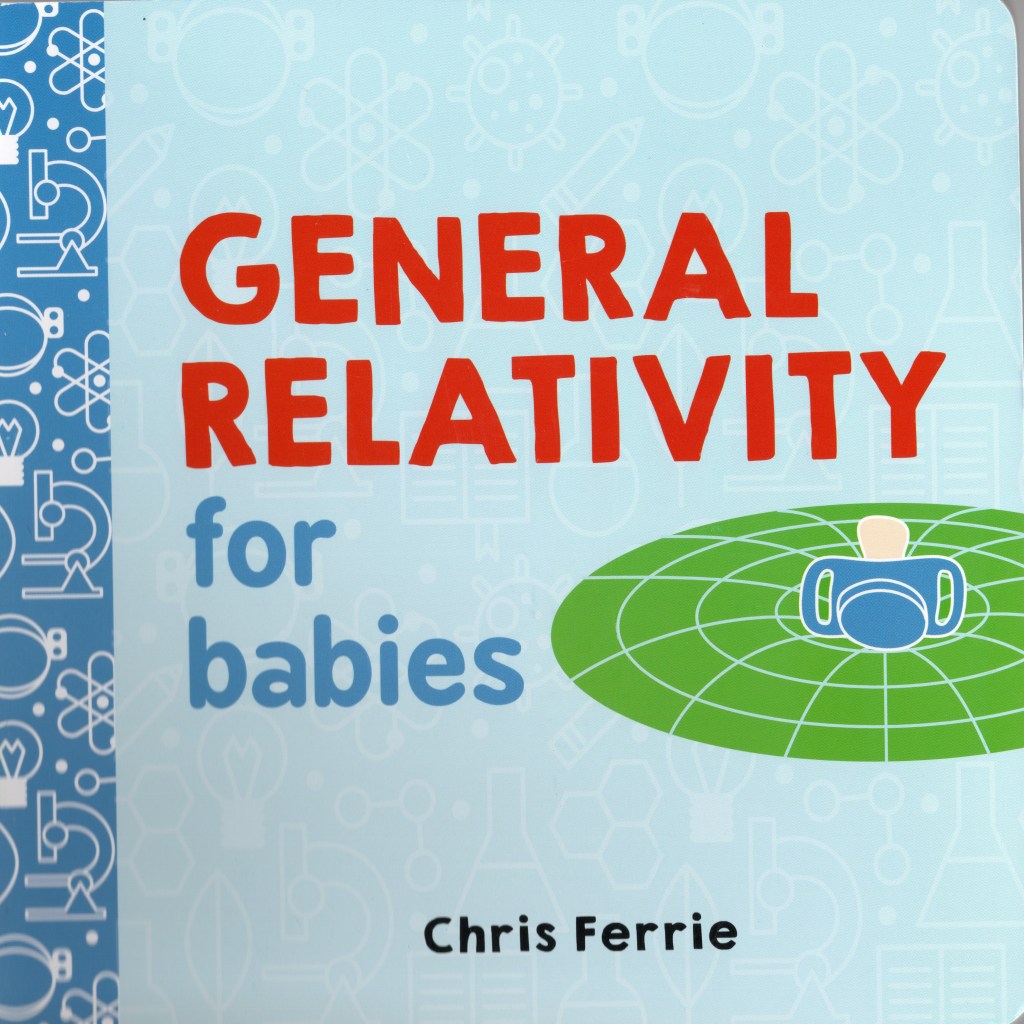
General Relativity for Babies
Front cover of General relativity for Babies.
This is the Amazon link for General Relativity for Babies.
We bought this board book for our not yet born grandson. This book simplifies the General Theory of Relativity as far as you possibly can. It uses simple language and colorful illustrations to give the reader an idea of what is going on. Different sized masses are different sized balls, space-time curvature is illustrated using a distorted grid, and objects orbiting larger masses, such as a star, are shown as small balls having their paths curved by a warped grid. There are simple explanations for what a black hole is and what gravity waves are.
A baby would not understand this book but maybe someone who is 3-4 years old would. But your expectations need to be realistic. It should also be noted that even if you understand the book, the explanations are too simplistic for you to really understand General Relativity, but the explanations are not so simple that they are wrong. The book will just give you an idea of what is going on. However, I was impressed by the fact that the author and illustrator were able to present such an abstract theory in a way that makes it possible for a child to at least have a clue. I think that the most important aspect of the book is not whether the child understands General Relativity but the interest in science that it may evoke.
Electromagnetism for Babies
Front cover of Electromagnetism for Babies.
This is the Amazon link for Electromagnetism for Babies.
We bought this short and colorfully illustrated board book for our not yet born grandson. I don’t think a baby will understand it but maybe when he is 2-3 years old. The book explains in simple terms and with colorful simple illustrations the basic concepts of charges, and attraction between negative and positive charges, and repulsion between two positive balls/charges and two negative balls. It explains about electrical and magnetic fields, and the fact that charges rotate around magnets. I believe this book can spur a child’s interest in science and engineering.
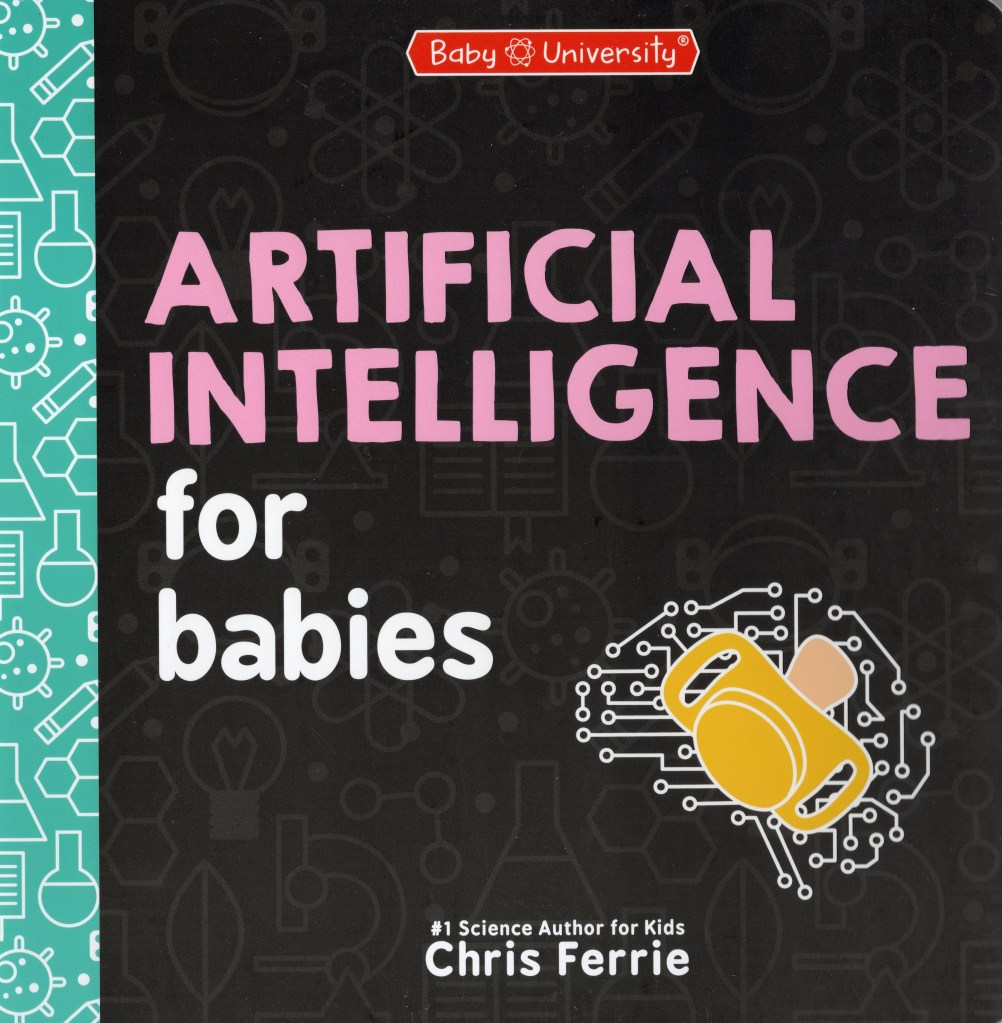
Artificial Intelligence for babies
Front cover of Artificial Intelligence for babies.
This is the Amazon link for Artificial Intelligence for babies.
We bought this board book for our not yet born grandson. He will not be able to understand it until he is at least one years old, but that is OK. The book explains the difference between a dog, a live thing, and a computer. It does this in very simple terms that I believe a young child could understand. According to the book, a computer can do some things that are impressive, such as complex calculations, and you can teach it certain skills, but it is not adaptable like a dog. I think that is about what you can make a very young child understand. Naturally, there are no neural networks or AI algorithms in the book. However, I think it sells artificial intelligence short, since artificial intelligence is becoming increasingly adaptable.
Quantum Physics for babies
Front cover of Quantum Physics for babies.
This is the Amazon link for Quantum Physics for babies.
Quantum Physics for Young Children and Adults who Detested Physics Class
We bought this board book for our not yet born grandson. We may need to wait until he is 2-3 years old before it makes sense to read it to him. In the meantime, it is also a good book for adults without a solid science education. The book talks about colorful balls with energy and presents a simplified version of the Bohr model of the atom. There are blue balls called electrons and red balls called protons in the middle (the nucleus). The electrons travel in circular orbits around the middle. Light can change the energy of electrons causing them to jump between the orbits.
My daughter made the comment that a baby is only going to understand that an electron is a blue ball and a proton is a red ball, which isn’t a correct description of electrons and protons. Protons and electrons don’t have specific colors, not to mention that a simplified Bohr model for the atom is quite different from the more realistic Schrödinger’s model of the atom with quantum waves and probabilistic electron clouds. However, I am still very impressed by how simple the author and the illustrator succeeded in making this abstract topic. It is a good start for budding physicists.
Organic Chemistry for babies
Front cover of Organic Chemistry for babies.
This is the Amazon link for Organic Chemistry for babies.
We bought this board book for our not yet born grandson. We will read it to him when he is 1-3 years old. Right now, we can read it. This book simplifies Organic as far as you possibly can. It uses simple language and colorful illustrations to give the reader an idea of what organic chemistry is. Basically, atoms are balls of different kinds. Atoms make up everything. Atoms can stick to each other, and they can make different shapes. The balls we call carbon (in black) can stick to small white balls called hydrogen and other balls called oxygen. We call those organic molecules, and they make up plants, food, and medicines. I think this is simple enough for a 1–3-year-old to understand, but not a baby. In my opinion, a better name for this series would have been “for Big Boys or Girls” rather than babies, because young children don’t like being called babies.
To watch a woman read Quantum Physics for Babies. Click on the YouTube video below.
A lot of people have died on the silver screen from being trapped in quicksand. In the 1960s, almost 3% of films featured someone sinking in clay, mud or sand. However, this is extremely rare, if it has ever happened, and it is very difficult to find any documented cases of people drowning in quicksand even when they struggle. The reason is that you can never completely become submerged in quicksand because quicksand is much denser than water so you’ll easily float. If you relax you will float and sink no more than up your waist or lower chest. In addition, quicksand pits are rarely more than a few feet deep. Another misconception spread by the silver screen is that quicksand appear in the desert. However, quicksand usually appears near water.
Quicksand is thick and heavy, and it is extremely difficult to get out once you are stuck. The best way to get out of quicksand on your own is to slowly lean back so that the weight of your body is distributed over a wider area and then do back and forth movements as if you are swimming. It will take a long time though, so expect to take it very slowly and gently.
That does not mean that getting stuck in quicksand is not dangerous. There are documented cases where people have gotten stuck in quicksand and there was no one around to help them and they couldn’t get out on their own and eventually died from thirst, exposure, or attacking animals. Another dangerous situation is when the quicksand is located on a beach near the shore. There are cases where a person was stuck in quicksand, and the tide came in resulting in a drowning.
There are situations in which the dangers associated with being submerged in quicksand are real, and that is what is called “grain entrapment” or “grain engulfment”. Several people are killed each year when they become submerged in grain and cannot escape. This happens in grain elevators and silos. So don’t jump into grain silos.
I should say that I do not consider this a super fact because it is not very important information, sort of trivia, and I also don’t think there is enough reliable information out there about this. However, I think it is interesting information that relates to me a little bit (see next section). To remind you, this is what I consider a super fact.
A super fact is:
An important fact that can be simply stated.
It is very surprising, shocking, widely disputed, misunderstood, or mind-blowing.
Yet it is true with a very high degree of certainty.
Woman sinking in quicksand Shutterstock Asset id: 2576940253 by Shutterstock AI
My Quicksand Experience
When I was about 6-7 years old, I had my own experience with quicksand or at least a mudpuddle that acted very much like quicksand. I should say that back then neighbors were friends, and your lawn was everyone’s lawn, and the kids in the neighborhood played with each other. The kids roamed the neighborhood and the forest. We threw stones at imaginary witches, screamed at moose, broke into barns to jump in the hay, ate dirt and cheerfully watched the schoolhouse burn down. There were no cellphones, doomscrolling, political keyboard warriors, online predators or overprotective parents. Kids were happy back then, but life was less safe.
I was with a group of kids, including a couple of kids a bit older than I was. We came upon a funny-looking mudpuddle, about two feet wide, and I decided to step in to check it out. I don’t remember why. Maybe I wanted to impress. Maybe I was curious. It only took a few seconds for me to sink in to right above my knees and then it was impossible to get out. The mud/quicksand held my legs in an iron grip. The fact that I stopped sinking around my knees might have been because my feet had hit solid ground. My friends tried to pull me up but could not get me up.
The older kids told me not to struggle and one of them ran to get my parents. They came running as fast as they could. My dad gripped me around the waist and slowly, bit by bit, he was able to pull me up. The rubber boots I was wearing stayed in the mud/quicksand. They might still be there like a fossil to be found by future inhabitants of our planet. Was it some sort of strange mud, or quicksand? I don’t know, but I remember being afraid. It taught me one lesson. Don’t step in funny looking mud puddles. In fact, maybe you shouldn’t step in mud at all unless you have to.
I have two blogs, Leonberger Life and this one called Superfactful.
Leonberger Life feature amusing and heartwarming stories about our late Leonberger dog Bronco, as well as other Leonbergers. It also has a lot of information about the Leonberger breed, the history, care, training, Leonberger organizations, etc. I also wrote a Leonberger book, which I am featuring in the sidebar. With my Leonberger Life blog I want to spread information about the Leonberger breed, a rare, large, furry, friendly and fun dog breed and also bring attention to my book The Life and Times of Le Bronco von der Löwenhöhle, stories and tips from thirteen years with a Leonberger.
The goal of Superfactful, which is this blog, is to create a long list of facts that are important, not trivia, and that are known to be true and yet are either disputed by large segments of the public or highly surprising or misunderstood by many. I call these kinds of facts Super facts because they could potentially be very impactful on how we view the world.
Humans have accumulated an enormous amount of knowledge. Science does not know everything, but it knows a lot. The same cannot be said for us as individuals. We know next to nothing and harbor a lot of false beliefs. I think that is pretty much true for all of us, including me, but we may not know it. With this blog I am trying to correct some of that, at least regarding important facts. In addition, along the way, I am hoping to learn a lot myself and have some of my own false beliefs corrected.
In short, the change I would like to make in the world with my blog is to correct as many false beliefs as possible and educate my readers, and myself, about facts that are both important and mind blowing.
Smash your old beliefs with new surprising facts, super facts. Expand your mind. Shutterstock ID: 1685660680 by MattL_Images
What is a Super fact?
A super fact is:
An important fact but it can be simply stated.
Very surprising, shocking, widely disputed, misunderstood, or mind-blowing.
Yet it is true with a very high degree of certainty.
The first two criteria are subjective. The last criteria can be determined from longstanding scientific consensus, my own expertise and education (valid for just a few topics), agreement between multiple reliable online or offline sources such as agreement among research papers, reputable scientific organizations, NASA, NOAA, Pew Research Center, Our World in Data, etc. I should say I also link to less academic sources such as Wikipedia, but I do not solely rely on them.
You can read more about how I choose super facts here. Also, I am open to challenges based on good data (not opinions), as well as questions. With that I don’t mean that you cannot give your opinion in a comment. I just won’t update or remove a super fact based on an opinion. In addition, I am happy to receive suggestions for super facts. I am trying to collect a few hundred super facts and need all the help I can get. In the end I want to pick the 100 best ones. I might use a poll for that.
Sometimes a super fact involves doing myth busting of a popular myth and sometimes a super fact is stating something that is well known but disputed by many. In these cases, the evidence is likely to be conclusive, but the fact is still disputed by those who don’t know much about the evidence, or don’t want it to be true. In this case, I will include a substantial amount of evidence, and it might be lengthy. People get bamboozled all the time, and that includes me. It is not easy to admit that you have been bamboozled. You can read about my own experiences with that here.
Fact or myth. Shutterstock Asset id: 2327968607
Examples of Super Facts
At the time of posting this I have made plans for 150 super facts and so far, I have posted 54. I will post a lot more. Below I am listing a few of my first 54 super facts.
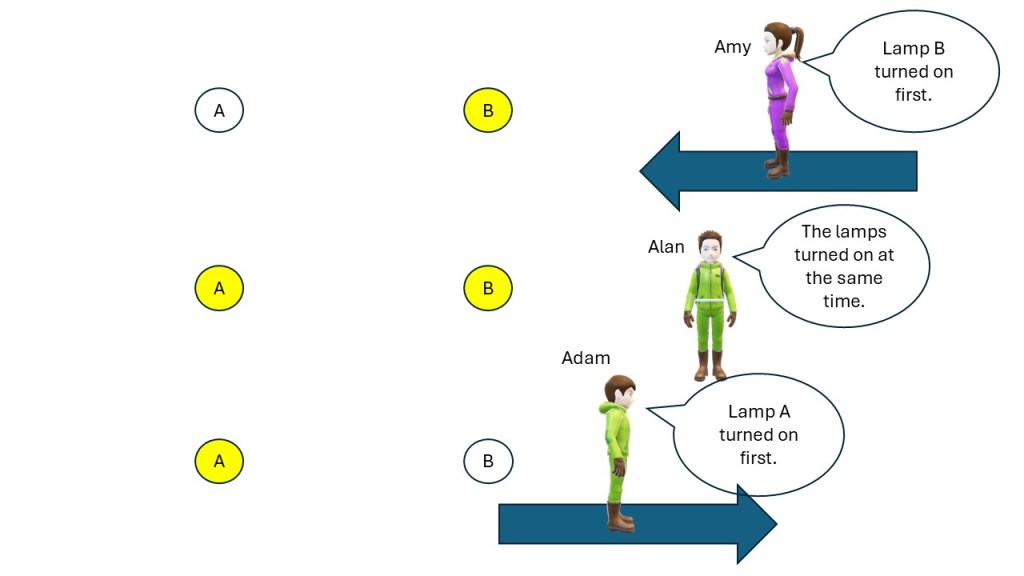
Superfact 5 : Two events may be simultaneous for some but not for others. Click to visit post.
Two events may be simultaneous for some but not for others. This means that two events that are simultaneous to an observer may happen at different times to other observers. If two lamps A and B turn on at the same time according to observer #1, lamp A may turn on first for observer #2, and lamp B may turn on first for observer #3. All three observers are correct because time is relative.
Amy is traveling at a high speed to the left compared to two lamps A and B. Alan is standing still compared to the lamps. Adam is traveling at a high speed to the right compared to two lamps A and B. Alan turns on the lamps at the same time. After considering the travel time of the light she sees, Amy concludes that lamp B turned on first. After considering the travel time of the light he sees, Adam concludes that lamp A turned on first. I should add this non-simultaneity can only happen if the lamps are separated by a distance.
Superfact 7 : Poverty and child mortality has been sharply reduced worldwide. Click to visit post.
Extreme poverty as well as child mortality has been sharply reduced the world over. The countries that are the worst-off today are still better off than the countries that were doing the best at the beginning of the 19th century. Over the last 20 years extreme poverty and child mortality have continued to decline sharply.
Child mortality in in the world since 1950. The spike you see around the end of 1950 to 1960 is the great leap forward famine in China. In 1950 the child mortality rate was 22.7% and in 2023 the child mortality rate was 3.6%.
Superfact 25: Global Warming is Happening and is Caused by us – click to visit post.
Global warming is happening. Or if you call it Climate Change or Climate Disruption is indeed happening. And it is happening very fast. We also know that it is caused by us primarily as a result of our burning of fossil fuels. There is a long-standing scientific consensus on these two facts because the evidence is conclusive. Check the evidence in the post.
Superfact 28: That Earth is round was well known long before Columbus – click to visit post.
That Earth is round, or spherical (or closely spherical) had been known for at least a couple of thousand years by the time Columbus set sail. Columbus did not set sail to prove that earth was round, and he knew it was round.
Illustration of the measurement of the Earth circumference by Eratosthenes (2,300 years ago). On June 21st there is no shadow in Syene/Aswan but there is one in Alexandria. Asset id: 2319651251 by Javier Jaime
It is a long post. Just read the parts that seem interesting to you.
I am a member of a non-partisan volunteer organization called the Citizens Climate Lobby (CCL) which seeks to create political will for a livable future. At one point I was quite skeptical and doubtful of global warming or climate change or climate disruption whatever you like to call it. The reason was that I almost exclusively read and watched rightwing news media such as world-net-daily (tended to push conspiracy theories), Newsmax and Fox News.
I believed in the concept of global warming / greenhouse effect, it is basic science after all, but I thought that it was exaggerated and politicized and that it was promoted and distorted by left-wing agendas. I incorrectly believed that there was no scientific consensus on the issue. I also bought into the false narrative that this was about environmentalist ideology, politics, or even a sort of environmentalist religion, and not a real and serious problem. My disdain for environmentalists, my ideology, and my gut feelings certainly aided the propaganda in misleading me. In addition, I read a lot by Björn Lomborg and Patrick J. Michaels and I believed them.
I joined CCL because I had been so wrong, at the same time as I felt that I had finally learned something substantial about the subject, that the topic is important, and I also liked that CCL is non-partisan.
As the name Citizens Climate Lobby suggests we do a lot of lobbying. It is not the kind of paid lobbying that is done by professionals and that is often associated with money. We are average constituents, average voters, with no money, who are visiting our legislators to give them information and opinions on legislation we support or don’t support. Since we are non-partisan, we visit both Democrats and Republican offices. We just had a CCL conference in Washington DC on Sunday, Monday and Tuesday. We were 800+ volunteers who visited 400+ Congressional offices in Washington DC on Tuesday July 22nd. That is why I have not been online much for about a week.
Roughly half of the CCL volunteers at 8:00AM on Tuesday July 22nd. The others were sleeping in but joined us later. In the background you see the Capitol.
On Tuesday I visited three Texas Congressmen, including Senator Ted Cruz (R, TXJR), Congresswoman Beth Van Duyne (R, TX24), and Congressman Marc Veasey (D, TX33). We also had a zoom call with Congressman John Carter’s (R, TX31) office (the fourth meeting). I am the CCL liaison for Senator Cruz’ office and I was the one who organized our visit, from our side. It was a brief visit with Senator Cruz and a substantial discussion with a couple of his staff. Ted Cruz does not always agree with us, but we had a friendly and interesting meeting, and he and his staff appreciated us being there. Below I have included three photos from my three Tuesday meetings.
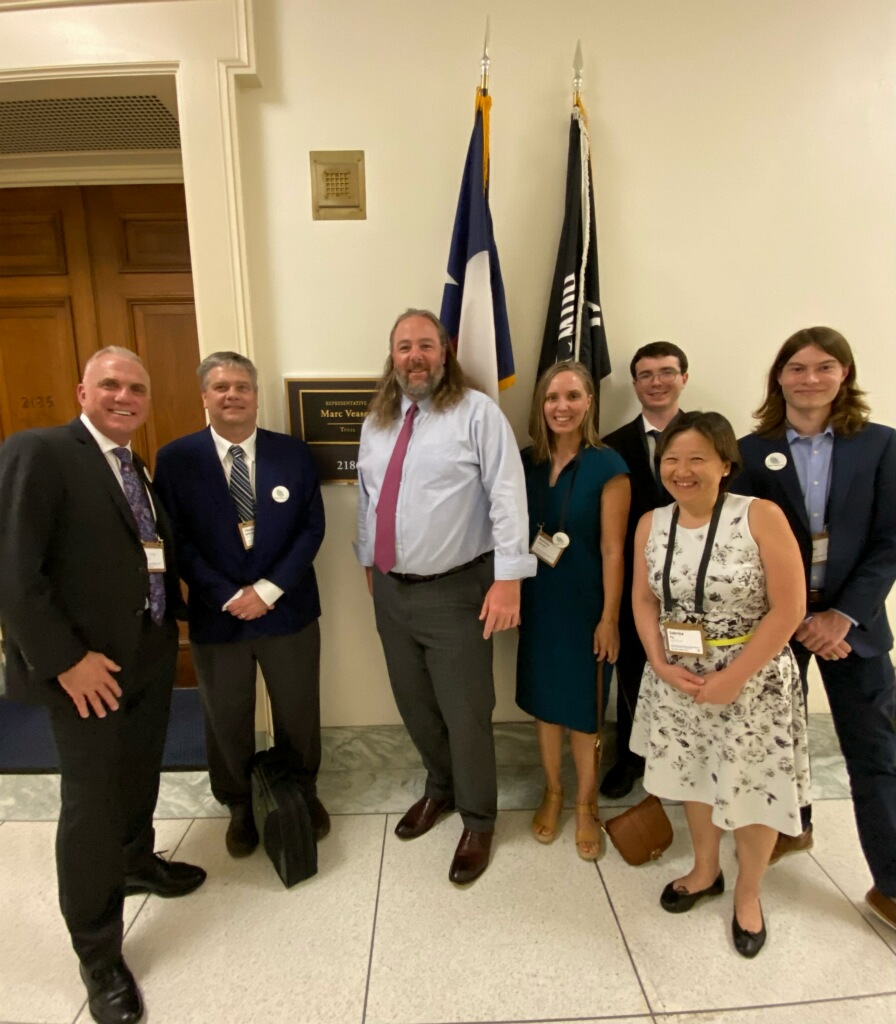
Senator Cruz hosts a Texas Tuesday Coffee for Constituents in Washington, DC on July 22, 2025. (Official U.S. Senate photo by Rebecca Hammel) Ted Cruz is standing in the back between the flags. I am in the front row, second from the right wearing a blue suit. We are twelve people.CCL volunteers meeting with a legislative aide, Isabel de Antonio, working for congresswoman Beth Van Duyne, Republican, Texas district 24 (that’s where I live). Isabel de Antonio is the one wearing a white shirt. I am standing on the far left. Eric, a CCL volunteer, is taking the photo and is not in the picture.CCL volunteers meeting with a legislative aide, Mike Burnside, working for congressman Mark Veasey, Democrat, Texas district 33. We also had a constituent and liaison representing 192 CCL volunteers in TX33 call into the meeting. Mike Burnside is the one wearing a white shirt. I am standing second from the left.
Overview of the Five Asks
With this post I wanted to show our Asks, so that readers know what we ask from our politicians. I do not expect anyone to read the CCL handouts below. I am including them to illustrate how we approach legislation. Don’t worry about the details. Trust me, the actual bills are even longer (the poor staffers of the politicians must read it). I can add that our Vice President of Government Affairs (CCL employee), Jennifer Tyler, was the Deputy Chief of Staff and Legislative Director for the Republican Congressman John Katko (NY-24). Having been a prominent leader in the Republican Party she is able to craft legislative Asks that not only appeal to Democrats but to Republicans as well.
I can add that CCL has a small staff consisting of highly educated people including climate scientists and policy experts. The CCL board features prominent climate scientists and prominent politicians and economists. George W. Schulz, Ronald Reagan’s Secretary of State, was (well is as an honorary member) on the CCL board but he passed away. I also think that CCL volunteers tend to be more nerdy than average. A lot of our volunteers are scientists, physicians, brain surgeons, engineers, PhDs, psychologists, authors, artists, businessmen, business owners, oil executives, etc., but naturally everyone is welcome. We are a well-informed volunteer organization and as a result both Democratic and Republican offices see us as a great resource for information and ideas.
These were our six Asks. As you can see, not all of them apply to both parties. One Ask is only for Republicans because Democrats are already fully onboard. One Ask is only for Democrats because the Republicans are already fully onboard. Another Ask is only for Republicans because there’s no chance Democrats will support it (but Republicans have more votes). In other words, an emissions and pollution reducing mix of Asks that overall is bipartisan.
Support the Clean Energy Transition – Fund Key Clean Energy Programs in FY26 Appropriations – Democrats + Republicans.
Support the Clean Energy Transition – Fix Clean Energy Tax Credit Implementation – Republicans only, because Democrats are already full onboard.
Support the Clean Energy Transition – Advance Smart Permitting Reform for Energy Projects – Democrats + Republicans but different handouts.
Support H.R. 471, the Bipartisan Fix Our Forests Act – Democrats only because Republicans already fully onboard.
Support S. 1462, the Bipartisan Fix Our Forests Act – Democrats + Republicans.
Support Foreign Pollution Tariff Legislation – Republicans only, because we know Democrats are against it.
Funding Clean Energy Research
Fund Key Clean Energy Programs in FY26 Appropriations was the first part of three parts for our primary Ask : Support the Clean Energy Transition. The 2025 Budget Reconciliation Bill (One Big Beautiful Bill) cuts funding from two research organizations, the Office of Energy Efficiency and Renewable Energy (EERE) and the Advanced Research Projects Agency (ARPA-E). ARPA by the way is a prominent research organization, it is, for example, responsible for the creation of the internet. The reason we are asking to restore some of the funding for these organizations is because the world is moving towards clean energy and recently China has aggressively invested in clean energy. Cutting research in this area is a recipe for getting behind.
Clean Energy Tax Credits
The Clean Energy Tax Credits were significantly cut in the Budget Reconciliation Bill. It was specifically provision 48E, investment credits for wind and solar, 45Y, tax credits for wind and solar, 25C, tax credits for home efficiency improvements, such as insulation, energy efficient doors and windows, etc., that were cut. I should say that the 48E and 45Y for other types of clean energy, such as Nuclear, Geothermal, Hydro, and Biofuels, stayed, which we are grateful for.
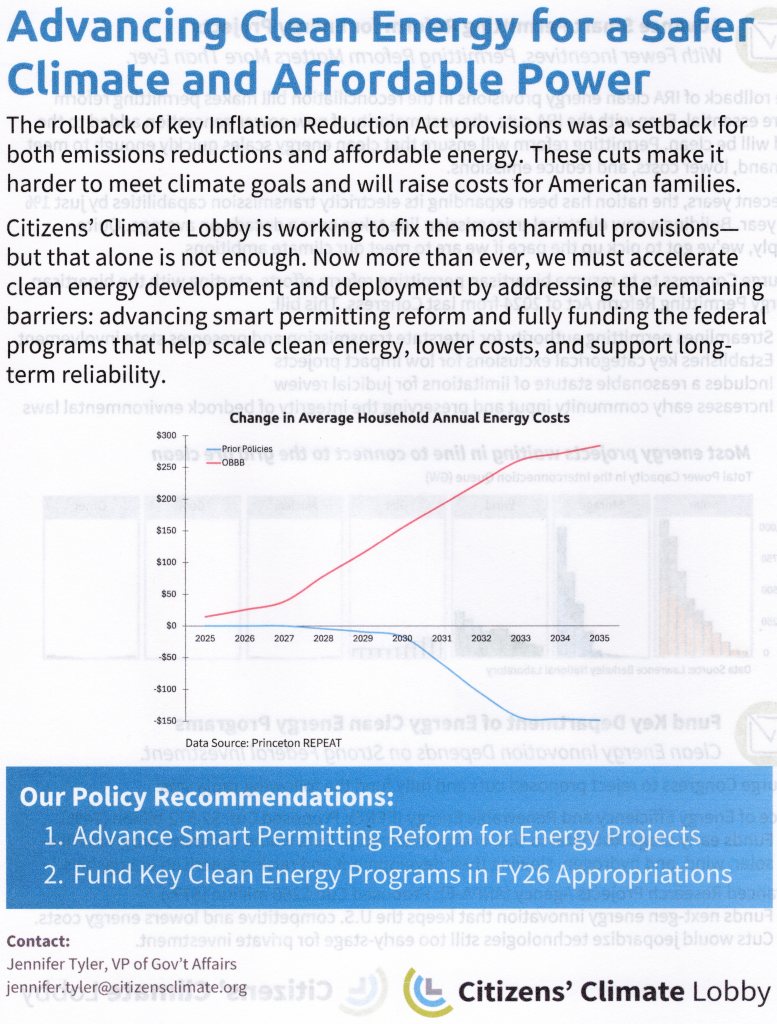
The reason we are asking to restore some of the tax credits for wind and solar, is not that they need the tax credits to survive. Wind and solar energy are very cheap, and they are doing very well. However, they are prominent sources of clean energy and removal of the tax credits will significantly increase the energy cost for consumers, as you can see in the graph below. The loss of the credits will also result in the loss of jobs and investments in projects already underway. A list of the effected investments and projects in the US listed per congressional district can be seen in this link. Since virtually all Democrats already support the restoration of the clean energy tax/investment credits, we are only asking this from Republicans. Admittedly this is a tough one for them.
Smart Permitting Reform for Energy Projects
The third part of the Primary Ask is Smart Permitting Reform for Energy Projects. What many people don’t realize is that what is holding clean energy back the most is not the cost or time for building wind and solar. That is relatively easy. The big obstacle is getting permits to build the energy plants and permits to build transmission lines needed to bring the electricity to our homes. In both cases the process is typically at least ten years. However, by cutting red tape and streamlining the process it could be reduced to around a year.
This applies not only to wind and solar but to all types of energy, which is why Republicans tend to support permitting reform. Since most of the new energy coming online is wind and solar, and they often replace dirty coal, thus reducing emissions, we strongly support permitting reform. We have done the research, so we know that this is a very good way to reduce emissions. In this case we formulated the Ask differently for Republicans and Democrats.
Primary Asks Sheets
Our primary Asks for Republicans. We are asking the same thing from Democrats and Republicans, but the presentation is different. Notice that in both cases we are pointing out that the removal of the Clean Energy Tax Credits for Wind and Solar in the 2025 Budget Reconciliation Bill (One Big Beautiful Bill) will increase costs for consumers. In the Republican version we are pointing out that not funding research into clean energy will put us behind the rest of the world, especially China, which is aggressively pursuing development in clean energy.Second page of primary Asks for Republicans.Our primary Asks for Democrats. Notice that in this case we are not asking them to fix the Clean Energy Tax Credit Implementation. The reason being that they are already 100% behind it.Second page of primary Asks for Democrats
Fix Our Forest Act
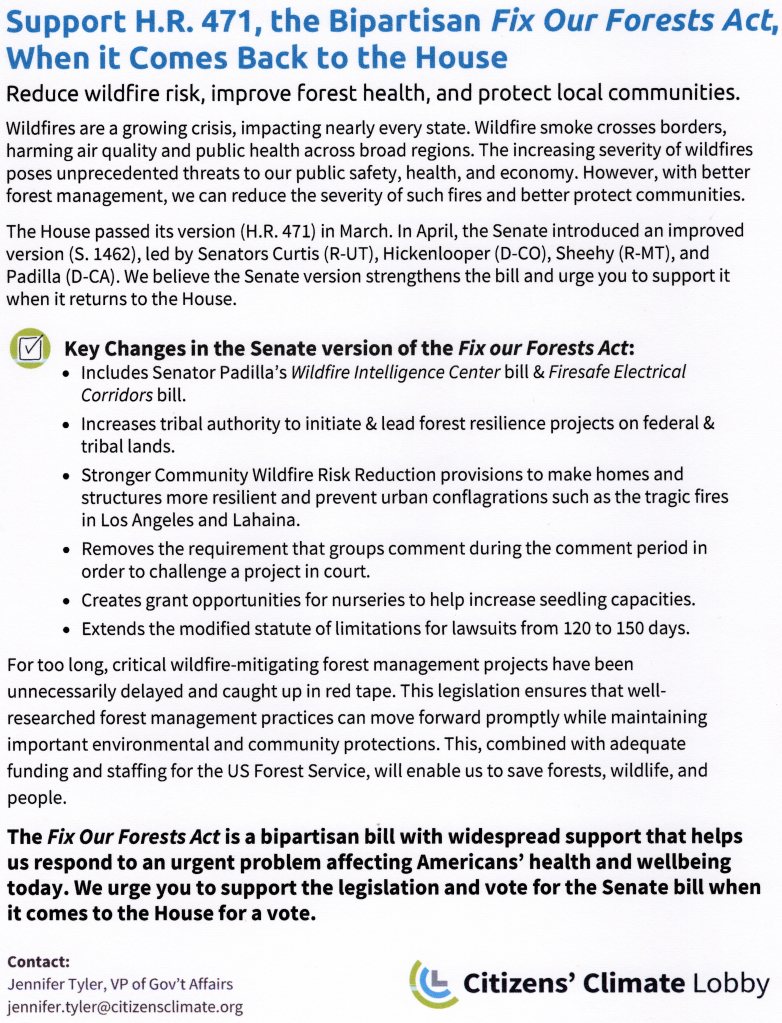
Our first Secondary Ask is Support H.R. 471, the Bipartisan Fix Our Forests Act, when it Comes Back to the House. To explain, it was voted on in the house, sent to the Senate where they made some changes, so it needs to be voted on again in the house. This is an Ask that we reserved for Democrats. It was not because we thought Republicans wouldn’t like it but because they had already voted Yes for it unanimously. We know the Republicans like it. However, we needed to make sure the Democrats who were less favorable of it would not turn against it, which is why we are asking them to vote yes on it.
To explain what the bill is about, scientists have concluded that climate change and poor forest management are both making wildfires worse, at least in the United States. Out of control wildfires in turn make climate change worse. Climate change will take several decades to fix and requires the whole world to act. However, improving forest management we can do today for ourselves. To read the full text of the original house bill click here. To read the full text of the Senate version of the bill (S.1462) click here.
This is the house version H.R.471 of the Fix Our Forest Act. It already has full Republican support in the house, so we are only asking Democrats to support it.This is the Senate version S.1462 of the Fix Our Forest Act. We are asking both Republican and Democratic Senators to support it.
Foreign Pollution Fee
The Foreign Pollution Fee Act S.1325 (full text in link) was introduced in the Senate by Senator Lindsey Graham (R). This is a resolution that if it becomes law would greatly reduce carbon emissions around the world, and yet it is pretty much only supported by Republicans. It might come as a surprise that there is a pro-climate resolution that’s almost entirely Republican, but it happens sometimes. Our goal is to get close to unanimous Republican support and with the help of a few moderate Democrats get it passed.
Some background, China emits more carbon pollution than any country on earth. On the other hand, there are 1.4 billion people in China and per capita they emit only half that of the United States, which comes in at number two with respect to total emissions. In addition, the United States is the country that has emitted the most carbon emissions over time. On the other hand, the US emissions are going down, unlike China’s, and more importantly in this context, certain products such as steel, aluminum, fossil fuels, etc., are produced creating a lot more emissions in China than in the US, which has cleaner manufacturing. For example, one ton of steel produced in China or Russia result in four times as much carbon emissions as the same ton of steel produced in the US. It is not fair to cleaner US manufacturers to import products from dirty manufacturers without taking into account the cost of pollution to all of us.
Make “Filthy Pollution Havens” Pay at the Border. Support Foreign Pollution Tariff Legislation.
Washington DC Congressional Buildings
The congressional buildings are the three buildings that are part of the house of representatives, Rayburn, Longworth, and Cannon, and the three Senate buildings, Russel, Dirksen and Hart. I encircled them in red in the map below. If you are visiting several offices, there is going to be a lot of walking. Therefore, women should bring a comfortable pair of shoes in a backpack in addition to nice shoes for inside the buildings.
I can add that the offices in Rayburn are bigger and nicer than the offices in Longworth and Cannon, and Rayburn has the main nice cafeteria. Longtime congressman tends to have their offices in Rayburn. The same is true for the Senate. Russel has the nicest offices and the best cafeteria, and the long-time Senators tend to be in Russel. Ted Cruz is in Russel 167. He has a great office.
This is a map of the Congressional buildings. The three houses of representatives’ buildings, Rayburn, Longworth and Cannon, are towards the bottom encircled by a red line. The three Senate buildings, Russel, Dirksen and Hart are towards the top left encircled by a red line.
In case you are interested, this is the full text of the 2025 Reconciliation Budget Bill H.R.1. The nickname for the bill is One Big Beautiful Bill. Warning, it is very big. Beautiful is a matter of opinion.
My Super Fact List
This is not a super fact post. Just an informational post. If you want to see my list of super facts, click the link below.
I haven’t posted or read blog posts for almost a week because I was busy with something else. I am a member of a non-partisan volunteer organization called the Citizens Climate Lobby which seeks to create political will for a livable future. As the name suggests we do a lot of lobbying. It is not the kind of paid lobbying that is done by professionals and that is often associated with money. We are average constituents, average voters, with no money, who are visiting our legislators to give them information and opinions on legislation we support or don’t support.
Since we are non-partisan, we visit both Democrats and Republican offices. We just had a CCL conference in Washington DC on Sunday, Monday and Tuesday. We were 800+ volunteers who visited 400+ Congressional offices in Washington DC on Tuesday July 22nd.
I visited four Texas Congressmen, including Senator Ted Cruz (R), Congresswoman Beth Van Duyne (R), and Congressman Marc Veasey (D). We also had a zoom call with Congressman John Carter’s (R) office. I am the CCL liaison for Senator Cruz’ office and I was the one who organized our visit, from our side, with Senator Cruz and a couple of his staff. Ted Cruz does not always agree with us, or perhaps more correctly, he seldom agrees with us, but we had a friendly and interesting meeting, and he and his staff were very appreciative of us being there.
Senator Cruz hosts a Texas Tuesday Coffee for Constituents in Washington, DC on July 22, 2025. (Official U.S. Senate photo by Rebecca Hammel) Ted Cruz is standing in the back between the flags. I am in the front row, second from the right wearing a blue suit. We are twelve people.
Right after our meeting with Senator Cruz I posted the following on Facebook “I am in Washington DC meeting with congressmen. We had an in person meeting with Ted Cruz and we took pictures with him.” along with a photo of the capitol building (not the group photo). Most people left interesting or nice comments but then a far-left Facebook friend of mine left a very hostile comment. He started out saying “so you are finally revealing your true colors Thomas…” and that was followed by an angry outburst in two separate comments filled with F-bombs and how he was ending his friendship with me. I deleted his comments and blocked him. Basically, a centrist on-line friend visiting with a Republican politician for a friendly exchange of opinions enraged him. Naturally I have seen a lot of this on both sides.
Division has become so severe in this country that we are losing our ability to talk to each other. Families are divided against each other, and the rhetoric is overheated. This is dangerous and it is what Amanda Ripley, the keynote speaker at our CCL conference in Washington DC calls High Conflict. High Conflict is a natural psychological phenomenon that sucks us deep into conflict that eventually gets out of hand. She compares it to the La Brea Tar Pits in Los Angeles. We form kinships and tribes, echo chambers, and dislikes for those with different opinions, we belittle and insult each other, which grows resentment, and we create an us-versus them scenario, which evolves into a good (us) versus evil (them).
Amanda Ripley is the author of the book High Conflict: Why We Get Trapped and How We Get Out. I think her message and her book are very important, and I have a lot of good things to say about the book. However, the book featured one false and defamatory statement and generalization about environmentalists, which prevents me from giving the book five stars. That claim pretty much ruined it for me , so I am giving the book three stars. I still recommend the book, and perhaps whether I like this book or not is not as important as the topic.
High Conflict the Book Formats
High Conflict: Why We Get Trapped and How We Get Out by Amanda Ripley. I bought the hardback format.
Hardcover – Publisher : Simon & Schuster (April 6, 2021), ISBN-10 : 1982128569, ISBN-13 : 978-1982128562, 368 pages, item weight : 1.26 pounds, dimensions : 6 x 1.2 x 9 inches, it costs $24.98 on US Amazon. Click here to order it from Amazon.com.
Paperback – Publisher : Simon & Schuster (April 5, 2022), ISBN-10 : 1982128577, ISBN-13 : 978-1982128579, 368 pages, item weight : 2.31 pounds, dimensions : 5.5 x 0.92 x 8.38 inches, it costs $13.95 on US Amazon. Click here to order it from Amazon.com.
Kindle – Publisher : Simon & Schuster (April 6, 2021), ASIN : B08LDW7M7J, ISBN-13 : 978-1982128586, 363 pages, it costs $ 15.99 on US Amazon. Click here to order it from Amazon.com.
Audio– Publisher : Simon & Schuster Audio (April 6, 2021), Listening Length : 9 hours and 50 minutes, ASIN : B0DCCWRMJS, it costs $0.00 with membership on US Amazon. Click here to order it from Amazon.com.
Front cover of the hardback format of the book High Conflict: Why We Get Trapped and How We Get Out by Amanda Ripley. Click on the image to go to the Amazon page for the hardcover version of the book.
Amazon’s Description of High Conflict
When we are baffled by the insanity of the “other side”—in our politics, at work, or at home—it’s because we aren’t seeing how the conflict itself has taken over.
That’s what “high conflict” does. It’s the invisible hand of our time. And it’s different from the useful friction of healthy conflict. That’s good conflict, and it’s a necessary force that pushes us to be better people.
High conflict is what happens when discord distills into a good-versus-evil kind of feud, the kind with an us and a them. In this state, the brain behaves differently. We feel increasingly certain of our own superiority, and everything we do to try to end the conflict, usually makes it worse. Eventually, we can start to mimic the behavior of our adversaries, harming what we hold most dear.
In this “compulsively readable” (Evan Osnos, National Book Award-winning author) book, New York Times bestselling author and award-winning journalist Amanda Ripley investigates how good people get captured by high conflict—and how they break free.
Our journey begins in California, where a world-renowned conflict expert struggles to extract himself from a political feud. Then we meet a Chicago gang leader who dedicates his life to a vendetta—only to realize, years later, that the story he’d told himself about the conflict was not quite true. Next, we travel to Colombia, to find out whether thousands of people can be nudged out of high conflict at scale. Finally, we return to America to see what happens when a group of liberal Manhattan Jews and conservative Michigan corrections officers choose to stay in each other’s homes in order to understand one another better, even as they continue to disagree.
All these people, in dramatically different situations, were drawn into high conflict by similar forces, including conflict entrepreneurs, humiliation, and false binaries. But ultimately, all of them found ways to transform high conflict into good conflict, the kind that made them better people. They rehumanized and recategorized their opponents, and they revived curiosity and wonder, even as they continued to fight for what they knew was right.
People do escape high conflict. Individuals—even entire communities—can short-circuit the feedback loops of outrage and blame, if they want to. This is an “insightful and enthralling” (The New York Times Book Review) book—and a mind-opening new way to think about conflict that will transform how we move through the world.
Interesting discussion on conflict but with a lot of interpretation and opinion
“Good conflict” is healthy conflict in which questions get asked, in which there is curiosity and movement in opinions. “High conflict” on the other hand is what happens when conflict devolves into a good versus evil kind of feud. The conflict takes on its own life and draws us in like a tar pit.
The book gives many examples of high conflict and explains how they came to be; the Hatfield’s and the McCoy, John Adams and Thomas Jefferson, our current political division, couples getting divorced, gang warfare, guerilla warfare, civil war, etc. The book focuses much attention on Gary, a friendly lawyer who rather solves conflict than benefit from it, as is typically a lawyer’s job. Gary runs for a local office and wins but because he is thinking a little bit too highly about himself and his abilities, he by mistake excludes some really knowledgeable, willing and helpful people from what he refers to as “the old guard”, which leads to a high conflict that he himself created. However, in the end he becomes part of the solution. It is a good story.
The author makes a lot of interesting observations such as; we have group belongings, we form factions, we need belonging, giving people two choices is dangerous, a proportional representation system might be better than the current American system, people have biases that inflame conflict such as confirmation bias, and there’s a conflict industrial complex. There are fire starters, group identities, conflict entrepreneurs, and humiliation. Media and social networking can function as conflict entrepreneurs. The areas in Rwanda where the radio reception was better there were more killings.
To escape high conflict, we need to recognize the conflict entrepreneurs around us, avoid excluding and humiliating people, and recognize that people want to be heard. Getting out of high conflict includes recognizing a saturation point where people had enough, building new broader identities, reframing the situation, and clearing the path for combatants. Welcome former combatants home rather than shaming them. Avoiding conflict involves complicating the narrative from the beginning. Simplifications do damage. I felt all that was pretty good advice.
Then on page 183 a strange claim is made, implying that very few people concerned about climate change would want a “carbon fairy” to solve climate change (that carbon fairy could be nuclear power) because they want to use “climate change” as vehicle for something else. I am volunteering in a climate change organization, and I have never met anyone who isn’t part of it primarily to solve carbon emissions. Half are pro nuclear power the other half skeptical about it being a “climate fairy” (I am pro nuclear). Some are pro-capitalists, others more left leaning, a substantial minority are Republicans, and world views are all over the spectrum. So obviously page 183 makes a false claim probably for sensationalistic reasons.
That’s just one dubious claim, but it alerted me to read the book more critically and I realized that the author is far from objective. She definitely wants to promote her ideas and make her book look more interesting. She is doing that by carefully selecting examples and stories, interpreting those cherry-picked situations, and there’s a lot of opinions, and who knows what she may get wrong or misreporting? It seems at first to be an authoritative work, but it is not a scientific book. That doesn’t mean that it’s wrong. I believe a lot of what the book claims to be true, but I do not know. It is a journalist’s opinion and interpretation of conflict, and it is therefore less than I expected.
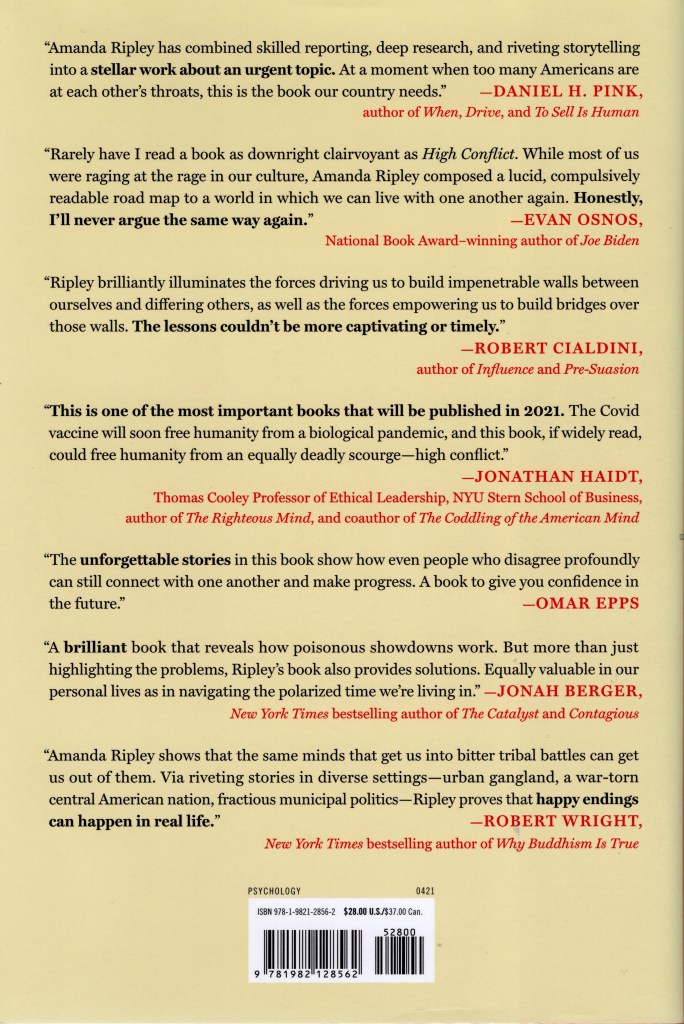
Back cover of hardback format of the book High Conflict: Why We Get Trapped and How We Get Out by Amanda Ripley. Click on the image to go to the Amazon page for the paperback version of the book.











 Super Facts