
Super fact 39 : Relativistic length contraction goes both ways. If two observers are moving compared to each other both will observe the length of the objects in the other’s system to be shorter in the direction of motion. The first observer will think that a yard stick in the second observer’s frame will be shorter whilst the second observer will think that the yard stick in the first observer’s frame is the shorter one.
Assume a pole and a barn are of equal length when both objects are stationary. If the pole is moving (at a high speed) compared to the barn, then the pole will be shorter than the barn from the barn’s perspective but longer than the barn from the pole’s perspective. Does the pole fit inside the barn or not? This is referred to as the pole-barn paradox, or the barn-door paradox, or the ladder paradox (if a ladder is used instead of a pole).
I call this conundrum a super fact because whilst most people have heard of relativistic time dilation and perhaps length contraction, the fact that it goes both ways comes as a surprising head scratcher. The situation is analogous to my super fact post “Time Dilation Goes Both Ways” where I state:
Super fact 38 : If two observers are moving compared to each other both will observe the other’s time as being slower. In other words, both observers will observe the other’s clocks as ticking slower. Time slowing down is referred to as Time Dilation. And this post is about how time dilation goes both ways.
Both the time dilation paradox and the pole-barn paradox are solved by the non-simultaneity in relativity. However, the pole-barn paradox is more concrete and perhaps more in your face. You can easily imagine the problematic paradox.
Postulates of Special Relativity
The two postulates of special relativity are:
- The laws of physics are the same in all inertial frames of reference. An inertial frame is a system that moves at a constant velocity.
- The speed of light in a vacuum is constant for all observers, regardless of the motion of the light source.
The first postulate is called the principle of relativity and goes all the way back to Galileo Galilei. It means that no experiment can determine whether you are at rest or moving at a constant velocity. The reciprocity of length contraction follows from this postulate. If the length of the pole in the example above is half as long as the barn in both the barn frame and the pole frame then you could tell who was standing still and who was moving from that fact, and that violates the first postulate. The first postulate demands that if the pole is half as long in the barn frame and that the barn is half as long in the pole frame.
The second postulate is the more shocking one and is special to relativity. It was discovered experimentally at the end of the 19th century but was too difficult for scientists to accept at first so various ad hoc explanations were put forth to explain it away, until the theories of relativity were created. I designated this postulate as my super fact #4 and you can read about it here.
Length Contraction
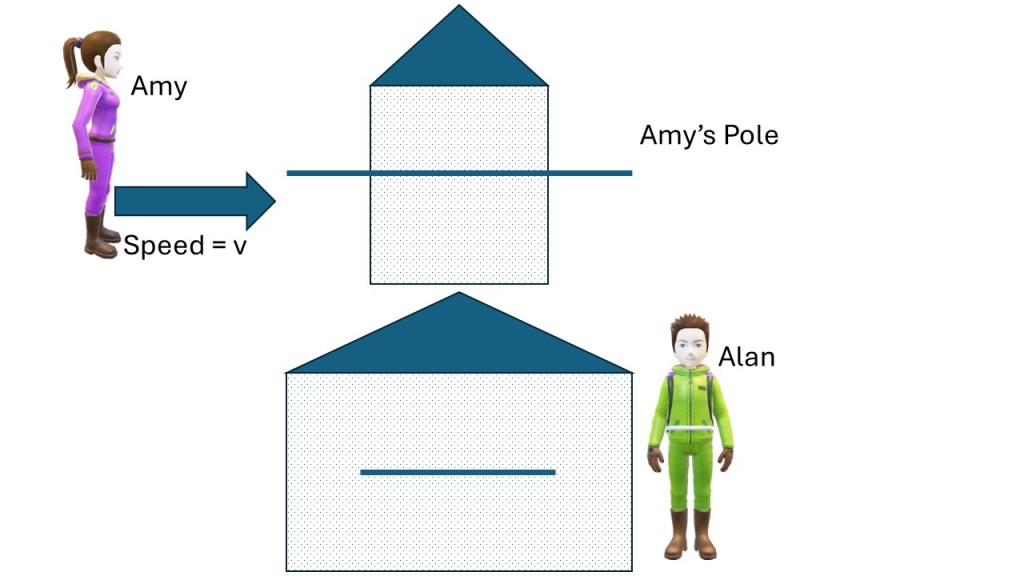
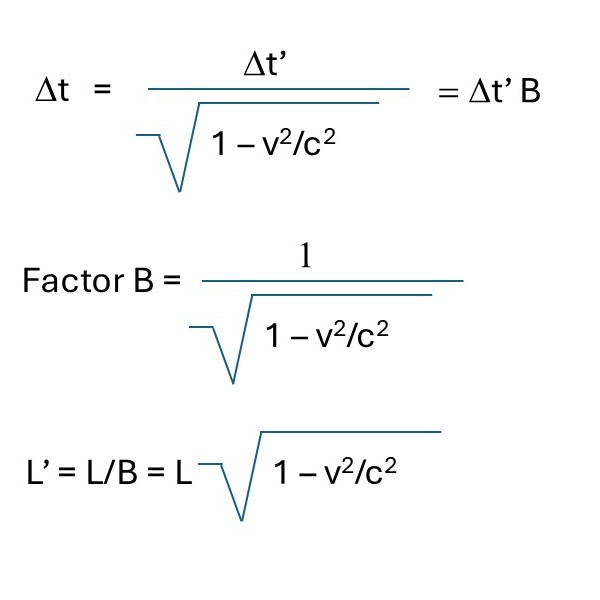
Time dilation means that a time interval between two events in a certain frame is longer by a factor B in a frame moving relative to the first frame (see picture below). Let’s imagine Amy moving at the speed v compared to Alan and his barn. Amy passes the left side of the barn at a certain time and soon after the right side. The time difference from Alan’s perspective is T and the width of the barn is L, so L = vT. From Amy’s perspective the time difference is T’ and width of the barn L’ and L’ = vT’. We denote Amy’s measurements with a prime. Note the velocity must be the same in both systems. However, Amy’s clock ticks slower (from Alan’s perspective) so T’ = BT or T = T’/B (time dilation). So, L’ = vT’ = vT/B = L/B.
If the derivation of the formulas above is confusing to you, ignore the math, and just remember that Alan measures a shorter time for the passing of the pole (because Amy’s clock is slower) from his perspective and therefore the pole must be shorter as measured from his system. If Alan measures two seconds for the passing of the pole than Amy measures maybe four seconds. It is Amy’s pole, so her longer measurement corresponds to the proper length of the pole whilst Alan’s measurement is the contracted length. Note the length contraction can only happen along the direction of motion, not perpendicular to it. To read more about length contraction click here.
Solution to the Pole-Barn Paradox
So, Amy’s pole cannot fit in Alan’s barn. The pole is moving fast so it must move in and out of the barn. Now let’s create the paradox. Imagine the barn having doors on each side that open for the moving pole and then close for a moment to entrap the pole and then they open as the pole leaves the barn. Here is the paradox, if they open and close at the same time, than the pole can be inside the barn (entrapped) from Alan’s perspective but not from Amy’s perspective. From Amy’s perspective the pole does not fit.
However, the solution to the paradox lies in “open and close at the same time”. If the doors open and close at the same time from Alan’s perspective, then they don’t open and close at the same time from Amy’s perspective.
From Amy’s perspective the door on the left side will open first and let the pole in and then after that the right door will open. After the pole has fully entered the barn and some of it is sticking out on the right-hand side then the left door will close but the door on the right will remain open until the pole is entirely outside. Relativistic non-simultaneity solves the paradox.

Finally, below is a YouTube video that explains and solves the pole-barn / barn-door / ladder paradox simply and efficiently in a little over two minutes.
Book Recommendations on Relativity
- Relativity Visualized by Lewis Carrol Epstein. This book does not require much education in physics and very little math, and yet it explains relativity very well.
- Relativity, The Special and the General Theory, by Albert Einstein. In my opinion, not the best overall, but it is easy reading for the public and the chapter on the relativity of simultaneity is pretty good.
- Quantum Physics of Atoms, Molecules, Solids, Nuclei and Particles by Robert Eisberg and Robert Resnick. An advanced but excellent explanation of special relativity in the appendix.
- The Special Theory of Relativity by David Bohm. It is written for people with some physics education. However, it is one of the best books on Special Relativity that I’ve read.
- Einstein’s Miraculous Year. This book features the translations of the five famous papers that Albert Einstein wrote in 1905 including “On the Electrodynamics of Moving Bodies”, which was his paper on Special Relativity. Not for the faint of heart but very interesting.
To see the other Super Facts click here

 Super Facts
Java Bean: “Ayyy, but what if Amy throws the pole? Can I catch it and run around with it???”
LikeLiked by 1 person
Our dog Rollo has been running around with a chew stick all day but not so fast that I noticed any relativistic effects. Java Bean, maybe you and Amy are faster.
LikeLike
Very interesting. I always learn something new from your Super Facts posts.
LikeLiked by 1 person
Thank you so much for your supportive comment Pooja
LikeLiked by 1 person
You’re very welcome.
LikeLiked by 1 person
Some of this is a bit above me, Thomas, but I got the basics.
LikeLiked by 1 person
Thank you Robbie. Greg probably knows this.
LikeLike
Probably 😉
LikeLiked by 1 person
Well Thomas….. this makes me want to sssssllllooooow dooooowwwwnnn to digest all of that.. 🙂 Way above my brain cells 🙂
But I do thank you for this Paradox…. One I had not been aware of. ❤
LikeLiked by 1 person
I think we all need to slow down a bit. This paradox has been a stumbling block for many who tried to understand relativity. As people start to learn and understand relativity, and they think they understand it, and then they run into this paradox, and crap, they are back to scratch. But luckily it has a solution. To claim you understand special relativity you have to get passed this paradox. Thank you for your comment Sue.
LikeLike
This one was totally over my head, Thomas. That or I need more caffeine. 🙂
LikeLiked by 1 person
Sorry, it is a very surprising and mindblowing paradox but unfortunately complicated and difficult to explain. But very shortly, length contraction in relativity is reciprocal, both obervers see the other ones yard sticks contracted, and therefore it is an apparent paradox. However, the fact that events happen at different times and even in different order to the two observers solves the paradox.
LikeLiked by 1 person
No apologies needed, Thomas. I love learning this stuff (or trying to learn it). Lol
LikeLiked by 1 person
Thank you so much Diane
LikeLiked by 1 person
Things get very weird when you approach the speed of light!
LikeLiked by 1 person
Yes you are right. You can make a long list weirdness.
LikeLike
If Amy is moving rightwards, as shown in the picture, wouldn’t the door on the right open first?
LikeLiked by 1 person
That is a good question. It is not obvious. However, if Amy is moving rightward from left to right, as in the picture then the left door opens first in her system. If the doors open at the same time in the barn system, and Amy is approaching the barn, then it is the door closest to Amy that opens first. It is similar to what would happen if the barn doors send off light rays. Amy would see the left door’s light beam first. I should add it is more than light beam travel times and optics though. If you calculate the distances and speeds, the left door really opens first in her system. It is not just that it looks that way to her.
LikeLike
Like OOPS! I meant wouldn’t the right door close and open first since Amy is going right?
I goofed all this time? Using the wrong term!
I feel ashamed!
LikeLiked by 1 person
Please World Questioner, you are asking very good questions, and you are deep thinker, please don’t be ashamed of anything. Amy is moving from the left to the right so the left door should open for her first. Why do you say it must be the door on the right that should open first for Amy?
LikeLike
Doesn’t the video you embedded seem to contradict what you described?
LikeLiked by 1 person
Sorry I don’t see that World Questioner. It is complicated so I certainly could have made a mistake. But perhaps you could explain why you think it is a contradiction.
LikeLike
This video https://youtu.be/wdCFFSA23PQ shows the door on the closing and right opening first and then the left door opening and closing, right? Doesn’t that seem to contradict what you are presenting of the left door opening, then the right door opening, then the left door closing, then the right door closing?
LikeLiked by 1 person
Sorry for the late reply World Questioner. For this question I had to check the video and think about it. The narrator does not say which door opens and closes first with respect to Jack’s frame, just that they open and close at different times. So, that leaves us to interpret what we see. I have to admit I cannot make out what they clearly intend. However, the left door has to open first in Jack’s frame or he would not get in. Also, in the basic scenario of non-simultenuity, for example, with two lamps turning on at the same time (see : the one with the two lamps) it is the lamp an observer is moving towards that turns on first (even if he has already passed it and is further away from it then the other lamp). As a verification I asked google AI and it agreed with me.
I asked : In special relativity, is it true, that if two lamps separated along a horizontal axis turn on at the same time, and someone, let’s call him Adam, is approaching the lamps fast coming from the left towards the lamps, then it is the left lamp that will turn on first in Adam’s system?
Yes, this is completely true. Because of the relativity of simultaneity, events that happen at the same time in one reference frame are not simultaneous in a reference frame that is moving relative to it.
Here is exactly how this plays out in Adam’s system, or frame of reference: The Ground Frame: In the frame where the lamps are stationary, both lamps turn on at exactly the same time.
The Motion: Adam is moving from the left towards the lamps. In Adam’s own reference frame, he considers himself stationary while the entire setup of lamps (and the ground) is rushing towards him from the right.
The Result: In Adam’s frame, the right lamp is moving away from the expanding light wave it creates, while the left lamp is moving towards the expanding light wave it creates. Because the speed of light must remain exactly the same in all directions for Adam, his clocks dictate that the event on the left (the left lamp turning on) must have happened first.
However, what you made me realize is that the video isn’t as clear as I hoped and neither are my explanations. I need to sit down and think through this carefully to make sure I got it right and I need to rewrite the two posts. If the video is not as clear as I first thought, I also need to address that. This is going to take some time but I will get it done.
LikeLike
I always thought that when I move close to the speed of light, the event farthest ahead of me happens first. That objects farther ahead are farther ahead in time.
LikeLiked by 1 person
No not if you are moving towards the object, then the closest event happens first.
LikeLike