The goal of this blog is to create a list of super facts. Important facts that are true with very high certainty and yet surprising, misunderstood, or disputed by many. This blog aims to be challenging, educational, and fun, without it being clickbait. I determine veracity using evidence, data from reputable sources and longstanding scientific consensus. Prepare to be challenged (I am). Intentionally seek the truth not confirmation of your belief.
Category: Mind blowing fact
A super fact that will blow your mind, in addition to be known to be true and important to our understansing of the world.
Super fact 132 : An estimated 100 trillion ghostly elementary particles, called neutrinos, pass through your body every second, which is 237 sextillion particles in 75 years. Despite that fact the chance that even a single neutrino will interact with an atom in your body during your entire life is about 1 in 4. These extremely abundant particles pass right through you as well as planets without interactions, like ghosts.
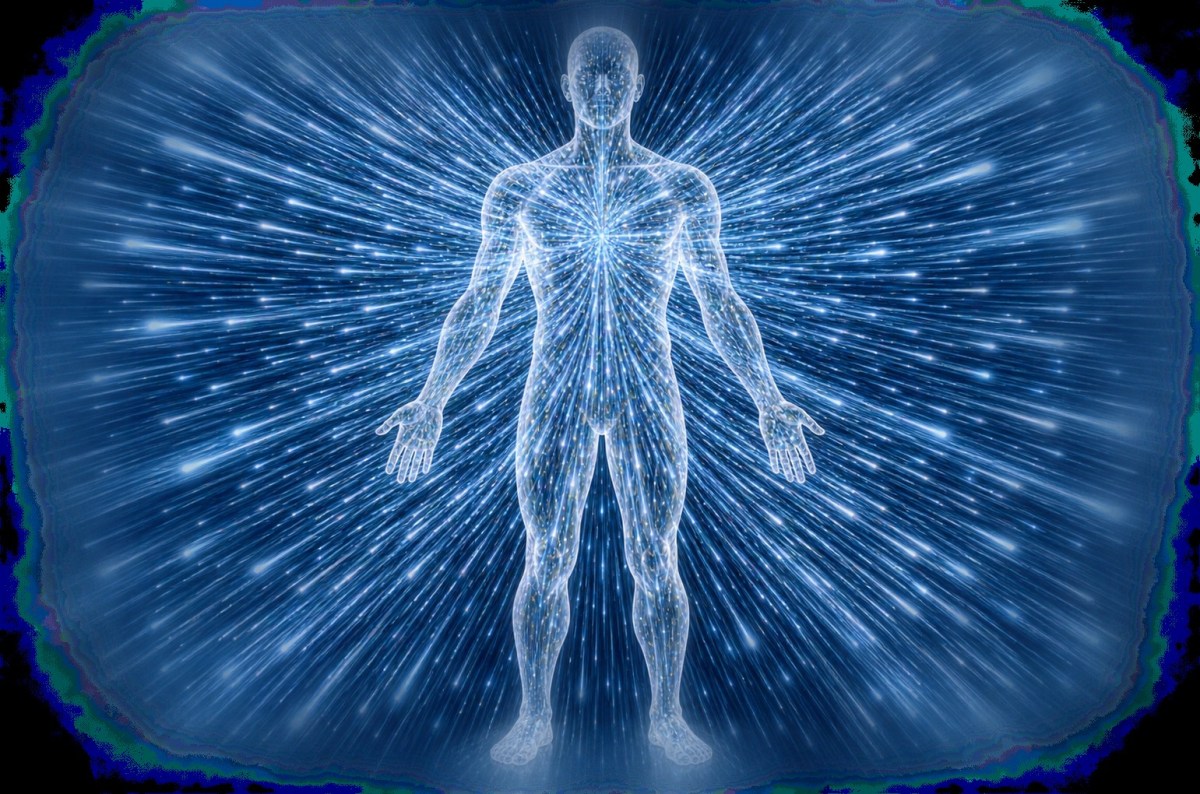
100 trillion neutrinos, almost entirely undetectable elementary particles, pass right through your body every second, without touching a single atom in your body, as if you don’t exist. I generated the picture with the help of ChatGPT.
Neutrinos are tiny subatomic particles, often called ‘ghost particles‘ because they barely interact with anything else. They are capable of passing right through our planet Earth as if it wasn’t there. As mentioned, an estimated 100 trillion neutrinos pass through your body every second.
Neutrinos do not interact with electromagnetic forces and not with the strong nuclear force. The electromagnetic forces are what is governing molecules, atoms, and matter and the strong nuclear force governs the nucleus of atoms. The only forces that neutrinos interact with are the weak nuclear force and gravity, which both are weak forces, and the weak nuclear force has a very short range. In addition, the mass of neutrinos is extremely tiny. That is why neutrinos pass through atoms as if they aren’t there, and it is why trillions of neutrinos can pass through your body without touching you even the slightest and it is also why they are completely harmless. This also makes them extremely hard to detect.
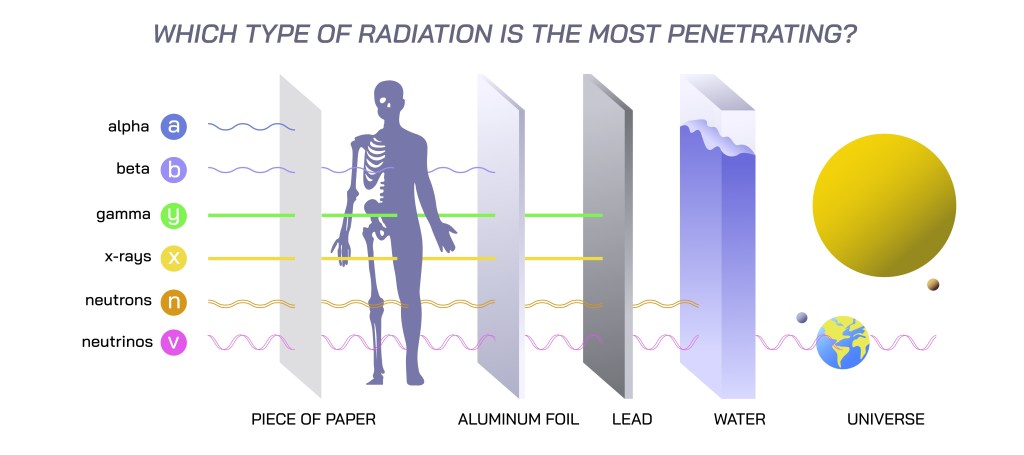
Alpha radiation is stopped by paper. Beta radiation (electrons) is stopped by aluminum foil. X-rays and gamma radiation (high energy photons) are stopped by a sheet of lead. Neutrons with certain energies can be stopped by a container of water. Neutrinos cannot even be stopped by a planet. Shutterstock asset id: 2313420693 by Anshuman Rath
An enormous amount of neutrinos flows right through your body as if you don’t exist. They are coming from the sky and from the ground below after passing through earth and none of them will touch any part of you. This is a mind blowing and surprising but not well known fact and therefore a super fact in my opinion.
The Mass of Elementary Particles
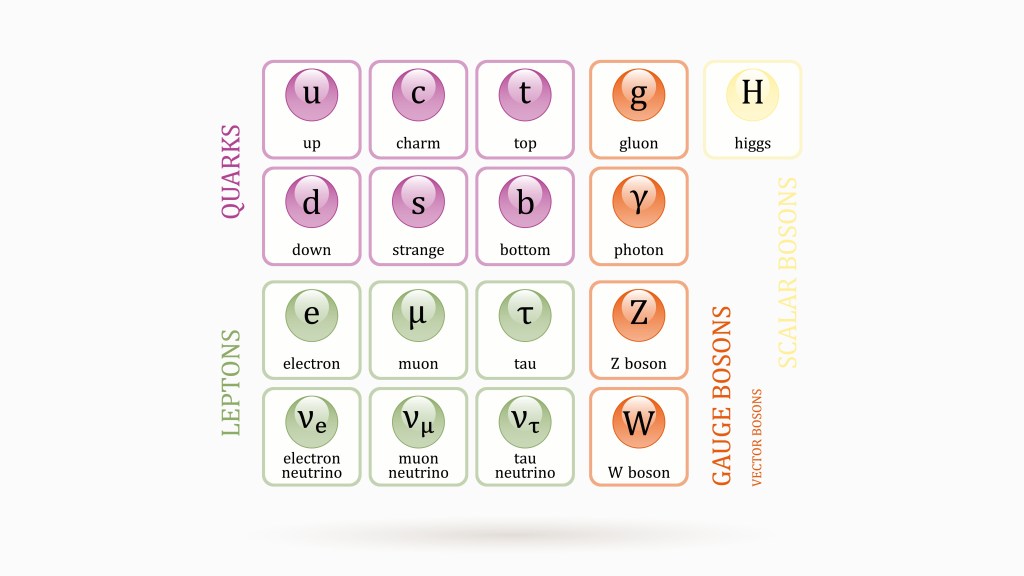
More than 200 subatomic particles have been discovered and there are probably many more that have not yet been discovered. Examples of subatomic particles are protons, neutrons and electrons. However, only some of them are elementary particles, or in other words fundamental particles. The electron is a fundamental particle, but the proton and the neutrons are not. Protons and neutrons are called composite particles and consist of quarks, gluons and mesons. The neutrino is an example of a fundamental particle like the electron. Quarks are other examples of fundamental particles.
Electrons are lightweight. They weigh 0.511 MeV/c², which is 1,836 times lighter than a proton, which weighs 938.272 MeV/c². The positron, which is the electrons anti-particle weighs exactly the same as the electron. The muon, which is very similar to an electron but is unstable and is 206.77 times heavier than an electron weighs 105.66 MeV/c². The tau is also similar to an electron and is about 3,477 times heavier than an electron and weighs 1,776.86 MeV/c². Quarks are also much heavier than electrons. Photons and gluons are massless.
The neutrino is a lepton and is in some ways similar to an electron, but it has no charge and does not interact with electromagnetic forces at all. The neutron also does not have any charge, but it does interact with electromagnetic forces, which makes it a lot easier to detect. As in the case for the electron there are lighter and heavier versions of neutrinos, the electron-neutrino, the muon-neutrino and the tau-neutrino. Here comes the shocker; the heaviest flavor of neutrino, the tau-neutrino weighs less than 0.12 eV/c² or 0.00000012 MeV/c² making it at least 4 million times lighter than an electron. However, the neutrinos may be a lot lighter than that. We don’t know. They have mass but it is very tiny.
Considering how tiny neutrinos are, and that they don’t interact with the electromagnetic force at all (unlike other neutral particles) and don’t interact with the strong nuclear force at all, it is understandable that neutrinos are like ghost particles, almost impossible to detect. Neutrinos are too light to be so called dark matter, but a hypothetical heavier form of neutrino called the sterile neutrino is a plausible candidate for dark matter.
Super fact 129 : Most fundamental forces of nature, gravity, electromagnetism, the weak nuclear force, become weaker as the distance between the objects with the charges increase, except for the strong nuclear force, which grows stronger, not weaker, when the distance between the quarks increases. The strong nuclear force is strange in other ways too. Unlike the electric force which has two forms of charges, positive and negative, the strong nuclear force has three forms of charge denoted red, blue, and green. It has actually six kinds of charges if you count anti-red, anti-blue, and anti-green. I can add that the strong nuclear force is the strongest fundamental force in nature.
As you may know, atoms consist of particles. Electrons surround the nucleus of the atom. The nucleus of the atom is in the middle of the atom, and it consists of protons and neutrons. Electrons have a negative charge. Protons have a positive charge. Neutrons do not have an electrical charge. Electrons are so called elementary particles. They are not composed of other particles. Protons and Neutrons, on the other hand, are not elementary particles. They are composite particles consisting of quarks, gluons and quark pairs called mesons.
Quarks have electric charges, just like an electron and a positron, which is why a proton has an electric charge, a positive electric charge. However, as mentioned, in addition quarks have something called color charge. Unlike electric charges, which come in two forms, negative and positive, they come in three forms red, green and blue. In addition, there are also anti-red, anti-green, and anti-blue charges, making it six forms of charges. I should say that the color charges, red, green and blue, are not real colors. They are just names. Just like electric charges are associated with electric forces; color charges are associated with the nuclear strong force.
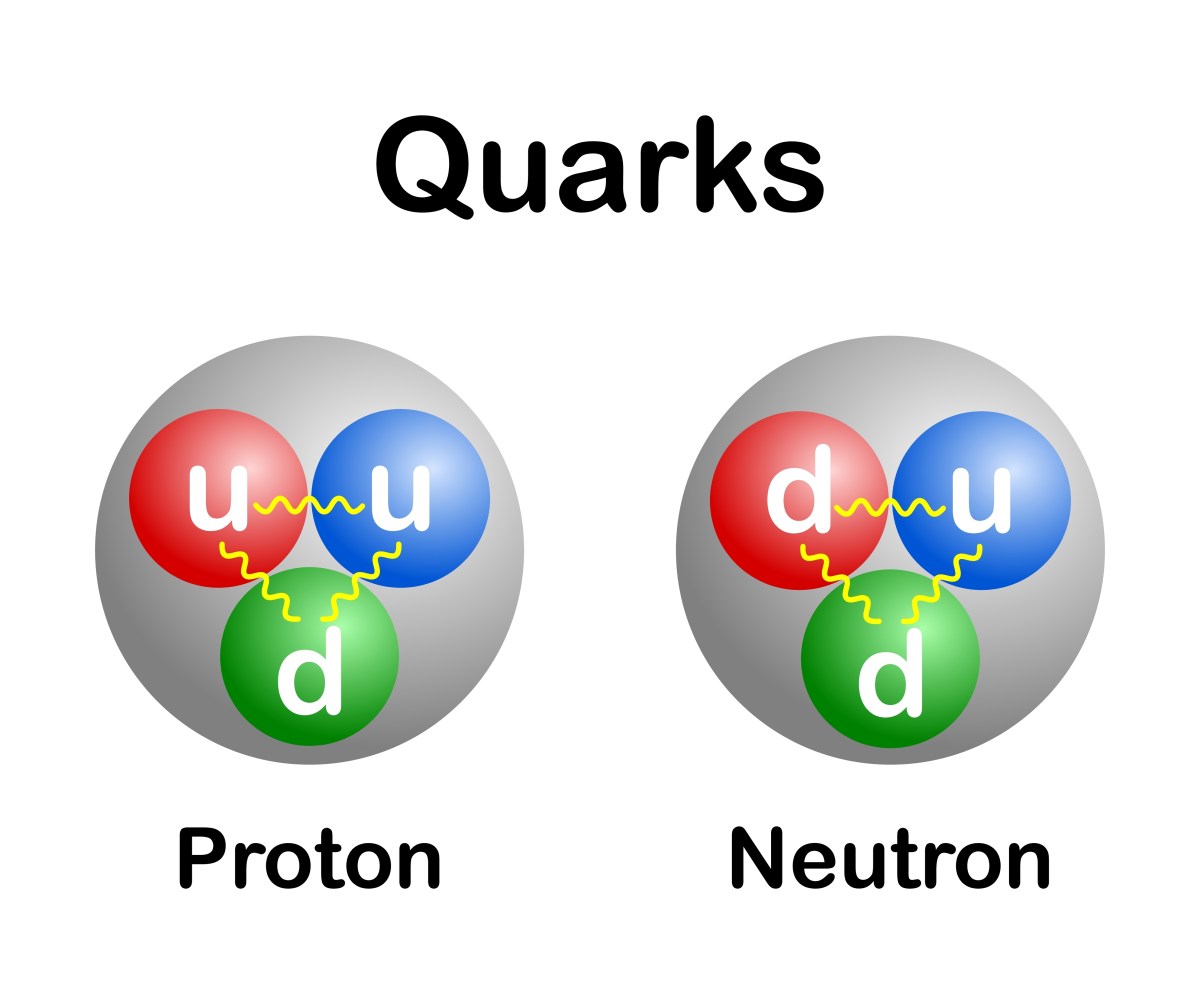
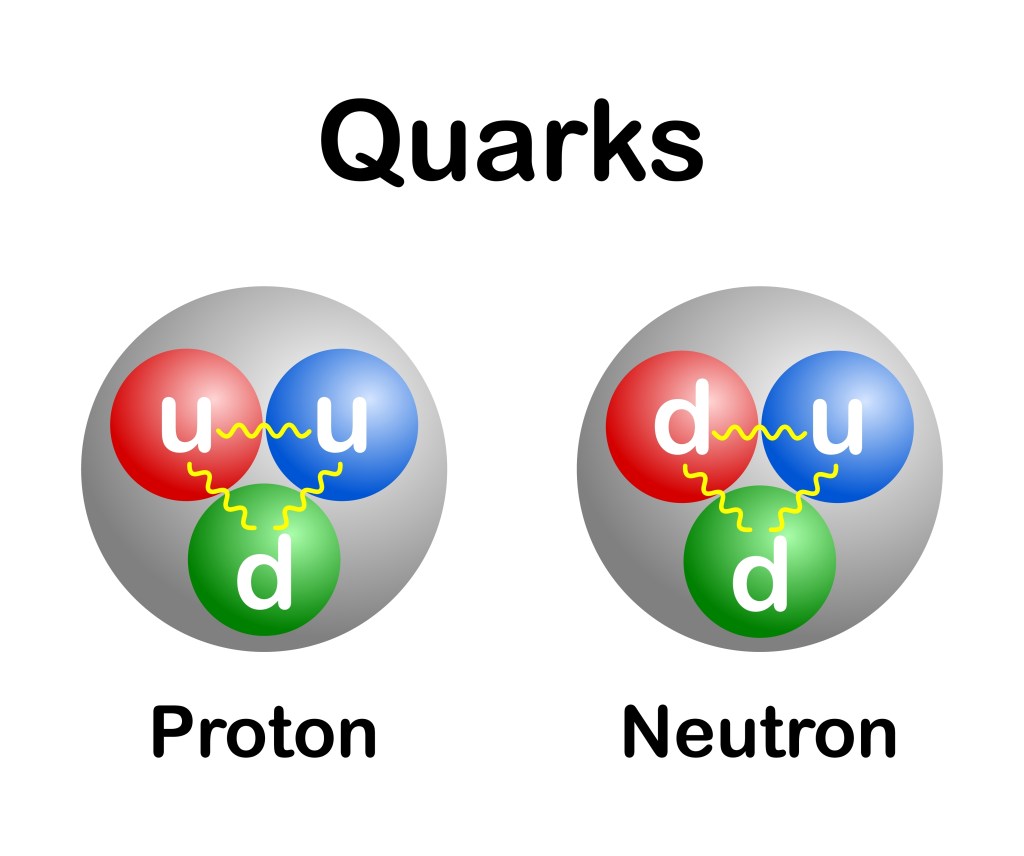
The proton and neutron each consist of three quarks. Protons consist of two up quarks and one down quark. Neutrons consist of two down quarks and one up quark. Both protons and neutrons have a net white charge. The yellow squiggly lines are gluons transporting color charge between the quarks. Asset id: 2333679305 by KRPD.
If you take an equal amount of positive and negative electric charges you get something that is electrically neutral. If you take an equal amount of red, green and blue you get what is called white, or neutral. If you take an equal amount of red and anti-red you also get white. Any other mix gives you a net color charge. As mentioned, unlike, for example, gravity or electromagnetism, which get weaker as objects move apart, the strong force grows stronger as quarks are pulled apart and weaker when they are squeezed together. This strange feature is referred to as Asymptotic Freedom.
As you separate a quark further and further from another the attractive strong force grows stronger and stronger until it becomes super strong, and at about 10,000 Newtons, which is more than one hundred billion times stronger than the force between an electron and a proton in a hydrogen atom it will finally quickly dimmish as if it was a rubber band that snapped. This event will create new particles and quarks, but not free quarks. 10,000 Newtons correspond to a weight of 2,200 pounds, like a small car. However, remember that we are talking about objects that are a trillion times smaller (in diameter) than one millimeter.
Not only is the nuclear strong force increasing with distance until it snaps, which is kind of strange, but by the time it snaps the force is shockingly gigantic for such a small particle. Therefore, this is a fact that is mind-blowing and kind of important to our understanding of the Universe and therefore I think it is a super-fact. With these kinds of forces inside the atomic nucleus no wonder we can blow up large cities using small amounts of the right matter.
The Other Fundamental Forces Become Weaker with Distance
As mentioned, the other fundamental forces gravity, electromagnetism, and the weak nuclear force get weaker as objects move apart. You may say what about friction, pressure, pulling a rope, and attraction between atoms in a molecule? Well, they are not fundamental forces and composed of electromagnetic forces at the bottom. Also, electric and magnetic forces are combined into electromagnetism because they are fundamentally the same thing.
Gravity gets Weaker as Masses Move Apart
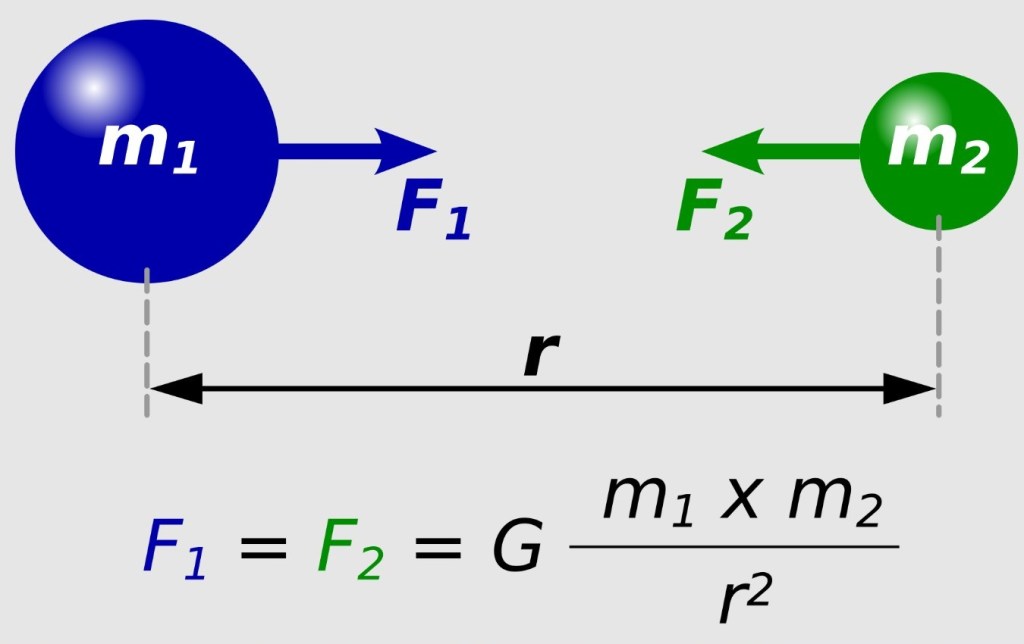
The force of gravity gets weaker as masses such as planet Earth, the moon, and the sun are separated further. Newtons law of gravity states that every object in the universe attracts every other object with a force that is directly proportional to the product of their masses and inversely proportional to the square of the distance between their centers.
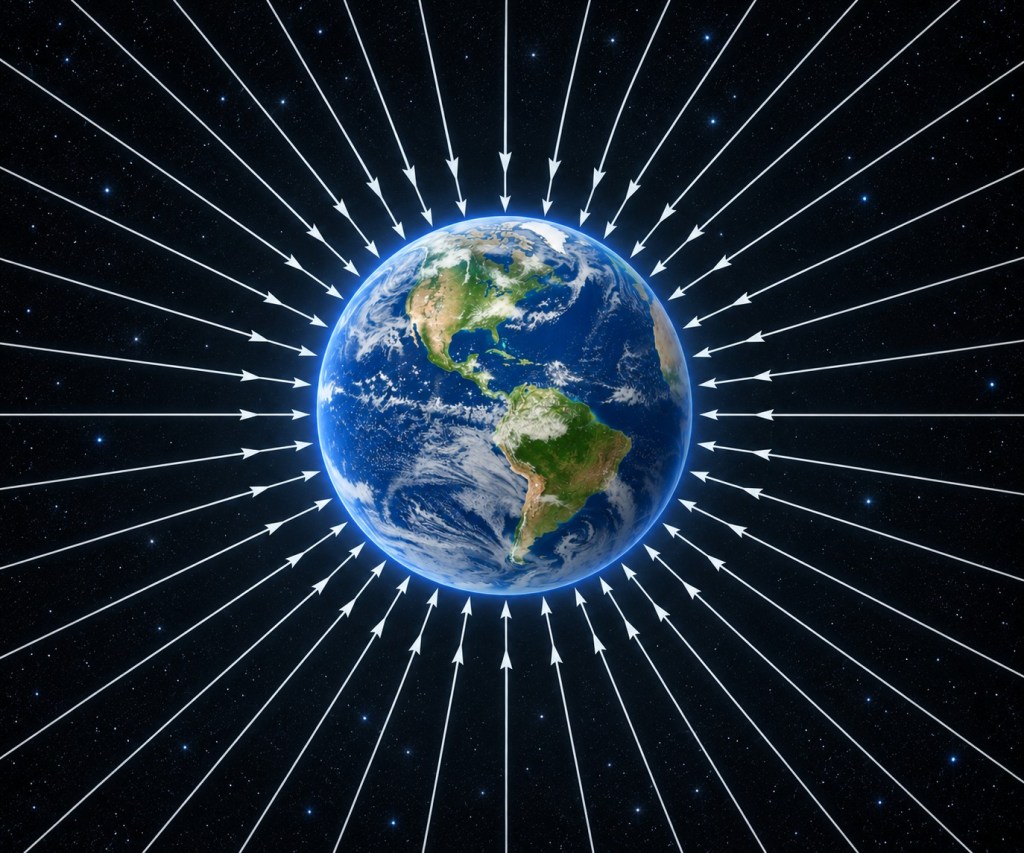
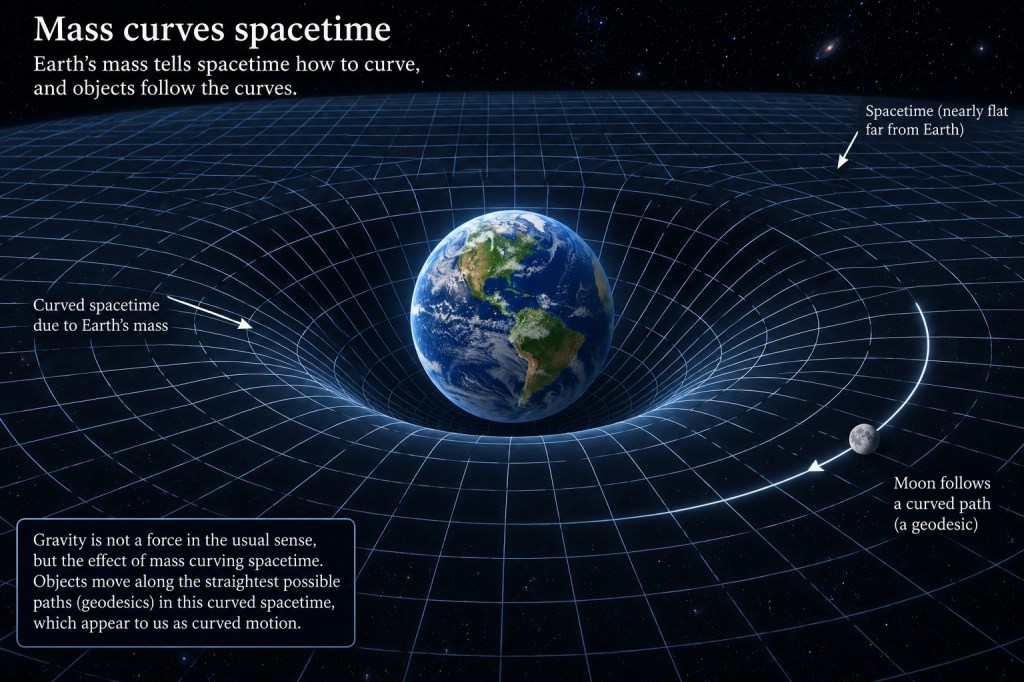
This diagram describes the mechanisms of Newton’s law of universal gravitation; A point mass m1 attracts another point mass m2 by a force F2 pointing along the line intersecting both points. The force is proportional to the product of the two masses and inversely proportional to the square of the distance (r) between the point masses. Dennis Nilsson, CC BY 3.0 https://creativecommons.org/licenses/by/3.0, via Wikimedia CommonsThe force field lines demonstrate how gravity gets weaker as the gravitational field spreads out in space. I generated this picture using ChatGPT.Even if you use the more modern model of gravity, Einstein’s General Theory of Relativity, you can see how the curvature of space becomes less further away from Earth. I generated this picture using ChatGPT.
This does not happen with the strong nuclear force.
The Electromagnetic Force gets Weaker as Objects Move Apart
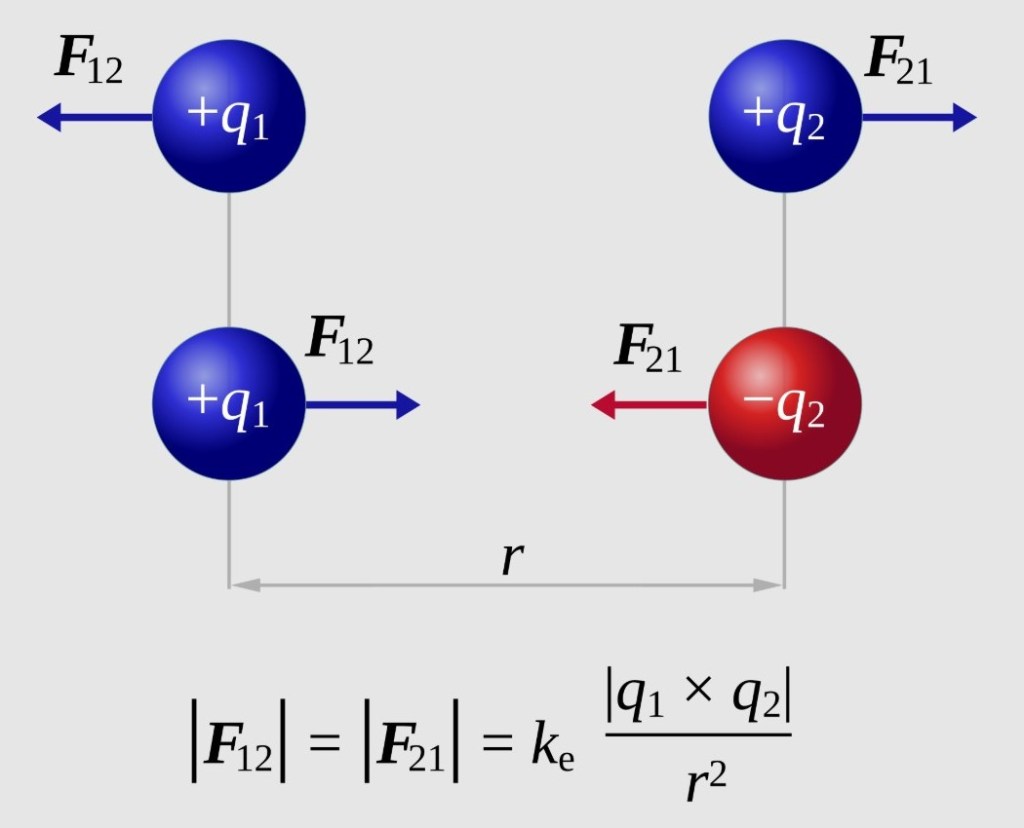
The electric force gets weaker as the charges are separated further. Coulombs law is similar to Newtons law of gravity. The force between them is inversely proportional to the square of the distance between their centers.
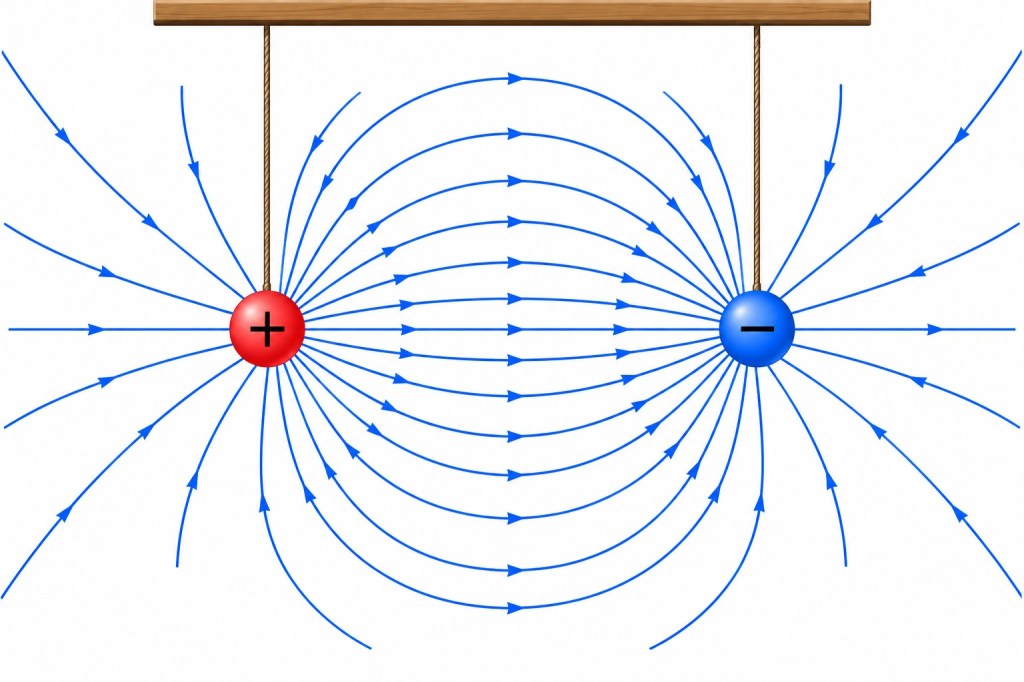
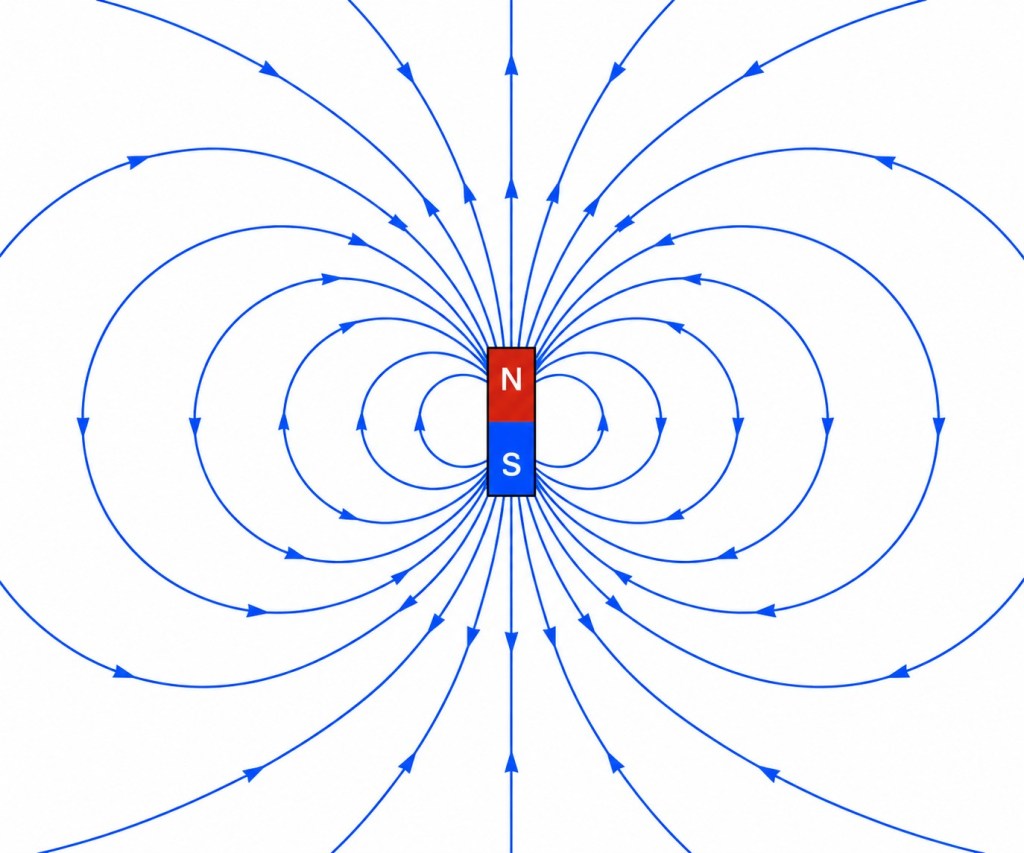
The magnitude of the electrostatic force F between two point charges q1 and q2 is directly proportional to the product of the magnitudes of charges and inversely proportional to the square of the distance between them. Like charges repel each other, and unlike charges attract each other. File:CoulombsLaw.svg: User:Dna-Dennis / *derivative work RJB1, CC BY 3.0 https://creativecommons.org/licenses/by/3.0, via Wikimedia Commons.The force field lines demonstrate how the electric force gets weaker as the electric field spreads out in space. I generated this picture using ChatGPT.Same thing with a magnetic dipole. The field lines are spreading out in space so the magnetic force (field) become weaker further away from the dipole. I generated this picture using ChatGPT.
Again, this does not happen with the strong nuclear force. It is different. The strong nuclear force is strange and very strong.
What is a Quark?
You can learn more about Quarks and the strong force by watching this 10 minute video below. The strong nuclear force is discussed towards the end of the video.
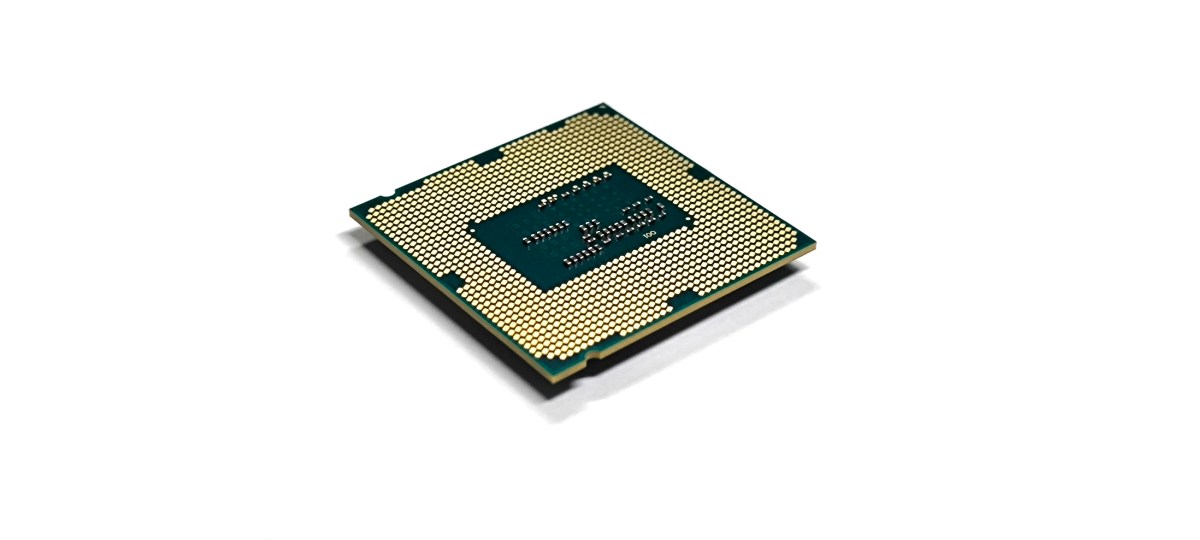
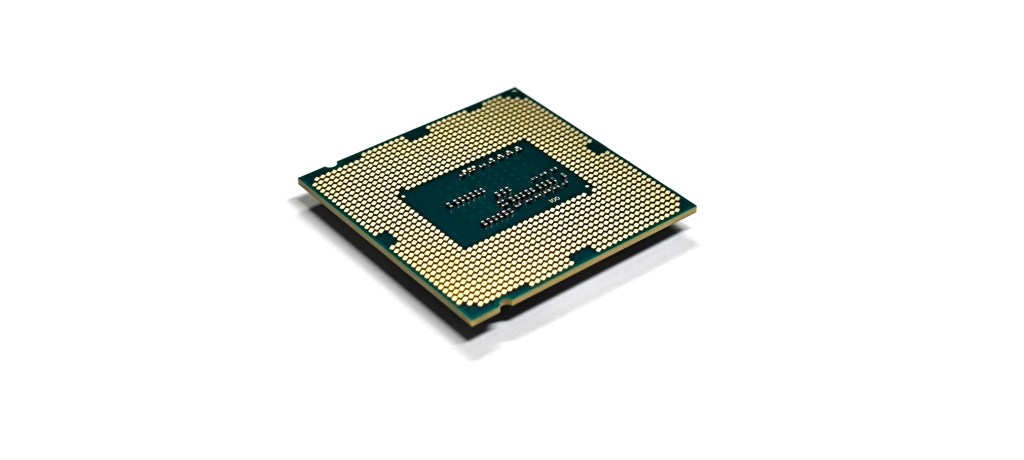
Superfact 127: The Intel 4004 processor chip created in 1971 had 2,308 transistors. Modern cutting-edge processors and AI accelerators exceed 50 billion to over 200 billion transistors, which is 25 million to nearly 100 million times as many transistors per chip. This follows Moore’s law, which states that the number of transistors on a microchip doubles roughly every two years, while the cost of computers drops. As a result, computer chips have gotten millions of times faster and the cost of memory (RAM) has dropped by four trillion times. This has made the modern AI / LLM possible.
CPU (a processor or a central processing unit). Concept of technological advancement. Shutterstock asset id: 2760284753 by pisanstock
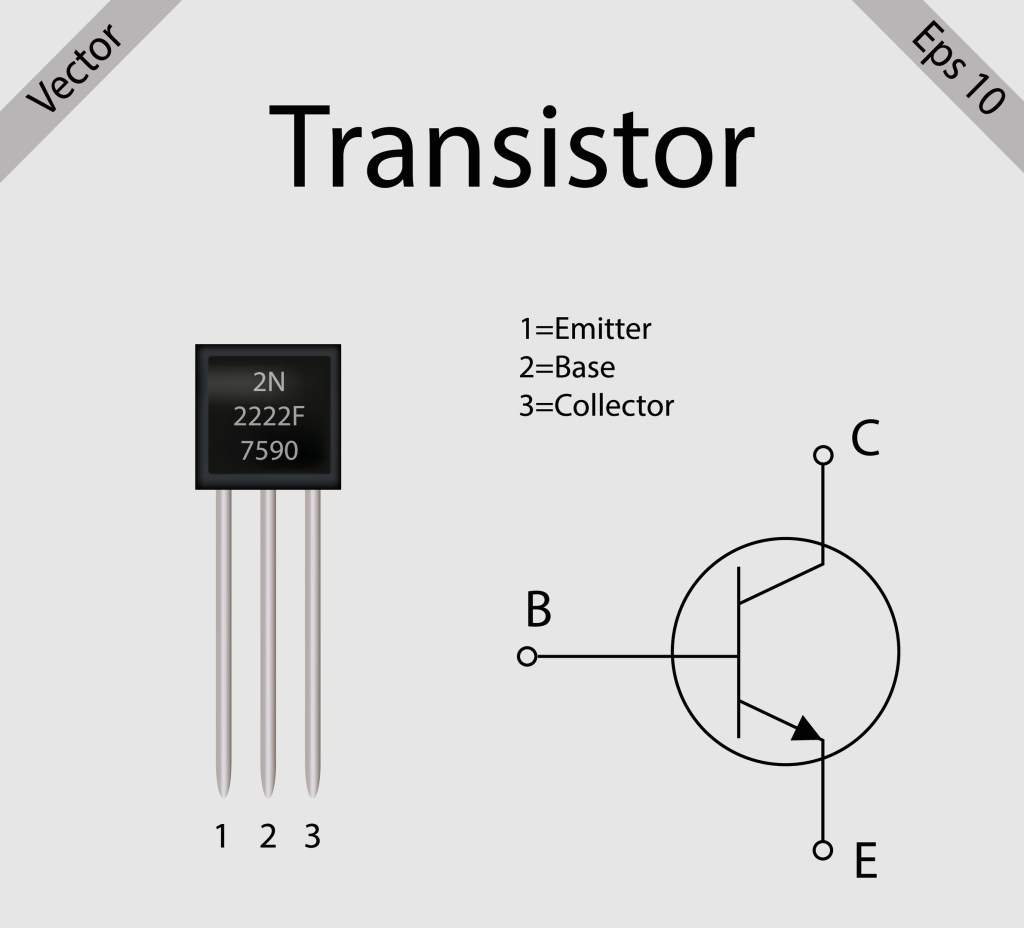
The transistor below is a large transistor that you can hold between your fingers. Transistors inside a computer chip are very small. They are microscopic. In the diagram, whenever a small voltage ( typically 0.7 volts) is applied to the base (B) it allows a much larger current to flow through the main terminals from the collector (C) to the emitter (E). Since electrons are negative this means that the electrons are flowing from the emitter to the collector. If there is no voltage or current at the base there is no current flowing from the collector to the emitter either. This is how you control the transistor and achieve more complex behavior if you have many connected transistors. Also, note that the transistor is a one way street.
A large NPN-BJP transistor with its symbol diagram on the right. Shutterstock asset id: 2169223279 by Surkhab Ahmad Art
Moore’s law, which states that the number of transistors on a microchip doubles roughly every two years, is not a physical law, it is a purely observational law that has held for well over half a century. It is just a reflection of how good we are at improving processors. No one knows whether Moore’s law will continue to hold but if it does, then today’s computers and today’s AI are very bad compared to tomorrows computers and AI, and they are super bad compared to what we will have 20 years from now.
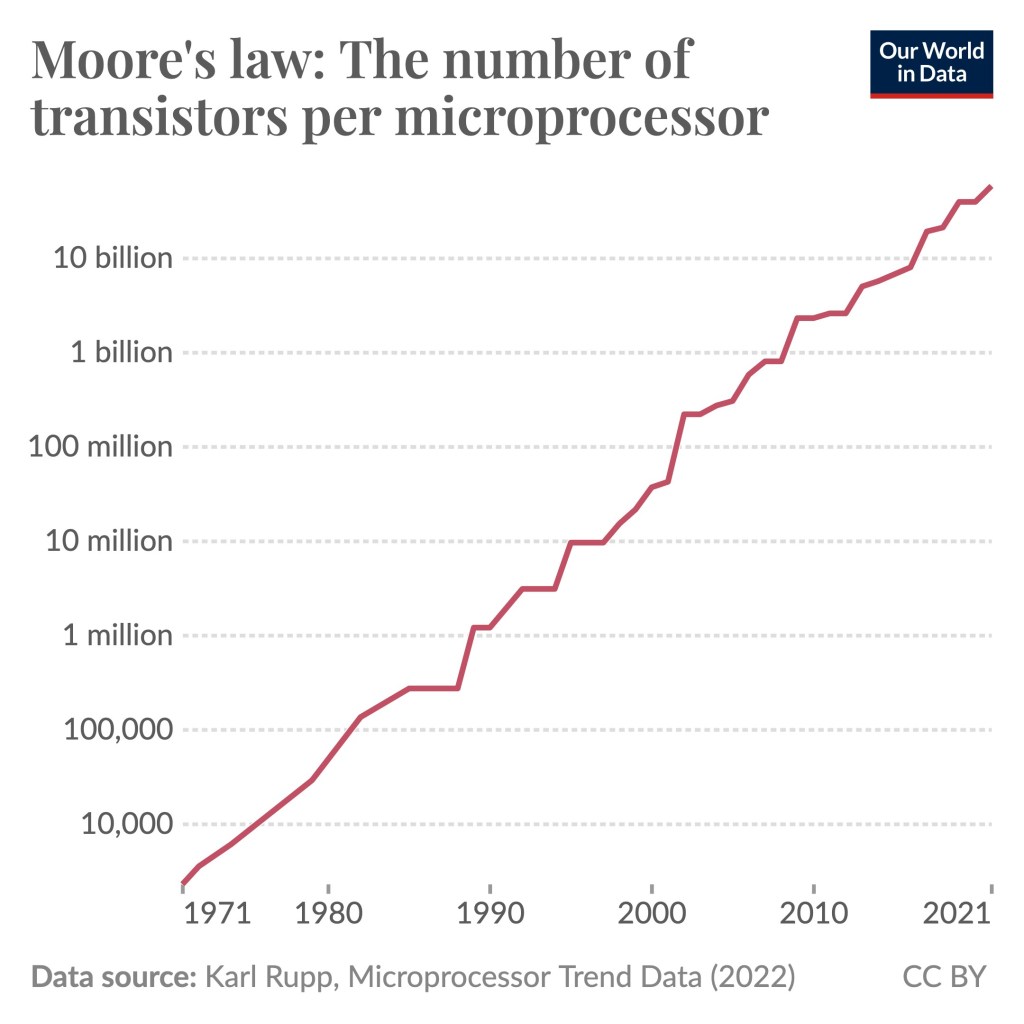
The diagram below shows 100+ microprocessors (CPUs), their number of processors, and the year they were introduced going from 1970 to 2020. The microprocessor data comes from this list. Intel 4004 is located in the lower left corner of the diagram and as mentioned it has 2,308 transistors. The AMD Epyc Rome processor in the upper right corner has 39.54 billion processors. Notice that the number of processors is on a logarithmic scale (not 1,2,3,4,5….but 1,10,100,1000,10000, etc.) A curve that grows exponentially becomes like a line in such a diagram. This is another way of saying that the technological progress for microprocessors is exponential. Every six and a half years the number of transistors is 10-doubled.
Moore’s Law: The number of transistors on microchips has doubled every two years. Moore’s law describes the empirical regularity that the number of transistors on integrated circuits doubles approximately every two years. This advancement is important for other aspects of technological progress in computing – such as processor speed or the price of computers. Data source: Wikipedia (wikipedia.org/wiki/Transistor_count). OurWorldData.org – Research and data to make progress against the world’s largest problem. Licensed under CC-BY by the authors Hannah Ritchie and Max Roser.
However, the processor that currently has the most transistors is the Cerebras Wafer Scale Engine 3 (WSE-3) with 4 trillion transistors. It is not in the diagram. A comparison between Intel 4004 and Cerebras Wafer Scale Engine 3 (WSE-3) may not be entirely fair since it is a wafer sized CPU specifically made for AI and much bigger than Intel 4004. However, the standard consumer or workstation CPU with currently the most transistors is Apple’s M3 Ultra (normal sized) with 184 billion transistors. However, 184 billion transistors that is more than 79 million times as many transistors as the Intel 4004.
Moore’s law: The number of transistors per microprocessor. Data source: Karl Rupp, Microprocessor Trend Data (2022) CC BY
This is a super fact because it is an important fact that is a surprise to you if you did not know about Moore’s law and mind-blowing even if you did.
Computational Capacity / Speed
One benefit of transistors and other electronic components becoming much smaller is increased speed. The graph below shows that the fastest supercomputers in 1993 had a processing speed of 124 Gigaflops and in 2025 a processing speed of 1.81 billion Gigaflops, which is 14.6 million times faster. One gigaflop equals one billion floating-point operations per second. Multiplying 3.1415926536 times 2.7182818284 = 8.5397342225 is an example of a floating point operation. Note that 1.81 billion Gigaflops is 1.81 quintillion floating-point operations per second.
Computational capacity of the fastest supercomputers. Number of floating-point operations carried out per second by the fastest supercomputer in any given year. This is expressed in gigaflops, equivalent to one billion floating-point operations per second. Data source: Dongarra et al. (2025) OurWorldinData/technological-change | CC BY
Cost of Memory
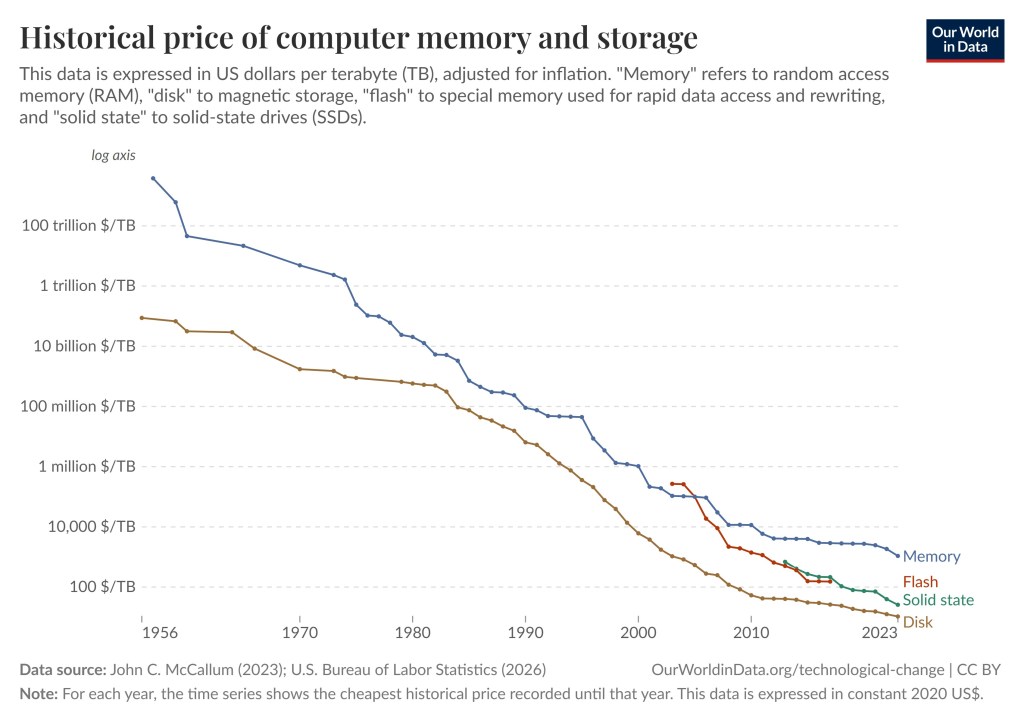
Much smaller and faster and transistors and other kinds of electronic components also come with additional benefits such as an extreme reduction in the price of memory, including the extreme reduction in the price of random access memory, RAM. In the diagram below (taken from this page ) the blue line shows that the price for one Terabyte of memory (RAM) in 1957 was 3,79 quadrillion dollars and now in 2023 it is only 1,088 dollars. 3,79 quadrillion dollars is a lot of money.
You may object that and point out that 3,79 quadrillion dollars is even more than our national deficit. So how can that be possible? The answer is that one terabyte of memory did not exist in 1957. 3,79 quadrillion dollars per terabyte is the same as 3.79 million dollars per kilobyte, but those are the numbers that make sense for 1957. The gigantic computers back then only had a few kilobytes of memory. You just need to do the conversion. Anyway, 3,79 quadrillion dollars versus 1,088 dollars corresponds to a reduction in price by 3,48 trillion times. For disk memory the price per terabyte went down from 87.5 billion in 1956 to 11 dollars in 2023, a reduction of 7.95 billion times.
Historical price of computer memory and storage. This data is expressed in US dollars per terabyte (TB), adjusted for inflation. “Memory” refers to random access memory (RAM), “disk” to magnetic storage, “flash” to special memory used for rapid data access and rewriting, and “solid state to solid-state” drives (SSDs). Data source: John C. McCallum (2023); U.S. bureau of Labor Statistics (2026). Note: For each year, the time series shows the cheapest historical price recorded until that year. This data is expressed in constant 2020 US$. OurWorldinData.org/technological-change | CC BY
Increased Computational Power and Artificial Intelligence
My super fact 88 states that “Artificial Intelligence is Not New” It goes back to at least 1943 with the creation of the first artificial neural network model, the first trainable (able to learn) neural network in 1957, and the foundation of the field of “Artificial Intelligence Research” in 1956. In 1986 a landmark paper was published by David Rumelhart, Geoffrey Hinton, and Ronald Williams which introduced the Rumelhart backpropagation algorithm, which is used today by modern AI and Large Language Models, such as ChatGPT. Geoffrey Hinton, who is said to be the father of Artificial Intelligence, received the Nobel Prize in physics in 2024. David Rumelhart and Ronald Williams were both dead and could therefore not receive the Nobel Prize.
So why did it take so long for today’s commercial LLMs to appear? The answer is, for the most part, that the computational power and huge memory required did not exist until recently. Sure, training these large AI systems require enormous amounts of data that comes from outside of the processors (internet) but you need enormous amounts of memory to store this data and an enormous computational processing power to run the algorithms such as Rumelhart’s backpropagation algorithm. For example, ChatGPT 3.5 and 4.0 feature 96 versus 120 hidden layers of neurons with hundreds of billions and trillions of parameters/neurons in total. The enormous increase in computer processing power and memory is an essential aspect of scaling up AI. Our World in Data has an article about this here.
The dots in the diagram are neurons. With permission from kwholley63
Conclusion
Moore’s law, a purely observational law, states that the number of transistors on a microchip doubles roughly every two years. This also means that the computational processing power of processors has greatly increased and the cost of memory has dropped by a lot. This in turn has made the existence of modern Large Language Models such as ChatGPT possible.
Transistors per Microchip Increased by More than 50 million Times in 50 Years. Processing speed has increased14.6 million times in 32 years. The reduction in price per Tera Byte has gone down 3,48 trillion times in 67 years.
If Moore’s law holds, we can expect that in twenty years the number of transistors per Microchip will increase by more than 1,000 times, that processing speed will increase roughly 29,000 times, and that memory RAM will be more than 6,000 times cheaper. These are my calculations based on the graphs above.
Superfact 123: The speed of light is the speed of causality, which is the speed corresponding to how fast anything in the Universe can influence anything else in the Universe. That is because the universe, or space-time has a strict maximum speed limit for any action, signal, or information to travel from one place to another. Light just happens to travel at this maximum limit because photons have no mass.
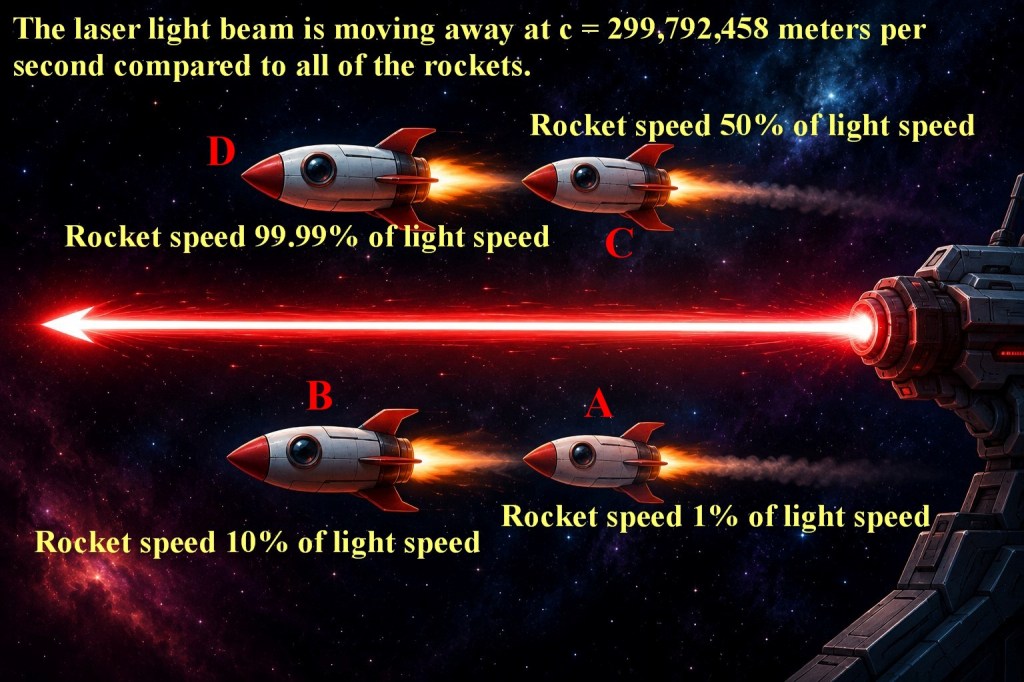
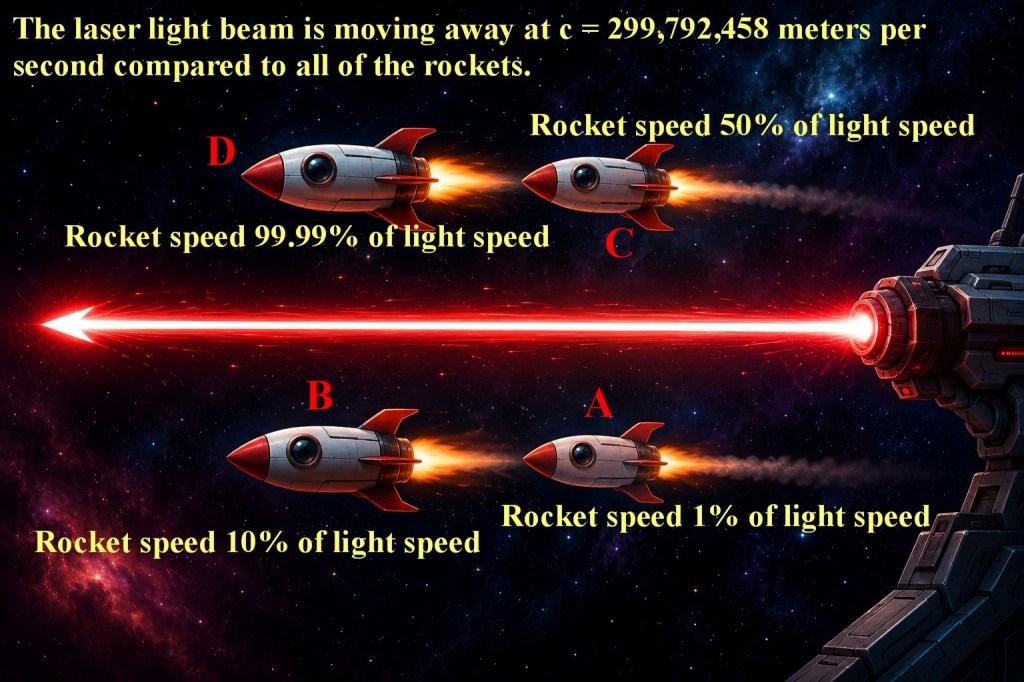
Four rockets, A, B, C, and D, are traveling along a light (laser) beam. No matter how fast they travel along the light beam, the light beam will always travel c = 299,792,458 meters per second faster than they do. I generated this picture with the help of ChatGPT.
I am posting about the speed of light again because there are so many aspects of it that are mind blowing. For starters, “The Speed of (Light in Vacuum) Is a Universal Constant”. It is always c = 299,792,458 meters per second for everyone no matter at what speed they are travelling. If you try to catch up to a light beam by going faster and faster the light beam will still keep moving at c = 299,792,458 meters per second faster than you. No matter how much you accelerate you can never catch up. The beam will keep moving away from you at c = 299,792,458 meters per second. This is possible because time and space are relative, at least if viewed separately, like we do.
Time is going to be different for me than for you. From shutterstock Illustration ID: 1055076638 by andrey_l
Photons and other massless particles will always move exactly at the speed of light c = 299,792,458 meters per second, whilst anything with mass could never travel at the speed of light. It will always move slower. In fact, when something with mass is approaching the speed of light, its mass will grow towards infinity, and it will require infinite energy to accelerate it to the speed of light. Basically, something with mass can never accelerate to reach the speed of light.
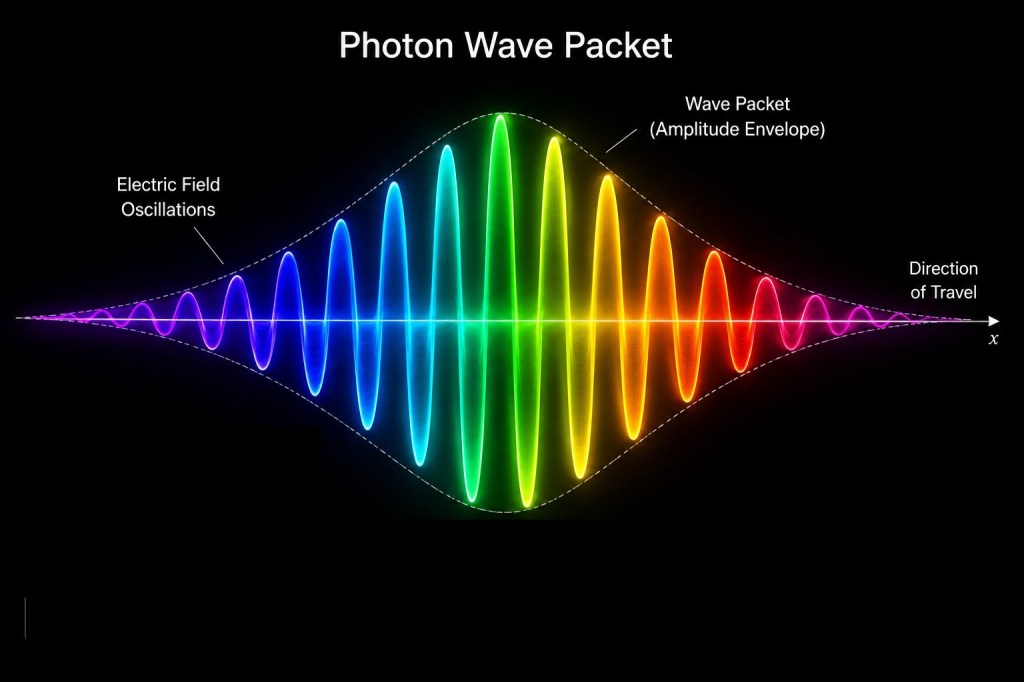
A photon wave packet. It has no mass, travel at the maximum speed, the speed of causality, and time does not exist for the photon.
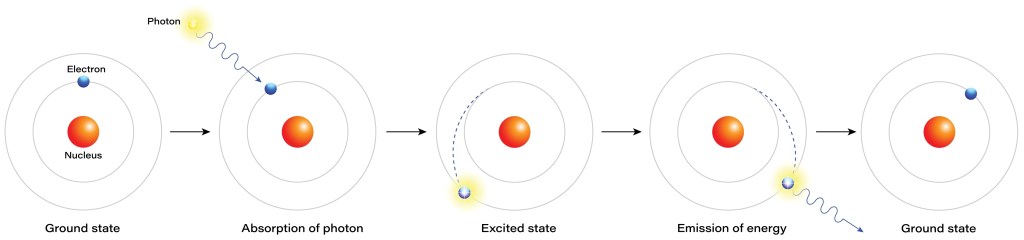
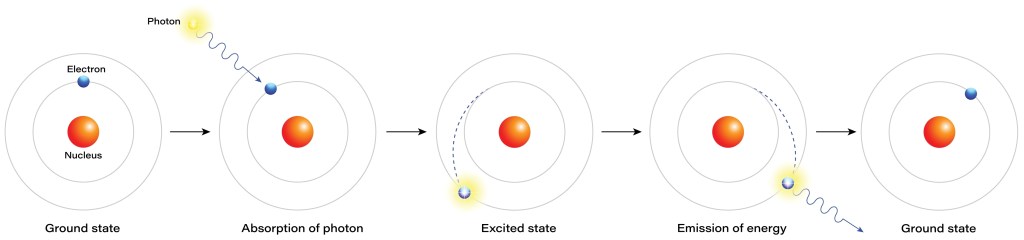
Note: In my first paragraph I wrote (Light in Vacuum) in parenthesis because light always travels at c = 299,792,458 meters per second, but it appears to be going slower in transparent matter. When light moves through matter it is being absorbed and emitted as it “travels” between the atoms in the material, and this absorption and emittance process takes time.
From ground state to excited state, absorption and emission of a photon in an atom. Shutterstock asset id: 2180385419 by rktz.
As mentioned, the speed of light is a maximum speed limit for any action, signal, or information to travel from one place to another. Einstein’s theory of relativity shows that space and time are linked. The c = 299,792,458 meters per second acts as a conversion factor that binds space and time together. So, in a sense the speed of light is not even a speed in a regular sense, it is a property of time and space.
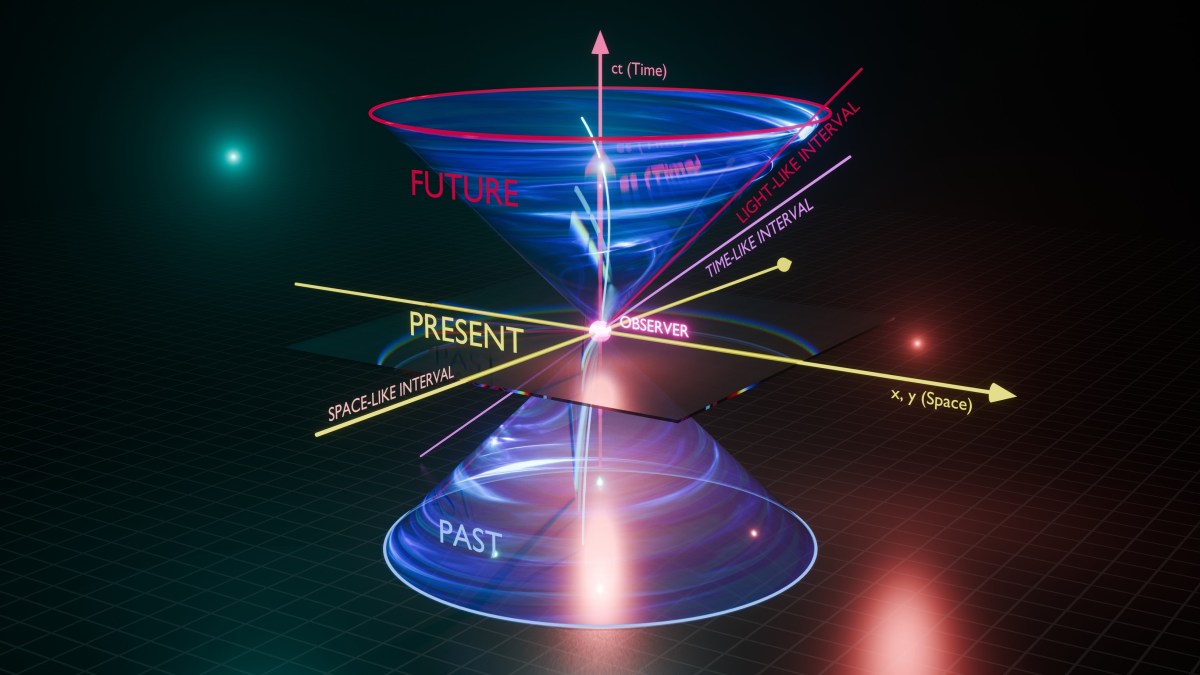
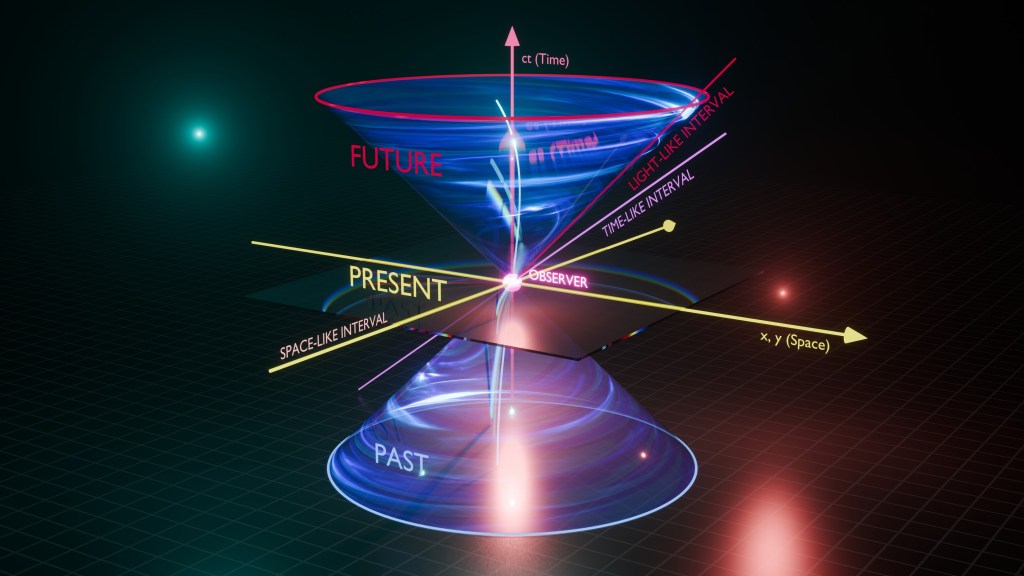
In the light cone diagram above, an observer can only affect what is confined within the future cone above it. Shutterstock asset id: 2728984295 by atdigit
The cone diagram above is a coordinate system with time being the pink arrow going from the bottom and up. The yellow arrows represent the x and y axis representing space. The center is the observer (you). The past cone below the center represents all the past events that could have affected you (the center). The future cone represents everything that you could possibly affect in the future. All light beams travel on the surface of the future cone. What is outside these cones are parts of the Universe you cannot affect and that cannot affect you. This is the non-observable part of the Universe.
That the speed of light is also the speed of causality, or the maximum speed of cause and effect is an important fact that is mind blowing, and therefore a super fact in my opinion.
Light is Beyond the Reach of Time
Since the speed of light is a conversion factor between time and space and not a speed in a real sense there is more to say about the speed of light that may come as a surprise, for example, that time does not exist for photons. This means that from the photon’s perspective there will be no time at all. A photon, or a light beam, will travel from Earth to a distant galaxy a billion light years away in an instant.
It will not take a billion years. It will not take one year. It will not take one second. It will not take one microsecond. It will not take a nanosecond, or a picosecond, or a trillionth of a picosecond. It will take zero seconds. The Big Bang and the end of the Universe (if there is one) happen at the same exact moment from the perspective of a photon. Time does not exist for a photon (or a gluon, or any other mass-less particle). This is explained in greater detail in my post “Light is Beyond the Reach of Time”.
What About Quantum Entanglement?
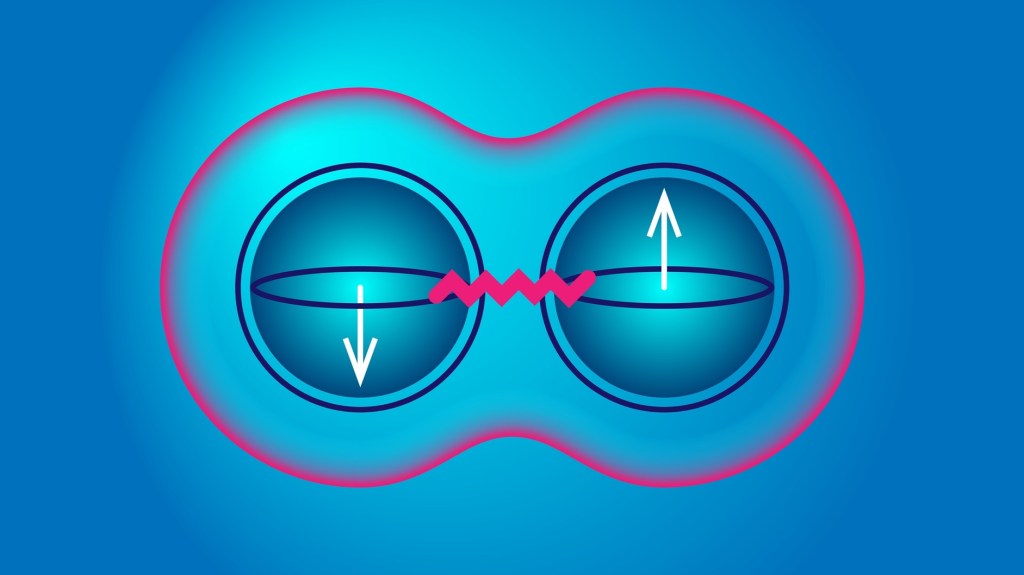
What about quantum entanglement? You may have heard about instantaneous action across vast distances due to quantum entanglement. Quantum entanglement is when pairs or groups of particles interact in ways such that the quantum state of each particle cannot be described independently of the others, even when the particles are separated by a vast distance. Therefore, measuring the state of one particle instantly determines the state of the other. Does that not violate the speed of light being the speed of causality? It turns out that it doesn’t.
Two entangled particles, one with spin up and one with spin down. If you measure one the other one will manifest the opposite spin across any distance.
It can be understood the following way. Imagine two identical looking shoe boxes, one containing a left white shoe and the other containing a black right shoe. If you were to randomly scramble the two boxes so that you did not know in which box respective shoe was. Then you send one of the boxes to Mars. If you open the shoe box still on earth, you will instantly know the content of the box on Mars. The Martians don’t need to send a message to Earth.
The analogy is not perfect because unlike the shoe boxes the quantum case involves pure randomness. The content of the shoe boxes has been predetermined, and the randomness stem from the fact that we don’t know which box is which. But the shoes are there the whole time before you open any box. This corresponds to what you would call a hidden variable in physics. In the quantum case, the quantum state is not hidden or predetermined, there is no hidden variable, it does not even exist until you measure. It is true randomness. However, it is still similar in the sense that no signal, no message, and no information is being sent, and no message or information need to be sent.
Two red boxes with a white left shoe and a black right shoe. I used ChatGPT to generate image.
What about Warp Drives ?
So, nothing with mass can travel at the speed of light, and nothing can exceed it. What about the warp drive in Star Trek? As I said, the speed of light is not really a speed but the conversion factor between time and space. It is a geometric fact of space-time. That is a pretty difficult reality to get around, just like it is pretty difficult to push Earth out of its orbit by pushing on the floor. However, there is a way to cheat and that is to stretch space-time itself. This is theoretically possible, but it requires colossal amounts of mass-energy and enormous amounts of negative energy. We don’t even know if negative energy exists on a macroscopic scale.
So, no one knows if a warp drive is possible, and if it isn’t, then we are stuck moving slower than the speed of light, which would make interstellar travel very difficult and inconvenient.
Superfact 116: Time and space do not exist for light particles (called photons) and not for other particles without mass either. All massless particles travel at the speed c = 299,792,458 meters per second compared to all other objects regardless of how fast those other objects are moving. Objects / particles that have mass will always travel slower than c = 299,792,458 meters per second. The speed of light, c, is not really a speed. It is a conversion factor between space and time. It is therefore a universal constant.
Billions of photons coming into the eye. Shutterstock asset id: 2629068895 by muratart.
Light does not travel through a medium, like a sound wave, or a water wave does. There is no medium for light to travel in. Photons are massless, which means that an extremely tiny force, an infinitesimal smallest possible force, could send a photon off at infinite speed. There is no mass to hold the photon back.
However, the conversion factor between space and time c = 299,792,458 meters per second will prevent that and the photon will travel at this “speed”. Since c is a conversion factor, a physical constant describing time and space, this is not motion, or movement, in a normal sense. Space and time won’t allow any physical event to have any effect faster, and no information of any kind can travel faster than c = 299,792,458 meters per second.
This means that from the photon’s perspective there will be no time at all. A photon, or a light beam, will travel from Earth to a distant galaxy a billion light years away in an instant. It will not take a billion years. It will not take one year. It will not take one second. It will not take one microsecond. It will not take a nanosecond, or a picosecond, or a trillionth of a picosecond. It will take zero seconds. The Big Bang and the end of the Universe (if there is one) happen at the same exact moment to a photon. Time does not exist for a photon (or a gluon, or any other mass-less particle).
This is a mind-blowing fact, and it is true and important to our understanding of the Universe. Therefore, I consider it a super fact.
What does the Speed of Light Being a Universal Constant Mean ?
Four rockets, A, B, C, and D, are traveling along a light (laser) beam. No matter how fast they travel along the light beam, the light beam will always travel c = 299,792,458 meters per second faster than they do. I generated this picture with the help of ChatGPT.
The first thing to acknowledge about the speed of light (in vacuum) is that it is a universal constant as explained in my post “The Speed of Light in Vacuum Is a Universal Constant”. However, I am explaining this fact slightly differently in the next few paragraphs with the help of the picture above.
In the picture above we are emitting a light beam from our spaceship using our super laser. There are also four rockets that travel along the light beam. The rocket on the lower right (rocket A) travel at 1% of the speed of light v = 2,997,924.5 meters per second (or 2,998 miles per second). That is extremely fast, but much slower than light. You would think that the light beam would travel a little bit slower compared to this rocket at the relative speed c – v = 299,792,458 – 2,997,924.5 = 296,794,533.5 meters per second. But it doesn’t. The light beam is still speeding ahead of rocket A at exactly c = 299,792,458 meters per second.
What happens if you compare the beam with the rocket in the lower left (rocket B)? That rocket travels at 10% the speed of the light beam. Shouldn’t the light beam move 10% slower compared to that rocket? No, the light beam speeds ahead at exactly c = 299,792,458 meters per second compared to rocket B, once again.
Now take rocket C in the upper right corner. It also travels along the light beam but at half the speed of light. Shouldn’t the light beam travel at half of the speed of light compared to rocket C? No, it will stubbornly travel at exactly c = 299,792,458 meters per second compared to rocket C. Not less and not more.
The same is true for the rocket in the upper left, rocket D. It travels at 99.99% of the light speed compared to us in the spaceship, and yet the light beam will stubbornly travel at exactly c = 299,792,458 meters per second compared to rocket D. Not less and not more.
The universal speed c = 299,792,458 meters per second is not so much about light. As mentioned, it is a conversion factor between space and time. You take this conversion factor with you everywhere you go and regardless of how fast you move. That’s the way time and space works.
The fact that the speed of light is a universal constant that is exactly the same for all observers, no matter how fast they move, should tell you that it is not a speed in a normal sense. It is not really a “speed” at all. As mentioned, it is a conversion factor between space and time. Light isn’t really travelling super-fast. It is just conforming to the geometric reality of time and space, and to us it looks like it is travelling at the speed c = 299,792,458 meters per second.
The Space-Time Interval for Light is Zero
I mentioned that from the photons perspective time does not exist but that from our perspective light travel through space or seem to travel through space and that takes time. However, for us space and time are separate things. If you combine them and measure space-time intervals instead you get a more complete picture. In 3D space you get the distance between two points by adding the differences between the coordinates using Pythagoras theorem, s^{2}=x^{2}+y^{2}+z^{2}. (x, y, and z, are differences in the coordinates) As long as you are consistent with the units you will always get the same distance regardless of position and orientation of your coordinate system. You can read more here.
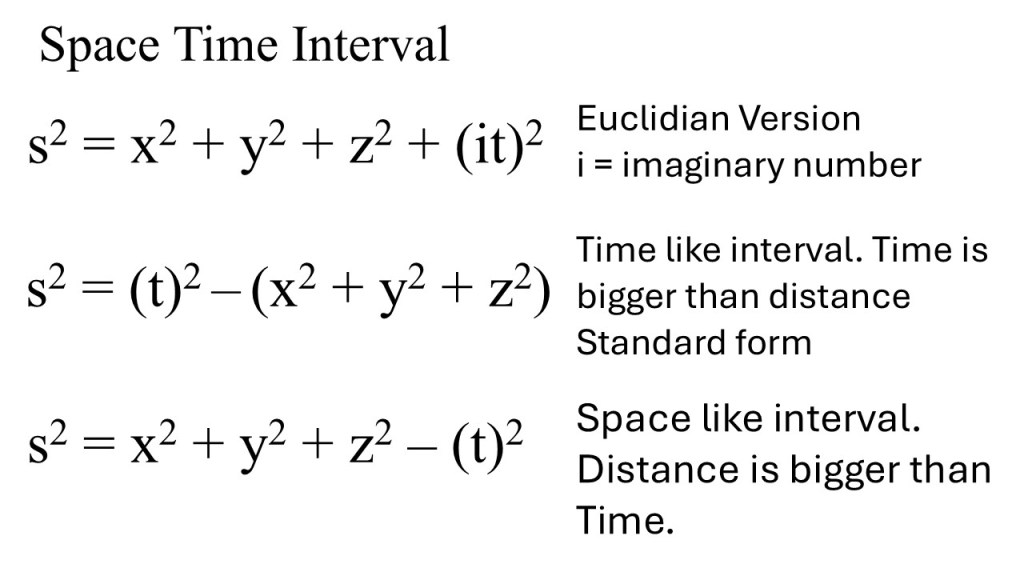
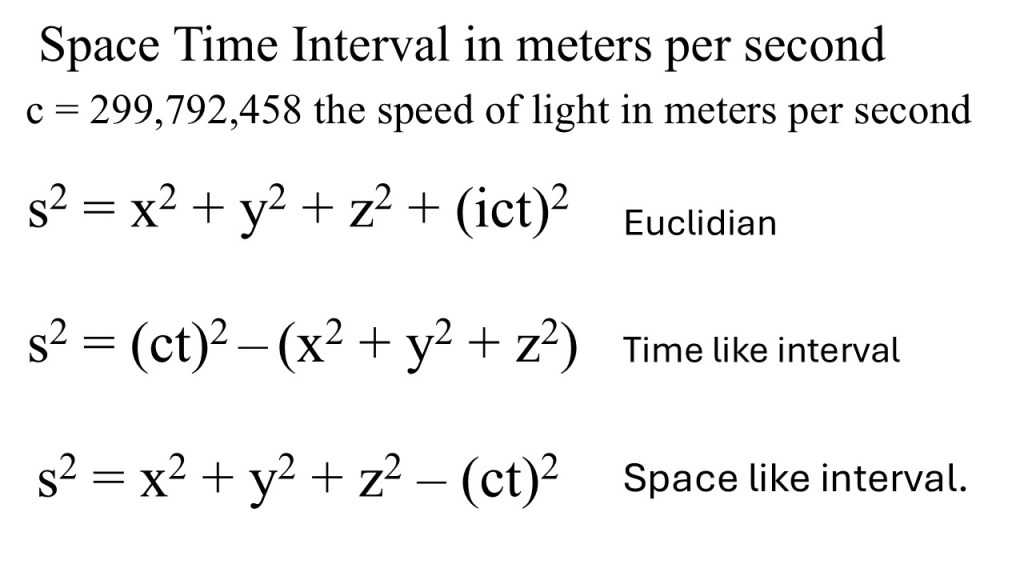
If you add time to Pythagoras theorem you will get the space-time interval, which interestingly enough is the same for all observers. There is no time dilation or length contraction in the interval. s^{2}=x^{2}+y^{2}+z^{2}+(it)^{2} As you might suspect, intervals involving light travelling from one event to another will always be zero for all observers, and not just from the photons perspective. And again, the same applies to all massless particles. Below are the Pythagoras formulas for different versions of the interval. In the top picture it is assumed that the conversion factor c = 299,792,458 meters per second has already been baked into to the time variable and in the bottom it has not. This is not any stranger than converting feet to meters.
The three formulas for the spacetime interval above all assume that the unit used for time is the time it takes light in vacuum to travel the distance unit used. If that is meters, it would be the time it takes light to travel one meter. The top formula is the Euclidian form of spacetime. It contains only the ‘+’ operator at the expense of adding the imaginary number (square root of -1) in front of the time coordinate. The second form is typically used with time like intervals and considered the standard form. The third form is used when the distance between two events is larger than the time distance, or distance like intervals.If you measure the space coordinates in meters and the time in seconds you must adjust the units to match by inserting the speed of light in vacuum c = 299,792,458. The three forms of the space interval now have the constant c attached to the time coordinate.
What about the speed of light in water ?
It is well known that the speed of light in transparent materials such as water and glass is slower than the speed of light in vacuum. The speed of light it water is about 75% of the speed in vacuum and about 70% or less in glass (depending of the type of glass) compared to the speed in vacuum. In some materials the speed of light can be much less than that. This seems to violate what I said above about the speed of light always moving at c = 299,792,458 meters per second for all observers regardless of their speed.
What is going on is that when light moves through matter it is being absorbed and emitted as it “travels” between the atoms in the material, and this absorption and emittance process takes time. This time is extremely short but long enough to be measurable. As the photons move in between the atoms they travel at the “speed” c = 299,792,458 meters per second, the time to space conversion factor I’ve been talking about. See the illustration below.
From ground state to excited state, absorption and emission of a photon in an atom. Shutterstock asset id: 2180385419 by rktz.
More about the mass of a Photon
I’ve said photons have no mass. According to Einstein’s theory of special relativity, time does not pass (or effectively “exist”) from the perspective of a massless particle. However, this is the intrinsic mass or so called proper mass or invariant mass. It is the mass of an object as measured by an observer who is completely at rest relative to it. This intrinsic mass is the mass that a photon does not have.
The mass of an electron is 511 Kilo Electron Volts, which is 0.0000000000000000000000000009109 grams. That is the intrinsic mass of the electron. If an electron is sped up to close the speed of light its mass increases and goes toward infinity. If its speed is very close to the speed of light its mass could be much bigger than that of the entire Universe. That’s because as you are increasing the speed of the electron, you are increasing its kinetic energy and as you increase the total energy of the electron you also increase its total mass according to E = mc2.
As the electron’s speed approaches the speed of light the kinetic energy goes toward infinity. That is one reason why it is impossible to travel at exactly the speed of light for anything but massless particles. Infinite energy and infinite mass are not realistic. We, the objects that have mass, can move closer and closer to light speed but never get there.
However, the intrinsic mass for photons is zero and therefore the photon is travelling at exactly the speed of light, c = 299,792,458 meters per second. E = mc2 still applies to light but the mass is not the intrinsic mass, which is zero, but the total mass, and the total mass can pretty much take on any number.
What about Warp Drives ?
So, nothing with mass can travel at the speed of light, and nothing can exceed it. What about the warp drive in Star Trek? As I said, the speed of light is not really a speed but the conversion factor between time and space. It is a geometric fact of space-time. That is a pretty difficult reality to get around, just like it is pretty difficult to push Earth out of its orbit by pushing on the floor. However, there is a way to cheat and that is to stretch space-time itself. This is theoretically possible, but it requires colossal amounts of mass-energy and enormous amounts of negative energy. We don’t even know if negative energy exists on a macroscopic scale.
So, no one knows if a warp drive is possible, and if it isn’t, then we are stuck moving slower than the speed of light, which would make interstellar travel very difficult and inconvenient.
Richard Feyman’s Lecture on Why Light Is NOT Moving Through Space?
The YouTube video below is very long, 48 minutes. However, Richard Feyman, Nobel prize winner in physics, has a knack for explaining extremely abstract concepts so that they are easy to understand. If you are very interested in this topic and have some extra time, this is a fascinating lecture. He certainly explains this topic better than I can.