Climate change worsens wildfires in the US

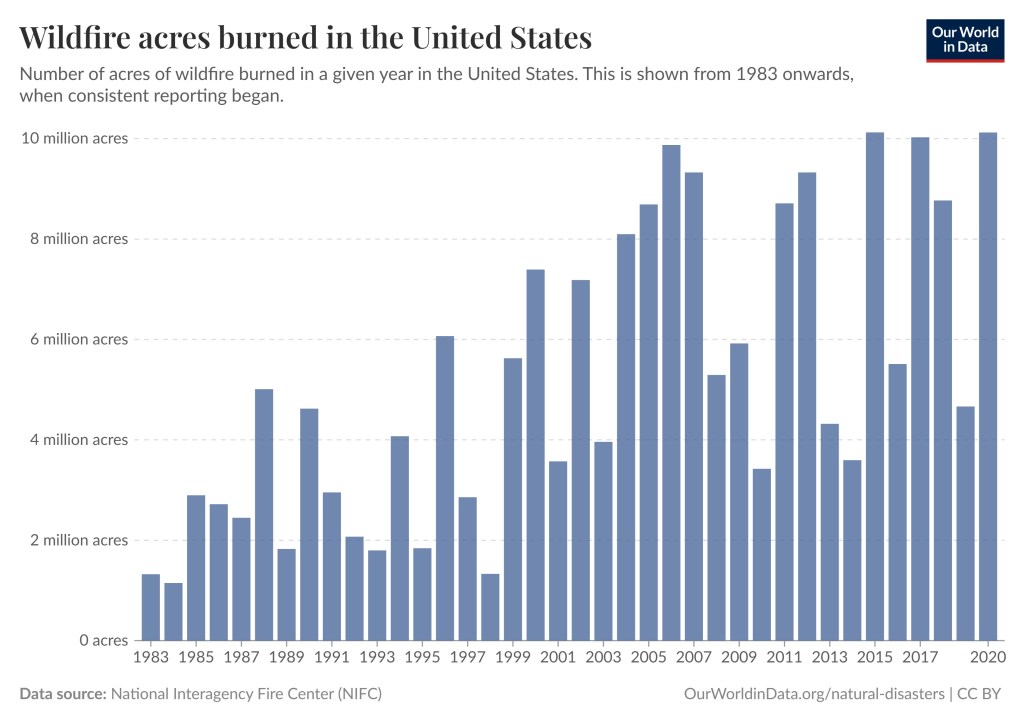
Super fact 52 : Climate change, including increased heat, extended drought, and a thirsty atmosphere, has been a key driver in increasing the risk and extent of wildfires in the United States, particularly the western United States during the last two decades. The number of Wildfire acres burned in the United States has significantly increased even though the number of wildfires has not. Another important factor is forest management.

The graph consists of blue bars corresponding to a year starting in 1983 with the last bar being 2020. The bars show the number of million acres burned per year in the US. In 1983 and 1984 the bars show between 1 and 2 million acres burned. The following three years more than 2 million acres were burned. From 2015 to 2020 the number of acres burned annually is between 5 and 10 million acres | Climate change worsens wildfires in the US
Wildfire acres burned in the United States. Number of acres of wildfire burned in a given year in the United States. This is shown from 1983 onwards, when consistent reporting began. Data source : National Interagency Fire Center (NIFC). Presented by OurWorldinData/natural disasters.

To some people this does not come as a surprise. However, due to the complexity of the issue combined with political spin, this is a surprise to me, or even something they refuse to believe. I’ve come across many people who are surprised to hear that there really is a connection between climate change and wildfires in regions of the world which are getting dryer and hotter due to climate change. There are also others who are surprised to hear about the complex picture and the importance of good forest management. In any case, since it is a surprising fact to many, and an important fact, I consider it a super fact.

As super fact 52 above states, Climate change is a key driver in the worsening of wildfires in the US, particularly in the American West. A 2016 study published in PNAS found that human-caused climate change caused over half of the documented increases in fuel aridity since the 1970s and doubled the cumulative forest fire area since 1984. I can add that we know that Climate Change, or if you call it Global Warming, is Happening and is Caused by us, primarily due to our burning of fossil fuels. I can also add that Scientists Agree that Global Warming is happening and that we are the Cause.

Wildfires and the Complex Statistical Picture

In general, you can’t look at wildfire statistics and draw conclusions without considering the context. Below are some considerations.

  • Wildfires are not started by climate change or poor forest management. They are started by lighting, falling powerlines, campfires that are not properly put out, and sometimes by arson. That doesn’t mean that climate change and poor forest management does not increase the risk and extent of wildfires.
  • Research organizations such as NOAA recognize that wildfire is a natural part of the western US ecosystem. However, climate change is significantly exacerbating the problem by creating conditions more conducive to intense and widespread wildfires.
  • Suppression of fire in certain ecosystems may in fact increase the likelihood that a wildfire will occur.
  • There are wildfires started intentionally to prevent future wildfires.
  • In the past, forests evolved with frequent, low-intensity fires that helped clear out underbrush. They can have ecological benefits. Therefore, the number of wildfires may not have increased over the last 100 years.
  • Local conditions and forest management have evolved through time complicating the wildfire statistics around the world.
  • In the past reporting was not always consistent.

That does not mean that we don’t know whether climate change worsens wildfires or not. Research organizations such as NASA, NOAA, NOAA (again), NOAA on LA fires , Ohio University, are all in agreement on the fact that Climate change has been a key driver in increasing the risk and extent of wildfires in the United States. Other organizations such as AccuWeather, Texas 2036, the Nature Conservancy, IFAW, American Progress, and the New York Times concurs.

The photo shows tree trunks on fire and professional firefighters extinguishing a large, high-priority part of a forest fire.
Highly skilled hotshot firemen crew working in a challenging remote area with flames reaching the treetops. Shutter stock asset id: 2258645599 by Gorodenkoff

Fix Our Forest Act

Climate change is a huge problem that is going to take decades to tackle and the whole world needs to be involved in that effort. However, we can quickly address wildfires here in the US, especially the American West by addressing the other half of the problem, forest management. There is currently a bill in congress called the Fix Our Forest Act that does that. It streamlines and enhances forest management based on the science. In the house of representatives, it has the number H.R.471 and in the Senate it is S.1642.

I was recently in Washington DC to do volunteer lobbying for these bills. You can read about it here.


To see the other Super Facts click here

My CCL Adventure in Washington DC

It is a long post. Just read the parts that seem interesting to you.

I am a member of a non-partisan volunteer organization called the Citizens Climate Lobby (CCL) which seeks to create political will for a livable future. At one point I was quite skeptical and doubtful of global warming or climate change or climate disruption whatever you like to call it. The reason was that I almost exclusively read and watched rightwing news media such as world-net-daily (tended to push conspiracy theories), Newsmax and Fox News.

I believed in the concept of global warming / greenhouse effect, it is basic science after all, but I thought that it was exaggerated and politicized and that it was promoted and distorted by left-wing agendas. I incorrectly believed that there was no scientific consensus on the issue. I also bought into the false narrative that this was about environmentalist ideology, politics, or even a sort of environmentalist religion, and not a real and serious problem. My disdain for environmentalists, my ideology, and my gut feelings certainly aided the propaganda in misleading me. In addition, I read a lot by Björn Lomborg and Patrick J. Michaels and I believed them.

After noticing a few red flags indicating that I was wrong I decided to take a deep dive into the topic, and I learned quite a bit. I learned that global warming / climate change, as well as ocean acidification is real and that it is caused by us, primarily because of our burning of fossil fuels. It helped that I had a background in physics. You can read more about my journey here.

I joined CCL because I had been so wrong, at the same time as I felt that I had finally learned something substantial about the subject, that the topic is important, and I also liked that CCL is non-partisan.

As the name Citizens Climate Lobby suggests we do a lot of lobbying. It is not the kind of paid lobbying that is done by professionals and that is often associated with money. We are average constituents, average voters, with no money, who are visiting our legislators to give them information and opinions on legislation we support or don’t support. Since we are non-partisan, we visit both Democrats and Republican offices. We just had a CCL conference in Washington DC on Sunday, Monday and Tuesday. We were 800+ volunteers who visited 400+ Congressional offices in Washington DC on Tuesday July 22nd. That is why I have not been online much for about a week.

The photo shows about 400-500 well-dressed people standing in front of the Capitol in Washington DC. The people in the front row are holding a big American flag | My CCL Adventure in Washington DC
Roughly half of the CCL volunteers at 8:00AM on Tuesday July 22nd. The others were sleeping in but joined us later. In the background you see the Capitol.

On Tuesday I visited three Texas Congressmen, including Senator Ted Cruz (R, TXJR), Congresswoman Beth Van Duyne (R, TX24), and Congressman Marc Veasey (D, TX33). We also had a zoom call with Congressman John Carter’s (R, TX31) office (the fourth meeting). I am the CCL liaison for Senator Cruz’ office and I was the one who organized our visit, from our side. It was a brief visit with Senator Cruz and a substantial discussion with a couple of his staff. Ted Cruz does not always agree with us, but we had a friendly and interesting meeting, and he and his staff appreciated us being there. Below I have included three photos from my three Tuesday meetings.

My CCL Adventure in Washington DC
Senator Cruz hosts a Texas Tuesday Coffee for Constituents in Washington, DC on July 22, 2025. (Official U.S. Senate photo by Rebecca Hammel)
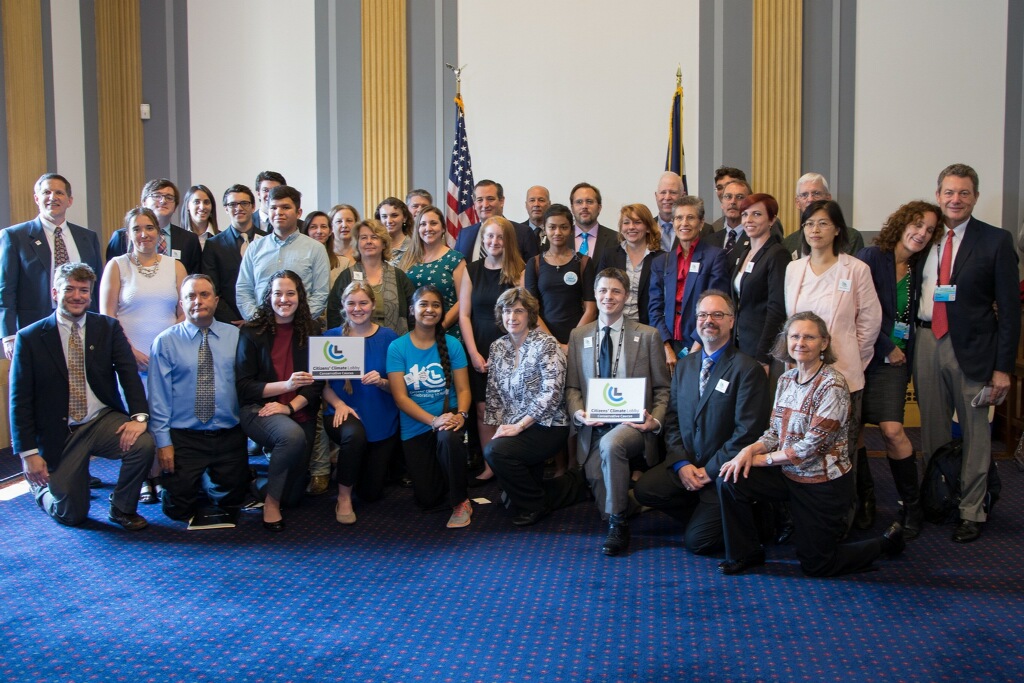
Ted Cruz is standing in the back between the flags. I am in the front row, second from the right wearing a blue suit. We are twelve people.
A photo of six people standing in front of Representative Beth Van Duyne’s Office. The legislative aide, Isabel de Antonio, is standing in the middle. There is also an American flag and a Texas flag.
CCL volunteers meeting with a legislative aide, Isabel de Antonio, working for congresswoman Beth Van Duyne, Republican, Texas district 24 (that’s where I live). Isabel de Antonio is the one wearing a white shirt. I am standing on the far left. Eric, a CCL volunteer, is taking the photo and is not in the picture.
A photo of seven people standing in front of Representative Marc Veasey’s Office. The legislative aide, Mike Burnside, is standing in the middle. There is also a Texas flag.
CCL volunteers meeting with a legislative aide, Mike Burnside, working for congressman Mark Veasey, Democrat, Texas district 33. We also had a constituent and liaison representing 192 CCL volunteers in TX33 call into the meeting. Mike Burnside is the one wearing a white shirt. I am standing second from the left.

Overview of the Five Asks

With this post I wanted to show our Asks, so that readers know what we ask from our politicians. I do not expect anyone to read the CCL handouts below. I am including them to illustrate how we approach legislation. Don’t worry about the details. Trust me, the actual bills are even longer (the poor staffers of the politicians must read it). I can add that our Vice President of Government Affairs (CCL employee), Jennifer Tyler, was the Deputy Chief of Staff and Legislative Director for the Republican Congressman John Katko (NY-24). Having been a prominent leader in the Republican Party she is able to craft legislative Asks that not only appeal to Democrats but to Republicans as well.

I can add that CCL has a small staff consisting of highly educated people including climate scientists and policy experts. The CCL board features prominent climate scientists and prominent politicians and economists. George W. Schulz, Ronald Reagan’s Secretary of State, was (well is as an honorary member) on the CCL board but he passed away. I also think that CCL volunteers tend to be more nerdy than average. A lot of our volunteers are scientists, physicians, brain surgeons, engineers, PhDs, psychologists, authors, artists, businessmen, business owners, oil executives, etc., but naturally everyone is welcome. We are a well-informed volunteer organization and as a result both Democratic and Republican offices see us as a great resource for information and ideas.

These were our six Asks. As you can see, not all of them apply to both parties. One Ask is only for Republicans because Democrats are already fully onboard. One Ask is only for Democrats because the Republicans are already fully onboard. Another Ask is only for Republicans because there’s no chance Democrats will support it (but Republicans have more votes). In other words, an emissions and pollution reducing mix of Asks that overall is bipartisan.

  • Support the Clean Energy Transition – Fund Key Clean Energy Programs in FY26 Appropriations – Democrats + Republicans.
  • Support the Clean Energy Transition – Fix Clean Energy Tax Credit Implementation – Republicans only, because Democrats are already full onboard.
  • Support the Clean Energy Transition – Advance Smart Permitting Reform for Energy Projects – Democrats + Republicans but different handouts.
  • Support H.R. 471, the Bipartisan Fix Our Forests Act – Democrats only because Republicans already fully onboard.
  • Support S. 1462, the Bipartisan Fix Our Forests Act – Democrats + Republicans.
  • Support Foreign Pollution Tariff Legislation – Republicans only, because we know Democrats are against it.

Funding Clean Energy Research

Fund Key Clean Energy Programs in FY26 Appropriations was the first part of three parts for our primary Ask : Support the Clean Energy Transition. The 2025 Budget Reconciliation Bill (One Big Beautiful Bill) cuts funding from two research organizations, the Office of Energy Efficiency and Renewable Energy (EERE) and the Advanced Research Projects Agency (ARPA-E). ARPA by the way is a prominent research organization, it is, for example, responsible for the creation of the internet. The reason we are asking to restore some of the funding for these organizations is because the world is moving towards clean energy and recently China has aggressively invested in clean energy. Cutting research in this area is a recipe for getting behind.

Clean Energy Tax Credits

The Clean Energy Tax Credits were significantly cut in the Budget Reconciliation Bill. It was specifically provision 48E, investment credits for wind and solar, 45Y, tax credits for wind and solar, 25C, tax credits for home efficiency improvements, such as insulation, energy efficient doors and windows, etc., that were cut. I should say that the 48E and 45Y for other types of clean energy, such as Nuclear, Geothermal, Hydro, and Biofuels, stayed, which we are grateful for.

The reason we are asking to restore some of the tax credits for wind and solar, is not that they need the tax credits to survive. Wind and solar energy are very cheap, and they are doing very well. However, they are prominent sources of clean energy and removal of the tax credits will significantly increase the energy cost for consumers, as you can see in the graph below. The loss of the credits will also result in the loss of jobs and investments in projects already underway. A list of the effected investments and projects in the US listed per congressional district can be seen in this link. Since virtually all Democrats already support the restoration of the clean energy tax/investment credits, we are only asking this from Republicans. Admittedly this is a tough one for them.

Smart Permitting Reform for Energy Projects

The third part of the Primary Ask is Smart Permitting Reform for Energy Projects. What many people don’t realize is that what is holding clean energy back the most is not the cost or time for building wind and solar. That is relatively easy. The big obstacle is getting permits to build the energy plants and permits to build transmission lines needed to bring the electricity to our homes. In both cases the process is typically at least ten years. However, by cutting red tape and streamlining the process it could be reduced to around a year.

This applies not only to wind and solar but to all types of energy, which is why Republicans tend to support permitting reform. Since most of the new energy coming online is wind and solar, and they often replace dirty coal, thus reducing emissions, we strongly support permitting reform. We have done the research, so we know that this is a very good way to reduce emissions. In this case we formulated the Ask differently for Republicans and Democrats.

Primary Asks Sheets

Portion of text -  Support the Clean Energy Transition for Affordable and Reliable Power. With household energy costs forecast to rise, we urge Congress to support targeted, pragmatic policies that enable clean energy to compete, scale, and deliver dependable and affordable power to Americans.
Our Policy Recommendations:
1. Fund Key Clean Energy Program in FY26 Appropriations
2. Fix Clean Energy Tax Credit Implementation
3. Advance Smart Permitting Reform for Energy Projects
As energy demand grows and extreme weather events strain the grid, clean energy can strengthen our domestic energy independence, enhance grid reliability, and reduce emissions—all while lowering costs, creating jobs, and spurring private-sector investment.
Our primary Asks for Republicans. We are asking the same thing from Democrats and Republicans, but the presentation is different. Notice that in both cases we are pointing out that the removal of the Clean Energy Tax Credits for Wind and Solar in the 2025 Budget Reconciliation Bill (One Big Beautiful Bill) will increase costs for consumers. In the Republican version we are pointing out that not funding research into clean energy will put us behind the rest of the world, especially China, which is aggressively pursuing development in clean energy.
Portion of text - Fund Key Department of Energy Clean Energy Prog. No Competing with China—or Cutting Costs—Without Investment in Innovation. Our global edge is at risk. Fix Clean Energy Tax Credit Implementation. Tax Credit Cuts Threaten Energy Security and Raise Costs. Advance Smart Permitting Reform for Energy Projects. Permitting Bottlenecks Are Holding Back American Energy | My CCL Adventure in Washington DC
Second page of primary Asks for Republicans.
Portion of text - Advancing Clean Energy for a Safer Climate and Affordable Power. Our Policy Recommendations:
1. Advance Smart Permitting Reform for Energy Projects
2. Fund Key Clean Energy Programs in FY26 Appropriations
The rollback of key Inflation Reduction Act provisions was a setback for both emissions reductions and affordable energy. These cuts make it harder to meet climate goals and will raise costs for American families | My CCL Adventure in Washington DC
Our primary Asks for Democrats. Notice that in this case we are not asking them to fix the Clean Energy Tax Credit Implementation. The reason being that they are already 100% behind it.
Portion of text - Fund Key Department of Energy Clean Energy Programs. Clean Energy Innovation Depends on Strong Federal Investment. We urge Congress to reject proposed cuts and fully fund the following programs: Office of Energy Efficiency and Renewable Energy (EERE). Advanced Research Projects Agency (ARPA-E).
Second page of primary Asks for Democrats

Fix Our Forest Act

Our first Secondary Ask is Support H.R. 471, the Bipartisan Fix Our Forests Act, when it Comes Back to the House. To explain, it was voted on in the house, sent to the Senate where they made some changes, so it needs to be voted on again in the house. This is an Ask that we reserved for Democrats. It was not because we thought Republicans wouldn’t like it but because they had already voted Yes for it unanimously. We know the Republicans like it. However, we needed to make sure the Democrats who were less favorable of it would not turn against it, which is why we are asking them to vote yes on it.

To explain what the bill is about, scientists have concluded that climate change and poor forest management are both making wildfires worse, at least in the United States. Out of control wildfires in turn make climate change worse. Climate change will take several decades to fix and requires the whole world to act. However, improving forest management we can do today for ourselves. To read the full text of the original house bill click here. To read the full text of the Senate version of the bill (S.1462) click here.

Portion of text - Support H.R. 471, the Bipartisan Fix Our Forests Act, when it Comes Back to the House. Reduce wildfire risk, improve forest health, and protect local communities.
Wildfires are a growing crisis, impacting nearly every state. Wildfire smoke crosses borders, harming air quality and public health across broad regions. The increasing severity of wildfires poses unprecedented threats to our public safety, health, and economy. However, with better forest management, we can reduce the severity of such fires and better protect communities. The House passed its version (H.R. 471) in March. In April, the Senate introduced an improved version (S. 1462), led by Senators Curtis (R-UT), Hickenlooper (D-CO), Sheehy (R-MT), and Padilla (D-CA). We believe the Senate version strengthens the bill and we urge you to support it when it returns to the House.
This is the house version H.R.471 of the Fix Our Forest Act. It already has full Republican support in the house, so we are only asking Democrats to support it.
Portion of text - Support S. 1462, the Bipartisan Fix Our Forests Act. Mitigate wildfires, improve forest health, and protect local communities. The Fix Our Forests Act incentivizes and streamlines the active management of our forests, while preserving and strengthening important environmental and community protections. The bill will make our forests and communities more resilient to wildfires.
This is the Senate version S.1462 of the Fix Our Forest Act. We are asking both Republican and Democratic Senators to support it.

Foreign Pollution Fee

The Foreign Pollution Fee Act S.1325 (full text in link) was introduced in the Senate by Senator Lindsey Graham (R). This is a resolution that if it becomes law would greatly reduce carbon emissions around the world, and yet it is pretty much only supported by Republicans. It might come as a surprise that there is a pro-climate resolution that’s almost entirely Republican, but it happens sometimes. Our goal is to get close to unanimous Republican support and with the help of a few moderate Democrats get it passed.

Some background, China emits more carbon pollution than any country on earth. On the other hand, there are 1.4 billion people in China and per capita they emit only half that of the United States, which comes in at number two with respect to total emissions. In addition, the United States is the country that has emitted the most carbon emissions over time. On the other hand, the US emissions are going down, unlike China’s, and more importantly in this context, certain products such as steel, aluminum, fossil fuels, etc., are produced creating a lot more emissions in China than in the US, which has cleaner manufacturing. For example, one ton of steel produced in China or Russia result in four times as much carbon emissions as the same ton of steel produced in the US. It is not fair to cleaner US manufacturers to import products from dirty manufacturers without taking into account the cost of pollution to all of us.

Portion of text - Make “Filthy Pollution Havens” Pay at the Border. Support Foreign Pollution Tariff Legislation. Through hard work and innovation, the United States is one of the cleanest and least-polluting countries in manufacturing. As President Trump has noted, other countries have “created filthy pollution havens,*” and their exports should not have a free ride in the US market | My CCL Adventure in Washington DC
Make “Filthy Pollution Havens” Pay at the Border. Support Foreign Pollution Tariff Legislation.

Washington DC Congressional Buildings

The congressional buildings are the three buildings that are part of the house of representatives, Rayburn, Longworth, and Cannon, and the three Senate buildings, Russel, Dirksen and Hart. I encircled them in red in the map below. If you are visiting several offices, there is going to be a lot of walking. Therefore, women should bring a comfortable pair of shoes in a backpack in addition to nice shoes for inside the buildings.

I can add that the offices in Rayburn are bigger and nicer than the offices in Longworth and Cannon, and Rayburn has the main nice cafeteria. Longtime congressman tends to have their offices in Rayburn. The same is true for the Senate. Russel has the nicest offices and the best cafeteria, and the long-time Senators tend to be in Russel. Ted Cruz is in Russel 167. He has a great office.

The map shows the Capitol, congressional buildings, part of the mall, US Supreme court, and library of congress.
This is a map of the Congressional buildings. The three houses of representatives’ buildings, Rayburn, Longworth and Cannon, are towards the bottom encircled by a red line. The three Senate buildings, Russel, Dirksen and Hart are towards the top left encircled by a red line.

In case you are interested, this is the full text of the 2025 Reconciliation Budget Bill H.R.1. The nickname for the bill is One Big Beautiful Bill. Warning, it is very big. Beautiful is a matter of opinion.

My Super Fact List

This is not a super fact post. Just an informational post. If you want to see my list of super facts, click the link below.


To see the Super Facts click here

Robotics And Leonberger Dogs

Daily writing prompt
On what subject(s) are you an authority?

So, on what subject(s) am I an authority? My understanding on what being an authority on a subject means is that it is being an expert with recognized credibility on that subject. However, the word “authority” has so many other meanings and it brings to mind the “appeal to authority fallacy”. The “appeal to authority fallacy” refers to appealing to influential people or organizations who may not necessarily be experts, and regardless of the evidence.

In science you don’t really have such authorities, you have experts who often disagree with each other. In the event almost all experts agree on a certain fact that has been thoroughly vetted you can trust that fact with nearly 100% certainty, and that is not appeal to authority but a probability argument. Therefore, I don’t really like the use of the word authority in this context. It is confusing. I would have preferred the question to be “In what subject(s) do you have recognized expertise?”

This is a screenshot of a pdf file. It says, “Reflex Control for Obstacle Avoidance and Self Preservation by Thomas Wikman. Submitted in partial Fulfillment of requirements for the degree of Ph.D. Thesis advisor Dr. Wyatt S. Newman. Department of Electrical Engineering and Applied Physics. Case Western Reserve University.”
This is the front page of my PhD thesis “Reflex Control for Obstacle Avoidance and Self Preservation”.

Robotics

Reflex Control for Obstacle Avoidance and Self Preservation

My PhD thesis was in Robotics, specifically Reflex Control for Obstacle Avoidance and Self Preservation. Therefore, you can say that I am an expert on Reflex Control for Obstacle Avoidance and Self Preservation, Reflex Control (in Robotics) as well as Robotics. My expertise has been recognized through my published research papers, the citing of those papers, my PhD thesis, and my peers including Rodney Brooks.

Rodney Brooks is a former director of the MIT Computer Science and Artificial Intelligence Laboratory, founder of several robotics research companies, and he is arguably the most famous roboticist in the world. In the 1990’s he was featured on the front page in national magazines such as Time Magazine several times. During my internship at the Robotics Lab at Sandia National Laboratory in Albuquerque, New Mexico in 1993, I spoke to Rodney Brooks about my research, and he congratulated me on my research, which he liked.

Briefly, reflex control in Robotics refers to functionally simple, quick, and reliable behaviors that override whatever more complex algorithms or humans (joystick / telerobotics) are commanding in case those algorithms or humans execute dangerous motion. Take for example, a robot moving quickly among multiple objects and the path planning algorithm generates a faulty command that would result in a collision when executed. The reflex control layer would detect the problem (assuming it knows about the objects) and halt the robot before it collided with the object. This would need to happen quickly, in milliseconds, and always in a failsafe way. After the collision has been avoided the system or the human can figure out what went wrong and figure out a new path.

To do this the Reflex controller needs to be embedded with the motion controller, and know the characteristics of the motors, the robot configuration, and mechanical characteristics, such as mass, friction model, inertia, etc., exactly. The result is that when you drive a robot around among multiple objects such as boxes hanging from the ceiling, coat racks, and sombreros, and other robots it will avoid colliding with these objects regardless of input from people or high-level path planning algorithms. It looked like the objects were protected by an invisible force field.

The Robotics Research Corporation Robot / RRC Robot, is a seven-jointed silver colored robot. It is mounted to the floor and surrounded by objects | Robotics And Leonberger Dogs
This is an old black and white photo of the Robotics Research Corporation Robot surrounded by objects including boxes hanging in the ceiling, a coat rack, and a control cabinet. I took the photo, and I created the software for the robot and placed the objects in its workspace.

Robot Kinematics

In addition, to “Reflex Control for Obstacle Avoidance and Self Preservation” or “Reflex Control for Robots”, which is very narrow field, I gained expertise in fields of robotics that are a bit wider. One such field is robot kinematics. That includes, for example, calculating the position, speed and acceleration of the tool tip (the end tip) of the robot from the position and motion of the joints of the robot. Or it could be calculating the possible joint angles from the position of the tool tip. The RRC robot was a seven-jointed robot so this could get complicated. I should say that when I worked for ABB Robotics (after my Ph.D) I created the kinematic models for 30+ of ABB Robotics robots. Therefore, I have expertise and recognized credibility in Robot Kinematics as well.

This is a stick figure drawing of the RRC robot for the purpose of defining the coordinate systems for each joint.
The drawing shows the seven joints, the seven possible rotations around those joints, the seven joint angles (the thetas), and the seven coordinate systems and their origos (the O’s) at each joint.

Robot kinematics can get complicated, at least for a seven-jointed robot like the RRC Robot. An example is the Jacobian, which is a matrix that relates joint velocities to end-effector / tool-tip velocities. The Jacobian is crucial for understanding and controlling robot motion, particularly for inverse kinematics and trajectory planning. Below is the Jacobian for the first four joints of the RRC robot. I spent an entire day deriving it. Depending on your eyesight it is difficult to read the scribbles, but it is a bunch of very long, mostly trigonometric equations. Don’t worry about understanding the matrix, it is just to show how complicated robot kinematics can get.

Hundreds of trigonometric expressions arranged in a 4 X 4 matrix.
First part of the 4-dimensional (first four joints) Jacobian for the RRC Robot.
Hundreds of trigonometric expressions arranged in a 4 X 4 matrix.
Second part of the 4-dimensional (first four joints) Jacobian for the RRC Robot.
Hundreds of trigonometric expressions arranged in a 4 X 4 matrix.
Third part of the 4-dimensional (first four joints) Jacobian for the RRC Robot.
Hundreds of trigonometric expressions arranged in a 4 X 4 matrix | Robotics And Leonberger Dogs
Fourth part of the 4-dimensional (first four joints) Jacobian for the RRC Robot.

Configuration Space in Robotics

Another subject I gained a lot of expertise in is configuration space or so-called C-space. It is related to robot kinematics. C-space is a mathematical representation of all possible configurations a robot can take. In C-space for a robot arm (like the RRC Robot) the coordinates are the joint angles instead of X, Y and Z.  For the seven-jointed RRC robot you have seven joint angles and C-space is thus seven dimensions. C-space is very useful if you succeed in representing obstacles in it. A point might become a curve, or multi-dimensional membrane in C-space, and a ball might become a multi-dimensional banana. I had a lot of fun creating algorithms for creating C-space with obstacles in it.

My Other Expertise

I also have a degree a master’s degree in engineering physics (Teknisk Fysik) from Uppsala University in Sweden. I should say that engineering physics in Uppsala was focused a lot on theoretical physics and modern physics as well as practical applications for physics. Case Western Reserve University later converted this degree to a master’s in electrical engineering. I loved physics and was a good student, but my special interest was the theory of relativity. Even though I had and still have a hard time with the General Theory of relativity and I studied the special theory of relativity way beyond what was required at school, and I read dozens of technical books on the subject. So, this is also sort of an area expertise for me.

Below are some links to topics related to the special theory of relativity on this website:

I spent at least 30 years working with software as a software engineer / robotics engineer and gained a lot of experience in software development. It was mostly embedded software but also graphical user interfaces, things you can see on a screen, and Networking Software Development. I worked a lot with Visual Studio, a powerful, expandable, and popular integrated development environment (IDE) from Microsoft.

I developed a lot of code using C++ and C#, .Net, WPF, but also other languages and libraries. I started with Visual Studio 97 (in 1997), then Visual Studio 6, Visual Studio .NET 2002, Visual Studio .NET 2003, Visual Studio 2005, Visual Studio 2008, Visual Studio 2010, Visual Studio 2012, Visual Studio 2015, Visual Studio 2017, but I never got around to Visual Studio 2019 and Visual Studio 2022. So, you can say that I am an expert on Visual Studio with C++ and C# and .NET (I am less of an expert on the other languages typically used with Visual Studio).

Later in life I also came to learn a lot about climate change / climate disruption / global warming / the greenhouse effect whatever you call it. I used to be skeptical about climate change, and I thought it might be politicized by the scientific community, but after some interesting red flags I took a deep dive into the subject, and I learned that climate change is very real and caused by us. I was politicized not the scientific community. There is a scientific consensus on the subject for very good reasons. I continued by reading dozens of climate science papers and several dozens of technical and non-technical books on the topic. Therefore, at this point I know more about it than a lot of people. Maybe expert is a strong word, but almost expert.

Least but not last

Being a Leonberger Dog Expert

I know a lot about Leonbergers because my family was lucky enough to live with one for thirteen years. His name was Le Bronco von der Löwenhöhle—but we called him “Bronco” for short. Bronco wasn’t our only dog, but our world wouldn’t have been the same without him. For instance, he once saved the life of our pug by fending off an attack from another dog. He probably saved our Labrador’s life, too, by sniffing out an impending insulin shock before it happened. Then there was the time he scared off a trespasser who’d been terrorizing my wife and other women in the neighborhood.

A big Leonberger is standing on a large red leather sofa and stretching out to give me a hug | Robotics And Leonberger Dogs
Bronco loved to dance and hug. Here he is giving me a hug (not yet fully grown).

Bronco is no longer with us, but even in his passing he was distinctive. Leonbergers tend to live less than nine years—but Bronco came very close to reaching his thirteenth birthday. In fact, he received an award for longevity called the “Grey Muzzle Award.”  We already knew he was a special dog, but we sent his DNA to two labs for research anyway. I wrote a book about our amazing Bronco and his many amusing adventures and included helpful information on Leonbergers for new owners and interested dog lovers. I also have a Leonberger website.

In the process of writing my book about Bronco and Leonbergers I came to learn a lot about Leonberger dogs, the Leonberger breed standard, their history, health issues, Leonberger organizations, health and care, etc. I became a bit of a Leonberger expert. If you are interested in the book, check it out here or here. You can also get it from Amazon in many other countries, Barnes & Noble, Chapters Indigo and many other bookstores. For more information check here.


To see the Super Facts click here

Review of Glacial by Chelsea Henderson

I recently read a very interesting book on the history of climate change politics; Glacial: The Inside Story of Climate Politics by Chelsea Henderson. Chelsea Henderson is a leader in the EcoRight movement, basically Republicans who care about the environment and climate change. She is a former senior advisor to Senator John Warner (Republican) and have held other positions in the US Congress. Her book is non-partisan. However, naturally she is accepting the reality of human caused global warming.

I should mention that the second last sentence of the seventh paragraph of my rather long review says this “As of very recently, a few days ago, those Tax Credits have been reversed.” Those few days ago have not yet happened. I thought Amazon would take longer to publish my review and I was predicting that the vote today/tomorrow on the Senate version of the Budget Reconciliation Bill (the Big Beautiful Bill) would allow it to pass. So those few days ago have not yet happened because Amazon was faster than I thought. Basically, the Budget Reconciliation Bill will roll back or phase out the clean energy tax credits enacted in 2022. For those who don’t know what a Budget Reconciliation Bill is, it is a bill that allows you to bypass the filibuster, and it is therefore typically a highly partisan bill.

Glacial The Book Formats

Glacial: The Inside Story of Climate Politics by Chelsea Henderson comes in four formats. I bought the hardback format.

  • Hardcover –  Publisher : Turner (August 6, 2024), ISBN-10 : 1684429579, ISBN-13 : 978-1684429578, 432 pages, item weight : 1.45 pounds, dimensions : ‎ 6.25 x 1.25 x 9.25 inches, it costs $ 23.11 on US Amazon. Click here to order it from Amazon.com.
  • Paperback –  Publisher : Turner (August 6, 2024), ISBN-10 : 1684429587, ISBN-13 : 978-1684429585, 432 pages, item weight : 1.34 pounds, dimensions : ‎ 6 x 0.96 x 9 inches, it costs $13.10 on US Amazon. Click here to order it from Amazon.com.
  • Kindle –  Publisher : Turner (August 6, 2024), ASIN : B0CBQKTM46, ISBN-13 : 978-1684429592, 460 pages, it costs $12.44 on US Amazon. Click here to order it from Amazon.com.
  • Audio–  Publisher : Tantor Audio (August 13, 2024), Listening Length : 9 hours and 50 minutes, ASIN : B0DCCWRMJS, it costs $0.00 with membership on US Amazon. Click here to order it from Amazon.com.
Front cover of hardback format of the book Glacial: The Inside Story of Climate Politics by Chelsea Henderson | Review of Glacial
Front cover of hardback format of the book Glacial: The Inside Story of Climate Politics by Chelsea Henderson. Click on the image to go to the Amazon page for the hardcover version of the book.

Amazon’s Description of Glacial

It took nearly sixty years for a meaningful climate change bill to run the political gauntlet from Capitol Hill to the Oval Office. Why?

From mavericks to party standard-bearers, U.S. Senators, members of the House of Representatives, and presidential candidates have campaigned for four decades espousing their intentions to address the impacts of climate change.

Glacial: The Inside Story of Climate Politics is the first Inside-the-Beltway account to lay bare the machinations of what went wrong in Washington—how and why our leaders failed to act on climate change as mounting scientific evidence underscored the urgency to do so. Glacial tells a story of behind-the-scenes infighting and power struggles that blocked or derailed federal legislative progress on climate change, even in times of bipartisanship and with polls showing most Americans favored action.

The good news today is that public opinion is at its highest level of support for climate action, from corporate boardrooms embracing sustainability for business reasons to movements led by passionate younger generations who can’t afford to stand mute because it is they who will inherit the worst environmental catastrophes. If the missed opportunities in Washington are instructive, the path to doing so is clear. Our elected officials must use their offices not solely for the power and prestige it bestows upon them personally, but for the public good—and they must do so while there is still time.

My five-star review for Glacial

The Glacial Pace of Climate Policy

This book recounts the history of the politics around climate change starting with the LBJ administration and ending with the Biden administration. LBJ was the first commander in chief to warn his fellow Americans of a steady increase in carbon dioxide from the burning of fossil fuels.

The author, Chelsea Henderson is a leader in the Eco-Right movement, basically Republicans for the Environment. Some well-known names in this movement are former secretary of state James Baker (under H.W. Bush), and the former secretary of state under Ronald Reagan, the late George Shultz, Bob Ingliss former Republican Congressman from South Carolina, the founders of RepublicEN, the Republican congressman Carlos Curbelo who founded the Climate Solutions Caucus in Congress together with Ted Deutch, Republican Utah Senator John Curtis, and George Mankiw a notable conservative economist.

It may come as a surprise to some that once upon a time the environment was not a divisive left versus right issue. Nixon signed into law the Clean Air Act, the Clean Water Act of 1972, the Endangered Species Act, and founded the Environmental Protection Agency. Ronald Reagan and Margaret Thatcher led the ratification of the Montreal Protocol in 1987 – 1989 to phase out the global use of CFCs due to their detrimental effect on the ozone layer. As a result, emissions of ozone-depleting gases have fallen by 99 percent, and it saves an estimated 2 million lives from skin cancer every year. This was one of Ronald Reagans greatest successes and yet it has been mocked by some subsequent Republican Presidents.

The book also talks about the history of acid rain and our fight against that. Margaret Thatcher, a chemist, was very concerned about the greenhouse effect, or global warming, and so was George H.W. Bush and Reagan to some degree. Unfortunately, the words climate change has grown to be deeply polarizing due to decades long disinformation campaigns funded by fossil fuel companies and far right think tanks and talk show hosts.

Another factoid that might surprise readers is that in 1957, scientists working for Humble Oil, later known as ExxonMobil, sounded the alarm on the greenhouse effect / global warming caused by burning fossil fuels. However, the executive leadership decided to deride the type of work its own scientists had done. The same thing happened on later occasions and Exxon funneled a lot of money into anti-climate change think tanks.

As the evidence that carbon dioxide was causing the greenhouse effect (or global warming or climate change) became increasingly indisputable in the 1990’s the fossil fuel industry and far right think tanks, and conservative talk show hosts, started to push back on the science very hard, by spreading misinformation, insulting and attacking scientists, environmentalists, and politicians taking a stand they did not like. Koch industries, the American Petroleum Institute and the Global Climate Coalition (GCC), which contrary to what the name seems to imply, opposed climate action, teamed up to fight climate action.

However, it was not only people on the right doing this. Democrat politicians from coal districts also opposed measures on global warming. Clinton and Gore tried make progress on the issue, but it became politically unworkable. The book explains what happened during the Contract with America episode, the Kyoto protocol, etc.

However, the issue of climate change was not purely a right versus left. Some Republican leaders such as Senator John McCain and Mitt Romney championed climate action (perhaps on and off and on again) and the George W. Bush administration contained both pro-fossil advocates such as Dick Cheney and those favoring action on climate change such as Treasury Secretary Paul O’Neill, Condoleezza Rice, Christine Todd Whitman, and Colin Powell.

Later during the Obama administration there was a climate change bill that was very close to passing, the Waxman-Markey bill. The bill passed the house but when it was going to be voted on in the Senate, Barbara Boxer (democrat) used her role as a committee chairman to change it and take it so far left that it became unpassable. She wasn’t against climate action, on the contrary, but she thought it would work.

I can add that the Tea Party, which had started out to oppose the national debt, but later focused on the culture war and opposed climate action made climate action more difficult. Well, it did not help that the oil and gas industry spent 175 million dollars lobbying against the bill in less than a year whilst environmental advocates spent only 22.4 million dollars lobbying for it, despite that being a record effort for environmental advocates.

The end of the book focuses on the Biden administration and the Clean Energy Tax Credits in the Inflation Reduction Act. This part of the book reads like a thriller because it was held up by one man, Joe Manchin, the Democrat Senator from West Virginia, who was pressured from all sides and kept changing his mind, until he finally decided to support it. As of very recently, a few days ago, those Tax Credits have been reversed. The history of action on climate change marches on.

By reading this book you will learn about a lot of people and their stories, politicians and scientists, who became embroiled in the climate change issue, for or against, George E. Brown, Dr. Roger Revelle, Dr. James Hansen, Katherine Hayhoe, Al Gore, Joe Lieberman, Rafe Pomerance, Speth, Shimberg, Senator John Chafee, John McCain, Mathew Stembridge, Rick Boucher, John Warner, Alex Bozmoski, Bob Ingliss, Lindsey Graham, John Sununu, Rahm Emmanuel, Congressman Joe Barton, Dick Cheney, Tom DeLay, Scott Pruitt, Lee Iacocca, Senator Inhofe, Rush Limbaugh, Harry Reid, Mitch McConnell, Myron Ebell, and many others. You will also learn about terms that relates to the American form of Democracy, the filibuster, budget reconciliation, appropriation, the parliamentarian, the various senate and house committees and caucuses, how bills are created and passed, an Omnibus bill, etc.

If you are interested in political history, the history of climate change politics, and the stories of the people involved, then this book is for you. The author explains all the terms used and it is not a complicated book. The book reads like a journey through political history, and you will learn thousands of facts and anecdotes. If you are a somewhat older reader, like me, you will be reminded of the events from the past and you will recognize people, and what they said, and the chaos, and the complexities, and all the hoopla, and you will think to yourself, what a crazy world politics is.

I also think that the book gives you a perspective of where the politics have been and where it might be going. Despite the many setbacks in the past, this book will give you reason for optimism. The younger generation both on the left and the right are more willing to accept the science and are more willing to embrace action on climate. Well, I guess it is their future. The world is moving forward, and it is decarbonizing, no matter what we do. Overall, I think the book is entertaining and fascinating and I highly recommend it.

Advance Praise for Glacial: The Inside Story of Climate Politics by Chelsea Henderson on a blue and red background. The praise for the book is by former South Carolina Congressman Bob Ingliss and environmentalist and author C.K. Westbrook.
Back cover of hardback format of the book Glacial: The Inside Story of Climate Politics by Chelsea Henderson. Click on the image to go to the Amazon page for the paperback version of the book.

Other Posts Related to Climate Change, Environment or Clean Energy


An update : The Senate version of the Budget Reconciliation Bill passed today (7/1 – 2025). The phase out of the clean energy tax credits stayed, as I predicted, but the excise tax on renewables that the Senate previously added to the bill was removed in the last minute, which is good news for those who care about the environment.


To see the Super Facts click here

There are many environmental success stories

Super fact 46 : There are many serious threats to the environment that we need to take seriously. However, there are also many environmental success stories that we tend to forget about.

It is important to remember the environmental success stories because if we forget about them, it breeds despair, which in turn discourages people from acting and doing the right thing. Denial and Despair are two seemingly opposite emotional reactions that both hinder action on problems. I consider the existence of the many important environmental success stories a super fact because even though it is undeniably true that there are many environmental success stories, some truly amazing, it comes as a surprise to many.

Below I am listing six environmental success stories that I previously chose to be super facts. Super facts are important and true facts that are surprising and perhaps even shocking to many, or widely misunderstood, or disputed amongst the public, but not seriously disputed amongst the experts/scientists. Super facts are facts that are very special and that I think we should be aware of these facts. I should add that this is just a sample of environmental success stories. There are many more.

Super Fact 29:

EV Cars Indeed Emit Less Carbon Pollution

EV Cars emit less pollution than Internal Combustion Engine Cars, even considering manufacturing, disposal and many EV Cars being charged by dirty grids. The basic reason for this is the much higher efficiency of EV cars. EV cars emit significantly less greenhouse gases than internal combustion engines even considering construction of fuel production facilities, production of the car, the battery, and the fuel, vehicle operation and disposal. For more information click here.

The histogram graph shows that if you consider construction of facilities, manufacturing of vehicle and battery, production of fuel, vehicle operation as well as disposal the total average greenhouse gas emissions from EV cars is 52% less | There are many environmental success stories
Lifecycle greenhouse gas emissions comparison of average gasoline car and average EV. This graph is taken from the US Department of Energy.

Super Fact 35:

Natural Disasters Kill Less People Now Than 100 Years Ago

Natural disasters kill a lot less people now compared to 100 years ago. That is despite a larger population and despite the fact that climate change has increased the frequency and intensity of many types of natural disasters. Surveys by Gap Minder show that this fact is quite surprising to people and therefore it is a super fact. To read more about this super fact click here.

The reason for the fewer deaths from natural disasters is not that there are fewer natural disasters. It is because we are now much better at predicting, handling and recovering from natural disasters. Our warnings systems, rescue systems and healthcare have improved significantly. The graph below from Gap Minder illustrates the decline in deaths from natural disasters.

The graph shows 300 to 400 thousand annual deaths at the beginning of the 20th century, then 971 thousand annual deaths in the 1930’s, then it continuously gets lower until the annual deaths in the 2010 to 2016 period is 72 thousand deaths per year.
This graph from the Gap Minder article shows the annual deaths from natural disasters.

Super Fact 41:

Emissions of ozone-depleting gases have fallen by 99 Percent

Largely thanks to the Montreal Protocol in 1987 the emissions of ozone-depleting gases have fallen by more than 99%, 99.7% to be exact, according to Our World in Data. This has resulted in the halt of the expansion of the ozone holes. The reduction in emissions of  ozone-depleting gases is saving millions of lives every year. To read more about this astounding success click here.

The NIH estimate that the Montreal Protocol has prevented 443 million cases of skin cancer worldwide, 2.3 million skin cancer deaths, and 63 million cases of cataracts in the United States alone. Globally, it is estimated that the Protocol has saved an estimated 2 million people from dying from skin cancer each year. The graph below is taken from Our World in Data.

Gases visualized in the diagram are CFCs, Halons, HCFCs, Carbon Tetrachloride, Methyl Bromide, Methyl Chloroform. The diagram shows a peak around the end of 1980’s | There are many environmental success stories
The phase out of six ozone depleting gases. Data source UN Environment Program (2023).

Super Fact 42:

Developed nations have successfully reduced carbon emissions

The developed nations (rich countries) have reduced their carbon emissions since the 1990’s despite continued GDP growth, even if we take offshore production into account. In addition, many developing countries have succeeded in reducing their emissions as well. Other fast-growing developing countries have flattened or at least slowed their increase in carbon emissions. Many countries have decoupled economic growth from CO2 emissions.

In other words, we do not need to increase carbon emissions or burn more fossil fuels to grow the economy. To read more about this promising development click here.

The graph shows three plotted graphs, a dark blue one showing GDP per capita, a light blue one showing UK carbon emissions per capita and a red one showing trade adjusted carbon emissions per capita. The GDP graph is increasing by more than 50% over 33 years and the CO2 emissions per capita graph is decreasing by almost 60% and the trade adjusted carbon emissions decline by almost 40%.
Data source: Data compiled from multiple sources by World Bank (2025); Global Carbon Budget (2024); Population based on various sources (2024). Note: GDP per capita is expressed in international dollars at 2021 prices. Graph taken from Our World in Data.

Super Fact 44:

Sulfur dioxide pollution has fallen by 95 percent in the US

Sulfur dioxide pollution has fallen by approximately 95 percent in the US since the 1970s. This significant reduction is primarily due to regulations like the Clean Air Act. Global sulfur dioxide pollution has also fallen but not as much. To read more about this success story click here. If you visit the aforementioned link you will also see that there are many other pollutants that we have successfully curtailed.

The graph shows a steep increase towards the end of the 19th century with a peak in 1973, followed by a steep decline |There are many environmental success stories
US sulfur dioxide pollution since 1800. US Emissions peaked in 1973. Data Source: Hoesly et al (2024) – Community Emissions Data System (CEDS). This graph is taken from this page in Our World In Data.

Super Fact 45:

Deforestation has peaked

Deforestation peaked back in the 1980s, meaning that is when it was worst. Deforestation has not stopped but the rate of deforestation has slowed as a result of government policies, corporate initiatives, and international agreements.

Overall, we are still losing forests. We had a 47-million-hectare loss of forest in the last decade, which is very bad, but that is better than the 151-million-hectare loss of forest in the 1980s. For temperate forests we have succeeded in reversing deforestation, which means that temperate forests are now gaining forest. To read more about this topic and how government policies, corporate initiatives, and international agreements have slowed the rate of deforestation you can click here. This change in deforestation rate is illustrated by the graph below, which is taken from Our World in Data.

The graphs show that during the 1700’s and the first half of the 1800’s the loss of forests was 19 million acres per decade. From the mid-1800’s to 1920 it was roughly 30 million acres per decade and from the 1920 and on it was 115 million acres per decade until the 1980s and the first half of the 1990s when it was 151 million acres per decade. Since then, it has fallen and in the last decade forest loss was 47 million acres | There are many environmental success stories
Decadal losses in global forest over the last three centuries. Decadal forest loss is measured as the average net loss every ten years, in hectares. This deforestation minus increases in forest area through afforestation. There is no single dataset that applies consistent or transparent methodology for deforestation over centuries. Two different datasets are therefore shown: these still shown the overall development and transition of forestation from temperate to tropical areas, but magnitudes should not be combined at the crossover point. Data sources: Pre-1995 data from Williams (2006). The second series is based on data from UN FAO Global Forest Resources.

Note : I am going on a trip with family and will return next Tuesday (5/27). During this time will not do any blogging. I love comments but I will respond to comments when I come back.

To see the other Super Facts click here