Magnetars Super Magnets in the Sky

Super fact 75 : Magnetars are a type of neutron star with extremely powerful magnetic fields ranging from 10,000,000,000,000 Gauss to 1,000,000,000,000,000 Gauss. In comparison, Earth’s magnetic field varied from about 0.25 to 0.65 Gauss at the surface. In other words, the magnetar magnetic fields are from 20 or 40 Trillion times to 2 or 4 Quadrillion times stronger than Earth’s magnetic field at the surface.

A bluish neutron star surrounded by impressive looking fields | rs Super Magnets in the Sky
Magnetar – neutron star in deep space. For use with projects on science, research, and education. 3D illustration. Shutterstock Asset id: 1138434620 by Jurik Peter

The magnetic fields of magnetars are trillions of times stronger than the sun’s magnetic field, which is 1 Gauss on a quiet sun surface and 2,000 to 4,000 Gauss in sunspots. The magnetic field of an MRI’s machine is also incredibly strong (2,000 Gauss to 100,000 Gauss). It is thousands to over a hundred thousand times stronger than Earth’s magnetic field. That’s why you should not have metals around an MRI machine. However, the magnetic field of a magnetar is still hundreds of millions to tens of billions of times stronger than the magnetic field of an MRI machine, and the magnetic field is not confined to a small machine but surrounds a neutron star and stretches far out into space.

If you placed a magnetar halfway to the moon from Earth (a magnetar is around 12 miles in diameter), it would erase all the credit cards on Earth (see video below). If you get close to a Magnetar (1000 kilometers) cars and other metal would float up in the air and the atoms in yourbody would stretch into rods making organic chemistry impossible and kill you. If you placed a steel beam on the surface of a magnetar the magnetic field would pulverize it and destroy the atoms.

In 2004 a magnetar named SGR 1806-20 located 50,000 light years from our solar system (700 million times farther than the planet Jupiter) had a starquake disturbing the magnetic field and sending out a gamma burst that disrupted radio communication on Earth. I consider the existence of magnetars a super fact because the existence of these super magnetic monsters is shocking and not well known amongst the public, and yet their existence has been confirmed.
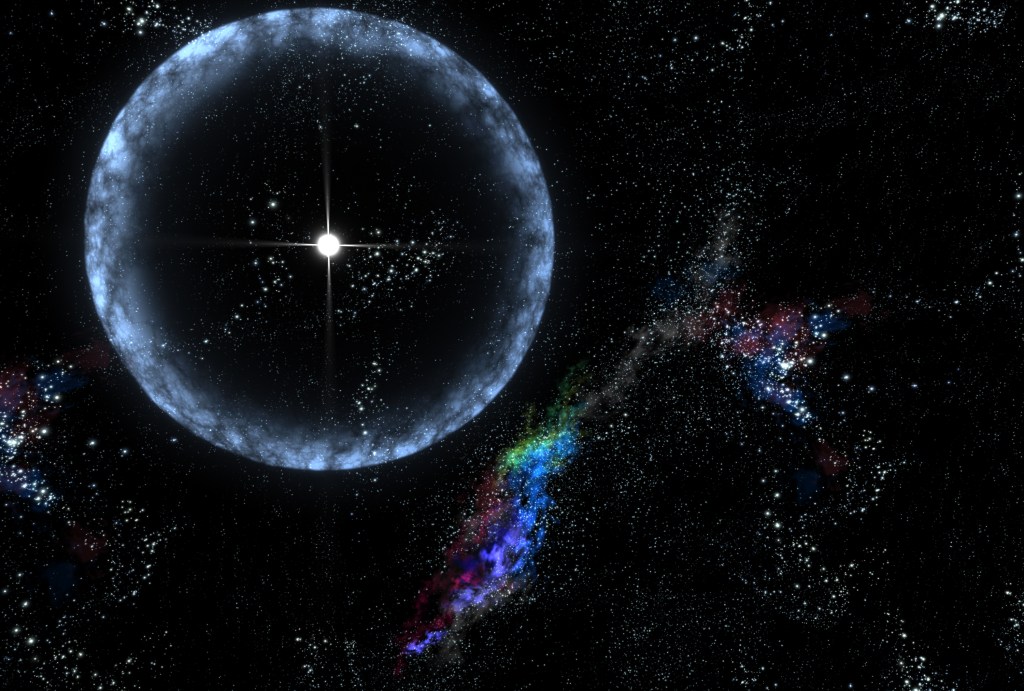
The picture shows a bright magnetar surrounded by a bluish gamma ray burst and it is all set to a background of stars.
On 27 December 2004, a burst of gamma rays from SGR 1806−20 passed through the Solar System (artist’s conception shown). The burst was so powerful that it had effects on Earth’s atmosphere, at a range of about 50,000 light-years. U Harvard, Public domain, via Wikimedia Commons.

What Are Neutron Stars and Magnetars?

A neutron star is the gravitationally collapsed core of a massive supergiant star. The collapse causes it to become super compact and relatively small by volume. As the name implies the atoms are crushed, and protons and electrons merge into neutrons, making the neutron star mostly neutrons. The typical diameter of a neutron star ranges from 10 to 25 km (6 to 15 miles) depending on its mass. Neutron star material is extremely dense.

A normal-sized matchbox containing neutron-star material would have a weight of approximately 3 billion tons, the same weight as a 0.5-cubic-kilometer chunk of the Earth (a cube with edges of about 800 meters) from Earth’s surface, or a very large mountain. In addition, the gravity on a neutron star is immense, about 100 billion to 200 billion times stronger than Earth’s gravity.

Magnetars are neutron stars with extremely powerful magnetic fields. They have the universe’s most powerful magnetic fields (trillions of times stronger than Earth’s) that power intense X-ray/gamma-ray bursts as its field decays, often seen as highly variable pulsars. They were first theorized in 1992 to explain Soft Gamma Repeaters (SGRs) and Anomalous X-ray Pulsars (AXPs). As of July 2021, 24 magnetars have been confirmed. According to the video below 30 magnetars have been confirmed in the Milky Way. There might be 3,000 in our Galaxy.
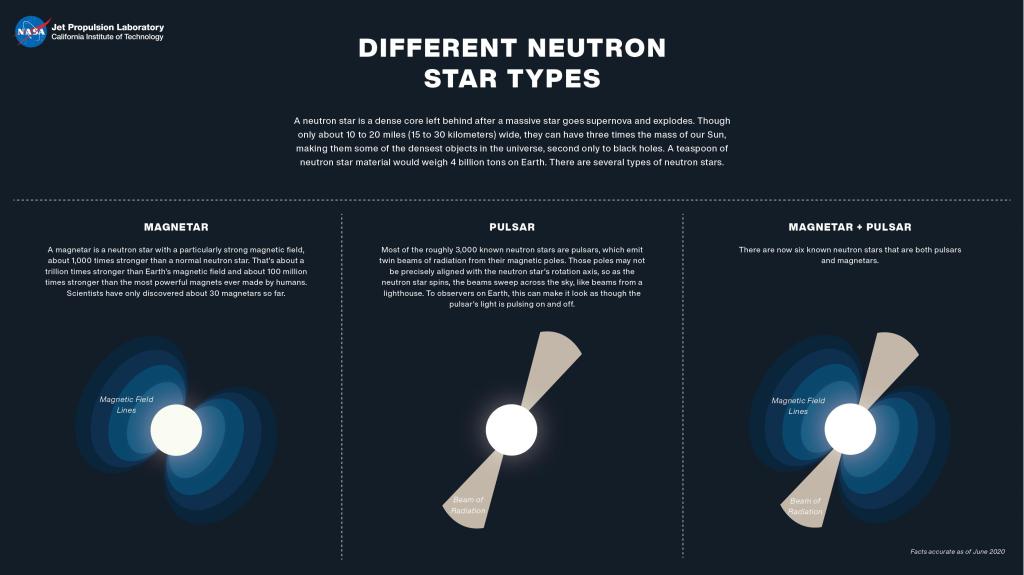
At top there is some text stating “A neutron star is a dense core left behind after a massive star goes supernova and explodes. Though only about 10 to 20 miles (15 to 30 kilometers) wide, they can have three times the mass of our Sun, making them some of the densest objects in the universe, second only to black holes. A teaspoon of neutron star material would weigh 4 billion tons on Earth. There are several types of neutron stars.” :  Below the text at the top there is a picture of a magnetar, a pulsar and a magnetar plus pulsar. The text for each picture says: Magnetar - A magnetar is a neutron star with a particularly strong magnetic field, about 1,000 times stronger than a normal neutron star. That's about a trillion times stronger than a normal neutron star. That's about a trillion times stronger than Earth's magnetic field and about 100 million times stronger than the most powerful magnets ever made by humans. Scientists have only discovered about 30 magnetars so far. Pulsar - Most of the roughly 3,000 known neutron stars ae pulsars, which emit twin beams of radiation from their magnetic poles. Those poles may not be precisely aligned with the neutron star's rotation axis, so as the neutron star spins, the beams sweep across the sky, like beams from a lighthouse. To observers on Earth, this can make it look as though the pulsar's light is pulsing on and off. Magnetar + Pulsar – there are about six known neutron stars that are both pulsars and magnetars. | Super Magnets in the Sky
Courtesy NASA/JPL-Caltech, Attribution, via Wikimedia Commons

Magnetar YouTube Video

Other extreme stellar objects

I wish all of you Happy Holidays and Happy New Year


To see the other Super Facts click here

Jesus was not born on Christmas

Super fact 74 : We celebrate the birth of Jesus on December 25th or December 24th, but it is quite unlikely that Jesus was born on those dates, and certainly not during the year zero.

This AI generated illustration feature baby Jesus in a crib, Mary and Joseph as well as some sheep. | Jesus was not born on Christmas
Jesus Mary and Joseph Birth – This content was generated by an Artificial Intelligence (AI) system. Shutterstock Asset id: 2560713955

I’ve come across many adults who seriously believe that Jesus was born on December 25th. To them it will come as a big surprise to find out that the date of Jesus’ birth is never mentioned in the Gospels, or elsewhere in the Bible, not in any of the non-canonical Gospels, nor in any known historical sources. In addition, Luke’s Gospel mentions (Luke 2:8) shepherds tending flocks outdoors at night, which is not consistent with the cold winter in Judea. Biblical scholars (see 4th and 5th paragraphs in link) suggest that the information in the Gospel of Luke regarding the vision of John the Baptists father, Zechariah, leads to the conclusion that Jesus was likely born in September.

When was Jesus Born?

Jesus was not born during the year zero, because there was no year zero. The year after 1 BC (or BCE) is 1 AD (or CE). This causes problems for various scientific disciplines such as astronomy, climate science and history. The Gospel of Matthew mentioned that the birth took place during the time of Herod the Great who died in the year 4 BCE. I can add that Herod the Great got his moniker “Great” because of his extensive construction of cities, palaces, fortresses, aqueducts, and theaters across Judea, as well as the expansion of the Jewish temple.

The Gospel of Luke (Luke 2:1-2) states that the birth of Jesus took place during the census of the Roman governor of Syria, Quirinius (Cyrenius), which was in the year 6 CE, ten years after the death of Herod. However, there were other census taken earlier and scholars suggest that perhaps Luke’s account is a misstatement and that Mathew’s is more realistic. They conclude that Jesus was most likely born between 6 BCE and 4 BCE.  As already mentioned it is very hard to pin down the time of the year when Jesus was born, but the month of September seems to be a likely candidate.

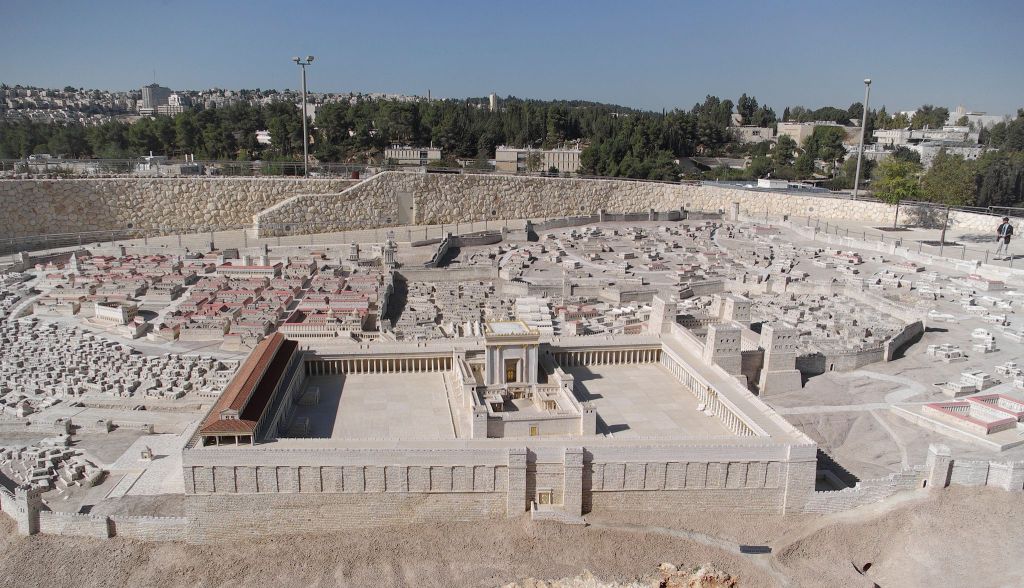
Herod's Temple as depicted on the Holyland Model of Jerusalem.
Herod was a builder and one of his projects was the expansion of the Temple. Herod’s Temple as depicted on the Holyland Model of Jerusalem. Berthold Werner, Public domain, via Wikimedia Commons.

Why is Christmas on December 25th?

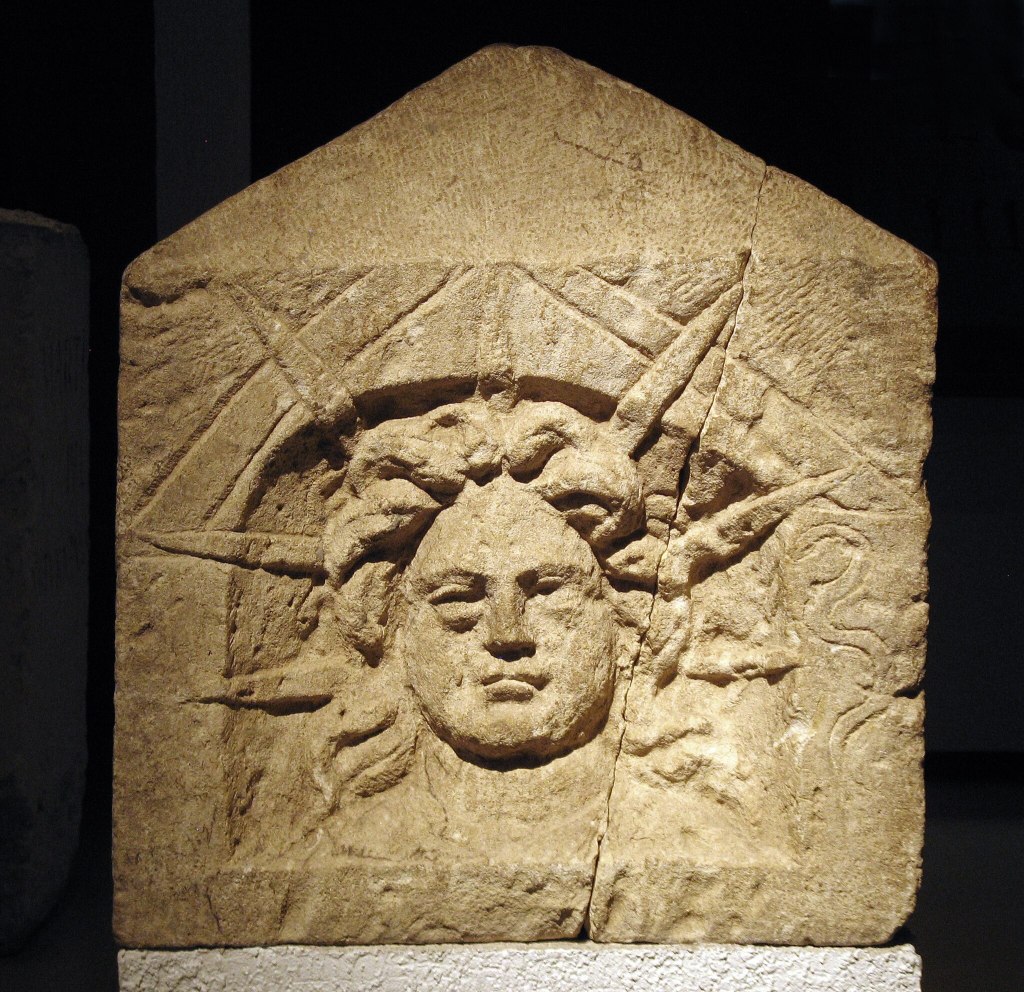
During the first few centuries after the birth of Jesus Christians did not celebrate his birth. The first mention of the birth of Christ on December 25 comes in the 3rd century CE by Hippolytus of Rome. The Roman festival Sol Invictus, celebrating the birth of the Sun God was Celebrated on December 25th. Many pre-Christian cultures marked the shortest day of the year, on December 21 or 22, as an important moment in the calendar, celebrating the “rebirth” of the sun. Germanic peoples celebrated Yule, and various Celtic and Mediterranean cultures held celebrations centered around the winter solstice. It is possible that December 25th was chosen as the day to celebrate the birth of Jesus so that people did not have to change the dates of their celebrations.

Relief in light brown stone featuring the face of the sun God. | A relief of Sol from Roman Lugdunum, 2nd–3rd century AD.
A relief of Sol from Roman Lugdunum, 2nd–3rd century AD. The Roman festival Sol Invictus was celebrated on December 25. Mark Landon, CC BY 4.0 <https://creativecommons.org/licenses/by/4.0&gt;, via Wikimedia Commons

Regarding Germanic peoples celebrating Yule. In my native country Sweden Christmas is referred to as “Jul” pronounced “Yool” / “Yuul”.  The word “Jul” directly comes from the Old Norse word “jól,” which referred to the pre-Christian midwinter festival (Yule in English). You can read about Scandinavian mythology here or here.

A Tomte wearing a red hat in a snowy winter forest.
Tomtar (plural of Tomte) or Nisse in Norwegian is a type of small magical people, or gnomes, related to Vitter folk. They are friendly and is an inspiration behind the Swedish version of Santa Claus. An illustration of a Tomte. Shutterstock ID: 2060057882 by PLIMPLUM.


Note this year Christmas Day is on 12/25/25


To see the other Super Facts click here

The Second Law of Thermodynamics Does Not Contradict Evolution

Super fact 73 : The second law of thermodynamics, or the fact that entropy is always increasing in an isolated system does not contradict evolution. Life is not a closed system. The environment is providing energy, the sun is providing energy, geological forces are providing energy, etc.

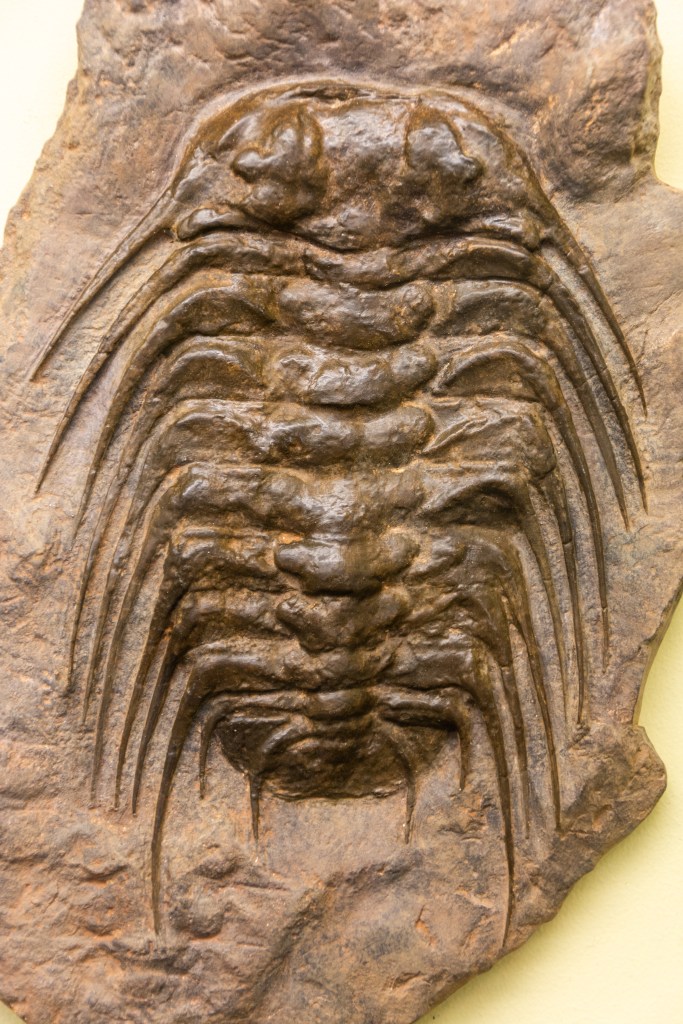
A photo of a trilobite fossil. | The Second Law of Thermodynamics Does Not Contradict Evolution
Does physical laws such as the second law of thermodynamics disprove evolution? This is a trilobite fossil. Shutter Stock Photo ID: 1323000239 by Alizada Studios

A lot of people have never heard of the second law of thermodynamics, or entropy and are unaware of the claim that the second law of thermodynamics contradicts evolution. So how can debunking this claim be surprising, and a super fact? The reason is that this is a popular claim among creationists and according to this Gallup poll 40% of Americans believe in creationism. The fact that this popular but false claim is rooted in a very basic misunderstanding of the second law of thermodynamics and what entropy is makes it super fact.

In the past I’ve read many creationist books that make the claim that the second law of thermodynamics contradicts evolution. One of them was Scientific Creationism (1985) by Henry M. Morris (the father of modern creation science), where he stated that the second law of thermodynamics says that everything tends towards disorder, making evolutionary development (ordering) impossible. The Death of Evolution: Restoring Faith and Wonder in a World of Doubt by Jim Nelson Black, another book I read, and which I gave a one star review on Amazon, makes the same claim. I’ve also come across a lot of people making this claim.

The people who make the claim that the Second Law of Thermodynamics contradict evolution typically do not understand the second law of thermodynamics and do not know what entropy is. Despite that fact they see it as a powerful argument against evolution. I’ve even seen it used against highly respected physics professors who “believe in”, well accept the reality of evolution, by people who had no understanding of the second law of thermodynamics. At one point I even believed the claim myself. Then I studied physics, and well, oops, I was forced to admit that I had been bamboozled.

The Second Law of Thermodynamics

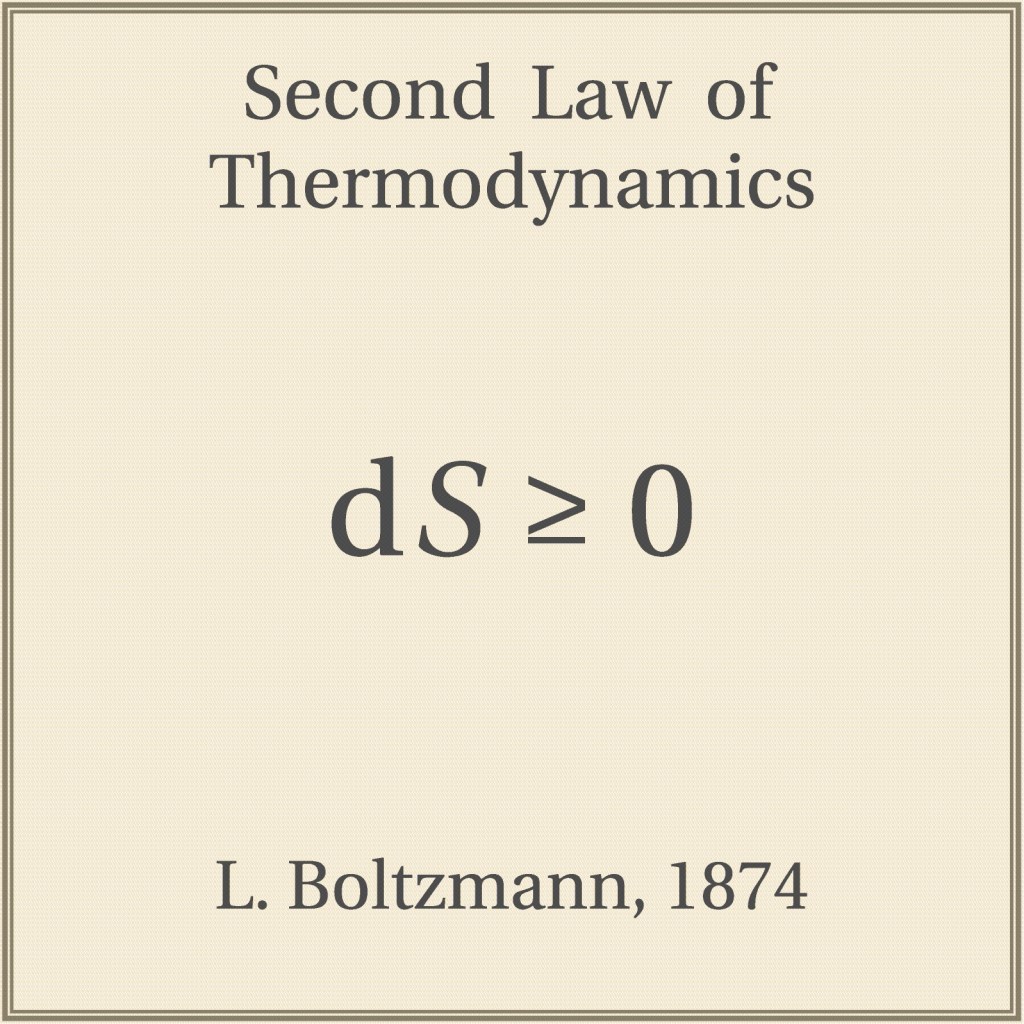
The Second Law of Thermodynamics states that the total entropy (disorder) of an isolated system always increases over time. This means that natural processes tend to move from order to disorder (within the isolated system). It should be noted that disorder is a popular but imperfect metaphor for entropy. Entropy is not the same thing as what people think of as disorder. In physics entropy refers to the logarithm of the number of microstates compatible with the system’s measurable macroscopic state. As molecules randomly arrange themselves into new macroscopic states, the number of possible microstates will increase.

It also means that heat will spontaneously flow from hotter to colder objects, but never the reverse. Another thing it means is that mechanical energy can be converted to thermal energy, but never the reverse. It turns out that those seemingly different statements are physically identical.

Second law of thermodynamics. S corresponds to entropy. Ludwig Boltzman’s formula from 1874
Second law of thermodynamics. S corresponds to entropy. Shutter Stock Vector ID: 2342031619 by Sasha701

It is very possible that the entropy of an organism is lower compared to a blob corresponding to all its molecules randomly distributed within a blob. However, that organism did not evolve in isolation inside a hermetically enclosed box without any energy from the outside. Life and evolution operate in an environment full of energy coming from the sun, the Earth, winds, oceans, geological forces, radiation, etc. Evolution does not take place in an isolated system.

It is also important to understand that within an isolated system, pockets of lower entropy can form if they are offset by increased entropy elsewhere within the system. That’s what the word “total” in total entropy means. Crystal formation is an example of creating local pockets of lower entropy (less “disorder”) within a system, but this is always accompanied by a greater increase in entropy in the surroundings. The Universe is an isolated system so the entropy within the Universe should always increase, but again the local pockets of lower entropy that evolution may create are accompanied by a greater increase of entropy elsewhere.

Crystal structure. This is model of a unique arrangement of atoms in a crystal.
Atoms in a crystal. The crystal represents a pocket of lower entropy. As this pocket of lower entropy forms there is equal of greater increase in entropy in the surroundings. What is true for the crystal is true for the molecules in living beings. Neither the formation of crystals nor the evolution of life contradicts the second law of thermodynamics. Asset id: 689181712 by BK_graphic.

Below is a YouTube video explaining how the second law of thermodynamics does not contradict evolution.


Entropy – Arrow of time

An interesting aspect of the second law of thermodynamics is that it makes entropy serve as an arrow of time. In general, the fundamental laws of physics are time reversible. The equations work the same forwards and backward in time. The equations for gravity, electromagnetism, and the strong nuclear force work the same regardless of time’s direction. An example is if you filmed a planet orbiting a star and played it backward, it would still follow the laws of motion the same way.

Throw a bunch of billiard balls on the floor and film them bouncing and hitting each other and the walls. If you then run the film backwards and forwards it would be far from obvious which is forward and which is backwards, except for the fact that the balls will slow down due to friction. However, balls slowing down due to friction is mechanical energy turning into heat, which is an example of the second law of thermodynamics. The fundamental laws of physics are time reversible, but the second law of thermodynamics is a notable exception. Entropy always increases in an isolated system (like the Universe). By measuring entropy, you can distinguish the past from the future, giving time a direction


Another evolution related post is: Evolution is a fact


To see the other Super Facts click here

How Our Planet Came to Life

I recently read a very interesting book on the history of our Planet Earth, Becoming Earth: How Our Planet Came to Life by Ferris Jabr. Life of various forms, microbes, fungi, plants, animals, etc., has had a large impact on climate, earth’s crust, the composition of the atmosphere, the oceans, and still do. This fact filled book is about this four and half billion history. Below is my review of the but first something about the book formats.

Becoming Earth Book Formats

Becoming Earth: How Our Planet Came to Life by Ferris Jabr comes in four formats. I bought the hardback format.

  • Hardcover –  Publisher : Random House (June 25, 2024), ISBN-10 : 0593133978, ISBN-13 : 978-0593133972, 304 pages, item weight : 2.31 pounds: ‎ 6.3 x 1.1 x 9.55 inches, it costs $16.68 on US Amazon. Click here to order it from Amazon.com.
  • Paperback –  Publisher : Random House Trade Paperbacks (April 1, 2025), ISBN-10 : 0593133994, ISBN-13 : 978-0593133996, 320 pages, item weight : 4.8 ounces, dimensions : ‎ 5.15 x 0.75 x 7.97 inches, it costs $ 13.57 on US Amazon. Click here to order it from Amazon.com.
  • Kindle –  Publisher : Random House (June 25, 2024), ASIN : B0CJTLBCDX, ISBN-13 : 978-0593133989, 423 pages, it costs $5.99 on US Amazon. Click here to order it from Amazon.com.
  • Audio–  Publisher : Random House Audio (June 25, 2024), Listening Length : 9 hours and 27 minutes, ASIN : B0CKM3P33F, it costs $0.99 on US Amazon with membership. Click here to order it from Amazon.com.
Front cover of Becoming Earth: How Our Planet Came to Life by Ferris Jabr.
Front cover of Becoming Earth: How Our Planet Came to Life by Ferris Jabr. Click on the image to go to the Amazon page for the hardcover version of the book.

Amazon’s Description of Becoming Earth

NEW YORK TIMES BESTSELLER • A vivid account of a major shift in how we understand Earth, from an exceptionally talented new voice. Earth is not simply an inanimate planet on which life evolved, but rather a planet that came to life.

“Glorious . . . full of achingly beautiful passages, mind-bending conceptual twists, and wonderful characters. Jabr reveals how Earth has been profoundly, miraculously shaped by life.”—Ed Yong, Pulitzer Prize winner and bestselling author of An Immense World

FINALIST FOR THE LOS ANGELES TIMES BOOK PRIZE • FINALIST FOR THE OREGON BOOK AWARD • AN AMERICAN LIBRARY ASSOCIATION NOTABLE BOOK OF THE YEAR

A BEST BOOK OF THE YEAR: Smithsonian, Chicago Public Library, Booklist, Scientific American, Nature

A BEST BOOK OF THE SUMMER: The Atlantic and NPR’s Science Friday

One of humanity’s oldest beliefs is that our world is alive. Though once ridiculed by some scientists, the idea of Earth as a vast interconnected living system has gained acceptance in recent decades. We, and all living things, are more than inhabitants of Earth—we are Earth, an outgrowth of its structure and an engine of its evolution. Life and its environment have coevolved for billions of years, transforming a lump of orbiting rock into a cosmic oasis—a planet that breathes, metabolizes, and regulates its climate.

Acclaimed science writer Ferris Jabr reveals a radical new vision of Earth where lush forests spew water, pollen, and bacteria to summon rain; giant animals engineer the very landscapes they roam; microbes chew rock to shape continents; and microscopic plankton, some as glittering as carved jewels, remake the air and sea.

Humans are one of the most extreme examples of life transforming Earth. Through fossil fuel consumption, agriculture, and pollution, we have altered more layers of the planet in less time than any other species, pushing Earth into a crisis. But we are also uniquely able to understand and protect the planet’s wondrous ecology and self-stabilizing processes. Jabr introduces us to a diverse cast of fascinating people who have devoted themselves to this vital work.

Becoming Earth is an exhilarating journey through the hidden workings of our planetary symphony—its players, its instruments, and the music of life that emerges—and an invitation to reexamine our place in it. How well we play our part will determine what kind of Earth our descendants inherit for millennia to come.

My five-star review for Becoming Earth

A Page Turner for People with a Curious Mind

This book gives us a brief overview of the natural history of Earth, emphasizing that not only is life impacted by geological forces, but life is influencing and even creating the composition of the atmosphere, impacting climate and even affecting geological forces. The author explains how microbes, plants, and animals transformed the planet. He is explaining how humans are transforming planet Earth and its climate through fossil fuel consumption, agriculture, and pollution. He is noting that we have altered more layers of the planet in less time than any other species, pushing Earth into a crisis. The author promotes the idea that Earth itself is a living organism (Gaia hypothesis). I am not sure if I entirely buy that idea, but he makes a good case for it.

The book covers a lot of history. Earth is four and half billion years old and a lot has happened. As a result, there are no deep dives into topics. However, the book is filled with hundreds of interesting facts and information, which makes the book a page turner to anyone with a curious mind. One major example of this is that about three billion years ago Cyanobacteria evolved a new type of photosynthesis that used sunlight, water, and carbon dioxide to create energy, while releasing oxygen as a waste product. This transformed the atmosphere and enabled complex life by allowing aerobic respiration to evolve. This invention turned the sky blue, gave us the protective ozone layer, but also caused climate change (snowball Earth) resulting in massive extinctions.

However, there is much more. Another example is that microbes helped transform Earth’s crust. During the first half billion years of Earth’s history, Earth was a water world save for volcanic islands. Trees communicate and assist each other via fungi (Mycorrhizas). Phytoplankton produces 50% of all oxygen, the invention of the Haber-Bosch process more than doubled the world’s crop harvest, there once was 30-60 million Bison roaming the plains, humans now emit 60 to 120 times more carbon dioxide each year than all the world’s volcanoes.

As I mentioned there are hundreds more interesting facts. He also presents a lot of facts and information regarding the destruction of the environment, which may not sit well with everyone. However, I think it is important information. The book includes a large number of references for further reading.

The book is well written and well organized and included fun personal anecdotes. It was easy and entertaining reading and like I said, it is a page turner to people with a curious mind. I loved this book and I highly recommend it.

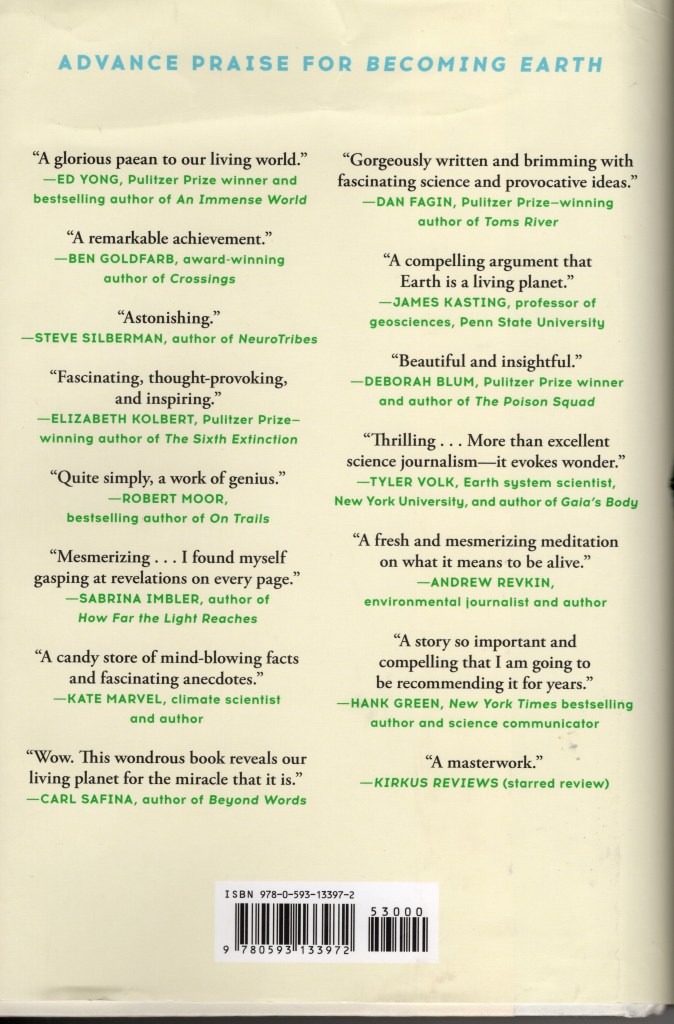
Back cover of Becoming Earth: How Our Planet Came to Life by Ferris Jabr.
Back cover of Becoming Earth: How Our Planet Came to Life by Ferris Jabr. Click on the image to go to the Amazon page for the paperback version of the book.


To see the Super Facts click here

Oxygen Blue Sky and Complex Life Exist Because of a Bacteria

Super fact 72 : About three billion years ago Cyanobacteria evolved a new type of photosynthesis that used sunlight, water, and carbon dioxide to create energy, while releasing oxygen as a waste product. This transformed the atmosphere and enabled complex life by allowing aerobic respiration to evolve. This invention turned the sky blue, gave us the protective ozone layer, but also caused climate change resulting in massive extinctions.

A microscopic photo of Cyanobacteria. They look like green blobs with small nucleuses. | Oxygen Blue Sky and Complex Life Exist Because of a Bacteria
An example of a Cyanobacteria. From Wikipedia. Luke Thompson from Chisholm Lab and Nikki Watson from Whitehead, MIT, CC0, via Wikimedia Commons

Cyanobacteria, also known as blue-green algae, are bacteria capable of oxygenic photosynthesis. Between 3.4 and 2.5 billion years ago they developed a new and very effective form of photosynthesis, which took advantage of highly abundant resources, using sunlight, water, and carbon dioxide turning it into sugar and releasing oxygen as byproduct. This is referred to as the Great Oxidation Event. You can read more about this event here, here, here, here, here, or in the book Becoming Earth by Ferris Jabr.

The atmosphere prior to the Great Oxidation Event was primarily composed of volcanic gases including nitrogen, carbon dioxide, water vapor, methane and ammonia, but almost no free oxygen. The Great Oxidation Event changed all this, but it likely took at least 200 million years.

Labeled educational bacteria internal structure scheme.
Cyanobacteria vector illustration. Biological blue green algae diagram with carboxysome, thylakoid and phycobilisome parts location inside cell. Asset id: 1687712761 by VectorMine

A Microbial Great Extinction and Snowball Earth

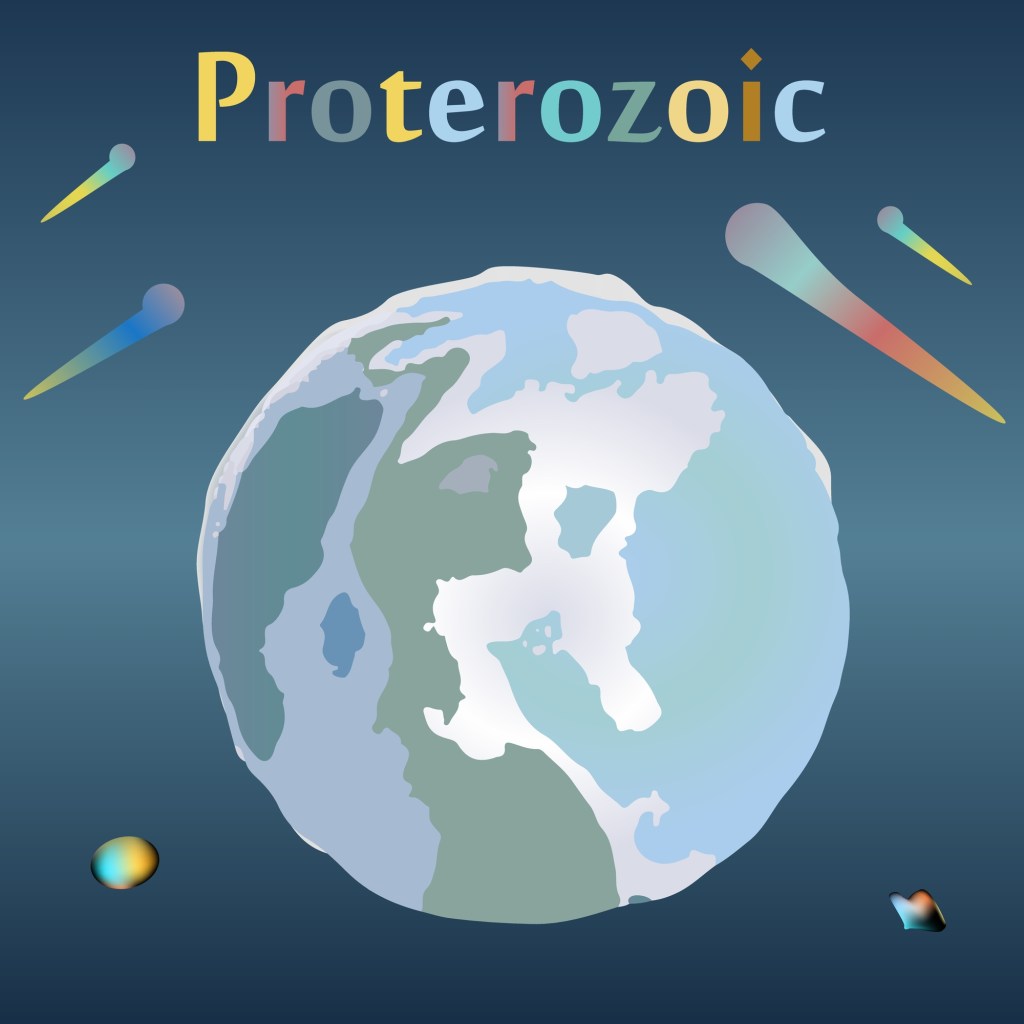
Oxygen was a toxic gas to many early microbes forcing them to adapt or perish. In addition, the change in the atmospheres composition changed the climate, resulting in a severe global cooling referred to as Snowball Earth. This caused a great extinction, perhaps the most severe extinction in Earth’s history. It is not included among the five mass extinction events in Earth’s history because it happened very early in Earth’s history when only primitive microbial life existed and fossil evidence from that time is nearly non-existent. The definition of a mass extinction event is that at least 75% of the world’s species are lost during a short period of time – geologically speaking. This period is not clearly defined but often defined to be two million years. It is very difficult to determine whether the great extinction following the Great Oxidation Event qualifies as a mass extinction event. To read about mass extinctions click here.

Ancient Earth almost entirely covered by ice and white snow. | Oxygen Blue Sky and Complex Life Exist Because of a Bacteria
Proterozoic era in the history of the Earth. Snowball earth. Global glaciation of the Earth. Asset id: 2010272753 by Elena Kelman

The Ozone Layer and the Blue Sky

Oxygen is also responsible for formation of the ozone layer in the atmosphere. The UV radiation from the sun split oxygen molecules, which consist of two oxygen atoms, into two separate atoms of oxygen, which then reacted with another oxygen molecule to generate ozone, and oxygen molecule consisting of three oxygen atoms. Ozone acts as a natural sunscreen to prevent harmful UV radiation from reaching the earth. Therefore, oxygen not only enables land dwelling complex multicell organisms to exist by allowing aerobic respiration to evolve, but also by protecting life from too much UV radiation.

As mentioned above, the atmosphere prior to the Great Oxidation Event was primarily composed of volcanic gases and almost no free oxygen. The color of the sky was likely orange, brown. As oxygen replaced the existing gases the sky slowly turned blue. Oxygen molecules along with Nitrogen molecules scatter blue light from the sun through a process called Rayleigh scattering, making the sky appear blue.

Cyanobacteria and The Great Oxygenation Event

It should be noted that there were other geological and biological processes that were responsible for this permanent shift in the Earth’s system, including changes in the composition of volcanic emissions and chemical reactions that allowed atmospheric hydrogen to escape to space, leaving behind an excess of oxygen molecules. However, whatever the exact mix of mechanisms, cyanobacteria were undoubtedly a critical source of accumulating oxygen. It is possible that tectonic activity altered the cycling and distribution of phosphorus and other nutrients essential for cyanobacteria. To read more see the book Becoming Earth by Ferris Jabr.


To see the other Super Facts click here