
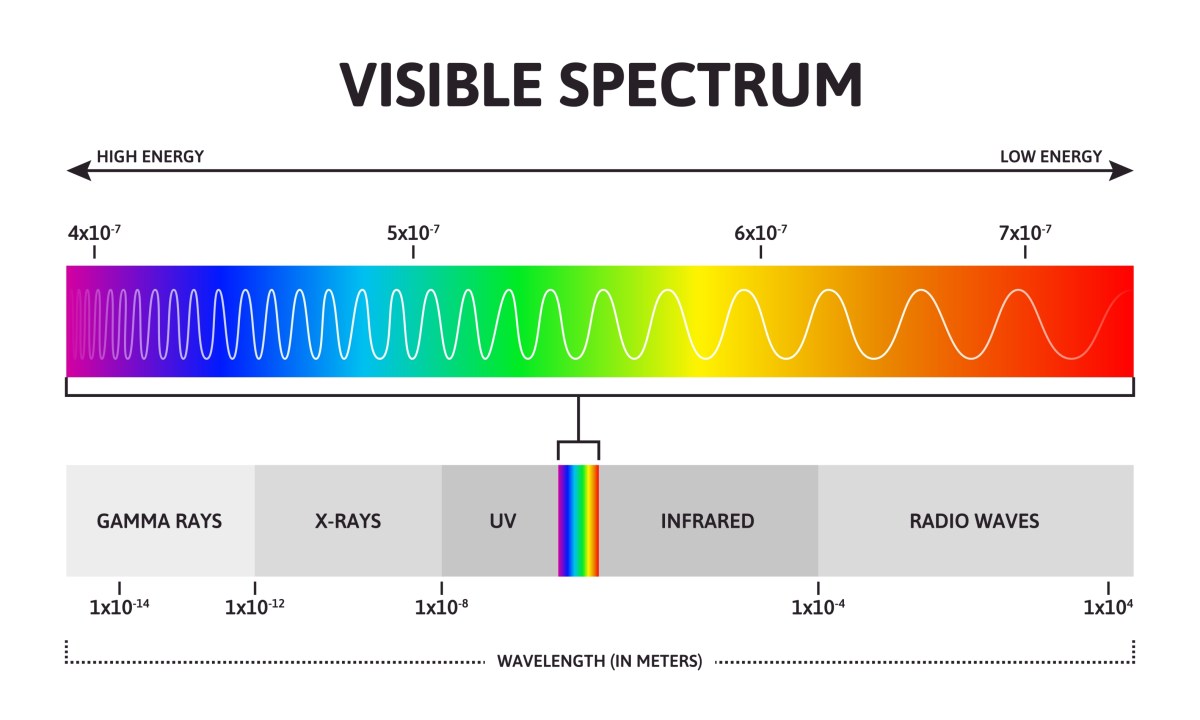
Superfact 94: Light is electromagnetic radiation. The electromagnetic spectrum we deal with goes from long wave radiation at a frequency of 0.3 Giga Hertz to gamma rays at 30,000,000,000 Giga Hertz, and far beyond. Light that is visible to humans goes from around 428,000 Giga Hertz to 750,000 Giga Hertz. This is a very thin sliver in the electromagnetic spectrum. In addition, many animals can see beyond the spectrum visible to humans.
Esther’s writing prompt: April 8 : Vision
Click here or here to join in.
If you consider wavelength instead of frequency, the electromagnetic spectrum goes from gamma rays at a wavelength of 0.00000000001 meters to long waves at a wavelength of 1,000 meters. Visible light has a wavelength of 0.0000004 meters to 0.0000007 meters. Again, human vision corresponds to only a thin sliver of the electromagnetic spectrum.
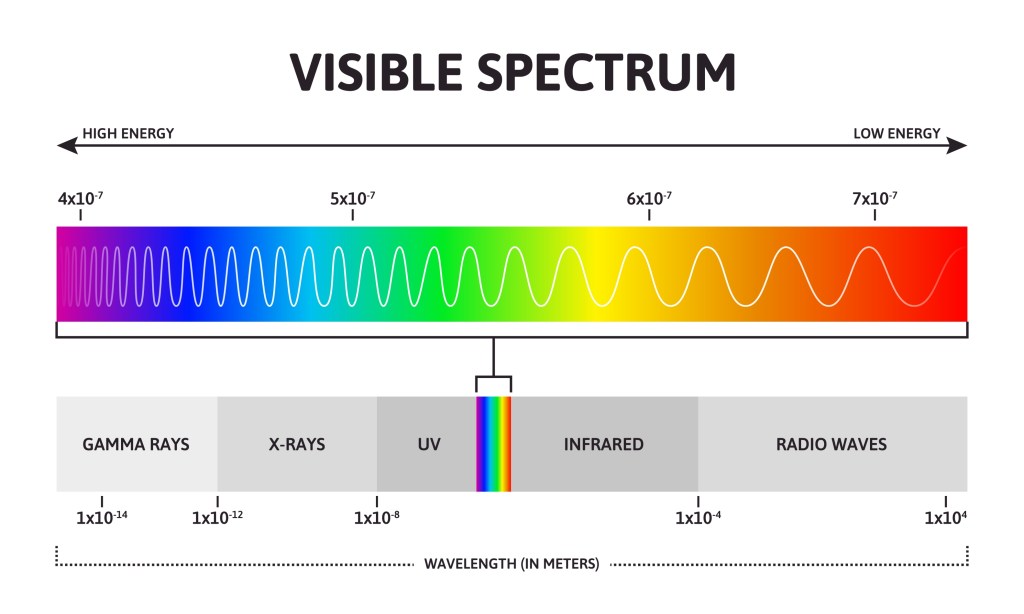
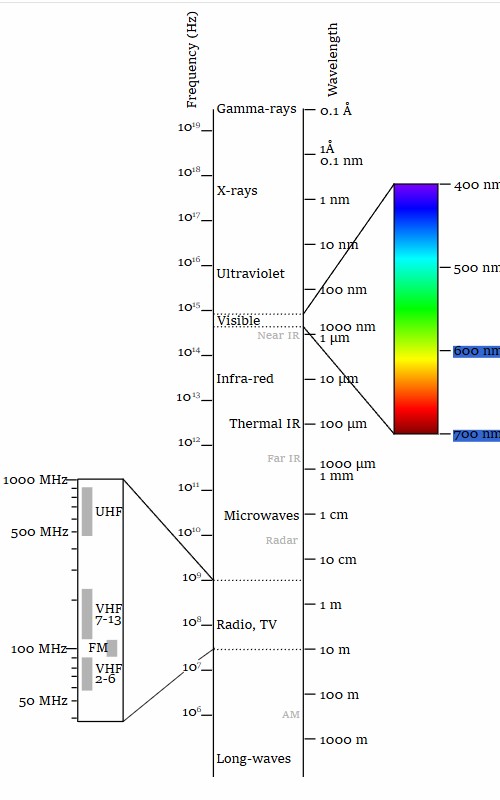
It should be noted that the spectra above go from long waves to gamma rays because that’s the range of the spectra we typically deal with. However, the electromagnetic spectrum continues far beyond that.
I consider “Human Vision Only Detects a Sliver of the EM Spectrum” a super fact because it is a well-known fact among those who have studied physics, and it is an important fact, and yet I believe it is a surprise to many.
The Spectrum Visible to Animals
A lot of animals can see beyond the spectrum visible to humans. For example, animals that can see UV light including reindeer, scorpions, butterflies, bees, salmon, hedgehogs, many birds, amphibians, and reptiles. Humans cannot see UV light. You can read about various animals that can see UV light here, here, and here.
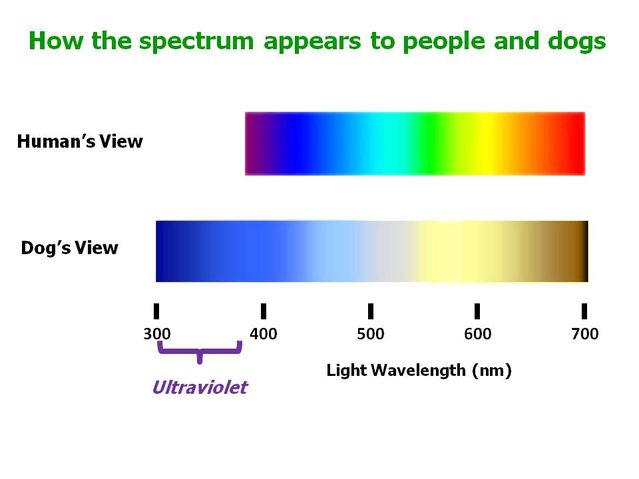
It appears that dogs and cats can see UV light as well. The color vision of dogs is in general poor, at least on the red side of the visible spectrum. However, dog vision includes UV light that we cannot see.
Many animals can also see or detect infrared radiation. A famous example are snakes. However, many other animals can detect infrared radiation including mosquitos, beetles, and other insects, some bats, bullfrogs, wolves, foxes, and some fish.
My Other Responses to Esther’s Prompts
- Prompt : Small : Small Microscopic Subatomic and Strings
- Prompt : Kind : Leonbergers Are Kind Dogs
- Prompt : Window : What Does Rollo See Out His Window
- Prompt : Charge : Electric Charge is not the only type of Fundamental Charge
- Prompt : Promises : Promises To My Dog
- Prompt : Shade : A Total Solar Eclipse the Ultimate Moon Shade
- Prompt : Money : Ten Money Facts
- Prompt : Edge : The Edge of the Observable Universe is 46.5 billion Light Years Away
- Prompt : Fish : Ten Amazing Fish Facts
- Prompt : Promise : I Promise Not to Post AI Generated Comments
- Prompt : Respect : Respect your Dog
- Prompt : Giving : Leonbergers Giving Gifts to Pugs
- Prompt : Family : Dogs Are Family
- Prompt : Snow : Snow and Ice in Norrland
- Prompt : Red : The Universe has a Redshift and its Increasing
- Prompt: Shapes : Conic Sections are the Shapes that Shape Our World
- Prompt: Flying : 10 Wind Blowing Facts About Birds
- Prompt: Drive : Letting Your Dog Drive the Car
- Prompt: Memories: False Memories Strange Memories Unpleasant Memories and Amnesia
- Prompt: Magic: Magic In New Orleans a Travel Overview
To see the Other Super Facts click here


I’m glad my dog can see better than I can, especially now that she’s deaf.
LikeLiked by 1 person
I am sorry to hear that your dog is deaf. Your dog can see some of the UV light spectra (UV-A) but on the other end of the visible spectra his color vision is worse (see the right side of the picture). So unfortunately, he may not be able to see better than you. However, dogs have an awesome sense of smell. Our Pug’s hearing became worse towards the end of her life, but she didn’t go entirely deaf.
LikeLiked by 1 person
I’m glad that over the last 12 years we’ve combined hand signals (often inadvertently) with our verbal commands, so she knows most of what we are saying. But we also noticed that she now has to go check out things visually that she would normally have figured out by her hearing (like where we are in the house at any time).
LikeLiked by 1 person
I am sorry she is going deaf. However, it is a great idea to combine hand signals with verbal commands. I’ve read that hand signals are easier for dogs to understand and remember and in case they lose their hearing they still have that. It is something dog trainers recommend.
LikeLiked by 1 person
I didn’t plan it ahead with this in mind. Just lucky, but for sure I’ll know to do it again next time.
LikeLiked by 1 person
Neither did we until we learned about it. Now we think about the hand gestures.
LikeLiked by 1 person
It sure helps!
LikeLiked by 1 person
So cool that snakes and some other animals can detect infrared radiation – I’ll need to tell my son about that, he’ll be fascinated!
LikeLiked by 1 person
I agree, it is a fascinating fact. What I should maybe have mentioned is that dogs can hear ultra sound 45,000–65,000 Hz, significantly higher than the human limit of 20,000 Hz. And of course bats can hear ultra sound too. So there are other senses beyond vision that supercede human capability. Speaking about bats. Bats and dolphins have echolocation. Sharks have electroreception, migratory birds have magnetoreception, etc. I can sense more super facts coming up.
LikeLiked by 1 person
This is an interesting post, Thomas. I do know about the UV vision many animals have. They are so lucky.
LikeLiked by 1 person
I am not surprised you knew about it. You certainly know a lot about animals and I have learned a lot from you already. You are right. It would be very cool to be able to see UV light.
LikeLike
Yes, it would 💛
LikeLiked by 1 person
I knew animals’ vision was different to ours but not how. Fascinating. Thank you, Thomas.
LikeLiked by 1 person
Thank you Esther. I agree it is fascinating and thank you so much for holding this write-off.
LikeLiked by 1 person
Another fascinating topic Thomas… our cat goes out at night and has a fully insulated house with heat pads. I go out last thing to leave him a snack and he was sitting on the ledge staring intently as something on the lawn by the bird table about 15 feet away. I walked over and it was not until I was nearly on top of it that I saw the hedgehog in the dark enjoying the messy bird’s throwaways on the lawn. The hedgehog got another treat with a banana.
LikeLiked by 1 person
Wow that is a fascinating story. In addition, to being able to see a wider part of the EM spectra, many animals can hear ultra sound, and have much better smell etc. It would be interesting to be able to experience that. I am so glad you gave the hedgehog a banana. Hedgehogs do not live (in the wild) in Texas, where I live, but I saw them all the time in Sweden where I grew up. Here in Texas we have a couple of other fun critters, opossum and armadillos.
LikeLiked by 1 person
I remember them well Thomas.. especially the armadillos in the woods next to our complex.. xxx
LikeLiked by 1 person
Oh yeah now when you say it I remember you lived in Texas and of course in Spain (that one I will not forget).
LikeLiked by 1 person
Oh wow, this is truly interesting,
Thomas. The animals are so keen and this explains it. 💗
LikeLiked by 1 person
Thank you so much Cindy, and you are right. In addition, to a seeing a wider vision spectra dogs can hear ultra sound 45,000–65,000 Hz, significantly higher than the human limit of 20,000 Hz, and not to mention their much better sense of smell. Other animals have keener senses as well, in different ways. Migratory birds can sense the magnetic field.
LikeLiked by 1 person
oh yes, that too.
We need one by our side all of the time..💕🙌🏽💃🏻
LikeLiked by 1 person
A dog by your side is certainly a wonderful thing to have
LikeLiked by 1 person
I soooo agree, like you! ❤️💕❤️
LikeLiked by 1 person
Interesting!
I once saw a YT about sound frequency. Did a quick search, but couldn’t find it.
It was a sound file, starting at the sub level of our low end, rising slowly, until it whistled past our upper range.
I played it through the home theater system for the fam, starting with a bass rumbling. As it rose, their hands drifted to their ears and they gave me annoyed looks. The dogs looked uncomfortable, then uneasy.
As it became higher, then piercing, shouting and hand waving replaced the looks, and the dogs ran around, barking and howling. I was not popular the rest of the day, but the kids still remember the day they learned about frequencies 😎
LikeLiked by 1 person
That is a very cool experiment that you did. I did not write about but dogs can hear ultra sound 45,000–65,000 Hz, significantly higher than the human limit of 20,000 Hz. Also children pick up on some ultra sounds.
Then of course bats can hear ultra sound too. So beyond vision there are other senses that supercede human capability. Bats and dolphins have echolocation. Sharks have electroreception, migratory birds have magnetoreception, etc. (I think I can sense more super facts coming up).
LikeLiked by 1 person
This was a point made to me early in my astronomy education. Most of my career has been spent in that narrow, visible part of the spectrum, but I’ve also taken radio and IR data. Most of the infrared data we take from the ground is in the so-called near-IR (those infrared frequencies closest to visible light) because Earth’s atmosphere absorbs a lot of IR light.
LikeLiked by 1 person
That is very interesting about the so-called near-IR. I guess Earth’s atmosphere absorbing a lot of IR light mean that good IR astronomy needs to be done in space? I am just thinking out loud.
LikeLiked by 1 person
That’s correct. Spacecraft can really help with IR astronomy. When I was in high school, the space telescope IRAS (Infrared Astronomy Satellite) was big news because of the discoveries it was making. This is also one of the reasons JWST is optimized to work in the infrared. In the history of astronomy, that’s one of the best and most effective infrared telescopes that’s been launched and we can learn a lot from it since so many objects emit infrared light.
LikeLiked by 1 person
Thank you David. That is very interesting and fascinating information.
LikeLiked by 1 person
Charlee: “Poor humans. They can’t hear what we hear, they can’t smell what we smell, they can’t see what we see, they can’t jump five times their own body height. No wonder they need us around to take care of them.”
LikeLiked by 1 person
I have to admit, being able to jump onto the roof instead of having to use a ladder would be pretty cool …
LikeLiked by 1 person
Yes I agree with that, and being able to fly would be even better.
LikeLike
Thank you so much Charlee for being around to help us humans with our limited abilities.
LikeLike
I think it’s 428,000 to 750,000 terahertz, not gigahertz.
LikeLike
Thank you for fact checking World Questioner. However, it is 428,000 to 750,000 gigahertz, which is more commonly written 428 to 750 terahertz. I wrote it in an unusual way.
LikeLike