The goal of this blog is to create a list of super facts. Important facts that are true with very high certainty and yet surprising, misunderstood, or disputed by many. This blog aims to be challenging, educational, and fun, without it being clickbait. I determine veracity using evidence, data from reputable sources and longstanding scientific consensus. Prepare to be challenged (I am). Intentionally seek the truth not confirmation of your belief.
Today’s daily writing prompt is “Who is the most famous or infamous person you have ever met”. That is former President George W Bush. In 2010 I met him at a Barnes and Noble book signing event here in northern Dallas where I live. It is also where he lives. He was selling and signing his book Decision Points. I bought four books, but he only signed a maximum of two books. Hundreds of people, perhaps thousands, wanted to have signed books and the security was rigorous, so signing a lot of books for each person was not practical.
George W. BushFront cover of the book Decision Points by George W. Bush. Click here or on the book to visit the hardback version of the book on Amazon.Back cover of the book Decision Points by George W. Bush. Click here or on the book to visit the paperback version of the book on Amazon.
I should say that at the time I was an admirer of George W. Bush, but I have a more nuanced understanding of him at this point. I have to admit I have not read his book yet. It has been sitting in my bookshelf for 15 years. I have a substantial TBR list and I have to admit that I might have bought the book for other reasons than reading it. But I will eventually get to it.
Senator Ted Cruz
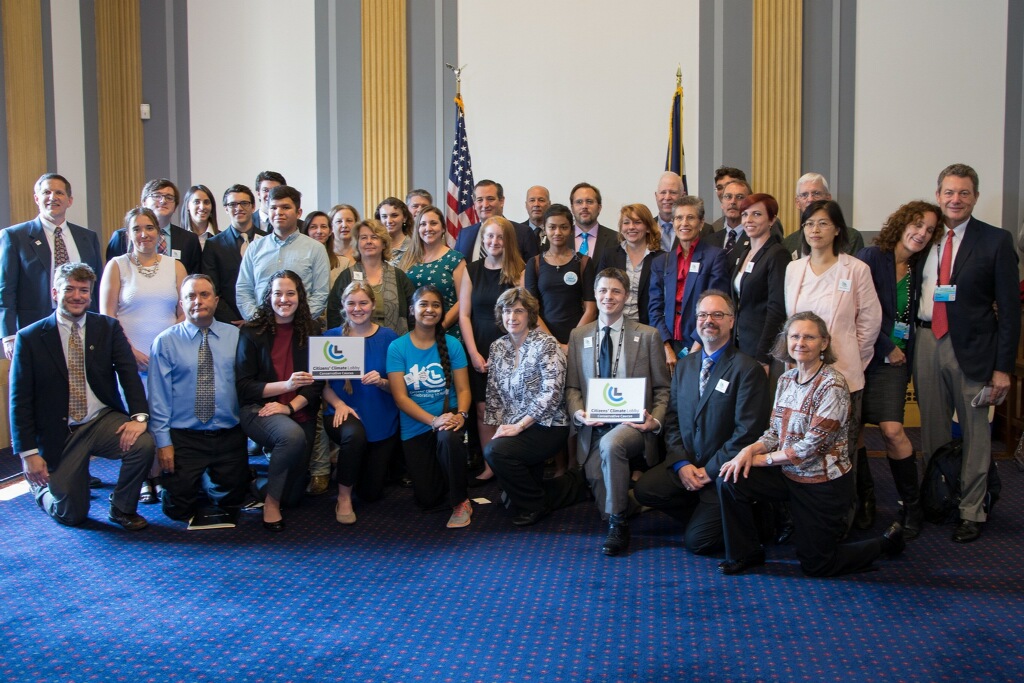
Another famous person that I’ve met is Senator Ted Cruz and in this case the contact was a bit more substantial. I am a member of a non-partisan organization that seeks to create political will for solving the climate crisis. They are called Citizens Climate Lobby, or CCL. We find bi-partisan legislation and try to get both Democrats and Republicans onboard with it and we have been fairly successful. I am the CCL liaison for Senator Cruz office and have had the pleasure to meet him in person a couple of times. We shook hands, talked, and took photographs with him.
Senator Ted Cruz TXJR with Citizens Climate Lobby in 2017. The senator is standing immediately to the right of the American flag, and I am standing immediately to the left of the American flag.Senator Cruz hosts a Texas Tuesday Coffee for Constituents in Washington, DC on July 22, 2025. (Official U.S. Senate photo by Rebecca Hammel) Ted Cruz is standing in the back between the flags. I am in the front row, second from the right wearing a blue suit. We are twelve people.
To read more about CCL and why I decided to engage in this issue click any of the links below.
It is a long post. Just read the parts that seem interesting to you.
I am a member of a non-partisan volunteer organization called the Citizens Climate Lobby (CCL) which seeks to create political will for a livable future. At one point I was quite skeptical and doubtful of global warming or climate change or climate disruption whatever you like to call it. The reason was that I almost exclusively read and watched rightwing news media such as world-net-daily (tended to push conspiracy theories), Newsmax and Fox News.
I believed in the concept of global warming / greenhouse effect, it is basic science after all, but I thought that it was exaggerated and politicized and that it was promoted and distorted by left-wing agendas. I incorrectly believed that there was no scientific consensus on the issue. I also bought into the false narrative that this was about environmentalist ideology, politics, or even a sort of environmentalist religion, and not a real and serious problem. My disdain for environmentalists, my ideology, and my gut feelings certainly aided the propaganda in misleading me. In addition, I read a lot by Björn Lomborg and Patrick J. Michaels and I believed them.
I joined CCL because I had been so wrong, at the same time as I felt that I had finally learned something substantial about the subject, that the topic is important, and I also liked that CCL is non-partisan.
As the name Citizens Climate Lobby suggests we do a lot of lobbying. It is not the kind of paid lobbying that is done by professionals and that is often associated with money. We are average constituents, average voters, with no money, who are visiting our legislators to give them information and opinions on legislation we support or don’t support. Since we are non-partisan, we visit both Democrats and Republican offices. We just had a CCL conference in Washington DC on Sunday, Monday and Tuesday. We were 800+ volunteers who visited 400+ Congressional offices in Washington DC on Tuesday July 22nd. That is why I have not been online much for about a week.
Roughly half of the CCL volunteers at 8:00AM on Tuesday July 22nd. The others were sleeping in but joined us later. In the background you see the Capitol.
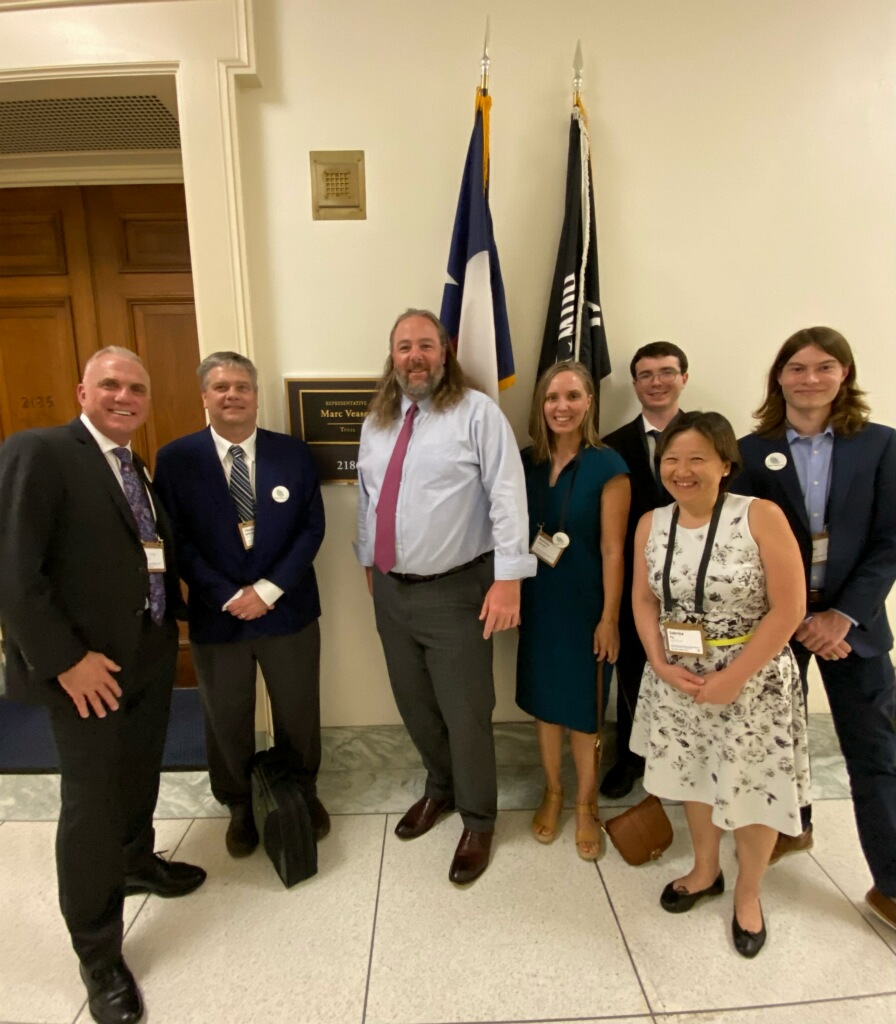
On Tuesday I visited three Texas Congressmen, including Senator Ted Cruz (R, TXJR), Congresswoman Beth Van Duyne (R, TX24), and Congressman Marc Veasey (D, TX33). We also had a zoom call with Congressman John Carter’s (R, TX31) office (the fourth meeting). I am the CCL liaison for Senator Cruz’ office and I was the one who organized our visit, from our side. It was a brief visit with Senator Cruz and a substantial discussion with a couple of his staff. Ted Cruz does not always agree with us, but we had a friendly and interesting meeting, and he and his staff appreciated us being there. Below I have included three photos from my three Tuesday meetings.
Senator Cruz hosts a Texas Tuesday Coffee for Constituents in Washington, DC on July 22, 2025. (Official U.S. Senate photo by Rebecca Hammel) Ted Cruz is standing in the back between the flags. I am in the front row, second from the right wearing a blue suit. We are twelve people.CCL volunteers meeting with a legislative aide, Isabel de Antonio, working for congresswoman Beth Van Duyne, Republican, Texas district 24 (that’s where I live). Isabel de Antonio is the one wearing a white shirt. I am standing on the far left. Eric, a CCL volunteer, is taking the photo and is not in the picture.CCL volunteers meeting with a legislative aide, Mike Burnside, working for congressman Mark Veasey, Democrat, Texas district 33. We also had a constituent and liaison representing 192 CCL volunteers in TX33 call into the meeting. Mike Burnside is the one wearing a white shirt. I am standing second from the left.
Overview of the Five Asks
With this post I wanted to show our Asks, so that readers know what we ask from our politicians. I do not expect anyone to read the CCL handouts below. I am including them to illustrate how we approach legislation. Don’t worry about the details. Trust me, the actual bills are even longer (the poor staffers of the politicians must read it). I can add that our Vice President of Government Affairs (CCL employee), Jennifer Tyler, was the Deputy Chief of Staff and Legislative Director for the Republican Congressman John Katko (NY-24). Having been a prominent leader in the Republican Party she is able to craft legislative Asks that not only appeal to Democrats but to Republicans as well.
I can add that CCL has a small staff consisting of highly educated people including climate scientists and policy experts. The CCL board features prominent climate scientists and prominent politicians and economists. George W. Schulz, Ronald Reagan’s Secretary of State, was (well is as an honorary member) on the CCL board but he passed away. I also think that CCL volunteers tend to be more nerdy than average. A lot of our volunteers are scientists, physicians, brain surgeons, engineers, PhDs, psychologists, authors, artists, businessmen, business owners, oil executives, etc., but naturally everyone is welcome. We are a well-informed volunteer organization and as a result both Democratic and Republican offices see us as a great resource for information and ideas.
These were our six Asks. As you can see, not all of them apply to both parties. One Ask is only for Republicans because Democrats are already fully onboard. One Ask is only for Democrats because the Republicans are already fully onboard. Another Ask is only for Republicans because there’s no chance Democrats will support it (but Republicans have more votes). In other words, an emissions and pollution reducing mix of Asks that overall is bipartisan.
Support the Clean Energy Transition – Fund Key Clean Energy Programs in FY26 Appropriations – Democrats + Republicans.
Support the Clean Energy Transition – Fix Clean Energy Tax Credit Implementation – Republicans only, because Democrats are already full onboard.
Support the Clean Energy Transition – Advance Smart Permitting Reform for Energy Projects – Democrats + Republicans but different handouts.
Support H.R. 471, the Bipartisan Fix Our Forests Act – Democrats only because Republicans already fully onboard.
Support S. 1462, the Bipartisan Fix Our Forests Act – Democrats + Republicans.
Support Foreign Pollution Tariff Legislation – Republicans only, because we know Democrats are against it.
Funding Clean Energy Research
Fund Key Clean Energy Programs in FY26 Appropriations was the first part of three parts for our primary Ask : Support the Clean Energy Transition. The 2025 Budget Reconciliation Bill (One Big Beautiful Bill) cuts funding from two research organizations, the Office of Energy Efficiency and Renewable Energy (EERE) and the Advanced Research Projects Agency (ARPA-E). ARPA by the way is a prominent research organization, it is, for example, responsible for the creation of the internet. The reason we are asking to restore some of the funding for these organizations is because the world is moving towards clean energy and recently China has aggressively invested in clean energy. Cutting research in this area is a recipe for getting behind.
Clean Energy Tax Credits
The Clean Energy Tax Credits were significantly cut in the Budget Reconciliation Bill. It was specifically provision 48E, investment credits for wind and solar, 45Y, tax credits for wind and solar, 25C, tax credits for home efficiency improvements, such as insulation, energy efficient doors and windows, etc., that were cut. I should say that the 48E and 45Y for other types of clean energy, such as Nuclear, Geothermal, Hydro, and Biofuels, stayed, which we are grateful for.
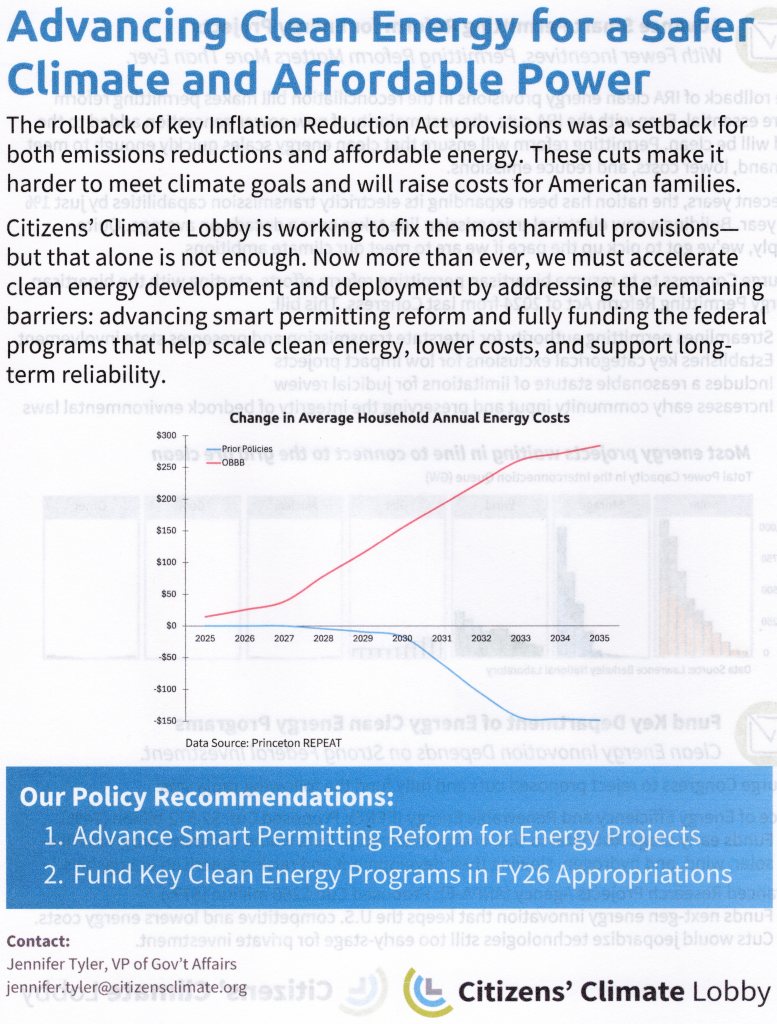
The reason we are asking to restore some of the tax credits for wind and solar, is not that they need the tax credits to survive. Wind and solar energy are very cheap, and they are doing very well. However, they are prominent sources of clean energy and removal of the tax credits will significantly increase the energy cost for consumers, as you can see in the graph below. The loss of the credits will also result in the loss of jobs and investments in projects already underway. A list of the effected investments and projects in the US listed per congressional district can be seen in this link. Since virtually all Democrats already support the restoration of the clean energy tax/investment credits, we are only asking this from Republicans. Admittedly this is a tough one for them.
Smart Permitting Reform for Energy Projects
The third part of the Primary Ask is Smart Permitting Reform for Energy Projects. What many people don’t realize is that what is holding clean energy back the most is not the cost or time for building wind and solar. That is relatively easy. The big obstacle is getting permits to build the energy plants and permits to build transmission lines needed to bring the electricity to our homes. In both cases the process is typically at least ten years. However, by cutting red tape and streamlining the process it could be reduced to around a year.
This applies not only to wind and solar but to all types of energy, which is why Republicans tend to support permitting reform. Since most of the new energy coming online is wind and solar, and they often replace dirty coal, thus reducing emissions, we strongly support permitting reform. We have done the research, so we know that this is a very good way to reduce emissions. In this case we formulated the Ask differently for Republicans and Democrats.
Primary Asks Sheets
Our primary Asks for Republicans. We are asking the same thing from Democrats and Republicans, but the presentation is different. Notice that in both cases we are pointing out that the removal of the Clean Energy Tax Credits for Wind and Solar in the 2025 Budget Reconciliation Bill (One Big Beautiful Bill) will increase costs for consumers. In the Republican version we are pointing out that not funding research into clean energy will put us behind the rest of the world, especially China, which is aggressively pursuing development in clean energy.Second page of primary Asks for Republicans.Our primary Asks for Democrats. Notice that in this case we are not asking them to fix the Clean Energy Tax Credit Implementation. The reason being that they are already 100% behind it.Second page of primary Asks for Democrats
Fix Our Forest Act
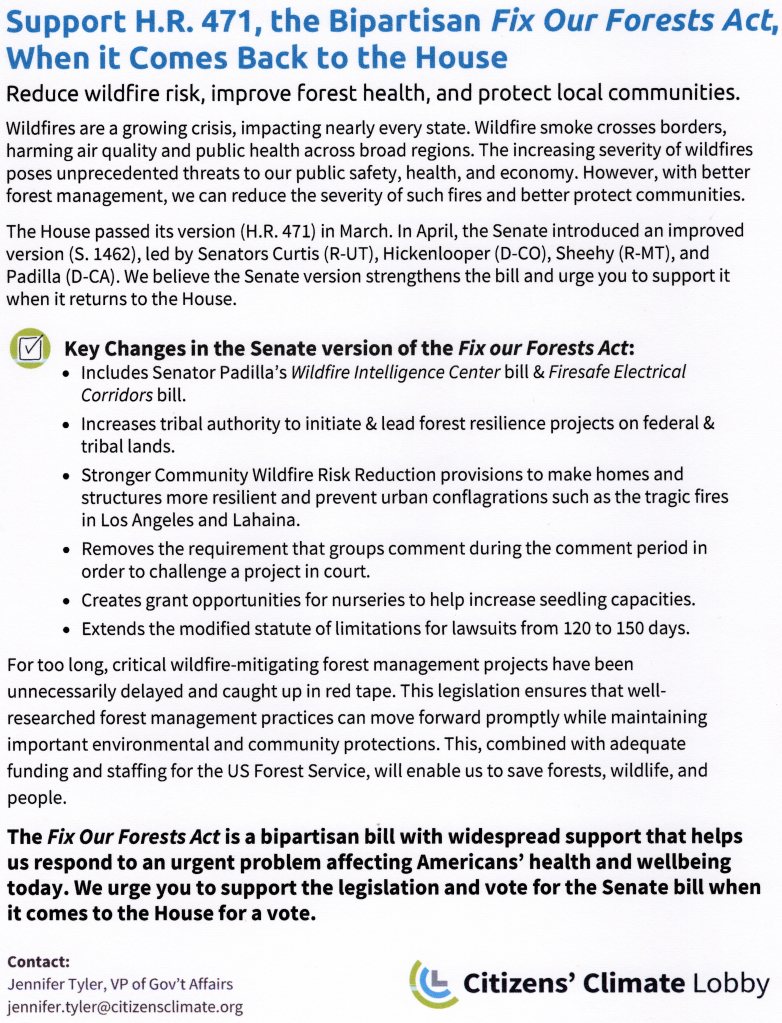
Our first Secondary Ask is Support H.R. 471, the Bipartisan Fix Our Forests Act, when it Comes Back to the House. To explain, it was voted on in the house, sent to the Senate where they made some changes, so it needs to be voted on again in the house. This is an Ask that we reserved for Democrats. It was not because we thought Republicans wouldn’t like it but because they had already voted Yes for it unanimously. We know the Republicans like it. However, we needed to make sure the Democrats who were less favorable of it would not turn against it, which is why we are asking them to vote yes on it.
To explain what the bill is about, scientists have concluded that climate change and poor forest management are both making wildfires worse, at least in the United States. Out of control wildfires in turn make climate change worse. Climate change will take several decades to fix and requires the whole world to act. However, improving forest management we can do today for ourselves. To read the full text of the original house bill click here. To read the full text of the Senate version of the bill (S.1462) click here.
This is the house version H.R.471 of the Fix Our Forest Act. It already has full Republican support in the house, so we are only asking Democrats to support it.This is the Senate version S.1462 of the Fix Our Forest Act. We are asking both Republican and Democratic Senators to support it.
Foreign Pollution Fee
The Foreign Pollution Fee Act S.1325 (full text in link) was introduced in the Senate by Senator Lindsey Graham (R). This is a resolution that if it becomes law would greatly reduce carbon emissions around the world, and yet it is pretty much only supported by Republicans. It might come as a surprise that there is a pro-climate resolution that’s almost entirely Republican, but it happens sometimes. Our goal is to get close to unanimous Republican support and with the help of a few moderate Democrats get it passed.
Some background, China emits more carbon pollution than any country on earth. On the other hand, there are 1.4 billion people in China and per capita they emit only half that of the United States, which comes in at number two with respect to total emissions. In addition, the United States is the country that has emitted the most carbon emissions over time. On the other hand, the US emissions are going down, unlike China’s, and more importantly in this context, certain products such as steel, aluminum, fossil fuels, etc., are produced creating a lot more emissions in China than in the US, which has cleaner manufacturing. For example, one ton of steel produced in China or Russia result in four times as much carbon emissions as the same ton of steel produced in the US. It is not fair to cleaner US manufacturers to import products from dirty manufacturers without taking into account the cost of pollution to all of us.
Make “Filthy Pollution Havens” Pay at the Border. Support Foreign Pollution Tariff Legislation.
Washington DC Congressional Buildings
The congressional buildings are the three buildings that are part of the house of representatives, Rayburn, Longworth, and Cannon, and the three Senate buildings, Russel, Dirksen and Hart. I encircled them in red in the map below. If you are visiting several offices, there is going to be a lot of walking. Therefore, women should bring a comfortable pair of shoes in a backpack in addition to nice shoes for inside the buildings.
I can add that the offices in Rayburn are bigger and nicer than the offices in Longworth and Cannon, and Rayburn has the main nice cafeteria. Longtime congressman tends to have their offices in Rayburn. The same is true for the Senate. Russel has the nicest offices and the best cafeteria, and the long-time Senators tend to be in Russel. Ted Cruz is in Russel 167. He has a great office.
This is a map of the Congressional buildings. The three houses of representatives’ buildings, Rayburn, Longworth and Cannon, are towards the bottom encircled by a red line. The three Senate buildings, Russel, Dirksen and Hart are towards the top left encircled by a red line.
In case you are interested, this is the full text of the 2025 Reconciliation Budget Bill H.R.1. The nickname for the bill is One Big Beautiful Bill. Warning, it is very big. Beautiful is a matter of opinion.
My Super Fact List
This is not a super fact post. Just an informational post. If you want to see my list of super facts, click the link below.
The goal of this blog is to create a list of what I call super facts. Important facts that we know to be true and yet they are surprising, shocking or disputed among non-experts. Super facts are important facts that people get wrong. However, I also create posts that are not super facts but other interesting information, such as this book review and book recommendation.
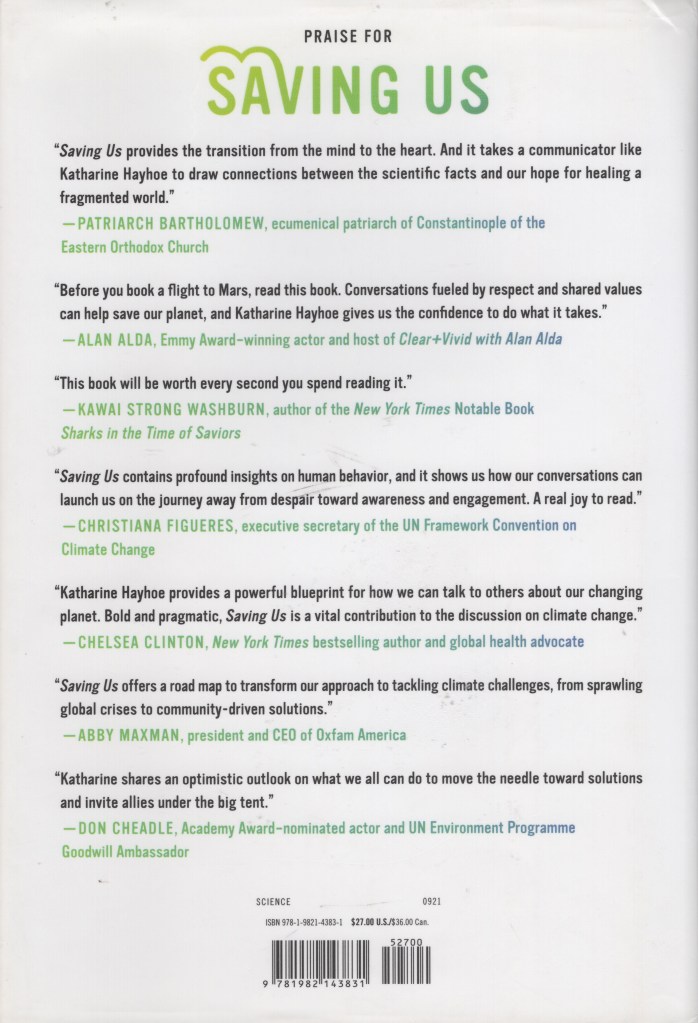
Saving Us: A Climate Scientist’s Case for Hope and Healing in a Divided World
Saving Us: A Climate Scientist’s Case for Hope and Healing in a Divided World by Katharine Hayhoe is a book about human caused Climate Change, how bad it is, and what we can do about it. The good news is that we are not all going to destroy ourselves. It is still bad, but we can do a lot to avoid making it really bad. However, there are a lot misunderstandings regarding what really makes a difference. This book examines these issues with a good dose of realistic optimism and science. I read the hardback version (and my review on Amazon is currently the top review).
Hardcover – Publisher : Atria/One Signal Publishers (September 21, 2021), ISBN-10 : 1982143835, ISBN-13 : 978-1982143831, 320 pages, item weight : 1.05 pounds, dimensions : 6 x 1 x 9 inches, it costs $19.14 on US Amazon. Click here to order it from Amazon.com.
Paperback – Publisher : Atria/One Signal Publishers (September 20, 2022), ISBN-10 : 1982143843, ISBN-13 : 978-1982143848, 320 pages, item weight : 8.8 ounces, dimensions : 5.5 x 0.7 x 8.38 inches, it costs $17.22 on Amazon. Click here to order it from Amazon.com.
Kindle – Published : Atria/One Signal Publishers (September 21, 2021), ASIN : B08BZW2BQG, 318 pages, it costs $14.99 on US Amazon. Click here to order it from Amazon.com.
Audiobook – Published : September 21, 2021, ASIN : B08D4RGYM8, Listening Length : 8 hours and 7 minutes, it costs $16.40 on US Amazon. Click here to order it from Amazon.com.
Front cover of Saving Us. Click on the image to go to the Amazon page for the hardcover version of the book.
Amazon’s description of the book
“An optimistic view on why collective action is still possible—and how it can be realized.” —The New York Times
“As far as heroic characters go, I’m not sure you could do better than Katharine Hayhoe.” —Scientific American
“It’s not an exaggeration to say that Saving Us is one of the more important books about climate change to have been written.” —The Guardian
United Nations Champion of the Earth, climate scientist, and evangelical Christian Katharine Hayhoe changes the debate on how we can save our future.
Called “one of the nation’s most effective communicators on climate change” by The New York Times, Katharine Hayhoe knows how to navigate all sides of the conversation on our changing planet. A Canadian climate scientist living in Texas, she negotiates distrust of data, indifference to imminent threats, and resistance to proposed solutions with ease. Over the past fifteen years Hayhoe has found that the most important thing we can do to address climate change is talk about it—and she wants to teach you how.
In Saving Us, Hayhoe argues that when it comes to changing hearts and minds, facts are only one part of the equation. We need to find shared values in order to connect our unique identities to collective action. This is not another doomsday narrative about a planet on fire. It is a multilayered look at science, faith, and human psychology, from an icon in her field—recently named chief scientist at The Nature Conservancy.
Drawing on interdisciplinary research and personal stories, Hayhoe shows that small conversations can have astonishing results. Saving Us leaves us with the tools to open a dialogue with your loved ones about how we all can play a role in pushing forward for change.
This is an extremely well written, informative, and hopeful book on climate communication. A decade ago I was doubtful that human caused climate change was anything to worry about even though it physically made sense that it was happening. I thought environmentalists were exaggerating and distorting the facts. In general I did not trust or respect environmentalists whom I thought were driven by leftist agendas.
I studied the topic on my own by reading books and scientific articles on the topic, and I learned what climate scientists, not opinionated bloggers, said about the topic. I was especially impressed by a book by James Hansen.
I came to realize that human caused global warming definitely was real and a serious problem. I think I was able to change my mind so easily because I never had a strong affiliation with a political tribe, I respected scientific expertise and my encounter with science deniers in other fields had inoculated me against their kind of rhetoric (it’s fairly universal). I’m an abstract thinker who loves pro-con-lists, and I prefer going in deep and I am not afraid of math, but I don’t think that’s typical.
The backside of that is that it made me a pretty crappy and easily frustrated climate change communicator once I came around. I felt I needed to take action so I joined Citizens Climate Lobby (CCL), a bipartisan volunteer organization with good solutions and good practices. From CCL I learned how to communicate better. In this book Katherine Hayhoe praises CCL and use it as a model for how to approach climate change with respect to solutions and communication.
In addition to climate change communication she gives a high level overview of why we know that global warming is happening (there are 26,500 lines of independent evidence for climate change), how fast it is happening (10 times faster than the last ice age warming), and how we know it isn’t natural. It’s a simple overview, not a deep dive. I thought her analogy about driving while looking in the rearview mirror as you hit a curve to be genius.
She also discusses our cognitive biases, and why not to engage with the 7% who are dismissives, the abuse she’s been a victim of, and so called zombie arguments. Zombie arguments are dismissive arguments that have been thoroughly debunked over and over but won’t die because they fulfill an emotional need for those who are dismissive of climate change. She discusses the political divided in the US, the “blame and shame the consumer” tactic and the misguided “population control solution” and solutions aversion in general.
She describes our situation lucidly. That there is no particular known limit that will doom us all. It is like smoking; you don’t get lung cancer after a certain amount of cigarettes, it’s just better to stop as soon as you can. She discusses solutions and the economy, including cap and trade and a price on carbon, and she states we don’t have to harm the economy to solve climate change, and a lot is already being done the world over. It is a mostly hopeful view.
I was surprised to learn that if you take into account, production subsidies, tax breaks, land leases on public lands below market rates, and the cost of pollution, the IMF estimates that fossil fuel subsidies in the US top $600 billion per year, twenty times clean energy subsidies. That’s about $2,000.00 per person and year, or $8,000.00 per family per year. That’s a lot of money.
Because of my experience with CCL I recognized a lot of what Katherine Hayhoe was saying in this book, but I still had a lot to learn, and besides the book is hopeful, and intelligently written and therefore a pleasure to read. She stresses that the most important thing we can do to solve climate change is to talk about it. I love this book and I highly recommend this book.
Back cover of Saving Us. Click on the image to go to the Amazon page for the kindle version of the book.
This is not one of the super fact posts. It is just a post related to an interest of mine that is informational. I volunteer for an organization called Citizens Climate Lobby, or CCL. CCL is a bipartisan organization that works with both Democrats and Republicans to create the political will for climate solutions. During the month of August CCL is promoting what is called electrification. Clean energy is taking the world with storm, but energy / electric power is not the only source of carbon emissions / greenhouse gases.
Take for example, transportation. Most cars still use gasoline and to move towards a fossil fuel free future we must move towards using transportation that uses less fossil fuels such as EV cars. We need to electrify transportation. Another aspect of electrification is replacing gas stoves with induction stoves, installing solar panels, as well as lowering the energy use of your house.
Lowering the energy consumption of your house lowers your emissions. Photo by Frans van Heerden on Pexels.com
EV Cars
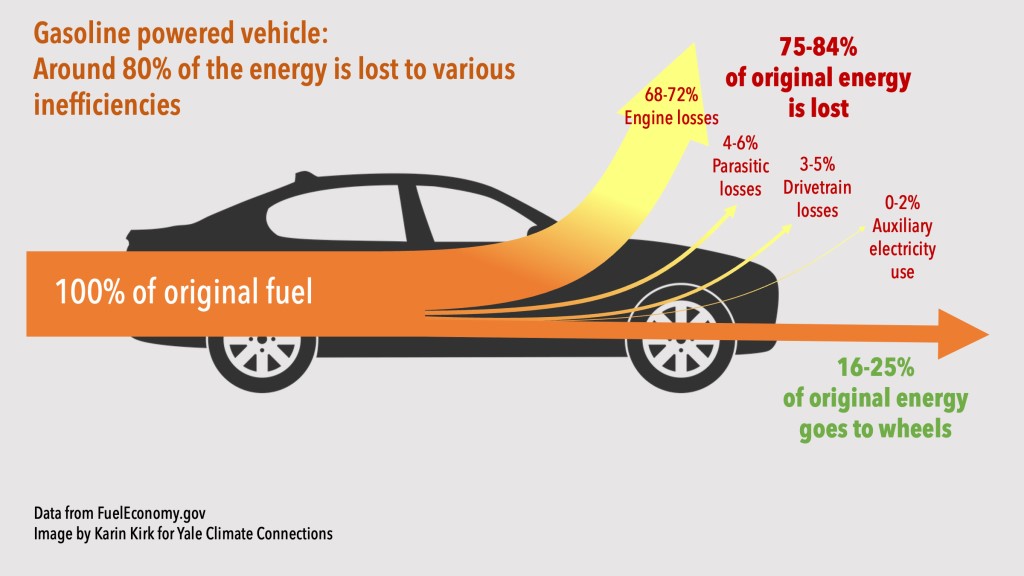
At least here in Texas it is quite common to believe that EV cars do not reduce emissions. After all EV cars use electricity from the dirty grid, right? Often this is said to environmentalists and people who care about fossil fuels emissions as if they don’t understand that the electricity for EV cars typically comes from the dirty grid. However, they do know that. In fact, they know a little bit more. EV cars are much more efficient than Internal Combustion Engine cars , or ICE, and therefore the emissions caused by EVs via the electrical grid, even a coal powered grid, is significantly less per mile. In fact, replacing gasoline-powered cars with EVs saves energy, regardless of the energy source used to recharge the EVs. For an ICE 16-25% of the original energy goes to the wheels whereas for an EV 87-91% of the original energy goes to the wheels.
16-25% of original energy goes to the wheels. Data from FuelEconomy.gov, Image by Karin Kirk for Yale Connections.87-91% of original energy goes to the wheels. Data from FuelEconomy.gov, Image by Karin Kirk for Yale Connections.
On the other hand, it takes more energy to manufacture an EV battery for an EV car than it does to produce a combustion engine. So, the production of an electric vehicle does emit more carbon than a petrol car. However, the lower emissions resulting from driving an EV means that an electric car quickly pays back its debt, so to speak. It is typically paid back within two years.
According to Hannah Richie at Our World in Data the statistics show that switching from an average ICE to an equally sized EV will save 1.2 tons of carbon emissions per person and year. That is a lot considering that the average carbon footprint per year is 4 tons worldwide and 14.4 tons per year for an American. Hannah Richie at Our World in Data also states that other environmental damages related to EVs such as mining for minerals are less than mining and extraction for fossil fuel cars, and she claims that the price of lithium-ion batteries has fallen by 98% over the last three decades.
EVs are becoming increasingly common. According to Our World in Data in 2022, 88% of all cars sold in Norway were EVs and 54% of all cars in Sweden were EVs. The United States is lagging a bit at 7.5% but there is a tax credit $7,000.00 for new EVs and a $4,000.00 tax credit for buying used EVs. I should add that we have not yet bought an EV because after I took early retirement, I did not need a car. We just share my wife’s hybrid, which we hardly ever drive.
Induction Stoves
We bought an electric stove, an induction stove, a couple of years ago when our previous stove stopped working. They come with an $840.00 rebate. I’ve read that professional chefs prefer gas stoves. However, our induction stove provides everything we need for our cooking needs and my beer brewing needs and it is easier to clean. If you are a professional chef you may want to be able switch the high heat on and off quicker, but we are not professional chefs even though the food we cook is delicious.
Another downside of an induction stove is that if the power goes out you can’t cook, but that has not been a problem for us. Considering that we get our electricity from a power company, Green Mountain Energy, that utilizes renewable energy, wind and solar, you can claim that our stove is 100% fossil fuel free.
Our induction stove with the lights in the kitchen turned off.
Heat Pumps
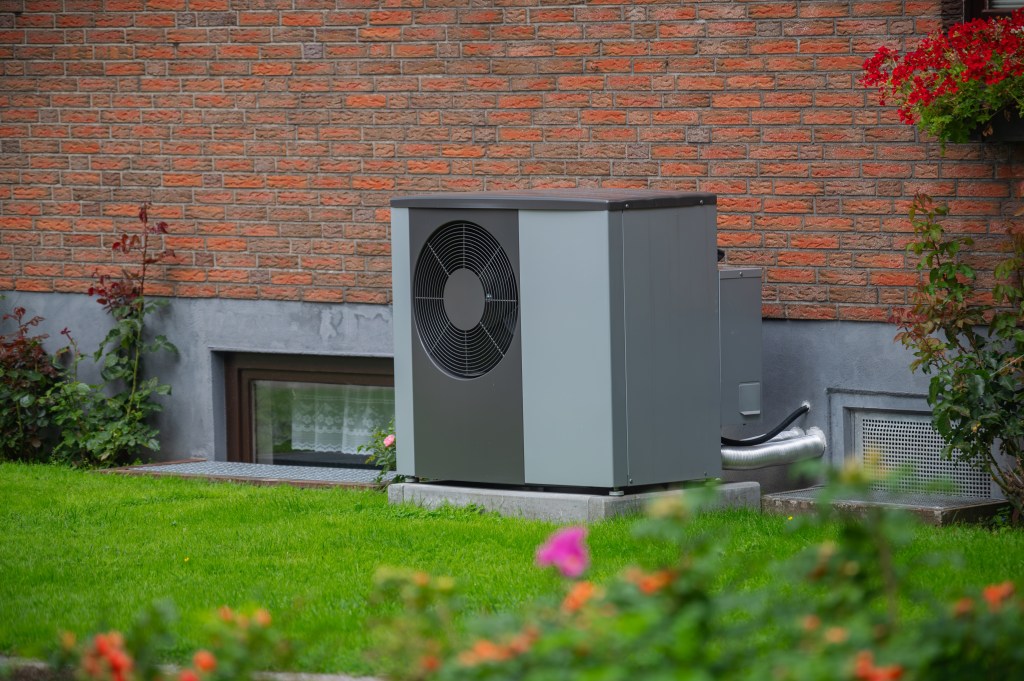
Air source heat pumps, which are the most common type of heat pumps, are a great, energy efficient choice for heating your home and water and as well as being low maintenance, they can help to cut your heating costs and lower your carbon footprint. An air source heat pump absorbs heat from the air outside a building and releases it inside. It uses the same vapor-compression refrigeration process and much the same equipment as an air conditioner, but in the opposite direction.
Air-to-air heat pumps provide hot or cold air directly to rooms. Heat pumps are the main way to phase furnaces but are also typically more efficient than other types of heaters and air conditioners and thus they reduce greenhouse gas emissions. There is an up to $8,000.00 upfront discount for heat pumps and a 30% tax credit up to $2,000.00. I should say we do not have a heat pump.
Air heat pump installed on the exterior facade of the old house. Sustainable heating solutions for old construction. Stock Photo ID: 2349325553 by Snapshot freddy.
Rooftop solar
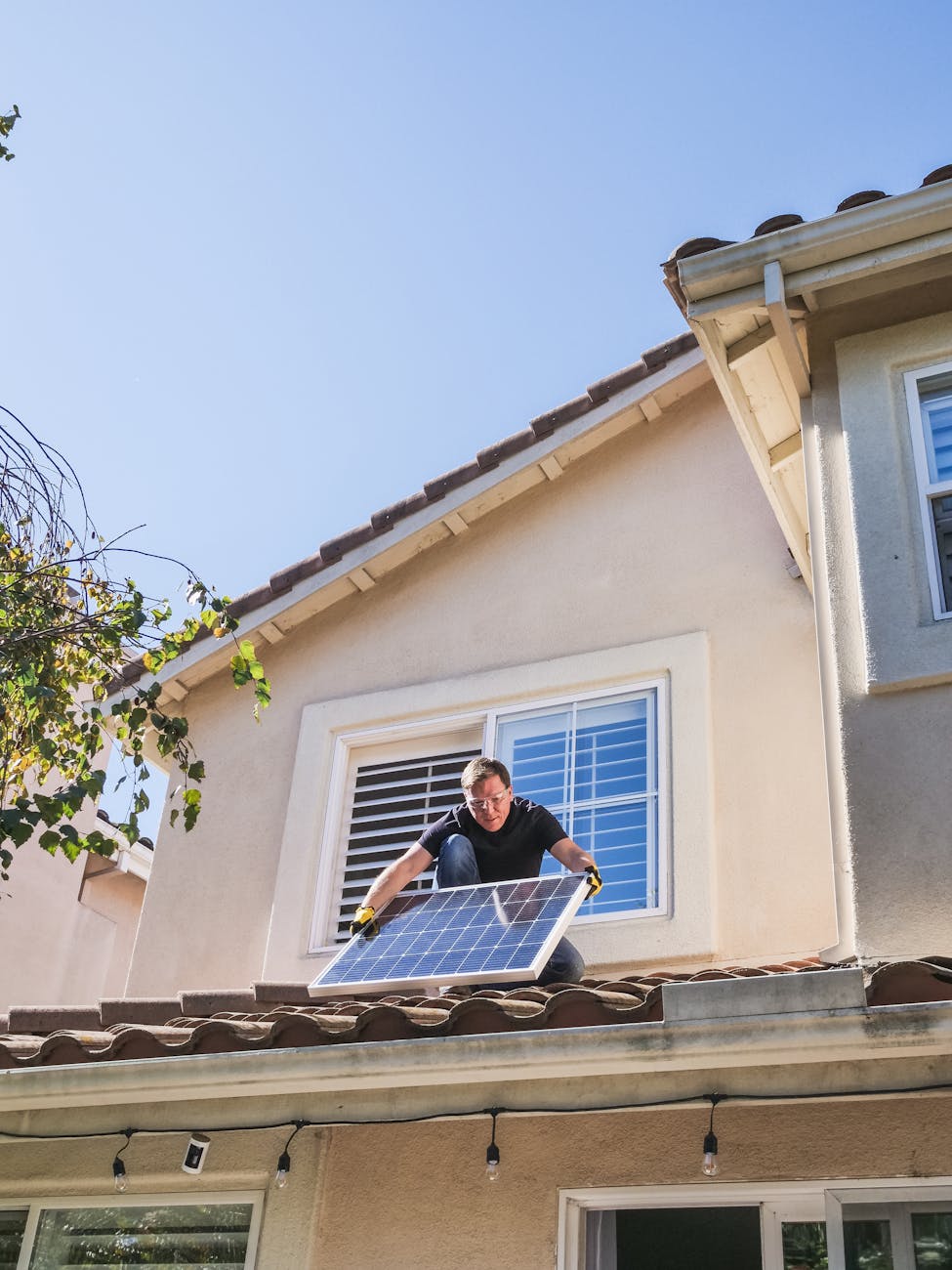
Another great thing that we have been thinking about but do not have yet is rooftop solar. Rooftop solar power system, or rooftop photo voltaic systems, consist of electricity-generating solar panels mounted on the rooftop of a residential or commercial building or structure. Residential rooftop solar power systems typically feature a capacity of about 5–20 kilowatts.
The average American household uses 1.2 kilowatts on average. Most rooftop solar systems are connected to the grid and can feed the extra power into the grid for compensation. I should add this is not entirely without difficulty. There are also hybrid systems which include any combination of wind turbines, diesel generators, and batteries for electricity on demand. There is a 30% tax credit for rooftop solar.
Saving energy is not exactly the same thing as electrification but it is a related topic. If you electrify your home and also reduce your energy needs, you are reducing emissions.
A few years ago, we changed the insulation in our house to reduce our energy needs and our electric bill. It made a difference. We also did weatherstripping, installed three pane windows and high security doors, that were well-insulated and reduced heat-loss. We received significant tax credits for doing this. I don’t remember how much, but it was several thousand dollars. I can add that you get a $150 tax credit for a home energy audit.
What do you think about electrification and energy savings?
Do you have additional ideas for electrification and energy savings?
















 Super Facts