The goal of this blog is to create a list of super facts. Important facts that are true with very high certainty and yet surprising, misunderstood, or disputed by many. This blog aims to be challenging, educational, and fun, without it being clickbait. I determine veracity using evidence, data from reputable sources and longstanding scientific consensus. Prepare to be challenged (I am). Intentionally seek the truth not confirmation of your belief.
Tag: Super fact
This post is about a super-fact. The goal of this blog is to create a list of facts or insights that are important and not trivia, known to be true, and yet highly surprising, shocking, amazing, or widely disputed amongst the public but not disputed among the scientists or experts in the relevant fields. However, not all of my posts are super-facts. This category distinguishes posts that are super-facts.
Super fact 47 : In 1991, after the dissolution of the Soviet Union, Ukraine became the third largest nuclear power in the world after Russia and the United States. Ukraine held about one third of the former Soviet nuclear weapons and delivery systems. Ukraine agreed to transfer these weapons to Russia for dismantlement in exchange for economic compensation and assurances to respect Ukrainian independence and borders.
In 1994, Ukraine agreed to transfer these weapons to Russia for dismantlement in exchange for economic compensation and assurances from Russia, the United States and the United Kingdom to respect Ukrainian independence and sovereignty within its existing borders. These political agreements are referred to as the Budapest Memorandum.
These events are relevant to what is happening in Ukraine today, and yet it is seldom discussed, and many people are unaware of or have forgotten about this history. It also comes as a surprise to many that there are nuclear states who have relinquished their nuclear weapons. This is why I call this fact a super fact.
Nuclear bomb dropped on a big city. Shutterstock, asset id: 2188083835 by CI Photos.
Nine Nuclear States
There are nine nuclear states in the world as of 2025 according to the Federation of Atomic Scientists. There are 12,331 nuclear warheads including 9,600 in active military stockpiles.
Russia – 5,449 warheads
The United States – 5,277 warheads
China – 600 warheads
France – 290 warheads
United Kingdom – 225 warheads
India – 180 warheads
Pakistan – 170 warheads
Israel – 90 warheads
North Korea – 50 warheads
There are also countries that are hosting nuclear warheads owned by other countries.
Italy (the United States) – 35 warheads
Turkey (the United States) – 20 warheads
Belgium (the United States) – 15 warheads
Germany (the United States) – 15 warheads
Netherlands (the United States) – 15 warheads
Belarus (Russia) – ? warheads
Four missiles aimed at the sky at sunset. Shutterstock, asset id: 2131803989 by Hamara
Four nations that relinquished their nuclear weapons programs
The four nations that relinquished their nuclear weapons programs are Belarus, Kazakhstan, South Africa, and Ukraine. Belarus, Kazakhstan, and Ukraine returned their inherited nuclear weapons to Russia after the dissolution of the Soviet Union. However, it should be noted that in 2023 Russia began deploying tactical nuclear weapons to Belarus. However, Belarus does not currently possess its own nuclear weapons. South Africa voluntarily dismantled its nuclear weapons program in 1991.
In 2023 Russia began deploying tactical nuclear weapons to Belarus.Russia (green) and Ukraine (brown) map on a world map. Ukraine is about the size of Texas. Russia is about twice the area of the United States. Belarus is the country located immediately to the north of Ukraine and Kazakhstan is the big country immediately to the south of Russia and east of Ukraine. Shutterstock Asset id: 2121271067 by buraktumler
How to Build a Nuclear Bomb
This section is just some extra reading that is only somewhat related to the topic. However, since it is an interesting topic somewhat related to the topic I might as well explain how to build a nuclear bomb. Don’t worry I will not present any engineering details, only general principals, which is all I know, and which are already all over internet. Besides if I were to give detailed engineering instructions some peacenik hippie might have a hissing fit and swear in the comment section (that was a joke).
Anyway, the main idea behind a nuclear fission bomb is to achieve a runaway chain reaction. A fusion bomb, or a so-called hydrogen bomb is different. To create a fission bomb you are not looking for the most radioactive materials there are. You are looking for a fuel which you can use to create a runaway chain reaction, and which is also stable enough to make a bomb possible, in other words not too radioactive. Basically, the fuel must be just right. The primary fuels used in fission bombs are uranium-235 and plutonium-239. These isotopes undergo fission when struck by neutrons, releasing a massive amount of energy in a chain reaction.
Uranium-235 and Uranium-238 are both not very radioactive and can be used for radiometric dating that stretches millions and billions of years. Uranium-235 is also the “just-right” uranium isotope that can be used for bomb making. Shutterstock Vector ID: 2417370135 by grayjay
I should explain, isotopes are different forms of an element. For example, hydrogen comes in three different forms, a nucleus with just a proton, a nucleus with one proton and one neutron (deuterium), and a nucleus with one proton and two neutrons (tritium). Isotopes for the same element are chemically identical but have different atomic weight and they may or may not be radioactive.
The three isotopes of Uranium are uranium-234, uranium-235, and uranium-238. The one we need is uranium-235, which has 92 protons and 143 neutrons in the nucleus. The isotopes of Plutonium include Pu-238, Pu-239, Pu-240, Pu-241, and Pu-242 but there are others. The one we need is plutonium-239, which has 94 protons and 145 neutrons in the nucleus. There are more than 3,500 known isotopes of which 3,000 are radioactive.
During Uranium-235 fission, an average of 2.5 neutrons are released. Specifically, the fission of U-235 typically releases 2 or 3 neutrons, with the average being close to 2.5. During the fission of plutonium-239, an average of 2.9 neutrons are released (depending on the energy of the incident neutron). The important thing for bomb making is that one atom/nucleus releases enough neutrons so that the neutrons from one nucleus cause more than one fission. For example, a nucleus releases three neutrons and two of those neutrons cause two more fission events, which in turn cause four fission events, etc. 2, 4, 8, 16, 32, 64, a trillion…
Illustration of nuclear chain reaction. Uranium-235 fission. Unfortunately, the picture has an error in it. It is 92 protons not 95 in a U-235 isotope. – Shutterstock asset id: 73714504 by Mpanchenko.
By putting together enough U-235 you can make it so that one fission event will result in more than one additional fission event. This is called the critical mass. The critical mass for U-235 is 47 kilograms (104 pounds). Theoretically, you can achieve this by taking a 24-kilogram half sphere of U-235 in your right hand and a 24-kilogram half sphere of U-235 in your left hand and bring them together. You will achieve a limited chain reaction for a nano second, but you will just blow the two halves apart and kill yourself, but your city will survive. This is called a fizzle. To make most of the 48-kilogram mass undergo fission you have to force them together long enough for the chain reaction to complete (or almost complete). This requires force and precise calculations. See the illustration below.
Components Inside of Uranium Nuclear Fission Bomb illustration – Shutterstock asset id: 2271462995 by BlueRingMedia.
Another difficulty is obtaining nearly 100% U-235 from natural uranium. 99% of the Uranium you find in nature is U-238. U-235 and U-238 chemically identical so extracting U-235 from natural uranium is difficult. However, U-235 is slightly lighter than U-238 so you can use centrifugal separation as you do to separate cream from milk. What is typically done is using a uranium compound, uranium hexafluoride, heat it into gaseous form and then utilize centrifugal separation to extract the uranium hexafluoride with U-235 isotopes. After that you can chemically extract the uranium, which is now U-235.
Super fact 40 : In chaotic systems the so-called butterfly effect means that a small change in initial conditions, such as a butterfly flapping its wing in Brazil, can lead to large, unpredictable changes in a system’s future, such as the appearance of a tornado in North Texas. However, that does not mean that the butterfly directly caused the tornado. It should also be noted that chaotic systems can contain predictable patterns and external forcings can certainly make aspects of a chaotic system behave in a predictable manner.
The first part of Super Fact 40 describes a well-established phenomenon that is often surprising to people who have not heard about it before. The second part (following the word “However”) address a few common misconceptions about the butterflyeffect. The butterfly effect is a surprising and widely misunderstood phenomenon and therefore I consider the information in bold above to be a super fact.
The butterfly effect is the sensitive dependence on initial conditions in which a small change in one aspect of the system can result in large differences later. A butterfly flapping its wing in Brazil, leading to the appearance of a tornado in North Texas, is one example. The butterfly effect is an aspect of chaos theory.
However, it is important to understand that the butterfly is not directly causing the tornado. It is the wing flaps of trillions of butterflies, the wing flaps of 50 billion birds, the barks of 900 million dogs, all the waterdrops in the world, and all the bushes and trees, etc., which together provide the initial conditions for the world’s weather system.
Remove one butterfly, anyone of them, or the bark of a dog, and you may or may not have a tornado in north Texas on a certain date. It isn’t the butterfly causing the tornado. Any tiny change in the initial conditions will eventually lead to a large difference in the system later. This is how the Butterfly Effect provides unpredictability.
Did a butterfly do this? Stock Photo ID: 2369175167 by g images.com.
The Butterfly Effect and Predictability
Because of the butterfly effect you may not be able to predict whether it is going to rain at 1:00PM next Thursday, but you can still safely predict that Dallas, Texas, will on average be cooler in January than in July. That’s largely because the sun will heat Dallas, Texas more in July than in January. We know that if you add carbon dioxide, or other heat trapping gases, to the atmosphere it will on average get warmer. External forcings make aspects of chaotic systems predictable. You sometime hear the argument that “climate is chaotic and cannot be predicted”. This is a myth that is debunked here.
In addition, chaotic systems can feature predictable patterns, even though chaotic systems are considered unpredictable. Chaos theory demonstrates that within the apparent randomness of chaotic systems, there are underlying statistical patterns, self-similarity, fractals, and interconnection.
I once created a robot control system for which the robot was shaking a little bit. The tool tip was moving in a little circle and did not get to where it was supposed to be. The reason was that the presence of static friction made the control system I was using a chaotic system.
However, the robot didn’t randomly go all over the place. It was moving quickly in a small circle. It was chaotic, and its exact motion was unpredictable, but there was an underlying statistical pattern. Another example is, fractals, which are geometric patterns that emerge from chaotic processes described by chaos theory. Fractals feature self-similar patterns repeating at different scales. They can visually represent the complex behavior of these systems. See an example below.
This is a file from the Wikimedia Commons Wikipedia. Simpsons contributor at English Wikipedia, Public domain, via Wikimedia Commons.
Edward Norton Lorenz
In 1961, Edward Norton Lorenz was using a computer to simulate weather patterns by modeling 12 variables (heat, wind, etc.). After finishing one simulation he wanted to see it again but to save time he started it in the middle using the saved variables at the point. To his surprise his simulation ended up with completely different weather. He realized that the computer the saved data had tiny errors from the computer rounding off the numbers. For example, 3.145787 instead of 3.1457872. That small difference was enough to eventually result in completely different weather.
Lorenz was not the first person to realize that, so called, non-linear systems can be extremely sensitive initial data. This realization goes all the way back to the mathematician Henri Poincaré in the 19th century. However, he was the founder of modern chaos theory and coined the term the Butterfly Effect.
The scientific evidence overwhelmingly show that Earth is billions of years old. There is no credible scientific evidence for a young Earth.
This is the second post on my super-factful blog. As I mentioned in my first post the goal of this blog is to create a long list of facts that are important and known to be true yet are either disputed by large segments of the public or highly surprising or misunderstood by many. These facts are not trivia, they are accepted as true by the experts in the relevant fields, the evidence that the fact is true is impressive, and they are important to the way we view the world and to what we believe, and yet they are hard pills to swallow for many. They are not scientific theories or complicated insights but facts that can be stated simply.
In lack of a better term, I am referring to these facts as “super facts” and so far, I’ve made a list of more than a hundred. In addition to just stating the fact I will explain why we know that it is true and discuss the evidence, give background information and provide links. However, my posts will not be deep dives into the topics in question. I will try to remember to suggest resources for further study. I am open to suggestions for super facts as well as challenges to super facts I’ve posted, or other things I written that someone may disagree with. In fact, I would find that helpful, as long as we can discuss the issue in good faith and keep it friendly.
I will certainly be open to counter arguments but let’s keep it friendly. Photo by Ketut Subiyanto on Pexels.com
My first super fact, which is this post, is “We Know That the Earth is Billions of Years Old”. To some this may seem trivial whilst others dispute it. The scientific community states that Earth is 4.5 billion years old and that humans evolved over millions of years. This is not in dispute among the scientists / experts in the relevant fields, and yet a lot of non-scientists do not believe this. A 2019 Gallup poll showed that 40% of US adults believe that God created humans in their current form within the last 10,000 years. Therefore, I think this is a good example of a super fact.
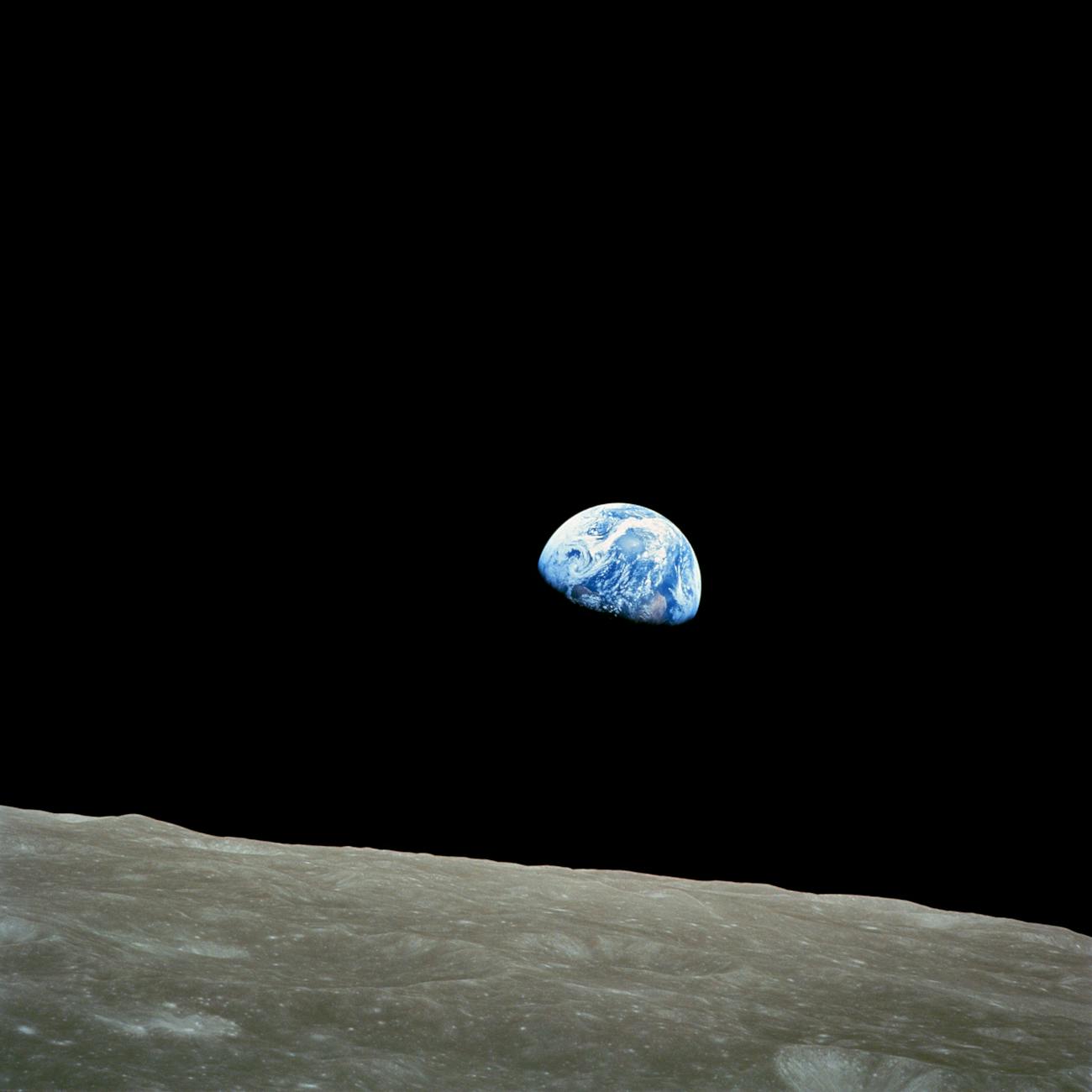
Is Earth 4.5 billion years old or 6,000 years old? Photo by Pixabay on Pexels.com. It was originally taken by Bill Anders and published by NASA.
Older Beliefs
As a teenager I believed that Earth was 6,000 years old. That was before I knew much about science. I had read agenda driven books that left out, or wrongfully dismissed the evidence for an old earth while presenting faulty arguments for a young earth. Just learning about the relevant science was enough for me to realize that I had been bamboozled. At first, I dug my heels in, but I eventually realized that the belief that earth was 6,000 years old was not tenable and unsupportable by science.
If I had known and understood any of what I am posting in this post when I was 14 years old, I don’t think I would have been bamboozled by the young earth creationist books. However, I can add it was not the only time I was bamboozled. I am hoping my blog will lead to some new insights and good reflection including for myself.
Perhaps some new insight. Perhaps some intellectually honest reflection. Photo by Keegan Houser on Pexels.com
“Old Earth” Vs “Young Earth”
Below I am first presenting some evidence for “old earth” and then some arguments, or faulty evidence, for “young earth”.
The various measurements include radiometric dating of rocks and crystals and meteorites found in the earth’s crust as well as moon rocks. There are a number of radiometric dating methods, not just carbon-14.
For example, comparisons of the abundance of carbon-12 and carbon-13 has been used to established that the increase of carbon dioxide in the atmosphere comes from burning fossil fuels, not another source of carbon. Radiometric dating methods use the relative abundance of radioactive isotopes in materials. For example, I-129 (Iodine 129) decays to X-129 (Xenon 129) with a half-life of 16 million years. So, if only a quarter of the original amount of I-129 remains you know that corresponds to 32 million years.
There are a lot of other radioactive isotopes with a wide range of half-lives that can be used for radiometric dating, including uranium-lead dating (U-235, U-238, Pb-206, Pb-207), Samarium–neodymium dating, Potassium–argon dating, Rubidium–strontium dating, Uranium–thorium dating, Chlorine-36 dating, Argon–argon dating, Iodine–xenon dating (I-129 – Xe-129), Lanthanum–barium dating, Lead–lead dating, Hafnium–tungsten dating, Oxygen-Oxygen dating (Isotopes O-16, O-17, O-18), Potassium–calcium dating, Rhenium–osmium dating, Uranium–uranium dating, Krypton–krypton dating, Beryllium dating (Be-10 Be-9), and many others as well the mixing of dating methods.
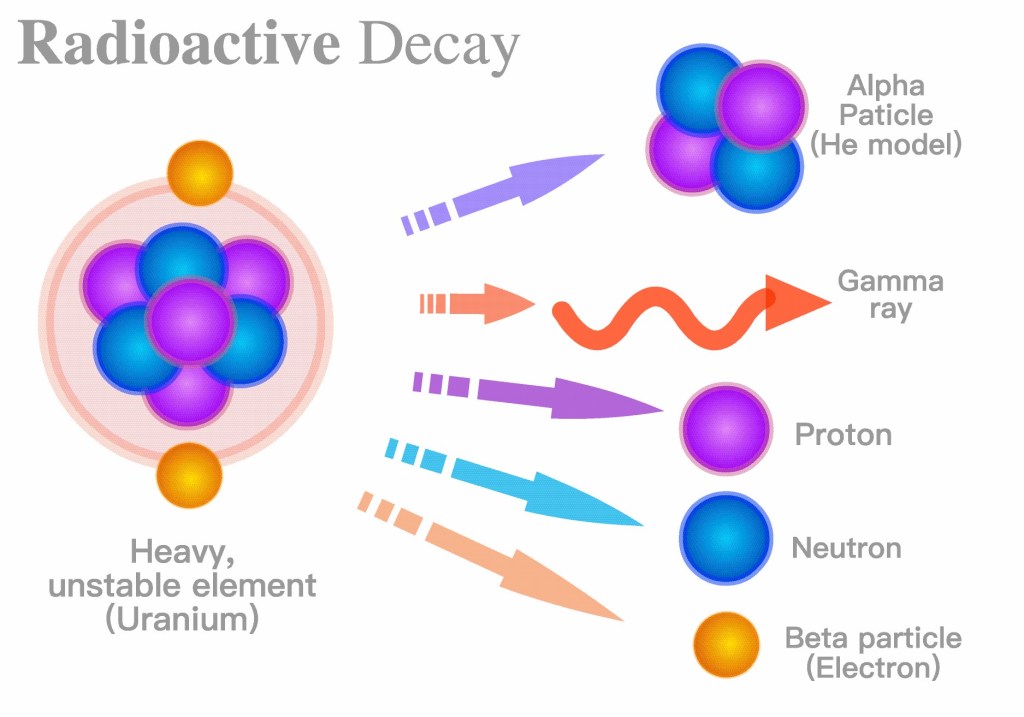
These dating methods use radioactive decay to establish age, and the various isotopes mentioned have half-lives from a few thousand years to billion years.
There are also dating methods that do not use the relative abundance of radioactive isotopes to establish age. In fission track dating you count the “track” markings left in it by the spontaneous fission of , for example, uranium-238 impurities. In this case you don’t need to know the initial abundance of the radioactive isotope.
In luminescence dating methods you don’t even rely on radioactive isotopes but the effect that background radiation has had on materials. Stratigraphy, or stratigraphic dating, is a relative dating method that uses layers of sediment, rock, debris, and other materials to date events.
Radiometric dating uses the rate of radioactive decay and knowledge of initial relative abundances to establish age. Earth comes out to be billions of years old, not 6,000. Stock Vector ID: 2417370135 by grayjay
We can see galaxies that are billions of lightyears away.
This does not establish the age of the earth, but young earth creationists typically also believe in a young universe. In addition, an old universe makes a young earth implausible.
The light from a powerful stellar object or a galaxy that is five billion light years away took five billion years to reach us.
We know stars are old because they develop according to certain physical processes.
These physical processes give different stars different lifespans. You can establish the age of a star by determining where it is along its development. An example is our sun. It has fused (burned up) up around five billion years’ worth of hydrogen, so we know it is around five billion years old.
The heavier elements in our solar system originate with older stars that burned out and exploded.
Our solar system, the earth and our bodies contain many kinds of elements heavier than iron. However, elements above iron in the periodic table cannot be formed in the normal nuclear fusion processes in stars. But they can be formed when massive stars die in a supernova explosion or when neutron stars (dead stars) collide. A massive star living, dying, exploding in a supernova, and after that the heavy elements are spread all the way to our solar system, is not a process that can take only 6,000 years. It’s millions and billions of years. It is also interesting to note that this means that parts of our body consist of materials originating in faraway dead stars. We are stardust.
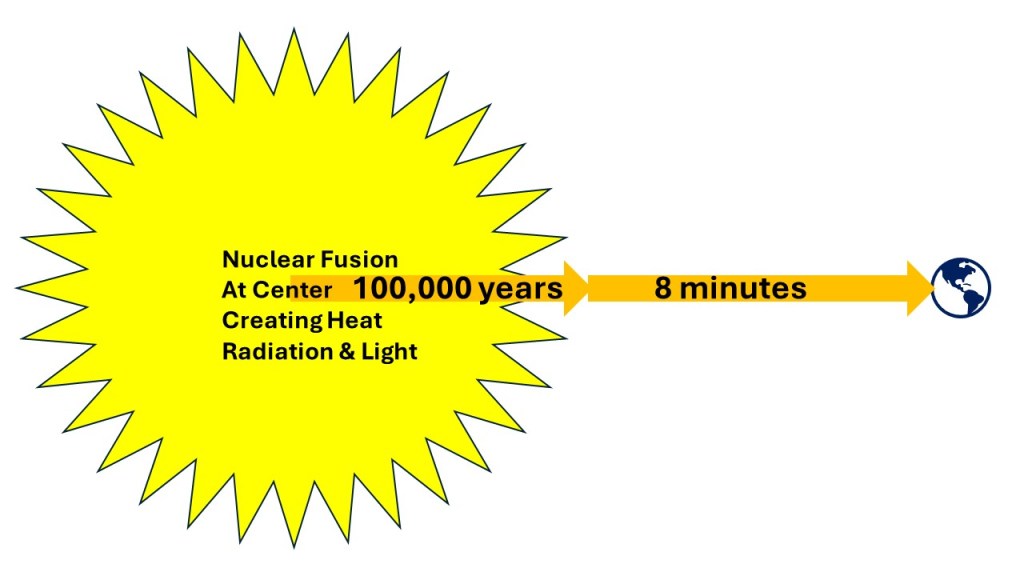
Electromagnetic radiation, including light, and heat transfer, travels from the inside of the sun to the surface and this process takes 100,000 years.
The photons are emitted and reabsorbed over and over, which is a relatively slow process inside the side. If the solar system, the earth, the sun, etc., is only 6,000 years old, how can we see the sun?
Heat / radiation transfer from the inside of the sun to the surface of the sun takes 100,000 years.
Finally, some young earth arguments
Radioactive decay rates have changed drastically (No!)
First, this is an ad hoc argument that lacks evidence. Secondly this claim cannot work. The rates of radiometric decay (the ones relevant to radiometric dating) are a result of fundamental physical properties of matter, such as the probability per unit time that a certain particle can “tunnel” out of the nucleus of the atom.
You can’t change fundamental physical properties without destroying physics and how atoms work. The claim is also contrary to empirical evidence. For example, analysis of spectra from quasars show that the fine structure constant has not changed over the last ten billion years.
Another problem with this argument is that for a young earth you would need the decay rates to have been millions of times faster in the past, which would require changes in fundamental properties that would have plenty of noticeable effects on processes other than radioactive decay, not to mention the radiation being millions of times stronger than today. That’s a lot of radiation for Adam and Eve to survive. It would have fried everything.
In addition it is also a mystery how the dozens of different radiometric dating methods could have remained consistent with each other throughout time and add the fact that there are dating methods that do not rely on the decay rate of isotopes.
Young earth creationists sometimes make the claim that the initial ratios between isotopes may have been different.
That the initial ratios/condition were different in the past and therefore radiometric dating is unreliable is a better argument, but it also fails. In this case you must take it case by case for each radiometric dating method and situation. There are some rare cases of mistaken assumptions but there are also cases where the amount of the daughter isotope is known to have been zero, which makes it easy and reliable.
The speed of light in vacuum has changed throughout history (No!)
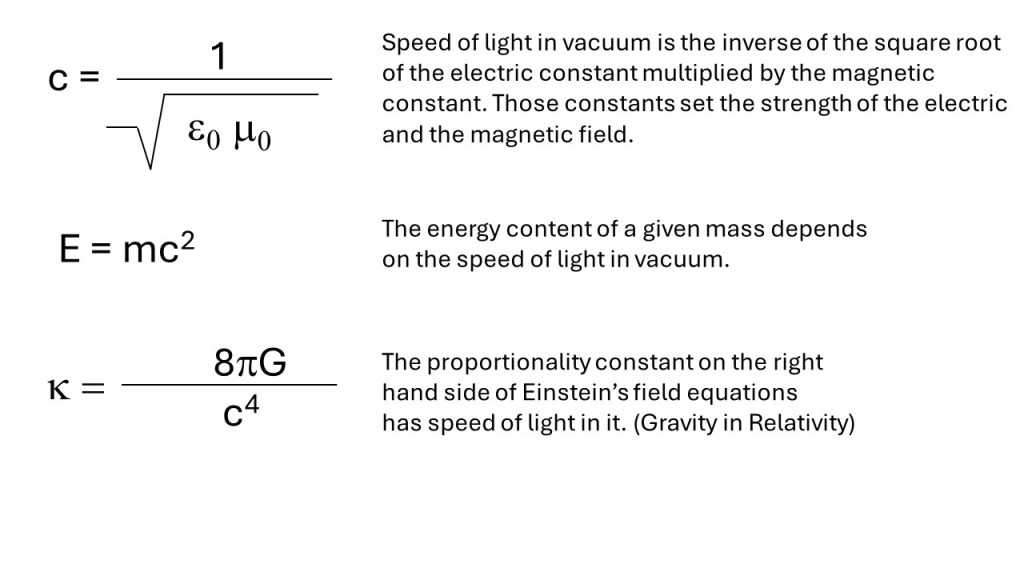
Similar to the situation above, this objection does not work because the light speed in vacuum is a fundamental constant that is not believed to change, and it would be very strange if it could change. It has been measured and no change has been seen. An example is the Einstein’s equivalence of energy and mass E = mc2. If the speed of light once was millions of times faster than now, the energy contained in a kilogram would be a trillion times larger than now. Where did all that energy go?
Another example, from electromagnetic theory the speed of light is determined by the inverse of the square root of the electric constant multiplied by the magnetic constant (see below). You would have to drastically change the strength of the electric and magnetic fields (by the trillions) to get the speed of light to be millions of times faster. If you for example made the electric field a trillion times weaker how would atoms hold together?
Yet another example, Planck’s law features the speed of light in vacuum constant. In physics, Planck’s law describes the spectral density of electromagnetic radiation emitted by a black body in thermal equilibrium at a given temperature T, when there is no net flow of matter or energy between the body and its environment. Changing the speed of light in vacuum would turn light into very slow microwaves. How would Adam and Eve be able to see? Not to mention that the proportionality constant on the right-hand side of Einstein’s field equations has the speed of light in it. Gravity would essentially disappear. The light speed in vacuum shows up in many other physical relations as well.
A few equations in which the speed of light in vacuum is a fundamental constant.
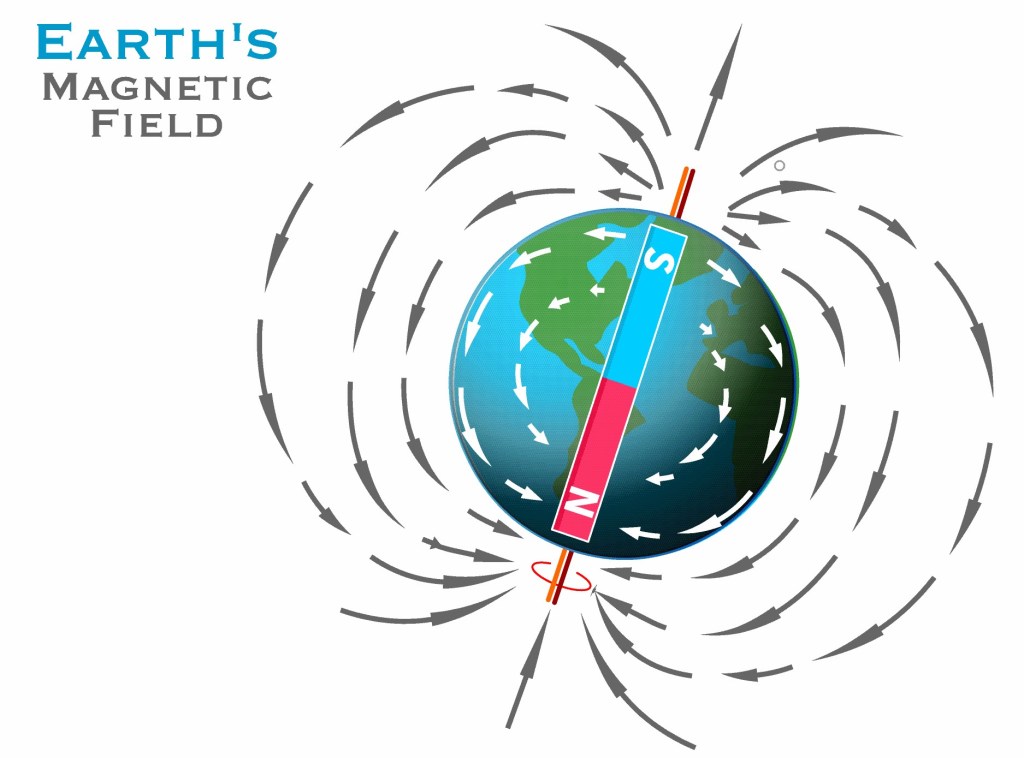
The earth’s magnetic field has been weakening during the last 130 years as if it was formed from currents resulting from earth being a discharging capacitor (claim by Thomas Barnes). This would make an impossibly strong magnetic field already 8,000 years ago.
I remember this being one of the arguments in a young earth creationist book that I read as a teenager. However, there are a number of problems with this claim.
The first problem with this argument is that there is no good reason to believe that earth’s magnetic field acts this way. It does not act like a discharging capacitor.
We know that earth’s magnetic field has reversed itself several times thus disproving the discharging capacitor model.
Thomas Barnes’ extrapolation completely ignores the nondipole component of the field.
Earth’s magnetic field. Stock Vector ID: 1851166585 by grayjay.
If the earth and the moon were billions of years old there would be a hundred feet thick dust layer from meteorites on the moon. The moon landing proved otherwise.
This is yet another argument I remember reading in a young earth creationist book (Scientific Creationism by Henry Morris) as a teenager. The problem with this argument, as I would later find out, is that Morris’ claims about a hundred feet thick dust layer was based on faulty and obsolete data. The expected depth of meteoritic dust on the Moon is less than one foot (after billions of years).
An old earth would be covered by 182 feet of meteoric dust.
This is another claim that I remember from Henry Morris’ book. The observed rates used in Morris’s calculations are based on dust collected in atmosphere; this measurement was contaminated by dust from the earth. More recent measurements of cosmic dust influx measured from satellites give an influx rate of about 1% as large, corresponding to a 66 centimeter at most thick over 4.5 billion years.
Basically, the evidence for an old earth is very compelling whilst young earth objections to that evidence fails, and young earth arguments tend to fail. At least I am not aware of any valid young earth argument. In addition, based on my readings of young earth creationist books, these books tend to be conspiratorial in nature and making implausible claims about scientific community having certain agendas. There is a reason the young earth view is nearly universally rejected by the relevant scientists.
Conclusion
My conclusion is that the fact that we know that the Earth is Billions of Years Old is a super fact. We know it’s true, it is important, and yet large portions of the public reject that fact.











 Super Facts