Electric Charge is not the only type of Fundamental Charge

Super fact 59 : Most people have heard of electrical charges, positive and negative. However, in nature there are also color charges—red, green, and blue—which are analogous to electric charges. In addition, there are anti-red, anti-green, and anti-blue charges.

Esther’s writing prompt: 10th September : Charge

Click here or here  to join in.

As you may know, atoms consist of particles. Electrons surround the nucleus of the atom. The nucleus of the atom is in the middle of the atom and it consists of protons and neutrons. Electrons have a negative charge. Protons have a positive charge. Neutrons do not have an electrical charge. Electrons are so called elementary particles. They are not composed of other particles. Protons and Neutrons, on the other hand, are not elementary particles. They are composite particles consisting of quarks, gluons and quark pairs called mesons.

The picture shows a Hydrogen atom consisting of one proton and one electron, one Carbon atom with six electrons, six protons and six neutrons, an Oxygen atom with eight electrons, eight protons and eight neutrons, and a Nitrogen atom with seven electrons, seven protons and seven neutrons | Electric Charge is not the only type of Fundamental Charge
Four elements with a nucleus and electron shells. The number of electrons, protons, and neutrons is shown. The green particles circling the nucleus are electrons. The red particles in the nucleus (middle) are protons and the blue particles in the nucleus are neutrons. The colors of the particles in this picture have nothing to do with color charges. The four elements are Hydrogen, Carbon, Oxygen, and Nitrogen. There are 118 elements. These elements can combine into millions of different kinds of molecules that make up everything. Asset id: 1555863596 by OSweetNature.

Quarks have electric charges, just like an electron and a positron, which is why a proton has an electric charge, a positive electric charge. However, in addition quarks have something called color charge. Unlike electric charges, which come in two forms, negative and positive, they come in three forms red, green and blue and in anti-red, anti-green, and anti-blue (well six forms actually). I should say that the color charges, red, green and blue, are not real colors. They are just names. Just electric charges are associated with electric forces; color charges are associated with the nuclear strong force. The strong force is even stronger than the electrical force.

If you take an equal amount of positive and negative electric charges you get something that is electrically neutral. If you take an equal amount of red, green and blue you get what is called white, or neutral. If you take an equal amount of red and anti-red you also get white. Any other mix gives you a net color charge.

vector illustration of up and down quarks in proton and neutron on white background. The proton (left) is a red and blue up quark and a green down quark. The neutron is a red and green down quark and a blue up-quark.
The proton and neutron each consist of three quarks. Protons consist of two up quarks and one down quark. Neutrons consist of two down quarks and one up quark. Both protons and neutrons have a net white charge. The yellow squiggly lines are gluons transporting color charge between the quarks. Asset id: 2333679305 by KRPD.

I can add that gluons are elementary particles that in many respects are like photons. Light consists of photons. It is because of the photons that we can see. In addition, the photons transport electrical charge. Photons are massless elementary particles with the intrinsic spin of one, and they belong to a group of elementary particles called Bosons. Gluons transport color charge, and they are massless and have an intrinsic spin of one and belong to the same group of elementary particles called Bosons. Unlike photons, they are stuck inside the nucleus and unlike photons they never get to see the light of day. The pun was intended.

Matter, light, and electrical charges are all part of our daily life. We can touch matter, see light, and we come across electrical charge when we touch something that is charged or when we see lightning. However, we do not come across quarks, gluons, and color charges in our daily life because they are hidden at the center of the atoms. Yet they are fundamental to the existence of matter, of us. We know color charges exist, the existence of color charges is an important fact, and yet it is not a well-known fact and often a big surprise to people. Therefore, I think it is a super fact.

The 118 Elements and the 3,500 Isotopes

There are 118 known elements. Why not 500, or just 4 or 5, like the ancient Greeks believed? Each element is defined by it having a certain number of protons and the same number of electrons if it is to be electrically neutral. The problem with having more than one proton in the nucleus is that protons all carry a positive charge and therefore want to push each other away. Same charges repel and different charges attract. What saves the nucleus from blowing apart are the neutrons and the associated strong nuclear force (protons & neutrons) which is guided by the color charges. The quantum model for electricity is called Quantum electrodynamics or QED. The quantum model for color charges is called Quantum chromodynamics or QCD.

As you add more protons it becomes increasingly more difficult for the nuclear forces (strong and weak) to hold the nucleus together. The positive charge of the protons is pushing too hard. That’s why there are only 118 Elements. Another thing to note is that the number of neutrons does not have to be the same as the number of protons. This means that for each element there are several kinds of so-called isotopes. For example, carbon has six protons and six electrons (if the atom is electrically neutral) but the carbon atom / element can have six neutrons, seven neutrons, or eight neutrons. You call them carbon-12, carbon-13, and carbon-14, where the number represents the number of protons plus the number of neutrons.

The picture shows a Carbon-12 isotope, a Carbon-13 isotope, and a Carbon-14 isotope | Electric Charge is not the only type of Fundamental Charge
Three natural isotopes of Carbon Stock Vector ID: 2063998442 by zizou7
Bohr model representation of the uranium atom, number 92 and symbol U. Conceptual vector illustration of uranium-238 isotope atom, mass number 238 and electron configuration 2, 8, 18, 32, 21, 9, 2.
This is a simplified Bohr model of the Uranium atom. There are 92 little blue balls circling a nucleus in the middle of the atom. Those are electrons. In the nucleus there are 92 protons. Those are the red balls with plus signs. In addition, there is a yellowish smudge around the protons in the nucleus. Those are the neutrons. Depending on the isotope, there are 143 neutrons for U-235, 146 neutrons for U-238 and 142 neutrons for U-234. Shutterstock asset id: 1999370450 by Patricia F. Carvalho

It is the electrons that determine the chemical properties of an element, and therefore isotopes with a different amount of neutrons are chemically identical. However, they are different with respect to properties that relate to he nucleus, such as radioactivity/stability, and of course weight. Also, when atoms combine into molecules their chemical properties change drastically, but again that is due to the rearrangement of the electrons. There are around 3,500 known isotopes, most of them radioactive.

What is a Quark?

To learn more about Protons, Neutrons, Quarks, Gluons, Color Charges, and Quantum Chromodynamics you can watch this 10 minute video below.

Other Physics Related Superfacts


To see the other Super Facts click here

The Bermuda Triangle the Big Non-Mystery

Super fact 56 : The Bermuda Triangle mystery is a myth. There is not a higher risk of disappearances in the Bermuda Triangle. To be specific, disappearances do not occur in the so-called Bermuda Triangle, or Devils Triangle, with any higher frequency than in other comparable regions of the ocean. The “mystery” of the Bermuda Triangle is largely a manufactured one, perpetuated by sensationalized accounts that often misrepresent the facts and downplay the role of natural hazards like storms.

The number of ships and aircraft reported missing in the Bermuda Triangle is not significantly greater, proportionally speaking, than in any other part of the ocean. The U.S. Coast Guard, along with NOAA, the U.S. Navy, Lloyds of London who pays out insurance for ships and aircraft lost/missing at sea, and other organizations do not recognize the Bermuda Triangle as a unique or mysterious geographic hazard. They emphasize that this is a highly traveled area where the losses are consistent with natural phenomena such as strong storms, the Gulf Stream, human error, and poor navigation, rather than any mysterious forces.

Considering all this, the number of disappearances and accidents is what you’d expect. The Bermuda Triangle isn’t any more mysterious than the Greenland square, the New Zeeland circle, or the Azores Octagon, that I just made up. I consider this a super fact because it is very likely true, and yet surprising to many people who are convinced that there really is a mystery. Furthermore, it is important because it is such a well-known myth.

The Bermuda triangle has one corner in Bermuda, one in Puerto Rico and one around Miami, Florida | The Bermuda Triangle the Big Non-Mystery
The Bermuda Triangle: It is approximately defined as a triangle Florida, Bermuda, and Puerto Rico. There is no exact definition. Alphaiosderivative work: -Majestic-, Public domain, via Wikimedia Commons.

Bermuda Triangle Mysteries

Just because the risk of disappearances of planes and ships is not higher in the Bermuda Triangle, does not mean that there aren’t mysterious disappearances and mysterious phenomenon occurring in the Bermuda Triangle. Some notable disappearances are USS Cyclops (1918), Flight 19 (1945), Star Tiger and Star Ariel (1948–1949), and the Witchcraft (1967). However, there are mysteries and mysterious phenomena occurring all around the world.

One of the mysterious phenomena occurring in the Bermuda Triangle is ocean swirls, and rogue waves, and methane burps might be another problem, but it is far from unique to the Bermuda triangle, and there are no magnetic anomalies in the Bermuda triangle as often alleged.

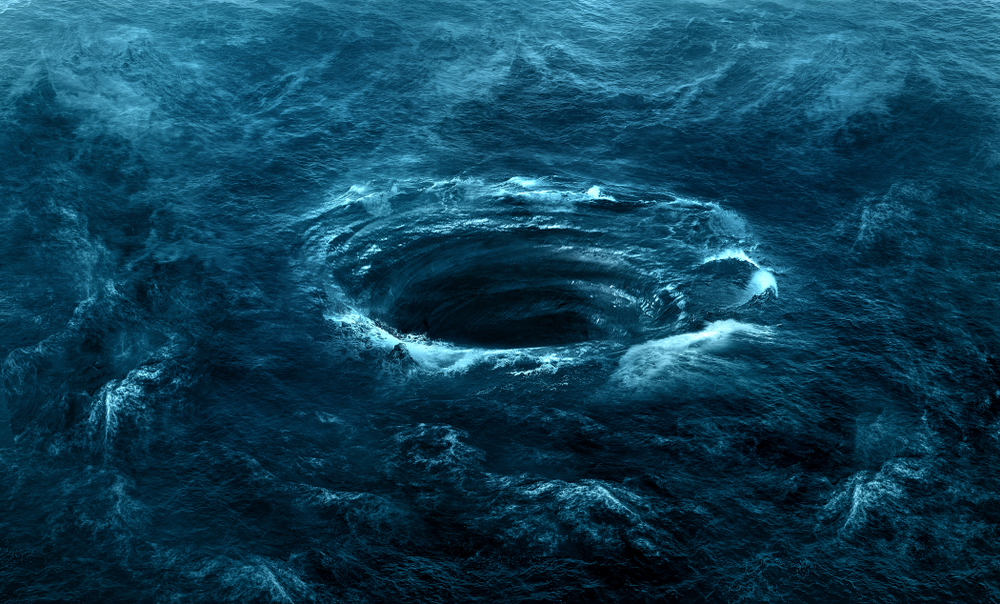
Ocean swirls frequently occur all over the world with some famous hotspots for ocean swirls by the coasts of Japan, Norway, Italy, Scotland, and Maine, USA. The ocean swirls in the Bermuda triangle might be due to movement of water between landmasses and/or the Gulf stream, but this is under investigation. There are no known giant or permanent ocean swirls in the Bermuda triangle.

A giant deep ocean swirl in the middle of the blue ocean.
Ocean swirl allegedly in the Bermuda Triangle Asset id: 1158148882 by PHOTO JUNCTION

As mentioned, another mysterious phenomenon is methane bubbling to the surface of the ocean. However, as can be seen in the maps in this National Geographic blog post the source of these methane burps of death aren’t typical to the Bermuda triangle. The methane hydrate field in the first map of the National Geographic blog post is mostly outside of the Bermuda triangle stretching from Cuba and up along the Florida coast. The second map, the world map, shows that these methane hydrate fields exist all around the world.

Our Honeymoon in Bermuda

Below are some old photos from our honeymoon in Bermuda in August of 1991.


To see the other Super Facts click here

The Enormous Kuiper belt

Super fact 55 : The enormous Kuiper belt.

The Kuiper Belt is a vast torus/donut shaped region of space beyond Neptune, filled with icy, rocky bodies, including dwarf planets like Pluto. It shares a lot of similarities with the Asteroid belt, but it is much larger, and further out. The Kuiper belt is 20 times wider than the Asteroid belt, 1,000 larger by volume, and 20 to 200 times more massive than the Asteroid belt. It extends from roughly 30 to 50 astronomical units (AU) from the Sun.

I can add that one Astronomical Unit (AU) is the distance from the sun to Earth.

In the middle of the picture is the sun and around it is Mercury, Venus, Earth and Mars. Then there is a grey circular band representing the asteroid belt. Further out is Jupiter, Saturn, Uranus, Neptune and Pluto and a large circular band representing the Kuiper belt | The Enormous Kuiper belt
I drew this illustration of the solar system and the Kuiper belt. It is not entirely to scale, and in reality, Mercury and Venus are not attached to the sun.

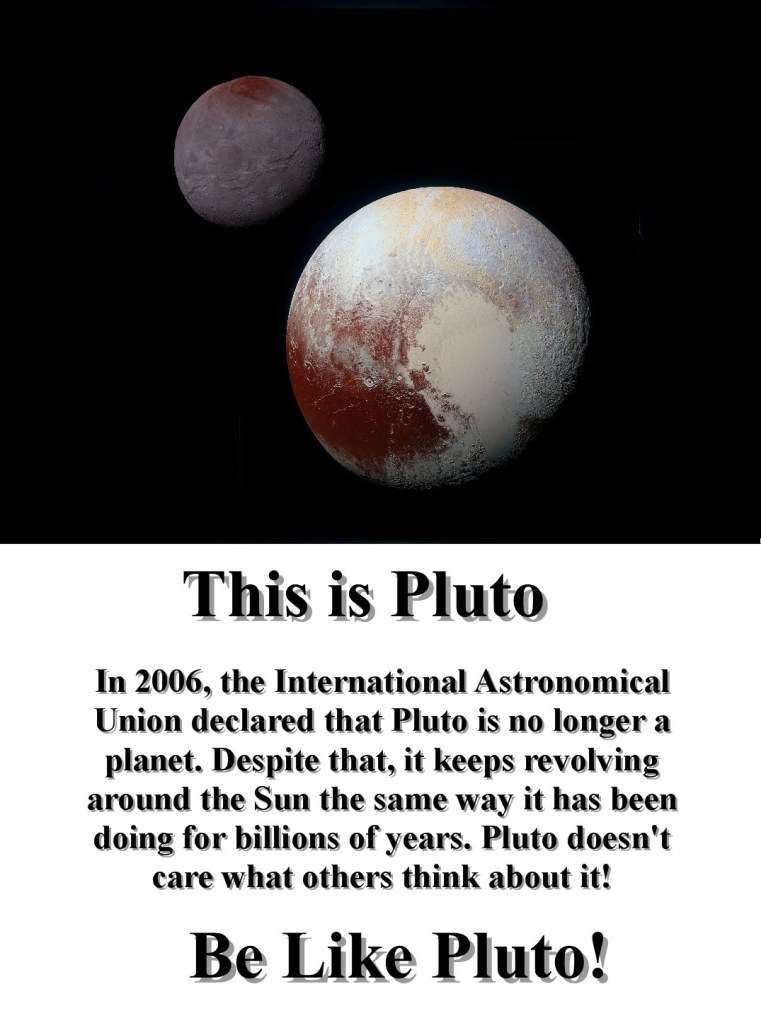
The Kuiper belt is like a giant Asteroid belt located further out, beyond Neptune. The Kuiper Object Pluto, formerly known as the Planet Pluto, is the most admired, the cutest and most beloved of all planets, and it was the first Kuiper object discovered in 1930. However, we did not know of the existence of the Kuiper belt at the time. The Kuiper belt was discovered in 1992 and predicted to possibly exist by Astronomer Gerard Kuiper in 1951. The discovery of the Kuiper belt was one of the reasons Pluto was demoted from its planet status in 2006. There are other dwarf planets in the Kuiper belt similar Pluto, including Makemake, Haumea, and Eris. However, there could be hundreds. Ceres is a dwarf planet located in the Asteroid belt. To read more about the Kuiper belt and verify the facts above, click here, or here, or here.

This picture features the photo of Pluto taken by NASA’s New Horizons spacecraft in 2015 plus some text. The text says : This is Pluto! In 2006, the International Astronomical Union declared that Pluto is no longer a planet. Despite that, it keeps revolving around the Sun the same way it has been doing for billions of years. Pluto doesn't care what others think about it! Be Like Pluto!
Pluto and its moon Charon from NASA/JHUAPL/SwRI. NASA / Johns Hopkins University Applied Physics Laboratory / Southwest Research Institute, Public domain, via Wikimedia Commons. NASA’s New Horizons spacecraft captured this high-resolution enhanced color view of Pluto in 2015.

I selected this to be a super fact because the existence of the Kuiper belt drastically changed our view of our Solar system, so it is important, we know it exists, so it is a true fact, and despite its enormous size the Kuiper belt is much less known than the Asteroid belt, and its existence often comes as a surprise to people.

The Kuiper Belt Resides in Darkness

You may wonder why the Kuiper belt was discovered so late whilst the Asteroid belt has been known since the beginning of the 19th century (Ceres 1801, Pallas 1802, Vesta 1807, etc.) The reason is that the Kuiper belt resides in darkness. The Asteroid belt is 2.2AU to 3.2AU from the sun whereas the Kuiper belt is between 30 to 50AU from the sun.

Let’s say you take an object that is 2.5AU from the sun and place it at a distance that is 40AU from the sun. Due to the spreading of the light the object will now receive 16 X 16 = 256 times less sunlight. This is called Geometric dilution. In addition, this light needs to be reflected back to earth for us to see the object, and once again the light will  spread resulting in 256 X 256 = 65,536 times less light reaching our telescopes. The Kuiper belt is huge, but it resides in darkness. Despite this fact, we have now discovered and catalogued more than 2,000 Kuiper belt objects. However, it is estimated that there are hundreds of thousands of Kuiper belt objects wider than 100 kilometers.

What is a Dwarf Planet?

A planet as well as dwarf planet is a celestial body that orbits the Sun and is nearly round due to its own gravity. Basically, it must be large enough to have compressed itself to a near spherical shape. To be classified as a planet and not a dwarf planet it must also have cleared its orbit of debris. So, a dwarf planet is therefore a celestial body that orbits the Sun, is nearly round due to its own gravity, but has not cleared the neighborhood around its orbit. Obviously, a planet in the Asteroid belt or the Kuiper belt is a dwarf planet. Just to make this complicated Astronomers have found giant exoplanets that have not cleared their orbit of debris . I wonder, are these exo-planets giant dwarf planets?

Oort Cloud

Astronomer and Author David Lee Summers (blog here) reminded me of the Oort cloud, which could be interesting to bring up in this context. The Oort Cloud is a vast spherical cloud of icy bodies, which is hypothesized to surround the solar system, extending from about 2,000 to 200,000 AU. It is thus thousands of times further out and wide than the Kuiper belt. I say hypothesized because the objects are so small, there’s really no direct observation of them and there’s some variation in numbers for its distance and extent, meaning it’s still not well defined yet. Still, its outer edge is believed to be the boundary between where the sun’s gravity dominates and the galaxy’s gravity dominates.

The Oort cloud is generally considered to be the outer edge of the solar system and believed to be the origin of most long period comets. The Oort cloud is thought to encompass two regions: a disc-shaped inner Oort cloud aligned with the solar ecliptic (also called its Hills cloud) and a spherical outer Oort cloud enclosing the entire Solar System.

The picture is of the Oort cloud with an inset picture of the Kuiper belt at the top. The inset picture is an enlargement of the dot in the middle corresponding to the Kuiper belt.
NASA This SVG image was created by Medium69.Cette image SVG a été créée par Medium69.Please credit this : William Crochot, Public domain, via Wikimedia Commons.

Other Astronomy Related Super Facts


To see the other Super Facts click here

Satellites handle a very small amount of global internet traffic

Super fact 54 : Satellites currently handle a very small percentage of global internet traffic, estimated at about 1%. The vast majority of internet traffic is carried by undersea cables.

I consider this a super fact because it is surprising, true and not trivia. It is an important fact since most of us use internet every day. It is a very common belief that satellites handle most of the global internet traffic, or at least a very large portion of it. I should say that a few years ago I thought so myself.

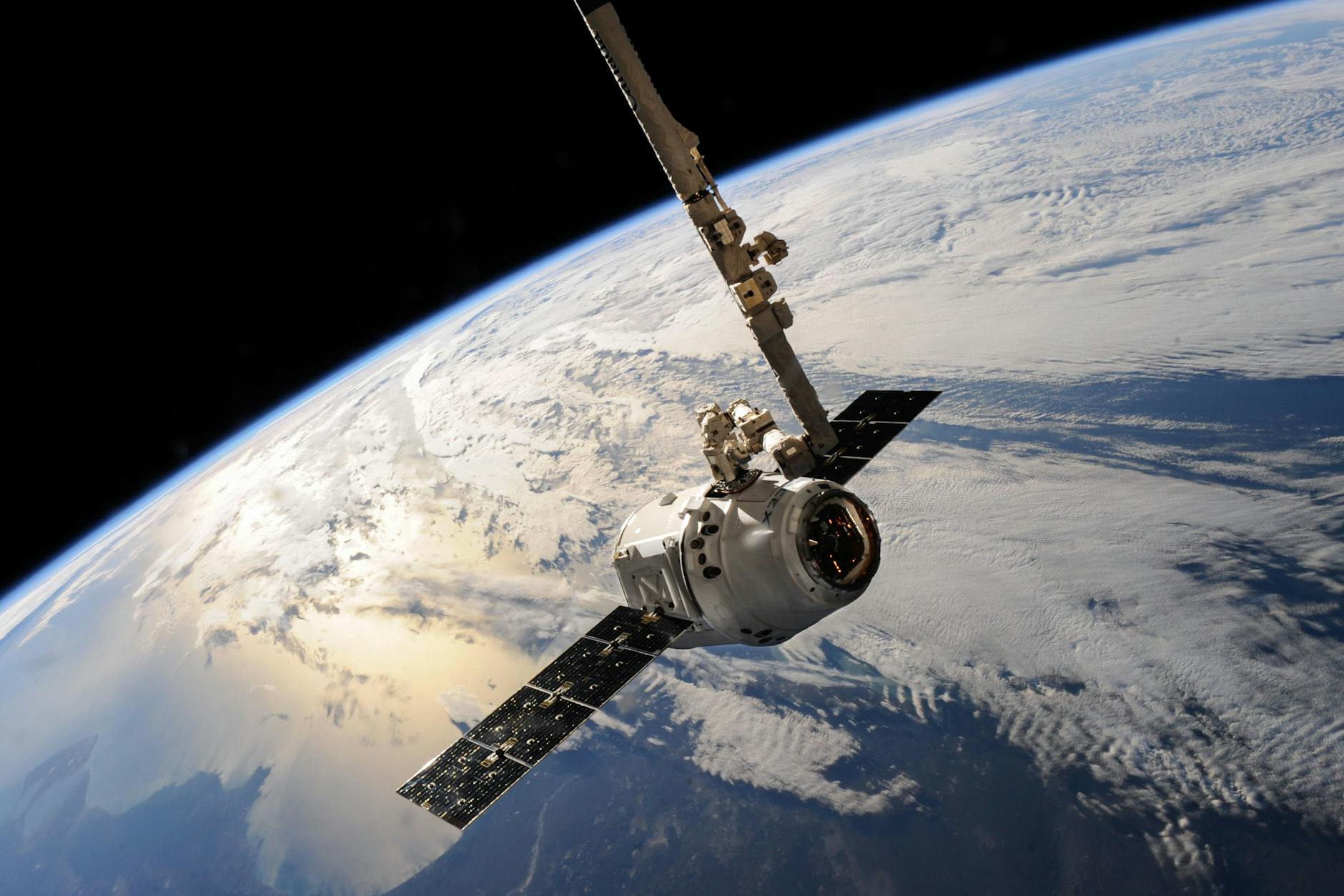
Space satellite orbiting the Earth. 3D rendering | Satellites handle a very small amount of global internet traffic
Stock Illustration ID: 1372134458 by Boris Rabtsevich
Multiple layers inside a black cable. Optical fibers emerge from the cut end, and they shine.
Submarine underwater communication fiber optic cable on deep seabed. Asset id: 2175977719 by Dragon Claws

How Much Internet Traffic is Handled by Satellites

I should say that I did not find a lot of sites that answered this question, but all of the sites that I found gave similar answers such as, less than 1%, 1.5%, 1-2%, very little, etc.

I started out by asking ChatGPT this question “How much of internet communication does Satellites handle?” The answer I got was that Satellites handle a relatively small percentage of global internet traffic — typically less than 1–2% — with most of the world’s internet communication carried through undersea fiber optic cables and terrestrial infrastructure (like cell towers and wired broadband). Wikipedia states that satellites handle less than 5% – to an estimate of even 0.5%. I should add I do not rely on ChatGPT, SGE or Gemini, or Wikipedia for this blog but I take hints from them.

According to NOAA, over 95 percent of international data and voice transfers are currently routed through the many fiber optic cables that crisscross the world’s seafloors, whilst satellites currently carry just about 1% of global internet traffic according to Research Outreach. Operations Forces Report, Space Voyage Ventures, Neterra, and Newsweek made similar claims .

The reason satellite internet is used less is because satellite internet is significantly more expensive to use than traditional wired connections. In addition, satellites have higher latency (delay) compared to fiber optic cables, and less bandwidth (data capacity). Satellite internet is primarily used in remote areas where other forms of internet access are unavailable. Satellite internet is also used for military and government operations, as well as maritime and aviation connectivity. However, satellite internet is improving so this may change in the future. This is a comparison between satellite internet and optical fiber.

Satellites handle a very small amount of global internet traffic
Photo by SpaceX on Pexels.com
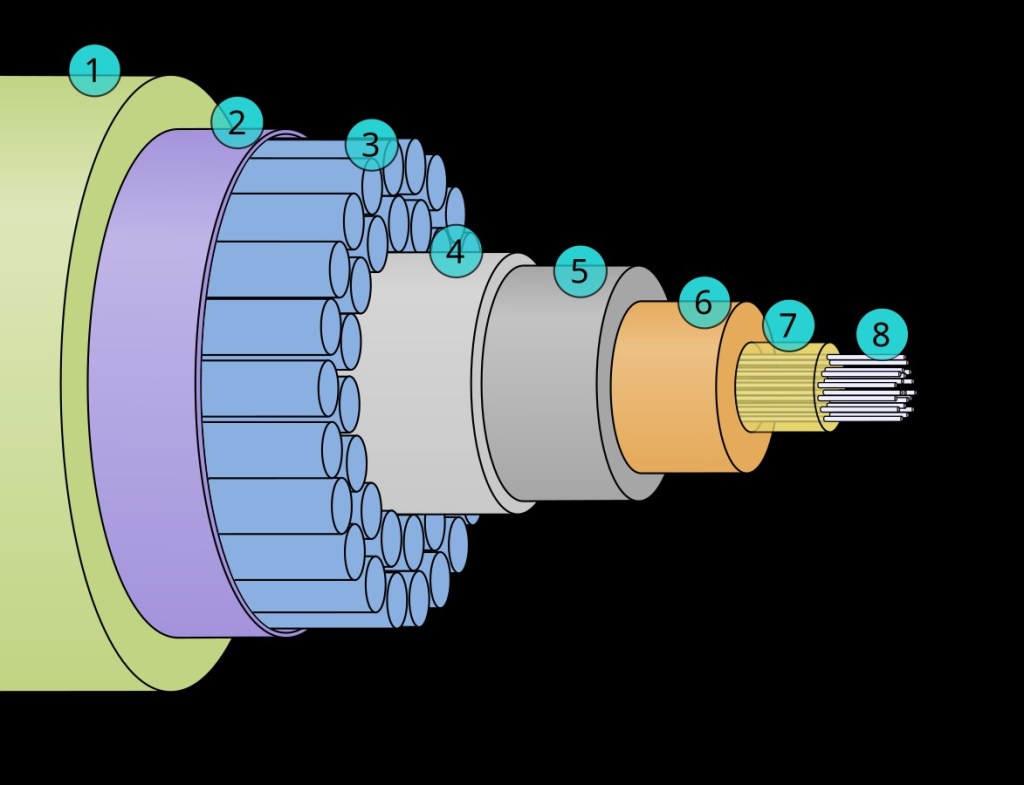
Eight layers in various colors are shown. See below for indicators.
This is a cross section of submarine fiber optic cable. Picture by Oona Räisänen (User:Mysid), Public domain, via Wikimedia Commons.

The layers in the picture of the submarine communications cable above are (from outside to inside): (1) Polyethylene (2) Mylar tape (3) Stranded steel wires (4) Aluminum water barrier (5) Polycarbonate (6) Copper or aluminum tube (7) Petroleum jelly (8) Optical fibers.

Related Post

A related post and super fact is: GPS uses relativity for accuracy


To see the other Super Facts click here

The Euler Number Math Magic

Super fact 53 : The Euler number denoted e, is an irrational number, which like the number pi is extremely important in mathematics. In addition, the relationship between the Euler number and pi; seemingly unrelated numbers, is quite amazing, especially if you throw the imaginary number: i = square root of -1 into the mix. Euler’s formula e^ix = cos(x) + isin(x), where x is degrees expressed in radians, is mind blowing to say the least. Radians means that 180 degrees is replaced by pi, and 90 degrees is replaced by pi/2, etc. A simpler special case, but equally amazing is Euler’s identity e^ix = -1, or e^ix + 1 =0. This is amazing math assuming you understand it.

As I said all this is amazing, mind blowing if you will, if you understand it, which is why I will try to explain it. Why I consider this a super fact is because when you first encounter the Euler number and the Euler formula, and you somewhat understand what it means, it is likely to be a mind-blowing experience. Those among you who have studied higher math, AP math classes in high school, or college level math are probably familiar with what I am about to describe, so your mind may not be blown. By the way you pronounce Euler like “Oiler”.

The formula e^ix + 1 =0 shown on a blue and black background | The Euler Number Math Magic
Euler’s formula in cyber space with grid 3d illustration, Asset id: 1636161301 by Giggle2000

Euler’s Number and Pi Two Irrational Numbers

Pi is the number you get when you divide the distance around a circle (the circumference) by the distance across the middle (the diameter). The Euler number is a bit more complicated to explain. I will do that next. Both pi and the Euler number are irrational numbers, which means that when written as a decimal, the number neither terminates nor repeats. As I mentioned, both pi and the Euler number are extremely important numbers in math. Perhaps the Euler should have its own day, just like pi has its own day (March 14). Maybe we should start celebrating Euler number day on February 7.

The picture shows a circle and a brief explanation of what pi is. The 20 first decimals of pi as well as the 20 first decimals of the Euler number are shown.
The first 20 decimals of pi and of the Euler number.

Exponents

Before I explain what, the Euler number is, I need to explain what an exponent is. If you multiply a number by itself x number of times, then x is the exponent. If you multiply two by itself four times 2*2*2*2, called 2 raised to 4, then 4 is the exponent. By the way the answer is 2^4 = 16 (called 2 raised to 4 is 16). I hope the illustration below will explain it.

This picture explains what an exponent is.
Overview of exponents.

And finally, before explaining what the Euler number is I should also mention what a factorial is. The factorial of a number is the product of all positive integers less than or equal to that number. The factorial of 5 is denoted 5! and is 1*2*3*4*5 = 120. Also, the factorial of 0 or 0! = 1 (per definition).

Definition of the Euler Number

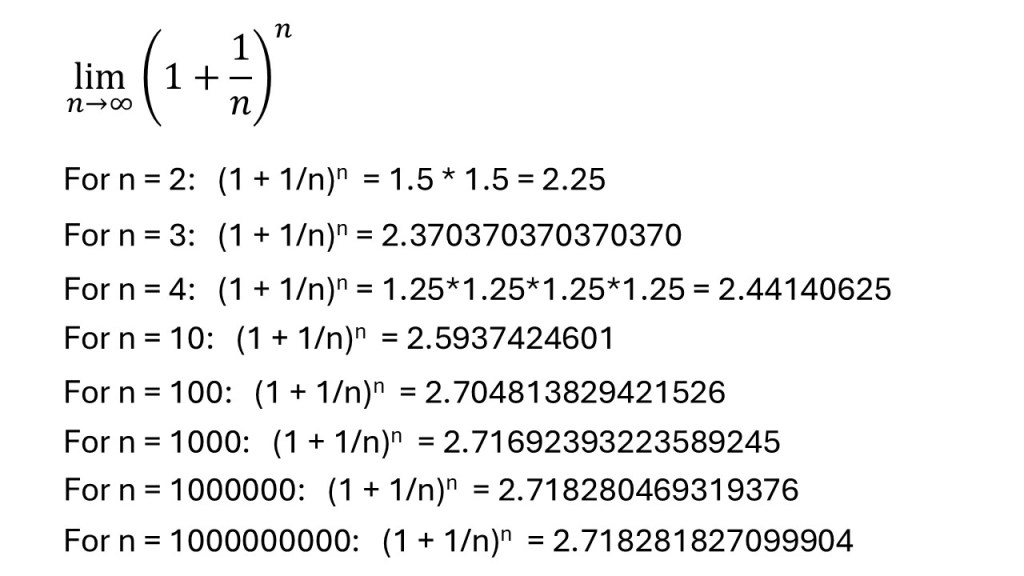
One more thing I need to explain before I go ahead with the definition for the Euler number is what is meant by allowing a number n in a formula to go towards infinity (limit –> infinity). Let’s say you have a formula that contains the number n. If the value of the formula does not change much as n becomes very large than it might be approaching a specific number as n approaches infinity. You say that it approaches a limit. I am trying to illustrate this in the picture below.

The formula (1 + 1/n)^n is given for a lot of different numbers n. You can see that a number, a limit, is reached as n approaches infinity | The Euler Number Math Magic
As the number n gets bigger the formula stops getting bigger and instead approaches a limit. When n approaches infinity that will be a very specific number. Which number do you think it is?
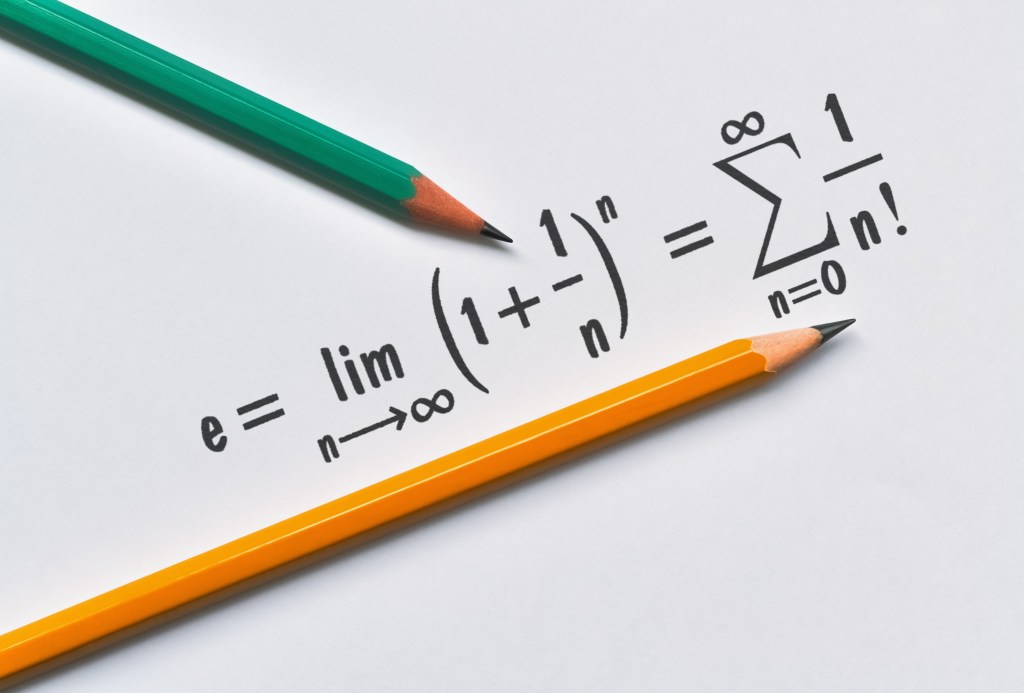
The picture features the definition of Euler’s Number as well as another formula consisting of an infinite sum that is also Euler’s number.
The definition of Euler’s number plus an infinite series sum that is also the same as Euler’s number.
Two formulas equal to Euler’s Number. One is an exponent approaching infinity and the other is a sum from 0 to infinity | The Euler Number Math Magic
Definition of the Euler’s constant in two different ways, Asset id: 1227561829, by benjaminec.

Euler’s Number in Calculus

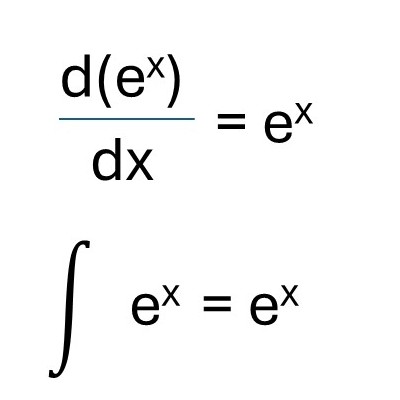
As I mentioned, Euler’s number shows up in mathematics in a lot of places. It is an extremely useful number with some amazing properties and that includes calculus. However, explaining functions and calculus may be going a bit too far, so I am just going to simply state that the derivate of e^x is just e^x and the indefinite integral, or the anti-derivative of e^x is e^x. In other words, differentiation / integration does not change this function. It also means that the slope of the curve is the same as the curve itself. Among all the infinite number of functions this is only true for e^x.

Differentiation and integration formulas for the exponential function.
Differentiation and integration does not change the function e^x.

Trigonometric Functions

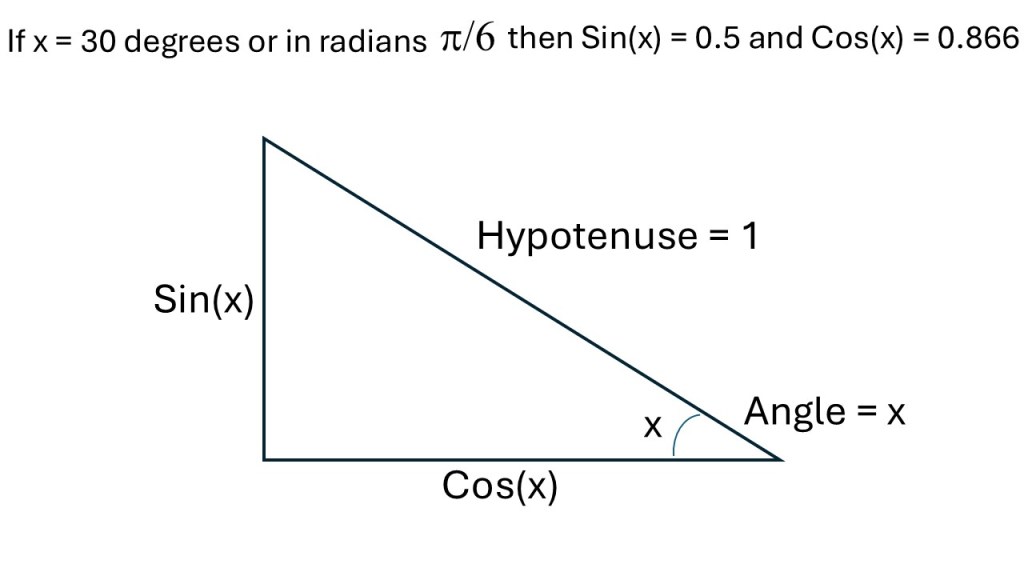
Next, I would like to launch into Euler’s formula. However, before I do that, I need to explain what trigonometric functions and imaginary numbers are. The trigonometric function sin(x) is the ratio of the length of the side opposite to a given angle to the length of the hypotenuse. In other words, if the hypotenuse is equal to 1, then sin(x) is the length of the opposite side to the given angle. The trigonometric function cos(x) is the ratio of the side of the triangle adjacent to the angle divided by the hypotenuse. In other words, if the hypotenuse is equal to 1, then cos(x) is the length of the adjacent side to the given angle.

Sin and cos are always between 1 and -1. ‘x’ is often expressed in degrees going from 0 to 360 (or 0 to 90 in a right-angled triangle). However, there is another way to express angles in triangles and that is radians. In this case the number pi corresponds to 180 degrees, pi/2 corresponds to 90 degrees, pi/4 corresponds to 45 degrees, etc. Euler’s formula uses trigonometric functions, but it only works if you use pi instead of degrees. Pi and Euler’s number have a special relationship. Sin and cos are illustrated in the picture below.

The picture shows a right-angled triangle with the sides being the hypotenuse set to 1 and the two other sides sin(x) and cos(x) respectively | The Euler Number Math Magic
Illustration of the trigonometric functions sin(x) and cos(x).

Imaginary Numbers

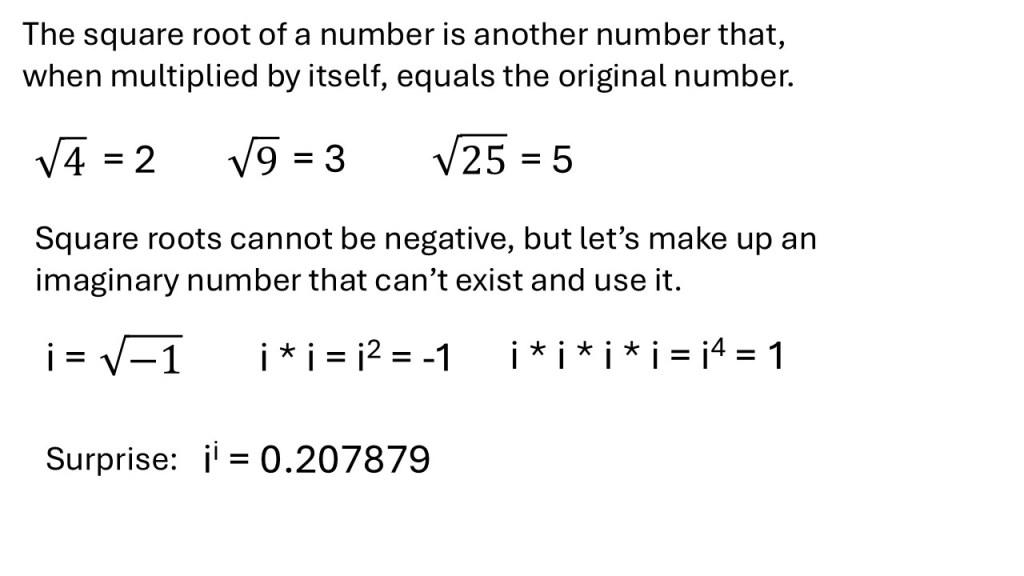
The last thing I need to explain before demonstrating Euler’s formula is imaginary numbers. The square root of a number is another number that, when multiplied by itself, equals the original number. For example, the square root of 4 is 2, because 2 * 2 = 4. The square root of 9 is 3, because 3 * 3 = 9. As long as you deal with real numbers, square roots must be positive numbers because you cannot multiply two numbers and get a negative number. -2 * -2 is 4, not -4.

However, that did not stop some mathematicians from making up a square root that was negative. This imaginary number is the square root of -1 and is referred to as i, yes just i, for imaginary. So, what’s the point of making up numbers that can’t exist? Well, it turned out to be quite useful and you can manipulate imaginary numbers to result in real numbers. For example, if you multiply the imaginary number i by itself i*i you get -1. If you multiply i by itself four times, in other words i^4, or i raised to 4, you get 1. Even more impressively, i raised to i, or i^i, is a real number. i^i = 0.207879… This is illustrated in the picture below.

The picture features the definition of the imaginary number and an explanation for what imaginary numbers are, as well as examples.
Imaginary numbers illustrated

Eulers Formula

Without giving the proof, or any detailed explanations, below is Euler’s identity and Euler’s Formula (e^ix = cos(x) + isin(x)). Notice the mix of Euler’s number, pi, the trigonometric functions using radians (based on pi), and the imaginary number. Well, likely mind-blown, if you have not seen it already and you understood this post up to here.

Euler’s identity and Euler’s formula | The Euler Number Math Magic
Euler’s identity and Euler’s formula.
The picture shows Euler’s formula illustrated in the complex plane.
Euler’s formula illustrated in the complex plane. Asset id: 2345669209 by Sasha701

If you want to see how you prove Euler’s Formula check out this youTube video.

If you want to learn more about the importance of Euler’s number in sommon and useful mathematics, check out this youTube video.


To see the other Super Facts click here