Relativity Visualized by Lewis Carroll Epstein

The goal of this blog is to create a list of what I call super facts. Super facts are important and true facts that are nevertheless highly surprising to many or disputed or misunderstood by many. In a sense this is a myth busting blog regarding important information. However, I also make posts that are not super facts but feature other interesting information, such as this book review and book recommendation.

Relativity Visualized by Lewis Carroll Epstein

Lewis Carroll Epstein <<Link-1>> is a physicist, teacher and author who has written a number of physics books for layman. He is somewhat famous for coming up with ingenious ways of using diagrams, pictures and puzzles to explain complex matters without using mathematics. His approach is unorthodox but, in my opinion, quite successful. You still have to invest time in reading this 200-page long book and solving most of the puzzles to understand what is going on. The book features some math, notably regarding the derivation of the formula for energy-mass equivalency E = mc2. However, it is in a special section for “teachers only”.

It is an old book and the only version currently available on Amazon is the paperback version. The publisher of the paperback is Insight Press; First Edition (January 1, 1985), ASIN : 093521805X, ISBN-13 : 978-0935218053, 206 pages, item weight : 12.8 ounces, dimensions : 6.25 x 0.75 x 9 inches. It costs $48.99 on US Amazon. Click here to order it from Amazon.com.

The front cover features the title “Relativity Visualized” and the author’s name and in the background is the night sky with the milky way. At the bottom of the front cover is a train with a head lamp and a light beam | Relativity Visualized by Lewis Carroll Epstein
Front cover of the paperback version of Relativity Visualized by Lewis Carroll Epstein. Click on the image to go to the Amazon page for the paperback version of the book.

Amazon’s Description of the Relativity Visualized By Lewis Carroll Epstein

Perfect for those interested in physics but who are not physicists or mathematicians, this book makes relativity so simple that a child can understand it. By replacing equations with diagrams, the book allows non-specialist readers to fully understand the concepts in relativity without the slow, painful progress so often associated with a complicated scientific subject. It allows readers not only to know how relativity works, but also to intuitively understand it.

This is my five-star review for Relativity Visualized

Note, I wrote this review in 2016, so it is relatively old, pun intended. In my original Amazon review I used very large paragraphs. I have changed that by breaking up the paragraphs a bit but without changing the content in any way.

Relatively Intuitive

In my opinion the theories of relativity are among the most interesting intellectual achievements in human history. They revolutionized physics and changed the way we think about physics, space, time, mass, energy, electromagnetism and essentially everything in nature. Despite that fact, the theories of relativity are deterministic and possible to visualize, and unlike Quantum Physics they are not statistical in nature and they don’t have a big issue with interpretation.

I’ve been interested in this topic ever since I came across it as a high school student. Therefore, I did not learn a lot about relativity from this book. I was more interested in the approach to explaining it, and I think his approach is a very good one.

I’ve found that an explanation for relativity that lacks rigor and quantitative reasoning creates misconceptions. The reader may end up thinking he understands it when he doesn’t. I’ve also found that books that focus on deriving complex equations were not only unattainable to the layman but sometimes left the mathematically inclined student with a poor understanding of relativity as well.

Lewis Carroll Epstein’s book “Relativity Visualized” seems to succeed in making relativity accessible to both the layman and those who are mathematically inclined. He explains the special theory of relativity and the general theory of relativity using graphs, visual constructs, and logical puzzles that the reader solves for himself. In a sense he allows the reader to develop the theories of relativity on his own. He avoids equations and formulas, but the reader will still discover more exactly what is going on.

One thing that really impressed me with this book is its special focus on the difference between what you see/experience and what you measure. As an example, take two lights that flash at the same time (in your reference frame). They could appear to flash at different times if the distance between them is large. So, you will see them flash at different times. However, if you time the light flashes and take the distance into account you can measure that they flashed at the same time (non-relativistic situation).

In relativity the differences you measure between frames do not only arise from the distance the light travels or from Doppler Effects but also from the relativity of time and space as well, and Epstein explains the details without confusing the reader. He focuses a lot on simultaneity/non-simultaneity right from the very beginning, and in my opinion understanding relativistic non-simultaneity is crucial to understanding what is going on.

The book also discusses the General Theory of Relativity. The General Theory of Relativity is often seen as completely off limits to the layman. It is typically explained using complex tensor calculus, differential geometry, and topology, or alternatively in a non-technical vague way that leaves the reader clueless. General Relativity was born out of an enigma. Special relativity had shown that energy and mass are the same things, so light has mass. A light beam traveling through a gravitational field must thus bend.

However, that means that the side of the light closer to the mass will travel a shorter distance. From known properties of light (always a transverse/orthogonal wave) this means that the side of the light beam closer to the mass moves slower than the outer rim which would violate the constancy of the speed of light in vacuum.

To solve this enigma Einstein had to introduce a time warp in gravitational fields. Later he discovered that this time warp would cause objects to fall towards the masses that caused the time warp and the practical effect of this turned out to be essentially identical to Newton’s theory of gravity and thus the mysterious force of gravity could be removed. Einstein also discovered that there is a warp effect on space which is negligible unless the speed of the objects is large (like magnetism for electric forces). The book helps you visualize all of this without using complex math.

Lewis Carroll Epstein’s book contains unique pedagogic approaches, novel geometric representations of relativity, as well as engaging questions and answers. For this reason, the book is fiercely protected by copyright law. On the negative side, his writing style is somewhat rigid and old fashioned, the drawings and the graphics are sometimes of low quality, and the book might be quite a bit of work for the layman reader, so it requires that you are really interested. However, overall, this is a very rigorous, detailed, correct, and yet entertaining book that I highly recommend.

Good Myths

I also would like to mention another tool that Lewis Carroll Epstein use in his book, and that is the concept of a Good Myth. A Good Myth is a description that isn’t technical and maybe not exact but that isn’t wrong either. In a loose way it captures the truth of what is going on.

An example of one of these myths is that everything, including all of us, is always traveling through time and space at exactly the speed of light in vacuum. In other words, we are all traveling at the speed of c = 299,792,458 meters per second. If we are sitting still, then we are traveling through time at the speed of light. If we are traveling through space at the speed of light then we are not traveling through time at all, like photons, for which time does not exist.

If we are traveling through space at a high speed, then if we add, in a vector way (Pythagoras theorem), our speed in space to our speed in time, they together will add up to the speed of light in vacuum. But that means that we are traveling through time at a speed that is less than the speed of light. So, our clocks will run slower.
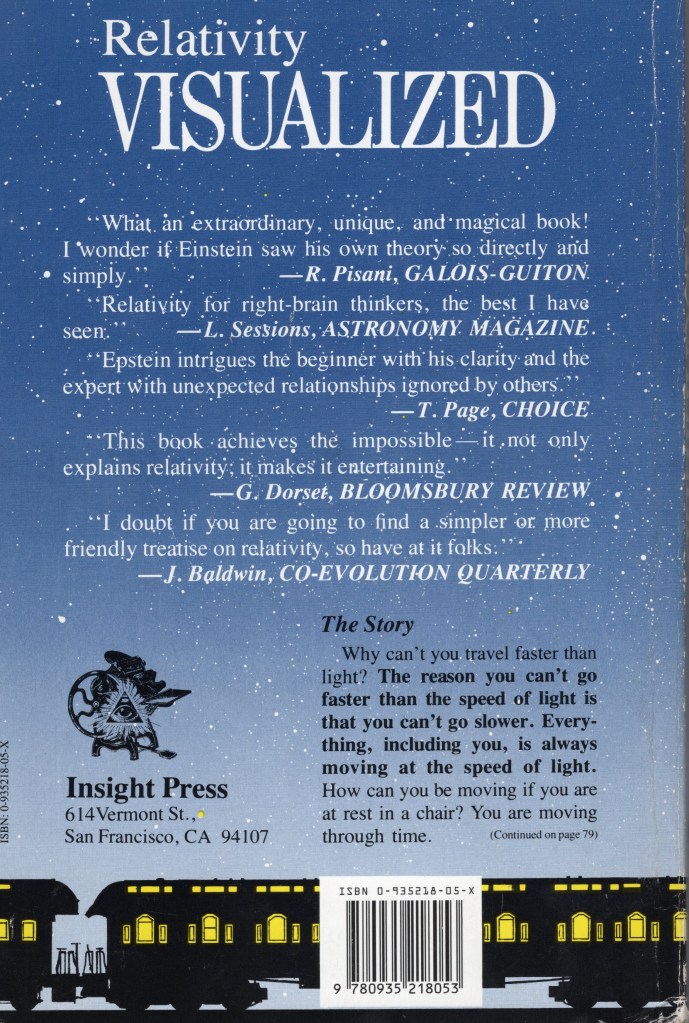
The back cover features the title of the book, praise for the book and very brief description | Relativity Visualized by Lewis Carroll Epstein
Back cover of the paperback version of Relativity Visualized by Lewis Carroll Epstein.

Other Posts on Relativity

Below is a list of other posts I made on Relativity

  • The Speed of Light In Vacuum Is a Universal Constant : to see post click here
  • Two events may be simultaneous for some but not for others : to see post click here
  • Time Dilation Goes Both Ways : to see post click here
  • The Pole-Barn Paradox and Solution : to see post click here
  • Book-Review : The Special Theory of Relativity by David Bohm : to see post click here

Do you feel that you are traveling through time at the speed of light?

To see the Super Facts click here
The Sunshine Blogger Award Is Rising Again

I’ve been nominated for the Sunshine Blogger Award a second time, this time by Pooja, from Lifesfinewhine. Thank you for the nomination, Pooja! It was a nice surprise.

The Sunshine Blogger Award Official Image
The Sunshine Blogger Award

Check out her blog for lots of great posts featuring blogging advice and expertise, beautiful poetry, short stories, thought provoking quotes and much more!

Without further ado, here are the rules which I’ve copied from Pooja’s blog:

  • Display the award’s official logo somewhere on your blog.
  • Thank the person who nominated you.
  • Provide a link to your nominator’s blog.
  • Answer your nominators’ questions.
  • Nominate up to 11 bloggers.
  • Ask your nominees 11 questions.
  • Notify your nominees by commenting on at least one of their blog posts.

Eleven Questions for Me

Below are my answers to Pooja’s eleven questions.

Question 1 : What’s your favorite animal?

Dogs, especially Leonberger dogs. I love dogs that are big or small. We’ve had a Labrador, a German Shepherd, a Leonberger, a Japanese Shin, a Pug and a mini-Australian Shepherd. I did not grow up with dogs. I learned to love them as an adult. Dogs are intelligent, they can understand hundreds of words, they are emotional, they are great communicators, they are loyal and loving. Dogs are the only animals capable of loving you more than they love themselves. Our Leonberger Bronco, or Le Bronco von der Löwenhöhle, was a very large dog. He was brave, confident, strong, and a great family dog.

A photo of our three months old Leonberger wearing a red scarf
Our Leonberger Bronco at the age of three months. He would grow to be 140lbs, and 167lbs when he was a bit overweight.

Bronco rescued hamsters and he saved our Pug’s life by stepping in between her and an attacking dog. He likely saved our Labrador’s life too by sniffing out an oncoming insulin shock. He chased off a trespasser and peeping Tom who was harassing my wife and other women in the neighborhood thereby saving the women in the neighborhood when police couldn’t.  He was very funny and an amazing swimmer as well as a skilled counter surfer. I wrote a book about Bronco that you can find here.

The cover is light brown and featuring an old Leonberger dog. The title is The Life and Times of Le Bronco von der Löwenhöhle: Stories and Tips from Thirteen Years with a Leonberger. Author is Thomas Wikman.
The front cover of The Life and Times of Le Bronco von der Löwenhöhle: Stories and Tips from Thirteen Years with a Leonberger. Click on the picture to visit the Amazon page the book.

Question 2 : What TV show or movie do you wish you could watch for the first time again?

I think that might be Ex Machina. This was a movie about Artificial Intelligence embedded in a female robot. She displayed human feelings in many ways, but she was imprisoned, and she wanted to get out. She was a disaster in the making. The movie was very thought-provoking, scary on many levels, as well as full of social commentary. Because it featured several surprises it is the kind of movie that is difficult to watch too many times.

Question 3 : What’s one thing you love unironically?

My wife, my children, my dog, well, that’s many things.

Question 4 : What is your favorite dish to cook?

I don’t have a favorite dish to cook but I love to grill or barbecue chicken, meat, sausage, and drink a beer while I am doing it.

Question 5 : Share the one joke that always makes you laugh no matter how many times you hear it?

There are some jokes that have a thought-provoking aspect to them and those I can laugh at even if I’ve heard them before. An example, “How will Descartes feel when he finds out that people who don’t think exist too?”.

A picture of Descartes with the caption How will Descartes feel when he finds out that people who don’t think exist too? | The Sunshine Blogger Award

I also love dog jokes, even the silly simple ones. An example featuring our Pug Daisy and our mini-Australian Shepherd is shown below.

Daisy tells Rollo “Rollo do you want to hear a joke?”. Rollo says “OK”, Daisy says “Knock! Knock!”, and they both stars barking.

Question 6 : What was your favorite cartoon growing up?

I read a lot of French Belgian Bande Dessinée (in Swedish) when I was a kid. My favorite was Tintin and maybe Asterix. That goes for both the comic books as well as the animated movies.

Question 7 : You get to bring three items to a desert island. What are they?

  • A knife. A gun needs ammunition and cannot be used for a lot of practical things. However, you can use a knife for a very long time. In addition, you can turn it into a spear and use it as a tool and use it to prepare a fire.
  • A hard bottle, or another sort of vessel, for carrying water or digging.
  • A reverse osmosis filter for removing salt from sea water.

Question 8 : What’s your go-to karaoke song?

I’ve only sang Karaoke a few times and I don’t remember what songs I picked, so I don’t have a go-to karaoke song. However, if I ever do Karaoke again, I think I will sing “Nothing Else Matters” by Metallica.

Question 9 : Are you more of a “stay in and binge-watch” person or “go out and explore” person?

I love nature and I love the outside world. However, Dallas, where I live, does not offer a lot of opportunities for that so I might stay inside and watch TV. When I am in the countryside, or where there is a forest, mountains, or beeches, or in a beautiful city like Paris, Stockholm, or Copenhagen, I go out and explore.

Question 10 : What’s your useless superpower?

My most useless superpower is pointing out to people when they are getting their facts wrong. You would think they would appreciate the learning opportunity, but no, they often get annoyed.

Question 11 : What’s the weirdest compliment you’ve ever received?

My dog gives me an implicit compliment when he sits outside the bathroom door and waits for me. He shows that he wants to be with me, but it is a little weird.

Our dog Rollo’s dark brown hair is visible under the white bathroom door | The Sunshine Blogger Award
Rollo’s fur sticking out underneath the bathroom door. He is waiting for me to come back out.

Here are my questions for my nominees:

Question 1 : What’s your favorite book?

Question 2 : What’s your ultimate comfort food?

Question 3 : What’s your favorite season and why?

Question 4 : Do you recharge better alone or with others?

Question 5 : What’s one adventure or trip that changed you?

Question 6 : What’s something you used to believe that you’ve changed your mind about?

Question 7 : What’s something you’ve learned about yourself in the past year?

Question 8 : What’s the weirdest or most random fact you know?

Question 9 : What’s a risk you’re glad you took?

Question 10 : What’s the best piece of advice you’ve ever received?

Question 11 : What kind of legacy do you want to leave behind?

Eleven New Victims

Below are my nominees. Naturally, whether you participate or not is entirely up to you. I do not have any expectations, and I fully understand if you are not up to it.

Susana Cabaço, Spiritual Insights & Personal Empowerment

John Howell, Fiction Favorites

Pete Springer, teacher and author

Violet Lentz from Thru Violet’s Lentz

Jan Sikes, Award winning Texas author

Laura Stamps from Dog Dazed

Ada Jenkins from The Introverted Bookworm

Joanne Macco, Anything is Possible with Love, Hope, and Perseverance

Darlene Foster from Darlene Foster’s Blog

Carol Ann Taylor from Carol Cooks2

The Mindful Mystic from the Wild Pomegranate Tree

To see the Super Facts click here

Time Dilation Goes Both Ways

Super fact 38 : If two observers are moving compared to each other both will observe the other’s time as being slower. In other words, both observers will observe the other’s clocks as ticking slower. Time slowing down is referred to as Time Dilation. And this post is about how time dilation goes both ways.

A lot of people know that if someone moves very fast his clocks will run slower. That’s relativity. If someone speeds through space in a rocket ship, close to the speed of light his time will slow down. When one hour passes on earth only half an hour may pass in the rocket. What comes as a shock to many people is when they find out that the converse is also true. When one hour passes in the rocket only half an hour will pass on earth.

Clearly that looks like a contradiction, but there is an explanation. I consider this a super fact because it is so strange and almost impossible for people to believe, and yet it is true.

The image shows two clocks side by side. On the left is a wall clock and on the right a wristwatch | Time Dilation Goes Both Ways
The guy on earth says my clock (left) is ticking double as fast as the rocket man’s clock (right). The rocket man say’s my clock (right) is ticking double as fast as the clock on earth (left). Who is right? Surprisingly both of them.

Postulates of Special Relativity

The two postulates of special relativity are:

  • The laws of physics are the same in all inertial frames of reference. An inertial frame is a system that moves at a constant velocity.
  • The speed of light in a vacuum is constant for all observers, regardless of the motion of the light source.

The first postulate is called the principle of relativity and goes all the way back to Galileo Galilei. It means that no experiment can determine whether you are at rest or moving at a constant velocity. The reciprocity of time dilation follows from this postulate. If the time for the rocket man in the example above was ticking at half the speed compared to the time for the guy on earth and they both agreed, then you could tell who was standing still and who was moving from that fact.

The first postulate demands that they disagree. The guy on earth thinks the rocket man’s clock is ticking at half the speed of his own clock, whilst the rocket man think it is earth man’s clock that is going slow. Therefore, you can’t tell who is standing still, which is what the first postulate requires.

The second postulate is the more shocking one and is special to relativity. It was discovered experimentally at the end of the 19th century but was too difficult for scientists to accept at first so various ad hoc explanations were put forth to explain it away, until the theories of relativity were created. I designated this postulate as my super fact #4 and you can read about it here.

The picture shows two people Alan and Amy. Alan is on the ground. Amy is flying by Alan in a rocket speeding left. Both Alan and Amy are pointing lasers to the left | Time Dilation Goes Both Ways
In this picture Amy is traveling past Alan in a rocket. Both have a laser. Both measure the speed of both laser beams to be c = 299,792,458 meters per second. The speed of light is a universal constant.

Time Dilation

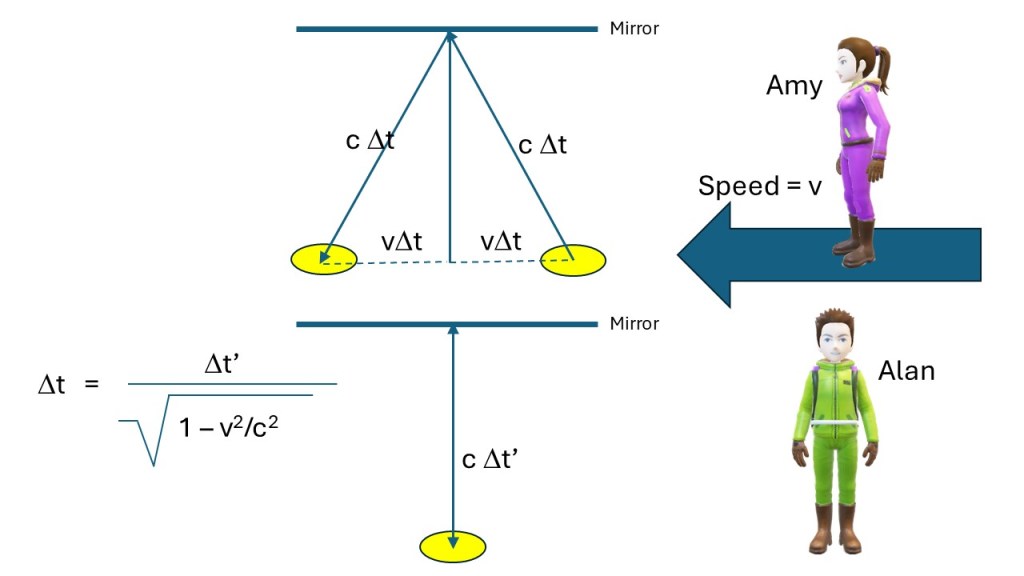
In the pictures below I am showing two rocket systems in space, Amy’s rocket and Alan’s rocket. They are travelling at a high speed compared to each other. Each rocket has a light clock that consists of a light beam bouncing up and down between a mirror in the ceiling and a mirror on the floor. The two light clocks are identical, and each bounce corresponds to a microsecond.

Amy is passing Alan at a high speed, and therefore Alan will see Amy’s light clock running slower than his because Amy’s light beam must travel further. Remember, the speed of light is identical for both light clocks (light speed is a universal constant). For those interested I am also deriving the formula for time dilation.

The picture shows two systems, each with a clock consisting of light beams bouncing between mirrors. In this set up Alan is stationary compared to us and therefore his light beam only moves vertically.
Alan and Amy have identical light clocks. We call the time it takes for the light beam to go from the floor to the ceiling (one clock tick) Dt in Amy’s case and Dt’ (reference frame) for Alan. Amy is speeding past Alan towards the left. From Alan’s perspective Amy’s clock is running slower. Using Pythagoras theorem, it is possible to derive the formula for time dilation shown in the lower left corner.

Since Amy moving left is the same as Amy standing still and Alan moving right you can say that Alan is the one moving fast. In this case it is Alan’s light clock that is ticking slower because from this viewpoint it is his light beam that has to travel further. From Amy’s perspective it is Alan’s clock that is going slower.

The picture shows two systems, each with a clock consisting of light beams bouncing between mirrors. In this set up Amy is stationary compared to us and therefore her light beam only moves vertically | Time Dilation Goes Both Ways
It is equally correct to say that Amy is standing still and that it is Alan that is moving fast to the right. This time (pun not intended) it is Alan’s clock that is ticking slower. Dt corresponds to Alan’s clock ticks and Amy’s clock ticks are Dt’.

This seemingly contradictory situation is resolved by the fact that Amy’s and Alan’s perspectives will drift apart as they continue their journey. They will increasingly disagree on whether events are simultaneous or not, and they will disagree in which order events occur. This is another shocking fact, or as I refer to it, super fact. It is strange but it resolves the apparent contradiction of reciprocal time dilation. I am explaining this in greater detail in this post.

The Twin Paradox

But what happens if one of Amy or Alan decides to turn around so that they meet up again. If Amy’s clock runs slower from Alan’s perspective and Alan’s clock runs slower from Amy’s perspective, how can you reconcile that when they meet up again? It turns out that whoever is turning around or accelerating or decelerating to turn back is the one who will have the least time pass. If Amy is the one turning back, then she will age less than Alan. During her acceleration she will see Alan’s clock starting to run faster and faster until he is older her.

Let say Alan’s clock is running half the speed of Amy’s clock from Amy’s perspective and Amy’s clock is running half the speed of Alan’s clock from Alan’s perspective. Let’s also say that Amy traveled to the left for 10 years before turning around.

From Alan’s perspective she would have traveled 20 years before turning around. However, from Amy’s perspective 5 years would have passed on Alan’s clock. As she turns around Alan’s clock will run faster and catch up so that when they meet up again Amy will be aged 20 years, while Alan will be aged 40 years. That is 35 years of catching up for Alan’s clock from Amy’s perspective. Alan’s clock advanced 35 years from Amy’s perspective after Amy turned around. In the end Amy will be the younger one.

The picture shows Amy on the left turning around and Alan on the right. Text explains what happens | Time Dilation Goes Both Ways
Observe that the fast-forward advancement of Alan’s clock from Amy’s perspective happens only while Amy is in the process of turning around (accelerating / decelerating). Further, how fast the fast forward happens depends on the distance as well. Once Amy is traveling at a constant speed again (inertial frame) Alan’s clock will run slower again from Amy’s perspective.

A somewhat halting but OK analogy for the 35 years of catching up that happens on Alan’s clock from Amy’s perspective is when you turn a boat around on a wavy sea. As you are moving in the direction of the waves the waves will hit you much less often (if at all) but after you turn around and move against them the waves will hit your boat very frequently. Alan’s clock will run faster for Amy whilst she is turning around.

Book Recommendations on Relativity

To see the other Super Facts click here

ERCOT Fuel Mix

This is not a super fact but just interesting information about ERCOT. ERCOT or the Electric Reliability Council of Texas is the organization that manages the state’s electricity grid, ensuring reliability and it operates the competitive wholesale electricity market for 90% of Texas’s electric load. There are a few things that are important to remember about ERCOT.

  • The ERCOT grid is located solely within the state of Texas and is not interconnected to the rest of the United States. In addition to Texans being independent, this is a way of avoiding federal regulation. ERCOT is regulated by the Texas Public Utility Commission while the rest of the country is regulated by the Federal Energy Regulatory Commission (FERC).
  • ERCOT is an ISO (independent system operator), meaning it’s a non-profit organization that manages the electricity grid independently of any single utility company.
  • When companies sell their energy (to ERCOT) it works like a continuous auction. The one with the lowest price is picked first and allowed to contribute with whatever they are able to and also, of course, considering what the grid-powerlines can carry safely.
A power grid. The sun is setting in the background | ERCOT Fuel Mix
The power grid carries the power and if not sufficient it can be a major bottle neck. Photo by Pixabay on Pexels.com

Renewables are successful in Texas

One thing that surprises many people is that renewable energy, for example, wind and solar, is quite successful in Texas. Fossil fuels is important in Texas, and there are many powerful oil and gas billionaires in Texas who fight the expansion of renewables. Texas politicians work hard to create laws that punish renewables with discriminatory permitting requirements.

For example, a recent bill in the Texas Senate SB819 adds a lot of requirements on renewables and battery storage that does not apply to fossil fuel-based energy sources. An example is the requirement in SB819 that wind turbines must be at least half a mile away from the property line of any neighboring property whilst, for example, oil rigs can be built up to the property line. There are a lot more regulations in SB819 that are discriminatory, contrary to free market principes, and even violations of private property rights.

Despite all the obstacles set up against renewable energy in Texas renewable energy is on the march in Texas. The reason is that ERCOT is ultimately a price competitive free market-based system and renewables are cheap. Solar and wind are the cheapest even considering subsidies and the cost of construction, land rent, disposal, and other costs not directly caused by electricity generation are taken into consideration disposal. Click here for details. The graph below shows the evolution of different energy sources in Texas. The graph is taken from this link provided by Dr. Joshua Rhodes, a research scientist at UT Austin.

The graph shows the average annual mix for natural gas, coal, wind, nuclear, solar, and other sources. Natural has roughly remained around 40-50%, coal has shrunk from 37% to 13%, wind has grown from 2% to 24%, nuclear has shrunk from 14% to 8%, and solar has grown from nothing to 10% over the last five years | ERCOT Fuel Mix
The ERCOT fuel mix from 2006 to 2024. Notice the expansion of wind power and notice that solar has gone from nothing to 10% of the average fuel mix in five years. The graph is taken from this link.

You can read more about the evolution of renewable energy in Texas by clicking here.

Watching the ERCOT Fuel Mix in Real Time

Finally, what I think is the most interesting portion of this post, the real-time ERCOT Fuel Mix. It includes a couple of energy sources not mentioned earlier in this post, hydro and power storage.

Hydro is very small in Texas and power storage is a new item that is not a true energy source but a feature that can be called upon when energy is suddenly needed somewhere. It is still not widely used but it reached 10% of the mix at one point in 2024. It is likely an energy source that will keep growing as it is instant and scalable. It is the most dispatchable energy source of all. I can add that there is a lot of misinformation spread about renewable energy, especially about wind power. To read more about that click here.

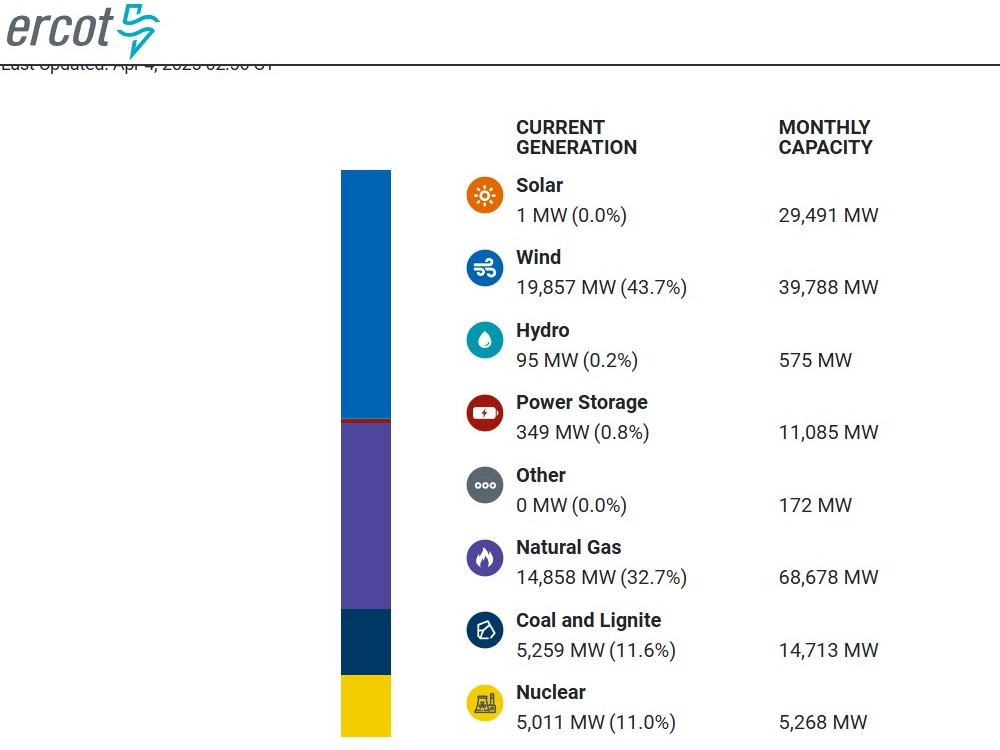
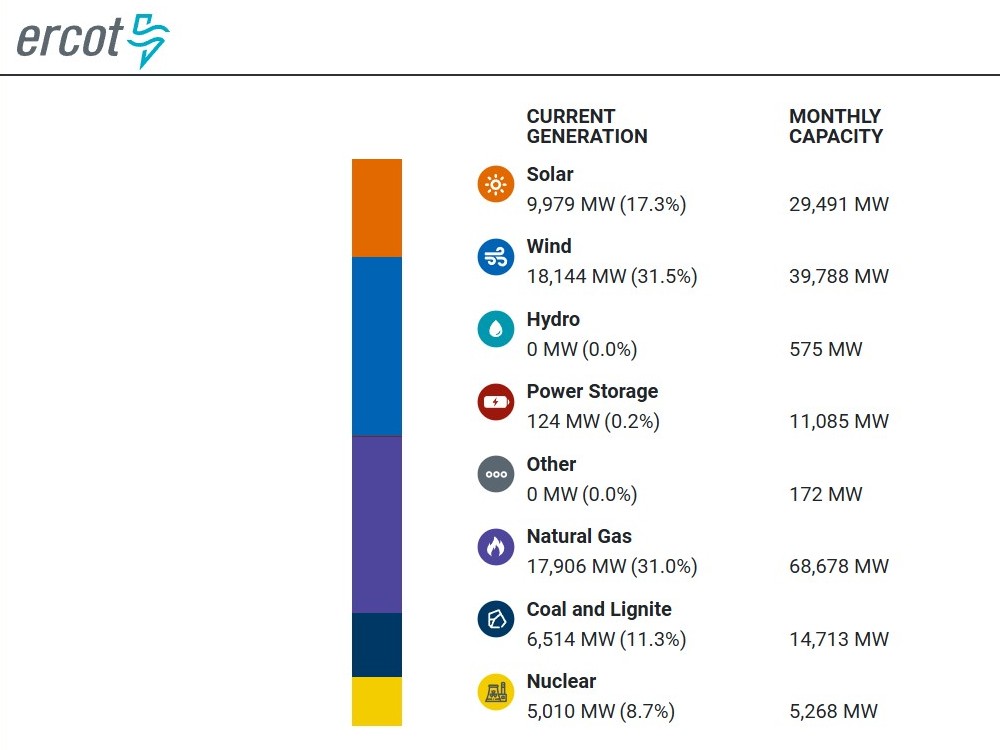
Last evening and today I took several screen shots of the real time ERCOT fuel mix (see below). A couple of things to note are that solar does not contribute at night and wind contributes more at night. It was a very cloudy and rainy day today so solar contributed less than normal during daytime, but not a lot less. It is not much less than the typical sunny day of 20%. It is true that wind and solar are intermittent, but it does not matter a whole lot because wind contributes more at night when solar does not contribute and battery storage, the most dispatchable energy source of all, is growing in importance.

Click here to watch the real-time ERCOT Fuel Mix minute by minute anytime you like. (highly recommended).

Wind is 40.5%, Natural Gas 38.8%, Power Storage 2.5% | ERCOT Fuel Mix
Fuel Mix on April 3rd 2025 at 8:00PM
Wind is 38.4%, Natural Gas 40.3%, Power Storage 0.7%
Fuel Mix on April 3rd 2025 at 10:00PM
Wind is 41.9%, Natural Gas 34.2%, Power Storage 0.4%
Fuel Mix on April 4th 2025, at 1:15AM
Wind is 43.7%, Natural Gas 32.7%, Power Storage 0.8% | ERCOT Fuel Mix
Fuel Mix on April 4th 2025, at 3:00AM
Wind is 31.5%, Natural Gas 31.0%, Power Storage 0.2%
Fuel Mix on April 4th 2025, at 12:35PM
Wind is 31.7%, Natural Gas 31.2%, Power Storage 0.2%
Fuel Mix on April 4th 2025, at 2:00PM
Wind is 32.7%, Natural Gas 34.3%, Power Storage 1.1%
Fuel Mix on April 4th 2025, at 4:00PM
Wind is 32.6%, Natural Gas 36.8%, Power Storage 0.8% | ERCOT Fuel Mix
Fuel Mix on April 4th 2025, at 5:30PM
Wind is 41.1%, Natural Gas 37.4%, Power Storage 0.2% | ERCOT Fuel Mix
Fuel Mix on April 4th 2025, at 9:30PM
Wind is 49.9%, Natural Gas 29.0%, Power Storage 0.0% | ERCOT Fuel Mix
Fuel Mix on April 4th 2025, at midnight
To see the Super Facts click here

There is strong evidence for the Big Bang

Super fact 37: There is strong evidence for the Big Bang, and we know a lot about how the Universe evolved through time since the Big Bang.

Considering the evidence that has accumulated throughout the years for the Big Bang it is hard to deny it happened. In my experience very few people are aware of this evidence, and they are surprised to find out how much evidence there is and how many details we know about the evolution of the universe. It is easy to believe that scientists are guessing when you don’t know much about the evidence yourself. But they are not guessing. That is why I call this a super fact.

In addition, there’s a lot of misconceptions around the Big Bang as well surprising facts. A few additional things that might surprise people are that the Big Bang was not like an explosion, the Universe did not expand into something. In addition, there might be multiverses and multiple Big Bangs, and there are cyclic models, and so-called eternal inflation. There are things we know and things we don’t know.

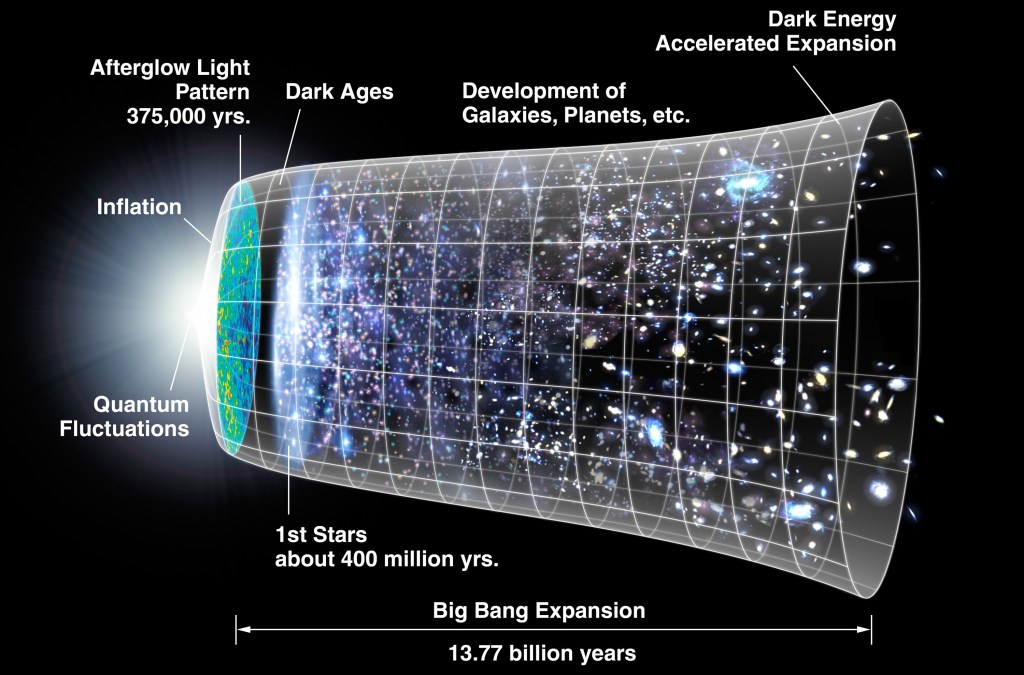
The pictures show an expanding Universe starting with quantum fluctuations followed by inflation, then an afterglow light pattern 375,000 after the Big Bang and then the so-called dark ages, the creation of stars and galaxies | There is strong evidence for the Big Bang
This file is in the public domain in the United States because it was solely created by NASA. (from Wikimedia commons

The Expansion of the Universe

It used to be believed that the Universe was static. In 1929 the astronomer Edwin Hubble discovered that the universe was expanding. He made this observation by analyzing the light from distant galaxies and noticing that their light was redshifted. I am going to explain what that means next.

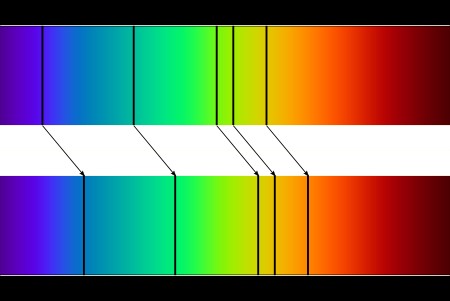
Light emitted from elements, atoms and molecules have light absorption patterns that are unique to the atom/element in question. This is called a light spectrum. This makes it possible to identify the elements in a star and their proportions. Red shifted means that the absorption lines have moved towards red because the frequency of the light has been shifted due to the motion. This is called the doppler effect.

You can notice this phenomenon for the case of sound when an ambulance is coming towards you and then speeding by you. The sound changes. Hubble was using the redshift to the determine that further away the galaxy was the faster it was moving away from us.

The top shows a colorful spectrum from blue to red with absorption lines in black. The bottom portion of the picture shows the same thing expect the black absorption lines have moved a bit to the right.
Visualization of redshifted absorption lines are redshifted due to velocity away from observer. Top lines are for an object at rest and in the bottom picture the object is moving away. Maxmath12, CC0, via Wikimedia Commons. This file is made available under the Creative Commons CC0 1.0 Universal Public Domain Dedication.

A natural explanation for this is that the universe is expanding, and that it once must have been much more compressed, but it is not the only explanation. However, there is more evidence.

The Cosmic Microwave Background Radiation

If you assume that the universe once was much more compact and much hotter than today, particles such as protons, neutrons and electrons would have been free and close together preventing light from freely moving around. However, as the universe kept expanding and cooling these particles eventually should have been able to form atoms allowing light or electromagnetic radiation to freely move around.

Some physicists, Alpher, Herman and Gamow predicted around 1950 that this should have left behind a detectable microwave background radiation. This radiation was detected by chance in 1964 by two physicists, Penzias and Wilson. This radiation had the expected properties and careful study of this Cosmic Microwave Background Radiation (CMBR or CMB) has given us a lot of information about our universe and may give us information about other universes (multiverses).

Its existence is strong evidence that the universe once was very compressed and much hotter, i.e., the Big Bang. An interesting fact is that in old TVs, between the channels (old people will remember this), you had this fuzz, or war of the ants as some people called it, and part of that TV fuzz is the CMBR.

A big sky map with varying colors, yellow, red, green and blue | There is strong evidence for the Big Bang
This is a sky map of the cosmic background radiation from when the universe was around 380,000 years old. It was created with the help of satellite (NASA) measurements. The colors are artificial and show tiny temperature variations. NASA / WMAP Science Team, Public domain, via Wikimedia Commons.

You can watch a 4-minute video about the discovery of the CMBR narrated by Neil DeGrass Tyson on this PBS web page by clicking here.

Abundances of Light Elements

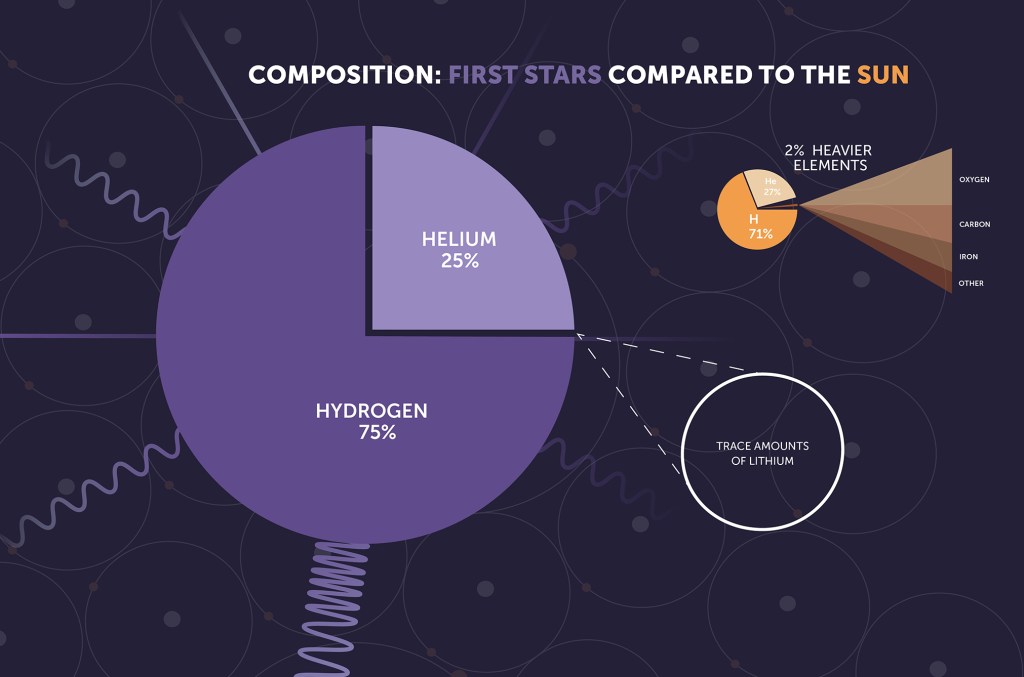
Yet another piece of evidence is the relative abundance of hydrogen and helium compared to heavier elements. The physics at the beginning of the Universe under the Big Bang tells us that initially regular matter should have consisted of 75% hydrogen and 25% helium and hardly anything else, and that is composition the oldest stars had when they were new. In addition, the oldest stars we’ve found appear to have an age just under the 13.8 billion years that we get for our Universe assuming the Big Bang theory (that’s another piece of evidence).

The picture consists of two pie chart graphs representing stars. The left one is a first-generation star with one pie for the 75% hydrogen and one pie for the 25% helium.
The first-generation stars consisted of 75% hydrogen and 25% helium and trace amounts of Lithium. A second or third generation star like our sun is still mostly hydrogen and helium but also many other elements. The rocky planets circling the sun are mainly elements heavier than hydrogen and helium. Image credit NASA, ESA, CSA, STScI

A Very Brief History of Time

So, it all started with a quantum fluctuation. The first 0.000000000000000000000000000000001 seconds is called the inflationary period characterized by super-fast expansion, much faster than the speed of light, as we know it today. At this time the strong nuclear force becomes distinct from the weak nuclear force.

I should point out that during the first 0.0000000000001 seconds the physics laws may not have applied in a normal sense. I should also point out that this was not an explosion. An explosion explodes into something but there was nothing else outside of the universe, so this is more like superfast growth.

At a fraction of a second protons and neutrons form from quarks and after one second neutrinos came into existence and if primordial black holes exist, they were formed at this time too. After two minutes nucleus consisting of neutrons and protons are formed, and the first elements hydrogen and helium formed. After 20 minutes an opaque hot plasma forms, after 100,000 years neutral helium atoms form, and after 375,000 years CMBR is created, etc.

This is just a small sample of everything that we know happened after the Big Bang, based on the known laws of physics. You can read about all the details in books like The First Three Minutes by Steven Weinberg or A Brief History of Time by Stephen Hawking.

vector illustration of up and down quarks in proton and neutron on white background. The proton (left) is a red and blue up quark and a green down quark. The neutron is a red and green down quark and a blue up quark | There is strong evidence for the Big Bang
The proton and neutron each consist of three quarks. They are formed at a fraction of a second after the Big Bang. Asset id: 2333679305 by KRPD.

Pre–Big Bang Cosmology

So, what was there before the Big Bang, if anything? Well, that part is speculation, but there are many good ideas. A popular hypothesis speaks of quantum fluctuations setting off the Big Bang. There are models in which the whole of spacetime is finite, including the Hartle–Hawking no-boundary condition. This means that time itself came into existence with the Big Bang and therefore nothing could have preceded it. This means that the Big Bang could not have been caused or created by anything else, just like a universe that has existed eternally could not have been caused or created by anything else.

In a sense, despite being 13.8 billion years old, the universe in this scenario would have always existed. Because the concept of “always” stops at 13.8 billion years ago. Stephen Hawking used the analogy of the north pole. You can’t go further north from the north pole.

There are other models that include multiverses, for example, eternal inflation, in which universal inflation ends locally here and there in a random fashion, each endpoint leading to a bubble universe, expanding from its own big bang. You can view this model as inflation being the river of time with the various universes popping up like bubbles in the stream.

In another model inflation is due to the movement of branes in string theory and Big Bangs are the result of colliding branes. There are cyclical models, such as Nobel Prize winner Roger Penrose’s Conformal cyclic cosmology in which one universe gives rise to another universe as it dies.

Notice that Pre-Big Bang Cosmology is speculative, but the reality of the Big Bang is backed by strong evidence.

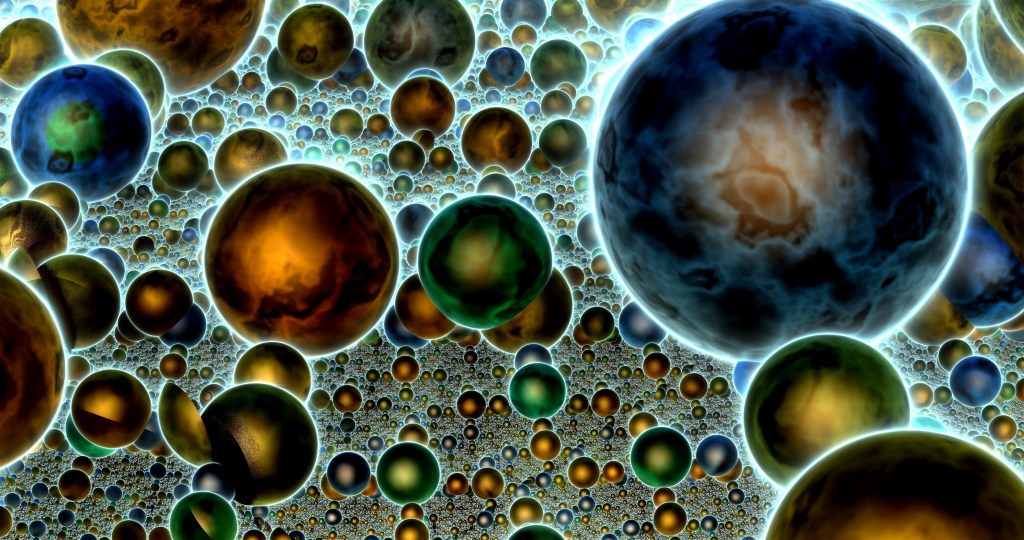
Thousands of universes represented as colorful balls | There is strong evidence for the Big Bang
The surface of a multiverse with a lot of universes 3d rendering Asset id: 2256998119 by Dr. Norbert Lange.

To see the other Super Facts click here