Global Warming is Happening and is Caused by us

Superfact 25: Global warming is happening. Or if you call it Climate Change or Climate Disruption is happening. And it is happening very fast. We also know that it is caused by us primarily as a result of our burning of fossil fuels. There is a long-standing scientific consensus on these two facts because the evidence is conclusive. Check the evidence below.

This is a long post. However, I summarized this somewhat complex issue in a post I hope is both comprehensive and easy to read at the same time. I believe you can learn a lot from reading it. Note in this post, Global Warming Is Happening And Is Caused By Us, I will use the terms climate change, climate disruption and global warming interchangeably, or nearly interchangeably. I am doing that on purpose.

A lot of people would like to dispute this fact. Including large segments of the public, politicians, and political organizations. I was once a so-called skeptic myself. However, climate scientists very rarely dispute this because of the large amount of compelling evidence. This is a good summary from NASA. We know it’s true, it is important, yet disputed, which makes it a super fact in my opinion.

Below I created a top 10 list of evidence for the fact that climate change / global warming is happening. As well as a top 10 list of evidence for the fact that we are the cause for it. Primarily because of our burning of fossil fuels.

Evidence that Global Warning is Happening

  • (1) The temperature records collected by numerous organizations show that global warming is happening. Organizations such as NASA, NOAA, the Hadley Centre, the European Centre for Medium-Range Weather Forecasts, the Japanese Meteorological Agency, the World Meteorological Organization, and many more, use data from land-based weather stations, ocean buoys, satellite measurements, and other sources to monitor Earth’s climate. Comparison with the palaeoclimatological record shows that the rise in average global temperatures is extremely fast. This is the smoking gun. However, for those who question the data from all of these organizations there are other simpler types of evidence (see below).
  • (2) Global sea levels has increased by 20–25 cm (8–10 in) since 1900, with half of that increase occurring since 1980. Sea level rise occurs from a combination of thermal expansion and the melting of land ice, both which happen as a result of warming. This sea level rise has been the fastest in “at least the last 3000 years”.
  • (3) Arctic ice is melting. See the video from NASA below.
  • (4) Glaciers are retreating.
  • (5) The Antarctic ice sheet is losing ice at a rate of about 100–200 billion tons per year, which has increased in the past two decades.
  • (6) Eco zones are generally shifting northward and to higher elevations, meaning that plant and animal habitats are moving towards cooler regions as temperatures rise in previously suitable areas.
  • (7) Snow seasons are getting shorter
  • (8) Extreme events are increasing in frequency showing that climate is changing
  • (9) After extensive research and scientific debates in the past there is now a long-standing scientific consensus that Global Warming is happening. This is not physical evidence itself, but it does not an appeal to authority fallacy either. Think about it in terms of probability.
  • (10) Old guys originating from northern climates like me, have noticed that the seasons are changing. Even if you dismiss all the evidence from NASA, NOAA, IPCC, and all the world’s meteorological institutions, and you claim that all the world’s climate scientists are all in a massive conspiracy, you cannot convince me of something that is contrary to what I can see with my own eyes.

Graphs and Videos Showing Global Warming

To see the NASA web page from where the YouTube video of the shrinking arctic ice is taken click here .
Graph showing global temperature rise since 1850 to 2022. There are five nearly identical graphs shown in different colors. Temperature anomaly graphs from NASA GISS – orange. HadCRUT – green. NOAA – purple, Japan Meteorological Agency – blue, Berkley Earth – red. The jagged curves show more than a 1.2 degrees Celsius increase | Global Warming is Happening and is Caused by us
Temperature anomaly graphs from NASA, Hedley Center, Japan Meteorological Agency, NOAA, and Berkley. Wikimedia commons << https://creativecommons.org/licenses/by-sa/4.0/deed.en>&gt;.
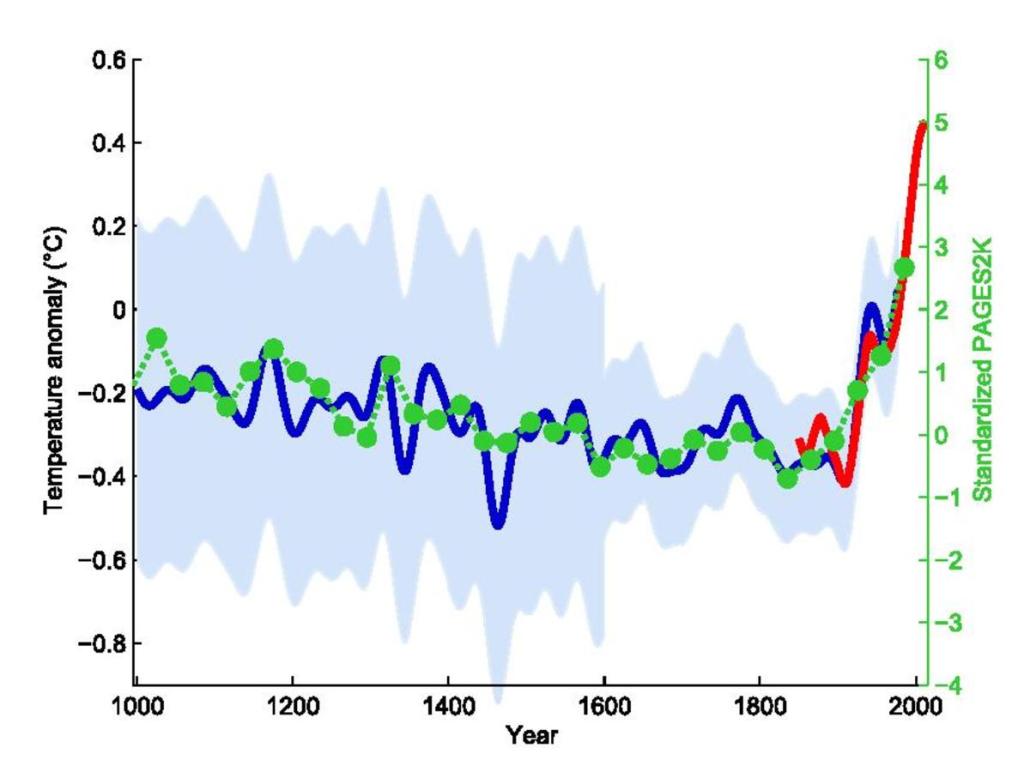
Hockey stick curve going back 1,000 years. The recent uptick in global temperature is very sharp and very sudden | Global Warming is Happening and is Caused by us
The so-called hockey stick curve depicting the last 1,000 years. The blue line is the first hockey stick curve ever created (by Michael Mann). He used proxy measurements such as tree rings, green-dots 30-year average, red temperature measurements. Wikimedia commons <<https://creativecommons.org/licenses/by-sa/4.0/deed.en>>. This graph is taken from this page
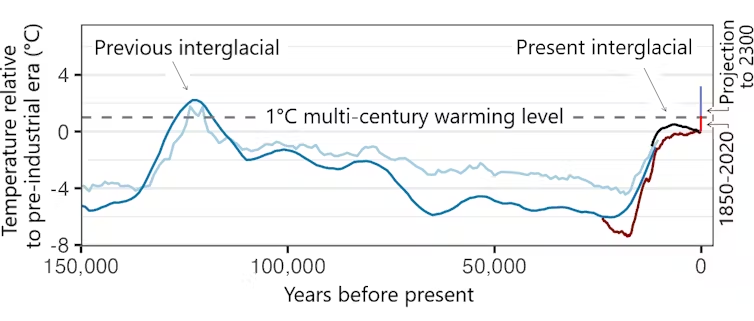
The graph shows wild swings over the last 150,000 years and then a very sharp uptick at the end | Global Warming is Happening and is Caused by us
Temperature record for the last 150,000 years. Notice the sharp uptick towards the end. This picture is taken from this article.

Confusion About Climate Change

Before continuing I would like to address a couple of issues that sometimes trip up people. And prevent them from learning about this topic.

The question “climate has always been changing, why would we be the cause now?”, is a good question. If asked honestly. However, it is a bad question if it is asked like a gotcha or a dismissive statement. In this case it is a bad question. Because the paleoclimatologists and the climate scientists, in other words the experts on past climate, are the ones telling us that the current climate change / global warming is caused by us, it is not “natural”. They obviously say that because they know something that the dismissive laymen don’t. All everyone needs is a tiny bit of reflection to realize that you’ve got something to learn from them.

Sometimes you come across people who have a hangup over the fact that we use a few different terms interchangeably, global warming, climate change, climate disruption, inadvertent climate modification, etc. The people who have a hangup about this jump to the incorrect conclusion that there is some sort of deception or backtrack going on. If I talk about my dog and my mini-Australian Shepherd, I am not confused or deceptive or backtracking anything. It is the same family member. Whether you call it global warming or climate change or something else is a distracting non-issue, a red herring if you will.

To add some information about it. Climate change has become the more popular term recently, but the terms climate change and inadvertent climate modification predates the term global warming, which became popular in the 1980’s largely because climate scientist James Hansen likes to use it. Climate change is a broader term since it could include global warming and global cooling, but in the current context, global warming is a good term as well since that is what is happening now. 

One advantage of the term climate change is that the average warming trend is in itself not the major issue. The effects on the overall climate that warming has is the more important issue. You could say that you want some global warming when the weather is cold and it would make sense. But you don’t want the destruction of eco systems, oceanic and atmospheric circulation changes, sea level rise, worse storms, draughts, floods, wildfires, etc., that it causes.

Natural Causes of Climate Change

There are many different kinds of natural causes of climate change. Two billion years ago cyanobacteria developed a form of photosynthesis that absorbed carbon dioxide and emitted oxygen, as well as a way of extracting nitrogen using a process called nitrogen fixation. This made cyanobacteria extremely successful. One consequence of this was that the carbon dioxide was largely removed from the atmosphere, and the earth got very cold, but the oxygen that was now present in the atmosphere paved the way for the existence of multicellular life and animals. To find out more about this, read this book

The planet changed but it took millions of years. The emergence of land plants did something similar. Examples of other slow-moving drivers of climate change are continental drift and the fact that the light from the sun has gotten 6% stronger over the last one billion years (0.006% per million years).
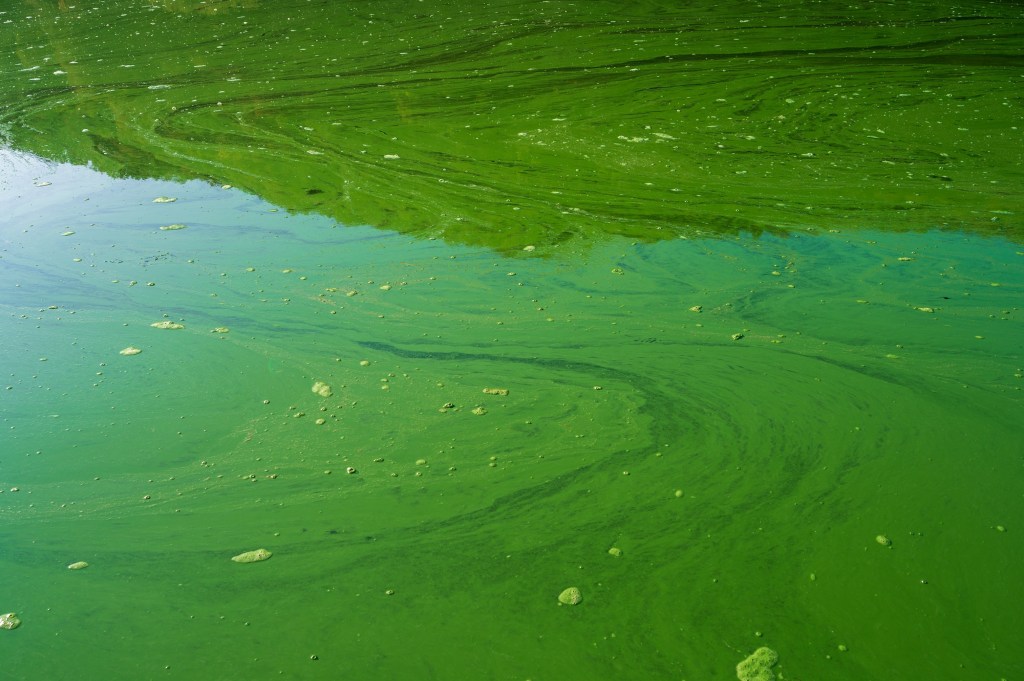
Green algae sludge in water.
Cyanobacteria caused a global cooling two billion years ago while paving the way for the existence of multicellular life and animals. Stock Photo ID: 2197045895 by Andre Engelhardt.

65 million years ago an asteroid struck earth, which caused earth’s climate to change, which is probably what killed the non-avian dinosaurs. Another example of a past climate change driver is unusual volcanic activity. Volcanoes emit greenhouse gases, such as carbon dioxide (CO₂) and water vapor, during eruptions. 

However, their contribution to the total CO₂ emissions in modern times is very small compared to human activities. Annual volcanic CO₂ emissions are estimated to be around 200-500 million tons while humans add 37-40 billion tons, or 100 times as much. Therefore, it is unlikely that volcanoes contribute much to the current warming, but the fine sulfate aerosols emitted by volcanoes can cause a significant cooling effect for a few years.

Two carnivorous dinosaurs and a flaming hot asteroid crashing through the atmosphere in the background.
Dinosaur and asteroids during extinction day Stock Illustration ID: 1438260563 by serpeblu
A black and orange colorful illustration of an erupting volcano.
Volcano – An active volcano that erupts lava. Stock Illustration ID: 2497156167 by MERT1995

One type of important type of climate forcing that’s been the cause behind the multiple ice ages that we’ve had over the last two million years are earth’s orbital cycles, or the Milankovitch cycles. There are three of them, orbital eccentricity, change in axial tilt, and axial precession. Could they explain the current warming? No, they can’t because we are currently in a cycle that should be cooling the planet. And it was until now. Below I have included a video from PBS that explains these orbital cycles.
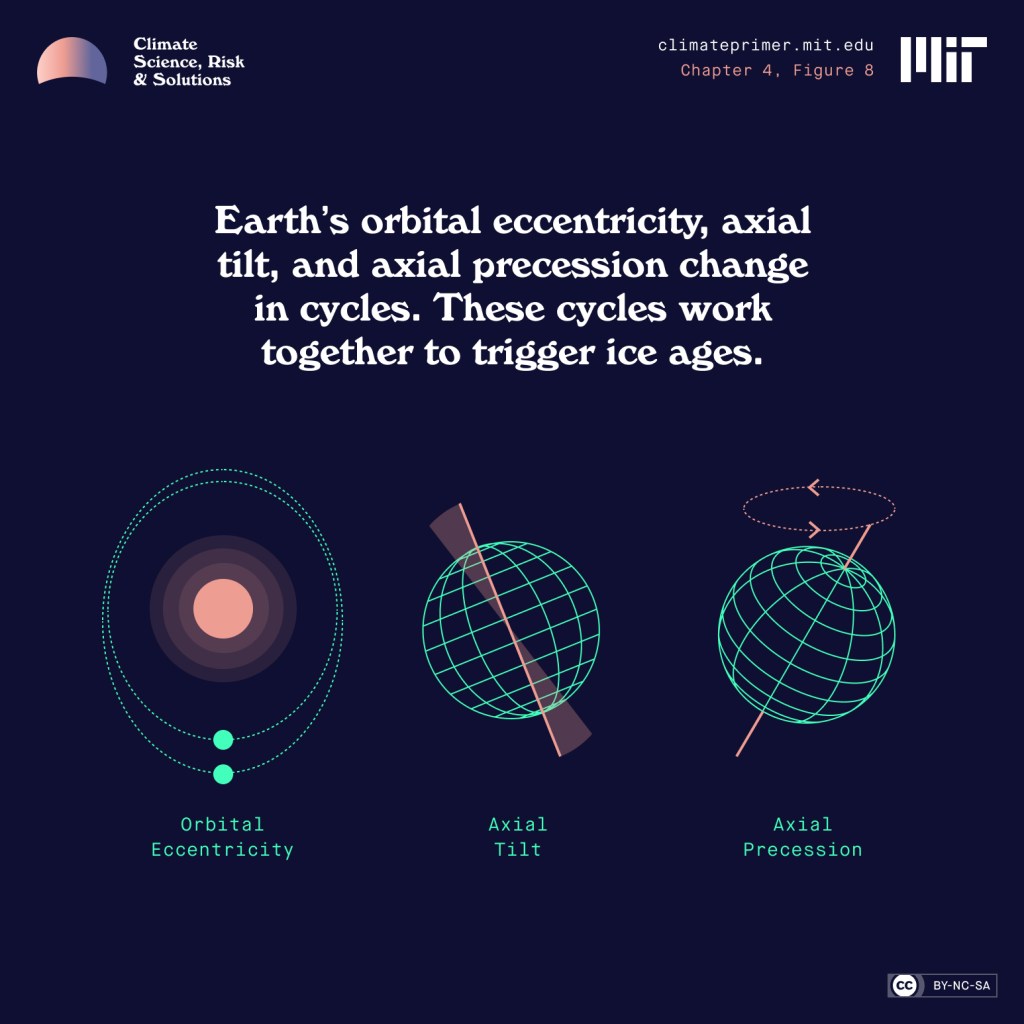
Three illustrated orbital cycles. On the left orbital eccentricity, in the middle is the axial tilt and on the right axial precession | Global Warming is Happening and is Caused by us
Illustration of Milankovitch cycles from MIT’s Climate Primer.<< Link-22>>.
From PBS explanation and overview of earth’s three orbital cycles.

There are also short-term solar irradiance cycles. There is an 11-year cycle and an 80-year cycle, but these correspond to small changes. The 11-year cycle corresponds to a temperature change of 0.05 degrees Celsius. 

In addition, the Sun’s irradiance has been slightly decreasing over the past few decades. Changes in the sun’s irradiance cannot explain the sharp warming we are witnessing. As you’ve seen above, neither can volcanic activity nor any known orbital cycles, slow moving climate drivers such as continental drift cannot explain it and we did not get hit by an asteroid recently. However, what fits the bill almost perfectly is our greenhouse gas emissions.

This is a brief overview from MIT.

What Does Climate Models Say About Climate Change

Unlike weather, the climate is not particularly sensitive to initial conditions (chaos). For example, we can be pretty certain that July will be warmer than January in Minnesota. We use climate models to try to predict future climate. All climate models rely on the laws of thermodynamics. But they vary in regard to the different understandings of the best ways to incorporate those laws in a representation of all of Earth. They do not come up with identical results. But they all get the average temperature of each region of the world right. 

In addition, the various old climate models from the 1990’s do a very good job of what has happened during the last 30 years. They aren’t perfect but they are useful and more importantly for our context they serve as powerful evidence that the current warming is caused by our emissions. You remove our emissions from the models and none of what we measure will happen. Climate models are therefore the smoking gun with respect to what is causing global warming, just like the temperature record is for the fact that it is happening in the first place.

Unfortunately, the climate models have been maligned and misrepresented by those who wish that the public do not pay attention to them. That’s why we need to mention additional types of evidence (see below).

Evidence that Global Warming is Caused by US

  • (1) Climate models – as we have seen above, climate models are the smoking gun evidence that we humans are causing global warming / climate change. In addition, both simplistic and complex climate models show that 100% of global warming is caused by humans.
  • (2) Greenhouse gases will make the planet warmer, and we are emitting a lot of them.
  • (3) The upper troposphere is cooling, which shows that the heating is from greenhouse gases and not the sun or orbital cycles. To understand how the lower atmosphere is warming while the upper is cooling, think of the greenhouse gases as a blanket.
  • (4) winters and nights are generally warming faster than other seasons and times of day due to the increased presence of greenhouse gases in the atmosphere, which trap heat more effectively during colder periods. This is considered a key indicator of human-induced climate change.
  • (5) The speed of the warming, 0.31 degrees Fahrenheit per decade, or 0.17 degrees Celsius per decade is extremely fast. Known natural climate forcing tends to be slower.
  • (6) Human activities is the only known explanation for the current global warming. One way that we know that the current warming is caused by human activity is because we are currently in a cycle that should be cooling the planet. The same is true for the sun’s irradiance. It is not volcanoes or any other known cause. See the section above called “Natural Causes of Climate Change”.
  • (7) Isotope studies show that the origin of the greenhouse gases added to the atmosphere are from burning fossil fuels. This is referred to as the isotopic footprint.
  • (8) The observed temperature rise mirrors industrialization.
  • (9) More than 90% of excess heat from global warming is absorbed by the oceans, causing significant increases in ocean temperatures. Oceans absorb about a quarter of human CO₂ emissions, leading to lower pH levels. This is unprecedented in at least 26,000 years and is directly linked to anthropogenic CO₂. These effects have been carefully studied and observed.
  • (10) Nearly all actively publishing climate scientists say humans are causing climate change. This is not physical evidence itself, but it does not appeal to authority fallacy either. Think about it in terms of probability.
This is a short one-minute overview of the causes behind global warming that is happening.
This video from NASA is a bit longer, 13 minutes. Click here to see the page this is coming from
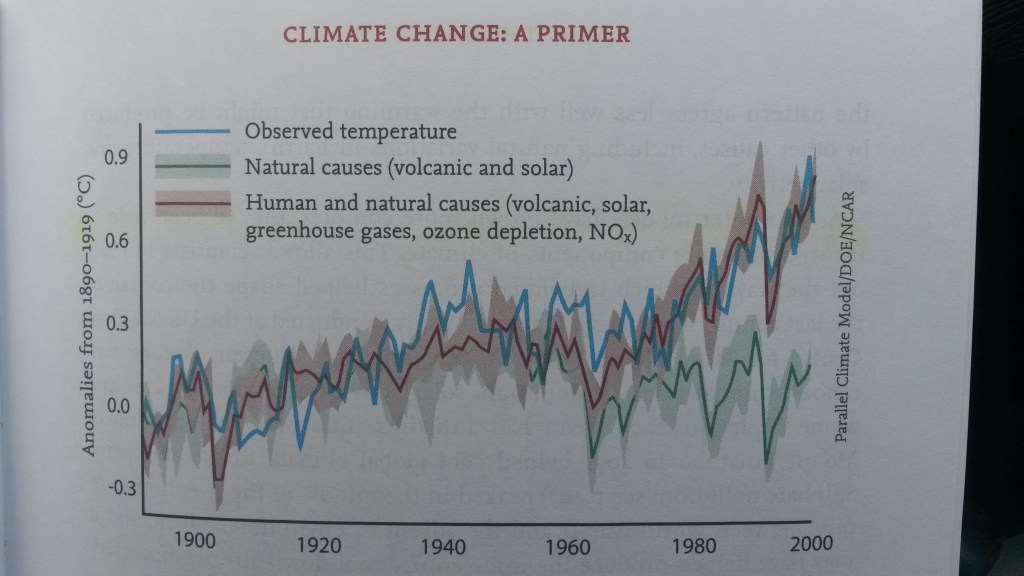
Graph showing possible causes for the observed temperature (blue), natural causes (volcanic, solar), human and natural causes (volcanic, solar, greenhouse gases, NO2, ozone depletion).
Natural causes for global warming / climate change would have cooled the planet, not warm it. Click here to visit this NASA web page regarding the causes behind global warming.<<Link-31>>
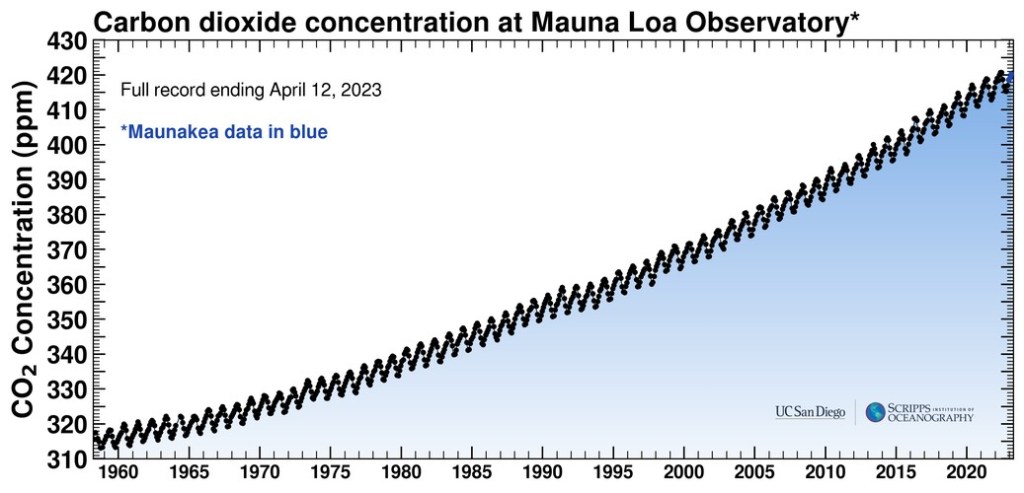
The Keeling curve starting in 1958 ending in 2022 showing the increase in carbon dioxide in the atmosphere.
The carbon dioxide concentration measurements began in 1958 at the Mauna Loa Observatory on the island of Hawaii. Since then, several other ways of measuring carbon dioxide concentration have been added.
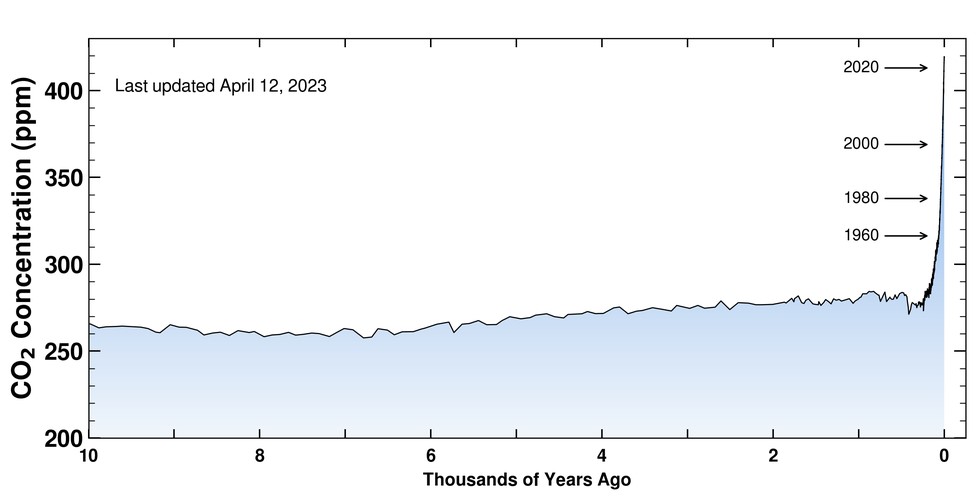
Curve showing CO2 concentration starting 10,000 years ago. Again a very sharp uptick towards end.
From Scripps institute. Keep two things in mind. First the warming from CO2 is delayed and may result in positive feedback that can manifest decades and centuries later. Secondly, human civilization developed during a period of stable climate. That CO2 levels and temperatures were higher millions of years ago is not much comfort.
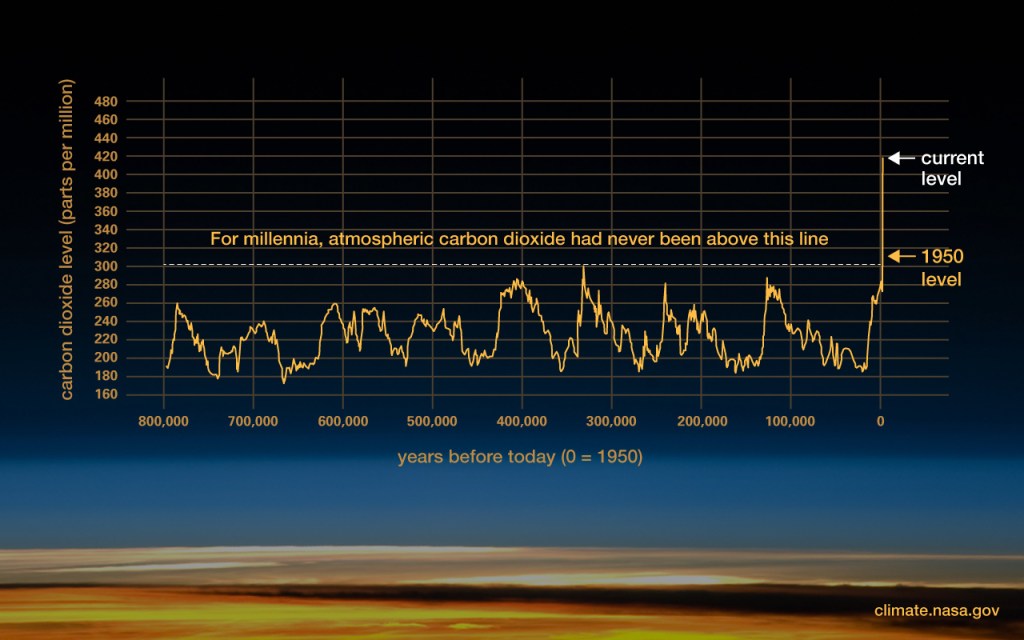
Graph showing CO2 concentrations starting 800,000 years ago. The curve is wavy until it suddenly shoots up towards the end | Global Warming is Happening and is Caused by us
Going back 800,000 years. From Scripps institute.
six young women and two young men holding signs. They are protesting Global Warming.
A Global Warming protest. It’s their future. Stock Photo ID: 1427361263 by manpeppe

To see the other Super Facts click here

What Can We Do About Climate Change

The goal of this blog is to create a list of what I call super facts. Important facts that we know to be true and yet they are surprising, shocking or disputed among non-experts. Super facts are important facts that people get wrong. However, I also create posts that are not super facts but other interesting information, such as this book review and book recommendation.

Saving Us: A Climate Scientist’s Case for Hope and Healing in a Divided World

Saving Us: A Climate Scientist’s Case for Hope and Healing in a Divided World by Katharine Hayhoe is a book about human caused Climate Change, how bad it is, and what we can do about it. The good news is that we are not all going to destroy ourselves. It is still bad, but we can do a lot to avoid making it really bad. However, there are a lot misunderstandings regarding what really makes a difference. This book examines these issues with a good dose of realistic optimism and science. I read the hardback version (and my review on Amazon is currently the top review).

  • Hardcover –  Publisher : Atria/One Signal Publishers (September 21, 2021), ISBN-10 : 1982143835, ISBN-13 : 978-1982143831, 320 pages, item weight : 1.05 pounds, dimensions : ‎6 x 1 x 9 inches, it costs $19.14 on US Amazon. Click here to order it from Amazon.com.
  • Paperback –  Publisher : Atria/One Signal Publishers (September 20, 2022), ISBN-10 : 1982143843, ISBN-13 : 978-1982143848, 320 pages, item weight : 8.8 ounces, dimensions : 5.5 x 0.7 x 8.38 inches, it costs $17.22 on Amazon. Click here to order it from Amazon.com.
  • Kindle –  Published : Atria/One Signal Publishers (September 21, 2021), ASIN : B08BZW2BQG, 318 pages, it costs $14.99 on US Amazon. Click here to order it from Amazon.com.
  • Audiobook –  Published : September 21, 2021, ASIN : B08D4RGYM8, Listening Length : 8 hours and 7 minutes, it costs $16.40 on US Amazon. Click here to order it from Amazon.com.
The front cover of “Saving Us: A Climate Scientist's Case for Hope and Healing in a Divided World” by Katahrine Hayhoe | What Can We Do About Climate Change
Front cover of Saving Us. Click on the image to go to the Amazon page for the hardcover version of the book.

Amazon’s description of the book

“An optimistic view on why collective action is still possible—and how it can be realized.” —The New York Times

“As far as heroic characters go, I’m not sure you could do better than Katharine Hayhoe.” —Scientific American

“It’s not an exaggeration to say that Saving Us is one of the more important books about climate change to have been written.” —The Guardian

United Nations Champion of the Earth, climate scientist, and evangelical Christian Katharine Hayhoe changes the debate on how we can save our future.

Called “one of the nation’s most effective communicators on climate change” by The New York Times, Katharine Hayhoe knows how to navigate all sides of the conversation on our changing planet. A Canadian climate scientist living in Texas, she negotiates distrust of data, indifference to imminent threats, and resistance to proposed solutions with ease. Over the past fifteen years Hayhoe has found that the most important thing we can do to address climate change is talk about it—and she wants to teach you how.

In Saving Us, Hayhoe argues that when it comes to changing hearts and minds, facts are only one part of the equation. We need to find shared values in order to connect our unique identities to collective action. This is not another doomsday narrative about a planet on fire. It is a multilayered look at science, faith, and human psychology, from an icon in her field—recently named chief scientist at The Nature Conservancy.

Drawing on interdisciplinary research and personal stories, Hayhoe shows that small conversations can have astonishing results. Saving Us leaves us with the tools to open a dialogue with your loved ones about how we all can play a role in pushing forward for change.

This is my five-star review for Saving Us

Climate Change; what can we do? Talk about it!

This is an extremely well written, informative, and hopeful book on climate communication. A decade ago I was doubtful that human caused climate change was anything to worry about even though it physically made sense that it was happening. I thought environmentalists were exaggerating and distorting the facts. In general I did not trust or respect environmentalists whom I thought were driven by leftist agendas.

I studied the topic on my own by reading books and scientific articles on the topic, and I learned what climate scientists, not opinionated bloggers, said about the topic. I was especially impressed by a book by James Hansen.

I came to realize that human caused global warming definitely was real and a serious problem. I think I was able to change my mind so easily because I never had a strong affiliation with a political tribe, I respected scientific expertise and my encounter with science deniers in other fields had inoculated me against their kind of rhetoric (it’s fairly universal). I’m an abstract thinker who loves pro-con-lists, and I prefer going in deep and I am not afraid of math, but I don’t think that’s typical.

The backside of that is that it made me a pretty crappy and easily frustrated climate change communicator once I came around. I felt I needed to take action so I joined Citizens Climate Lobby (CCL), a bipartisan volunteer organization with good solutions and good practices. From CCL I learned how to communicate better. In this book Katherine Hayhoe praises CCL and use it as a model for how to approach climate change with respect to solutions and communication.

In addition to climate change communication she gives a high level overview of why we know that global warming is happening (there are 26,500 lines of independent evidence for climate change), how fast it is happening (10 times faster than the last ice age warming), and how we know it isn’t natural. It’s a simple overview, not a deep dive. I thought her analogy about driving while looking in the rearview mirror as you hit a curve to be genius.

She also discusses our cognitive biases, and why not to engage with the 7% who are dismissives, the abuse she’s been a victim of, and so called zombie arguments. Zombie arguments are dismissive arguments that have been thoroughly debunked over and over but won’t die because they fulfill an emotional need for those who are dismissive of climate change. She discusses the political divided in the US, the “blame and shame the consumer” tactic and the misguided “population control solution” and solutions aversion in general.

She describes our situation lucidly. That there is no particular known limit that will doom us all. It is like smoking; you don’t get lung cancer after a certain amount of cigarettes, it’s just better to stop as soon as you can. She discusses solutions and the economy, including cap and trade and a price on carbon, and she states we don’t have to harm the economy to solve climate change, and a lot is already being done the world over. It is a mostly hopeful view.

I was surprised to learn that if you take into account, production subsidies, tax breaks, land leases on public lands below market rates, and the cost of pollution, the IMF estimates that fossil fuel subsidies in the US top $600 billion per year, twenty times clean energy subsidies. That’s about $2,000.00 per person and year, or $8,000.00 per family per year. That’s a lot of money.

Because of my experience with CCL I recognized a lot of what Katherine Hayhoe was saying in this book, but I still had a lot to learn, and besides the book is hopeful, and intelligently written and therefore a pleasure to read. She stresses that the most important thing we can do to solve climate change is to talk about it. I love this book and I highly recommend this book.

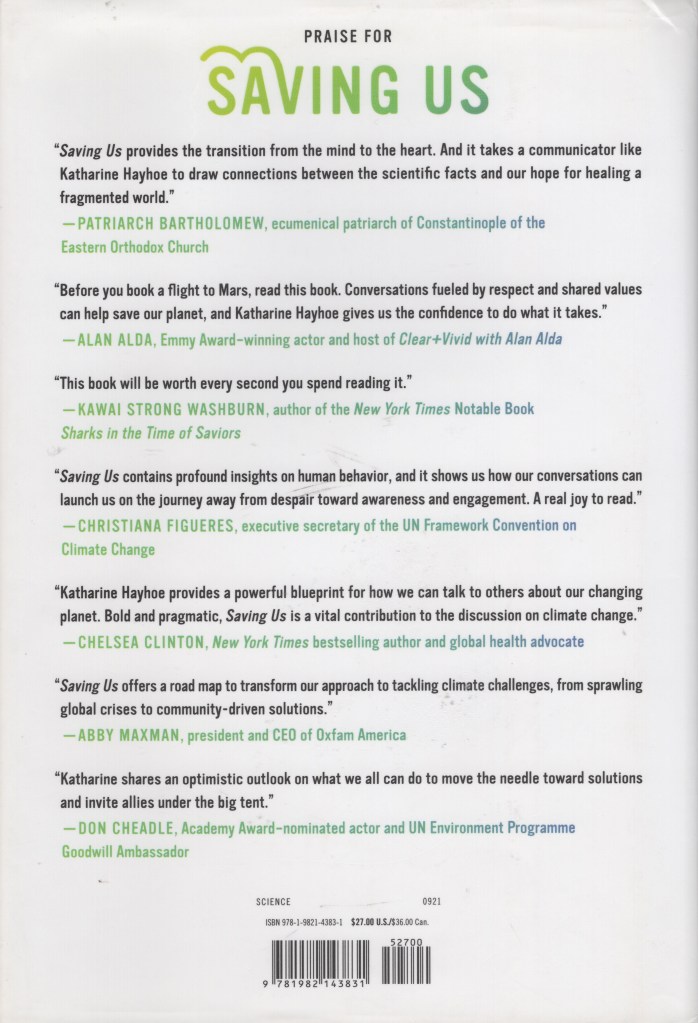
Back cover of “Saving Us: A Climate Scientist's Case for Hope and Healing in a Divided World” by Katharine Hayhoe
Back cover of Saving Us. Click on the image to go to the Amazon page for the kindle version of the book.

To see the Super Facts click here


Wind power is not a major cause of bird death

Superfact 17: Fossil fuels kill a lot more birds per gigawatt hour than wind power does. Cats, windows, cars, poison and powerlines are examples of things that kill a lot more birds than wind power does. Wind power killing birds is not the huge environmental problem it is often made out to be.

Wind power killing birds is often mentioned as a slam dunk environmentally based argument against wind power and evidence for the hypocrisy of environmentalists. This is misguided. Wind power killing birds is a real problem and it should be addressed, and it is being addressed. No energy source comes without environmental problems. However, wind turbines account for only a small fraction of overall bird deaths compared to other human causes. It is not a good argument against wind power, and it does not demonstrate any hypocrisy by environmentalists. In fact, a study made in 2012 (overview here) concluded that fossil fuels killed 24 million birds per year in the US, which correspond to 35 times more birds per GWh than wind power kills according to this study. Even though this study and other similar studies are estimates based on assumptions that are far from perfect, they are good indicators that replacing fossil fuels with wind power likely saves birds rather than kills them.

Photo by Pixabay on Pexels.com

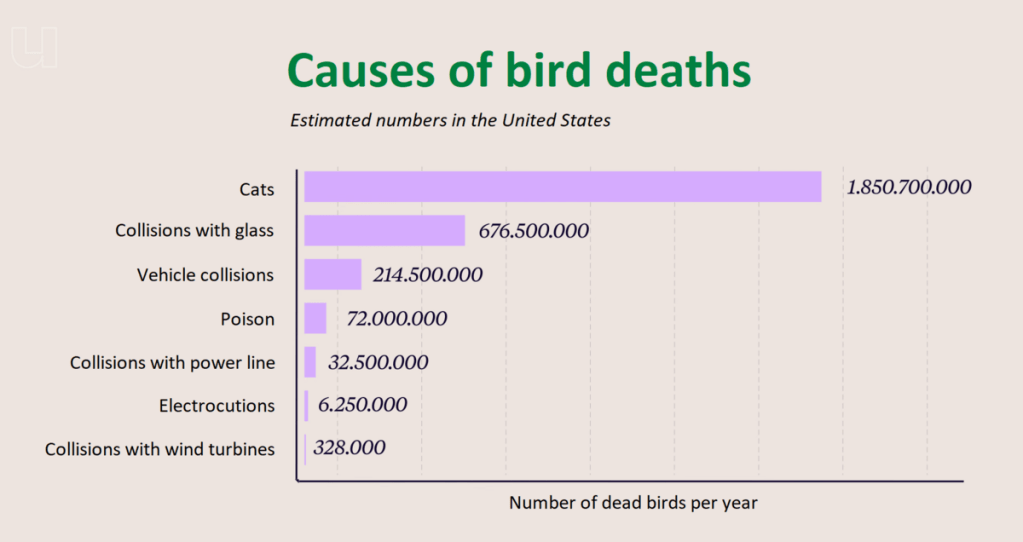
In any case, as this Wikipedia article states, collisions with wind turbines are a minor source of bird mortality compared to other human causes. According to the graph below cats kill 5,600 times more birds than wind power and collisions with powerlines kills 99 times more birds than wind power, and yet we rarely discuss these problems. Even though these numbers are estimates they are mostly confirmed by other studies and analysis, as this overview from MIT and this analysis by Hannah Richie shows. The numbers aren’t the same, but they make the same point. FYI Hannah Richie is the deputy editor and lead researcher at Our World in Data. Our World in Data is a scientific online publication that focuses on large global problems. They are associated with Oxford University and is one of the most respected statistics, analysis and research organizations in the world.

The graph shows that Wind Turbines kill 328,000 birds per year in the US, Electrocutions kill 6,250,000 birds, Collisions with powerlines kill 32,500,000 birds, Poison kills 72,000,000 birds, Vehicle collisions kill 214,500,000 birds, Collisions with glass kill 676,500,000 birds, and cats kill 1,850,700,000 birds per year in the US.
From Wikipedia: Universiteit van Nederland, CC BY 3.0 <https://creativecommons.org/licenses/by/3.0&gt;, via Wikimedia Commons
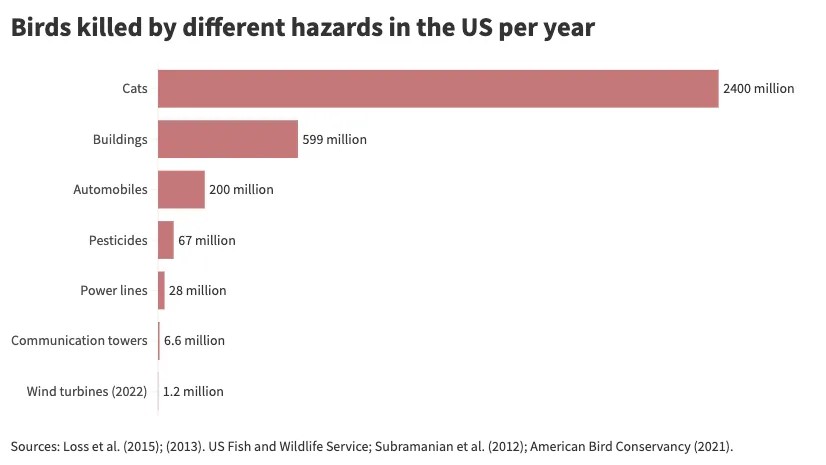
Bar graph showing cats killing an estimated 2,400 million birds per year, buildings killing an estimated 599 million birds per year, automobiles killing an estimated 200 million birds per year, pesticides killing an estimated 67 million birds per year, powerlines killing an estimated 28 million birds per year, communication towers killing an estimated 6.6 million birds per year, and wind turbines killing an estimated 1.2 million birds per year.
An alternative graph taken from Hannah Richie / Our World in Data, using alternative sources essentially showing the same thing. Sources: Loss et al. (2015), (2013), US Fish and Wildlife Service; Subramnayan et al. (2012), American Bird Conservancy (2021).

Wind power has been on the receiving end of false claims, nonsense, and strange rumors for quite some time. It is not the only energy source maligned by false information, but it is an interesting case study in misinformation regarding energy sources. To read about nonsense and rumors about wind power click here.

Photo by Athena Sandrini on Pexels.com


To see the other Super Facts click here


Life Must Have Hydrogen Oxygen Carbon Nitrogen and Phosphorus

The goal of this blog is to create a list of what I call super facts. Important facts that we know to be true and yet they are surprising, shocking or disputed among non-experts. Special facts that any well-informed person should know. 

  • Paperback –  $18.95 on Amazon – future release March 25, 2025.
  • Hardcover –  Publisher : Princeton University Press; First Edition (September 12, 2023), ISBN-10 : 0691177295, ISBN-13 : 978-0691177298, 240 pages, item weight : 1 pounds, dimensions : 5.75 x 1 x 8.5 inches, it costs $18.95 on Amazon. Click here to order it from Amazon.com.
  • Kindle –  Publisher : Princeton University Press (September 12, 2023), ASIN : B0C5SBB26C, 229 pages, it costs $15.37 on US Amazon. Click here to order it from Amazon.com.
  • Audio –  Publisher : Princeton University Press (September 19, 2023), ASIN : B0CF6WHBVX, listening length 7 hours, narrator : Christopher Ragland, it costs $0.99 on US Amazon. Click here to order it from Amazon.com.
A picture of planet earth, the title and the subtitle “How Five Elements Changed Earth’s Past And Will Chape Our Future” The letters H, N, C, P, O are circled | Life Must Have Hydrogen Oxygen Carbon Nitrogen and Phosphorus
Front cover of Elemental. Click on the image to go to the Amazon page for the hardcover version of the book.

Amazon’s description of the book

It is rare for life to change Earth, yet three organisms have profoundly transformed our planet over the long course of its history. Elemental reveals how microbes, plants, and people used the fundamental building blocks of life to alter the climate, and with it, the trajectory of life on Earth in the past, present, and future.

Taking readers from the deep geologic past to our current era of human dominance, Stephen Porder focuses on five of life’s essential elements—hydrogen, oxygen, carbon, nitrogen, and phosphorus. He describes how single-celled cyanobacteria and plants harnessed them to wildly proliferate across the oceans and the land, only to eventually precipitate environmental catastrophes.

He then brings us to the present, and shows how these elements underpin the success of human civilization, and how their mismanagement threatens similarly catastrophic unintended consequences. But, Porder argues, if we can learn from our world-changing predecessors, we can construct a more sustainable future.

Blending conversational storytelling with the latest science, Porder takes us deep into the Amazon, across fresh lava flows in Hawaii, and to the cornfields of the American Midwest to illuminate a potential path to sustainability, informed by the constraints imposed by life’s essential elements and the four-billion-year history of life on Earth.

This is my five-star review for the book Elemental

The Story of HOCNP the Five Elements Essential to all Life

The author, a biogeochemist, explains why five elements, hydrogen (H), oxygen (O), carbon (C), nitrogen (N), and phosphorus (P) are essential to all life. As an example, in the sunlit waters of the central equatorial Pacific Ocean, a lack of Nitrogen creates a water desert with no life. Lifeforms that are able extract more of these elements have a competitive advantage.

This book focuses on three world-changing organisms that were able to extract unprecedented amounts of these elements from the environment also resulting in success and huge increases in the total mass of lifeforms, as well as consequences causing mass extinction eventually followed by an entirely new planet. Note this book is not about mass extinctions, which have happened at least five times, but something more profound. It is about planet-changing events.

During the first two billion years of earth’s history there had been no oxygen in the environment; oxygen was always bound to some other atom, such as hydrogen in water. There was life back then but in the form of primitive bacteria using a primitive form of photosynthesis involving sulfur. Then came cyanobacteria which had invented a more effective form of photosynthesis, as well as a way of extracting nitrogen using a process called nitrogen fixation. The two-atom nitrogen in the air is nearly inert and very difficult to use. This made cyanobacteria extremely successful.

However, one consequence was that the carbon dioxide was largely removed from the atmosphere, while the atmosphere was filled up by oxygen, which is a byproduct of the new form of photosynthesis. Carbon dioxide is a greenhouse gas that warms the planet, something scientists had already figured out in the 1850’s. With much less carbon dioxide, the earth got very cold, and a snowball earth disaster followed. However, in the long run the oxygen paved the way for the existence of multicellular life and animals. The planet changed.

About 400 million years ago plants was a new type organism that was able to extract water (hydrogen and oxygen) from land as well as phosphorus. Their success led to another depletion of carbon dioxide causing another ice period, but they paved the way for life on land. The planet changed again. Now humans, the third type of organism, are extracting all five elements in unprecedented amounts causing global warming and other unintended consequences.

Unlike cyanobacteria and plants, we are not doing this to primarily extract nutrients but for transportation, heating and consumer products and we can control and predict the consequences of our actions.

As evidence for global warming / climate change the author discusses the temperature measurement records of various organizations (NOAA etc.). That is the smoking gun.

However, he also mentions things like the fact that the vast majority of glaciers in the world are retreating or disappearing and the fact that anyone above the age of 50 who comes from a northern climate (that would be me) can attest to the fact that winters have gotten noticeably shorter snow seasons and warmer summers. That is true and it is a good thing to mention because there are those who are quick to dismiss temperature records as big hoaxes.

The second part of his global warming discussion, the evidence that we humans are the cause of the current warming, leaves something out in my opinion. He explains why the various climate models provide incontrovertible evidence that the chief cause for the current global warming is our burning of fossil fuels, despite the models being far from perfect. I totally agree with that, but once again there are those who are not willing to accept climate models as solid evidence, and therefore you should mention other evidence as well, which he does not do.

Examples of evidence that we are the cause and that does not involve complex models would be, no known natural cause can explain the current warming, the upper troposphere is cooling while the lower troposphere is warming, the arctic is warming much faster than average, nights are warming much faster than days, etc. Those are things that would not happen if the cause was a hotter sun (which we also kept a record of) or an orbital cycle.

In addition, spectral analysis shows the cause to be the adding of greenhouse gases to the atmosphere, and various isotope studies show that the carbon emissions come from the burning of hundreds of millions of years old carbon. Why not mention that as well? I know all this is baked into the models, but simple explanations appear more convincing to many. I am not taking off a star for it, but I felt it was a missed opportunity.

One environmental threat that you don’t hear much about is the depletion of phosphorus. This is something that may be far into the future but something that seems impossible to solve once it arrives and could evolve into an enormous food crisis. This was certainly a unpleasant surprise to me.

The book explains many processes and concepts, biogeochemistry, primitive photosynthesis using sulfur, photosynthesis using water (cyanobacteria) and releasing oxygen, nitrogen fixation, endosymbiosis, how plants extract phosphorus from the ground, the evolution of plants, the slow carbon cycles, the fast carbon cycle, the effect of volcanoes on climate, respiration, why can trust certain aspects of climate models, nitrogen fixation, nitrogenase, the immense effect fertilizers have had on food production, the Haber-Bosch process, earth’s climate history, why phosphorus is both finite and irreplaceable, the danger to aquifers, how we have changed ecosystems, and more.

Despite that the author makes himself understood. He explains complex concepts, so they are easy to understand and connects them all in a logical way that makes a lot of sense. So don’t be afraid that the book will be difficult to read. You may just learn a lot.

The author considers climate change / global warming to be our most serious environmental challenge, but he offers a lot of suggestions for a way forward. He discusses a lot of interesting technological solutions. I think he may be a bit gloomier than necessary but overall, what he says is very insightful and somewhat hopeful.

Again, I was very impressed by the organization of the book. It is easy to create a mess when you try to connect a lot of different concepts and complex science into a logical narrative, but he was very successful. It was a delight to read this book, it was interesting and full of facts, which were new to me, and I think are very important. I learned a lot and I think it is a very well written page turner.

The back cover advanced praise for the book.
Back cover of Elemental. Click on the image to go to the Amazon page for the kindle version of the book.

To see the Super Facts click here


Electrification

This is not one of the super fact posts. It is just a post related to an interest of mine that is informational. I volunteer for an organization called Citizens Climate Lobby, or CCL. CCL is a bipartisan organization that works with both Democrats and Republicans to create the political will for climate solutions. During the month of August CCL is promoting what is called electrification. Clean energy is taking the world with storm, but energy / electric power is not the only source of carbon emissions / greenhouse gases.

Take for example, transportation. Most cars still use gasoline and to move towards a fossil fuel free future we must move towards using transportation that uses less fossil fuels such as EV cars. We need to electrify transportation. Another aspect of electrification is replacing gas stoves with induction stoves, installing solar panels, as well as lowering the energy use of your house.

A picture of houses by a lake | Electrification
Lowering the energy consumption of your house lowers your emissions. Photo by Frans van Heerden on Pexels.com

EV Cars

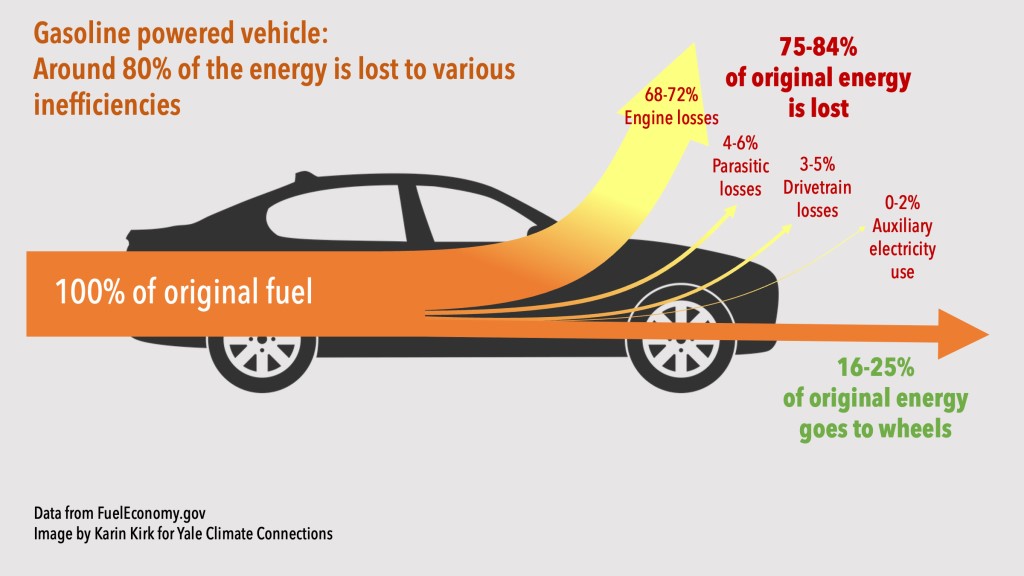
At least here in Texas it is quite common to believe that EV cars do not reduce emissions. After all EV cars use electricity from the dirty grid, right? Often this is said to environmentalists and people who care about fossil fuels emissions as if they don’t understand that the electricity for EV cars typically comes from the dirty grid. However, they do know that. In fact, they know a little bit more. EV cars are much more efficient than Internal Combustion Engine cars , or ICE, and therefore the emissions caused by EVs via the electrical grid, even a coal powered grid, is significantly less per mile. In fact, replacing gasoline-powered cars with EVs saves energy, regardless of the energy source used to recharge the EVs. For an ICE 16-25% of the original energy goes to the wheels whereas for an EV 87-91% of the original energy goes to the wheels.

Image showing an ICE car and its various losses | Electrification
16-25% of original energy goes to the wheels. Data from FuelEconomy.gov, Image by Karin Kirk for Yale Connections.
Image showing an EV car and its various losses | Electrification
87-91% of original energy goes to the wheels. Data from FuelEconomy.gov, Image by Karin Kirk for Yale Connections.

On the other hand, it takes more energy to manufacture an EV battery for an EV car than it does to produce a combustion engine. So, the production of an electric vehicle does emit more carbon than a petrol car. However, the lower emissions resulting from driving an EV means that an electric car quickly pays back its debt, so to speak. It is typically paid back within two years.

According to Hannah Richie at Our World in Data the statistics show that switching from an average ICE to an equally sized EV will save 1.2 tons of carbon emissions per person and year. That is a lot considering that the average carbon footprint per year is 4 tons worldwide and 14.4 tons per year for an American. Hannah Richie at Our World in Data also states that other environmental damages related to EVs such as mining for minerals are less than mining and extraction for fossil fuel cars, and she claims that the price of lithium-ion batteries has fallen by 98% over the last three decades.

Blonde woman pumping gas.
Photo by Andersen EV on Pexels.com

EVs are becoming increasingly common. According to Our World in Data in 2022, 88% of all cars sold in Norway were EVs and 54% of all cars in Sweden were EVs. The United States is lagging a bit at 7.5% but there is a tax credit $7,000.00 for new EVs and a $4,000.00 tax credit for buying used EVs. I should add that we have not yet bought an EV because after I took early retirement, I did not need a car. We just share my wife’s hybrid, which we hardly ever drive.

Induction Stoves

We bought an electric stove, an induction stove, a couple of years ago when our previous stove stopped working. They come with an $840.00 rebate. I’ve read that professional chefs prefer gas stoves. However, our induction stove provides everything we need for our cooking needs and my beer brewing needs and it is easier to clean. If you are a professional chef you may want to be able switch the high heat on and off quicker, but we are not professional chefs even though the food we cook is delicious.

Another downside of an induction stove is that if the power goes out you can’t cook, but that has not been a problem for us. Considering that we get our electricity from a power company, Green Mountain Energy, that utilizes renewable energy, wind and solar, you can claim that our stove is 100% fossil fuel free.

One cooking plate is red hot. The stove itself is made of granite.
Our induction stove with the lights in the kitchen turned off.

Heat Pumps

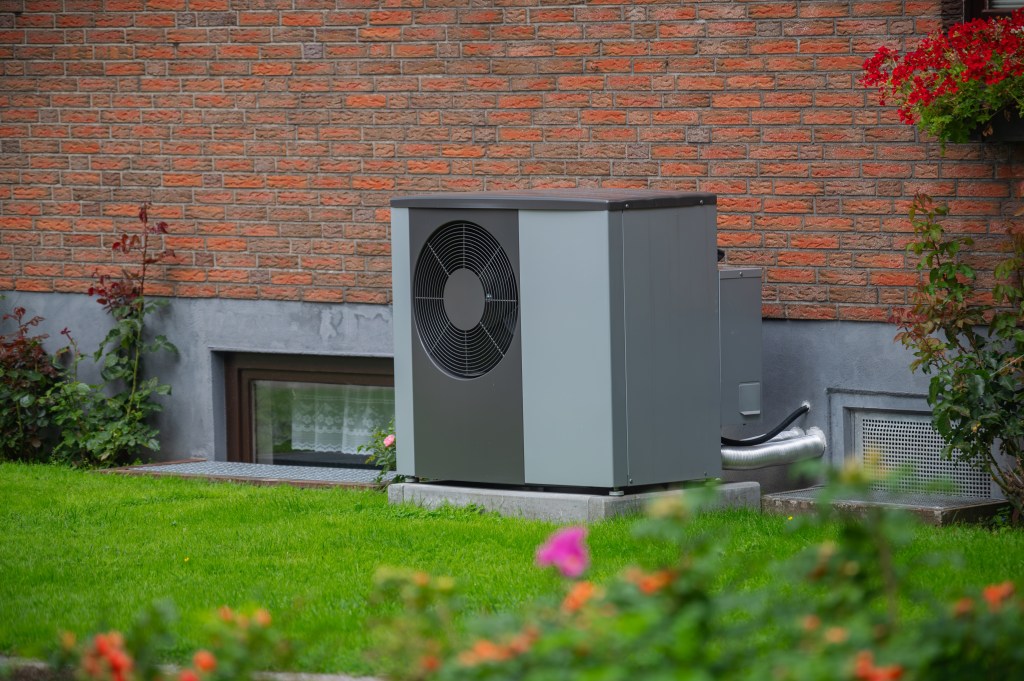
Air source heat pumps, which are the most common type of heat pumps, are a great, energy efficient choice for heating your home and water and as well as being low maintenance, they can help to cut your heating costs and lower your carbon footprint. An air source heat pump absorbs heat from the air outside a building and releases it inside. It uses the same vapor-compression refrigeration process and much the same equipment as an air conditioner, but in the opposite direction.

Air-to-air heat pumps provide hot or cold air directly to rooms. Heat pumps are the main way to phase furnaces but are also typically more efficient than other types of heaters and air conditioners and thus they reduce greenhouse gas emissions. There is an up to $8,000.00 upfront discount for heat pumps and a 30% tax credit up to $2,000.00. I should say we do not have a heat pump.

Grey heat pump standing towards the wall of an old red brick house.
Air heat pump installed on the exterior facade of the old house. Sustainable heating solutions for old construction. Stock Photo ID: 2349325553 by Snapshot freddy.

Rooftop solar

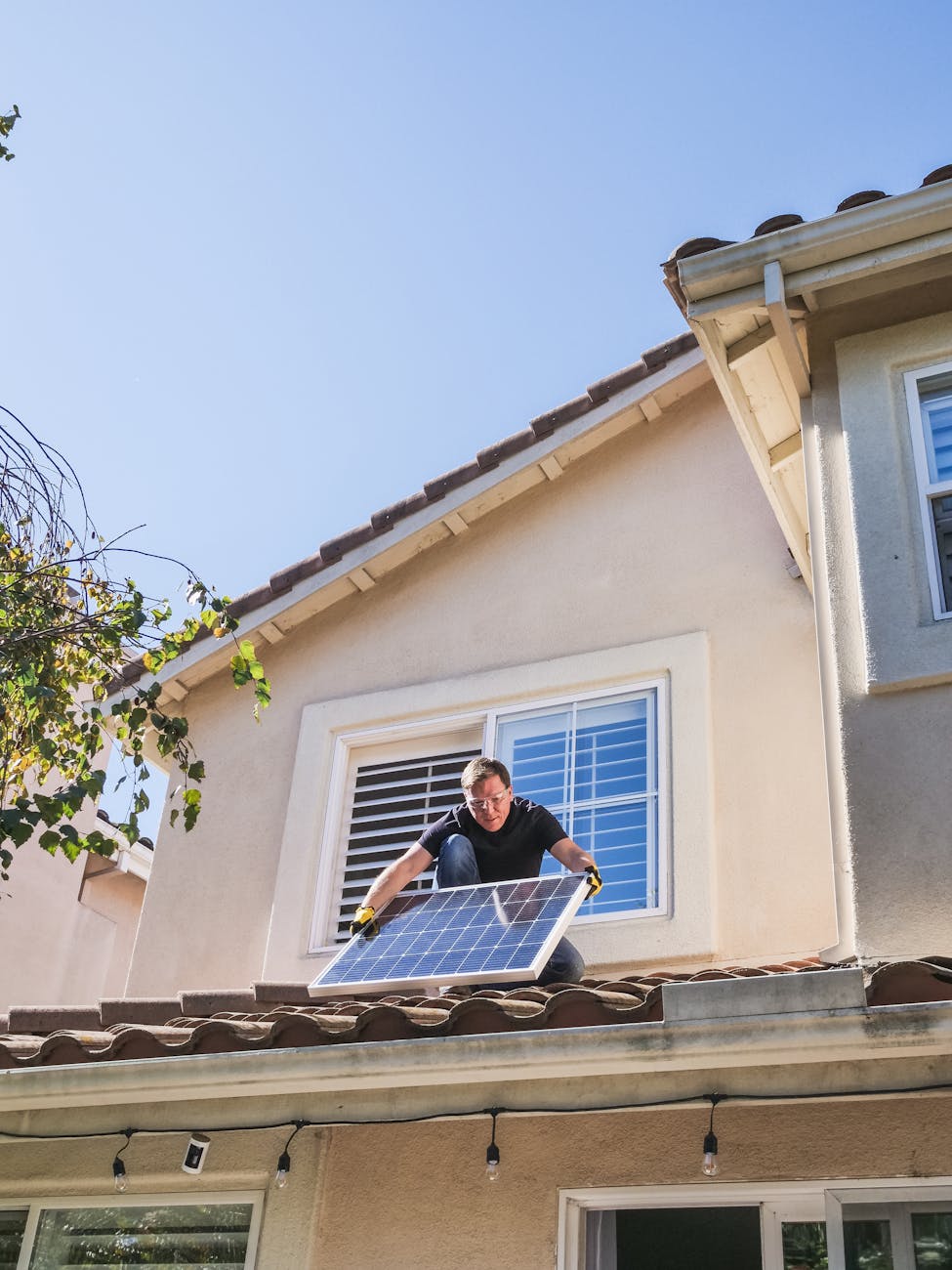
Another great thing that we have been thinking about but do not have yet is rooftop solar. Rooftop solar power system, or rooftop photo voltaic systems, consist of electricity-generating solar panels mounted on the rooftop of a residential or commercial building or structure. Residential rooftop solar power systems typically feature a capacity of about 5–20 kilowatts.

The average American household uses 1.2 kilowatts on average. Most rooftop solar systems are connected to the grid and can feed the extra power into the grid for compensation. I should add this is not entirely without difficulty. There are also hybrid systems which include any combination of wind turbines, diesel generators, and batteries for electricity on demand. There is a 30% tax credit for rooftop solar.

Solar panels being installed | Electrification
Photo by Kindel Media on Pexels.com

Miscellaneous Energy Savings

Saving energy is not exactly the same thing as electrification but it is a related topic. If you electrify your home and also reduce your energy needs, you are reducing emissions.

A few years ago, we changed the insulation in our house to reduce our energy needs and our electric bill. It made a difference. We also did weatherstripping, installed three pane windows and high security doors, that were well-insulated and reduced heat-loss. We received significant tax credits for doing this. I don’t remember how much, but it was several thousand dollars. I can add that you get a $150 tax credit for a home energy audit.

What do you think about electrification and energy savings?

Do you have additional ideas for electrification and energy savings?


To see the Super Facts click here