
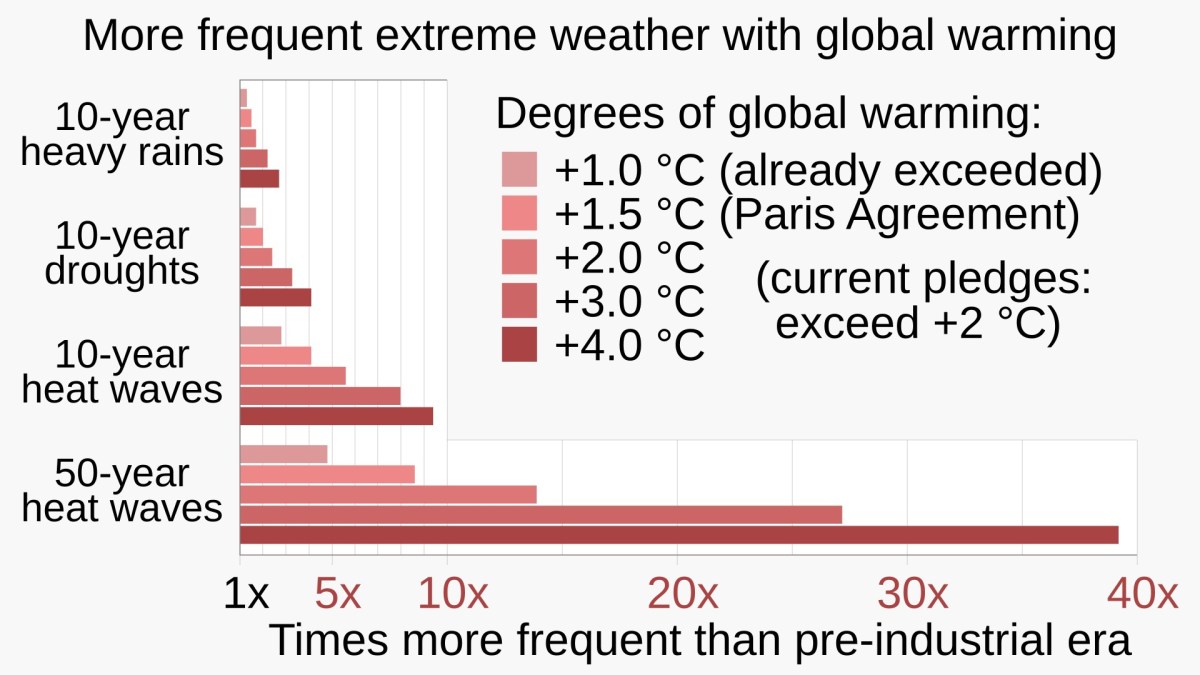
Superfact 119: Heat waves are becoming significantly more frequent, intense, and longer-lasting globally due to human-caused climate change. The combination of a high temperature and humidity can create a high so called wet-bulb temperature that you cannot survive unless you can find a way to cool down. High humidity and heat can make it impossible to cool off through sweating, which rapidly leads to heatstroke. It is estimated that this kills about 500,000 people annually.

Imagine that it is a hot and humid day, but you want to go for a hike for a few hours. It is 104 degrees (40 Celsius) and humid, but you don’t know how humid. You are concerned about the Wet-bulb temperature. You use the Wet Bulb calculator and you find out that a relative humidity of 70% will yield a Wet-bulb temperature of 35 Celsius, which is deadly. You won’t survive that. A relative humidity of 45% will yield a Wet-bulb temperature of 30 Celsius, which is very dangerous but survivable for a healthy person.
How would you find out how big the risk is? The wet-bulb thermometer above is in Japanese and pretty cryptic but Amazon has wet-bulb thermometers that you can easily understand. Here is another one also on Amazon. I promise, I am not trying to sell Web-bulb thermometers for Amazon. I am just pointing out that we may need to start paying attention to Wet-bulb temperatures and perhaps buying these products as heat waves are becoming significantly more frequent, more intense, and longer-lasting due to our burning of fossil fuels.
I should say that the Wet-bulb temperature of 95 Fahrenheit / 35 Celsius is more of an upper limit for survivability, like a suicide temperature. Wet bulb temperatures below 35 Celsius can also be very dangerous, at least for some people. As mentioned, excess heat and humidity kill about 500,000 people annually. You can read more here or here.
I was first made aware of the Wet-bulb temperatures when I read a science fiction novel focused on climate change, a so called Cli-Fi novel, the Ministry for the Future by Kim Stanley Robinson. It was a dystopian novel with the premise that 20 million Indians died because the Wet-bulb temperature became deadly in a large area in India, and not many people had air conditioning. Also, animals including wildlife and cattle died because, well obviously they did not have air-conditioning.
What followed was international crises, revenge and terrorism by the survivors against those whom they believed to be most responsible for our global warming / climate change, and desperate geo-engineering solutions to cool the planet. At first, I thought it seemed exaggerated but then I learned that dozens of places have already reached deadly Wet-bulb temperatures. Hopefully, a catastrophe like that will never happen but it is not entirely implausible.
The existence of the Wet-bulb temperature scale was a surprise to me. I knew that if you got locked into a Sauna for a long time you would not survive. Accidents that like that have happened in Sweden where I grew up. I did not know that the same thing could happen at natural temperatures. It made me realize that the more frequent, intense, and longer-lasting heat waves we are experiencing is a serious issue. I consider this to be a super fact because it is a true and important fact that many are unaware of.
What is the wet bulb temperature?
The wet bulb temperature is the lowest temperature to which a body can cool down through the evaporation of water (like sweating). It is measured using a thermometer covered in a water-soaked cloth. Because evaporation absorbs heat, the wet bulb temperature is lower than the actual air (dry bulb) temperature. When it is dry outside, sweat evaporates rapidly, keeping you comfortable. When it is humid, the air is already saturated, making it difficult for sweat to evaporate.
The humidex index, real feel and the wet-bulb all take both temperature and humidity into account, but Wet-bulb is focused on the body’s ability to cool down and is a safety measure. For example, if the Wet-bulb temperature is 28 Celsius then a body hotter than that (a human body is 37 Celsius) can lower the temperature via evaporation (sweating). So, a Wet-bulb temperature of 28 Celsius is not a problem (in that regard).
However, if the Wet-bulb temperature is 37 then the human body cannot use evaporation to cool down. Sweating won’t do anything. You’ll overheat and die. A Wet-bulb temperature of 35 is close enough to 37 for your evaporation system to fail and you’ll die. Basically, humidex is about feel, and Wet bulb about whether the body’s cooling system will work.
Our emissions seemed to have peaked, what is the worry ?
I have stated in other posts that thanks to the expansion of renewable energy our carbon emissions have taken a different path lately and that it looks like our emissions have started to go down, so what is the worry? It is important to understand that the average temperatures are not directly tied to our emissions but to the total amount of greenhouse gases in the atmosphere, for example, CO2 (an important greenhouse gas) leaves the atmosphere very slowly, and any level of excess CO2 emissions will keep accumulating.
Before we humans came along there was a balance, the soil, volcanoes, etc., added CO2 and roughly the same amount left the atmosphere. The so called carbon cycle. Imagine a bathtub with a drain that is slowly emptying water and a faucet adding about the same amount. Then we came along and sped up the faucet. For example, humans add roughly 60 to 100 times more CO2 to the atmosphere each year than all the volcanoes on the planet combined. Note: Our current administration is trying to censor climate science related information from NOAA and NASA, so tell me if the link in the previous sentence has stopped working.


Other Climate Change Related Super facts
- (25) Global Warming is Happening and is Caused by us
- (26) The Hockey Stick Graph is not Wrong
- (34) Scientists Agree that Global Warming is happening and that we are the Cause
- (52) Climate change worsens wildfires in the US
- (77) Landman Lies
- (91) Without carbon dioxide the Earth would freeze
- (106) IPCC Did Not Backtrack on Global Warming Being Human Caused

