
Superfact 116: Time and space do not exist for light particles (called photons) and not for other particles without mass either. All massless particles travel at the speed c = 299,792,458 meters per second compared to all other objects regardless of how fast those other objects are moving. Objects / particles that have mass will always travel slower than c = 299,792,458 meters per second. The speed of light, c, is not really a speed. It is a conversion factor between space and time. It is therefore a universal constant.
Light does not travel through a medium, like a sound wave, or a water wave does. There is no medium for light to travel in. Photons are massless, which means that an extremely tiny force, an infinitesimal smallest possible force, could send a photon off at infinite speed. There is no mass to hold the photon back.
However, the conversion factor between space and time c = 299,792,458 meters per second will prevent that and the photon will travel at this “speed”. Since c is a conversion factor, a physical constant describing time and space, this is not motion, or movement, in a normal sense. Space and time won’t allow any physical event to have any effect faster, and no information of any kind can travel faster than c = 299,792,458 meters per second.
One of the effects of the speed of light being a universal constant is that different observers measure different distances and time durations, and even the order of events may be in different orders for different observers. As you travel ever closer to the speed of light the time it will take to travel between two points will shrink towards zero as you approach the speed of light. In addition, the distance between the two points will shrink. You can read Albert Einsteins original paper on the topic here, and about space-time here.
This means that from the photon’s perspective there will be no time at all. A photon, or a light beam, will travel from Earth to a distant galaxy a billion light years away in an instant. It will not take a billion years. It will not take one year. It will not take one second. It will not take one microsecond. It will not take a nanosecond, or a picosecond, or a trillionth of a picosecond. It will take zero seconds. The Big Bang and the end of the Universe (if there is one) happen at the same exact moment to a photon. Time does not exist for a photon (or a gluon, or any other mass-less particle).
This is a mind-blowing fact, and it is true and important to our understanding of the Universe. Therefore, I consider it a super fact.
What does the Speed of Light Being a Universal Constant Mean ?
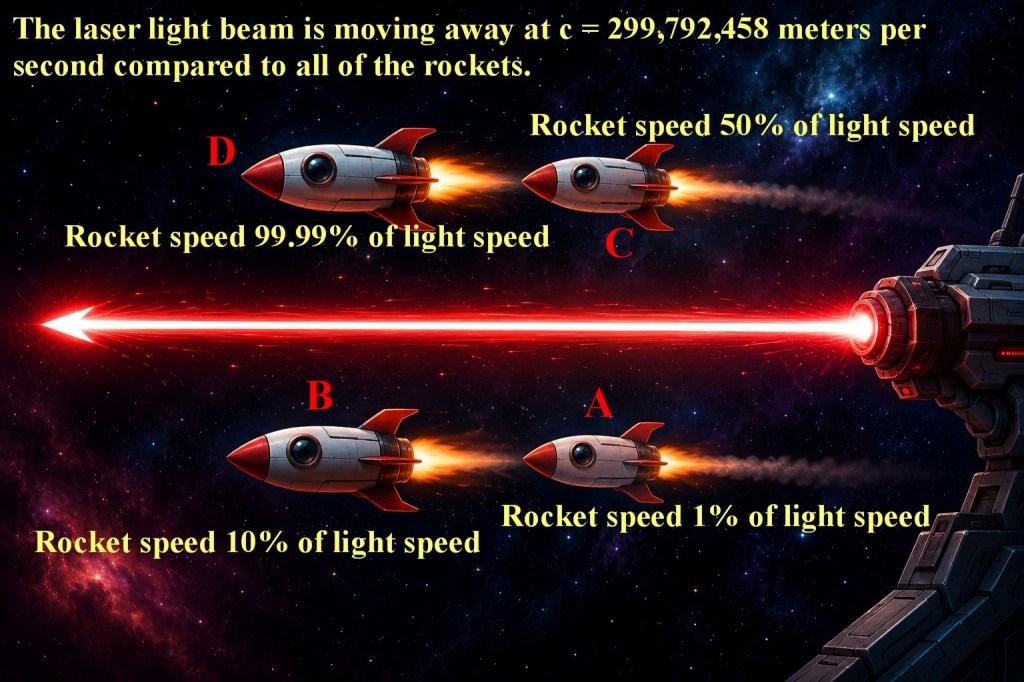
The first thing to acknowledge about the speed of light (in vacuum) is that it is a universal constant as explained in my post “The Speed of Light in Vacuum Is a Universal Constant”. However, I am explaining this fact slightly differently in the next few paragraphs with the help of the picture above.
In the picture above we are emitting a light beam from our spaceship using our super laser. There are also four rockets that travel along the light beam. The rocket on the lower right (rocket A) travel at 1% of the speed of light v = 2,997,924.5 meters per second (or 2,998 miles per second). That is extremely fast, but much slower than light. You would think that the light beam would travel a little bit slower compared to this rocket at the relative speed c – v = 299,792,458 – 2,997,924.5 = 296,794,533.5 meters per second. But it doesn’t. The light beam is still speeding ahead of rocket A at exactly c = 299,792,458 meters per second.
What happens if you compare the beam with the rocket in the lower left (rocket B)? That rocket travels at 10% the speed of the light beam. Shouldn’t the light beam move 10% slower compared to that rocket? No, the light beam speeds ahead at exactly c = 299,792,458 meters per second compared to rocket B, once again.
Now take rocket C in the upper right corner. It also travels along the light beam but at half the speed of light. Shouldn’t the light beam travel at half of the speed of light compared to rocket C? No, it will stubbornly travel at exactly c = 299,792,458 meters per second compared to rocket C. Not less and not more.
The same is true for the rocket in the upper left, rocket D. It travels at 99.99% of the light speed compared to us in the spaceship, and yet the light beam will stubbornly travel at exactly c = 299,792,458 meters per second compared to rocket D. Not less and not more.
The universal speed c = 299,792,458 meters per second is not so much about light. As mentioned, it is a conversion factor between space and time. You take this conversion factor with you everywhere you go and regardless of how fast you move. That’s the way time and space works.
The fact that the speed of light is a universal constant that is exactly the same for all observers, no matter how fast they move, should tell you that it is not a speed in a normal sense. It is not really a “speed” at all. As mentioned, it is a conversion factor between space and time. Light isn’t really travelling super-fast. It is just conforming to the geometric reality of time and space, and to us it looks like it is travelling at the speed c = 299,792,458 meters per second.
The Space-Time Interval for Light is Zero
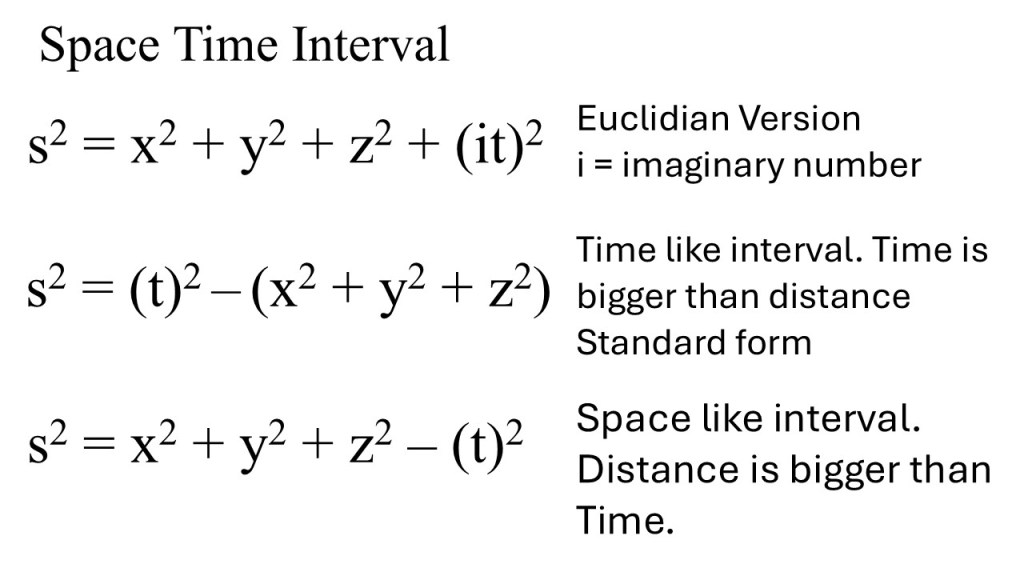
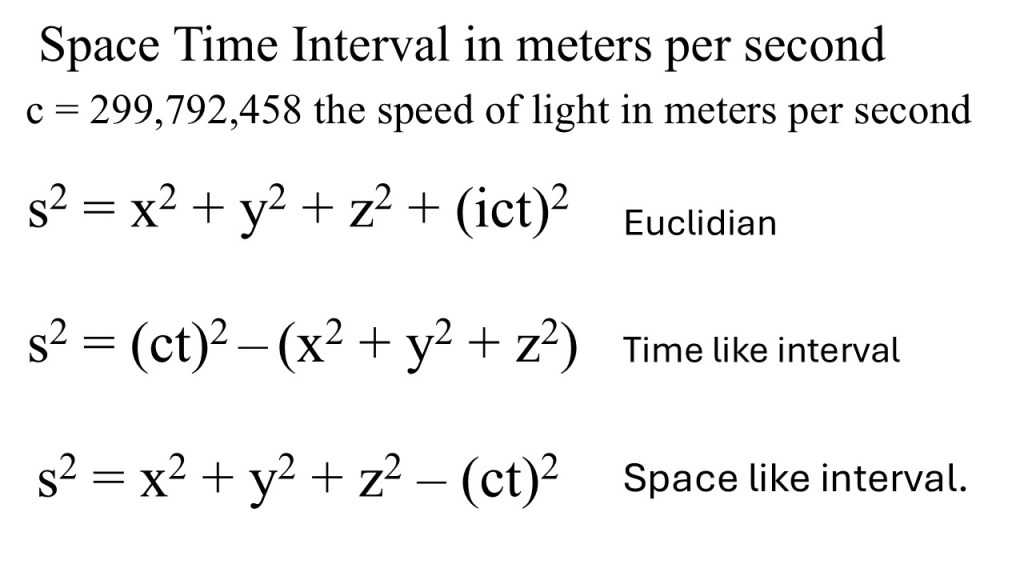
I mentioned that from the photons perspective time does not exist but that from our perspective light travel through space or seem to travel through space and that takes time. However, for us space and time are separate things. If you combine them and measure space-time intervals instead you get a more complete picture. In 3D space you get the distance between two points by adding the differences between the coordinates using Pythagoras theorem, s^{2}=x^{2}+y^{2}+z^{2}. (x, y, and z, are differences in the coordinates) As long as you are consistent with the units you will always get the same distance regardless of position and orientation of your coordinate system. You can read more here.
If you add time to Pythagoras theorem you will get the space-time interval, which interestingly enough is the same for all observers. There is no time dilation or length contraction in the interval. s^{2}=x^{2}+y^{2}+z^{2}+(it)^{2} As you might suspect, intervals involving light travelling from one event to another will always be zero for all observers, and not just from the photons perspective. And again, the same applies to all massless particles. Below are the Pythagoras formulas for different versions of the interval. In the top picture it is assumed that the conversion factor c = 299,792,458 meters per second has already been baked into to the time variable and in the bottom it has not. This is not any stranger than converting feet to meters.
What about the speed of light in water ?
It is well known that the speed of light in transparent materials such as water and glass is slower than the speed of light in vacuum. The speed of light it water is about 75% of the speed in vacuum and about 70% or less in glass (depending of the type of glass) compared to the speed in vacuum. In some materials the speed of light can be much less than that. This seems to violate what I said above about the speed of light always moving at c = 299,792,458 meters per second for all observers regardless of their speed.
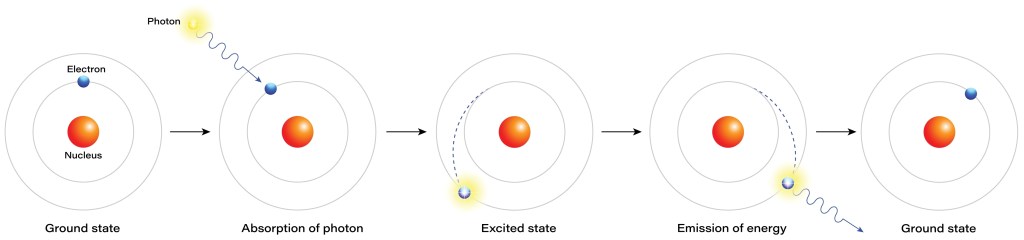
What is going on is that when light moves through matter it is being absorbed and emitted as it “travels” between the atoms in the material, and this absorption and emittance process takes time. This time is extremely short but long enough to be measurable. As the photons move in between the atoms they travel at the “speed” c = 299,792,458 meters per second, the time to space conversion factor I’ve been talking about. See the illustration below.
More about the mass of a Photon
I’ve said photons have no mass. According to Einstein’s theory of special relativity, time does not pass (or effectively “exist”) from the perspective of a massless particle. However, this is the intrinsic mass or so called proper mass or invariant mass. It is the mass of an object as measured by an observer who is completely at rest relative to it. This intrinsic mass is the mass that a photon does not have.
The mass of an electron is 511 Kilo Electron Volts, which is 0.0000000000000000000000000009109 grams. That is the intrinsic mass of the electron. If an electron is sped up to close the speed of light its mass increases and goes toward infinity. If its speed is very close to the speed of light its mass could be much bigger than that of the entire Universe. That’s because as you are increasing the speed of the electron, you are increasing its kinetic energy and as you increase the total energy of the electron you also increase its total mass according to E = mc2.
As the electron’s speed approaches the speed of light the kinetic energy goes toward infinity. That is one reason why it is impossible to travel at exactly the speed of light for anything but massless particles. Infinite energy and infinite mass are not realistic. We, the objects that have mass, can move closer and closer to light speed but never get there.
However, the intrinsic mass for photons is zero and therefore the photon is travelling at exactly the speed of light, c = 299,792,458 meters per second. E = mc2 still applies to light but the mass is not the intrinsic mass, which is zero, but the total mass, and the total mass can pretty much take on any number.
What about Warp Drives ?
So, nothing with mass can travel at the speed of light, and nothing can exceed it. What about the warp drive in Star Trek? As I said, the speed of light is not really a speed but the conversion factor between time and space. It is a geometric fact of space-time. That is a pretty difficult reality to get around, just like it is pretty difficult to push Earth out of its orbit by pushing on the floor. However, there is a way to cheat and that is to stretch space-time itself. This is theoretically possible, but it requires colossal amounts of mass-energy and enormous amounts of negative energy. We don’t even know if negative energy exists on a macroscopic scale.
So, no one knows if a warp drive is possible, and if it isn’t, then we are stuck moving slower than the speed of light, which would make interstellar travel very difficult and inconvenient.
Richard Feyman’s Lecture on Why Light Is NOT Moving Through Space?
The YouTube video below is very long, 48 minutes. However, Richard Feyman, Nobel prize winner in physics, has a knack for explaining extremely abstract concepts so that they are easy to understand. If you are very interested in this topic and have some extra time, this is a fascinating lecture. He certainly explains this topic better than I can.
Other Super Facts Related to the Speed of Light
- The Speed of Light in Vacuum Is a Universal Constant
- Two events may be simultaneous for some but not for others
- GPS uses relativity for accuracy
- Time Dilation Goes Both Ways
- The Pole-Barn Paradox and Solution
- Time is a Fourth Dimension
- The Edge of the Observable Universe is 46.5 billion Light Years Away

