
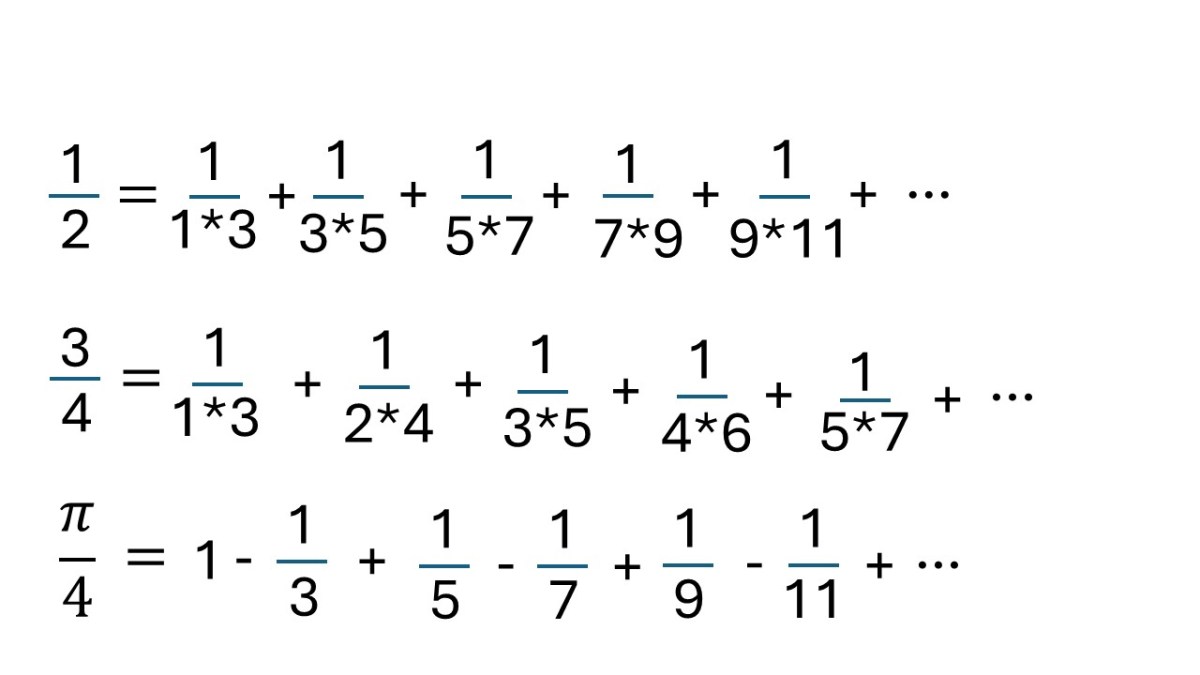
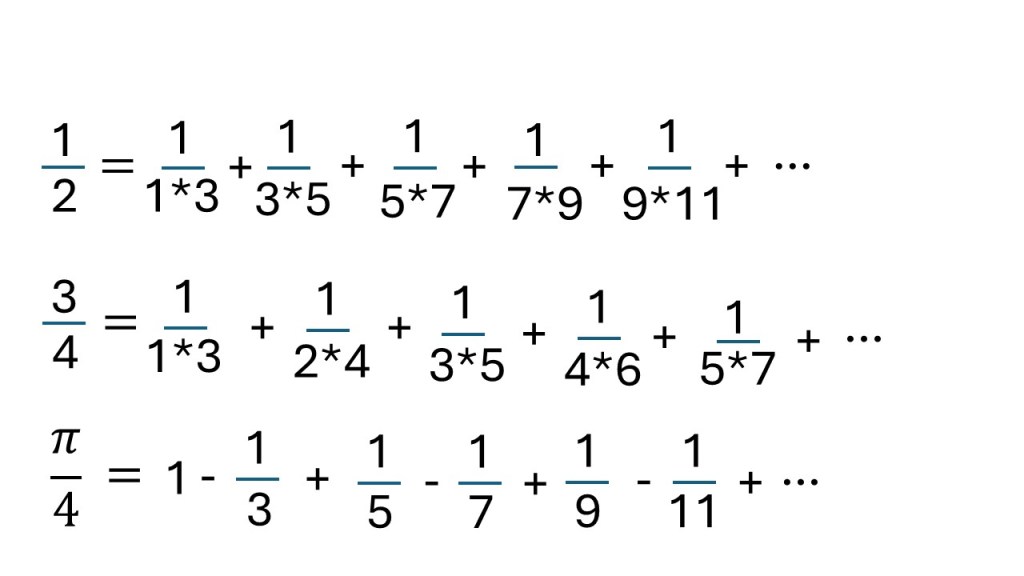
Super fact 112 : Adding infinitely many numbers may result in a finite number. In addition, adding infinitely many numbers may result in an irrational important constant such as Pi. The same holds true for infinitely nested radicals (square roots).
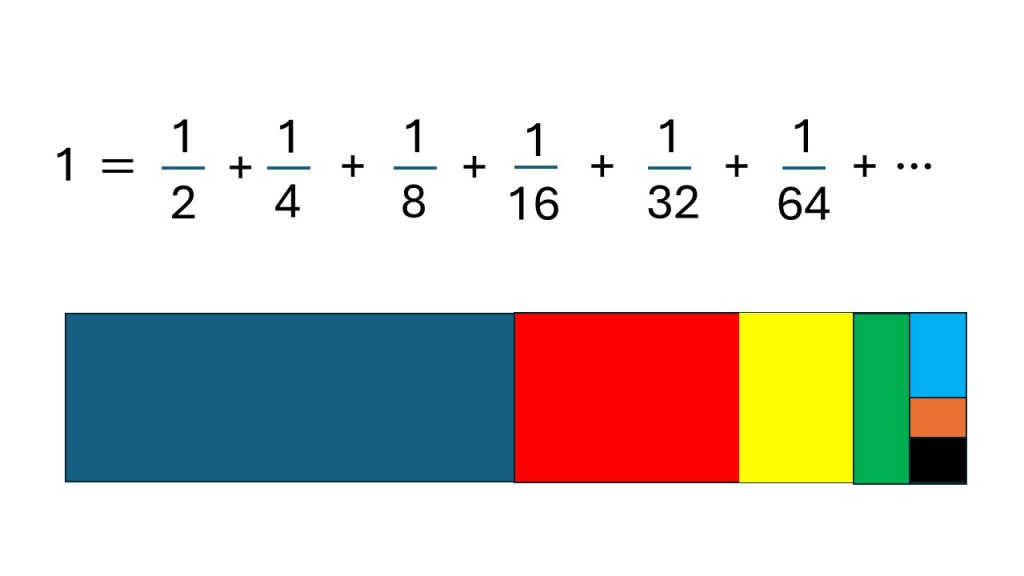
That you can add infinitely many numbers and get a finite number as the result is possible to understand if you imagine cutting a rectangle into smaller and smaller pieces and then adding them to get the rectangle back. If you start with half the rectangle and then you add the half of the remaining half and then the half of that remaining half, etc., you can keep doing that forever without exceeding the size of the rectangle. This is illustrated in the picture above. Note all these pictures are drawn by me.
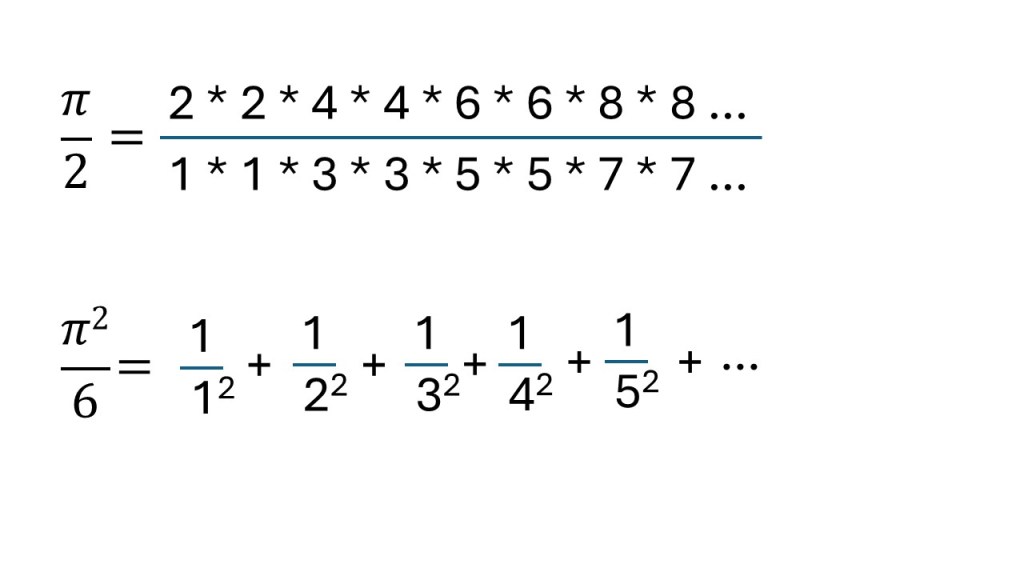
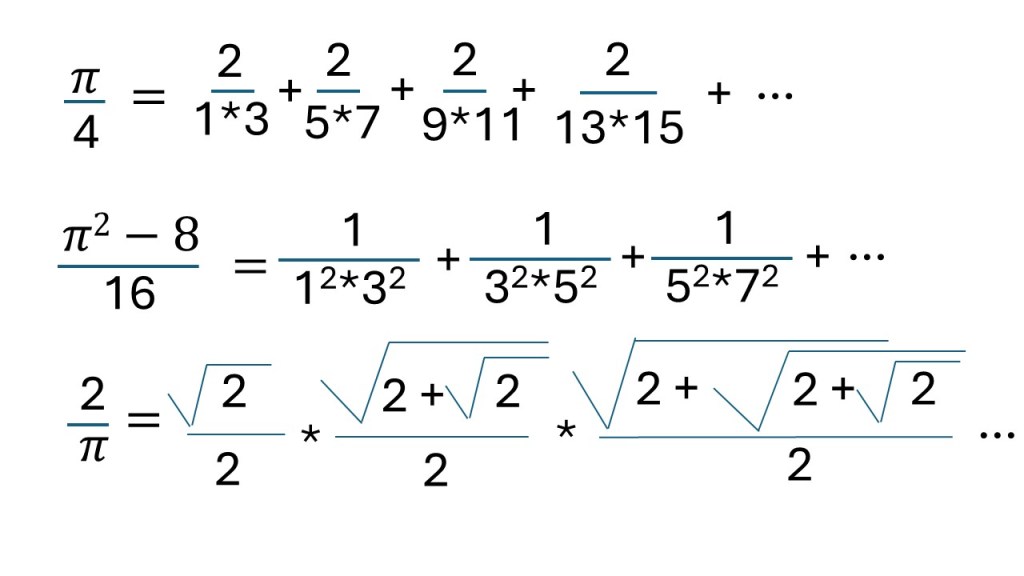
If you’ve never seen an infinite series before this may come as a surprise. However, what is even more surprising is that you can add an infinite number of addends that are constructed from simple patterns and get all kinds of surprising results including irrational numbers with special meaning such as pi. You can easily find thousands of examples in mathematical handbooks and online. This reality is important in mathematics and our understanding of the world, as well as surprising, and therefore a super fact in my opinion.
Infinitely Nested Radicals
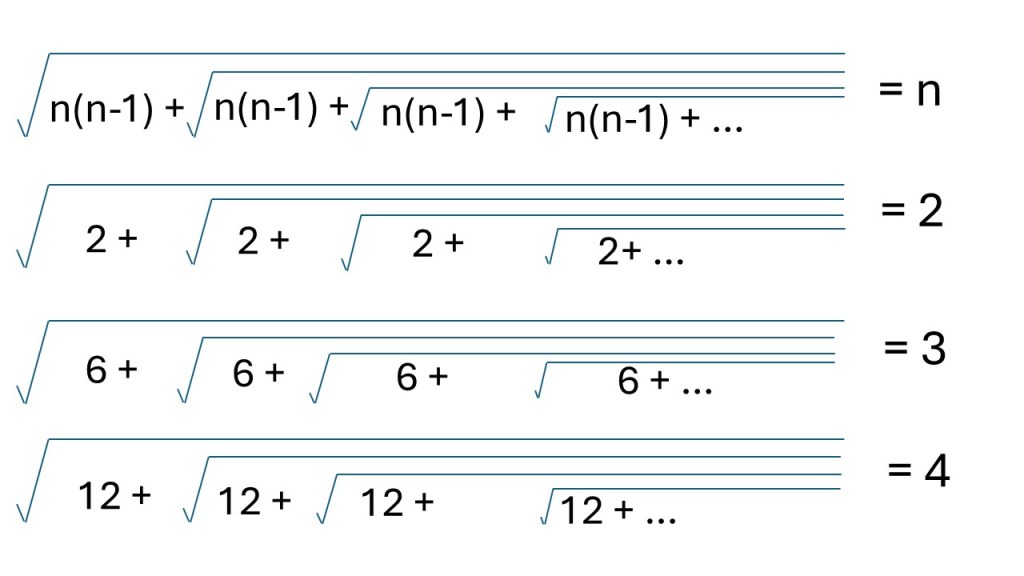
In addition, to adding an infinite number of addends you multiply an infinite number of factors and end up with a non-infinite (finite) result. You can even have an infinite number of nested radicals. To explain what a radical is. A square is a number multiplied by itself. For example, the square of 5 is five times five, which is twenty five. A cube is a number multiplied by itself three times. The cube of five is five times five times five, which is one hundred and twenty five. The square is denoted by adding a superscript of 2 (5 with a superscript 2). The cube is denoted by adding a superscript of 3 (5 with a superscript 3).
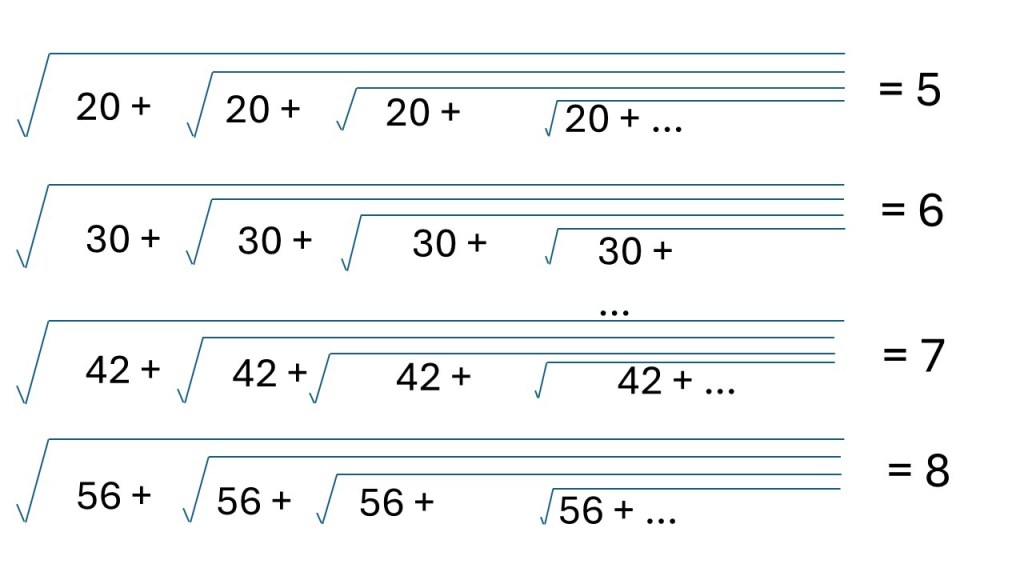
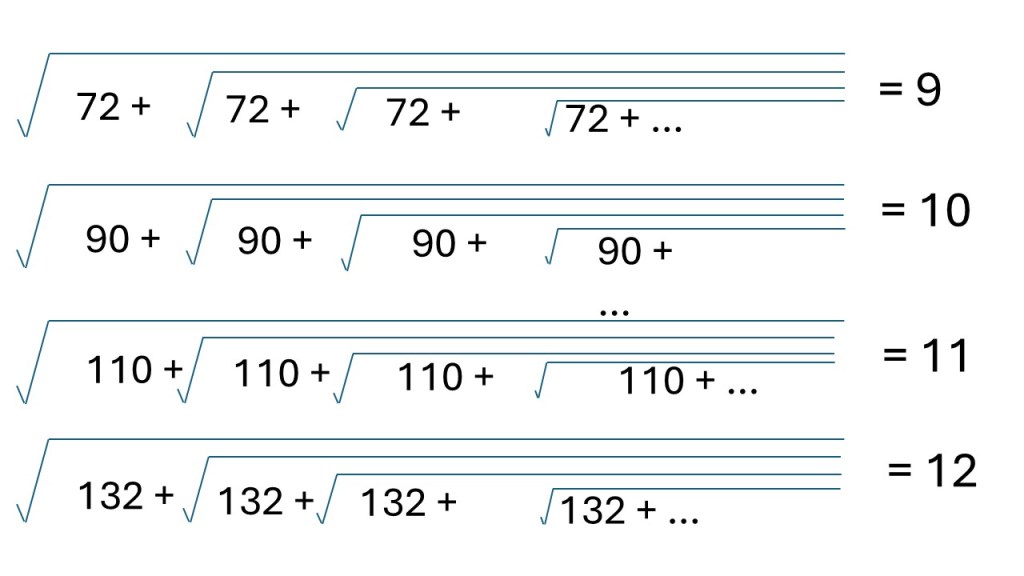
The square root is the opposite of the square. The square root of twenty five is five. The cube root is the opposite of the cube. The cube root of one hundred and twenty five is five. The square root and the cube root are examples of radicals. Radicals are indicated by using a little house on top of the number as shown in the pictures below. For radicals that are not square roots you add a number indicating what type of radical you have. The cube root has the number three above the house. All the examples below are square roots and in those cases the number two is left out.
The three pictures below show one example of infinitely nested radicals (square root) using numbers n(n-1) repeatedly in the square roots. When n = 2 then n(n-1) is 2*1 = 2. When n = 3 then n(n-1) is 3*2 = 6, etc.
Infinite Series and Pi
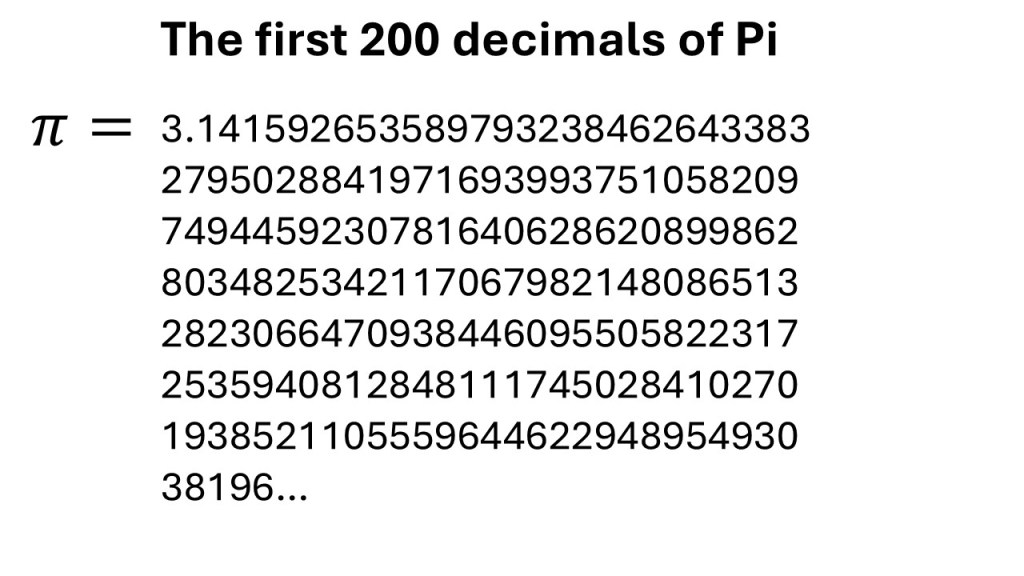
The constant pi is a special mathematical number that tells you exactly how the distance around the edge of any circle compares to the distance straight across the middle (diameter). Pi is an irrational number, meaning it cannot be expressed as a fraction and when written as a decimal it has an infinite number of decimals that have no repeating patterns. Despite pi being irrational, it shows up as the result of a very large number of infinite series that follow surprisingly simple patterns.
Other Mathematics Superfacts
- Every Symmetry is Associated with a Conservation Law
- The Euler Number Math Magic
- Eulers Polyhedra Math Magic
- Infinities Come in Different Sizes
- Conic Sections are the Shapes that Shape Our World
- Russel’s Paradox
 Super Facts