
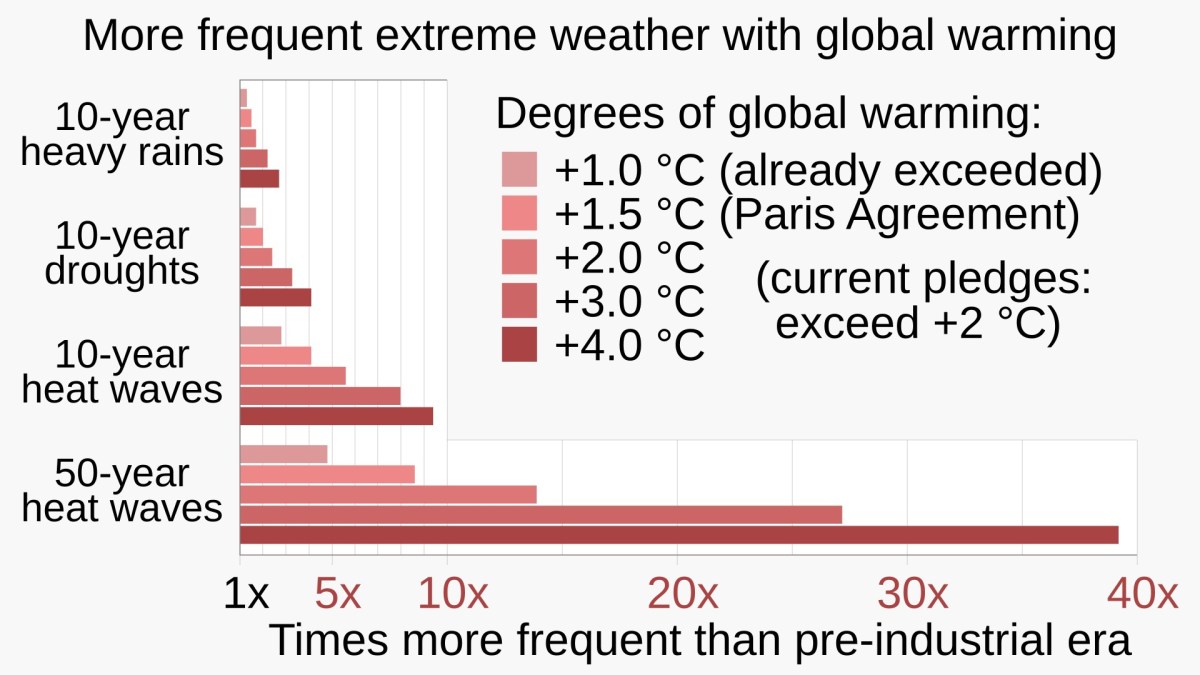
Superfact 119: Heat waves are becoming significantly more frequent, intense, and longer-lasting globally due to human-caused climate change. The combination of a high temperature and humidity can create a high so called wet-bulb temperature that you cannot survive unless you can find a way to cool down. High humidity and heat can make it impossible to cool off through sweating, which rapidly leads to heatstroke. It is estimated that this kills about 500,000 people annually.

Imagine that it is a hot and humid day, but you want to go for a hike for a few hours. It is 104 degrees (40 Celsius) and humid, but you don’t know how humid. You are concerned about the Wet-bulb temperature. You use the Wet Bulb calculator and you find out that a relative humidity of 70% will yield a Wet-bulb temperature of 35 Celsius, which is deadly. You won’t survive that. A relative humidity of 45% will yield a Wet-bulb temperature of 30 Celsius, which is very dangerous but survivable for a healthy person.
How would you find out how big the risk is? The wet-bulb thermometer above is in Japanese and pretty cryptic but Amazon has wet-bulb thermometers that you can easily understand. Here is another one also on Amazon. I promise, I am not trying to sell Web-bulb thermometers for Amazon. I am just pointing out that we may need to start paying attention to Wet-bulb temperatures and perhaps buying these products as heat waves are becoming significantly more frequent, more intense, and longer-lasting due to our burning of fossil fuels.
I should say that the Wet-bulb temperature of 95 Fahrenheit / 35 Celsius is more of an upper limit for survivability, like a suicide temperature. Wet bulb temperatures below 35 Celsius can also be very dangerous, at least for some people. As mentioned, excess heat and humidity kill about 500,000 people annually. You can read more here or here.
I was first made aware of the Wet-bulb temperatures when I read a science fiction novel focused on climate change, a so called Cli-Fi novel, the Ministry for the Future by Kim Stanley Robinson. It was a dystopian novel with the premise that 20 million Indians died because the Wet-bulb temperature became deadly in a large area in India, and not many people had air conditioning. Also, animals including wildlife and cattle died because, well obviously they did not have air-conditioning.
What followed was international crises, revenge and terrorism by the survivors against those whom they believed to be most responsible for our global warming / climate change, and desperate geo-engineering solutions to cool the planet. At first, I thought it seemed exaggerated but then I learned that dozens of places have already reached deadly Wet-bulb temperatures. Hopefully, a catastrophe like that will never happen but it is not entirely implausible.
The existence of the Wet-bulb temperature scale was a surprise to me. I knew that if you got locked into a Sauna for a long time you would not survive. Accidents that like that have happened in Sweden where I grew up. I did not know that the same thing could happen at natural temperatures. It made me realize that the more frequent, intense, and longer-lasting heat waves we are experiencing is a serious issue. I consider this to be a super fact because it is a true and important fact that many are unaware of.
What is the wet bulb temperature?
The wet bulb temperature is the lowest temperature to which a body can cool down through the evaporation of water (like sweating). It is measured using a thermometer covered in a water-soaked cloth. Because evaporation absorbs heat, the wet bulb temperature is lower than the actual air (dry bulb) temperature. When it is dry outside, sweat evaporates rapidly, keeping you comfortable. When it is humid, the air is already saturated, making it difficult for sweat to evaporate.
The humidex index, real feel and the wet-bulb all take both temperature and humidity into account, but Wet-bulb is focused on the body’s ability to cool down and is a safety measure. For example, if the Wet-bulb temperature is 28 Celsius then a body hotter than that (a human body is 37 Celsius) can lower the temperature via evaporation (sweating). So, a Wet-bulb temperature of 28 Celsius is not a problem (in that regard).
However, if the Wet-bulb temperature is 37 then the human body cannot use evaporation to cool down. Sweating won’t do anything. You’ll overheat and die. A Wet-bulb temperature of 35 is close enough to 37 for your evaporation system to fail and you’ll die. Basically, humidex is about feel, and Wet bulb about whether the body’s cooling system will work.
Our emissions seemed to have peaked, what is the worry ?
I have stated in other posts that thanks to the expansion of renewable energy our carbon emissions have taken a different path lately and that it looks like our emissions have started to go down, so what is the worry? It is important to understand that the average temperatures are not directly tied to our emissions but to the total amount of greenhouse gases in the atmosphere, for example, CO2 (an important greenhouse gas) leaves the atmosphere very slowly, and any level of excess CO2 emissions will keep accumulating.
Before we humans came along there was a balance, the soil, volcanoes, etc., added CO2 and roughly the same amount left the atmosphere. The so called carbon cycle. Imagine a bathtub with a drain that is slowly emptying water and a faucet adding about the same amount. Then we came along and sped up the faucet. For example, humans add roughly 60 to 100 times more CO2 to the atmosphere each year than all the volcanoes on the planet combined. Note: Our current administration is trying to censor climate science related information from NOAA and NASA, so tell me if the link in the previous sentence has stopped working.


Other Climate Change Related Super facts
- (25) Global Warming is Happening and is Caused by us
- (26) The Hockey Stick Graph is not Wrong
- (34) Scientists Agree that Global Warming is happening and that we are the Cause
- (52) Climate change worsens wildfires in the US
- (77) Landman Lies
- (91) Without carbon dioxide the Earth would freeze
- (106) IPCC Did Not Backtrack on Global Warming Being Human Caused
To see the Other Super Facts click here


great post – sad too that many countries with older buildings don’t have a/c & the rest of the infrastructure needed to cope with high temps for humans…
LikeLiked by 3 people
Thank you so much da-AL. Yes as heat waves become increasingly common and intense more people need air conditioning and ways to cool down and the lack of will be a problem.
LikeLiked by 2 people
I’m listening to a great book you might enjoy if you haven’t read it already – “Not the End of the World” by Hannah Ritchie, who is a young Scottish data scientist. it’s very hopeful in that she discusses how fear only paralyzes us, the strides we’ve made, while keeping in mind what needs to be done…
LikeLiked by 1 person
Yes I read that book and it is a great book. I read it before I had this blog, otherwise I would have reviewed it here, but I wrote an Amazon review for it. Maybe I will put my review here. Thank you for reminding me. BTW I forgot to explain what Wet-bulb temperature actually is, so I just added a section about that.
LikeLiked by 1 person
I’m halfway through it & she mentions Biden – I wonder what she’d say if she wrote it during trump… wet-bulb is fascinating & useful
LikeLiked by 1 person
Thank you da-AL Luckily she works for Our World in Data, which is registered in the UK and the research team is at Oxford, so the Trump administration cannot censor her as they have done with Earth Science and climate science at EPA, NASA and NOAA. She wrote another book “Clearing the Air: A Hopeful Guide to Solving Climate Change in 50 Questions and Answers” – which I bought but have not read yet.
LikeLike
I was stunned to find out that so much of Europe doesn’t have AC (during the World Cup, when visitors exclaimed over America’s AC).
LikeLiked by 2 people
Yes, it hasn’t been the same need for AC in Europe in the past. It hasn’t been part of the culture the same way. I am from Sweden but I travelled extensively in southern Europe in the summer when I was 22 years old, and I worked in southern Germany in July and August. No one had air conditioning. But I never experienced a temperature in Europe above 85F back then. The first time I experienced a temprature above 85F degrees was when I came to the US as a college level exchange student, and it was a shock when I drove through California, Arizona and Nevada when it was 110F+ the summer of 1988. I thought both 85F and 105F was warm but just nice weather. Well that wasn’t the case. Temperatures close to 100F are horrible. I can add that the air conditioning in my Oldsmobile Cutless Supreme that I bought for $250 was broken. The continental US is on average hotter than Europe but the US also has larger temperature swings with sometimes very hot summers. 100 years ago people did not have air conditioning in Texas and I don’t even understand how they lived.
LikeLiked by 1 person
Great backstory. Thanks for this.
LikeLiked by 1 person
Thank you Jacqui
LikeLiked by 1 person
I’ll have to look up to see if the humidex rating (which our weather stations report) is the same as the wetbulb. This information should be more widely known. Another great post Thomas.
LikeLiked by 1 person
Thank you so much Maggie. Sorry I did not explain what Wet-bulb really is. Both humidex and wet-bulb takes both temperature and humidity into account but humidex is for how hot the weather feels, while wet-bulb correspond to the lowest temperature for which evaporation will occur. For example, if the Wet-bulb temperature is 28 Celsius then a body hotter than that (a human body is 37 Celsius) can lower the temperature via evaporation (sweating). So a Wet-bulb temperature of 28 Celsius is not a problem (in that regard). However, if the Wet-bulb temperature is 37 then the human body cannot use evaporation to cool down. Sweating won’t do anything. You’ll overheat and die. A Wet-bulb temperature of 35 is close enough to 37 for your evaporation system to fail and you’ll die. Basically, humidex is about feel, and Wet-bulb about whether the bodies cooling system will function or not.
LikeLiked by 2 people
Oh, thanks.
LikeLiked by 1 person
Thank you for alerting me Maggie. I had completely forgotten to explain it. I just added a section explaining what the Wet-bulb temperature is and I think I explained it a little bit better than in the comment.
LikeLike
Thanks for that explanation, Thomas. I wasn’t sure either.
LikeLiked by 1 person
I completely forgot to explain what the Wet-bulb temperature is. I just added a section explaining what the Wet-bulb temperature is and I think I explained it a little bit better than in the comment above.
LikeLiked by 2 people
That sounds pretty scary, Thomas.
LikeLiked by 1 person
Yes the Wet-bulb temperature is becoming something important to check. I forgot to explain what Wet-bulb temperature actually is, so I added a section about that.
LikeLiked by 1 person
I saw that. Good explanation.
LikeLiked by 1 person
Thank you Anneli
LikeLiked by 1 person
I’ve noticed that summers have been getting increasingly hotter for a while now, but Summer 2026 has been awful so far…and we still have to go through the rest of July, August, and early September….
LikeLiked by 2 people
Yes you are right Alex, the same here. In northern Sweden it is easier to see the warming because the snow season has on average gotten shorter by a month over the last 30 years and you can see that. It is a little harder to see here but still noticeable. BTW I forgot to explain what Wet-bulb temperature actually is, so I added a section about that.
LikeLiked by 1 person
We’re seeing such a big surge of heatwaves in the UK this summer. Thank you for your interesting article – I’d never heard of the wet-bulb temperature.
LikeLiked by 2 people
Thank you so much Esther. It is worldwide. BTW I forgot to explain what Wet-bulb temperature actually is, so I added a section about that.
LikeLiked by 1 person
Learned something new today. Never heard of this but it makes sense. Florida can get very hot and humid. Oddly the temp in Florida is usually around mid 90’s there have been day’s in New Hampshire hotter with high humidity but never more than a couple of days. Those were a bit worse than Florida but Florida went on for weeks.
LikeLiked by 2 people
Yes here in north Texas we’ve had temperatures 99-100 degrees (close to 40 Celsius) pretty much every day for several weeks. BTW I forgot to explain what Wet-bulb temperature actually is, so I just added a section about that.
LikeLike
I wasn’t familiar with the wet-bulb temperature and appreciate the education, Thomas. The future looks frightening in so many aspects! On July 1, in suburban Toronto, Canada, we had an actual high of 37C, with a humidity index reading of 49C. Crazy/dangerous! 🥵 That was only one heatwave, with another one going on this week, although not quite as hot. I feel sorry for all the people in Europe who are suffering through high temperatures without air conditioning!
LikeLiked by 2 people
That is terribly hot. The humidity index reading is an indicator of how dangerous the temperature / humidity combination is, but the Wet-bulb temperature will tell exactly if you are in danger, 30 dangerous, 35 dead. As I mentioned above, I forgot to explain what Wet-bulb temperature actually is, so I just added a section about that. I can also add that evaporation / sweating ceasing to work leading to heat stroke and organ failure is not the only way heat can hurt. There’s dehydration, people with weak hearts, etc. However, a high Wet-bulb temperature is the most common reason to death, and it can cause mass casualties.
LikeLiked by 1 person
As always, a lot of interesting information. We, happily, have been fortunate not to have much of the crazy heat yet, but our time is coming. Mostly 80s so far.
My sister lives outside of Fairbanks, Alaska. A couple of years ago, they had temps in the 90s, which is extremely unusual for them. A quick Google search tells me that the average high temperature in the summer is usually in the 70s. It also says that because humidity is so low, the wet-bulb temps peak in July at 50. Like Sweden, they have long daylight in summer and short daylight in winter. I think she said six hours of daylight in winter?
LikeLiked by 1 person
That is interesting. I forgot where you live. It seems like in northern Sweden we lived further north than your sister. In winter we only had a few hours of daylight, and further north, above the arctic circle, where I did my army service, no daylight at all. I don’t think people in Alaska or Sweden need to worry about the Wet-bulb temperature but people in India and the middle east and certain places in the continental US need to, and now, perhaps southern Europe too.
LikeLiked by 1 person
No, you are right. People in India, the Philippines, and places like that are in danger, sadly, and few resources to combat the heat.
LikeLiked by 1 person
Yes long lasting Wet-bulb temperatures (35C/95F) over a large area where people don’t have access to air-conditioning or a grid that could not handle the load (as in Kim Stanley Robinson’s novel) would be a giant catastrophy. Hopefully, that will never happen.
LikeLiked by 1 person
A timely and most fascinating breakdown, Thomas. Much of the world is in heat wave right now. I heard thousand have died in Europe from the almost 50 temps with the ‘wet bulb’ factor. The future is scary. I love the sun, but being 40C today, I took a pass on laying out for a tan, lol. Our building pool is closed for maintenance, so just no. I’m that person who gets over-heated. In fact, I carry a hand fan with me in my purse and one in my gym bag, lol. I also guzzle 3-4 litres of water daily too. 😋
LikeLiked by 2 people
but being 40C today, I took a pass on laying out for a tan – ha ha that is funny. Some time ago my cousin’s daughter came to visit and at first she was very excited about the sun and heat in north Texas and she went outside into the backyard to tan. She came back in five minutes later telling us in Swedish that the heat was horrible and she couldn’t take it. Anyway, it is a great idea to drink a lot of water. In addition, to the Wet-bulb phenomenon, dehydration is also a killer in a heat wave.
LikeLiked by 1 person
That’s funny! And yes, water is essential to keep our engines hydrated and cooled. 😊
LikeLiked by 1 person
Yes that is right. Less coffee and beer and more cold water.
LikeLiked by 1 person
Absolutely! 🙂
LikeLiked by 1 person
Learned something new today – thank you!
LikeLiked by 1 person
Thank you so much Linda
LikeLiked by 1 person
thank YOU 😊
LikeLiked by 1 person
Well that was really interesting, and rather worrying. Thanks for all those facts though, Thomas.
LikeLiked by 2 people
Thank you Chris. Yes, the good news is that we have changed the trajectory of our ever increasing emissions, but that won’t make the average temperatures come down until we are close to the net zero, so it will get hotter for many decades to come. Air-conditioning will be important.
LikeLiked by 1 person
Java Bean: “Ayyy, our Dada is familiar with the wet bulb phenomenon! When they were all getting roasted by the heat wave while he was visiting back East, he said something to his family to the effect of ‘At least it’s not a wet bulb’ and nobody knew what he was talking about.”
Lulu: “He’s been waiting for a book called The Ministry for the Future to go on sale so he can buy it. It starts with a wet bulb event. Apparently it’s not enough to read about climate disasters in the news, he likes to read fiction about them too …”
LikeLiked by 2 people
Ha your dada knows a lot Java Bean. Lulu, The Ministry of the Future is a very good book. I read it a few years ago. Like you say it started with a Wet-bulb event, a large one in India, the grid failed, air-conditioning was very rare, lots of cattle died, and 20 million people died. An event like that will have a huge impact on politics. Well, he’ll find out.
LikeLike
Thank you for the interesting article. I first learned about wet bulb temperatures when my parents bought me a meteorology set as a child. It included a wet bulb thermometer along with the standard thermometer, so I could see wet bulb temperature right away and could use that to calculate humidity. It’s the lesson that stuck with me most from that experience. And indeed, it’s very worrisome how much worse heat waves are becoming.
LikeLiked by 2 people
Wow that was a great present for a curious mind. I can see how you got into science. I am worried too. It seems like our worldwide emissions may have peaked but that does not mean global warming will reverse since it is dependent on the total amount we have added past and present. It will get worse before it gets better.
LikeLiked by 1 person
A friend of ours was telling us another fact about heating temperatures in the Pacific Ocean. A couple of years ago, the temps heated up some 2.5 degrees. The floods they casused in Central CA were phenomenol. Tulare Lake filled up for the first time in about 100 years. That is happening already in the ocean, and it is early, which means that we will face even more floods this fall.
I didn’t realize that humidity made such a difference. I grew up in the Midwest, and I struggled with it even as a child. It was such a relief to move to Portland, Oregon when I was 15. I still sweat like a pig, but, like you say, it goes away and cools me off.
LikeLiked by 2 people
Yes I think I remember that from the news. One thing effects another. We’ll see what happens but hopefully no big disasters. I just wanted to thank you for doing this “My commitment to anyone who comments is to provide a link to your blog so the community can get to know each other better.” — that is so nice and supportive of you to do for your commentors.
LikeLiked by 1 person
I’ve tried to do it for more than just Story Chat, but I don’t usually have the time to do it for every post.
LikeLiked by 2 people
I certainly understand that you don’t have time to do it for every post, that is very time consuming. But the fact that you are doing it at all is very kind of you.
LikeLiked by 1 person
Thank you Thomas. 🙂
LikeLiked by 1 person
Thank you for keeping us informed. I had no idea that “this kills about 500,000 people annually.” I feel sorry for the animals, too. Air conditioning is great as long as there’s electricity.
LikeLiked by 2 people
Yes what happened in Kim Stanley Robinson’s novel was that a large area in India reached dangerous Wet-bulb temperatures (35C/95C or more) and the electrical went down (something that almost happened in Texas last summer). 20 million people died (in the novel). I thought it was way too extreme and unrealistic but then I looked up the facts around it, and wow it was an extreme disaster but far from implausible.
LikeLike
We can’t take our current electrical systems for granted. Do humans make any progress in that novel? Does it have any hope? If so, I might be interested in taking a look at it. (I need balance in novels.)
LikeLiked by 1 person
Yes you are right. The Texas grid (ERCOT) came very close to a shutdown in 2023 due to excessive heat and in 2024 due to a winter storm. People can die when that happens.
LikeLike
JoAnna I forgot to adress the The Ministry of the Future. Yes, the novel starts out dark, then it is complicated, but towards the end things will be better. It is not a depressing novel. Sometimes big crisis is what wakes people up and real progress can finally be made. I should maybe a book review for it here.
LikeLiked by 1 person
Thanks! I agree about a big crisis sometimes being needed to wake people up and make real progress. Our crises are piling up, so I hope we as humans wake up soon.
LikeLiked by 1 person
Yes you are right JoAnna and I sure hope so.
LikeLiked by 1 person
An eye-opening post. Wet-bulb temperature is a critical but often overlooked measure showing how heat and humidity together can become deadly. As climate change increases extreme heat events, understanding these risks can help save lives and highlights the importance of urgent climate action. Thank you for raising awareness.
LikeLiked by 1 person
Yes that is a good summary Anowar, and you are right. Thank you for your supportive comment.
LikeLiked by 1 person
It’s my pleasure 😊❤️
LikeLiked by 1 person
Ho Thomas, I’m glad I came here to see if I’d missed any posts. I’d missed this and it is very educational. I know that high temperatures and high humidity are a problem but didn’t know how this was measured. I think most people don’t actually know about this lethal combination at all and I’m sure governments are prepared to hide these facts or lie about them. I have recently concluded that humanity is on an irreversible road to self destruction and the scenario you’ve described as painted in that book sounds very plausible. Sadly, only people like you and I read those books so the ignorance remains. There is no will in a society run by old men who only care about money and power to change it. After all it won’t impact them in their lifetimes.
LikeLiked by 1 person
Yes that’s the problem with politicians. All they want is to be elected and the future of our chilrden and grand children is not as important. Many of the right leaning politicians have also painted themselves into a corner. After years/decades of denying and attacking the science and the reality of human caused they can’t just change their minds, even the some have done that. The ones who do change often lose their primary elections. The primary elections here in the US, which typically are attended by the more extreme voters. However, despite all that pretty much all developed countries have succeeded in reducing their emissions between 20-40%, China’s carbon emissons seem to have peeked and pollution gone down by 43% over the last ten years, and as a result the average Chinese now has a life expectancy that is 2.2 years longer compared to ten years ago. That is thanks to the rapid growth of renewables and EVs in China. They still use a lot of coal though, but it is slowly changing. There are similar stories around the world. We are getting better ever so slowly. The worst emissions scenarios are no longer plausible but there’s going to be massive damage to eco systems and as well as human suffering. The imrpovements are too late and too slow to change that. However, there’s hope and the emissions forecasts look better than they were ten years ago. The scenario in this book could still happen though.
LikeLike
I think the change is to slow and to late to avoid massive world wide problems. The climate change issues have come much faster than the experts estimated and that is my concern. No one actually knows.
LikeLiked by 1 person
Yes I think you are right. Massive damage is unavoidable.
LikeLike
😥
LikeLiked by 1 person