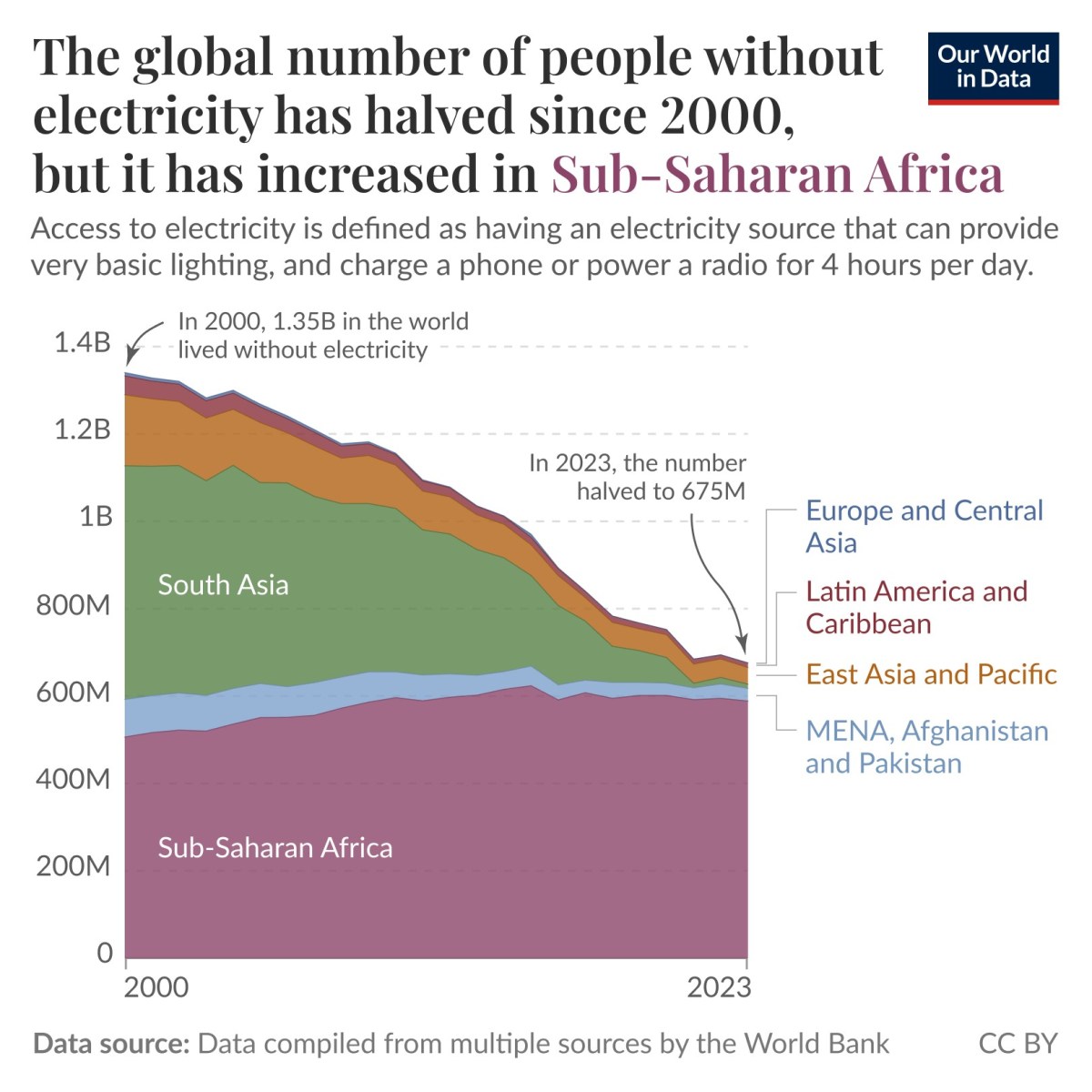
Super fact 109 : The global number of people without electricity has halved since 2000, but it has increased in Sub-Saharan Africa. In the year 2000 1.35 billion people in the world was without electricity and in the year 2023 it was 675 million people according to Our World in Data. The dark aspect of the statistics is that the number of people without electricity in Sub-Saharan Africa has increased from 500 million people to more than 600 million people.
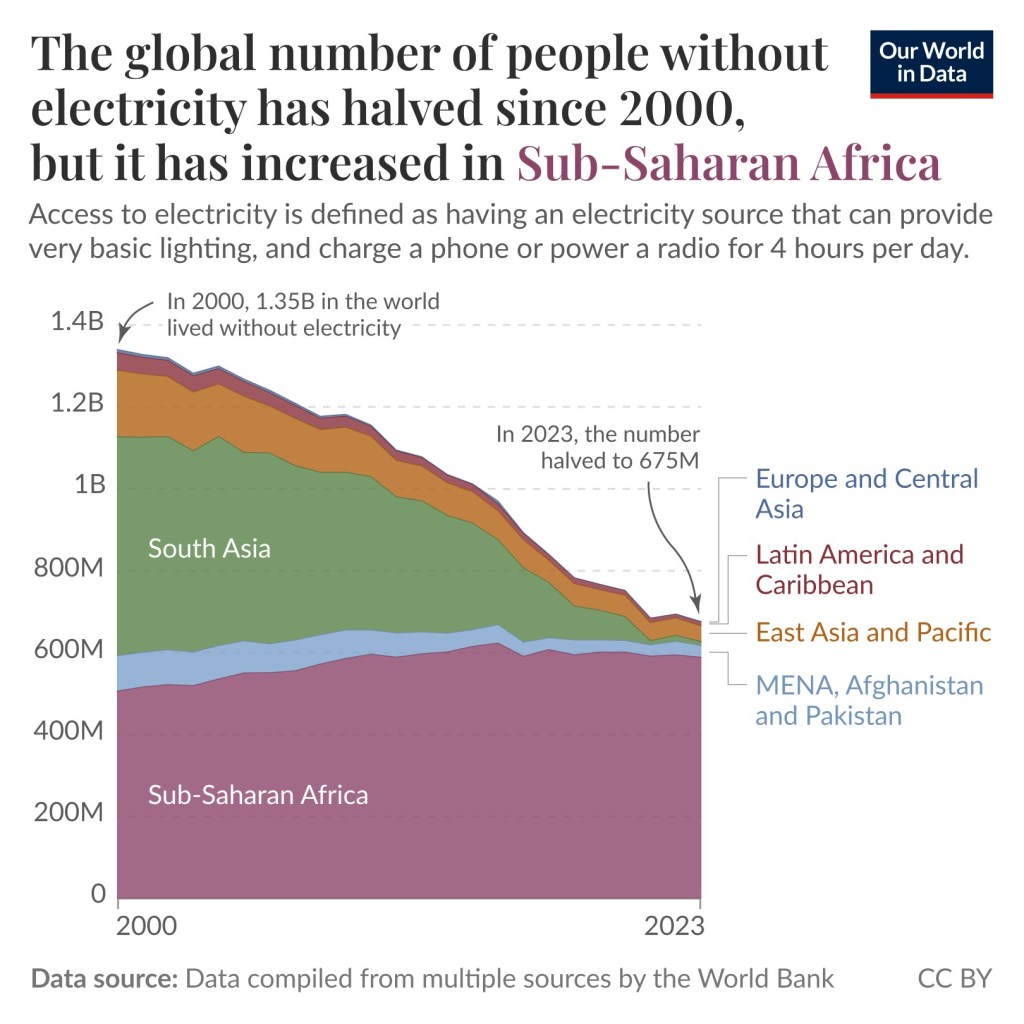
This also means that the share of people without electricity living in Sub-Saharan Africa increased from 37% in the year 2000 to 80% now. However, it is also true that the share of people in Sub-Saharan Africa with electricity has doubled, rising from 26% to 53%. What is going on is that population growth has outpaced this expansion, meaning the number of people without electricity has still risen.
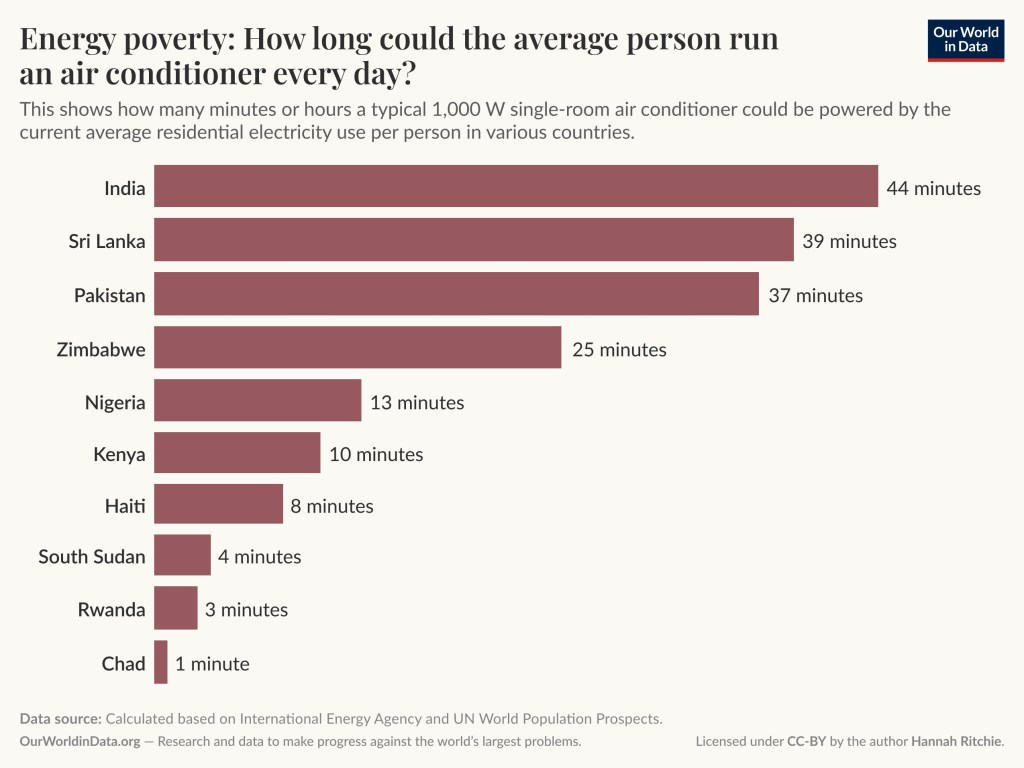
For the rest of the world, it is unequivocally good news. For example, in South Asia more than 500 million people lacked electricity in the year 2000, 414 million lacked electricity in 2010, and only 27 million people lacked electricity in 2023. Another way to look at the access to energy gap is by considering how long it is possible to run an air conditioner in different countries. Click here for data and analysis. In summary, the news for Sub-Saharan Africa is complicated but for the rest of the World, it is very good news. To read more about this topic click here.
I consider this a super fact because I believe it is an important but surprising fact in two parts. First the great news for the world and secondly the mixed news for Sub-Saharan Africa.
No Relief for the Heat Down in Africa
As mentioned, four of the five regions of the world, Europe and Central Asia, Latin America and the Caribbean, East Asia and the Pacific, MENA, Afghanistan, and Pakistan have made substantial progress. However, Sub-Saharan Africa is a complicated case. Note that MENA stand for Middle East and North Africa.
An alternative way of looking at access to electricity is to consider how much electricity is being used in each country and how that translates into the number of hours or minutes that an air conditioner could be running. Note it doesn’t mean that an air conditioner will be shut off after, let say 25 minutes, just that is much electricity one person use. What should be noted from the graph below is how dire the situation still looks like in Sub-Saharan countries. Sub-Saharan Africa is still very behind in this regard, and the fact that global warming is likely to hit Africa very hard that is not good news.