
Superfact 123: The speed of light is the speed of causality, which is the speed corresponding to how fast anything in the Universe can influence anything else in the Universe. That is because the universe, or space-time has a strict maximum speed limit for any action, signal, or information to travel from one place to another. Light just happens to travel at this maximum limit because photons have no mass.
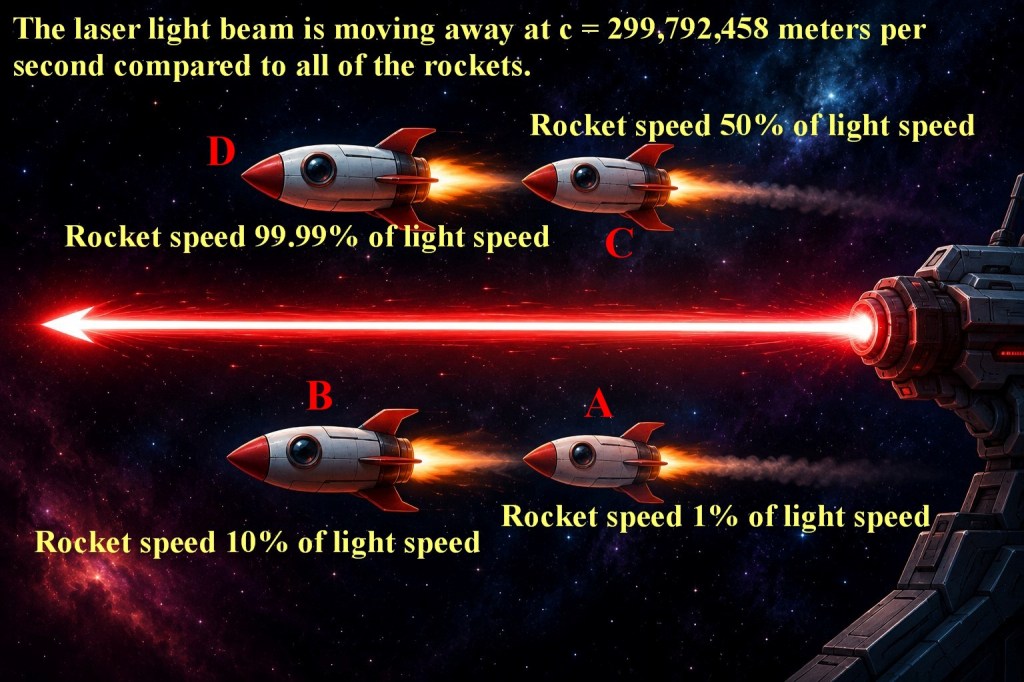
I am posting about the speed of light again because there are so many aspects of it that are mind blowing. For starters, “The Speed of (Light in Vacuum) Is a Universal Constant”. It is always c = 299,792,458 meters per second for everyone no matter at what speed they are travelling. If you try to catch up to a light beam by going faster and faster the light beam will still keep moving at c = 299,792,458 meters per second faster than you. No matter how much you accelerate you can never catch up. The beam will keep moving away from you at c = 299,792,458 meters per second. This is possible because time and space are relative, at least if viewed separately, like we do.
Photons and other massless particles will always move exactly at the speed of light c = 299,792,458 meters per second, whilst anything with mass could never travel at the speed of light. It will always move slower. In fact, when something with mass is approaching the speed of light, its mass will grow towards infinity, and it will require infinite energy to accelerate it to the speed of light. Basically, something with mass can never accelerate to reach the speed of light.
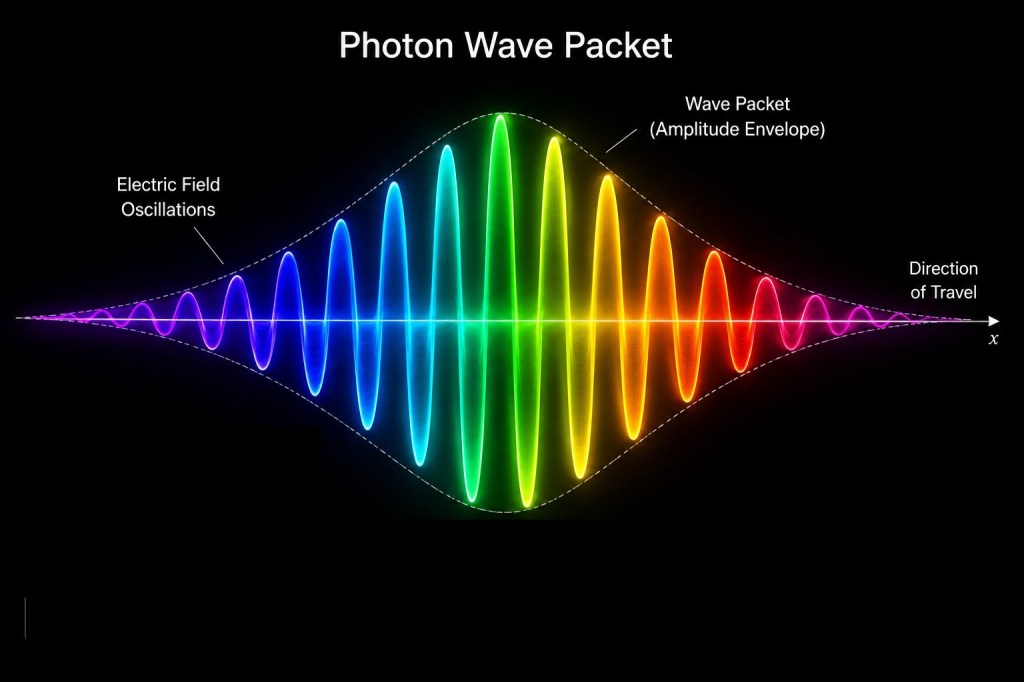
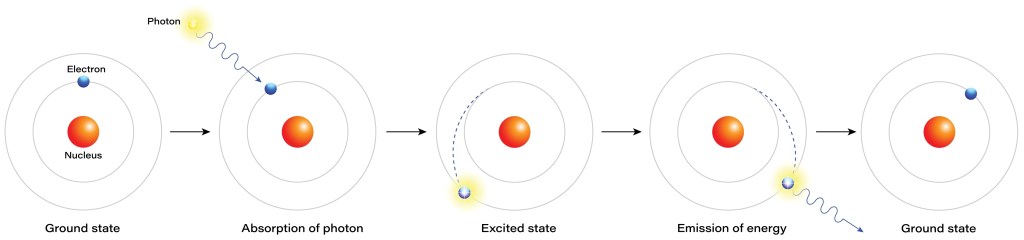
Note: In my first paragraph I wrote (Light in Vacuum) in parenthesis because light always travels at c = 299,792,458 meters per second, but it appears to be going slower in transparent matter. When light moves through matter it is being absorbed and emitted as it “travels” between the atoms in the material, and this absorption and emittance process takes time.
As mentioned, the speed of light is a maximum speed limit for any action, signal, or information to travel from one place to another. Einstein’s theory of relativity shows that space and time are linked. The c = 299,792,458 meters per second acts as a conversion factor that binds space and time together. So, in a sense the speed of light is not even a speed in a regular sense, it is a property of time and space.
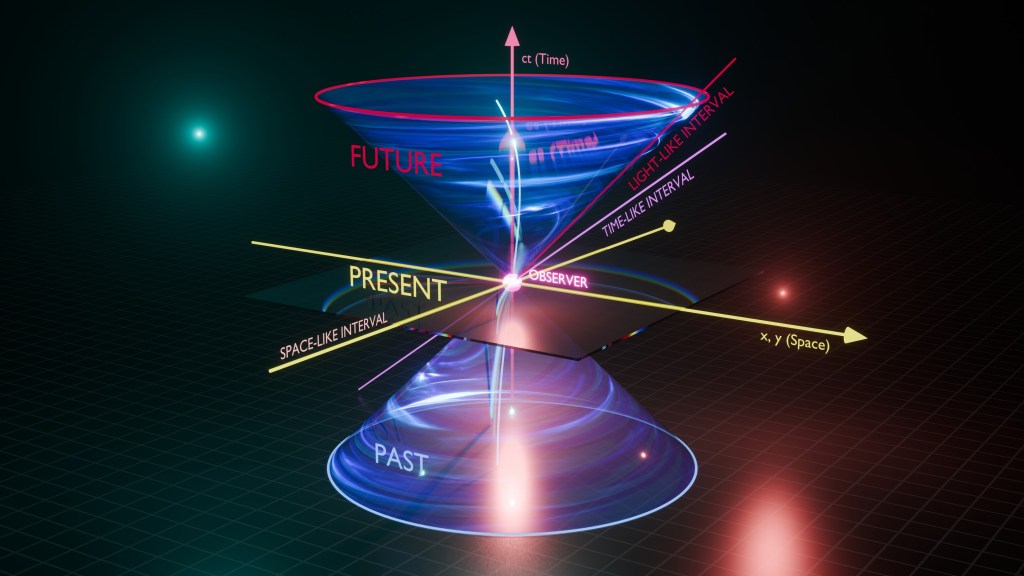
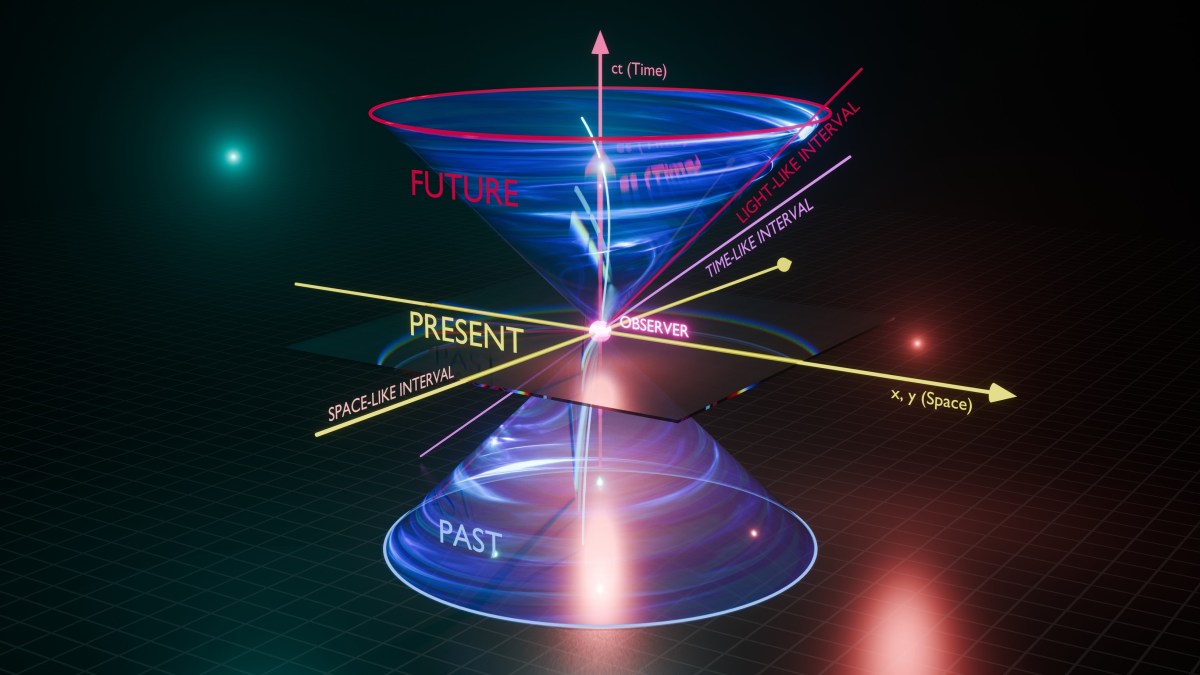
The cone diagram above is a coordinate system with time being the pink arrow going from the bottom and up. The yellow arrows represent the x and y axis representing space. The center is the observer (you). The past cone below the center represents all the past events that could have affected you (the center). The future cone represents everything that you could possibly affect in the future. All light beams travel on the surface of the future cone. What is outside these cones are parts of the Universe you cannot affect and that cannot affect you. This is the non-observable part of the Universe.
That the speed of light is also the speed of causality, or the maximum speed of cause and effect is an important fact that is mind blowing, and therefore a super fact in my opinion.
Light is Beyond the Reach of Time
Since the speed of light is a conversion factor between time and space and not a speed in a real sense there is more to say about the speed of light that may come as a surprise, for example, that time does not exist for photons. This means that from the photon’s perspective there will be no time at all. A photon, or a light beam, will travel from Earth to a distant galaxy a billion light years away in an instant.
It will not take a billion years. It will not take one year. It will not take one second. It will not take one microsecond. It will not take a nanosecond, or a picosecond, or a trillionth of a picosecond. It will take zero seconds. The Big Bang and the end of the Universe (if there is one) happen at the same exact moment from the perspective of a photon. Time does not exist for a photon (or a gluon, or any other mass-less particle). This is explained in greater detail in my post “Light is Beyond the Reach of Time”.
What About Quantum Entanglement?
What about quantum entanglement? You may have heard about instantaneous action across vast distances due to quantum entanglement. Quantum entanglement is when pairs or groups of particles interact in ways such that the quantum state of each particle cannot be described independently of the others, even when the particles are separated by a vast distance. Therefore, measuring the state of one particle instantly determines the state of the other. Does that not violate the speed of light being the speed of causality? It turns out that it doesn’t.
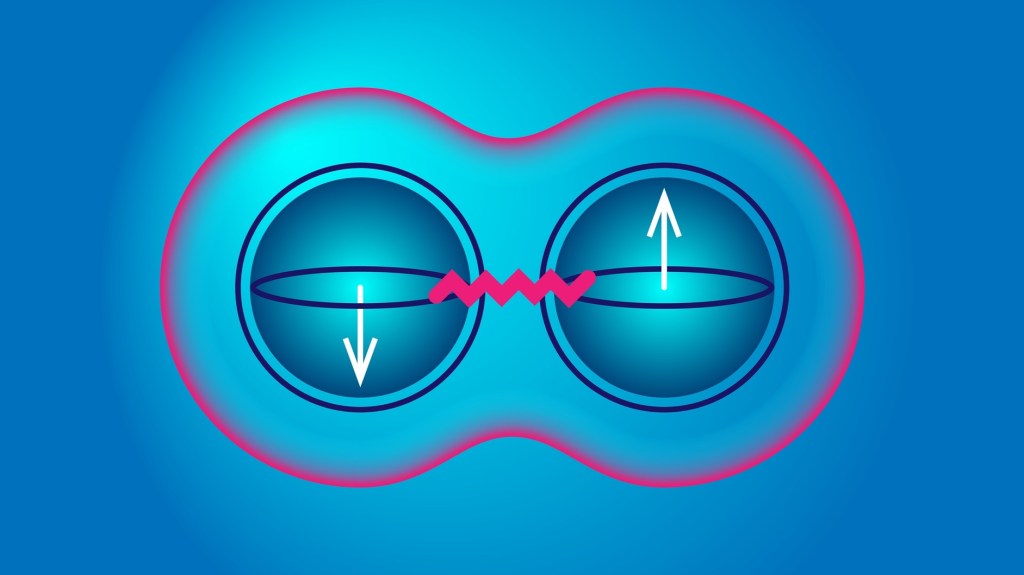
It can be understood the following way. Imagine two identical looking shoe boxes, one containing a left white shoe and the other containing a black right shoe. If you were to randomly scramble the two boxes so that you did not know in which box respective shoe was. Then you send one of the boxes to Mars. If you open the shoe box still on earth, you will instantly know the content of the box on Mars. The Martians don’t need to send a message to Earth.
The analogy is not perfect because unlike the shoe boxes the quantum case involves pure randomness. The content of the shoe boxes has been predetermined, and the randomness stem from the fact that we don’t know which box is which. But the shoes are there the whole time before you open any box. This corresponds to what you would call a hidden variable in physics. In the quantum case, the quantum state is not hidden or predetermined, there is no hidden variable, it does not even exist until you measure. It is true randomness. However, it is still similar in the sense that no signal, no message, and no information is being sent, and no message or information need to be sent.

What about Warp Drives ?
So, nothing with mass can travel at the speed of light, and nothing can exceed it. What about the warp drive in Star Trek? As I said, the speed of light is not really a speed but the conversion factor between time and space. It is a geometric fact of space-time. That is a pretty difficult reality to get around, just like it is pretty difficult to push Earth out of its orbit by pushing on the floor. However, there is a way to cheat and that is to stretch space-time itself. This is theoretically possible, but it requires colossal amounts of mass-energy and enormous amounts of negative energy. We don’t even know if negative energy exists on a macroscopic scale.
So, no one knows if a warp drive is possible, and if it isn’t, then we are stuck moving slower than the speed of light, which would make interstellar travel very difficult and inconvenient.
Other Super Facts Related to the Speed of Light
- The Speed of Light in Vacuum Is a Universal Constant
- Two events may be simultaneous for some but not for others
- GPS uses relativity for accuracy
- Time Dilation Goes Both Ways
- The Pole-Barn Paradox and Solution
- Time is a Fourth Dimension
- The Edge of the Observable Universe is 46.5 billion Light Years Away
- Light is Beyond the Reach of Time
To see the Other Super Facts click here


It’s fascinating. I’m going to watch the YouTube video later!
LikeLiked by 1 person
Thank you so much Karen (is that correct or was it Kiki?) My cousin who commented below, just told me that the video is AI generated and not Richard Feynman. I may have to delete it, so hold off on watching it. I will investigate.
LikeLiked by 1 person
Ok thank you!!
Yes – my name is Karen. I got the name Kiki in college and it stuck. Being that Karen is a joke if a name lately I pretty much go by Kiki. lol
LikeLiked by 1 person
OK Kiki it is. I removed the video. It was AI generated. I just did not pay attention.
LikeLiked by 1 person
I’m going to read this post and show the light cone diagram to my son, who will be fascinated and delighted by this topic, Thomas! As an aside, I hope a warp drive is possible, as interstellar travel would be an incredible possibility! Thanks for sharing.
LikeLiked by 1 person
Thank you so much Ada. Yes your son might be interested in the light cone diagram and would be a good preparation for a more advanced physics class, in case he does that in the future. Whether warp drive is possible or impossible is more up to the Universe than any future technology. If it isn’t possible (which it looks like) then there is nothing anyone can do about it. It might be part of the answer to Fermi’s famous question regarding the hundreds of billions of solar systems in our galaxy and trillions of galaxies — “Where is everybody?”.
LikeLiked by 1 person
I like the shoe analogy. I have read a little on the quantum entanglement, it was pretty interesting. I recently read the big bang was not the beginning but the end of the previous universe.
LikeLiked by 1 person
I have not read a book about entanglement yet but I have one (TBR) and I am in the middle of reading Cycles of Time by Roger Penrose. According to him there are many big bangs. There is a big bang and the Universe expands almost forever but then there will be only photons left (the heat death), which is the same as no time, and no space, nothing can happen and that state appears like a Big Bang for the next Universe, and this happens over and over, and it bypasses the problem with entropy. He calls his “theory” or perhaps better described as a hypothesis, Conformic Cyclic Cosmology. He claims that there is evidence for it in Cosmic Microwave Background Radiation.
LikeLiked by 1 person
I like the shoe analogy. I have read a bit on the quantum entanglement that was cool. I heard the big bang was not the beginning but the end of the previous universe as a theory. Pretty interesting.
LikeLiked by 1 person
Since you brought it up. I realized I goofed my explaination a bit. I will updated in a few minutes.
LikeLike
Hej Thomas,
Intressant post. Jag såg dock att Feynman-videon du länkade till var AI-genererad, kanske borde du ha uppmärksammat det? Det blir lite mindre intressant för mig att titta på den, den kan dock ändå vara bra förstås.
Mvh, Per
LikeLiked by 1 person
Tack så mycket Per. Jag uppmärksammade inte det men det står ju i texten. Ett annat problem är att tydligen så har de som gjort de diverse Feynman videon kopierat hans föreläsningar utan tillstånd vilket är upphovsrättsintrång. Jag vet inte om det är fallet med denna video, men det är bäst att ta bort det. Så jag gjorde det. Jag använde ChatGPT för att göra två av bilderna men jag säger det och jag tycker att göra bilder med AI är OK så länge som du säger det.
LikeLike
Tipsade jag dig om denna bok förut? General Relativity from A to B av Robert Geroch
Tyckte den var mycket bra och enkelt förklarande.
Mvh, Per
LikeLiked by 1 person
Nej jag tror inte du nämnde det förut men nu har jag just köpt den (Amazon). Tack så mycket Per.
LikeLike
More than fascinating on this one, Thomas. I love the idea about warp speed! 😊
LikeLiked by 1 person
Thank you so much Chris. Warp speed is an interesting idea but the Universe may not allow it. If so that could explain why no one is visiting us.
LikeLiked by 1 person
That one went over my head with the speed of light, Thomas, but it goes to show that our petty troubles are less than nothing by comparison to what is going on around us with regard to time, space, light, and matter. I still wonder if Earth is really part of a molecule in a giant’s toenail.
LikeLiked by 1 person
Yes you are right. It is a profound thought. What if we are the only planet in the Galaxy with advanced life (among a trillion planets). Maybe we are the only way the Universe can experience itself, to be aware of itself. We are just living on a tiny blue dot. A blue little dot that is alive in an infinite Universe of death. And here we are destroying the little tiny blue dot and killing each other.
LikeLiked by 1 person
Fascinating, Thomas. I will need to read it again to really understand. Thank you for sharing your brilliance with us!
LikeLiked by 1 person
Thank you so much Gwen for your very kind words. I really appreciate your support.
LikeLiked by 1 person
My brain is doing somersaults, but I love how you break this down. Thank you, Thomas.
LikeLiked by 1 person
Thank you so much Kymber for your very kind words. I admit it is a complicated and abstract topic, but mindblowing.
LikeLiked by 1 person
It really is mindblowing, Thomas. I appreciate learning about this from you.
LikeLike
Thanks for the interesting article. From all I’ve read, the people who have thought seriously about “warp drives” believe that they would only work if you could invoke dimensions beyond the three spatial and one time dimension we sense and measure. While I know theoretical physicists have long suspected such dimensions could exist, proving them much less utilizing them, would be very challenging indeed!
LikeLiked by 1 person
Thank you David. I have to admit I do not know a lot about warp drives but from what I’ve read it seems quite far fetched. What you say about additional dimensions is very interesting.
LikeLiked by 1 person
What if there existed a loophole that allowed information to travel faster than light? Just hypothetically?
LikeLiked by 1 person
I can think of one loop hole, warp drive, but that is bending and stretching space itself, which may never be possible. Quantum entanglement cannot do it. A so called Einstein-Rosen bridge or worm hole is the same way as a warp drive a hypothetical concept that may be impossible. But your question is a good one what-if? If so it would make time travel back in time possible.
LikeLike
What if teleportation ignored special and general relativity, and ignored the no-FTL rule? Hypothetically?
Another hypothetical scenario, what if the speed of light was a speed, and not a conversion factor between space and time? What if light traveled multiple units of distance per unit of time?
Or what if the speed of light was infinite and the mass-energy equivalence was an independent constant of some megajoules equals some micrograms (can’t get close math)? What if adding energy to an object to accelerate it didn’t add mass. What if mass really was “stuff”? What if mass was not energy, but just something that could be converted to and from energy?
Another hypothetical, what if time was absolute? What if when observer A views observer B’s clock as slow, B would always view A’s clock as fast? What if, instead of Lorentz transformations, there were location-dependent preferred frame of reference? As if the motion or rest of an object depended not on the motion of the observer, but on the location of the observer? If an observer could detect its own motion? If location-dependent preferred frames of reference diverged from each other? Like an expanding luminiferous aether?
I believe the last one I just gave could exist in another universe.
What if there were no Minkowski cones and nothing was space like separated and everything time like separated? If instead of the margins of the future and past being diagonal 45 degrees, they were horizontal and the future bordered on the past? If simultaneity was absolute?
Is it possible that there are other universes with different laws of physics from our own?
In the Big Bang, were the Laws of Physics not established until the end of the Planck era and the beginning of the Inflation period? “Cosmological constants break down” in the Planck era of the big bang and Big Crunch? Cosmological constants not established until the end of the Planck era and beginning of the inflation period?
If there are laws of physics, that begs the question of a Government of Physics. The government that makes the laws of physics?
LikeLiked by 1 person
Is it possible that there are other universes with different laws of physics from our own? – maybe. Also the government can’t make laws of physics.
About all your other questions: In our Universe special relativity has been verified in thousands of experiments, maybe millions (if you count all the accelerator experiments), with respect to all kinds of scenarios and situations. And your questions would require special relativity not to be valid. However, you are thinking very deeply and asking good questions.
LikeLike
Let’s suppose a hypothetical scenario where quantum entanglement could carry information faster than light.
If the no-faster-than-light rule only applied to traveling through fabric and didn’t apply to teleportation… What if teleportation ignored the no-faster-than-light rule?
LikeLiked by 1 person
It is a good question, perhaps for science fiction. The lightspeed in vacuum “speed limit” is a fundamental law in physics since it is just a conversion factor when you convert time into space and vice versa, which is why it is the speed limit is causality. Therefore it would get you into a lot of trouble with causality as it would allow travel back time in certain systems. You could kill your mother before you were born, and what would happen to you then? Would you be able to still live to kill your mother, or is everything that happens set in stone so you could travel back in time but not have free will to do that.
LikeLike
So the bottom line of the “no faster than light travel of information” rule is that causal faster-than-light travel is equivalent to traveling back in time, right?
Faster-than-light travel is as feasible as traveling back in time, right? You know what I mean by that, don’t you?
Outside both cones “hasn’t happened” yet any more than events in the future cone. The events outside the past cone not yet real? You’ve heard of local realism and the principle of locality, have you not? That events outside the past cone can be said to be in the equivalent of superposition and the superposition doesn’t collapse (i.e. the events don’t happen) until they enter the past cone? The events outside both cones are not yet real until they enter the past cone? The many-worlds interpretation apply not only to events in the future cone but also to events outside both cones?
LikeLike
Java Bean: “Ayyy, our Dada says warp drives that fold space would be cool, but he has seen Event Horizon so no thanks!”
Chaplin: “Hmm, so photons exist in an eternal present, and so do dogs and cats. Does that mean we’re photons?”
Charlee: “I think if you were a photon you’d be a little brighter.”
LikeLiked by 1 person
Java Bean I saw that movie too. It is scary. My guess is that it could never work but I am not 100% sure. But that is up to the Universe not us. If it isn’t possible then it isn’t. Chaplin that is an interesting question. The thing is you have mass, maybe not a lot, but you have some mass, which means that time exist for you, even though you may not pay much attention to it. Ha ha Charlee. You are right photons are bright, but Chaplin is bright too.
LikeLike
This was interesting. I don’t understand most of it, but it was good to think about such things as how fast light travels. So, is this any light at all, or just laser lights that will travel so fast. Is our many kinds of lights here on Earth traveling through space to other planets and galaxies and beyond? And the part about it taking no time at all… it’s just instantly somewhere else. Are scientists working on that to make time travel for humans a possibility? I enjoyed reading this post. 🙂
LikeLiked by 2 people
Thank you Barbara. Those are good questions. This applies to all light including laser light, infrared light, ultraviolet light, as well as all electromagnetic radiation, gamma, x-ray, microwave, radiowaves, etc. And not just electromagnetic radiation and photons but any particle that is massless, including, all the eight variations of gluons (particles inside atoms).They all travel at c = 299,792,458 meters per second compared to all observers no matter how they travel. This is because it is not travel in a normal sense. It is a maximum speed limit resulting from how time and space work. It is the conversion factor if you want to turn time into space and vice versa. If you didn’t the conversion factor creating maximum speed limit all massless particles / radiation they would move infinitely fast.
I can add that light in, for example, glass and water travel slower than c = 299,792,458 meters per second but is because it is being absorbed and remitted by molecules and atoms. Between the atoms it is travelling c = 299,792,458 meters per second.
For your second question, yes our many kinds of lights here on Earth are traveling through space to other planets and galaxies and beyond. However, it gets diluted as it spreads out and will eventually get undetectable unless it is very concentrated. Perhaps a very focused and powerful laser beam could be detected in another solar/star system.
The taking no time at all, that part is from the photon’s (light particle) perspective, not ours, and you cannot use that to do time travel. For the photon time does not even exist but for us time exist. We have mass and it slows us down so we could never go as fast as c = 299,792,458 meters per second. For us it would require infinite energy to reach that speed. For the photon (or gluon) that has no mass they have to travel at c = 299,792,458 meters per second (compared to use) but from their perspective no time passes, so from their perspective there isn’t even any travel. You can say that from their perspective they travel at an infinite speed but also zero speed because everything happens in the same instant. There is no before or after, and “now” has no meaning. It is a bit abstract.
LikeLiked by 2 people
Thanks Thomas, for the extra information. Still so interesting. Well, I do like science fiction and now I do like science fact. 🙂
LikeLiked by 2 people
Thank you Barbara. I like Science Fiction too and science facts too of course.
LikeLiked by 2 people
Wow, this is fascinating. The idea that the speed of light is also the speed limit of causality makes the universe even more mind-blowing. I especially enjoyed the explanation of quantum entanglement and why it doesn’t allow faster-than-light communication.
LikeLiked by 1 person
Thank you so much for your kind words Anowar. I also think it is quite fascinating.
LikeLiked by 1 person
You’re most welcome 🤗
LikeLiked by 1 person
I suppose the Speed of Light could be called Planck Velocity.
LikeLiked by 1 person
I’ve never thought about that but I believe you are right
LikeLike