GPS uses relativity for accuracy

Superfact 23: GPS uses relativity for accuracy. Global Positioning Systems or GPS uses Special Relativity and General Relativity to guide you to your destination. In fact, GPS systems would be rendered useless without the Theories of Relativity.
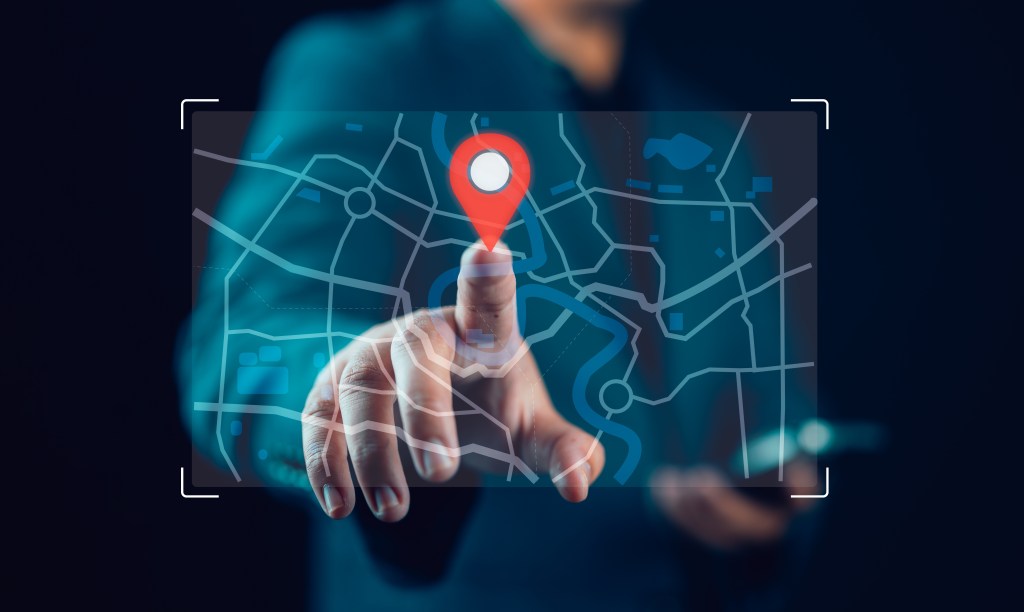
Businessman finger pin for location points and search addresses on the world map application. Marking destination for travel or finding business places in GPS Satellite coordinates system online web | GPS uses relativity for accuracy
Stock Photo ID: 2502019165 by mayam_studio

Did you use Einstein’s Theories of Relativity to get to the grocery store today?

The theories of relativity may seem strange and impractical, something you only use for astrophysics, black holes, cosmology and extreme velocities. They feature strange concepts such as time dilation, the stretching and bending of space, events simultaneous to some are not to others, the universal constancy of the speed of light in vacuum, the energy and mass equivalency, etc. 

Therefore, it is a bit surprising that without the theories of relativity the GPS app on your phone would not be able to guide you to the grocery store. That’s why I call it a super fact that GPS uses relativity for accuracy.
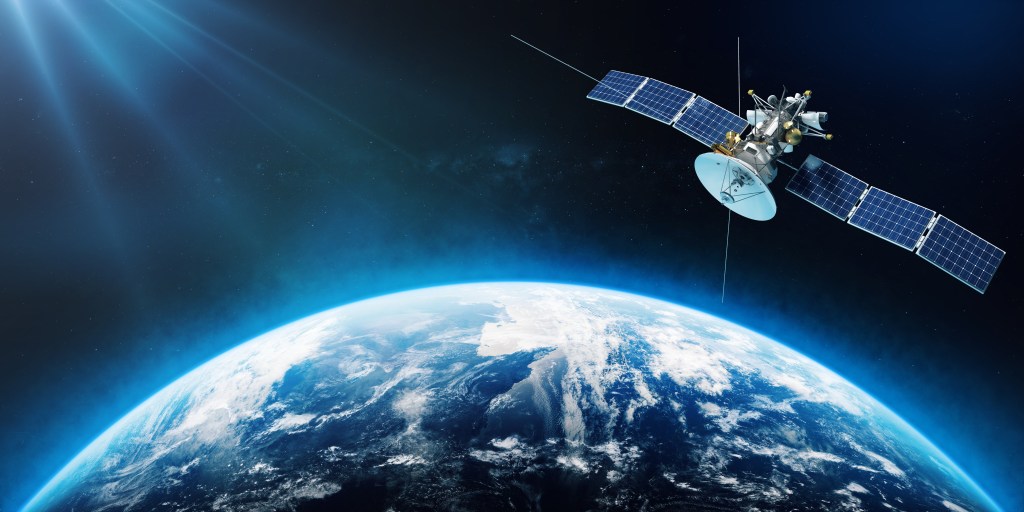
Space satellite orbiting the Earth. 3D rendering
Stock Illustration ID: 1372134458 by Boris Rabtsevich

GPS and Time Dilation

GPS is a satellite-based  radio navigation system that provides location information and time anywhere on Earth. It is amazingly accurate. The basic GPS service provides users with approximately 7.0-meter accuracy, 95% of the time, anywhere on or near the surface of the earth.

The fact that the information is provided by satellites that orbit earth at high speeds and high above earth’s surface makes General Relativity and Special Relativity necessary. The GPS system needs to calculate precisely the time it takes for signals to travel from the satellites to a receiver on Earth for it to work. GPS satellites travel at high speeds causing a large enough time dilation that must be accounted for. In addition, they orbit earth high above earth’s surface where earth’s gravitational field is weaker than on earth’s surface. Clocks run faster in weaker gravitational fields due to gravitational time dilation, so you must correct that as well.

If you ignore relativity, you will accumulate a discrepancy of six miles in one day.  You are not going to find the grocery store that way, unless you use the old-fashioned method of reading a map. In a sense, if your GPS device finds the grocery store for you, you have proven Einstein right.

Below is a YouTube video animation visualizing the GPS system.


GPS Facts

  • The GPS project was started by the U.S. Department of Defense in 1973. It is also owned by the U.S. Department of Defense.
  • The GPS satellites were sent up by the United States Air Force (and not NASA).
  • The first NAVSTAR satellite, later called GPS, was launched in 1978.
  • There are 31 GPS satellites currently in orbit.
  • The system requires 24 GPS satellites.
  • The 24-satellite system became fully operational in 1993.
  • The Global Positioning System cost (the US government) $1.8 billion annually to operate and maintain.
  • The Global Positioning System is free to use for the public worldwide.
  • Making GPS free to civilians worldwide was a decision by President Ronald Reagan in 1983 after a Korean airliner was shot down for straying off course.
  • GPS satellites carry extremely accurate atomic clocks. As explained, GPS must account for relativity, special relativity as well as General Relativity.
  • Other satellite systems help improve GPS, including WAAS (in the U.S.), EGNOS (in Europe), and MSAS (in Japan).
  • GPS is not the only satellite navigation system. Other countries have their own satellite navigation systems. GLONASS (Russia), Galileo (EU), and BeiDou (China).
  • Ukraine is helped by both GPS and Galileo.
  • Russian forces have been actively jamming GPS signals in Ukraine.

Uses of GPS

  • Examples of consumer electronics that use GPS are smart phones, tablets, Smartwatches, Car navigation systems, Cameras (DSLR with GPS), some models of laptops, fitness trackers (Fitbit), and drones.
  • Examples of vehicles using GPS are cars, delivery vans, trucks, aircraft, trains, ships and boats.
  • Military uses of GPS include guided missiles, guided munitions, tactical radios, communication systems, soldier-worn devices for location tracking, military vehicles and military aircraft.
  • Additional examples of GPS use include construction equipment for site positioning and machine guidance,  tractors for precision farming and other agricultural machinery, surveying equipment, pipeline inspection drones, other inspection drones and rovers, emergency locator beacons, pet trackers, smart collars, livestock monitoring, personal trackers, and geocaching devices.

As you can see, GPS is extremely useful, and there are a lot of interesting facts about GPS.


To see the other Super Facts click here

Astronomer

Daily writing prompt
What alternative career paths have you considered or are interested in?

So I am trying out the Daily writing prompt for the first time, answering the question “What alternative career paths have you considered or are interested in?”.

I’ve always been interested in astronomy and astrophysics, and I studied engineering physics, later electrical engineering. I did not think astronomer or astrophysicist was an easily attainable career and perhaps not very well paid either, but I think it would have been a fun job to have.

Astronomer
Photo by Lucas Pezeta on Pexels.com

Celestron Powerseeker 70EQ

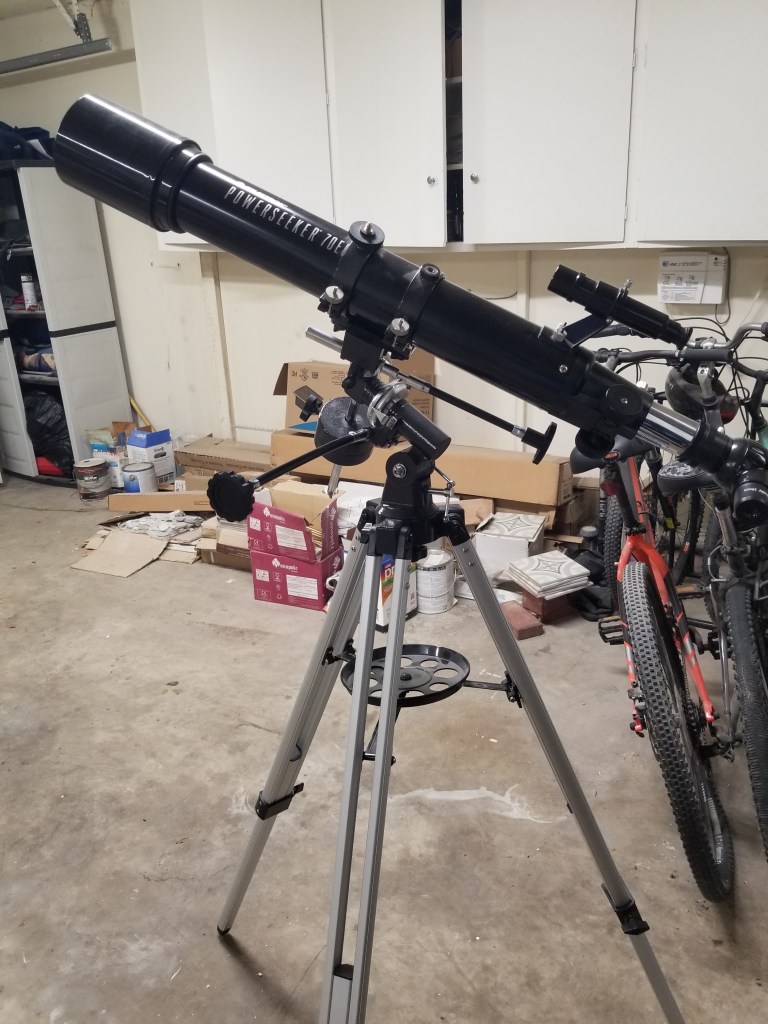
I am a bit of an amateur astronomer, and I own a basic telescope for amateurs, a Celestron Powerseeker 70EQ. It is not a great telescope, but it is good enough for observing objects such as Saturn and its rings, Jupiter and its four Galilean moons, Mars, Venus (the crescent), the moon and its craters. Those objects you can see from inside a big city like Dallas. Naturally you can do much better if you leave the city and especially if you visit a dark spot. I am a member of TAS, Texas Astronomical Society and they own a dark spot in Oklahoma. Below is a photo of my Celestron Powerseeker 70EQ standing in my garage.

Black Telescope standing in front of bicycles in a garage
Celestron Powerseeker 70EQ

What Does an Astronomer Do?

Astronomers study the universe, including galaxies, stars, planets, and other celestial objects, using telescopes and other instruments to observe and analyze them. They observe and analyze celestial objects. Depending on their specific area, astronomers have different duties.

  • They observe celestial objects using telescopes.
  • They conduct research, analyze data and test hypothesis.
  • They use and develop models including complex mathematical models and computer simulations to understand complex astrophysical phenomena.
  • They collaborate with peers, they teach, and they do mentoring and public outreach.

Types of Astronomers

  • Observational Astronomers use telescopes and other observational instruments to collect data from celestial objects.
  • Theoretical Astrophysicists use mathematical models and computer simulations to understand the physical processes in the universe. They may study stellar evolution, galaxy formation, cosmology, and black holes.
  • Planetary Scientists study planets, moons, and other objects within our solar system. They use data collected by space missions, telescopes, and remote sensing techniques.
  • Stellar Astronomers study stars, their properties, and their life cycles. They may study variable stars, binary star systems, massive stars, stellar remnants such as white dwarfs, neutron stars, or black holes.
  • Galaxies and Cosmology researchers study galaxies and the large-scale structures in the universe.
  • Radio Astronomers study celestial objects using radio waves instead of visible light. They may study radio galaxies, cosmic microwave background radiation, and the structure of the Milky Way.
  • Exoplanet Astronomers study and discover planets orbiting stars outside our solar system. They use techniques such as transit photometry and radial velocity measurements to detect and characterize exoplanets.

Famous Astronomers

  • Nicolaus Copernicus 1473–1543, discovered the heliocentric model putting the sun at the center of our solar system.
  • Johannes Kepler 1571–1630, revolutionized our understanding of how planets orbit the Sun. He used the Copernicus heliocentric model and very careful measurements to show that the planets moved in elliptical orbits around the sun and he came with additional laws to describe the speed of the planets in their orbits.
  • Galileo Galilei, 1564–1642, or Galileo di Vincenzo Bonaiuti de’ Galilei, was an Italian astronomer, physicist and engineer who greatly improved the optical telescope and discovered the four primary moons of Jupiter and the rings of Jupiter. He proved that all falling bodies fall at the same rate, regardless of mass, and developed the first pendulum clock. He got in trouble for defending Nikolai Copernicus idea.
  • Edmund Halley, 1656–1742,  investigated and discovered many things including the nature of comets’ orbits.
  • Edwin Powell Hubble, United States, 1889–1953. Hubble proved that many objects previously thought to be clouds of dust and gas and classified as “nebulae” were galaxies beyond the Milky Way. He showed that these galaxies were moving away from us and each other leading to the conclusion that the universe was expanding.
  • Vera Rubin, 1928–2016,  studied the rotation of galaxies and uncovered the discrepancy between the predicted and observed angular motion. This led to the discovery of dark matter.

What about you? What alternative career paths have you considered or are interested in?


To see the Super Facts click here


Super Facts on Facebook

I created a Facebook page for my super facts or Superfactful blog. The purpose of this post is partially to test if my posts here are showing up on my super fact Facebook page, but it is also to invite you all to follow my Superfactful Facebook page if you wish, or my Leonberger book Facebook page, or send me a friend request to my personal Facebook. I am putting the links to all three below.

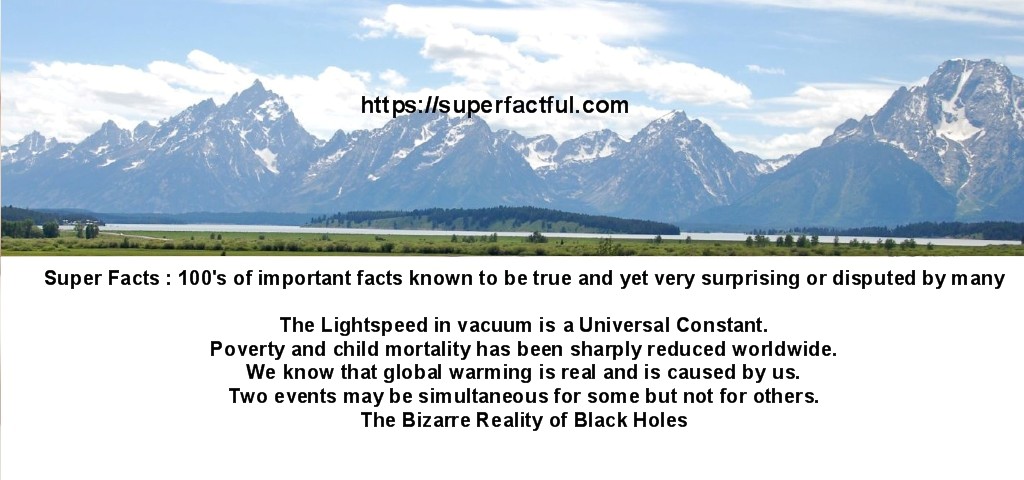
The top of the photo feature the Grand Teton Mountains. The bottom has examples of super facts | Super Facts on Facebook
Cover photo for my new Facebook page. Click on the photo to visit my new Facebook page.

Note: I just checked and it is showing up on my new Facebook page


To see the Super Facts click here


Blog Note Opinions Welcome

This post is not another super fact but a blog note about the blog and a request for opinions. My most recent post included three super facts combined into one post. The three super facts were:

  • There has been a steep decline in extreme poverty
  • There has been a steep decline in child mortality
  • War and violence have declined

The post became very long. It had more than 2,000 words and several graphs filled with additional text and data. In addition, I rushed the third super fact. The discussion of the third super fact was muddy, incomplete, and it lacked references. Therefore, I deleted the third super fact. I think that was the right thing to do, especially since I had planned a separate super fact entry for it anyway with the title “We are living in relatively peaceful times”. I will write that post for it soon.

The updated post featuring only the two first super facts is called: “Poverty and child mortality has been sharply reduced worldwide”.

However, I’ve realized that some of my other posts have problems as well. The second half of the post titled “Two events may be simultaneous for some but not for others”  feature equations and complex reasoning that physics nerds may appreciate but not typical readers. I don’t think I need to delete that section but, in the future, I need separate such sections from the rest and make it clear that I don’t expect readers to read that, well unless they are physics or math nerds, etc.

Image showing a disintegrating brain | blog note
Expand your mind. Smash your old beliefs with new surprising facts, so called super facts. But there’s no need to confuse or bore your mind. Shutterstock ID: 1685660680 by MattL_Images

So, I am wondering what you all think about this and if you have suggestions or opinions on how I can improve my super fact posts. Blog notes are very much welcome.


To see the Super Facts click here