
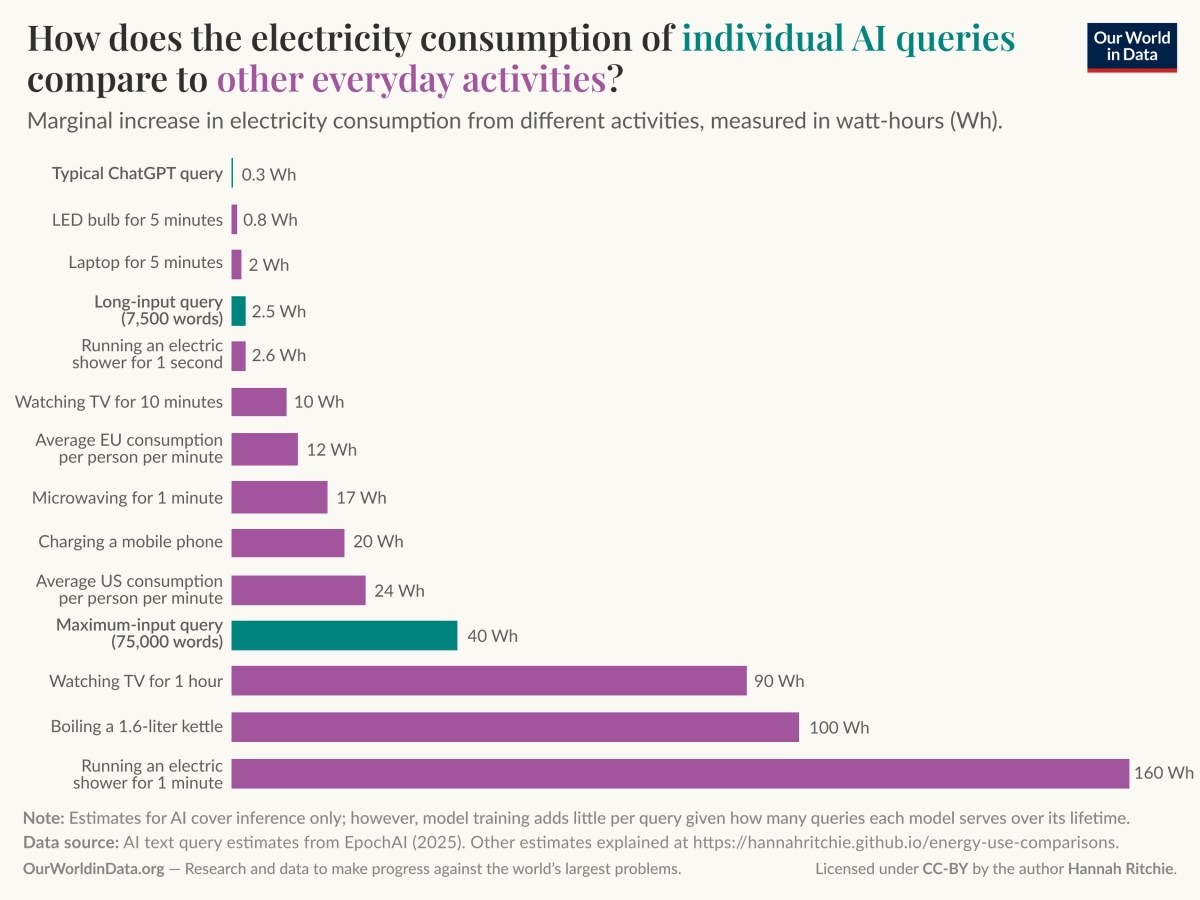
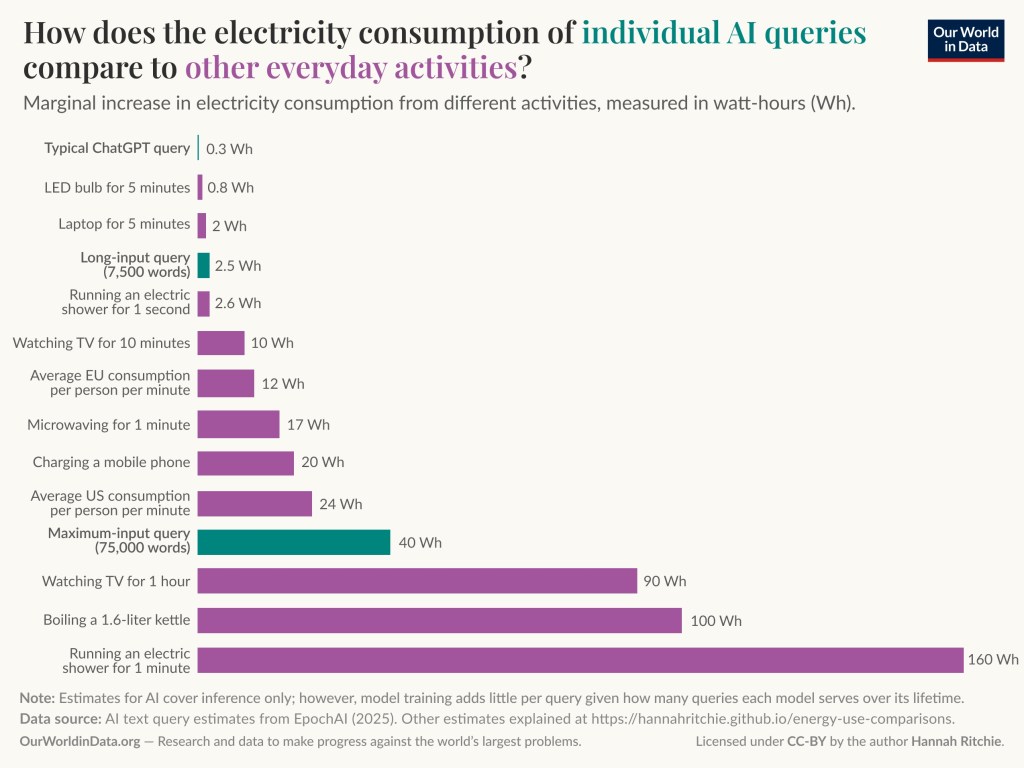
Super fact 138 : A typical AI Query uses less energy than using a laptop for one minute. A typical AI Query uses between a few drops of water to half a bottle of water at worst. Data centers in the United States use roughly 0.2% of total U.S. freshwater when combining direct facility cooling and indirect water used for electricity generation. A ten minute shower uses more energy than 5,000 typical AI Queries.
According to the Manhattan institute, NVIDIA, Google and this article the data centers in the United States use roughly 0.2% of total U.S. freshwater when combining direct facility cooling and indirect water used for electricity generation. Most fresh water used in the US is for irrigation / agriculture and the second largest consumer of fresh water is thermoelectric plants (coal, natural gas, nuclear). Worldwide 70% of freshwater used is used by agriculture and industry is another big user. According to this article Google says that a typical AI query uses five drops of water, and half a bottle of water at the worst. You can read more about water usage here, here, here, and here.
Around half of all energy used by data centers is thermoelectric. Most of the freshwater usage that is part of the 0.2% number is due to the thermoelectric powerplants supplying the energy to data centers. However, it should be noted that as clean energy is increasingly adopted this number will decline. On the other hand, the manufacturing of computer chips, which also use a lot of freshwater, is not taken into account in this number because it is a onetime event that is difficult to account for. It might double or even triple the 0.2% number, which is still very little.
It should be noted that there are a lot of valid concerns about AI and datacenters, but to reduce carbon emissions and pollution and to waste less freshwater, it might be more effective to eat less beef, irrigate your lawn less, take shorter showers, drive an EV or a hybrid instead of a gas guzzling SUV with an internal combustion engine, or perhaps use public transportation. You’d start with the low hanging fruit. In fact, if the AI query you are about to make saves you some time on your laptop, then the AI query probably helps the environment.
Datacenters use less freshwater than many of us would expect, and typical AI queries use almost no energy and correspond to very little use of freshwater. I think this comes as a surprise to many considering the ongoing datacenter panic. It is therefore a super fact.
Datacenters and Energy Usage
Datacenters use a significant amount of energy but perhaps not as much as one would think. However, their energy use is increasing, and they are part of our rising energy demand. With a growing population, a growing economy, cryptocurrencies, AI, datacenters, electrification, we are going to need a growing supply of electricity and an expanding grid. Hopefully our energy sources will be mostly clean energy, which luckily seems to be the trend. See “The Unfolding Clean Energy Revolution”.
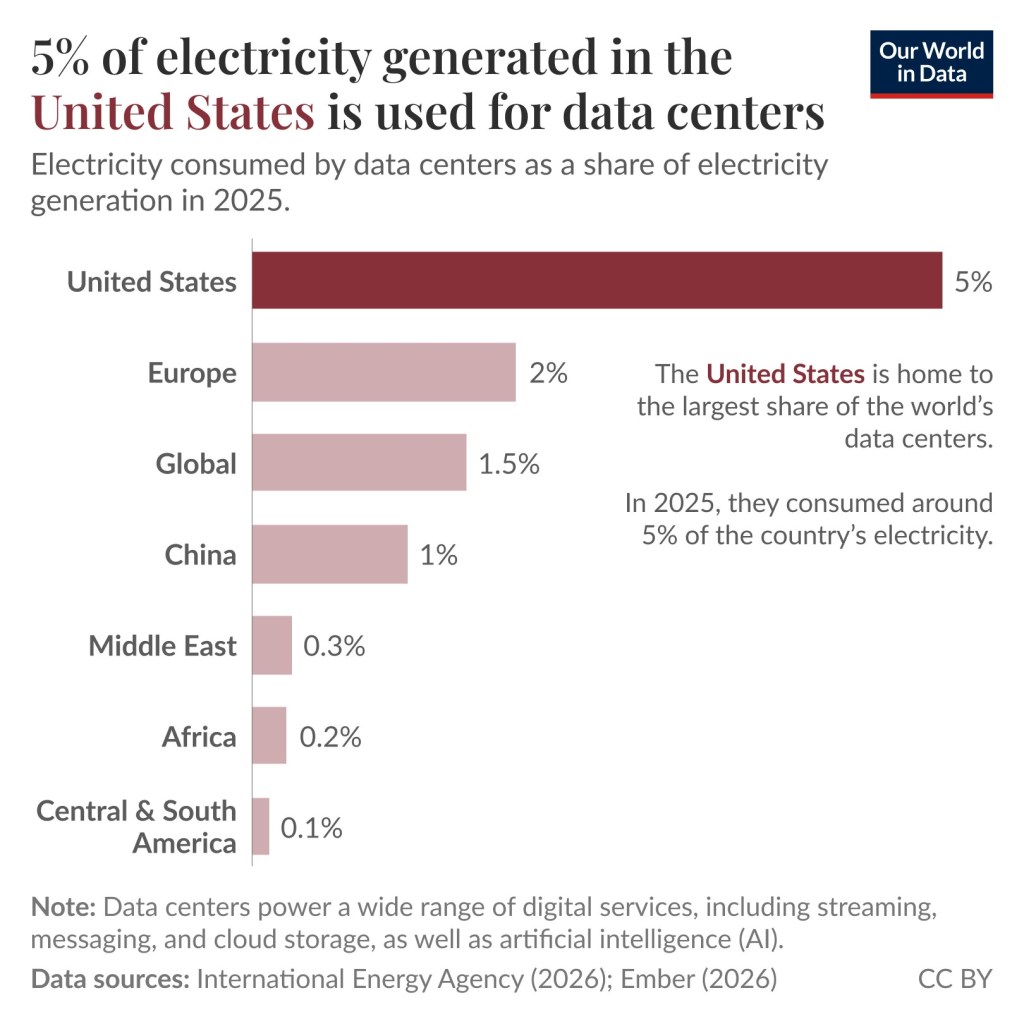
The United States is the country with the most datacenters and as can be seen in the graph below, the datacenters in the United States use a relatively large portion of its available electricity for datacenters and it is increasing.
The Growing Energy Use by Datacenters
The three graphs below are from this page and this page. Note the projected increase in electricity use for data centers. Note that by visiting these pages you play around with the graphs and changed regions and countries and other settings to generate your own graphs.
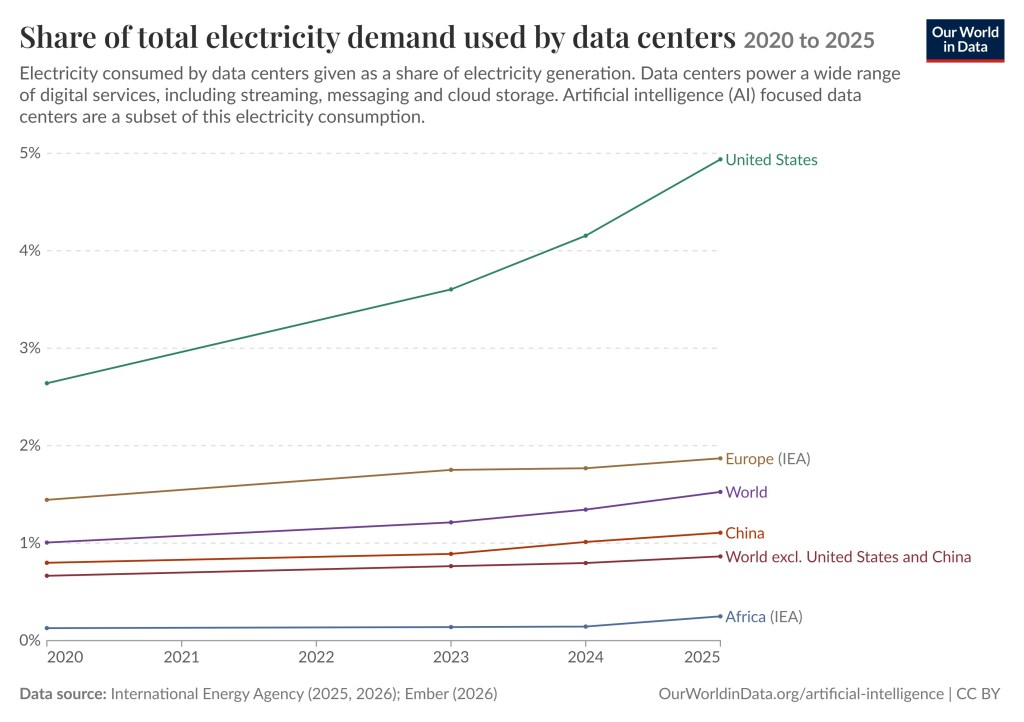
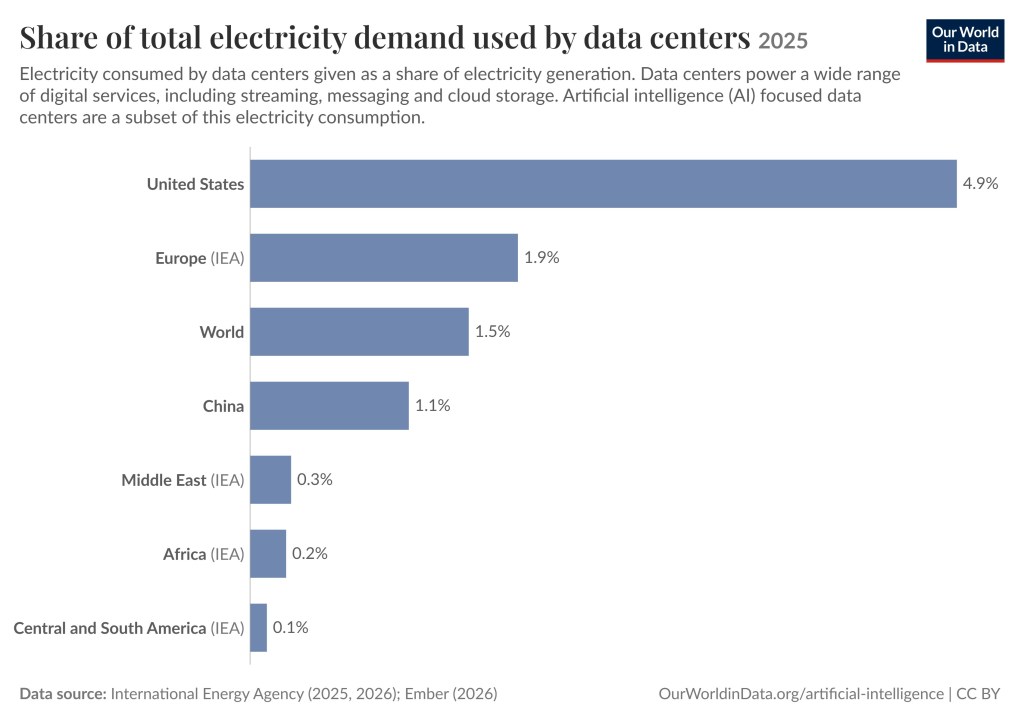
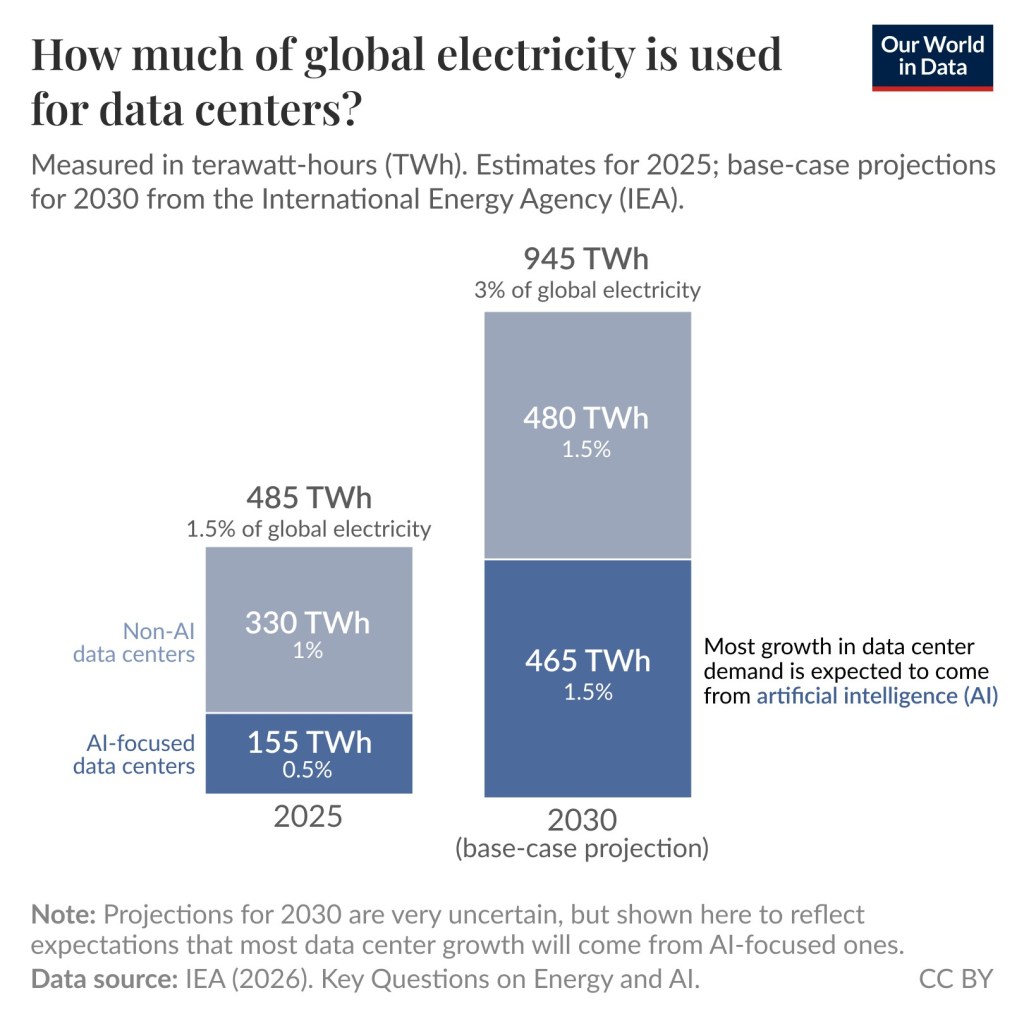
As you can see in the graphs above, there is a significant portion, but not a large portion, of electricity usage by data centers. However, it is important to note that only a portion of this is for Artificial Intelligence. It will grow though. You can read more about this issue here, and here, or here.
Fresh Water Usage in the United States
The graphics below showing the source and use of freshwater in the United States is in the public domain and is taken from this article.
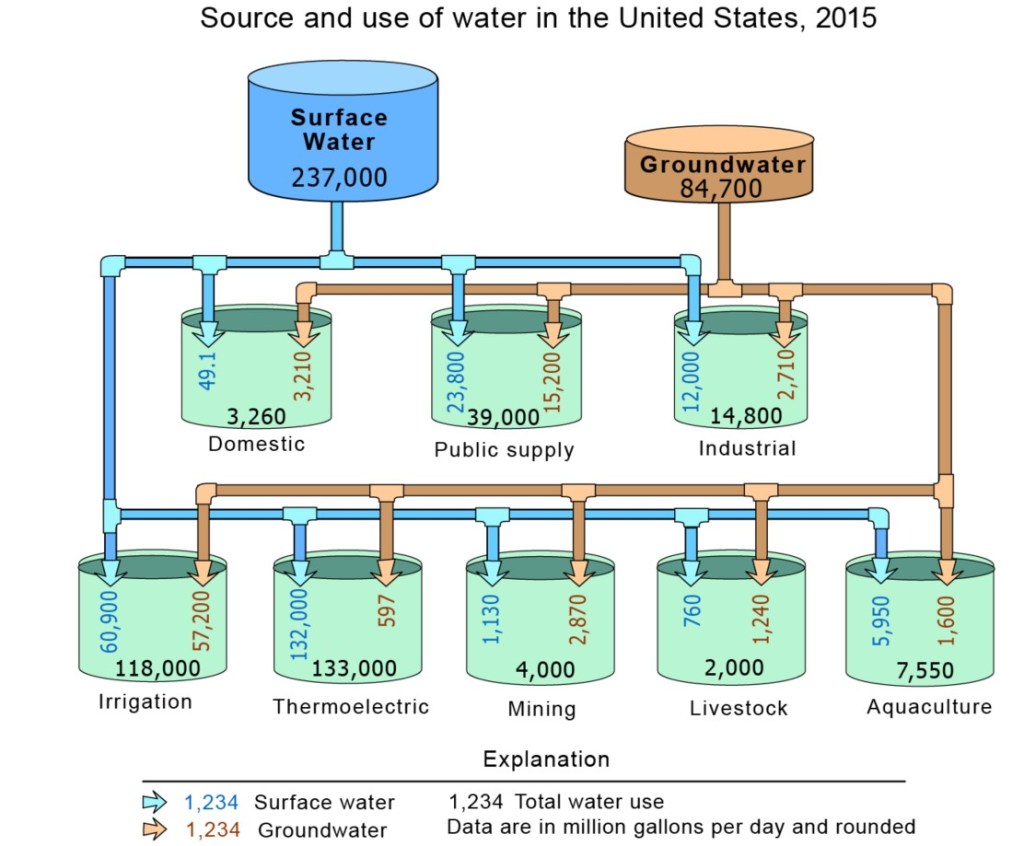
In the diagram above, the top row of cylinders represents where America’s freshwater came from (source) in 2015, either from surface water (blue) or from groundwater (brown). You can see most of the water we use came from surface-water sources, such as rivers and lakes. About 26 percent of water used came from groundwater. The pipes leading out of the surface-water and groundwater cylinders on the top row and flowing into the bottom rows of cylinders (green) show the categories of water use where the water was sent after being withdrawn from a river, lake, reservoir, or well.
For example, the blue pipe coming out of the surface-water cylinder and entering the public supply cylinder shows that 23,800 Mgal/d of water was withdrawn from surface-water sources for public-supply uses (you probably get your water this way). Likewise, the brown pipe shows that public-suppliers withdrew another 15,200 Mgal/d of water from groundwater sources. Each green cylinder represents a category of water use. The industrial cylinder, for instance, shows how much groundwater, surface water, and total water was used inthe United States, each day, by industries.
Other Super Facts Related to Artificial Intelligence
- The Nobel Prize in Physics and Neural Networks
- Artificial Intelligence is Not New
- Large Language Models is just One Branch of Artificial Intelligence
- The Dark Side of Artificial Intelligence
- Transistors per Microchip Increased by More than 50 million Times in 50 Years
- AI is Already More Capable Than Humans in Many Areas
To see the other Super Facts click here


Fascinating how EU per person electricity consumption is half the US one!
LikeLiked by 2 people
Yes I should clarify that if you referring to graphs under “Datacenters and Energy Usage” that is for the data centers only not the individual electricity use. The US has a lot of data centers.
LikeLiked by 2 people
Such an interesting post and surprising conclusions. Totally new to me, and I thank you, Thomas, for this timely and comprehensive update. Much enjoyed! Light and blessings to you, my friend, today and always!🙏✨🍀
LikeLiked by 2 people
Thank you so much Susana. There are a lot of valid concerns about AI but a regular typical AI query has a very miniscule impact on the environment and is nothing to worry about (at least for that reason). Light and blessings to you too, my friend.
LikeLiked by 1 person
That was really interesting, Thomas.
LikeLiked by 2 people
Thank you so much Chris
LikeLiked by 1 person
Very cool. Isn’t it odd how the topic goes south and all the crazy information that gets out there with the doom and gloom. One thing I have thought about for some time, not just AI-related, is that politicians decide policy and law on things they know nothing about. Oddly, last week I saw a story where they asked several congressmen what they knew about AI, specifically basic LLMs, and they were honest; at least they said they knew nothing. The tech is not the issue; it is the people building it and the people trying to legislate it.
LikeLiked by 1 person
Yes there are a lot of concern about AI queries for environmental reasons. They even cancelled using AI in a college class my daughter is taking because of pressure from the students stating that using AI is very bad for the environment. As it turns out a regular typical AI query has a very miniscule impact on the environment and is nothing to worry about (at least for that reason). However, there are valid concerns about AI as well as data centers but we’ve got to know what is a problems and what is not a problem.
LikeLiked by 1 person
Interesting Thomas and opposite to what I’m reading and hearing on the news. Water usage is one of the biggest reasons people here are giving for not wanting the data centres in their communities. Maggie
LikeLiked by 2 people
Yes because of pressure from the students stating that using AI is very bad for the environment the professor in one of my daughter’s classes at college cancelled all assignments requiring AI queries. However, a regular typical AI query has a very miniscule impact on the environment and is nothing to worry about (at least not for that reason). The same students who were upset about AI queries are using their mobile phones daily and charging them, which uses a times more energy and water than a AI query will.
LikeLiked by 2 people
I think the problem results from the sheer volume of AI enquiries which globally are absolutely massive. Individually they may not use much but when taken together they are having a huge, unsustainable impact. Adding considerably to the issue is the fact that much AI use is frivolous. I agree with your daughter’s professor, Thomas. Personally, I refuse to store data in the cloud since “the cloud” is actually a data centre. Here’s a piece about the impact from MIT:
https://news.mit.edu/2025/explained-generative-ai-environmental-impact-0117
LikeLiked by 1 person
Thank you Lynette. You are right that the sheer volume of AI queries add up, and thank you for the link. However, there are a few things to account for. Counting all messaging, AI, streaming, cloud storage, other services, and all individuals and all businesses, the total data center water usage is still only 0.2% in the United States, and that includes cooling (which is very little), and water usage by the thermoelectric plants providing part of the electricity. Data centers use 5% of US electricity (1.5% globally), which correspond to between 0.5% to 2% of all US carbon emissions and other pollutants. Then consider that AI takes a third of the electricity that data centers use, and that in terms of processing 13.3% of that is personal use (most is business). Even if you add it all up the environmental impact is not very big. It is significant but not big.
I can add that the article you gave me does not contradict anything I said here. They are concerned about the energy, the additional electricity and associated carbon emissions, and so am I. However, they are not providing comparisons with other emissions sources (in percentage or otherwise).
LikeLiked by 1 person
Thanks very much, Thomas. I appreciate your comments. Most of what I’m reading indicates that data centres and their heat and effluent output is environmentally unsound and unsustainable, however.
Here are a couple of other articles I’ve read lately, one Canadian and one American. https://canadians.org/analysis/a-moratorium-on-ai-data-centres/
https://environment.yale.edu/news/article/data-centers-urban-heat-and-ai-growth
LikeLiked by 1 person
Thank you again for your articles Lynette. Your second article brought up waste heat, which I had not considered. However, as the article in your previous comment, these articles are not making overall / global comparisons and are focused on local effects and comparisons with university buildings or small cities. In addition, with respect to climate, waste heat is not a major contributor. It is difficult to get a perspective of the overall global impact this way. According to this science article, globally, data centers generate an estimated 70 to 170 terawatt-hours (TWh) of waste heat per year. Global warming adds between 2.3 million to 5.8 million Terawatt-hours (TWh) of excess heat to Earth every year. You can calculate that from this article (NASA, NOAA, WMO) and Earth’s surface and number of hours in a year. Double check with AI (or the other way around). Basically, our overall emissions are causing Earth to heat between 15,000 to 80,000 times as much the waste heat from data centers does. My point is that we drive cars, heat or cool our houses, take showers, eat beef, which cause environmental impacts that are close to hundreds of times larger than the impacts from data centers. So how much should we worry about the environmental impact from data centers? I think we should worry but maybe not as is common to believe.
LikeLiked by 1 person
Thanks very much for your detailed reply. I appreciate it. I think that we have to think of all these sources of environmental degradation as a combined force as nature reacts to them that way. I believe that the attempted proliferation of data centres is another serious contributor to that force and the pushback on these centres is completely justified. We don’t need them in any way at all; they’re driven by the greed of huge corporations and companies.
LikeLiked by 1 person
This post was about that AI (and data centers) are not as bad for the environment as many think. It was not a pro-AI or pro-datacenter post. However, you are right Lynette. It all adds up. And you mention another issue, whether we need them or not. That is a very interesting question. AI carry a lot of risks (not necessarily environmental) that are under appreciated amongst the public. We could have nasty surprises. But that might be another post.
LikeLiked by 1 person
Agreed. Definitely getting into another post!
LikeLiked by 1 person
Hi Thomas, I could not post a comment directly on your site. I could only leave a comment through the Reader 🤦♀️. An interesting post and well researched, as always. The issue always boils down to over population – the elephant in the room 🐘
LikeLiked by 1 person
Thank you so much Robbie. You are right. I am also having problems posting comments on people’s posts. I complained on one of your posts that I could not post on LatinoUSA. It turns out I struggle with everyone’s websites, more or less. At the minimum I have to log in on every comment despite being logged in. At worst I can’t comment at all. This started yesterday. I don’t know what is going on.
LikeLike
It is a recent thing and it’s happened to me on and off for the 10 years I’ve blogged. I usually use either Jetpack or the reader to comment now.
LikeLiked by 1 person
OK I have to look into that
LikeLike
💛
LikeLiked by 1 person
One AI query may not use much energy, but who stops at one? Added up, they’re not insignificant. And I hope we don’t become collectively lazy and stop using our brains. It’s analogous to walking and using public transit instead of driving.
LikeLiked by 3 people
You are right Audrey. There are many valid and significant concerns about AI and data centers and there are billions of AI queries every day. However, if you add it all up AI queries are still not a major environmental concern and we’ve already been extensively using data centers for non-AI things such as online storage, communication, search engines, etc. AI is just a smaller part of data centers. I agree that us collectively becoming lazy and stop using our brains would be very bad.
LikeLiked by 2 people
Always so much to think about – you always do a great job of presenting the several sides of each argument!!
LikeLiked by 1 person
Thank you so much for your kind words Linda
LikeLike
A lot of surprising data on data centers. I wonder if it’s the seemingly sudden and drastic increase in those huge buildings that scare me (along with the fear of AI taking over.) The graphs suggest I need to turn the TV off more. And then there’s the energy used in blogging…. Sigh. We can definitely be responsible and make our energy use count rather than being random or excessive in out use of these technologies. (I’m talking to myself here.)
LikeLiked by 1 person
I think there are a lot of valid concerns about AI and data centers. The leading AI scientists are warning us about the dangers and they know what they are talking about. However, the environmental impacts of AI, and even data centeres in general, are much smaller than people seem to think. So, while we should worry about AI and the growing use of data centers we shouldn’t feel bad for the environment when we make a typical average person AI Query. It does not do much harm. I guess that is what I tried to say. However, wasteful use of AI is not good. But then we do a lot of wasteful google searches, facebook scrolling and social media ineractions, which uses even more data center resources than AI does.
LikeLiked by 1 person
Good point about scrolling. I have occasionally gotten caught up in Youtube scrolling. It’s designed to suck people in.
LikeLiked by 1 person
Yes you are right. The same here.
LikeLike
Java Bean: “Ayyy, and our Dada definitely takes showers that are longer than ten minutes! Maybe he can atone for his use of AI but speeding things up in there!”
LikeLiked by 1 person
Ha ha Java Bean, yes easily. One minute less in shower would allow him hundreds of AI Queries.
LikeLike
Thanks for explaining this Thomas. But I question – an AI query uses five drops of water, and half a bottle of water at the worst. It makes me think that if all the world queried AI, daily, it would have to start affecting somewhere?
LikeLike
Yes you are right Debby. It all adds up. There are billions of AI queries every day. However, even so, all AI Queries in the US uses about 1% of all electricity and 0.2% of the freshwater, and only 13% of that is private individuals. We also don’t complain much about cloud storage, phone messages, etc., which take up a lot of data center resources. It is just the perspective that AI Queries may not be the big environmental crook we commonly think.
LikeLike