
Superfact 120: The amount of wealth owned by the billionaires is roughly double as much as the poorest half of the world’s population. The amount of wealth owned by the 12 richest billionaires is more than the wealth of the poorest 50% of the world’s population. The richest 1% of the global population owns approximately 38% to 45% of the world’s total wealth.
Esther’s writing prompt: July 15th : Rich
Click here or here to join in.
There are at the moment of this writing 3,428 dollar billionaires in the world worth 20.1 trillion dollars together. For comparison the poorest 50% of the world’s population holds between $9 trillion to $12 trillion dollars of wealth (about half). According to this report the amount of wealth owned by the poorest half of the world is less than the amount owned by just the 12 richest billionaires. By the time you read this the numbers have probably changed (likely upwards). You can also read more in Wikipedia.
I am specifying that it is in dollars and not let’s say in the Iranian Rial. With respect to the Iranian Rial, I am also a billionaire, and you are probably too (if you own a phone or computer). One dollar can buy roughly 1,300,000 to 1,600,000 IRR. You just need $700 to be a billionaire in the Iranian Rial.

I should say that initially I was just going to list interesting statistics about the super-rich. However, I found myself surprised by the statistics, and I am sure I am not the only one. Therefore, I picked a couple of facts I decided super facts.
The ten richest billionaires in the World
The numbers below are from Forbes Magazine. To see a list of all billionaires in the world, click here. To see a list with numbers that are updated minute by minute, click here.
- Elon Musk – 839 billion dollars – source Tesla, SpaceX
- Larry Page – 257 billion dollars – source Google
- Sergey Brin – 237 billion dollars – source Google
- Jeff Bezos – 224 billion dollars – source Amazon
- Mark Zuckerberg – 222 billion dollars – source Facebook
- Larry Ellison – 190 billion dollars – source Oracle
- Bernard Arnault & family – 171 billion dollars – source LVMH
- Jensen Huang – 154 billion dollars – semiconductors
- Warren Buffet – 149 billion dollars – source Berkshire Hathaway
- Amancio Ortega – 148 billion dollars – source Zara
Wealth share of the richest 1%
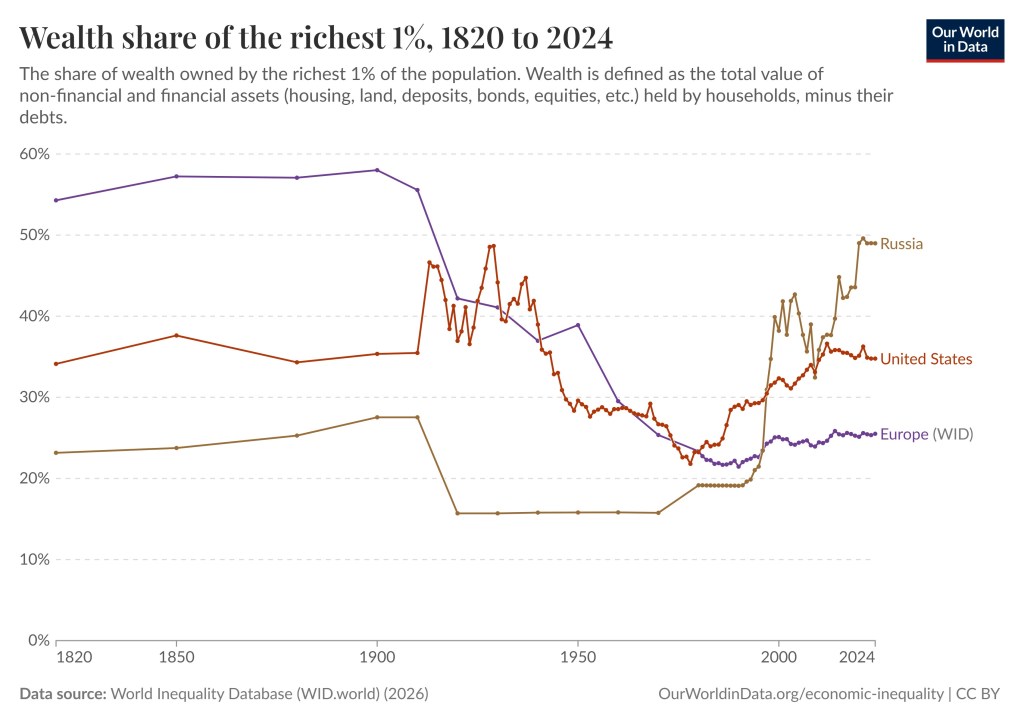
The richest 1% of the global population owns approximately 38% to 45% of the world’s total wealth, which is more than what 95% of humanity own according to Oxfam. The richest 1% of the global population is not about billionaires, it may very well include you and me. Our World in Data has collected and analyzed the statistics for each country in the world. The top richest 1% in the United States own 34.78% of the wealth in the United States. The top richest 1% in Russia own 48.99% of the wealth in Russia. The top richest 1% in Sweden own 27.49% of the wealth in Sweden. The top richest 1% in the Netherlands own 13.98% of the wealth in the Netherlands. See the graphs below from Our World in Data.

As you can see from the graphs below the extreme inequality is nothing new. Europe was extremely unequal in the 19th century. The 1% owned 58.01% of the wealth in 1900. The United States was relatively equal in 1978 when the 1% owned 21.79% of the wealth. Russia became very unequal since 1995. I suggest that you play around with the graphs yourself .
ABBA’s Money, Money, Money
Note: This post is not an implicit suggestion that we should tax billionaires more or less, and not about how or whether we should solve inequality, and it is not about politics. It is just surprising statistics regarding wealth and the reality of inequality.
My Other Responses to Esther’s Prompts
- Prompt : Small : Small Microscopic Subatomic and Strings
- Prompt : Kind : Leonbergers Are Kind Dogs
- Prompt : Window : What Does Rollo See Out His Window
- Prompt : Charge : Electric Charge is not the only type of Fundamental Charge
- Prompt : Promises : Promises To My Dog
- Prompt : Shade : A Total Solar Eclipse the Ultimate Moon Shade
- Prompt : Money : Ten Money Facts
- Prompt : Edge : The Edge of the Observable Universe is 46.5 billion Light Years Away
- Prompt : Fish : Ten Amazing Fish Facts
- Prompt : Promise : I Promise Not to Post AI Generated Comments
- Prompt : Respect : Respect your Dog
- Prompt : Giving : Leonbergers Giving Gifts to Pugs
- Prompt : Family : Dogs Are Family
- Prompt : Snow : Snow and Ice in Norrland
- Prompt : Red : The Universe has a Redshift and its Increasing
- Prompt: Shapes : Conic Sections are the Shapes that Shape Our World
- Prompt: Flying : 10 Wind Blowing Facts About Birds
- Prompt: Drive : Letting Your Dog Drive the Car
- Prompt: Memories: False Memories Strange Memories Unpleasant Memories and Amnesia
- Prompt: Magic: Magic In New Orleans a Travel Overview
- Prompt: Vision: Human Vision Only Detects a Sliver of the EM Spectrum
- Prompt: Flower: Leonberger Dogs with Flowers
- Prompt: Capture: Carbon Capture and Storage an Unfulfilled Promise
- Prompt: Eyes: The Evolution of Eyes is Convergent
- Prompt: Pet: The Joy of Having a Pet
- Prompt: Cross: Why did the Dog Cross the Road
- Prompt: Close: Close Encounter with Grizzly Bear Number 399
- Prompt: Block: 60 million Lego Blocks
- Prompt: Bank: The Riverbank of Moälven
To see the Other Super Facts click here


Stunning, Thomas. I did not know of this extreme wealth. My goodness, I hope they are using this gift for the good of mankind. Blessing to you….
LikeLiked by 3 people
Thank you Gwen. Yes I hope so too and blessings to you too.
LikeLiked by 1 person
I think many of these super rich people do a lot to give to those who are less fortunate. Also, they provide a lot of jobs associated with their businesses, so we shouldn’t be in a hurry to tear them down just because they have had the smarts and good fortune to make a lot of money.
LikeLiked by 3 people
I agree with you Anneli. A good example is Bill Gates who have given billions to the less fortunate around the world.
LikeLiked by 3 people
Those statistics are a bit staggering, and I also hope billonaires are using their money for good. You cited Bill Gates as an example of one who does. There is a perception that many rich people get away without paying taxes, using all kinds of loop holes. I do think they should pay their fair share, proportionate to their income. Here’s another money song that was popular at one time:
LikeLiked by 2 people
I agree Debbie, billionaires is a mixed bag. Some are helpful and honest, pay their fair share of taxes and help other, while others are not. I remember this song but it was a long time since I heard it.
LikeLiked by 1 person
Why not tax them? They can afford it! This is the end result of the flawed capitalist model – everyone can aim to be rich, but not everyone can have a bite of the top cherries. The relentless drive to increase productivity at all costs as well as business models’ greed eliminates healthy competition.
LikeLiked by 1 person
You might be right. I have to look into that more.
LikeLiked by 1 person
These are fascinating facts – it’s interesting to delve into it further as you have. Thank you for your insight.
LikeLiked by 1 person
Thank you so much for holding these fun prompt wrte-offs, Esther
LikeLiked by 1 person
Startling facts. They could help a lot of people with that money, and I know some do, but not all, or probably most. Maggie
LikeLiked by 1 person
You might be right. Thank you so much Maggie.
LikeLike
When I read this information all together like this I do wonder why so much wealth is attributed to companies that contribute nothing needed for the survival of mankind. For want of a better expression, these businesses are so irrelevant at the end of the day.
LikeLiked by 1 person
Yes, you are right, but I think people spend a lot of money on technology and in combination with the fact that you need innovation and specialized skilled labor makes so that fewer people can enter into the business. But it would be nice if we paid more attention to food businesses and health care.
LikeLiked by 1 person
Still, we should totally tax billionaires (and that one wannabe trillionaire) more, instead of shoveling yet more money at them via government policies that gut benefits and services for everyone else …
LikeLiked by 1 person
Yes, you might be right James.
LikeLike
Wow, that’s a lot of money. We could probably solve world hunger with half of that.
LikeLiked by 1 person
You might be right Edward, at least in the short run.
LikeLiked by 1 person
If implemented correctly (through training, jobs, childcare, etc) it could provide a long-term solution.
LikeLiked by 1 person
Yes you are right Edward
LikeLiked by 1 person
Charlee: “Just remember, no matter how rich these people get, they will never be cats. So their inferiority is baked in.”
Chaplin: “We would feel sorry for them, but … We’re cats.”
LikeLiked by 1 person
Charlee and Chaplin you are absolutely right. For what will it profit a man if he gains all the money in the world but he can’t be a cat?
LikeLiked by 1 person
A very thought-provoking post. These statistics really highlight how unequal wealth distribution has become. Thank you for presenting the facts so clearly and giving us something important to reflect on.
LikeLiked by 1 person
Thank you so much Anowar for your kind and supportive words.
LikeLiked by 2 people
It’s my pleasure 😊❤️
LikeLiked by 2 people
The Mister was just telling me some of these things the other day, but it is nice to see it all together here in black and white. The numbers are staggering.
LikeLiked by 3 people
I agree the numbers are staggering. This is one of those super facts I just discovered. Thank you so much Kymber.
LikeLiked by 3 people
The inequity of wealth distribution is truly astonishing whenever I run up against it. It’s hard for me to point to any one human being and say they are hundreds of billions of times more capable than any other human being. That noted, I have met three Nobel Laureates in physics — William Fowler, Subrahmanyan Chandrasekhar, and Saul Perlmutter — and while none of them were poverty stricken, their abilities and contributions to knowledge certainly didn’t propel them into the top tiers of wealth.
LikeLiked by 3 people
Wow you met William Fowler, Subrahmanyan Chandrasekhar, and Saul Perlmutter, that is very cool. I agree, positive externalities exist, and there are individuals who have contributed to the well being of humanity beyond what any billionaire have and yet they did not get very much paid for it, for example, Jonas Salk, Isaac Newton, Galileo, Albert Einstein and the individuals you mentioned. Positive externalities is especially a thing associated with scientists.
LikeLiked by 3 people
I’m sure it’s always been this way (from the pyramid-pharaohs onwards), but so much money in the hands of so few feels so wrong. Amazing, well researched post as always!
LikeLiked by 1 person
Thank you so much for your very kind words Linda
LikeLiked by 1 person
happy to be here!
LikeLiked by 1 person
That a super fact that is hard to fathom, isn’t it? There’s a limit to what they can use for themselves. They have the privilege of investing in other things. Some of them might be philanthropic, hospitals, help for the poor, housing. Some of it we know end up blowing up in thin air or landing on a dime after a nice trip into the sky. It might be an interesting study to see what this 1% does with their money, and how they came by it. The power of having it is choosing how to spend it. If we tax it at a different rate, first many would move it to another location to protect it. But the option is also that it sometimes gets corrupted by the greedy ones who are meant to help those who need it. These thought-provoking facts beg for more inquiry into them. 🙂 Great post, Thomas.
LikeLiked by 2 people
Thank you so much Marsha for your kind words. I just kept it surface level, the numbers, and I left the complicated stuff for reader, as an exercise, ha ha. Well you are certainly bringing up some interesting points for discussion.
LikeLiked by 1 person
You started it, Thomas! 🙂
LikeLiked by 1 person
Ha ha yes but I leave the difficult discussion for others
LikeLiked by 1 person
And I fell right into your trap! 🙂
LikeLiked by 1 person
Yes if you want to put it that way
LikeLiked by 1 person
That does sound conniving, which you weren’t. My brain is somewhat empty of vocabulary right now. You’ll just have to forgive it. I enjoyed the discussion! 🙂
LikeLiked by 1 person
Yes I wasn’t entirely serious but the thing is that I just posted the statistics, which I think is quite surprising, maybe even shocking, at least to me. However, how to interpret this economically and with respect to society, and what is fair and not, etc., is a much bigger and complicated question that I just don’t know enough about to say much about.
LikeLiked by 1 person
Nor do I, but it touched a nerve, obviously! LOL I’m glad you shared the stats, Thomas. And just as it is with our narrative writing, we can’t control where readers are going to take what we write.
LikeLike
Yes you are so right Marsha.
LikeLiked by 1 person
🙂
LikeLike
I knew most of this and it’s so gross! And out of all those greed mongers, I think Warren Buffet is the most philanthropic. Sadly, so many believe the Reagan ‘trickle down’ theory. 🙂
LikeLiked by 1 person
You are well informed Debby. I did not go into the those kind of questions. I kept it simple for myself.
LikeLiked by 1 person
Lol Thomas. I like to dig deep. 🙂
LikeLiked by 1 person
That is good. Thank you Debby.
LikeLiked by 1 person
These facts feel uncomfortable, but we need to know these things. I can understand the desire for wealth better now than I did in my anti-materialistic youth. I agree with Marsha that, “It might be an interesting study to see what this 1% does with their money, and how they came by it.”
LikeLiked by 1 person
yes I just thought we should know the numbers and then we can try to interpret. I don’t know if there is a study like Marsha suggested.
LikeLiked by 1 person
hey
LikeLike
Billionaires are too dominant, aren’t they?
People aren’t so rich because they are working exceptionally hard, are they? Did they really earn it any more than their thousandaire employees?
What would the world be like without billionaires? Or if all billionaires were much less rich, but still in the millions or one to a few billions?
LikeLiked by 1 person
They are all good questions that I don’t know the answer to.
LikeLike
Businesses are greedy! Don’t they realize that by squeezing every penny they can out of their customer’s pockets will only make inflation worse? Don’t they realize that by worsening inflation, they will hurt themselves by making the products they desire to buy more expensive?
Don’t they realize that by having enough money to afford the expensive things they need, and therefore buying them, will only make those things more expensive?
Don’t they realize that the problem with not being able to afford something is not that they don’t have enough money, but that supply is limited?
LikeLiked by 1 person
Again they are all good questions. I’ve studied a little bit of economics but not enough to answer those questions.
LikeLike