
Super fact 132 : An estimated 100 trillion ghostly elementary particles, called neutrinos, pass through your body every second, which is 237 sextillion particles in 75 years. Despite that fact the chance that even a single neutrino will interact with an atom in your body during your entire life is about 1 in 4. These extremely abundant particles pass right through you as well as planets without interactions, like ghosts.
Neutrinos are tiny subatomic particles, often called ‘ghost particles‘ because they barely interact with anything else. They are capable of passing right through our planet Earth as if it wasn’t there. As mentioned, an estimated 100 trillion neutrinos pass through your body every second.
Neutrinos do not interact with electromagnetic forces and not with the strong nuclear force. The electromagnetic forces are what is governing molecules, atoms, and matter and the strong nuclear force governs the nucleus of atoms. The only forces that neutrinos interact with are the weak nuclear force and gravity, which both are weak forces, and the weak nuclear force has a very short range. In addition, the mass of neutrinos is extremely tiny. That is why neutrinos pass through atoms as if they aren’t there, and it is why trillions of neutrinos can pass through your body without touching you even the slightest and it is also why they are completely harmless. This also makes them extremely hard to detect.
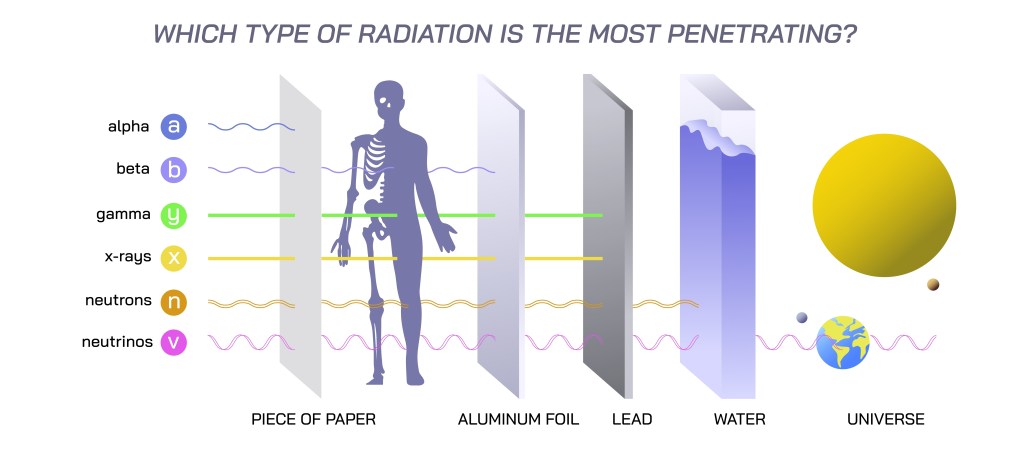
An enormous amount of neutrinos flows right through your body as if you don’t exist. They are coming from the sky and from the ground below after passing through earth and none of them will touch any part of you. This is a mind blowing and surprising but not well known fact and therefore a super fact in my opinion.
The Mass of Elementary Particles
More than 200 subatomic particles have been discovered and there are probably many more that have not yet been discovered. Examples of subatomic particles are protons, neutrons and electrons. However, only some of them are elementary particles, or in other words fundamental particles. The electron is a fundamental particle, but the proton and the neutrons are not. Protons and neutrons are called composite particles and consist of quarks, gluons and mesons. The neutrino is an example of a fundamental particle like the electron. Quarks are other examples of fundamental particles.
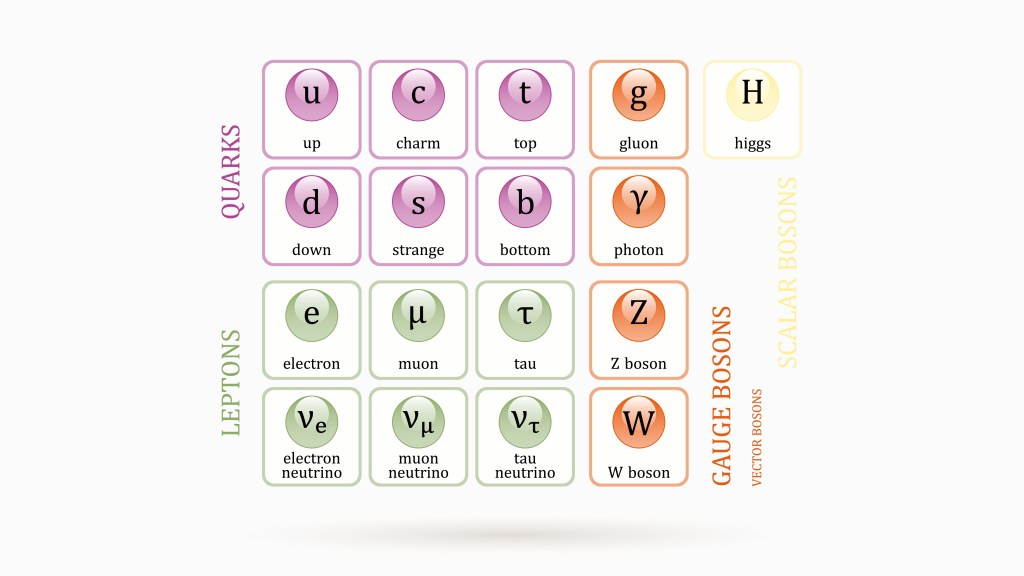
Electrons are lightweight. They weigh 0.511 MeV/c², which is 1,836 times lighter than a proton, which weighs 938.272 MeV/c². The positron, which is the electrons anti-particle weighs exactly the same as the electron. The muon, which is very similar to an electron but is unstable and is 206.77 times heavier than an electron weighs 105.66 MeV/c². The tau is also similar to an electron and is about 3,477 times heavier than an electron and weighs 1,776.86 MeV/c². Quarks are also much heavier than electrons. Photons and gluons are massless.
The neutrino is a lepton and is in some ways similar to an electron, but it has no charge and does not interact with electromagnetic forces at all. The neutron also does not have any charge, but it does interact with electromagnetic forces, which makes it a lot easier to detect. As in the case for the electron there are lighter and heavier versions of neutrinos, the electron-neutrino, the muon-neutrino and the tau-neutrino. Here comes the shocker; the heaviest flavor of neutrino, the tau-neutrino weighs less than 0.12 eV/c² or 0.00000012 MeV/c² making it at least 4 million times lighter than an electron. However, the neutrinos may be a lot lighter than that. We don’t know. They have mass but it is very tiny.
Considering how tiny neutrinos are, and that they don’t interact with the electromagnetic force at all (unlike other neutral particles) and don’t interact with the strong nuclear force at all, it is understandable that neutrinos are like ghost particles, almost impossible to detect. Neutrinos are too light to be so called dark matter, but a hypothetical heavier form of neutrino called the sterile neutrino is a plausible candidate for dark matter.
Other Physics Related Super facts
- Some Things Cannot be Known
- Radon Represents our Largest Exposure to Ionizing Radiation
- We are Star Dust
- The Speed of Light In Vacuum Is a Universal Constant
- Two events may be simultaneous for some but not for others
- The Strange Worlds of Exoplanets
- The vastness of space and the beginning of infinity
- The Bizarre Reality of Black Holes
- Every Symmetry is Associated with a Conservation Law
- GPS uses relativity for accuracy
- Time Dilation Goes Both Ways
- The Pole-Barn Paradox and Solution
- The Enormous Kuiper belt
- Time is a Fourth Dimension
- Electric Charge is not the only type of Fundamental Charge
- Superfluid Liquids are Like Magic
- The Edge of the Observable Universe is 46.5 billion Light Years Away
- Magnetars Super Magnets in the Sky
- Neutron Stars Trillions of Times Denser than the Sun
- The Universe has a Redshift and its Increasing
- Electrons Have Spin Without Spinning
- We Can See What Stars Are Made of
- Stars Twinkle but Planets Do Not
- Pulsars the Cosmic Lighthouses
- Light is Beyond the Reach of Time
- The speed of light is the speed of causality
- The Strong Nuclear Force Increases with Distance
To see the other Super Facts click here


Thomas, this is a fascinating reminder that the universe can be passing through us every second without leaving the slightest trace. I particularly love the comparison to ghosts, except these ghosts can pass straight through an entire planet! The sheer scale of 100 trillion neutrinos every second is almost impossible to picture. Science has a wonderful way of making the invisible feel astonishingly real.
LikeLiked by 1 person
Thank you so much Patricia. I thought it is a mind-blowing fact. I’ve read about it the first time when I was a kid interested in physics. This has been known for a long time. However, now we know a lot more about neutrinos than we did 50 years ago. Neutrinos are strange and very hard to study due to their hard to detect nature, but also fascinating and there are so many of them all around us and inside of us.
LikeLiked by 1 person
After this article, that scene from Ghost with Whoopi Goldberg as a clairvoyant freaks me out a lot less!
LikeLiked by 1 person
Yes I remember that scene too. I had forgotten that movie but you reminded me.
LikeLiked by 1 person
Well, ghost neutrinos caught my attention! So interesting, but I have heard of them from watching the TV shows, Big Bang Theory and Young Sheldon. They mention all these things quite often. Still it is weird that they pass through us and we don’t even know or feel anything. What are they even good for, or their purpose? 🙂
LikeLiked by 1 person
Yes I can understand that they caught your attention and it is great that you knew about them already. I agree, it is weird that trillions are passing right through us every second and not a single atom is touched. They go right through all the atoms and only extremely rarely interact with one.
I am not sure about purpose but they were first postulated in 1930 to explain why radiative decay seems to be mysteriously losing some energy. The German physicist Wolfgang Pauli, said it must be a particle that is impossible to detect (or near impossible to detect). In 1970 the first one was detected. As for being useful, there is potential. Since they go through everything, including entire planets, you could potentially use them to spy on things hidden deep in the ground, or things hidden behind planets and stars. Light /electromagnetic radiation particles, called photons, are also numerous but they get absorbed and re-emitted all the time so you can’t use them to see through dense matter. The cosmic background radiation (photons) from the Big Bang is from 380,000 years after the Big Bang for that reason. However, the Universe is filled with neutrinos that come from only 1 second after the Big Bang. It is called the cosmic neutrino background radiation. There is potential. It is difficult to use that potential but it exist.
LikeLiked by 1 person
Gosh, isn’t it interesting about those tiny particles. I have never thought about that before!
LikeLiked by 1 person
Yes I think neutrinos are very interesting. So strange.
LikeLiked by 1 person
There is so much we don’t know about the world, isn’t there.
LikeLiked by 1 person
Yes you are so right Jacqui.
LikeLiked by 1 person
Oona: “Not Oona’s body! She detects and deflects every single one of them! LIKE A NINJA!”
LikeLiked by 1 person
Oh I forgot about Oona. She can detect anything, like a super ninja.
LikeLike
Great title. My oh my, my 237 sextillionth birthday is coming up soon. What is the purpose of these ghostly particles?
LikeLiked by 1 person
Thank you Marsha, and ha ha, your 237 sextillionth birthday is coming up soon. Happy birthday. Incidentally, I am currently reading a book about vampires and they can live very long. About your question “purpose”. Barbara above asked the same question and my answer is below.
I am not sure about purpose but they were first postulated in 1930 to explain why radiative decay seems to be mysteriously losing some energy. The German physicist Wolfgang Pauli, said it must be a particle that is impossible to detect (or near impossible to detect). So, they participate in radioactive decay. In 1970 the first one was detected. As for being useful, there is potential. Since they go through everything, including entire planets, you could potentially use them to spy on things hidden deep in the ground, or things hidden behind planets and stars. Light / electromagnetic radiation particles, called photons, are also numerous but they get absorbed and re-emitted all the time so you can’t use them to see through dense matter (well there’s glass). The cosmic background radiation (photons) from the Big Bang is from 380,000 years after the Big Bang for that reason. However, the Universe is filled with neutrinos that come from only 1 second after the Big Bang. It is called the cosmic neutrino background radiation. There is potential. It is difficult to use that potential but it exist.
LikeLike
Spy neutrinos! That sounds like a book!
LikeLiked by 1 person
That is a good idea, a science fiction book.
LikeLike
Which might be true in the future!
LikeLiked by 1 person
Yes you are right. There is already a neutrino detector in Antarctica.
LikeLiked by 1 person
I remember reading years ago that neutrinos were dark matter, but that was quickly discounted.
LikeLiked by 1 person
Yes they are too light to explain dark matter. However, the postulated but not found or even explained heavy neutrinos, called sterile neutrinos could potentially be dark matter. They are just speculation though.
LikeLiked by 1 person
Very cool and fascinating Information, Thomas. Thanks for sharing this!
LikeLiked by 1 person
Thank you so much for your kind words Denise
LikeLiked by 1 person
I must admit, Thomas, this is rather a strange and disconcerting fact to get one’s head around. Certainly a fascinating piece of information.
LikeLiked by 1 person
Thank you Robbie. I agree it is strange. But it is cool to think that you have a lot more neutrinos in your body than cells right now, and none of them touches a single atom in you. They go just through all atoms.
LikeLike
It is amazing
LikeLiked by 1 person
An interesting post, Thomas. I’ve read about neutrinos before but you do an excellent job of explaining about these little particles.
LikeLiked by 1 person
Thank you so much for your kind words Lynette
LikeLiked by 1 person
Not at all, Liz x
LikeLiked by 1 person
This is one of those things that I will just never fully comprehend. Not only is it so complex, but it’s just weird to think about there being so much out there that we can’t feel or see or even detect.
LikeLiked by 1 person
Yes I agree that is very strange. Imagining neutrinos, more of them in your body then there are cells, passing right through all the atoms in your body as if the atoms don’t exist, is strange. They are filling up the entire Universe and a large portion of them come from just 1 second after the Big Bang.
LikeLiked by 1 person
Well, I learned something new today. They pass through anything? Wow, never knew that there’s no real charge. How did they find it? and they morph too, pretty cool.
LikeLiked by 1 person
They were proposed in 1930 by the German physicist Wolfgang Pauli because radioactive decay lost a bit of energy. He suggested that the lost energy was a particle that was impossible or almost impossible to detect. Soon it got the name neutrino by Enrico Fermi. It was first detected in 1970. They searched for it for 40 years. It is extremely difficult to detect but not impossible. This is a link to the IceCube neutrino observatory in Antarctica.
LikeLiked by 1 person
As someone with phasmophobia, I don’t know how I feel about this fact lol.
LikeLiked by 1 person
phasmophobia, I had to look that up. Elementary particles sometimes has funny nick names, or even funny official names. Neutrinos – ghost particles, Higgs Boson – God particle, and the quarks: charm, strange, truth and beauty.
LikeLiked by 1 person
Those are fun names, I remember Higgs Boson from The Big Bang Theory. They mentioned it a lot on that show.
LikeLiked by 1 person
And a little trivia. Bosons are named after the Indian physicist Satyendra Nath Bose. The first part of “Higgs Boson” is named after Peter Higgs.
LikeLiked by 1 person
Woah I had no idea, I thought it was a random name.
LikeLiked by 1 person
There are also the two branches of quantum statistics. One for matter particles called Fermi statistics (after physicist Enrico Fermi) and one for bosons (radiation particles) called Bose-Einstein statistics named again after Satyendra Nath Bose and Albert Einstein who invented it together. There is also a state of matter that happens at extreme colds called Bose-Einstein condensate, same situation as with Bose-Einstein statistics. Bose is in a lot of places in quantum physics.
LikeLiked by 1 person
He definitely seems like he helped make some major strides in physics. Very interesting to know.
LikeLiked by 1 person
Yes he was one of the major contributors to particle physics and quantum mechanics. However, he did not get the nobel prize in physics, which many see as an oversight. However, his most prominent achievement was probably the Bose-Einstein condensate was only proven experimentally in 1995, and he was long dead by then, and the nobel committee don’t give nobel prizes posthumously. However, a number of later physicists who worked on the Bose-Einstein condensate and Bose-Einstein statistics got the nobel prize.
LikeLiked by 1 person
Well, I think as long as his work lived on and helped other physicists I think prizes maybe don’t matter as much.
LikeLiked by 1 person
You are right. That is the most important.
LikeLiked by 1 person