
Super fact 132 : An estimated 100 trillion ghostly elementary particles, called neutrinos, pass through your body every second, which is 237 sextillion particles in 75 years. Despite that fact the chance that even a single neutrino will interact with an atom in your body during your entire life is about 1 in 4. These extremely abundant particles pass right through you as well as planets without interactions, like ghosts.
Neutrinos are tiny subatomic particles, often called ‘ghost particles‘ because they barely interact with anything else. They are capable of passing right through our planet Earth as if it wasn’t there. As mentioned, an estimated 100 trillion neutrinos pass through your body every second.
Neutrinos do not interact with electromagnetic forces and not with the strong nuclear force. The electromagnetic forces are what is governing molecules, atoms, and matter and the strong nuclear force governs the nucleus of atoms. The only forces that neutrinos interact with are the weak nuclear force and gravity, which both are weak forces, and the weak nuclear force has a very short range. In addition, the mass of neutrinos is extremely tiny. That is why neutrinos pass through atoms as if they aren’t there, and it is why trillions of neutrinos can pass through your body without touching you even the slightest and it is also why they are completely harmless. This also makes them extremely hard to detect.
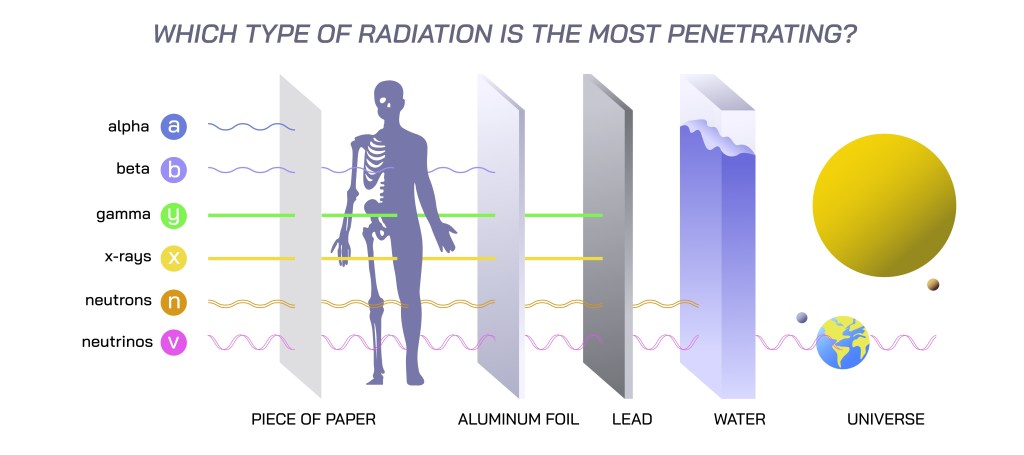
An enormous amount of neutrinos flows right through your body as if you don’t exist. They are coming from the sky and from the ground below after passing through earth and none of them will touch any part of you. This is a mind blowing and surprising but not well known fact and therefore a super fact in my opinion.
The Mass of Elementary Particles
More than 200 subatomic particles have been discovered and there are probably many more that have not yet been discovered. Examples of subatomic particles are protons, neutrons and electrons. However, only some of them are elementary particles, or in other words fundamental particles. The electron is a fundamental particle, but the proton and the neutrons are not. Protons and neutrons are called composite particles and consist of quarks, gluons and mesons. The neutrino is an example of a fundamental particle like the electron. Quarks are other examples of fundamental particles.
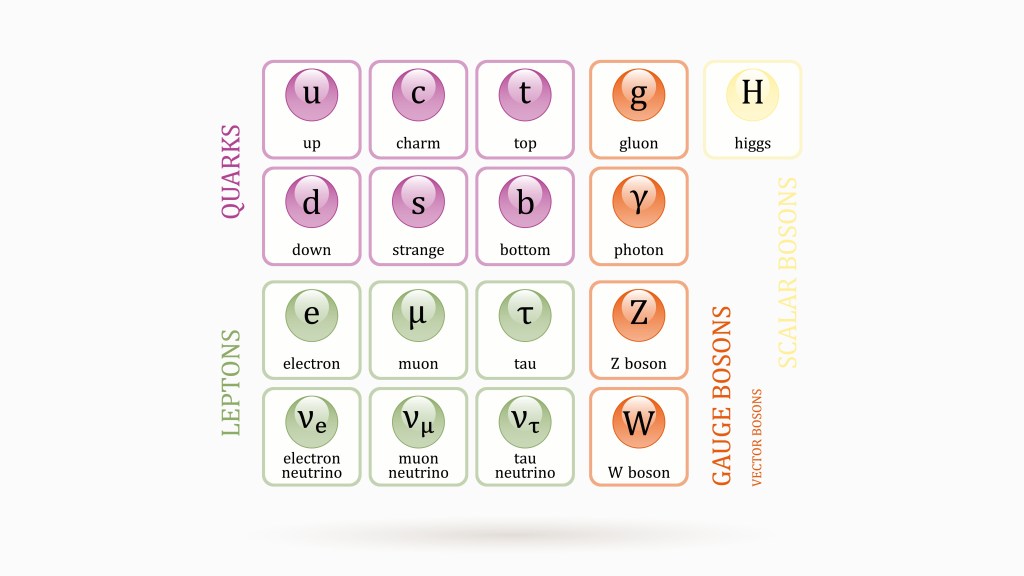
Electrons are lightweight. They weigh 0.511 MeV/c², which is 1,836 times lighter than a proton, which weighs 938.272 MeV/c². The positron, which is the electrons anti-particle weighs exactly the same as the electron. The muon, which is very similar to an electron but is unstable and is 206.77 times heavier than an electron weighs 105.66 MeV/c². The tau is also similar to an electron and is about 3,477 times heavier than an electron and weighs 1,776.86 MeV/c². Quarks are also much heavier than electrons. Photons and gluons are massless.
The neutrino is a lepton and is in some ways similar to an electron, but it has no charge and does not interact with electromagnetic forces at all. The neutron also does not have any charge, but it does interact with electromagnetic forces, which makes it a lot easier to detect. As in the case for the electron there are lighter and heavier versions of neutrinos, the electron-neutrino, the muon-neutrino and the tau-neutrino. Here comes the shocker; the heaviest flavor of neutrino, the tau-neutrino weighs less than 0.12 eV/c² or 0.00000012 MeV/c² making it at least 4 million times lighter than an electron. However, the neutrinos may be a lot lighter than that. We don’t know. They have mass but it is very tiny.
Considering how tiny neutrinos are, and that they don’t interact with the electromagnetic force at all (unlike other neutral particles) and don’t interact with the strong nuclear force at all, it is understandable that neutrinos are like ghost particles, almost impossible to detect. Neutrinos are too light to be so called dark matter, but a hypothetical heavier form of neutrino called the sterile neutrino is a plausible candidate for dark matter.
Other Physics Related Super facts
- Some Things Cannot be Known
- Radon Represents our Largest Exposure to Ionizing Radiation
- We are Star Dust
- The Speed of Light In Vacuum Is a Universal Constant
- Two events may be simultaneous for some but not for others
- The Strange Worlds of Exoplanets
- The vastness of space and the beginning of infinity
- The Bizarre Reality of Black Holes
- Every Symmetry is Associated with a Conservation Law
- GPS uses relativity for accuracy
- Time Dilation Goes Both Ways
- The Pole-Barn Paradox and Solution
- The Enormous Kuiper belt
- Time is a Fourth Dimension
- Electric Charge is not the only type of Fundamental Charge
- Superfluid Liquids are Like Magic
- The Edge of the Observable Universe is 46.5 billion Light Years Away
- Magnetars Super Magnets in the Sky
- Neutron Stars Trillions of Times Denser than the Sun
- The Universe has a Redshift and its Increasing
- Electrons Have Spin Without Spinning
- We Can See What Stars Are Made of
- Stars Twinkle but Planets Do Not
- Pulsars the Cosmic Lighthouses
- Light is Beyond the Reach of Time
- The speed of light is the speed of causality
- The Strong Nuclear Force Increases with Distance
To see the other Super Facts click here


Thomas, this is a fascinating reminder that the universe can be passing through us every second without leaving the slightest trace. I particularly love the comparison to ghosts, except these ghosts can pass straight through an entire planet! The sheer scale of 100 trillion neutrinos every second is almost impossible to picture. Science has a wonderful way of making the invisible feel astonishingly real.
LikeLiked by 1 person
Thank you so much Patricia. I thought it is a mind-blowing fact. I’ve read about it the first time when I was a kid interested in physics. This has been known for a long time. However, now we know a lot more about neutrinos than we did 50 years ago. Neutrinos are strange and very hard to study due to their hard to detect nature, but also fascinating and there are so many of them all around us and inside of us.
LikeLike