The goal of this blog is to create a list of what I call super facts. Super facts are important and true facts that nevertheless are surprising to a lot of people, mind-blowing, or misunderstood or disputed among non-experts. They are special facts that we all can learn something important from. However, I also make posts that are not super facts but feature other interesting information, such as this book review and book recommendation. The book is:
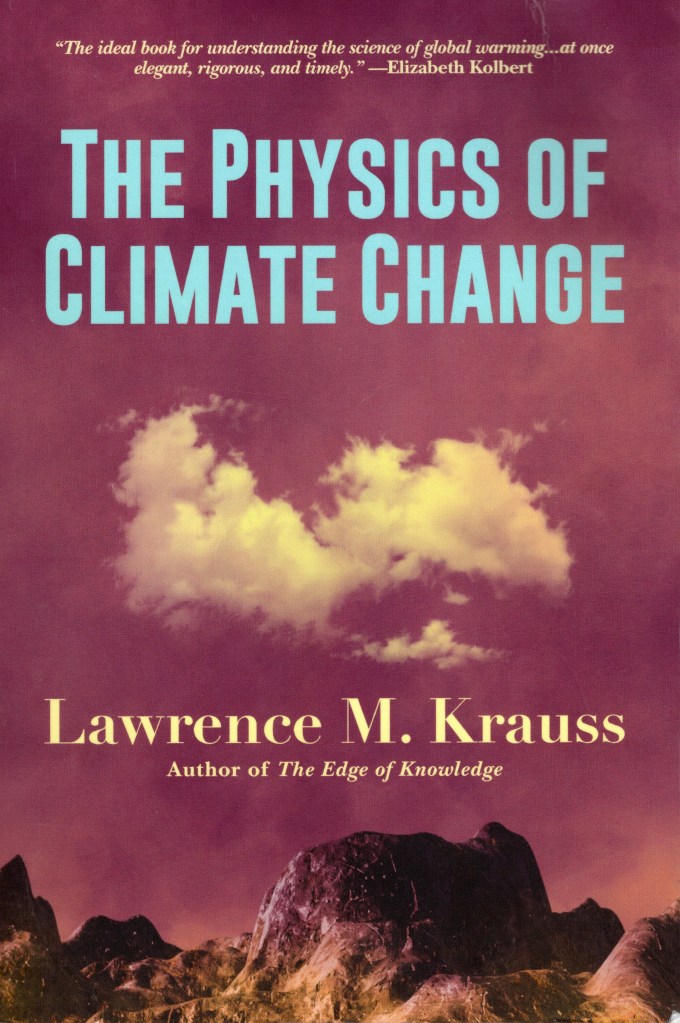
The Physics of Climate Change by Lawrence M. Krauss
I should mention that Lawrence M. Krauss is a renowned theoretical / particle physicist and cosmologist and not a climate scientist. However, he took a deep dive into the physics of climate change because of its importance. Below I am listing the four versions of this book. I bought and read the paperback version.
- Hardback – Publisher : Post Hill Press (March 2, 2021), ISBN-10 : 1642938165, ISBN-13 : 978-1642938166, 208 pages, item weight : 13.6 ounces, dimensions : 5.5 x 0.7 x 8.25 inches. It costs $8.70 on US Amazon. Click here to order it from Amazon.com.
- Paperback – Publisher : Post Hill Press (March 28, 2023), ASIN : B0BTMPFL93, ISBN-13 : 979-8888450925, 208 pages, item weight : 8 ounces, dimensions : 5.5 x 0.6 x 8.25 inches. It costs $15.01 on US Amazon. Click here to order it from Amazon.com.
- Kindle – Publisher : Post Hill Press (January 26, 2021), ASIN : B08P5DK7HB, ISBN-13 : 978-1642938173, 187 pages, it costs $12.99 on US Amazon. Click here to order it from Amazon.com.
- Audiobook – Publisher : Primordial Productions INC (January 26, 2021), ASIN : B08R6HT764, Listening length : 4 hours and 53 minutes. $0.00 with membership. Click here to order it from Amazon.com.
Amazon’s Description of the Book
The first book to briefly and clearly present the science of climate change in a way that is accessible to laypeople, providing the perspective needed to understand and assess the foundations and predictions of climate change.
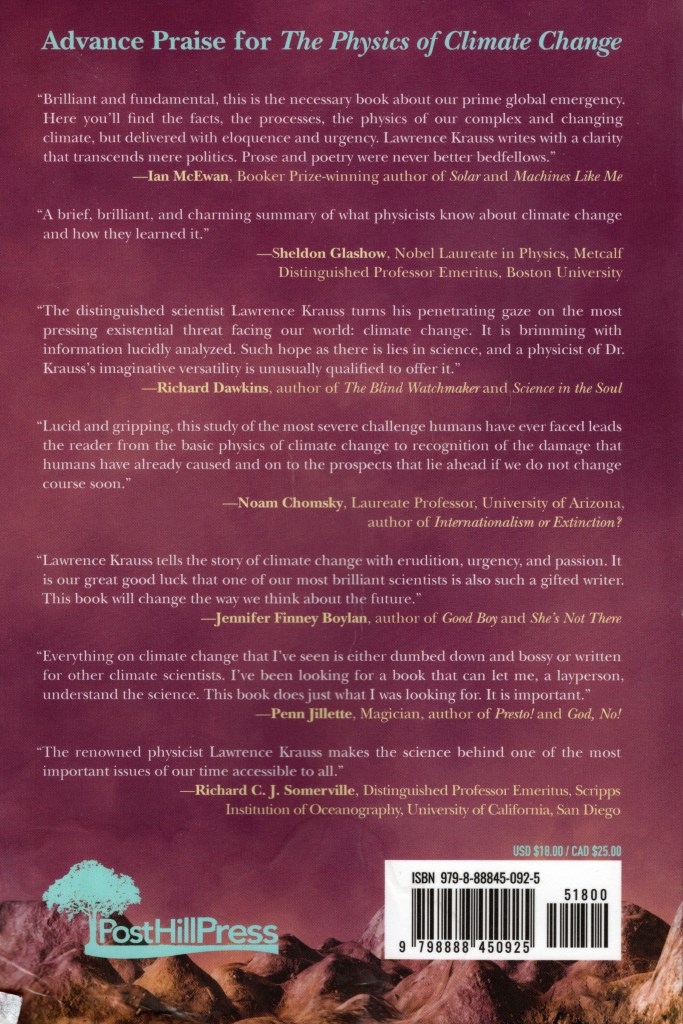
“Brilliant and fundamental, this is the necessary book about our prime global emergency. Here you’ll find the facts, the processes, the physics of our complex and changing climate, but delivered with eloquence and urgency. Lawrence Krauss writes with a clarity that transcends mere politics. Prose and poetry were never better bedfellows.” —Ian McEwan, Booker Prize-winning author of Solar and Machines Like Me
“Lawrence Krauss has written the ideal book for anyone interested in understanding the science of global warming. It is at once elegant, rigorous, and timely.”—Elizabeth Kolbert, staff writer, The New Yorker, and Pulitzer prize-winning author of The Sixth Extinction
“A brief, brilliant, and charming summary of what physicists know about climate change and how they learned it.” —Sheldon Glashow, Nobel Laureate in Physics, Metcalf Distinguished Professor Emeritus, Boston University
“The distinguished scientist Lawrence Krauss turns his penetrating gaze on the most pressing existential threat facing our world: climate change. It is brimming with information lucidly analysed. Such hope as there is lies in science, and a physicist of Dr. Krauss’s imaginative versatility is unusually qualified to offer it.” —Richard Dawkins, author of The Blind Watchmaker and Science in the Soul
“Lucid and gripping, this study of the most severe challenge humans have ever faced leads the reader from the basic physics of climate change to recognition of the damage that humans have already caused and on to the prospects that lie ahead if we do not change course soon.” —Noam Chomsky, Laureate Professor, University of Arizona, author of Internationalism or Extinction?
“Lawrence Krauss tells the story of climate change with erudition, urgency, and passion. It is our great good luck that one of our most brilliant scientists is also such a gifted writer. This book will change the way we think about the future.” —Jennifer Finney Boylan, author of Good Boy and She’s Not There
“Everything on climate change that I’ve seen is either dumbed down and bossy or written for other climate scientists. I’ve been looking for a book that can let me, a layperson, understand the science. This book does just what I was looking for. It is important.” —Penn Jillette, Magician, author of Presto! and God, No!
“The renowned physicist Lawrence Krauss makes the science behind one of the most important issues of our time accessible to all.” —Richard C. J. Somerville, Distinguished Professor Emeritus, Scripps Institution of Oceanography, University of California, San Diego
“Lawrence Krauss is a fine physicist, a talented writer, and a scientist deeply engaged with public affairs. His book deserves wide readership. The book’s eloquent exposition of the science and the threats should enlighten all readers and motivate them to an urgent concern about our planet’s future.” —Lord Martin Rees, Astronomer Royal, former president of the Royal Society, author of On the Future: Prospects for Humanity.
This is my five star review for the book The Physics of Climate Change
These Climate Change Physics Lessons will Make You Smarter
The author, Lawrence M. Krauss, is a particle physicist and cosmologist who took a deep dive into climate science, because it is an important topic that is misunderstood amongst the public. He demonstrates conclusively that the very rapid current global warming is indeed happening and is caused by us. He states that “Climate Change, evolution, and the Big Bang are all empirical facts, not speculation.” And that the existence of the greenhouse effect and its theoretical interpretation are by now essentially unimpeachable. He also states that “the basic physics is relatively straightforward and can and should be explained comprehensively to interested bystanders.”
However, this is easier said than done. Physics is hard for people without a physics education and people often underestimate what scientists understand. A famous example of this that is mentioned in this book is when former Fox TV host Bill O’Reilly notoriously claimed that no one knows why the tides happen, when in fact none other than Sir Isaac Newton explained the fundamental physics behind the tides hundreds of years ago. This book features a lot of facts, a lot of detailed explanations of complex systems, a lot of physics, some formulas, diagrams, and actual science. Even though this book is written for lay people it is not easy to read and I had to reread and think about some passages before continuing, despite having a degree in physics.
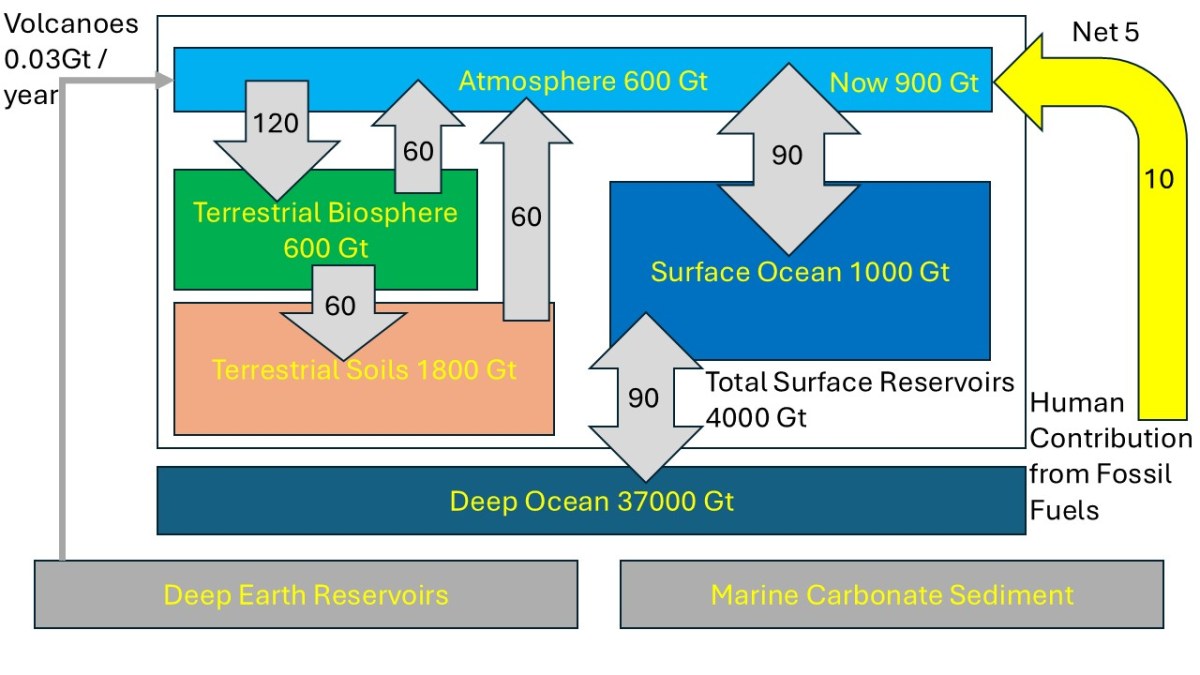
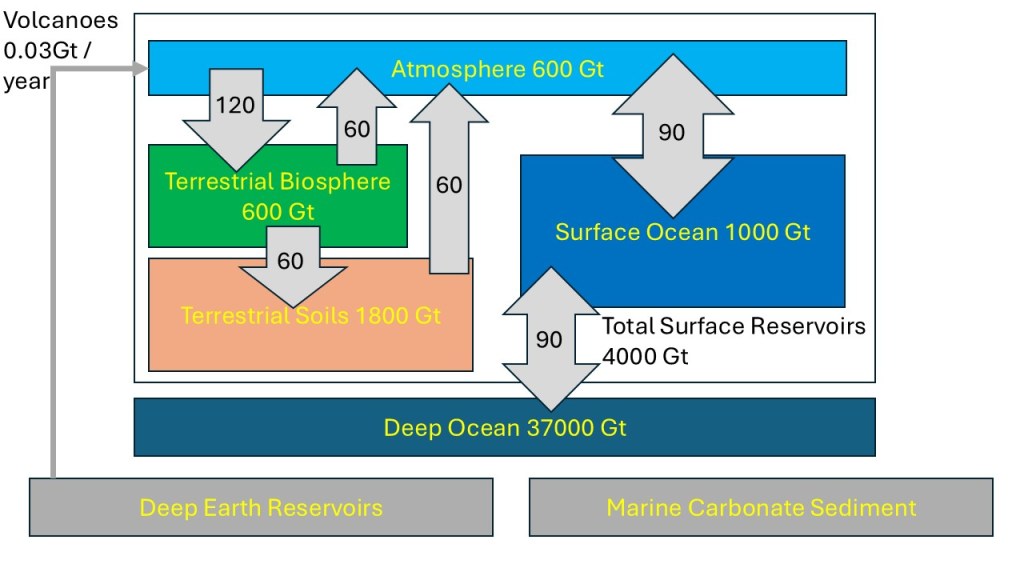
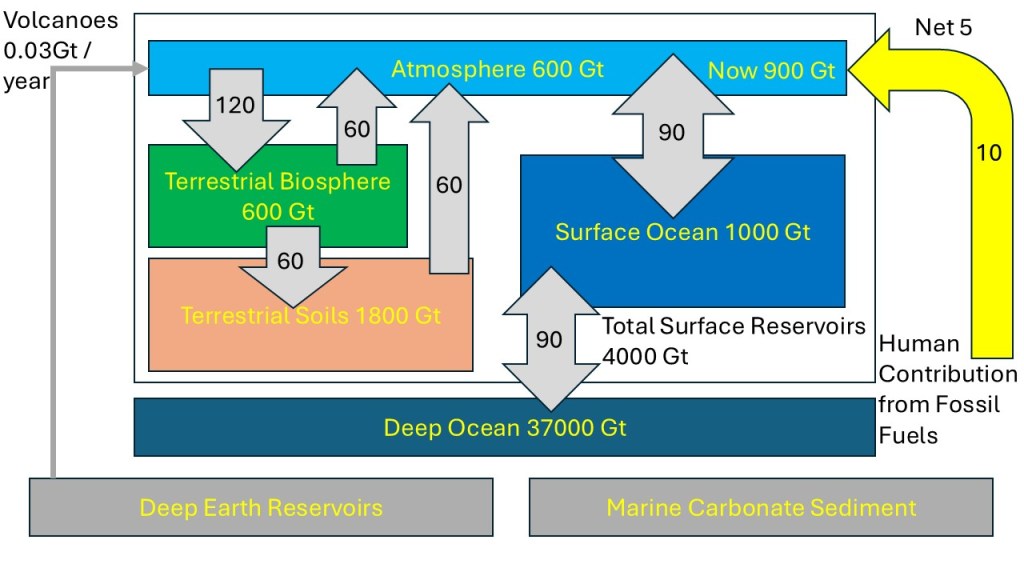
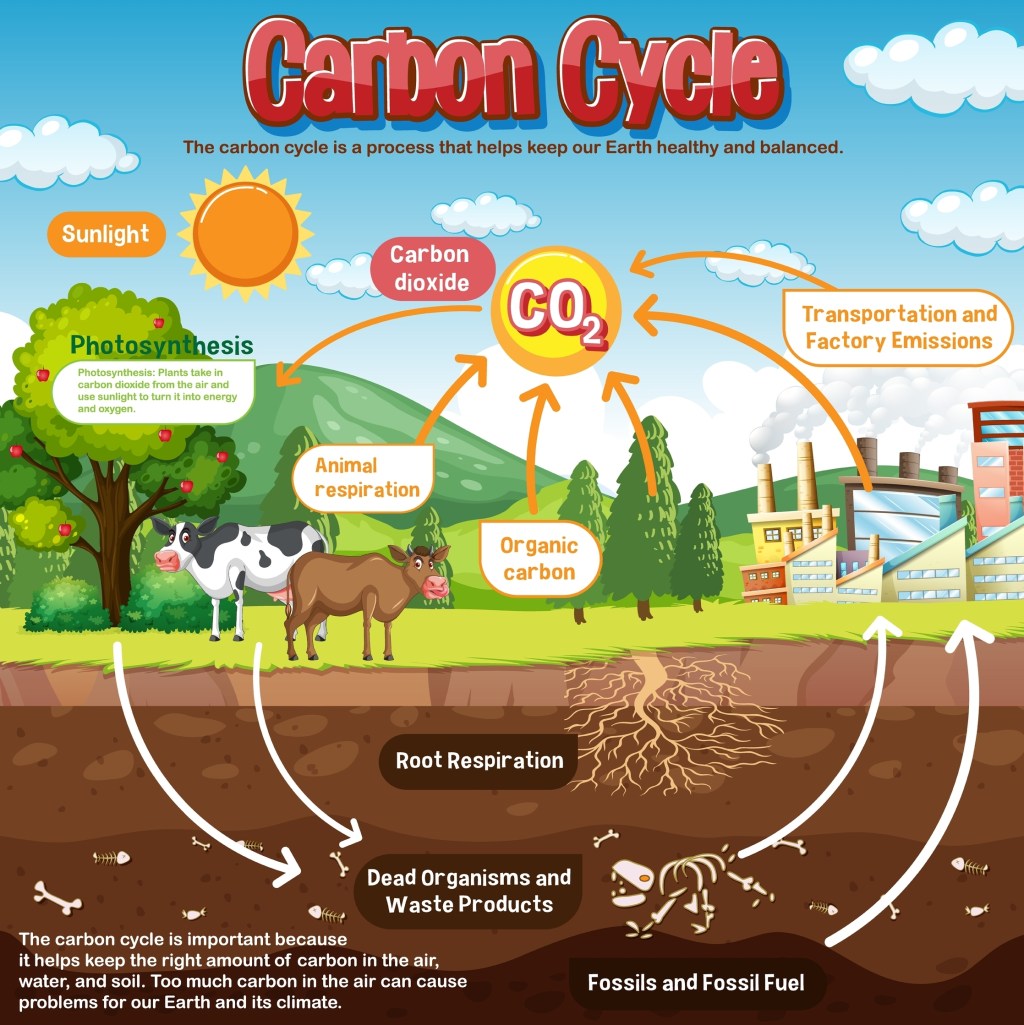
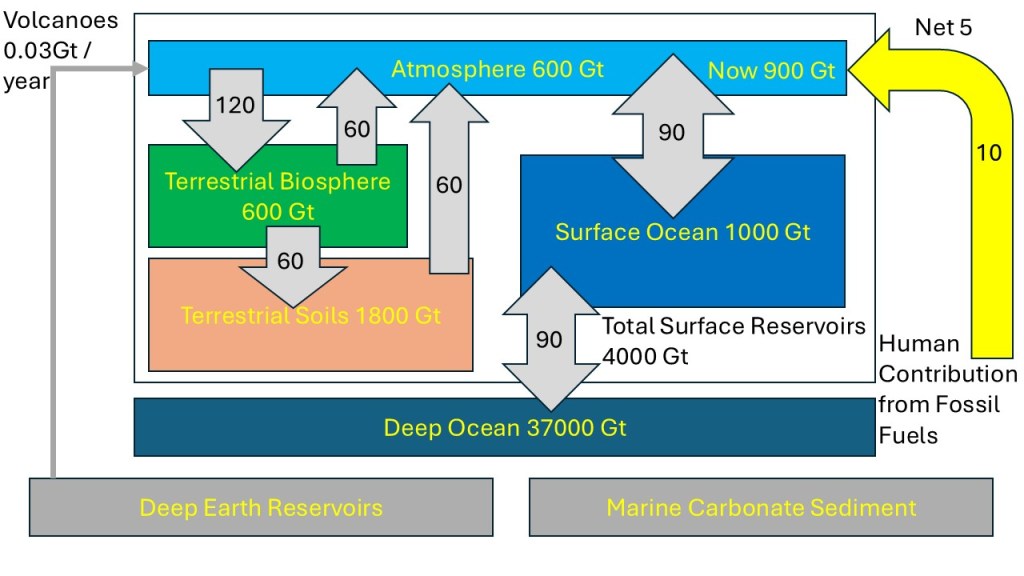
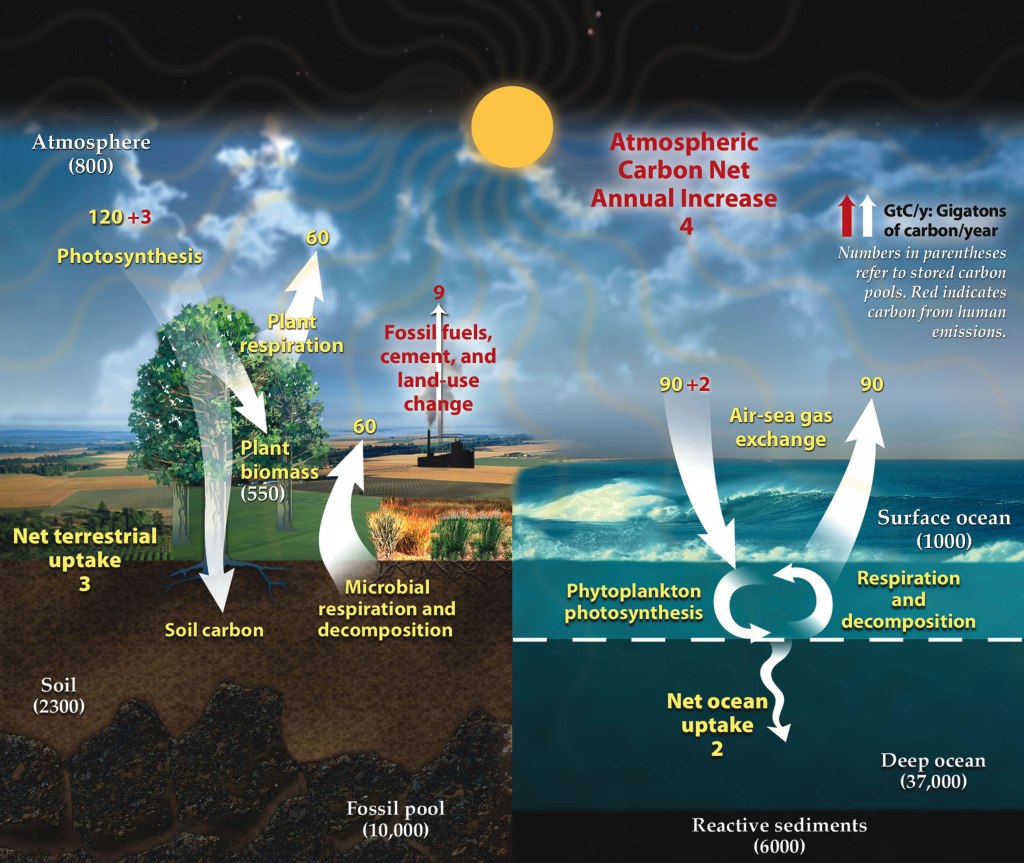
The author explains the so called carbon cycle, how carbon dioxide gets cycled through Earth’s oceans, mantle, the atmosphere, the biosphere, terrestrial soils, and the reservoirs of CO2 stored in each system and the flow absorption/emission between them. The carbon cycle diagram he provides is probably the most informative I’ve seen. One of the smallest emitters in the diagram are volcanoes, which emit about 1% of what we do by burning fossil fuels and is part of the carbon cycle, which has existed long before we did.
He explains how carbon dioxide emissions form a blanket around the Earth, the so called somewhat misnamed greenhouse effect and how it together with Earth’s overall reflectivity determines Earth’s surface temperature, which would have been 33 degrees Celsius (60 Fahrenheit) colder without the gases in our atmosphere. He explains why certain molecules are greenhouse gases, whilst other gases are not. Oxygen and nitrogen are not greenhouse gases, but carbon dioxide is a greenhouse gas whilst water vapor acts like a greenhouse gas.
To explain what is going on he invokes the electromagnetic spectrum and thermodynamics, for example, Stefan-Boltzman’s law, he does some math, examines the incoming and outgoing radiation, the absorption of IR radiation in the atmosphere, how carbon dioxide and water vapor absorb radiation at different frequencies and complement each other. For example, carbon dioxide absorbs IR radiation mostly in the 600 to 700 micrometers and water vapor in other frequencies. And by the way water vapor is not a driver behind global warming.
He explains how we can know past carbon dioxide content as well as global temperatures from ice cores going back 800,000 years. He gives us an overview of the science history of the greenhouse effect and global warming. It is hundreds of years old. For example, in 1896 the Swedish chemist/physicist Svante Arrhenius calculated pretty accurate numbers for how much the average global temperature would rise depending on how much carbon dioxide we are emitting, and roughly how the warming would distribute across the globe (not evenly). However, the author points out that calculating the average global temperature rise or environmental damage from the size our emissions is a very complicated task that not even complex models can do perfectly well.
One thing we can calculate very easily and accurately is radiative forcing. Radiative forcing is defined as the change in total radiation power (in watts per square meter) emitted by Earth into space as some quantity like the CO2 abundance. In the formula below C is the abundance of carbon dioxide and C0 is the initial abundance of carbon dioxide, and ln is the natural logarithm and Delta-P is the change in power, again in watts per square meter. (+/- 0.5) is the margin of error.
Radiative forcing Delta-P = 5.35 (+/- 0.5) ln(C/C0) Watts per meter square.
In addition, the book discusses the melting of land ice, Greenland, the different ice sheets in Antarctica, the distribution of temperature changes across Earth and across the atmosphere, potential tipping points, the potential future ill effects of global warming, including future sea level rise from thermal expansion and the melting of land ice (not sea ice). He states that under high emissions CoastalDEM (a study) indicates up to 630 million people live on land below projected annual flood levels for 2100.
In this review it seems like I’ve given a lot of detail regarding the content of the book. However, it is still just a small sample. The book is short, at less than 200 pages, but it has a lot of interesting content, perhaps even in depth content. It is well written and well organized, and Lawrence M. Krauss is a great popularizer of science. I’ve read other physics books by him. By giving some details about the content, I wanted to give potential readers an idea of what to expect and prepare them for the fact that this book is written for laymen at the same time as it is not easy reading. Please read it carefully and try to understand the content. If you can do that then I highly recommend it for you. The book will make you much smarter.