
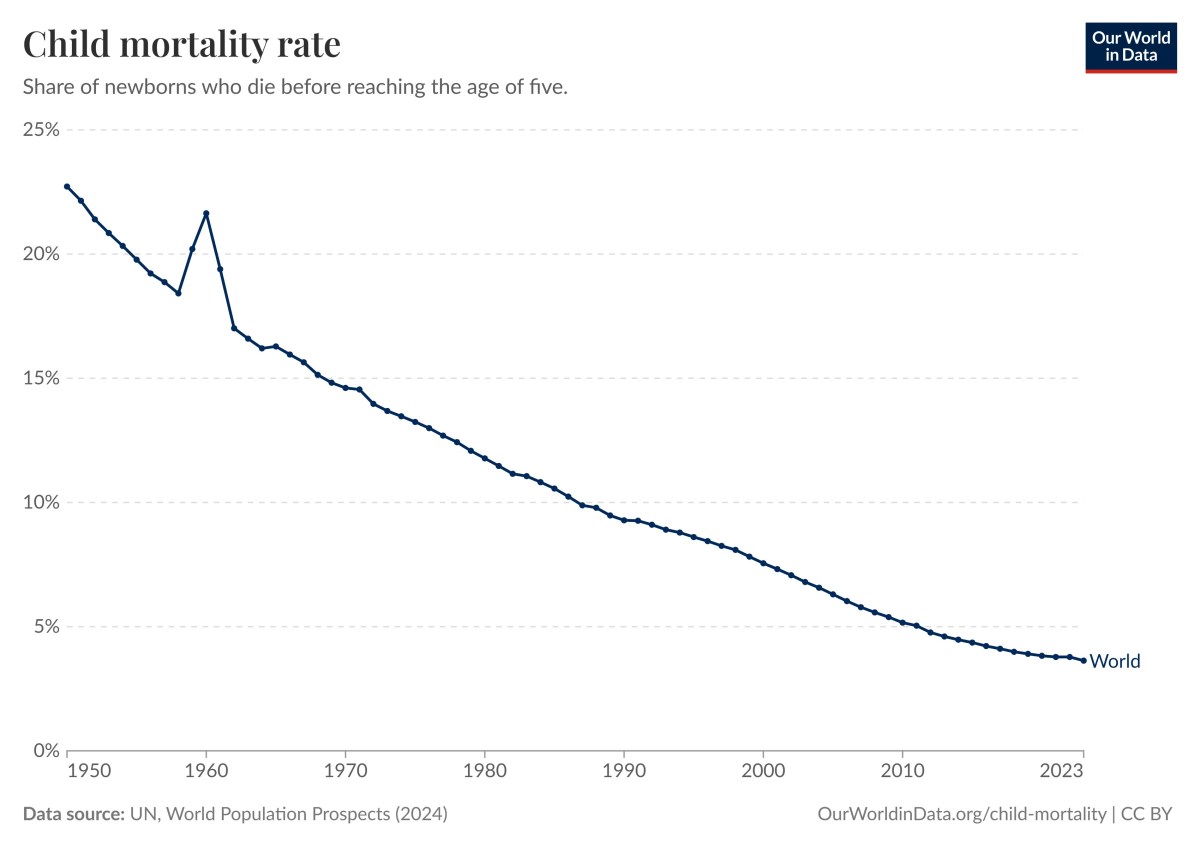
Super fact 137 : Child mortality has sharply declined in all world regions. Despite that fact, five million children die every year. Most of these deaths are preventable.
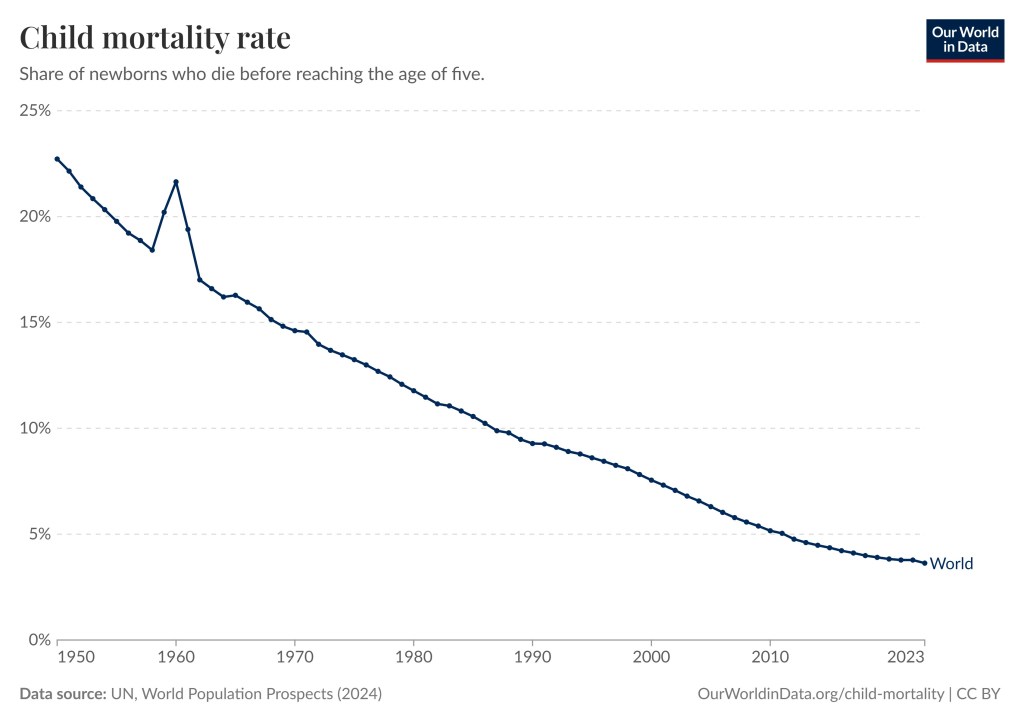
The graph above shows the probability a newborn would die before reaching the age of five if the year’s age-specific mortality rates stayed unchanged. It is not the share of an actual cohort that has been observed dying. As you can see, the child mortality worldwide has gone from 22.7% in 1950 to 3.6% in 2023. That is more than a sixfold improvement. The significant uptick in child mortality in 1960 is because of the Great Leap Forward in China.
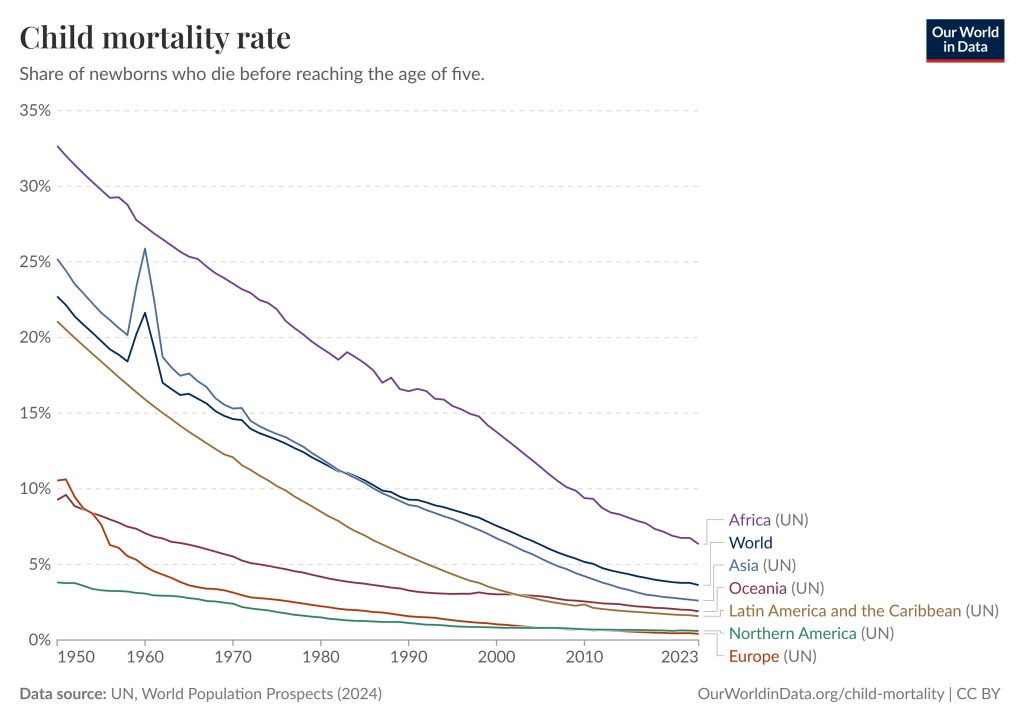
The graph below shows that the sharp decline in child mortality exists across all regions of the world. The graph depicts the child mortality rate for Africa, Asia, Oceania, Latin America and the Caribbean, Northern America, Europe and the whole world. You can play around with the graph and select your own regions and countries by clicking here. Note that Africa is the region with the worst numbers. However, the decline in child mortality still goes from 32.7% in 1950 to 6.3% in 2023, a fivefold decline.
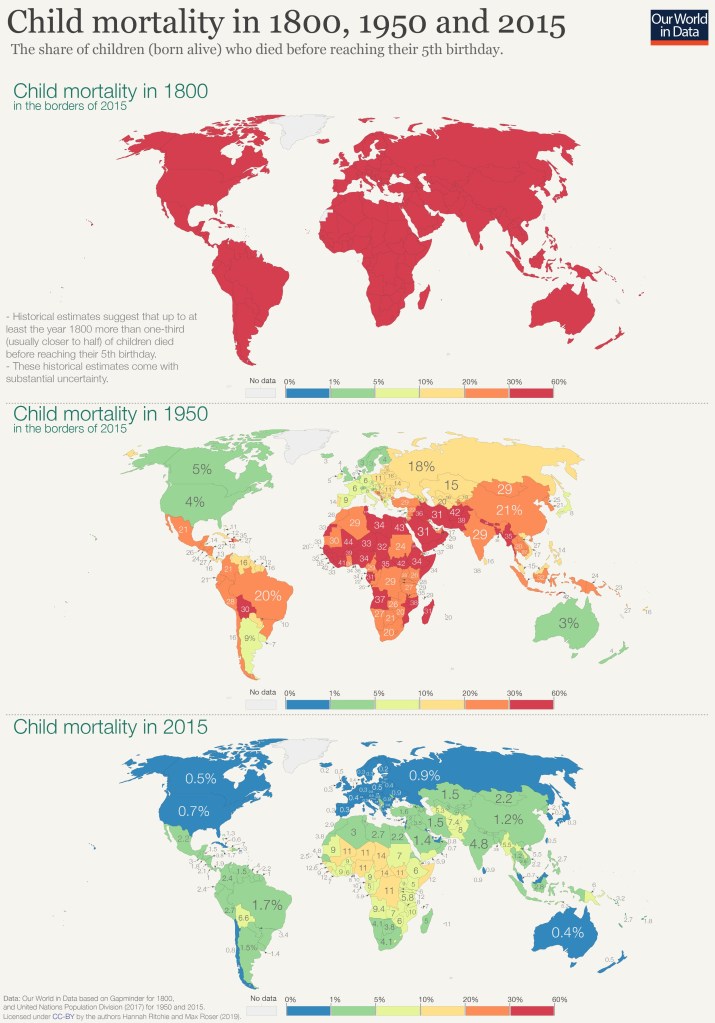
If you look further back in time the numbers are not as accurate, but they are a lot more impressive. In the maps below you can see that the child mortality rate in the 1800 is estimated to be between 30% and 60% everywhere in the world. If you look at the bottom map, you’ll see that the countries that are the worst off with respect to the child mortality rate in 2015 have a child mortality rate of 14%. That means that the worst off country in the 21st century is much better off than any of the countries were in the 1800. You can read more about this map and related information here.
However, a child mortality rate of 3.6% still means that nearly five million children die every year before the age of five. The UN estimates that 990 million children have died globally since 1950. Most of these deaths are preventable. Infectious diseases and birth disorders (primarily preterm births and neonatal suffocation) dominate deaths among children under five. The impressive and almost steady decline in the child mortality rate across all regions in the world is a positive but surprising and important fact.
However, the fact that despite the success in reducing the child mortality rate five million children still die, and those deaths are preventable is a surprising but less positive fact. That’s why I consider this a super fact.
Look at the bottom half on the following page for details about the original sources.
Additional Child Mortality Rate Graphs and Maps
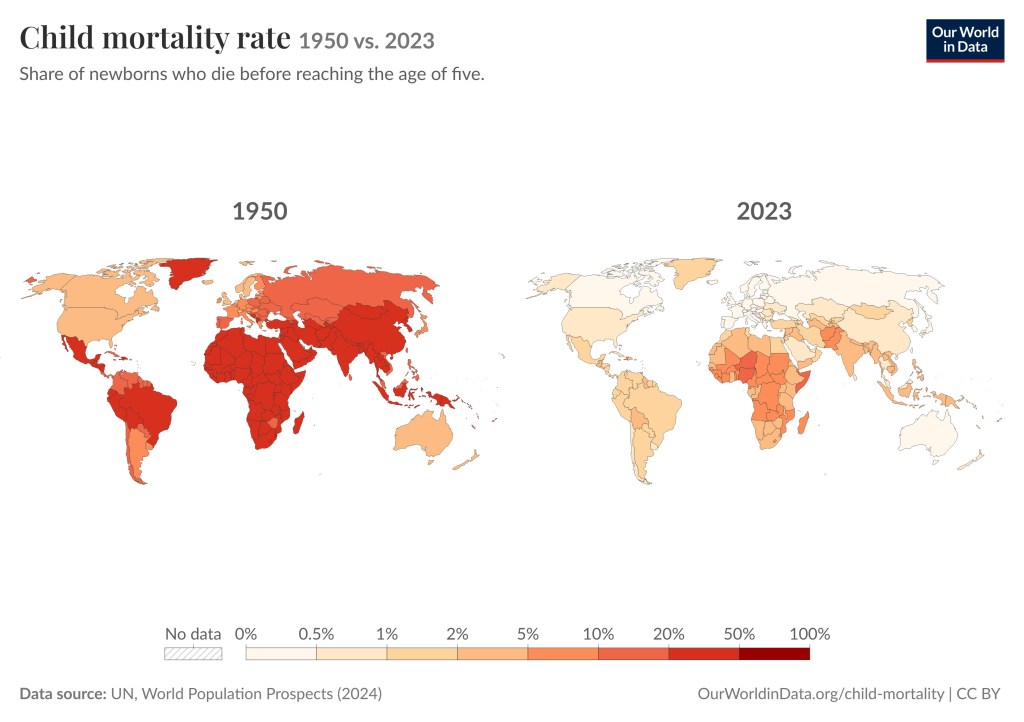
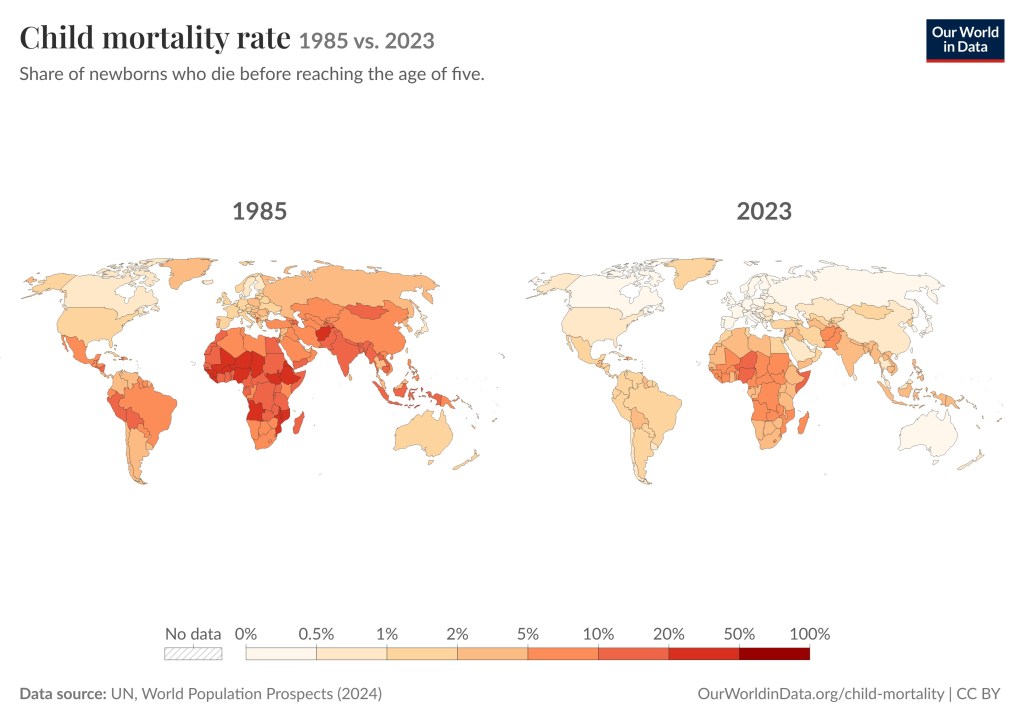
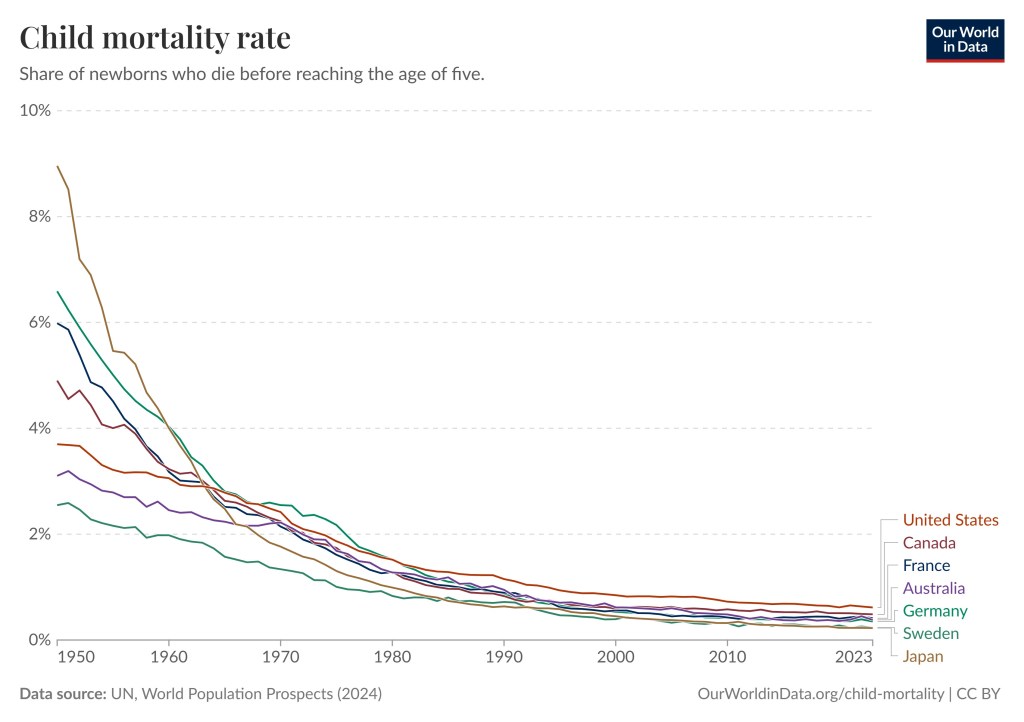
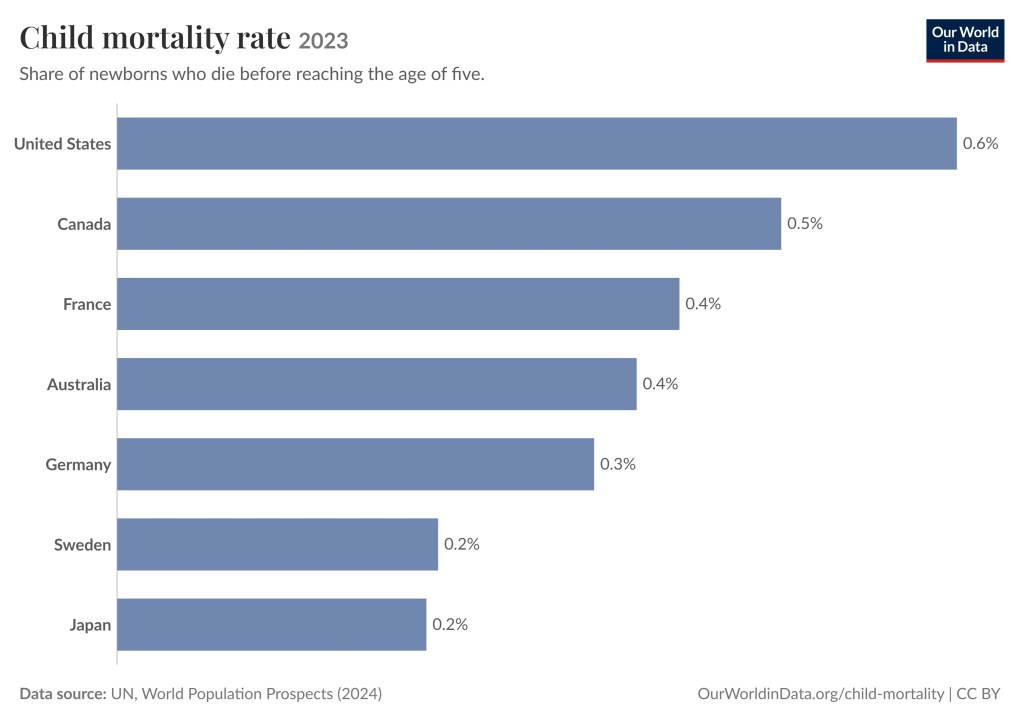
In the graph below notice that Japan shows a decline in the child mortality rate from 9% in 1950 to 0.2% in 2023, which is quite impressive.
The Death of Five Million Children
Five million children die every year — what do they die from?
44% died from infectious diseases including pneumonia, influenza, covid-19, malaria, rotavirus, cholera, typhoid, hepatitis, encephalitis, measles, whooping cough, and meningitis, STDs, tuberculosis, and HIV/AIDS. It may come as a surprise that 118,000 children died from measles in 2023 and 95,600 children died from whopping cough in 2023.
42% died from birth disorders including preterm birth, neonatal asphyxia, heart abnormalities, neonatal sepsis, etc. The remaining 14% were cardiovascular diseases, digestive diseases, genetic blood disorders, malnutrition, cancers, accidents such as drowning and transport accidents. You read the details and check the graphics here.
Related Super Facts
- Poverty and child mortality has been sharply reduced worldwide
- We are living in relatively peaceful times
- Smallpox Killed 300 million People in the Last Century Before Eradication
- Natural Disasters Kill Less People Now Than 100 Years Ago
- Emissions of ozone-depleting gases have fallen by 99 Percent
- Vaccines do not cause Autism
To see the other Super Facts click here


This so so sad, we have it good here but there is always needed more to be done. Here the trend of having baby at home again, is not the best of trend in my opinion. Also unfortunately in Finland in some pllaces the distance to get to the hospital with current cut to hospitals is the northern areas. Vaccination level is still good.
LikeLiked by 2 people
Thank you Ritva. It is a mix of good and bad news. The good news is that is much better than in the past and the bad news is that it is still bad. I see that Finland is doing pretty well though (as of 2023). I am sorry they are cutting funding for northern areas. I believe the same has happened in Sweden.
LikeLike
I’m surprised that the death rate in more developed countries is as high as it is.
LikeLiked by 2 people
Yes but at the same time it is much lower than in the developing world. In the developed countries it is 0.2 to 0.6, which is much better than the global average of 3.6. Not good enough but better.
LikeLiked by 1 person
I saw something a while ago where the US was ranked 16th, and even that puts the US above some countries. You would expect the US to be best with all the money and modern technology. It was stated that with all the money and technology, we just don’t prioritize this the way other countries do, almost an acceptable risk. Also, the numbers are way better, as you state, but still high, and we have to consider that number against more people too, I would suspect.
LikeLiked by 1 person
Well, the US is a developed country and like most developed countries it is doing much better than most developing countries, and the world average of 3.6. However, among developed countries the US is not doing so well.
LikeLiked by 1 person
An incredibly powerful ‘super fact’, thank you for sharing.
The historic decline from 1950 is a massive triumph for humanity, but knowing that five million children still die from preventable causes is a heartbreaking reminder that our work is far from ove
LikeLiked by 2 people
Thank you so much for your kind words Luisa. You are right, “the historic decline from 1950 is a massive triumph for humanity”. Yet the five million children who still die from preventable causes is something that is sad and needs to be fixed.
LikeLiked by 1 person
Beautifully said, my dear Thomas!
We must celebrate progress but never close our eyes to the sadness that remains.
Thank you for this meaningful thought.
LikeLiked by 1 person
Thank you so much Luisa. That is a very good way to say it.
LikeLiked by 1 person
Im glad the rate has gone down but that is still too many unnecessary deaths, especially when treatable.
LikeLiked by 2 people
Yes you are so right Denise. We’ve had great success and that is great news but still too many children die unnecessarily.
LikeLiked by 1 person
It’s stunning to see how many children were dying of preventable causes as recently as 1950. It’s before my time (I quickly add). My mother had an older brother who died in infancy. I’m not sure of the cause(s). He died before my mother was born, and people didn’t talk about these sorts of things in the past, especially not to children.
My understanding is that the US has the highest mortality rate of infants and mothers among industrialized nations. Black women are 2-3 times more likely to die of childbirth complications than white women. This has been true for decades. Current policy changes will only make these things worse, I’m afraid.
When I did research into my family, I found that frequently a family would have up to ten to twelve children, with half of them surviving to adulthood.
The reduction in childhood death is a great triumph, but the suffering and preventable death that remain remind us of how much work needs to be done.
Thanks for this great thought-provoking article.
LikeLiked by 3 people
Thank you so much Denise. You are so right. In the past it was common for half of the kids to die pretty much anywhere in the world. The US being developed country is doing much better than the developing countries but among the developed countries it is not ahead. I am sorry to hear about your mother’s older brother. Back then kids dying was very common. We’ve had great improvements since 1950. That is because of vaccination, better healthcare, lower etreme poverty, and improved safetry in all kinds of life that is the root of the improvements.
LikeLiked by 1 person
It’s good to see the numbers down and reminder we have work to do, Thomas. A wonderfully presented post with amazing charts as always! 🩷💕🩷
LikeLiked by 1 person
Thank you so much for your very kind words Cindy
LikeLiked by 1 person
You’re so very welcome, Thomas!❣️💓🙏💓
LikeLiked by 1 person
This is very interesting, Thomas. Sad that the US is at the top of the list. I wonder what would happen if we changed the data and looked at a prenatal mortality rate, which would include abortion, both natural and elective. I also wonder whether that would change the results worldwide. Even without figuring in unborn children, that is a huge number of children who have died.
LikeLiked by 1 person
Thank you so much Marsha and those are good questions. I don’t know how that would change numbers. I should say that the graphs for developed nations are much better than the graphs for developing nations. So they are all relatively good numbers. However, among those countries (Europe, Australia and Japan) US is not doing well. 0.6% is still much better than the world average of 3.6%.
LikeLiked by 1 person
So higher is better? I read it wrong.
LikeLiked by 1 person
No the child mortality numbers are better the lower they are. In my comment I mentioned the bar graph for developed nations. However, right below that graph I just added a graph for North America with a mix of developed and developing countries. Since it is a mix of developing countries and developed countries I think you’ll get a better view.
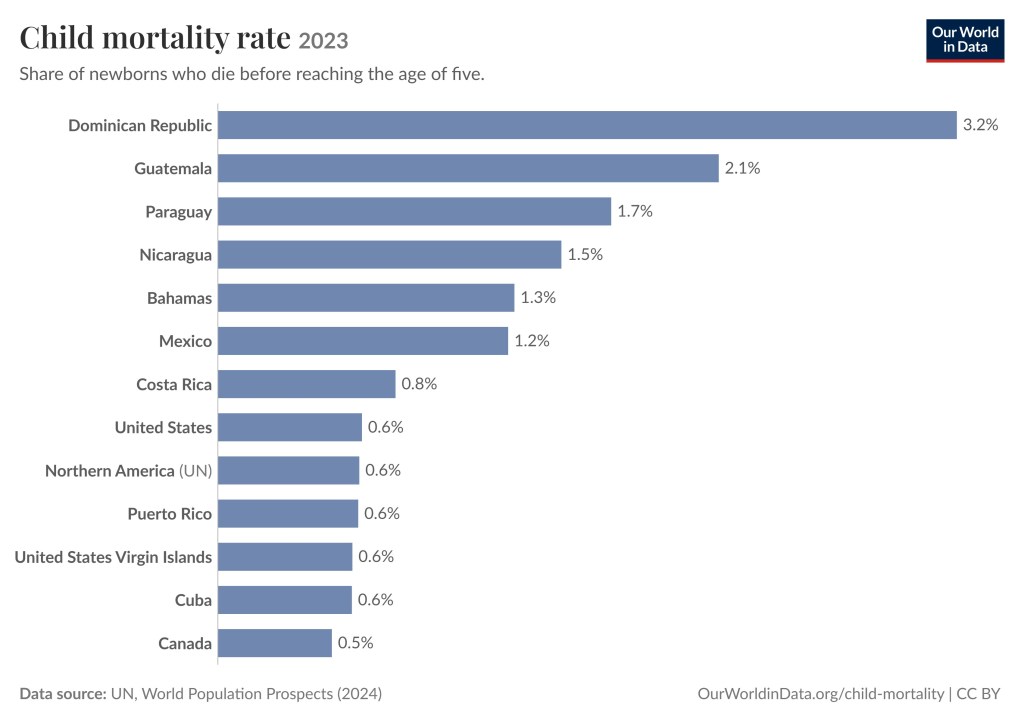
This new bar graph shows the child mortality rate for North American countries in 2023 from best to worst, Canada 0.5%, Cuba 0.6%, United States Virgin Islands 0.6%, Puerto Rico 0.6%, Northern America 0.6%, United States 0.6%, Costa Rica 0.8%, Mexico 1.2%, Bahamas 1.3%, Nicaragua 1.5%, Paraguay 1.7%, Guatemala 2.1%, Dominican Republic 3.2%. The bigger number the worst. Dominican Republic a poor developing country is 3.2%, which is very bad. The United States at 0.6% is doing much better but 0.6% is an usually bad number for a developed country. Maybe I should mention that developing country is the politically correct term for poor country and developed country is the politically correct term for rich country.
LikeLike
I wasn’t thinking straight when I read the 3.6 rather than .36%. Sometimes I just slap my forehead in wonder – “What was I thinking?”
LikeLiked by 1 person
Oh I see what happened. Well I got an extra graph out of it. BTW if you are interested you can visit this link and play around with the graphs yourself. Select countries and regions and then you can download the picture for free and use it, as long as you give credit (the little text at the bottom of the picture.)
LikeLiked by 1 person
Thanks, Thomas. As bad as I am with decimal points, do you think I can handle a graph on my own???
LikeLiked by 1 person
You can try. You just select the countries by pressing check boxes and don’t worry about decimal points. Then you can change from line graph over time (since 1950) to bar graph. You make many thousands of graphs and download them for free.
LikeLiked by 1 person
Thanks, Thomas. I was being silly about the decimal points. Data and maps are very intriguing. That is a cool program. Thanks for sharing.
LikeLiked by 1 person
Thank you so much Marsha
LikeLiked by 1 person
Thank you for sharing your knowlege and doing it so that normal humans can understand it. 🙂
LikeLiked by 1 person
You are so very kind Marsha
LikeLiked by 1 person
Thanks, Thomas. You are tool 🙂
LikeLiked by 1 person
A good article, Thomas. My understanding is that part of the problem in the U.S. is the widespread resistance to vaccinations for children. The same issue exists here but it’s to a lesser extent. For instance, the U.S. has this year had a measles epidemic; that disease was eliminated and almost eradicated before people started believing the disinformation around vaccinations and it unfortunately again became a health issue.
LikeLiked by 1 person
Thank you so much Lynette. I think you are right that the widespread resistance to vaccinations for children is harming children. However, it seems like this is a fairly new phenomenon and the last year for the numbers I am quoting is 2023 (collected 2024). I think the US being behind other developed nations (notice the US is still way ahead of developing nations) is a problem that has existed for a while. Interestingly the strongest and most insulting attack on me because of a super fact was an Englishman who became enraged when I stated that “Vaccines do not cause Autism” … But I know, you are right, anti-vaxx sentiments is less of a problem in the UK.
LikeLiked by 1 person
Anti-vax movements have been around for at least 100 years but the more recent issues began in 1998, so it’s actually not a new phenomenon. Here’s an article you might find interesting: https://pmc.ncbi.nlm.nih.gov/articles/PMC2831678/
FYI, I’m in Canada. 😊 Cheers.
LikeLiked by 1 person
Yes you are right Lynette and thank you for the article. I do know about Andrew Wakefield and his faulty and very small study (insufficient size) and the 24 large, often very large, and properly conducted studies that debunked his study. I was just thinking that the anti-vax stuff has grown worse during the last few years in the US with RFK Junior etc. But again, you are right, anti-vax movements have been around a very long time. Incidentally, I got vaccinated today against the flu and covid-19. I also know very well that you are Canadian and live in British Columbia. I don’t know why I thought the UK when I wrote the comment. Maybe it was the beer I had. Anyway, I am sorry about that.
LikeLiked by 1 person
Thanks, Thomas. No worries whatsoever about U.K. mix-up. It happens to me, too. 😊 We’re coming up to our covid and flu shots, also. Cheers.
LikeLiked by 1 person
Ha ha thank you so much Lynette.
LikeLiked by 1 person
Java Bean: “Ayyy, our Dada saw that spike in the 1960s and he was like ‘What happened there?!’ So thanks for clearing that up!”
Lulu: “Seems like being a kid is less hazardous than it used to be, but still more hazardous than it needs to be …”
LikeLiked by 1 person
Oh yes Java Bean. The great leap forward was a pretty major disaster in China and largely caused by the authoritarian Chinese government. Lulu, you summarized the situation perfectly.
LikeLike
Hi Thomas, these statistics are interesting. I’m not surprised Africa has the highest instance of child mortality.
LikeLiked by 1 person
Thank you so much Robbie. I think it is pretty interesting statistics too. It is great that Our World in Data let us use it for free. There are other websites with similar statistics but they’ll charge you. I agree Africa is not doing so well.
LikeLike
Yes, does the World Economic Forum not have statistics like this? I always find good info there.
LikeLiked by 1 person
Yes and Our World in Data use them as a source. What is good with Our World in Data is that they take statistics from reputable sources and turn it into interactive graphs that you are free to download. They also analyze the data, verify it with multiple sources, and sometimes collect their own statistics. This is why I end up using them a lot. However, I use all kinds of reputable sources.
LikeLike
Okay, this is good to know, Thomas. I use the WEC because I know it is reliable and I find a lot of economic statistics there. I also enjoy their annual Future of Jobs report.
LikeLiked by 1 person
I agree WEC is reliable and it is a good source to use
LikeLike
👍🏻
LikeLiked by 1 person
It’s good to remember kids still die despite the numbers not being as vast as they were before modern medicine.
LikeLiked by 1 person
Yes that is a good summary of the situation. Thank you Sara.
LikeLiked by 1 person
“It may come as a surprise that 118,000 children died from measles in 2023 and 95,600 children died from whopping cough in 2023.”
One assumes this is from falling vaccination rates? I for one never want to see smallpox return. Nor Diptheria, yet in Australia, we had a recent outbreak which the government threw money at… and many were not vaccinated. To have a child die from one of these preventable diseases would be the worst horror imaginable. To me the small risks of vaccines are well justified, but I respect those who choose to not or do not vaccinate. It is a risk….
LikeLiked by 1 person
Yes I agree with you. When it is about measles and whooping cough I think it is mostly places where vaccination against these diseases are not yet as common, but maybe some of them are from falling vaccination rates. Northern Sweden got the measles vaccine later than the US, so in the 1970’s we had an epidemic of measles, rubella and chicken pox. My entire 3rd grade class got measles almost all at the same time. Out of about 25 kids only 3 did not get it. It spread like wildfire. I thought measles was terrible, lots of itching, red dots, high fever, coughing, and it lasted about 2-3 weeks and then I had a complication, pneumonia. I also got rubella and chicken pox. However, smallpox, that is a different issue. It is much more serious than any of those. Smallpox killed at least 300 million people in 20th century, a monstrous giant killer, like five World War II. However, no one has died from smallpox since 1978 and it has been eradicated since 1980. That is thanks to vaccination. I am so sorry to hear about the diphteria in Australia.
LikeLiked by 1 person
Very interesting facts Thomas. Perhaps things have gotten better, but still far too many children dying. 😉
LikeLiked by 1 person
Thank you so much Debby and you are right. We’ve had a lot of progress but 5 million children under five years old dying every year is still too much.
LikeLike