The Special Theory of Relativity by David Bohm

The goal of this blog is to create a list of what I call super facts. Super facts are important and true facts that are nevertheless highly surprising to many, disputed among the public, or unnecessarily misunderstood. They are special facts that we all can learn something important from. However, I also make posts that are not super facts but feature other interesting information, such as this book review and book recommendation.

The Special Theory of Relativity by David Bohm

David Bohm a close colleague of Albert Einstein was one of the most interesting theoretical physicists of the 20th century. This book “The Special Theory of Relativity” is one of the most interesting and thorough introductory books on the Special Theory of Relativity that I have come across. It is a series of lectures on the topic. It features algebra, equations, and a little bit of differentials but not too much.

You may want to have some math, physics and some relativity under your belt before you tackle this book. In my estimate it is written for those who have taken high school AP physics and AP algebra, maybe calculus as well, or one or two college level physics classes and math classes (or more). It is probably too basic for professional physicists, but it is not written for laymen. I bought the paperback version.

  • Hardback –  Routledge; 1st edition (October 10, 1996), ISBN-10 : 0415148081, ISBN-13 : 978-0415148085, 256 pages, item weight : 13.6 ounces, dimensions : ‎ 5.75 x 0.75 x 9 inches. It is out of stock, and it costs $75.60 – $144.00 on US Amazon. Click here to order it from Amazon.com.
  • Paperback –  Publisher : Routledge; 1st edition (September 4, 2006), ASIN : 0415404258, ISBN-13 : 978-0415404259, 304 pages, item weight : 12 ounces, dimensions : 5.08 x 0.69 x 7.8 inches. It is out of stock, and it costs $12.36 – $17.21 on US Amazon. Click here to order it from Amazon.com.
  • Kindle –  Published : Routledge; 1st edition (September 29, 2015), ASIN : B009W3W6MG, 306 pages, it costs $10.10 – $13.77 on US Amazon. Click here to order it from Amazon.com.
The front cover of “The Special Theory of Relativity by David Bohm.”
Front cover of the paperback version of The Special Theory of Relativity by David Bohm. Click on the image to go to the Amazon page for the paperback version of the book.

Amazon’s Description of the Book

In these inspiring lectures David Bohm explores Albert Einstein’s celebrated Theory of Relativity that transformed forever the way we think about time and space. Yet for Bohm the implications of the theory were far more revolutionary both in scope and impact even than this. Stepping back from dense theoretical and scientific detail in this eye-opening work, Bohm describes how the notion of relativity strikes at the heart of our very conception of the universe, regardless of whether we are physicists or philosophers.

This is my five-star review for The Special Theory of Relativity

Note, I wrote this review in 2014, so it is relatively old, pun intended.

Lorentz Electrodynamics, Special Relativity, and our Perception of Reality

This book is a thorough and well written introduction to the “Special Theory of Relativity”. In addition to the basics of special relativity it covers the history of Special Relativity and it includes 60-pages of Lorentz Electrodynamics. The book also discusses Minkowski Diagrams, the Twin Paradox, relativistic Doppler effects, K-Calculus, and philosophy related to relativity. The book does not discuss General Relativity.

Bohm does not derive many formulas for electrodynamics, optics, quantum physics, thermodynamics, etc., and therefore this book does not resemble a textbook. Bohm’s focus is on a deeper understanding of the special theory of relativity itself, and on time and space.

He discusses perception of reality and includes discussions on child development, psychology and neurology related to perception, the meaning of the relational concepts in relativity, the structure of scientific revolutions (T.S. Kuhn), our perceptions of time and space, philosophy, and other related topics that cannot be classified as physics.

In K Calculus you draw the world lines of light pulses sent at constant intervals between different observers. Then you calculate what is essentially the Doppler factor K and uses it to explain what is going in relativity. In contrast the Lorentz transform is concerned with the space-time coordinates that you measure after taking into account that light have to travel a certain distance and that this takes time. Basically, the “actual time and space coordinates”.

K Calculus on the other hand is including both relativistic effects and the distance and time it takes for light to travel. K Calculus is thus not what you “measure” but what you “observe”. K Calculus makes it very easy to explain special relativity to an audience that is not strong in math and it also adds a new understanding to the special theory of relativity.

However, I see an inherent risk with K-Calculus in that it can end up fooling the student into believing that he understands relativity, for example, if a student incorrectly comes to believe that time dilation is some form of Doppler Effect.

Except for the fact that some of the mathematical derivations were unnecessarily complex I thought this book presented relativity lucidly, the philosophical discussions were insightful, and it added to my understanding of the topic. It should probably not be your first book on Special Relativity but it is a very good second book. I highly recommend it for those who want to think through the concepts of relativity a little deeper.

The back cover of "The Special Theory of Relativity by David Bohm"
Back cover of the paperback version of The Special Theory of Relativity by David Bohm. Click on the image to go to the Amazon page for the kindle version of the book.

To see the Super Facts click here

What Can We Do About Climate Change

The goal of this blog is to create a list of what I call super facts. Important facts that we know to be true and yet they are surprising, shocking or disputed among non-experts. Super facts are important facts that people get wrong. However, I also create posts that are not super facts but other interesting information, such as this book review and book recommendation.

Saving Us: A Climate Scientist’s Case for Hope and Healing in a Divided World

Saving Us: A Climate Scientist’s Case for Hope and Healing in a Divided World by Katharine Hayhoe is a book about human caused Climate Change, how bad it is, and what we can do about it. The good news is that we are not all going to destroy ourselves. It is still bad, but we can do a lot to avoid making it really bad. However, there are a lot misunderstandings regarding what really makes a difference. This book examines these issues with a good dose of realistic optimism and science. I read the hardback version (and my review on Amazon is currently the top review).

  • Hardcover –  Publisher : Atria/One Signal Publishers (September 21, 2021), ISBN-10 : 1982143835, ISBN-13 : 978-1982143831, 320 pages, item weight : 1.05 pounds, dimensions : ‎6 x 1 x 9 inches, it costs $19.14 on US Amazon. Click here to order it from Amazon.com.
  • Paperback –  Publisher : Atria/One Signal Publishers (September 20, 2022), ISBN-10 : 1982143843, ISBN-13 : 978-1982143848, 320 pages, item weight : 8.8 ounces, dimensions : 5.5 x 0.7 x 8.38 inches, it costs $17.22 on Amazon. Click here to order it from Amazon.com.
  • Kindle –  Published : Atria/One Signal Publishers (September 21, 2021), ASIN : B08BZW2BQG, 318 pages, it costs $14.99 on US Amazon. Click here to order it from Amazon.com.
  • Audiobook –  Published : September 21, 2021, ASIN : B08D4RGYM8, Listening Length : 8 hours and 7 minutes, it costs $16.40 on US Amazon. Click here to order it from Amazon.com.
The front cover of “Saving Us: A Climate Scientist's Case for Hope and Healing in a Divided World” by Katahrine Hayhoe | What Can We Do About Climate Change
Front cover of Saving Us. Click on the image to go to the Amazon page for the hardcover version of the book.

Amazon’s description of the book

“An optimistic view on why collective action is still possible—and how it can be realized.” —The New York Times

“As far as heroic characters go, I’m not sure you could do better than Katharine Hayhoe.” —Scientific American

“It’s not an exaggeration to say that Saving Us is one of the more important books about climate change to have been written.” —The Guardian

United Nations Champion of the Earth, climate scientist, and evangelical Christian Katharine Hayhoe changes the debate on how we can save our future.

Called “one of the nation’s most effective communicators on climate change” by The New York Times, Katharine Hayhoe knows how to navigate all sides of the conversation on our changing planet. A Canadian climate scientist living in Texas, she negotiates distrust of data, indifference to imminent threats, and resistance to proposed solutions with ease. Over the past fifteen years Hayhoe has found that the most important thing we can do to address climate change is talk about it—and she wants to teach you how.

In Saving Us, Hayhoe argues that when it comes to changing hearts and minds, facts are only one part of the equation. We need to find shared values in order to connect our unique identities to collective action. This is not another doomsday narrative about a planet on fire. It is a multilayered look at science, faith, and human psychology, from an icon in her field—recently named chief scientist at The Nature Conservancy.

Drawing on interdisciplinary research and personal stories, Hayhoe shows that small conversations can have astonishing results. Saving Us leaves us with the tools to open a dialogue with your loved ones about how we all can play a role in pushing forward for change.

This is my five-star review for Saving Us

Climate Change; what can we do? Talk about it!

This is an extremely well written, informative, and hopeful book on climate communication. A decade ago I was doubtful that human caused climate change was anything to worry about even though it physically made sense that it was happening. I thought environmentalists were exaggerating and distorting the facts. In general I did not trust or respect environmentalists whom I thought were driven by leftist agendas.

I studied the topic on my own by reading books and scientific articles on the topic, and I learned what climate scientists, not opinionated bloggers, said about the topic. I was especially impressed by a book by James Hansen.

I came to realize that human caused global warming definitely was real and a serious problem. I think I was able to change my mind so easily because I never had a strong affiliation with a political tribe, I respected scientific expertise and my encounter with science deniers in other fields had inoculated me against their kind of rhetoric (it’s fairly universal). I’m an abstract thinker who loves pro-con-lists, and I prefer going in deep and I am not afraid of math, but I don’t think that’s typical.

The backside of that is that it made me a pretty crappy and easily frustrated climate change communicator once I came around. I felt I needed to take action so I joined Citizens Climate Lobby (CCL), a bipartisan volunteer organization with good solutions and good practices. From CCL I learned how to communicate better. In this book Katherine Hayhoe praises CCL and use it as a model for how to approach climate change with respect to solutions and communication.

In addition to climate change communication she gives a high level overview of why we know that global warming is happening (there are 26,500 lines of independent evidence for climate change), how fast it is happening (10 times faster than the last ice age warming), and how we know it isn’t natural. It’s a simple overview, not a deep dive. I thought her analogy about driving while looking in the rearview mirror as you hit a curve to be genius.

She also discusses our cognitive biases, and why not to engage with the 7% who are dismissives, the abuse she’s been a victim of, and so called zombie arguments. Zombie arguments are dismissive arguments that have been thoroughly debunked over and over but won’t die because they fulfill an emotional need for those who are dismissive of climate change. She discusses the political divided in the US, the “blame and shame the consumer” tactic and the misguided “population control solution” and solutions aversion in general.

She describes our situation lucidly. That there is no particular known limit that will doom us all. It is like smoking; you don’t get lung cancer after a certain amount of cigarettes, it’s just better to stop as soon as you can. She discusses solutions and the economy, including cap and trade and a price on carbon, and she states we don’t have to harm the economy to solve climate change, and a lot is already being done the world over. It is a mostly hopeful view.

I was surprised to learn that if you take into account, production subsidies, tax breaks, land leases on public lands below market rates, and the cost of pollution, the IMF estimates that fossil fuel subsidies in the US top $600 billion per year, twenty times clean energy subsidies. That’s about $2,000.00 per person and year, or $8,000.00 per family per year. That’s a lot of money.

Because of my experience with CCL I recognized a lot of what Katherine Hayhoe was saying in this book, but I still had a lot to learn, and besides the book is hopeful, and intelligently written and therefore a pleasure to read. She stresses that the most important thing we can do to solve climate change is to talk about it. I love this book and I highly recommend this book.

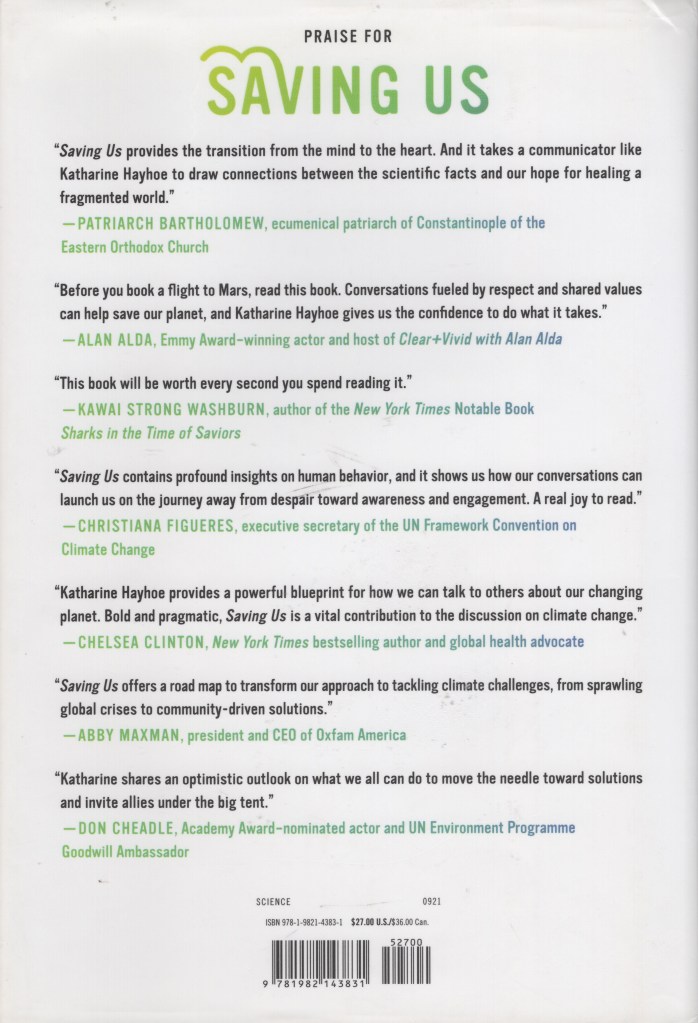
Back cover of “Saving Us: A Climate Scientist's Case for Hope and Healing in a Divided World” by Katharine Hayhoe
Back cover of Saving Us. Click on the image to go to the Amazon page for the kindle version of the book.

To see the Super Facts click here