Modern Physics is Fundamentally Different from Classical Physics

Superfact 144: Modern Physics including Quantum Physics and Relativity is fundamentally different from Classical Physics. Even if you include Relativity in Classical Physics, which is often done, it is still fundamentally different from “Classic Classical Physics”.

Esther’s writing prompt: October 28th: Classic

Click here or here to join in.
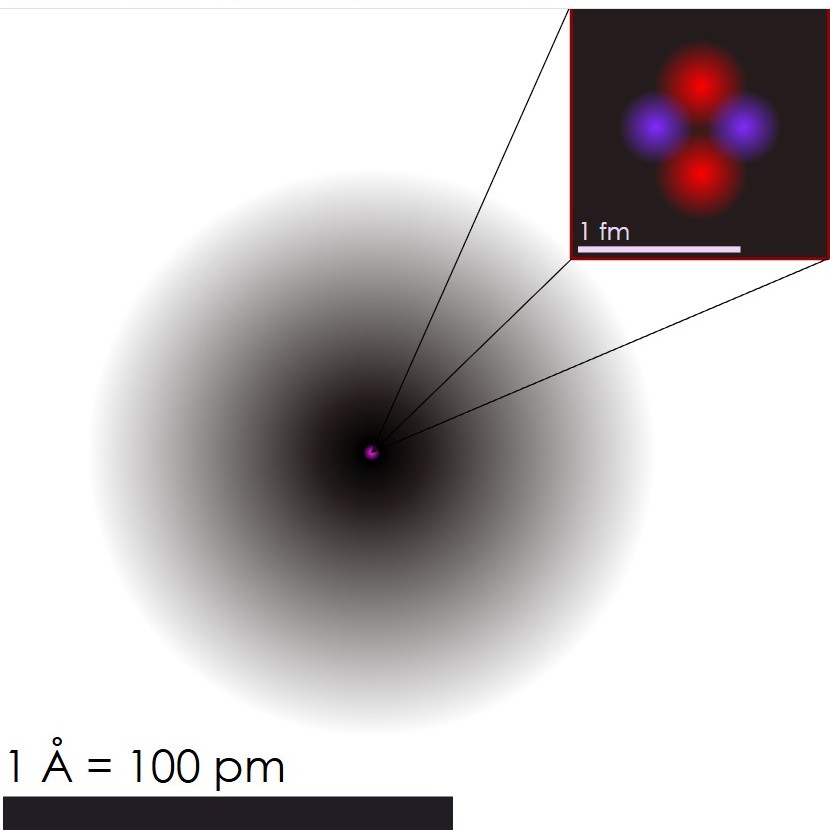
An illustration of the helium atom, depicting the nucleus (pink) and the electron cloud distribution (black). The nucleus (upper right) in helium-4 is in reality spherically symmetric and closely resembles the electron cloud, although for more complicated nuclei this is not always the case. | Modern Physics is Fundamentally Different from Classical Physics
Electrons (and other particles) don’t have specific positions. They are probability clouds. This is an illustration of the helium atom, depicting the nucleus (pink) and the electron cloud distribution (black). The black bar is one angstrom (10−10 m or 100 pm). The nucleus is 0.01pm. User: Yzmo, CC BY-SA 3.0, via Wikimedia Commons.

Classical physics and modern physics represent two major phases in our understanding of how the universe works. Classical physics includes fields such as classical mechanics, electromagnetism, optics, and thermodynamics. Modern physics include relativity and quantum mechanics. However, relativity is often said to be classical physics as well as modern physics.

In classical physics time and space are independent of the observers, objects can have exact positions and velocities, and if you measure them precisely you can make exact predictions. Furthermore, energy and matter are continuous. In relativity time and space are relative, and there is no universal now. The order of events depends on the observer and energy and mass are interchangeable. In quantum physics particles do not have a specific positions or velocities, they behave as both particles and waves, and energy is quantized. In quantum physics you have probabilities instead of certainties. The electrons (and other particles) in atoms are described as probability clouds (see picture above). Classical physics and modern physics are very different.
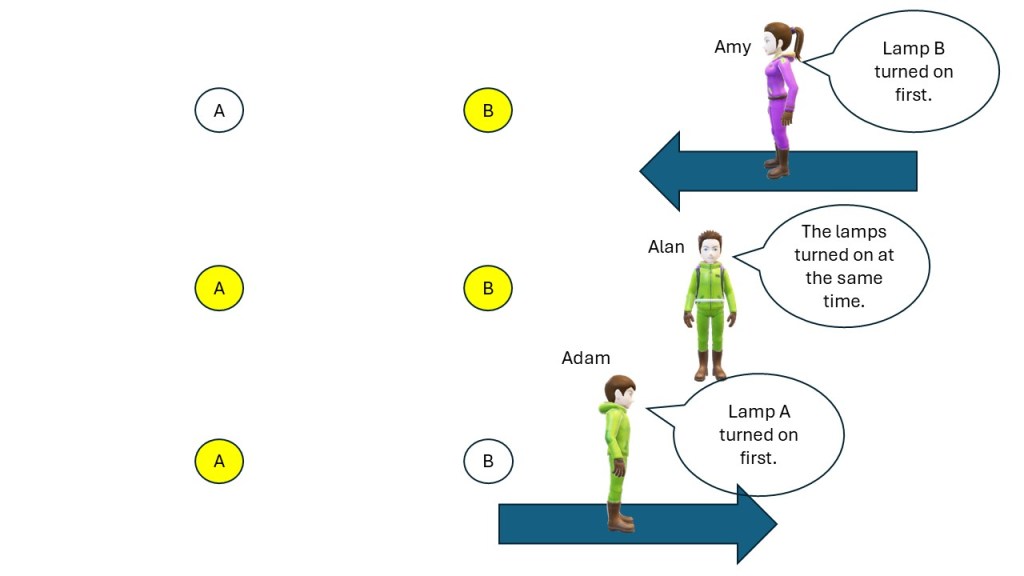
The picture shows three pairs of lamps and three people. The setup is used to show three situations.
Amy is traveling at a high speed to the left compared to two lamps A and B. Alan is standing still compared to the lamps. Adam is traveling at a high speed to the right compared to two lamps A and B. Alan turns on the lamps at the same time. After considering the travel time of the light she sees, Amy concludes that lamp B turned on first. After considering the travel time of the light he sees, Adam concludes that lamp A turned on first. I should add this non-simultaneity can only happen if the lamps are separated by a distance.

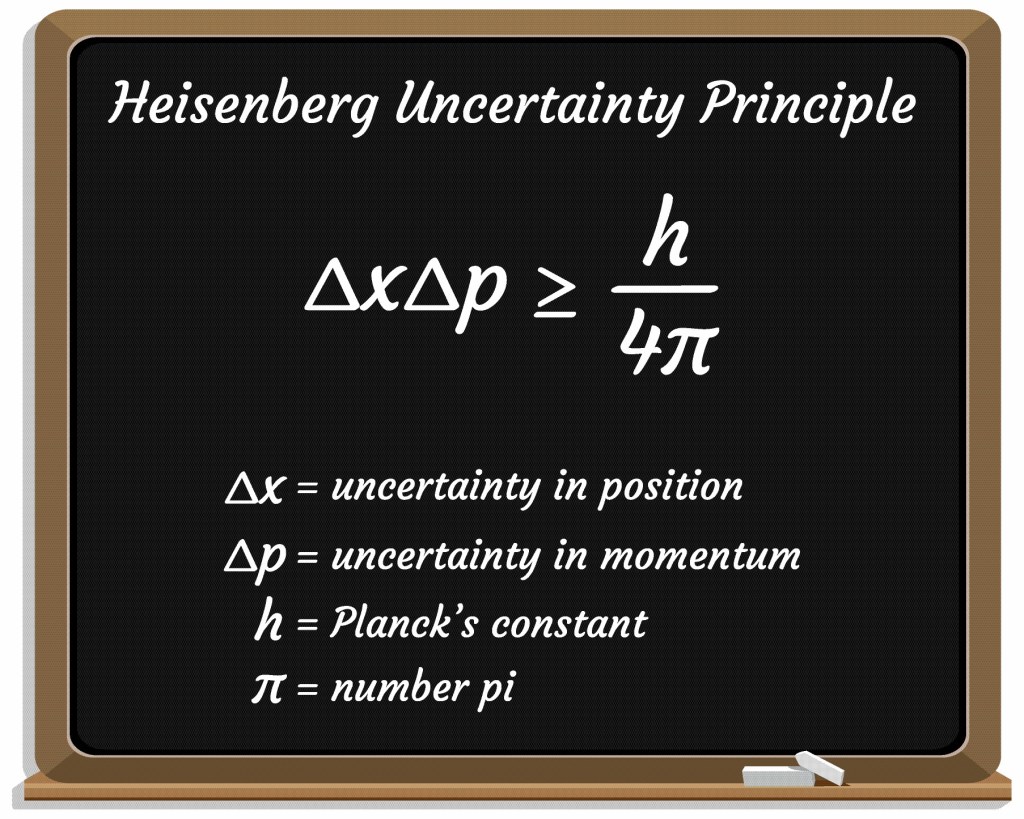
A famous but simple formula from quantum mechanics is the Heisenberg uncertainty principle which states that you cannot both know the exact position and momentum (that is mass times velocity) of a particle. Another version of it states that you cannot both know the exact energy and the time interval to measure it. Basically, it is impossible to know a particle’s quantities exactly. They don’t even exist other than as probabilities.
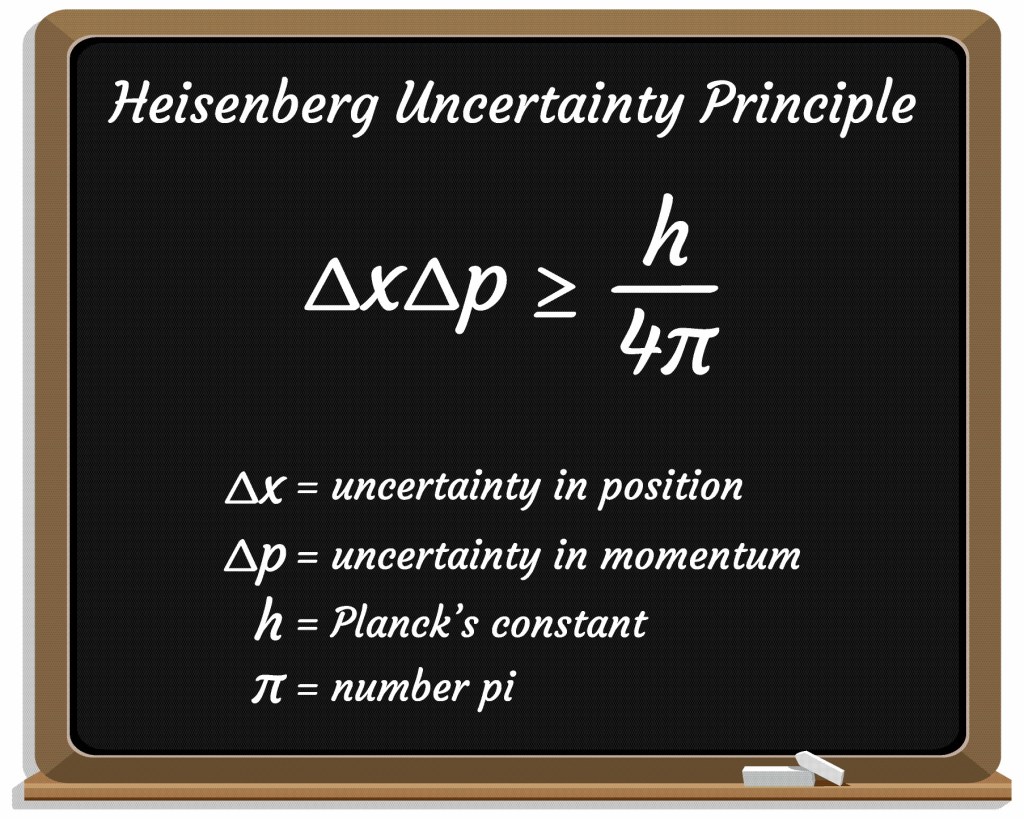
The picture shows the formula for the Heisenberg uncertainty principle  | Modern Physics is Fundamentally Different from Classical Physics
Heisenberg uncertainty principle Shutter Stock Vector ID: 2380436193 by Sasha701

The difference between how things work in classical physics and in modern physics is very large. The language and philosophy of classical physics and modern physics is not even the same. I believe that the fact that there is such a large and distinct difference between the two phases of physics comes as a big surprise to those who were unaware of it. Since this fact is important and potentially surprising, perhaps mind-blowing, it is a super fact in my opinion.

It is easy to think that modern physics is philosophical, mysterious, esoteric, and impractical. It is not. Pretty much all of the electronics you have ever used exist because of modern physics. Modern physics is also essential for lasers, MRI and PET scans, modern medicine, nuclear power, nuclear weapons, GPS, atomic clocks, solar power, small-scale nanotechnology, and a large amount of new materials. That might be a super fact all in itself.

Special Relativity

Relativity comes in two flavors, special relativity and general relativity both pioneered by the physicist Albert Einstein. Special relativity states that the speed of light in vacuum is a universal constant c = 299,792,458 meters per second. The speed of light in vacuum is the same for all observers regardless of their speed and the direction in which they are going. It is always c = 299,792,458 meters per second. If you try to catch up to a light beam and try to travel close to the speed of the light beam, you will not be able to catch up. The speed of the light beam will still be c = 299,792,458 meters per second compared to you no matter how fast you go. In fact, anything without (rest) mass will travel at exactly this speed compared to everything else, whilst nothing else could ever reach or exceed this speed.
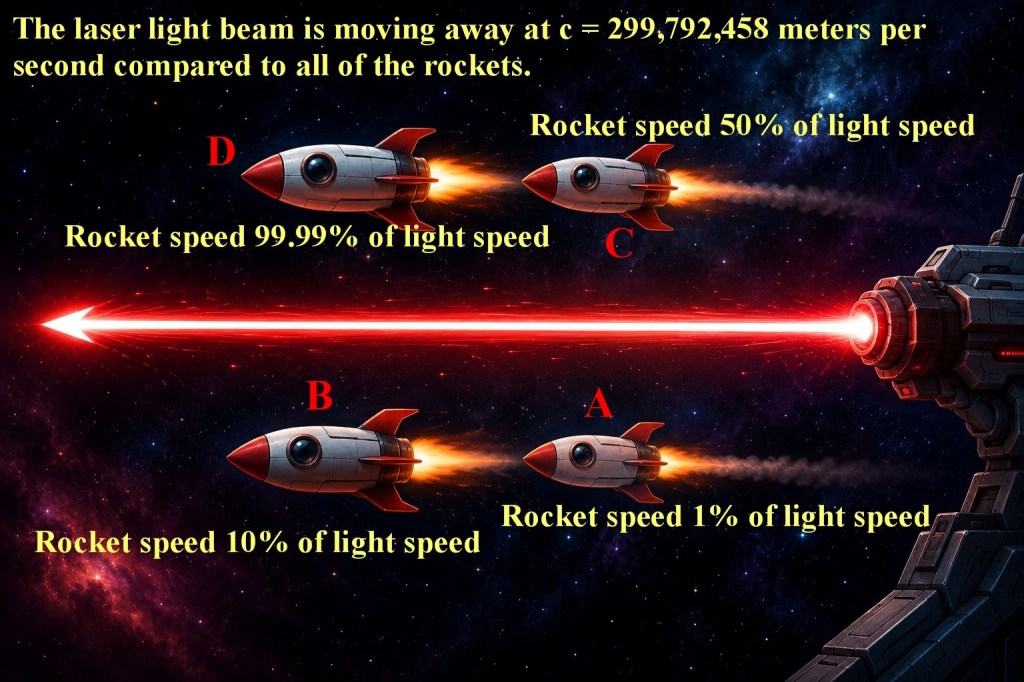
A spaceship on the right is shooting out a laser beam towards the left. Alongside the laser beam are four rockets trying to catch up with the light beam.
Four rockets, A, B, C, and D, are traveling along a light (laser) beam. No matter how fast they travel along the light beam, the light beam will always travel c = 299,792,458 meters per second faster than they do. I generated this picture with the help of ChatGPT.

Some consequences of this is that there is no universal now, two events may be simultaneous for some but not for others, two observers moving compared to each other will both observe the other’s time as being slower, and energy and mass are interchangeable, and time acts like a fourth dimension.
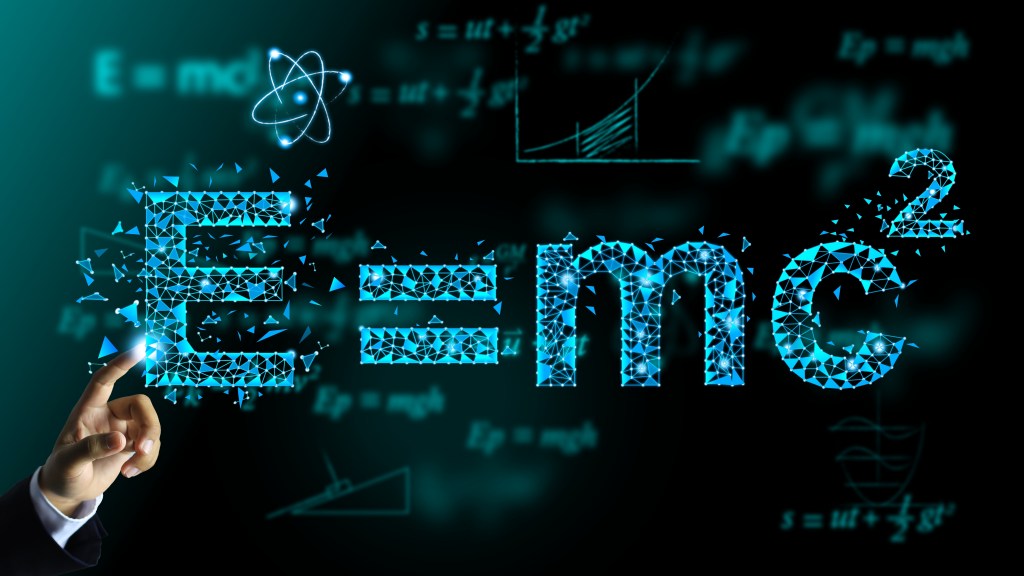
The E = mc2 formula | Modern Physics is Fundamentally Different from Classical Physics
Mass is energy and vice versa, a direct result of the way time and space are related. Stock Photo ID: 2163111377 by Aree_S
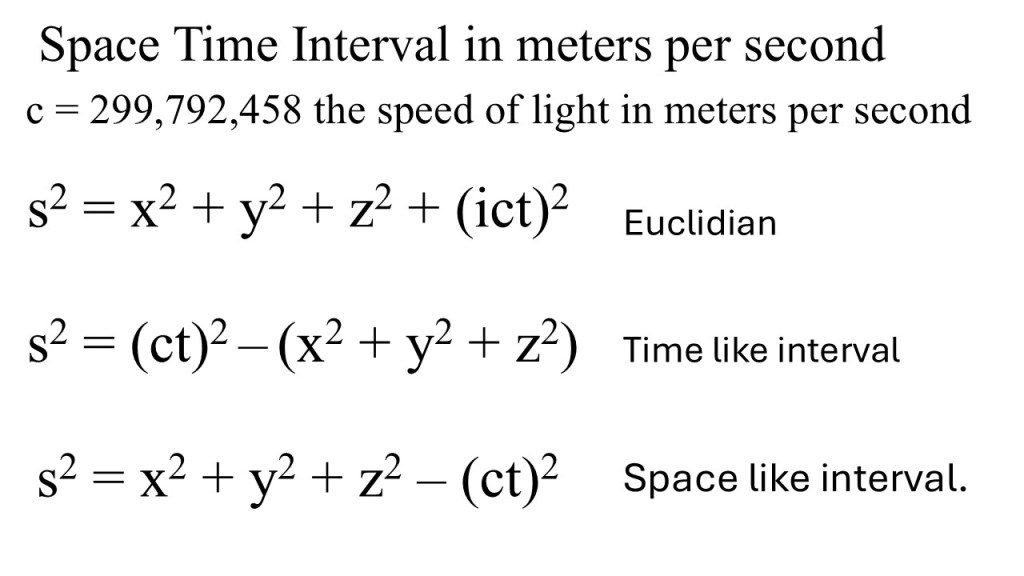
The image shows the formulas for the spacetime interval with the constant representing the speed of light in vacuum “(s^{2}=x^{2}+y^{2}+z^{2}+(ict)^{2}”,  “s^{2}= (ct)^{2} – (x^{2}+y^{2}+z^{2})” and “(s^{2}=x^{2}+y^{2}+z^{2}-(ct)^{2}”.
If you measure the space coordinates in meters and the time in seconds you must adjust the units to match by inserting the speed of light in vacuum c = 299,792,458. The three forms of the space interval now have the constant c attached to the time coordinate.

General Relativity

In General Relativity gravity is not viewed as a force over distance. Mass / energy is distorting the local space-time creating the effects of gravity. Even though the end result is very similar to Newton’s theory of gravity, the General Theory of Relativity is much more accurate. The General Theory of Relativity also predicts that clocks will be running slower in gravitational fields. It predicts gravity waves, and the strange behavior of black holes, and it is necessary for GPS to work.
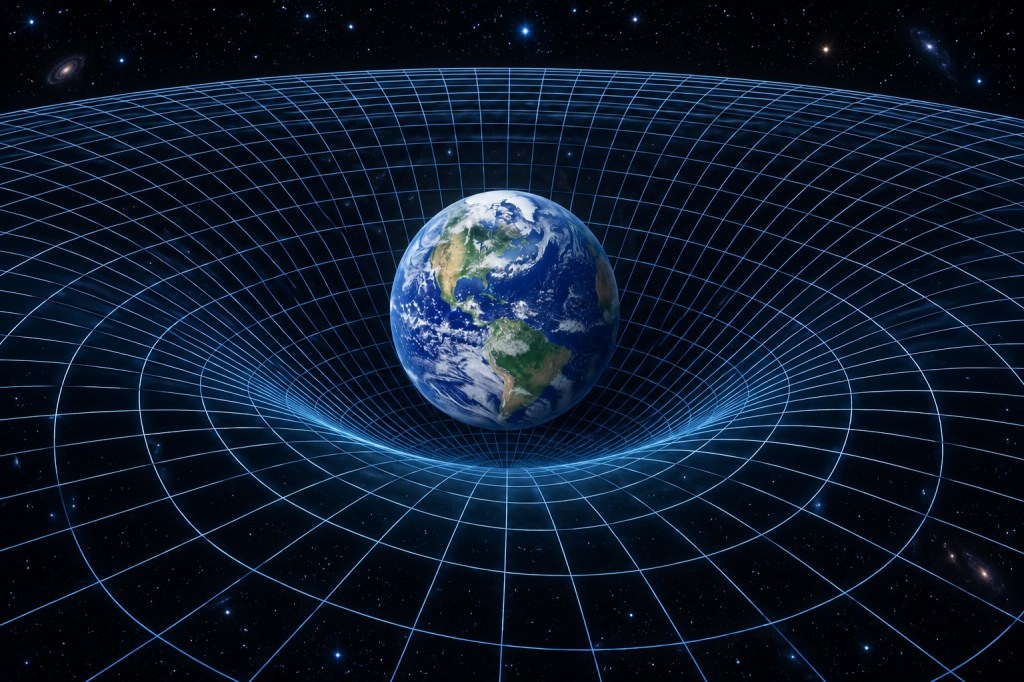
The picture shows planet Earth in the middle surrounded by a bent grid with Earth in a gravity well.
Earth is a mass that distorts space-time resulting in what we call gravity.
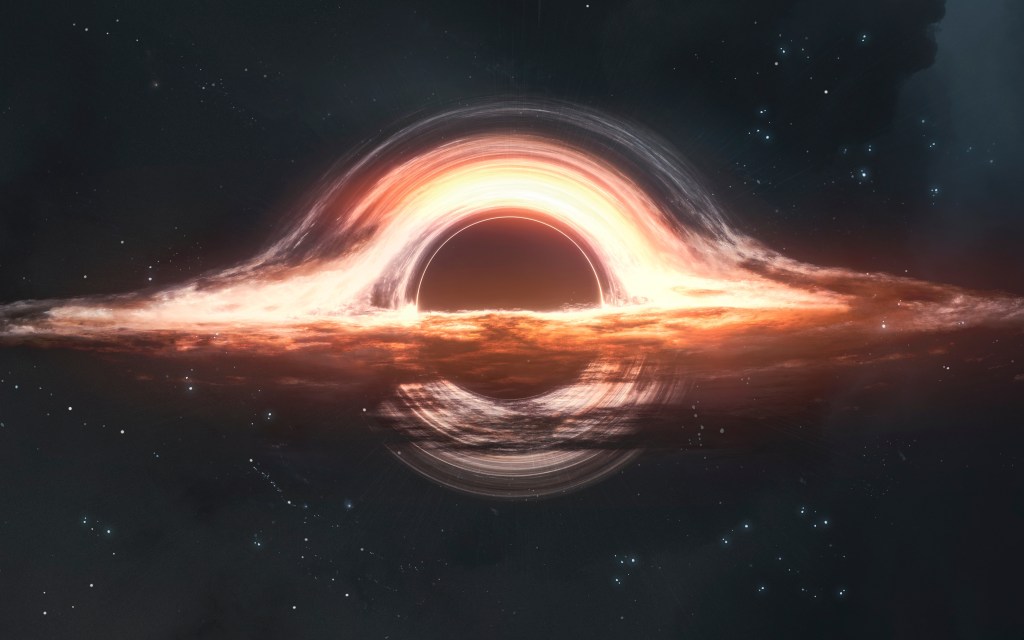
A black hole with a large bright accretion disk.
3D illustration of giant Black hole in deep space. High quality digital space art in 5K – realistic visualization. Stock Illustration ID: 2476711459 by Vadim Sadovski.

Quantum Physics

As mentioned, in quantum physics, particles do not have specific positions or velocities. See the Heisenberg uncertainty principle above. In quantum physics you have probabilities instead of certainties, and energy is quantized. The electrons (and other particles) in atoms are described as probability clouds. Particles behave as both particles and waves, the so called wave particle duality. Particles exhibit both wave-like and particle-like properties depending on the type of measurement. An example is the famous double slit experiment.

If you shoot electrons, or any particle, through a double slit (panel with two slits) they will show up on the detector panel behind the first panel as if they were a wave. There will be interference patterns (multiple bands), the same as you would get from light waves or water waves. You will even get the interference pattern if you shoot the electrons one by one. However, if you try to detect the individual electrons to see which slit they went through you will get just two bands as if the electrons were bullets going through the slits. In other words, if you look at them, they won’t do the beautiful interference pattern anymore, as if they are saying, “if you look at me, I won’t do it”.
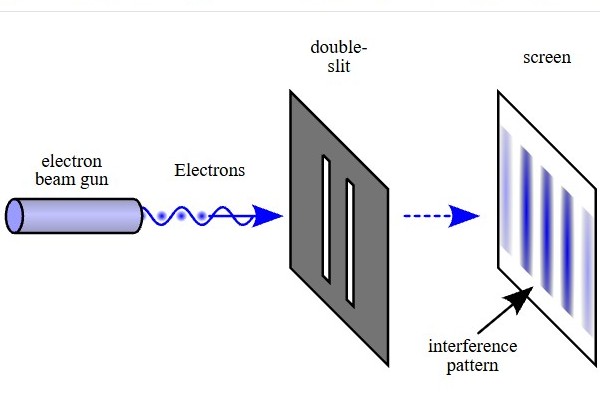
The experimental setup is an electron gun on the left. Electrons are shot towards a panel with two slits. Behind that panel is another panel which displays an interference pattern with multiple bands. | Modern Physics is Fundamentally Different from Classical Physics
Photons or matter (like electrons) produce an interference pattern with multiple bands when two slits are used. Original: NekoJaNekoJa Vector: Johannes Kalliauer, CC BY-SA 4.0, via Wikimedia Commons.

One amazing discovery was that of anti-particles / anti-matter. Anti-matter was predicted in 1928 by the physicist Paul Dirac when he combined quantum mechanics with Albert Einstein’s special theory of relativity. A few years later (1932) the anti-particle of the electron, called the positron was discovered. Since then, many anti-particles have been found. I can add that Matter and anti-matter annihilate upon contact releasing enormous amounts of energy.
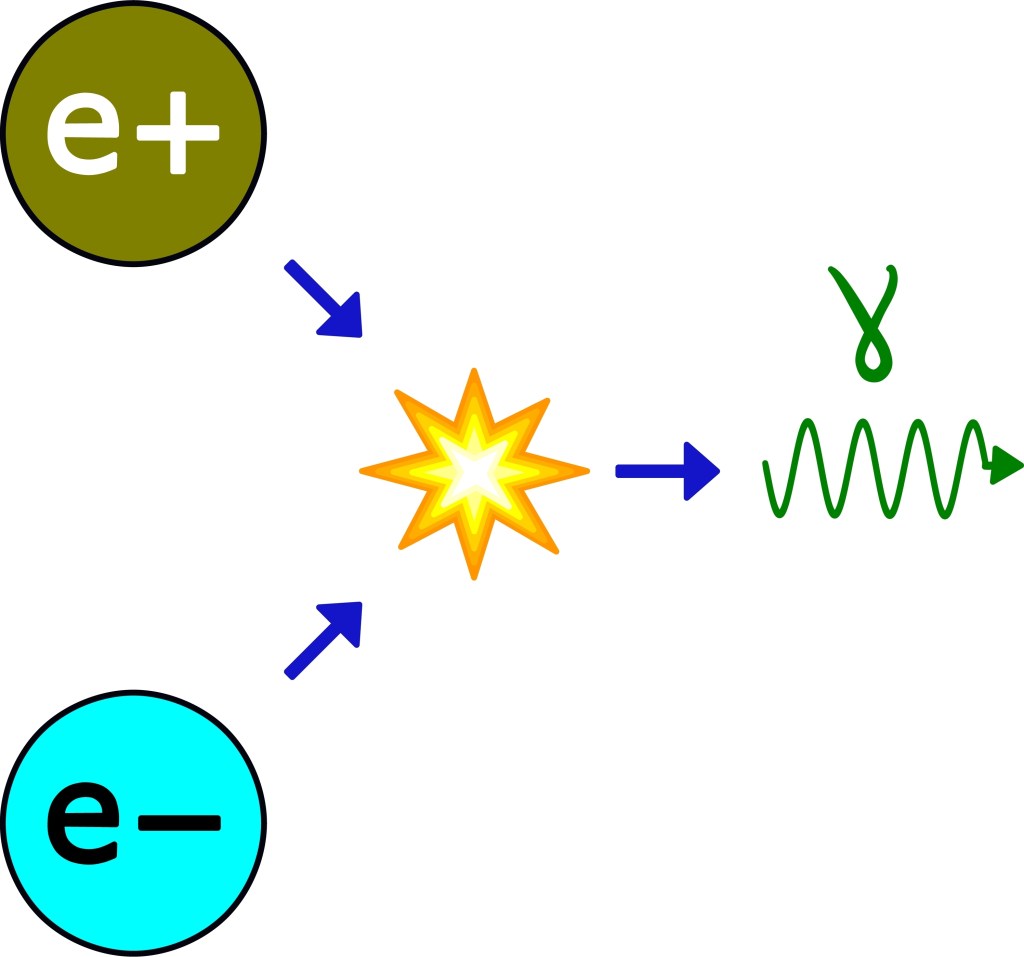
The pictures show a positron and an electron merging in an explosion with a wavelike photon emerging on the right.
Annihilation of a positron (at the top left) and an electron (bottom left) with the release of energy and gamma quanta Shutterstock asset id: 2200151693 by Sergey Merkulov

Conclusion

Going from classical physics to modern physics represented a huge quantum leap forward (pun intended) both with respect to our understanding of the Universe and the technological revolution this shift (paradigm shift) caused.

My Other Responses to Esther’s Prompts

To see the Other Super Facts click here

Some Things Cannot be Known

Superfact 2 : Some Things Cannot Be Known

Some things cannot be known. There are things in mathematics and about our physical world that we know can never be known. For example, we can’t simultaneously know both the exact speed and the exact position of small particles (Heisenberg uncertainty principle). This is not because of a limitation of our instruments. It is a fundamental property of the Universe. But there are more examples of unattainable knowledge. In mathematics there are true statements that can never be proven.

“This”Some Things Cannot be Known” is the third post on my super-factful blog. As mentioned, the goal of this blog is to create a long list of facts that are important and known to be true, yet either disputed by large segments of the public or highly surprising or misunderstood by many. They are facts that are so unnecessarily controversial or astounding that I refer to them as super-facts.

This post is about a fact that may be highly surprising to many. Science knows a lot. People without a solid education in science are often surprised when they find out about some of the amazing things we actually do know.

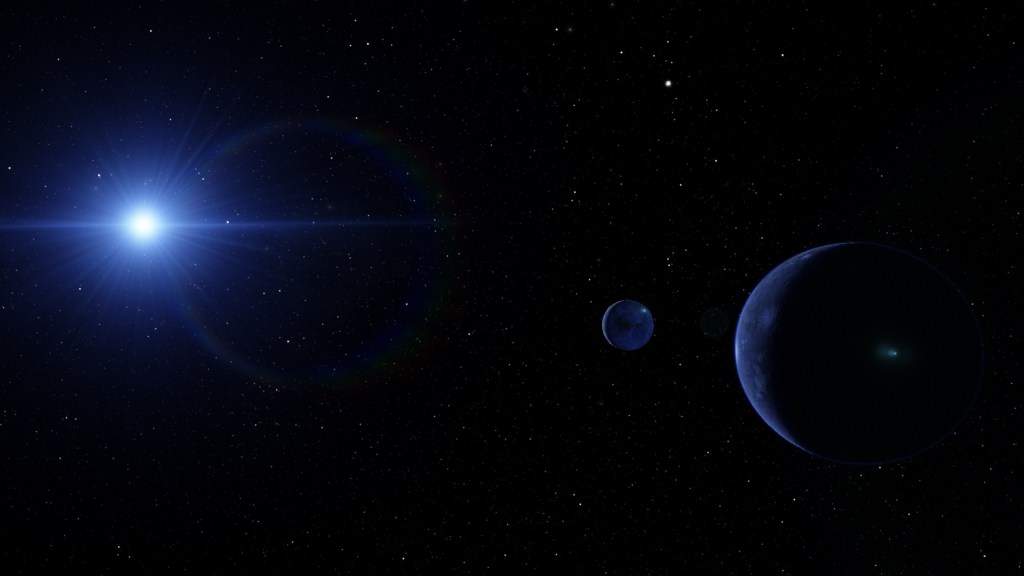
For example, just by studying the light from a distant star, we can determine what elements it is composed of. The star may be composed of 71% hydrogen, 27% helium, 1% Lithium, and 1% other elements, and we can know that just from its light. We can also determine its temperature, the distance to the star, how it is moving compared to us, where it will be 2.5 million years from now, roughly its age and longevity, and more. 150 years ago, we could not have dreamed of this capability.

Bright white star with a planet and a moon | Some Things Cannot be Known
We can know so much about a star from its light. Shutter Stock Illustration ID: 566774353 by Nostalgia for Infinity.

However, there are also many things we don’t know, and what may come as a big surprise, we know that there are things we can never know, no matter how advanced science becomes. Infinite experimentation, super intelligence, a quintillion super geniuses, infinite time, we simply cannot acquire some knowledge. The universe itself forbids some knowledge. It also means that the statement “nothing is impossible” is false.

At least my natural reaction to such a claim is, “come on you can’t say that with certainty”, and I expect many others will feel the same. However, the reason some knowledge will never be attainable is that physical laws as well as mathematics and logic forbid some knowledge. Some things are not meant to be known. I will give four examples in the four sections below: the event horizon, the Heisenberg uncertainty principle, beyond the observable Universe, and Gödels incompleteness theorem.

The Event Horizon of a Black Hole

A black hole is a region of spacetime where gravity is so strong that nothing, including light, can escape it. The boundary of no escape is called the event horizon. If you pass the event horizon you cannot come back out no matter how much energy, you expand. Nothing can escape, no matter, no radiation, not light or other electromagnetic radiation, and no information. Nothing at all can escape. The curvature of time and space itself forbids it.

I should add that right at the event horizon, there is so called Hawking radiation, but without complicating things it is not the same thing as escaping a black hole. You can guess from physical laws what might be inside, but you can never observe and report what is inside to planet Earth.

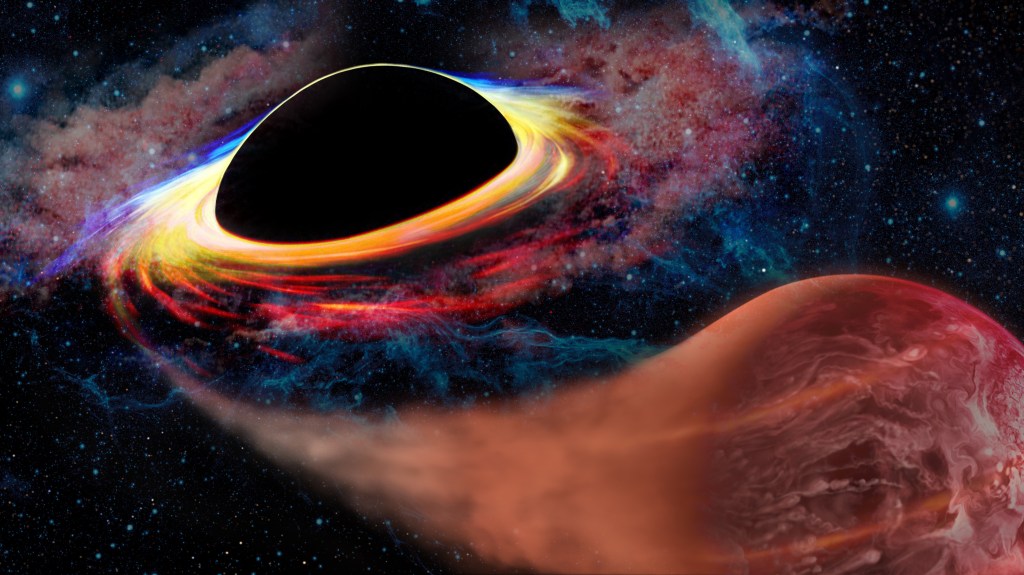
Black hole devouring a planet.
Black Hole Stock Photo ID: 2024419973 by Elena11

I would also like to add some basic information about black holes. Some black holes are formed when large stars die and collapse. These black holes are estimated to have a mass of five to several tens of solar masses. However, there are also super massive black holes that reside in the center of galaxies.

The super massive black hole at the center of our galaxy, the Milky Way, is called Sagittarius A* and is estimated to have a mass of four million times the mass of our sun. The largest known supermassive black hole TON 618 is 66 billion times more massive than our sun. There are an estimated 100 million black holes in our own galaxy, the Milky Way. One interesting fact is that celestial objects can orbit a black hole, just like planets orbit the sun, but as you get too close you will rush, at the speed of light, into the depths of the black hole.

The Heisenberg uncertainty principle

The Heisenberg uncertainty principle states that it’s not possible to know the position and momentum of an object with perfect accuracy at the same time. Another way of saying that is that we cannot know both the position and speed of a particle, such as a photon or electron, with perfect accuracy. The formula is: dX * dP >= h/4pi , or uncertainty in position (dX) times uncertainty in momentum (dP) is larger than half of Planck’s constant.  There is also an energy and time precision limit : dT * dE >= h/4pi.

These equations basically means that there are no perfectly exact measurements or knowledge. Everything is a bit fuzzy. Planck’s constant is very small, so Heisenberg uncertainty principle does not matter for everyday objects, but it matters when sizes are very small (positions, energies, etc.) Note, Heisenberg uncertainty principle is not because of a limitation of our equipment, but a limit set by a law of physics. It is a limitation set by the Universe if you will.

The picture shows the formula for the Heisenberg uncertainty principle
Heisenberg uncertainty principle Shutter Stock Vector ID: 2380436193 by Sasha701

Beyond the observable Universe

The observable universe is a ball-shaped region of the universe consisting of all matter that currently can be observed from Earth or its space-based telescopes. The radius of the observable universe is 46.6 billion light-years. The size of the observable universe is growing. Unfortunately, at those distances, space itself is stretching/expanding faster than the speed of light. Since no signal or information can travel faster than the speed of light we are losing, not gaining, celestial objects from the observable universe.

In the past we’ve lost many galaxies this way. Since the expansion is accelerating, we will keep losing more galaxies beyond the boundary of the universe and some galaxies were always lost (with respect to observation). I can add that the universe may be infinite.

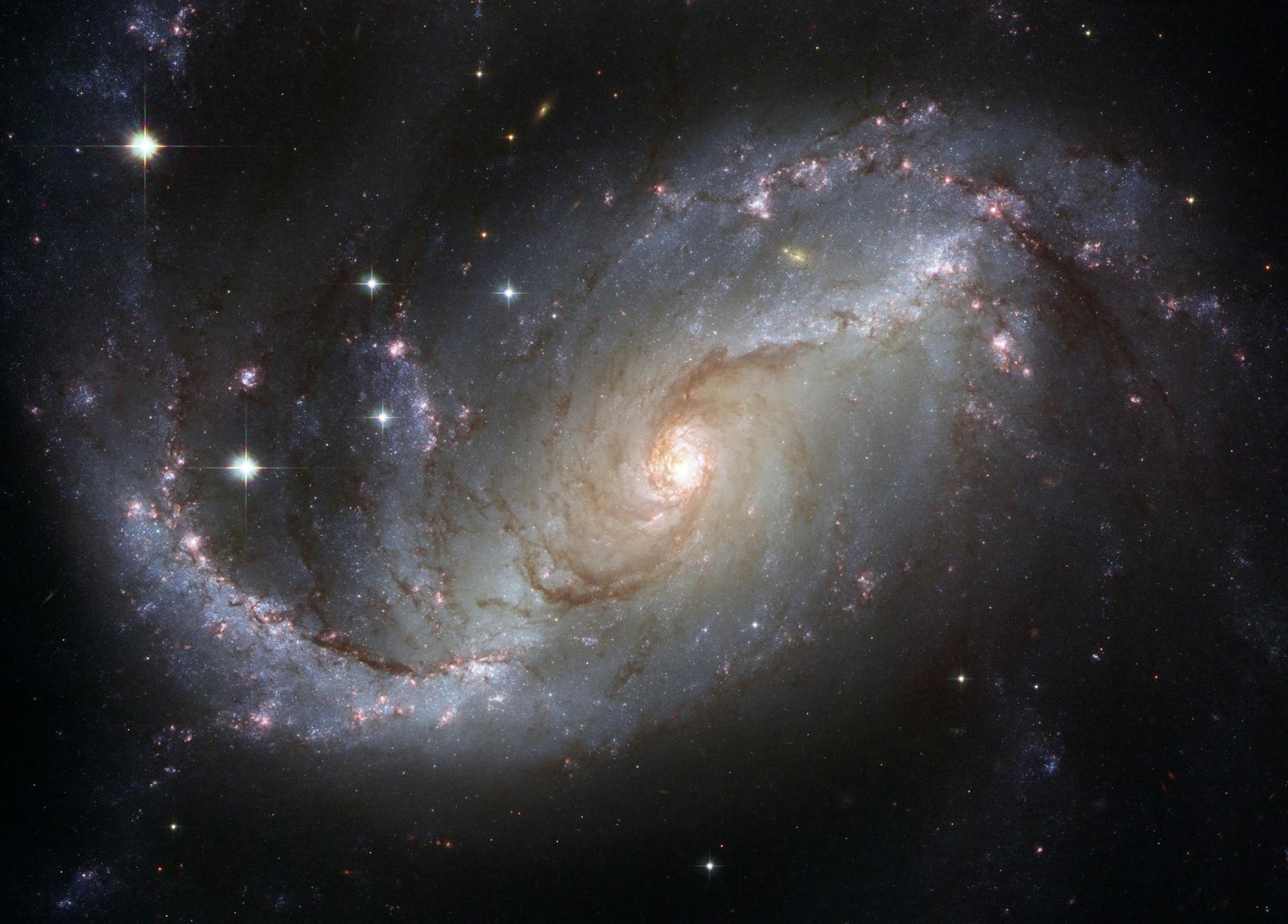
A picture of a galaxy full of stars.
A view of a galaxy full of stars. Photo by Pixabay on Pexels.com

If we are wrong about the fact that the expansion of the universe is accelerating, then perhaps we can observe more galaxies in the future. But if not, then there are galaxies that we have never observed, galaxies that we can never observe, and there are galaxies that will become unobservable in the future. Depending on the size of the universe we may never be able to observe more than an infinitesimally small portion of the universe. Again, the universe is stopping us from knowing something.

Gödels incompleteness theorem(s)

The theorem states that in any reasonable mathematical system there will always be true statements that cannot be proved. In other words, to find a complete and consistent set of axioms for all mathematics is impossible. There are forever hidden truths in mathematics. For the case of natural numbers this means that there will always be statements about natural numbers that are true, but that are unprovable. I can add that there is also a second incompleteness theorem that states that a formal system cannot prove that the system itself is consistent. Basically, there are limits to mathematics set by logic. And some things cannot be known.

Some Things Cannot be Known
I have a book on Gödels incompleteness theorem, which I have not read, but I will read it before I make a post about it. Photo by Andrea Piacquadio on Pexels.com


To see the other Super Facts click here