
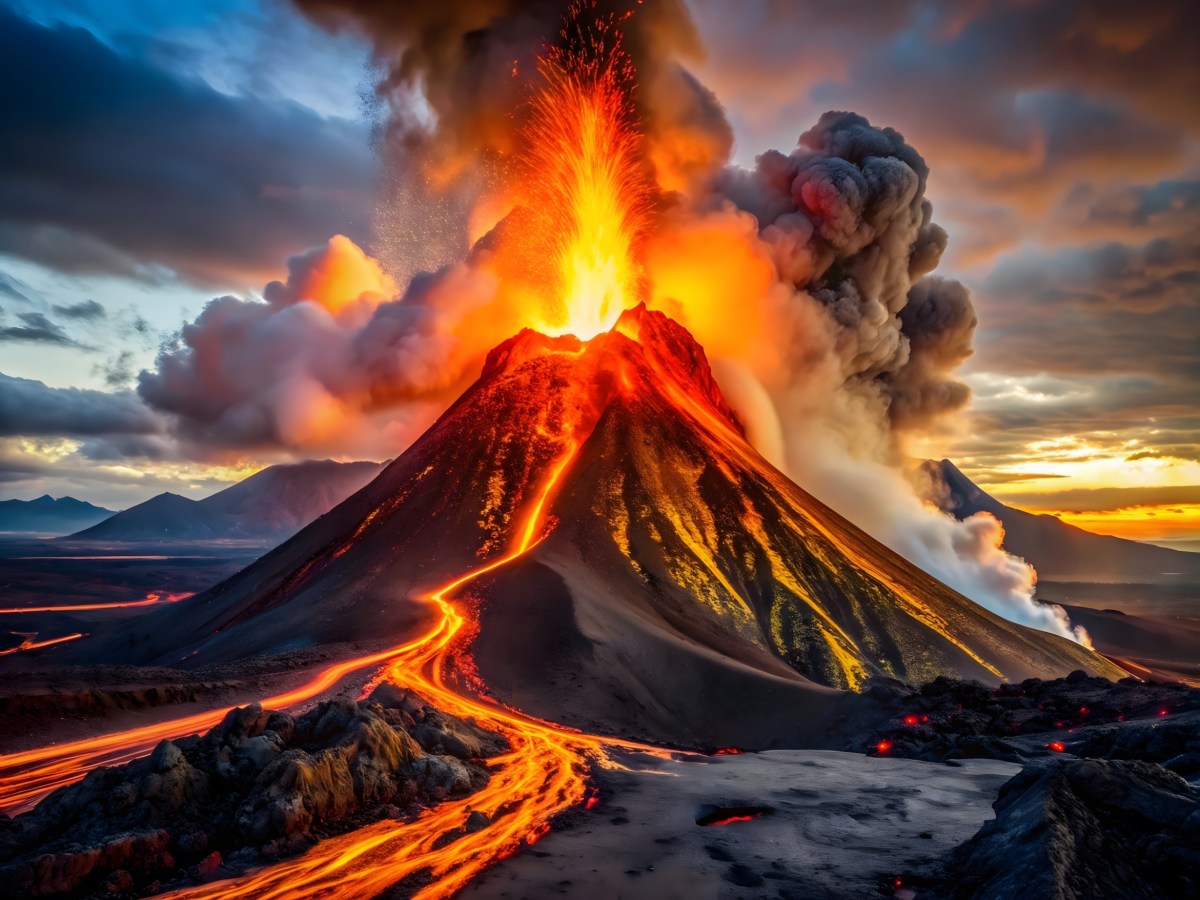
Superfact 125: Volcanoes emit about 0.2 to 0.6 billion metric tons of carbon dioxide per year globally. Our burning of fossil fuels and industrial activities release more than 35 billion metric tons annually. Human emissions are roughly 60 to 100 times greater than all global volcanic output combined. Thus, volcanoes are not the cause of the current rapid global warming.
Have you ever seen claims on social media such as “a single volcanic eruption release as much CO2 as all of humanity has to date? Or 100 times as much? Or 10,000 times as much? As Snopes explains this is of course nonsense. I’ve seen this kind of claim many times and I’ve seen in the comment sections that a lot of people fall for them. That makes me wonder about people’s critical thinking skills as well as Facebook’s alleged fact checking.
As the super-fact above states, volcanoes emit about 0.2 to 0.6 billion metric tons of carbon dioxide per year globally. Our burning of fossil fuels and industrial activities release more than 35 billion to 38 metric tons annually. Thus, volcanoes emit only a small fraction of CO2 compared to what we do burning fossil fuels. Which also means that volcanoes are not the cause of the current rapid global warming. You can read more about this here, or here, or here, or here.
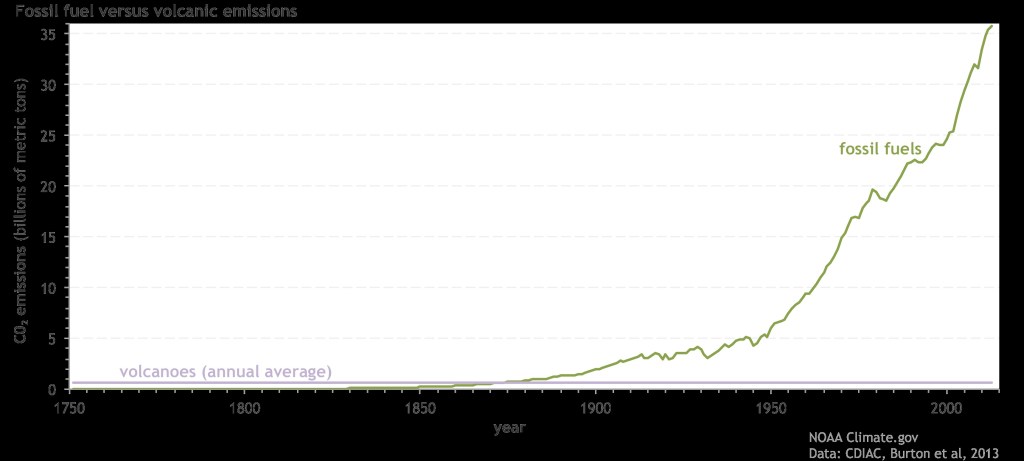
The graph above compares human carbon emissions (green line) with carbon emissions from volcanic eruptions (purple line). Human carbon emissions (the burning of fossil fuels and cement production) correspond to 35 billion metric tons annually while volcanic emissions are less than one ton annually. The graph is based on data from the Carbon Dioxide Information Analysis Center (CDIAC) at the DOE’s Oak Ridge National Laboratory and Burton et al., 2013.
Since so many people so quickly believe the disinformation, this fact should be surprising to a lot of people, and it is kind of important. Therefore, I consider it a super fact.
How do Volcanoes Affect Climate?
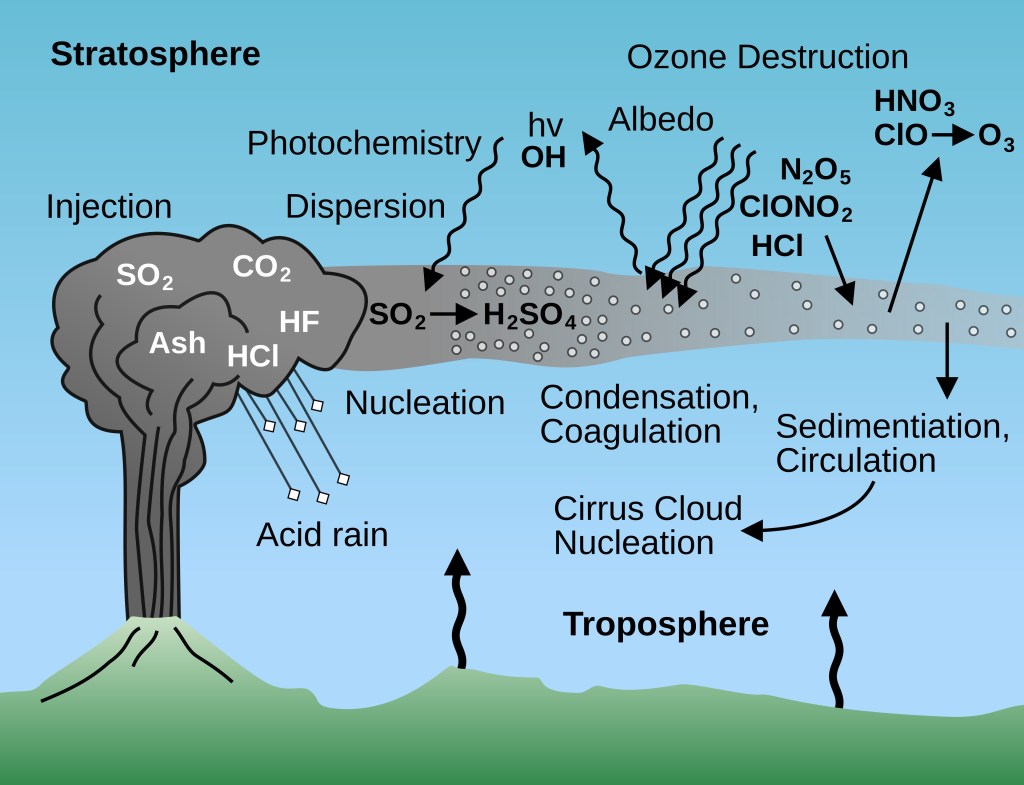
The emissions from volcanoes and their effect on climate are complicated. A large volcanic eruption can result in a lot of carbon emissions during a short period of time, but that typically does add up to being substantial in comparison to our annual anthropogenic carbon emissions. However, volcanic emissions include other gases that are not greenhouse gases, particularly Sulphur dioxide, which acts like an aerosol reflecting sunlight. This results in a more noticeable effect, but it is not a warming effect, but a cooling effect.
Long story short, when a volcano has a massive explosion, it shoots sulfur dioxide gas high up into the stratosphere, it mixes with water to make tiny liquid drops that reflect sunlight away from Earth. This causes global temperatures to drop for one to three years. In addition, to some global cooling volcanic eruptions can deplete Earth’s Ozone layer. However, as mentioned the amount of carbon dioxide released from volcanic eruptions is negligible compared to our emissions from burning fossil fuels.
How did Volcanoes Affect Climate in the past?
It has been proposed that intense volcanic release of carbon dioxide in the deep geologic past did cause global warming back then, and possibly some mass extinctions. This is a topic of scientific debate. However, whether these eruptions caused global warming or not, their intensity and the circumstances under which they happened were much different from today.
Unlike the single eruptions that cool the Earth with ash and sulfur today, these rare ancient eruptions were giant outpourings that lasted hundreds of thousands of years, or millions of years, and overwhelmed the planet’s natural carbon cleanup systems. Instead of coming from a single mountain peak, the magma poured out of giant cracks, or fissures, in the earth.
The Permian-Triassic extinction or the Paleocene-Eocene Thermal Maximum (PETM) 56 million years ago is thought to possibly have been such an event. It could also have been that volcanic eruptions caused the sudden release of methane hydrates from ocean sediments.

A Couple of Videos and Links
The video below is a short one-minute overview of the causes behind global warming.
The video below from NASA is a bit longer, 13 minutes, but it gives a more detailed overview. Click here to see the page from where this is coming from.
Conclusion
This is my third post in the series about natural causes of climate change that we know are not the cause of the current rapid global warming / climate change (I use both words interchangeably). The fact that no known natural cause for climate change can explain the current rapid global warming is just one small piece of the evidence. However, it is a piece that people tend to get stuck on a lot. You often hear claims such as “climate has always changed”. “I think it is a natural cause”.
Unlike the sun and orbital cycles carbon emissions from erupting volcanoes would warm the lower atmosphere while cooling the upper atmosphere, just like our burning of fossil fuels does, and the warming would distribute in time and geography in a similar way. However, we know that the carbon emissions from volcanoes are relatively tiny compared to the emissions from the burning of fossil fuels.
In addition, isotope studies show that the origin of the greenhouse gases added to the atmosphere are from burning fossil fuels. This is referred to as the isotopic footprint. These two reasons are how we know that it cannot be volcanoes that are causing the current rapid warming. Here is an additional long list of answers to common questions and objections to human caused global warming.
Other super facts related to global warming
- Global Warming is Happening and is Caused by us
- The Hockey Stick Graph is not Wrong
- Scientists Agree that Global Warming is happening and that we are the Cause
- Climate change worsens wildfires in the US
- Without carbon dioxide the Earth would freeze
- IPCC Did Not Backtrack on Global Warming Being Human Caused
- Orbital Cycles are not the Cause of the current Global Warming
- The Sun is not the Cause of the current Global Warming

