
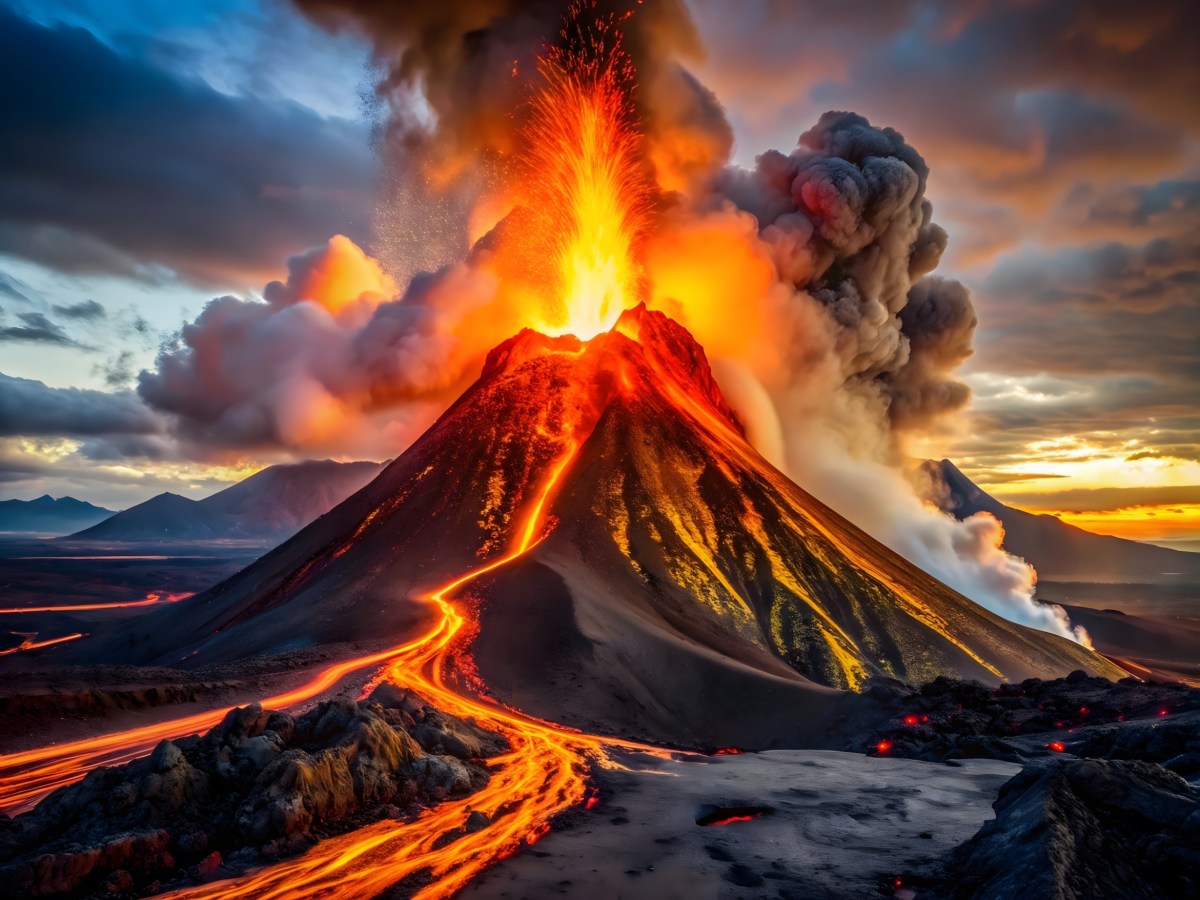
Superfact 125: Volcanoes emit about 0.2 to 0.6 billion metric tons of carbon dioxide per year globally. Our burning of fossil fuels and industrial activities release more than 35 billion metric tons annually. Human emissions are roughly 60 to 100 times greater than all global volcanic output combined. Thus, volcanoes are not the cause of the current rapid global warming.
Have you ever seen claims on social media such as “a single volcanic eruption release as much CO2 as all of humanity has to date? Or 100 times as much? Or 10,000 times as much? As Snopes explains this is of course nonsense. I’ve seen this kind of claim many times and I’ve seen in the comment sections that a lot of people fall for them. That makes me wonder about people’s critical thinking skills as well as Facebook’s alleged fact checking.
As the super-fact above states, volcanoes emit about 0.2 to 0.6 billion metric tons of carbon dioxide per year globally. Our burning of fossil fuels and industrial activities release more than 35 billion to 38 metric tons annually. Thus, volcanoes emit only a small fraction of CO2 compared to what we do burning fossil fuels. Which also means that volcanoes are not the cause of the current rapid global warming. You can read more about this here, or here, or here, or here.
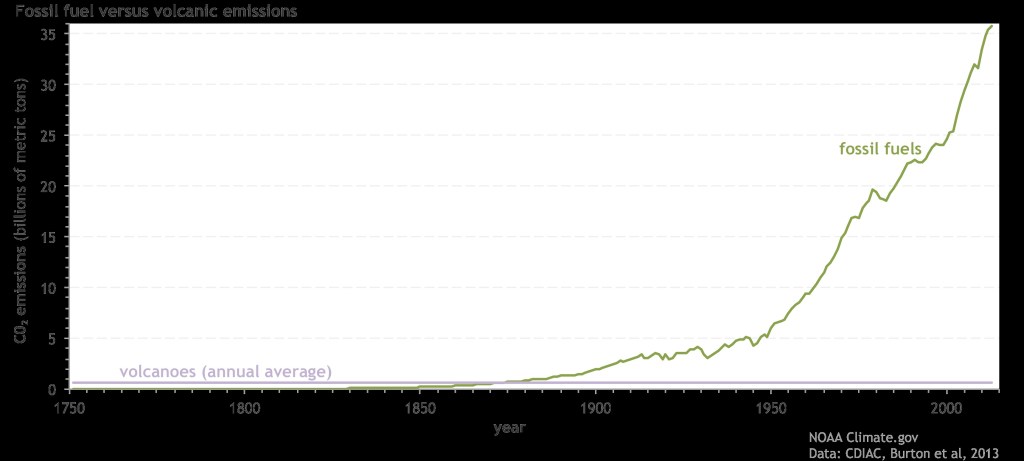
The graph above compares human carbon emissions (green line) with carbon emissions from volcanic eruptions (purple line). Human carbon emissions (the burning of fossil fuels and cement production) correspond to 35 billion metric tons annually while volcanic emissions are less than one ton annually. The graph is based on data from the Carbon Dioxide Information Analysis Center (CDIAC) at the DOE’s Oak Ridge National Laboratory and Burton et al., 2013.
Since so many people so quickly believe the disinformation, this fact should be surprising to a lot of people, and it is kind of important. Therefore, I consider it a super fact.
How do Volcanoes Affect Climate?
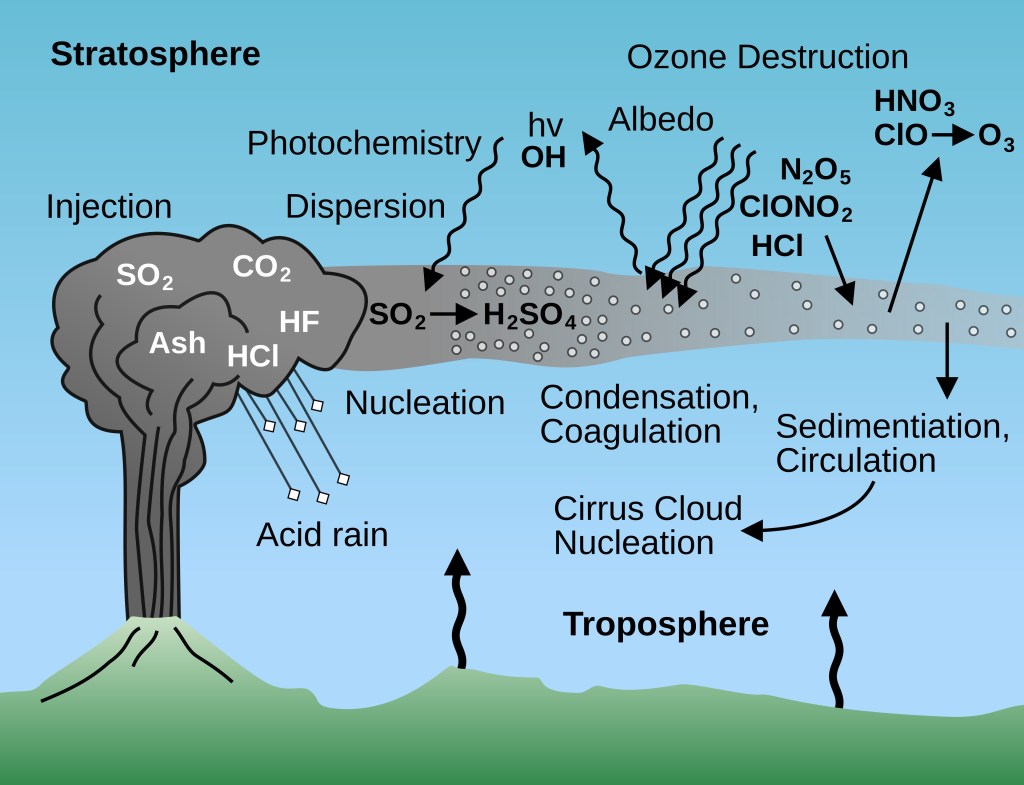
The emissions from volcanoes and their effect on climate are complicated. A large volcanic eruption can result in a lot of carbon emissions during a short period of time, but that typically does add up to being substantial in comparison to our annual anthropogenic carbon emissions. However, volcanic emissions include other gases that are not greenhouse gases, particularly Sulphur dioxide, which acts like an aerosol reflecting sunlight. This results in a more noticeable effect, but it is not a warming effect, but a cooling effect.
Long story short, when a volcano has a massive explosion, it shoots sulfur dioxide gas high up into the stratosphere, it mixes with water to make tiny liquid drops that reflect sunlight away from Earth. This causes global temperatures to drop for one to three years. In addition, to some global cooling volcanic eruptions can deplete Earth’s Ozone layer. However, as mentioned the amount of carbon dioxide released from volcanic eruptions is negligible compared to our emissions from burning fossil fuels.
How did Volcanoes Affect Climate in the past?
It has been proposed that intense volcanic release of carbon dioxide in the deep geologic past did cause global warming back then, and possibly some mass extinctions. This is a topic of scientific debate. However, whether these eruptions caused global warming or not, their intensity and the circumstances under which they happened were much different from today.
Unlike the single eruptions that cool the Earth with ash and sulfur today, these rare ancient eruptions were giant outpourings that lasted hundreds of thousands of years, or millions of years, and overwhelmed the planet’s natural carbon cleanup systems. Instead of coming from a single mountain peak, the magma poured out of giant cracks, or fissures, in the earth.
The Permian-Triassic extinction or the Paleocene-Eocene Thermal Maximum (PETM) 56 million years ago is thought to possibly have been such an event. It could also have been that volcanic eruptions caused the sudden release of methane hydrates from ocean sediments.

A Couple of Videos and Links
The video below is a short one-minute overview of the causes behind global warming.
The video below from NASA is a bit longer, 13 minutes, but it gives a more detailed overview. Click here to see the page from where this is coming from.
Conclusion
This is my third post in the series about natural causes of climate change that we know are not the cause of the current rapid global warming / climate change (I use both words interchangeably). The fact that no known natural cause for climate change can explain the current rapid global warming is just one small piece of the evidence. However, it is a piece that people tend to get stuck on a lot. You often hear claims such as “climate has always changed”. “I think it is a natural cause”.
Unlike the sun and orbital cycles carbon emissions from erupting volcanoes would warm the lower atmosphere while cooling the upper atmosphere, just like our burning of fossil fuels does, and the warming would distribute in time and geography in a similar way. However, we know that the carbon emissions from volcanoes are relatively tiny compared to the emissions from the burning of fossil fuels.
In addition, isotope studies show that the origin of the greenhouse gases added to the atmosphere are from burning fossil fuels. This is referred to as the isotopic footprint. These two reasons are how we know that it cannot be volcanoes that are causing the current rapid warming. Here is an additional long list of answers to common questions and objections to human caused global warming.
Other super facts related to global warming
- Global Warming is Happening and is Caused by us
- The Hockey Stick Graph is not Wrong
- Scientists Agree that Global Warming is happening and that we are the Cause
- Climate change worsens wildfires in the US
- Without carbon dioxide the Earth would freeze
- IPCC Did Not Backtrack on Global Warming Being Human Caused
- Orbital Cycles are not the Cause of the current Global Warming
- The Sun is not the Cause of the current Global Warming
To see the other Super Facts click here


Another excellent article in your series.
LikeLiked by 2 people
Thank you so much Peter / Craigavad
LikeLike
Good to know that volcanoes only emit a small fraction CO2 compared to what we do burning fossil fuels, as it’s not always portrayed this way in the media. Intriguing that Sulphur dioxide creates a cooling effect; I didn’t know that!
LikeLiked by 1 person
Yes in fact the Mount Pinatubo eruption in 1991, which was a large eruption, lowered average global temperatures by about 0.5°C (0.9°F). This temporary cooling effect lasted for nearly two years, spanning from 1992 through 1993. However, the long term warming effect from the carbon dioxide emissions were too small to be estimated.
LikeLiked by 1 person
Lets get the obvious out of the way first
That makes me wonder about people’s critical thinking skills as well as Facebook’s alleged fact-checking.
These are both grossly overstated. Most people have no critical thinking skills.
Now, I’m no genius, but it seems logical that a volcano couldn’t have had much impact, since volcanoes have been around forever and we’re only now seeing signs of climate change. That is my simple way of looking at it.
LikeLiked by 4 people
Thank you Kevin. That is a good observation. I did not mention this, but there is a natural carbon cycle. There are continuous carbon emissions from various sources and then carbon dioxide is continously absorbed but slowly. Our emissions from burning fossil fuels are extra that is too large and fast so it builds up. It takes about a 1,000 years to fully be re-absorbed. I think my illustration of the glass bath tubs with a faucet and the drain in my post “High Wet-bulb Temperatures the Mass Killer in Heat Waves” illustrates this. Normally the faucet and the drain are in balance. That is the carbon cycle that volcanoes are part of. Now the faucet is running too fast due to our human emissions.
LikeLiked by 1 person
I found your post truly informative.
In Italy, Mount Etna, on the island of Sicily, has been erupting for days. Fortunately, it hasn’t caused much damage: it’s simply a fabulous spectacle.
However, Catania airport was forced to close for several days due to Etna’s eruptive activity.
LikeLiked by 2 people
Thank you so much Luisa. I can imagine that is fabulous spectacle. When we visited Costa Rica we saw a continuously erupting volcano, the Arenal volcano. From below the mountain you could see a littlt bit of red lava and hot rocks falling and the smoke. Like mount Etna it was a tourist attraction. If it started getting too active they evacuated, which had only happened once in recent history.
LikeLiked by 1 person
That sounds like an incredible experience, Thomas! Arenal must have been breathtaking to see in person. It’s amazing how these powerful volcanoes can become such beautiful tourist attractions, as long as we respect their strength just like we do with Etna.
LikeLiked by 1 person
Yes you have to be able to trust the volcano to be one of those that won’t suddenly erupt
LikeLiked by 1 person
🌹🌹🌹
LikeLiked by 1 person
Sadly, people often chose to follow the path of least resistance which includes taking the view that human activity is causing global warming. Accepting that human activities are causing global warming would require action to be taken to stop this situation. It is easier to be ignorant.
LikeLiked by 2 people
Thank you Robbie. I assume that in your first sentence you meant “…..which includes taking the view that human activity is NOT causing global warming. ” You are right doing something about it seems inconvenient. Another aspect about it is that the fossil fuel industry succeeded in making it a political talking point. Once an opinion on a topic has become a political talking point people will get dismissive and stubborn. It no longer matters what the science and evidence says.
LikeLike
You only need to look at photos of any large Asian city to see that nothing is being done to slow down emissions from vehicle traffic.
LikeLiked by 1 person
Yes vehicles are becoming more common in Asia. However, there’s been some progress. According to the University of Chicago, China has replaced a lot of cars with EVs lately, and renewables such as wind and solar and batteries has replaced a significant amount of coal (not enough but some) and therefore pollution in China has been reduced by 43% over the last ten years, resulting in Chinese life expectancy increasing by 2.2 years. One of my graphs in my post “The Unfolding Solar Power Boom“. I might make a post about this.
LikeLiked by 1 person
Great information Thomas, hopefully your message is getting out to those who need to read it. Maggie
LikeLiked by 1 person
Thank you so much Maggie. I really appreciate it.
LikeLiked by 1 person
I fact checked you (because that’s how I am!) and Grok agrees with you.
LikeLiked by 1 person
Thank you so much Jacqui for doing that. If I get it wrong I want to know.
LikeLiked by 1 person
Very interesting, I didn’t even know volcanos emitted carbon dioxide.
LikeLiked by 1 person
Thank you Pooja. I am glad you saw this before you saw the false claims on social media saying they emit much more than humans.
LikeLiked by 1 person
Yeah, I’m glad too. There are all kinds of crazy claims on social media.
LikeLiked by 1 person
Yes you are right. You have to google and check every claim you see on social media that you are not sure about.
LikeLiked by 1 person
Wow a great comprehensive post with so many great videos and info I’ll come back to! Hoping we can get a handle on it💕
LikeLiked by 1 person
Thank you so much for your kind words Cindy. I agree I am also hoping we can get a handle on it
LikeLiked by 1 person
You’re so very welcome, Thomas! I hope so as well!! 🥰❤️🩹🥰
LikeLiked by 1 person
Thank you so much Cindy.
LikeLiked by 1 person
❤️❤️❤️
LikeLiked by 1 person
Fascinating explanation of how volcanoes can both cool the planet in the short term and, under very different conditions, contribute to warming over geological timescales. The contrast between brief explosive eruptions and vast ancient volcanic outpourings really puts today’s climate processes into perspective. I had an idea that humans are far more destructive than volcanones, but your numbers were shocking.
LikeLiked by 1 person
Thank you so much Patricia. Yes volcanoes emit a tiny amount of carbon compared to us (except for the massive million year eruptions 250 million years ago). Despite that a lot of social media posts claim the opposite and a lot people fall for the deception.
LikeLiked by 1 person
Thomas, this was really clear and helpful. The comparison between volcanic CO₂ and human emissions says a lot, and the sulfur dioxide cooling effect was interesting to see laid out. A great read.
LikeLiked by 1 person
Thank you so much Kymber. I really appreciate your kind and supportive words. I’ve known this for a while but the first time I came across it I was surprised as well.
LikeLiked by 1 person
Great info as always. Thanks, Thomas.
LikeLiked by 1 person
Thank you so much for your kind words Denise
LikeLiked by 1 person
More fascinating facts. I would have thought for sure volcano erupting would be worse for the environment than humans. And also interesting that it would also drop temps a bit. Thanks for keeping us smart. 😋
LikeLiked by 1 person
I’ve known this for a while now but the first time I came across it I was surprised as well. Thank you so much Debby.
LikeLiked by 1 person
Thank you Thomas. 😁
LikeLiked by 1 person
I knew this before but your post was still very interesting, Thomas. People are the worst polluters and given all the denial, rather stupid, too.
LikeLiked by 1 person
Thank you so much Lynette. Some people know it. It is great you knew. And I agree with you.
LikeLiked by 1 person
Chaplin: “But you know, volcanoes are just so big and dramatic! So of course people are going to try to blame them for things. Just like when there’s a plane crash and everyone swears off flying for a while even though it’s so much safer than driving.”
Java Bean: “Ayyy, what?! Are you saying we should be taking a plane to the park instead of riding in the car?”
LikeLiked by 1 person
You are right Chaplin. Volcanoes seem very scary and powerful. It is easy to fool people with wrong claims using volcanoes. I saw a volcanic eruption from a distance when we visited Costa Rica. We were never in danger but it is an ominious foreboding feeling to watch it. Ha ha Java Bean, maybe you are right. I remember 9/11 and people at work refused to travel by plane when traveling in business. They drove across the country instead. The Germans even refused to go home for a while because they were afraid of flying.
LikeLike
Thanks for posting this and that readers absorb the information.
LikeLiked by 1 person
Thank you so much for your kind words Forestwood
LikeLiked by 1 person
Værsågo Thomas!
LikeLiked by 1 person
Tack så mycket!
LikeLike
😃
LikeLiked by 1 person
Facebook fact checks? 😒I have seen those claims about volcanoes. Some people are desperate to relieve mankind (and their behavior) from blame for the changing climate. (And I don’t believe that climate change is abnormal in and of itself. It is always changing. However, the PACE at which it is changing is the real issue.)
LikeLiked by 1 person
Thank you rangewriter. You are right the pace at which climate is changing now is unprecendent in the geological record. It is vert fast. In addition, human civilization developed during a period of relative stability. Sudden changes may not be so great, and we know it is us, not natural this time.
LikeLiked by 1 person
Another eye-opening Super Fact. I had no idea how small volcanic CO₂ emissions are compared with human emissions. The comparison really puts the scale of human impact on the climate into perspective.
LikeLiked by 1 person
Yes you are so right Anowar. Volcanoes are big events but they emit much less CO2 than we do. Thank you so much for your kind words.
LikeLiked by 1 person
You’re most welcome 🤗
LikeLiked by 1 person