
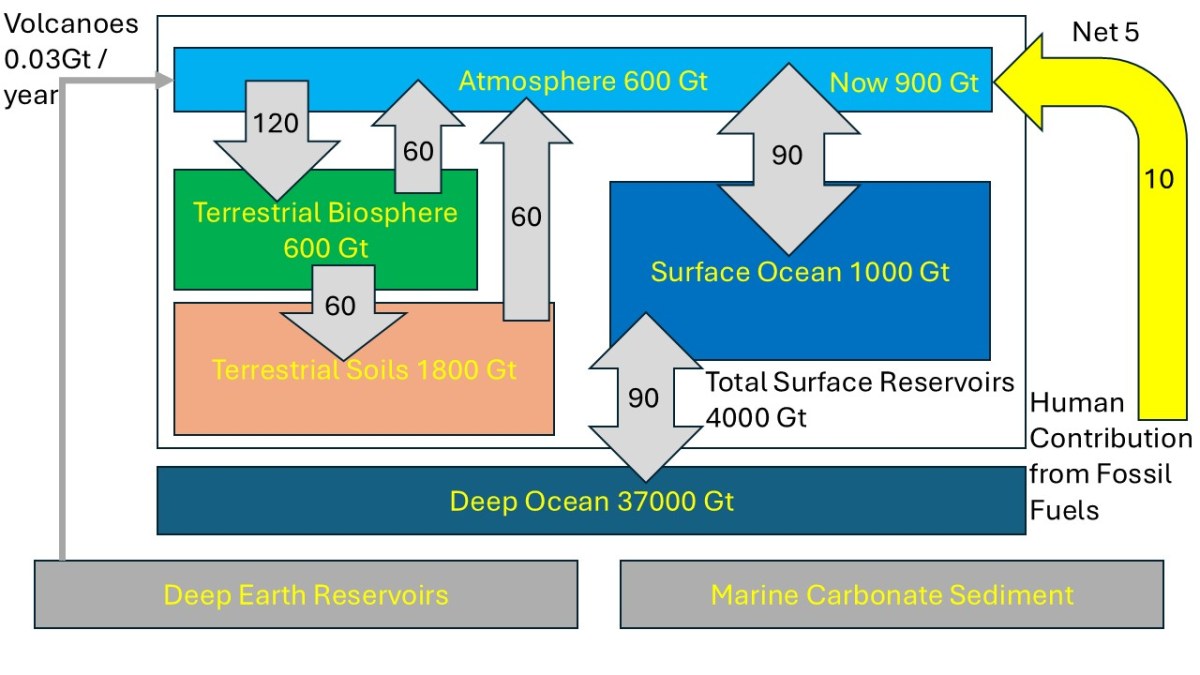
Superfact 128: There are a lot of natural carbon emissions from the soil, rotting plants, animal and human respiration, and oceans, and a small amount from volcanoes. However, carbon is also absorbed by the oceans, and by plants via photosynthesis, etc., and this creates a balance that has existed for many thousands of years. This is called the carbon cycle. Despite the fact that the carbon emissions from our burning of fossil fuels are much smaller than some of the naturally occurring carbon emissions mentioned, they are what is behind the increase of carbon in the atmosphere because they are a new addition that disrupts the carbon cycle.
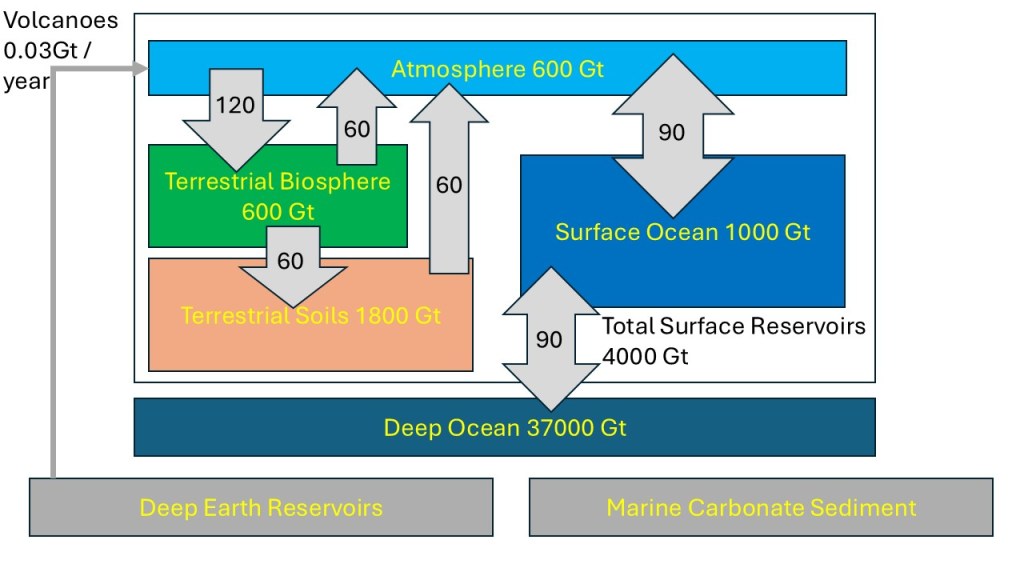
Regarding the picture above, the units are in Gigatons of carbon, i.e. the weight of the carbon atom. To get the numbers in Gigatons of carbon dioxide multiply all numbers by 3.67. The numbers in yellow inside the blocks correspond to how much carbon is stored in the system. The numbers without units in the grey arrows correspond to the number of Gigatons of carbon per year. I can add that Lawrence M. Krauss is not a climate scientist but a prominent theoretical physicist focusing on cosmology and quantum physics. However, he took a deep dive into the physics of climate change.
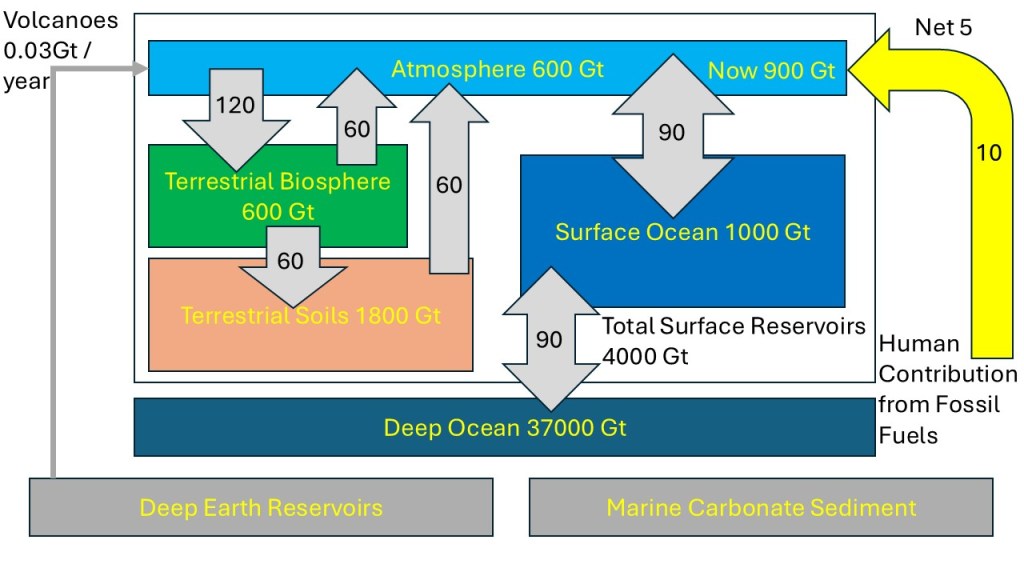
As you can see in the picture above the amount of carbon stored in the atmosphere was 600 Gigaton originally and now we have increased it to 900 Gigaton. We are adding 10 Gigatons of carbon from our emissions, chiefly from burning fossil fuels, which correspond to 37 Gigatons of carbon dioxide. About half of this is absorbed by the ocean and other systems, resulting in a net addition of 5 Gigatons per year. The carbon dioxide added and stored in the atmosphere will be there for hundreds or thousands of years.
The existence of the carbon cycle and how it explains what is going on is an important fact that is widely misunderstood and therefore a surprising fact. You quite often see or hear claims such as “animal and human respiration emit a lot more carbon dioxide than our burning of fossil fuels, and therefore human caused global warming is BS”. The first part of that sentence is true, but the rest ignores the carbon cycle and the balance that has existed for many thousands of years. Therefore, this is a super fact.
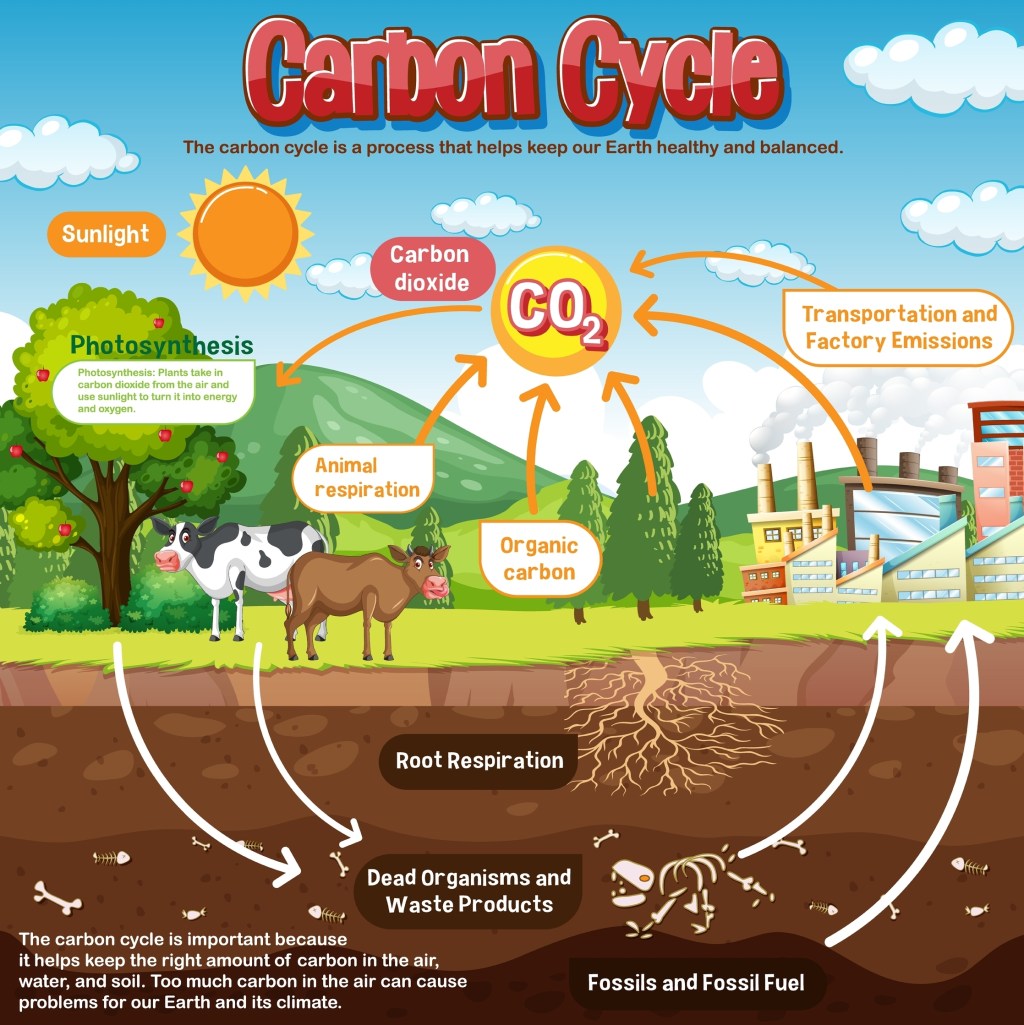
More on the Carbon Cycle
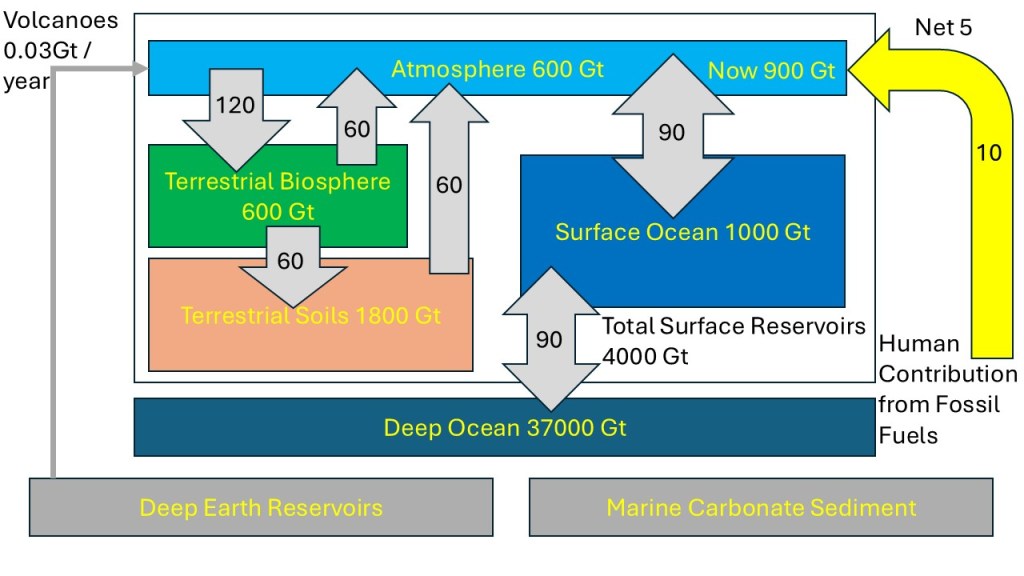
The carbon cycle describes the process in which carbon atoms continually travel from the atmosphere to the Earth and then back into the atmosphere. In the picture above you can see that the atmosphere, the oceans, the biosphere, and the soil, as well as deep Earth reservoirs and Marine Carbonate Sediments are all absorbing and emitting carbon (dioxide). For example, the terrestrial biosphere absorbs 120 Gigatons of carbon per year, chiefly through photosynthesis, and emits 60 Gigatons of carbon into the atmosphere, via for example, animal / microbial / human respiration, rotting plants, and it adds another 60 Gigatons of carbon to terrestrial soils. 120 Gigatons of carbon correspond to 440 Gigatons of carbon dioxide.
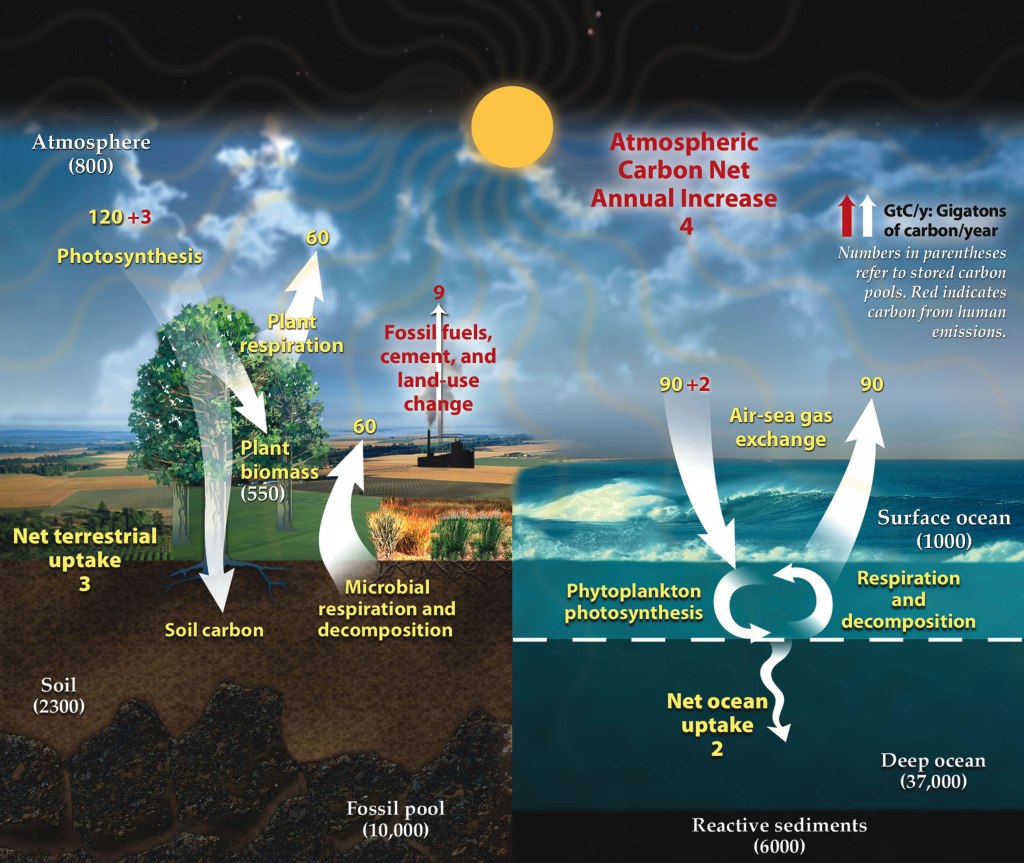
The carbon cycle was relatively stable until we started burning massive amounts of fossil fuels. Our burning of fossil fuels emits 10 Gigatons of carbon (37 Gigatons of carbon dioxide) into the atmosphere. About 30% of this carbon is absorbed by the oceans. This slows the warming but causes ocean acidification, which is another dangerous problem. In total 50% of the carbon emissions are absorbed by oceans, the soil, the biosphere, etc., according to “The Physics of Climate Change by Lawrence M. Krauss”. This is why I wrote Net 5 Gigatons per year in the picture above. You can read more about the Carbon Cycle here and here.
Another thing to pay attention to in the diagrams above is that not only are volcanoes part of the carbon cycle, but their contribution to carbon emissions is tiny compared to our emissions, which contradicts the many false claims you see on social media. You can read about that in my post “Volcanoes emit a tiny fraction of carbon compared to humans”.
Conclusion
Many of our Planet’s systems (oceans, biosphere, terrestrial soil, atmosphere, etc.) emit (and absorb) more carbon dioxide than our burning of fossil fuels does. However, the fact that they are part of the long existing carbon cycle makes them irrelevant to the rapid and sudden global warming phenomenon that we are witnessing. The recent rapid Global Warming is happening, and it is caused by us, chiefly because of our burning of fossil fuels. I am illustrating this using the two bathtub pictures below.


Other super facts related to global warming
- Global Warming is Happening and is Caused by us
- The Hockey Stick Graph is not Wrong
- Scientists Agree that Global Warming is happening and that we are the Cause
- Climate change worsens wildfires in the US
- Without carbon dioxide the Earth would freeze
- IPCC Did Not Backtrack on Global Warming Being Human Caused
- Orbital Cycles are not the Cause of the current Global Warming
- The Sun is not the Cause of the current Global Warming
- Volcanoes emit a tiny fraction of carbon compared to humans
- Climate change worsens wildfires Globally and human Land-Use Changes Reduces them
To see the other Super Facts click here

 Super Facts
What was in balance so far has been deregulated by unexpected, unnatural inputs. One change here has implications everywhere, as your pictures show so well. Nature’s resilience is extraordinary; the question is, is it enough to counterbalance anthropogenic disturbances of this magnitude and over time? Very insightful and informative, Thomas! A better understanding is pivotal to better choices! Thank you! Sending light and blessings to you, my friend, always! ✨🙏🍀
LikeLiked by 1 person
Thank you so much for kind words Susana and you understood exactly like I hoped. You are right “What was in balance so far has been deregulated by unexpected, unnatural inputs.” is exactly right. We don’t know how bad it will get, but hopefully we will pull through. I am also sending light and blessings to you, my friend!
LikeLiked by 1 person
I think we can no longer deny that there is climate change happening and it’s not going in a good direction.
LikeLiked by 1 person
Yes you are right Anneli. It is happening and our emissions from burning fossil fuel is the main cause. I should say that one good news is that almost all developed countries has manages to reduce their emissions and China seems to have peaked with their emissions, largely due to their investment in renewables and replacing internal combustion engine cars with EVs. So all hope is not lost. Let’s see where it takes us.
LikeLiked by 1 person
Good explanation, Thomas.
LikeLiked by 1 person
Thank you so much Chris
LikeLiked by 1 person
Java Bean: “Ayyy, our Dada was just reading an article at the AP that said ‘Earth has lost its chance to prevent some of the worst of global warming’s harms’ and he was like, yeah, stupid Earth, not cooling down when it had the chance! So inconvenient for the humans who are just minding their own business!”
LikeLiked by 1 person
Yes your Dada is right. It is going to get worse. However, we have started to improve things, which is a good indicator. Unfortunately, even if we reduce our emissions that is not going to be enough to lower average temperatures and damage to eco systems. That will continue. But sooner we act the better. Luckily it seems like the world is finally acting.
LikeLike
it would seem logical, I won’t say common sense, if the system is build on balance and burning fossil fuels is not accounted for in the cycle that would be the cause. We either stop burning then or find ways they are consumed without impact to maintain the balance.
LikeLiked by 1 person
Thank you so much Kevin. In fact it was your comment on “Volcanoes emit a tiny fraction of carbon compared to humans” that inspired this post. You have to account for the carbon cycle. Now we have imbalanced the carbon cycle and we have to fix it.
LikeLiked by 1 person
it would seem logical, I won’t say common sense, if the system is build on balance and burning fossil fuels is not accounted for in the cycle that would be the cause. We either stop burning then or find ways they are consumed without impact to maintain the balance.
LikeLiked by 1 person
A question related to your comment is if we continue burning fossil fuels at the same rate would it eventually settle into a new carbon cycle with oceans, the biosphere, soil, etc., absorbing more. I could not find a clear answer to that so I asked ChatGPT. The answer I got was yes. It would eventually settle on a new carbon cycle but at a much higher CO2 percentage in the atmosphere and a signficiantly higher and potentially very dangerous temperature, but it would settle. Exactly where, how much, etc., is difficult to predict, and depends a lot on what would happen to the biosphere and the potential for tipping points.
LikeLiked by 1 person
I think it would like any system adjusting but I think the issue is , does it become worse for humans. Like any change to a system it will adjust but better or worse. I read they released wolves back to some area and it was great, the pythons in the Everglades not so good. They don’t belong there and it is adjusting, not well.
LikeLiked by 1 person
Yes, you are exactly right Kevin. I’ve read in the book the Physics of Climate Change that if we don’t do significantly better with our emissions, we can expect a sea level rise by 2100 of half a meter to one meter, which sounds like nothing. After all, 25,000 years ago during the last Glacial Maximum the sea level was 125 to 130 meters lower than now. However, 25,000 years ago we did not have 630 million people living in low lying river deltas with extensive amounts of rice patties and other low lying regions that would be inundated and destroyed by an increased level of just one meter of sea water. How would those 630 million people feed themselves and where would they live? The Ph level of ocean water could go from 8.1 (now) to 7.7 by 2100, which sounds like nothing considering that the Ph level of some freshwater rivers is 6.5. However, there are no coral reefs in rivers. 7.7 could wipe out coral reefs world wide and coral reefs support a quarter of all species. Rapid changes that seem small could be catastrophic with a planet with complex eco systems (that need time to adjust) and ten billion people.
We don’t want the carbon dioxide levels and temperatures that the dinosaurs had to arrive very suddenly. Our ecosystems don’t have time to adapt and a civilization with 10 billion people isn’t ready for it.
LikeLiked by 1 person
That is the part that drives me mad with all the deniers. They say, “Climate always changes.” Well, yeah, except that, you know, there wasn’t all the other stuff around, or the people to be impacted.
LikeLike
Hi Thomas, I think this post explains the situation very eloquently.
LikeLiked by 1 person
Thank you so much for your kind words Robbie
LikeLike
💚🌈
LikeLiked by 1 person
Stuff like this is what makes me think Kim Stanley Robinson was too optimistic in his Ministry for the Future book. Although it was still an interesting read …
LikeLiked by 1 person
Oh you finished “Ministry for the Future” already. You read it faster than I did.
LikeLiked by 1 person
I did! It was good, but I liked Aurora and New York: 2140 better. Come to think of it, New York: 2140 was kinda optimistic too, with its idea that they kept New York City going by waterproofing the lower levels of all the flooded skyscrapers. If you can’t beat ’em, join ’em, I guess …
LikeLiked by 1 person
That is good. I’ve read New York: 2140 and maybe I agree with you it was better. However, I did not read Aurora.
LikeLike
Thoms, from a writer’s point of view, I love how a seemingly scientific diagram can open the door to a much bigger story: one about balance, disruption, and the consequences of human choices. The carbon cycle is a powerful reminder that everything is connected, and sometimes the smallest detail in a diagram carries the biggest story. Great post.
LikeLiked by 1 person
Yes you are right Patricia. A very good point and thank you so much for your kind words.
LikeLike
ok – wow!
LikeLiked by 1 person
Thank you Linda
LikeLiked by 1 person
so welcome – you always open my eyes and blow my mind!!
LikeLiked by 1 person
Thank you Linda that is so kind of you to say
LikeLiked by 1 person