The Most Important Greenhouse Gas Does Not Drive Global Warming

Superfact 133: Water vapor is responsible for roughly half of Earth’s total greenhouse effect, but unlike carbon dioxide or methane, water vapor condenses and falls as precipitation. Water molecules only stay in the atmosphere for about two weeks. We do not directly control global water vapor levels. When carbon dioxide warms the planet the atmosphere holds more water vapor, which amplifies the initial warming. However, water vapor does not drive global warming. Carbon dioxide emissions and to a lesser degree methane emissions drive global warming. Water vapor just amplifies the effect.
Several transparent water molecules floating around on a blue background. The atoms in the molecules look like glass balls. | The Most Important Greenhouse Gas Does Not Drive Global Warming
Water vapor is water in gaseous form, and it is invisible. This is a 3D illustration of a water molecule (H2O – two hydrogen atoms and one Oxygen atom). Shutterstock asset id: 1656757654 by Anusorn Nakdee

On social media you often see the claim that water vapor is a more powerful greenhouse gas than carbon dioxide, and the implicit implication is supposedly that our carbon emissions are not the problem. Alternatively, since water vapor has been around forever and is a more powerful greenhouse gas than carbon dioxide, global warming can’t be caused by greenhouse gases. What is getting lost in these posts is that we are not adding water vapor to the atmosphere like we are adding carbon dioxide (or methane) to the atmosphere. The amount of water vapor in the atmosphere will increase because a warmer atmosphere can hold more water vapor, but that is because of our carbon emissions in the first place. You can read more about that here, and here, and here.
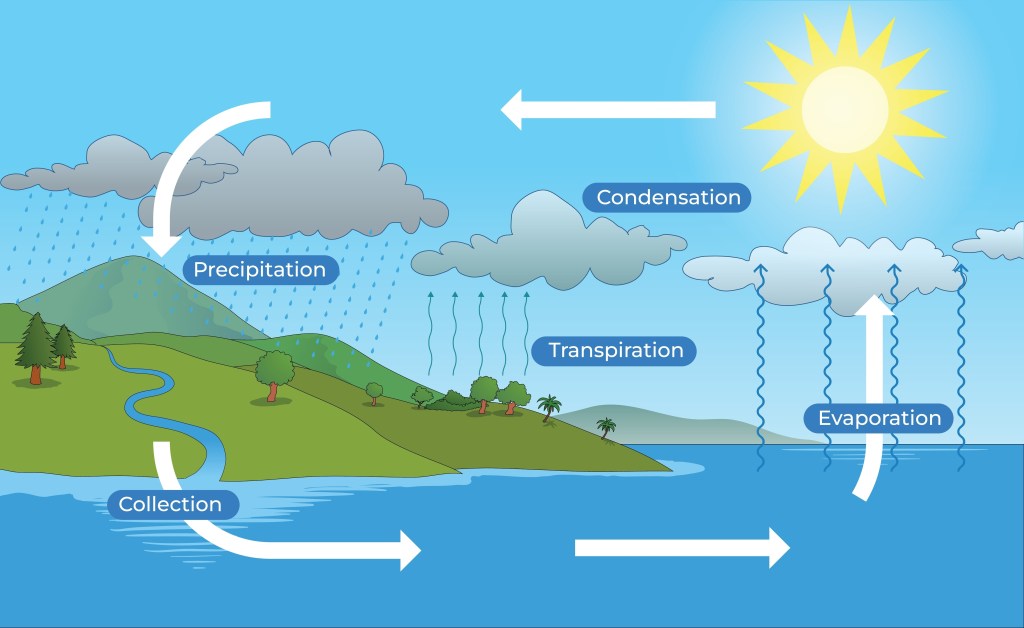
The picture shows a river flowing into the see (labeled collection), evaporation from the sea and transpiration from the land. The condensation creates clouds and it rains (precipitation).
Illustration of simple water cycle diagram. Water vapor, a greenhouse gas, is added to the atmosphere from evaporation (the sea) and transpiration (soil, plants, etc.) Then it condenses into clouds and comes down as precipitation. It collects in rivers, etc., and ends up in oceans and lakes. – Shutterstock asset id: Asset id: 2524245337 by zombiu26

A related fact is that the water cycle is a relatively fast cycle compared to the carbon cycle. A water molecule stays in the atmosphere on average for two weeks according to MIT and nine days according to Wikipedia. Our carbon emissions stay in the atmosphere for several hundred years. In short, water vapor is not the driver of the current rapid global warming. That is chiefly carbon dioxide, but also methane, and deforestation.

It does not matter that water vapor causes a larger percentage of the warming than carbon dioxide. It is not what is causing the increase in the average global temperature. Since so many people have been fooled by the water vapor misdirection, incorrectly thinking that carbon dioxide is unimportant because water vapor is a more important greenhouse gas, this is an important fact that will come as a surprise to many. Therefore, it is a super fact in my opinion.

More on the Water Cycle and the Greenhouse Effect

Below is a more detailed illustration of the water cycle for those who are interested. It should be noted that even though water vapor is not driving the rapid global warming we are witnessing, the very rapid global warming we are experiencing is affecting the water cycle, for example, the precipitation patterns around the world. You can read more about that here.
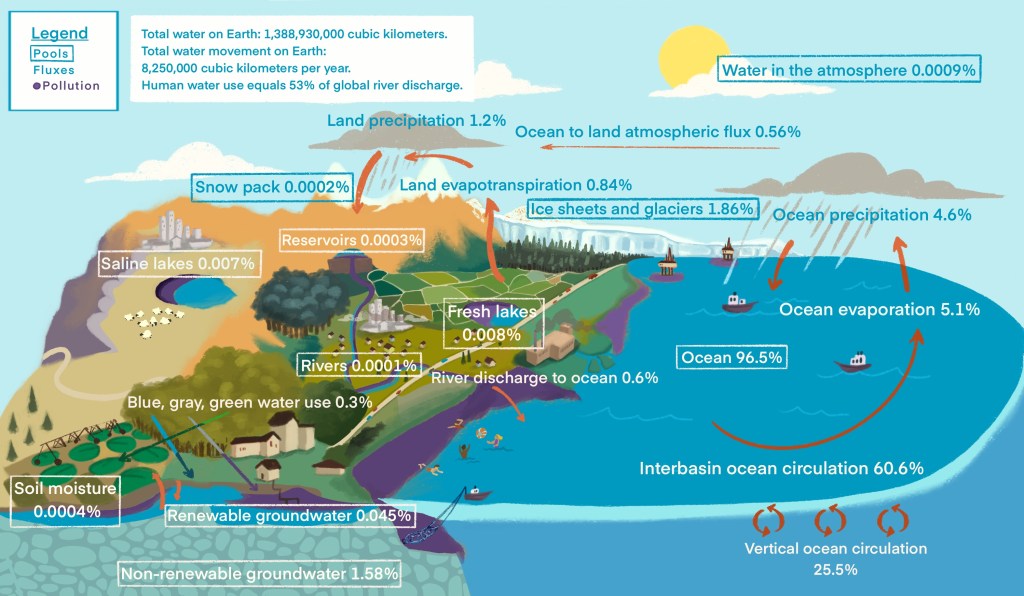
This detailed illustration of the water cycle shows the different fluxes and pools that are part of the water cycle. The percentages and circulation patterns are shown. | The Most Important Greenhouse Gas Does Not Drive Global Warming
Water cycle showing human influences and major pools (storages) and fluxes. This is a more detailed picture than the one above. LangeLeslie and Anna Wright, CC BY-SA 4.0 https://creativecommons.org/licenses/by-sa/4.0, via Wikimedia Commons. This picture is taken from here.

Another less simplistic argument based on water vapor as a greenhouse gas that tries to claim that carbon dioxide is not behind the rapid global warming we are seeing is that water vapor is such an effective greenhouse gas across all frequences that there is not much room for carbon dioxide to make it worse.

Greenhouse gases absorb infrared radiation and that is what warms the atmosphere like a blanket. However, the different greenhouse gases absorb radiation at different frequencies. As you can see in the figure below water vapor has a pretty impressive spread across most frequencies.

However, if you look carefully, you see that carbon dioxide and water vapor complement each other in the spectra and in addition, as mentioned, we are not increasing water vapor directly, but we are increasing the amount of carbon dioxide directly. It should be noted that, in addition, satellite measurements directly confirm that our emissions are warming the planet. The topic of absorption at different frequencies by carbon dioxide and water vapor is explored in greater detail in the book “The Physics of Climate Change by Lawrence M. Krauss”, which I reviewed here.
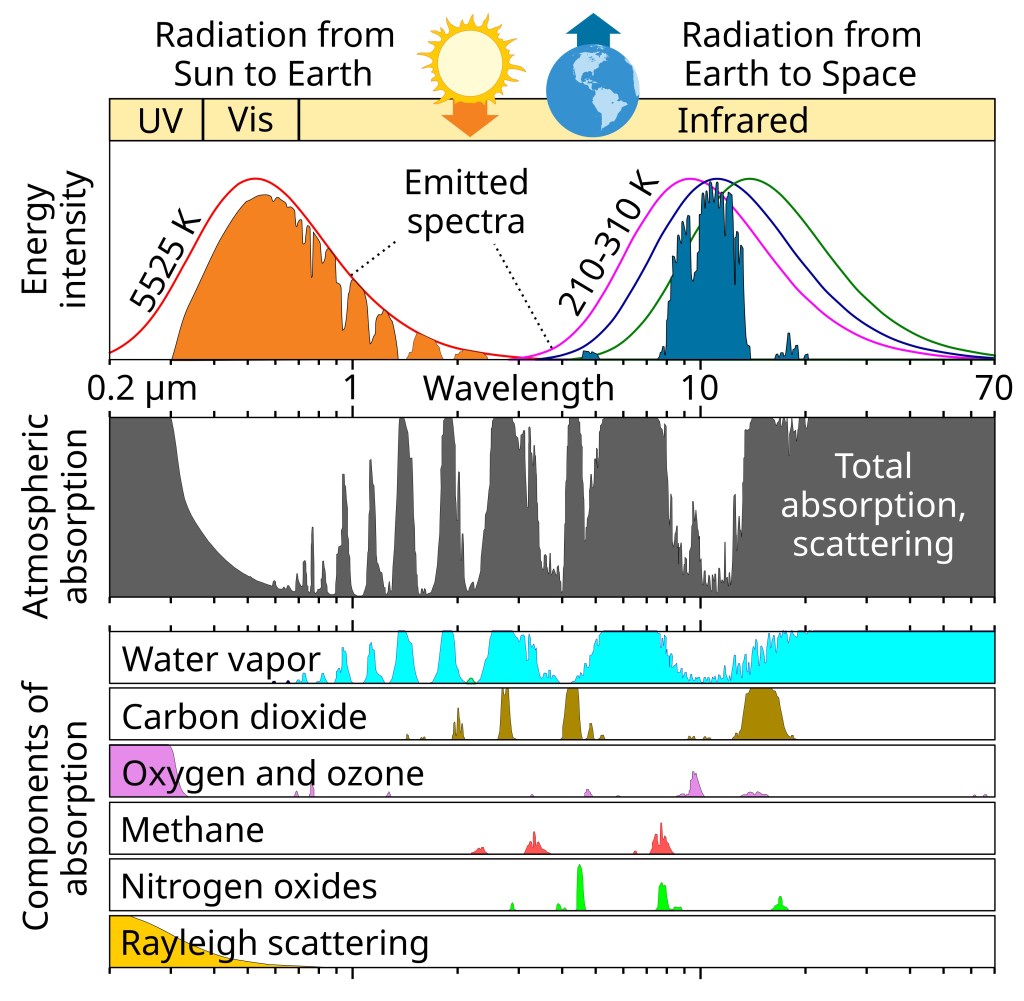
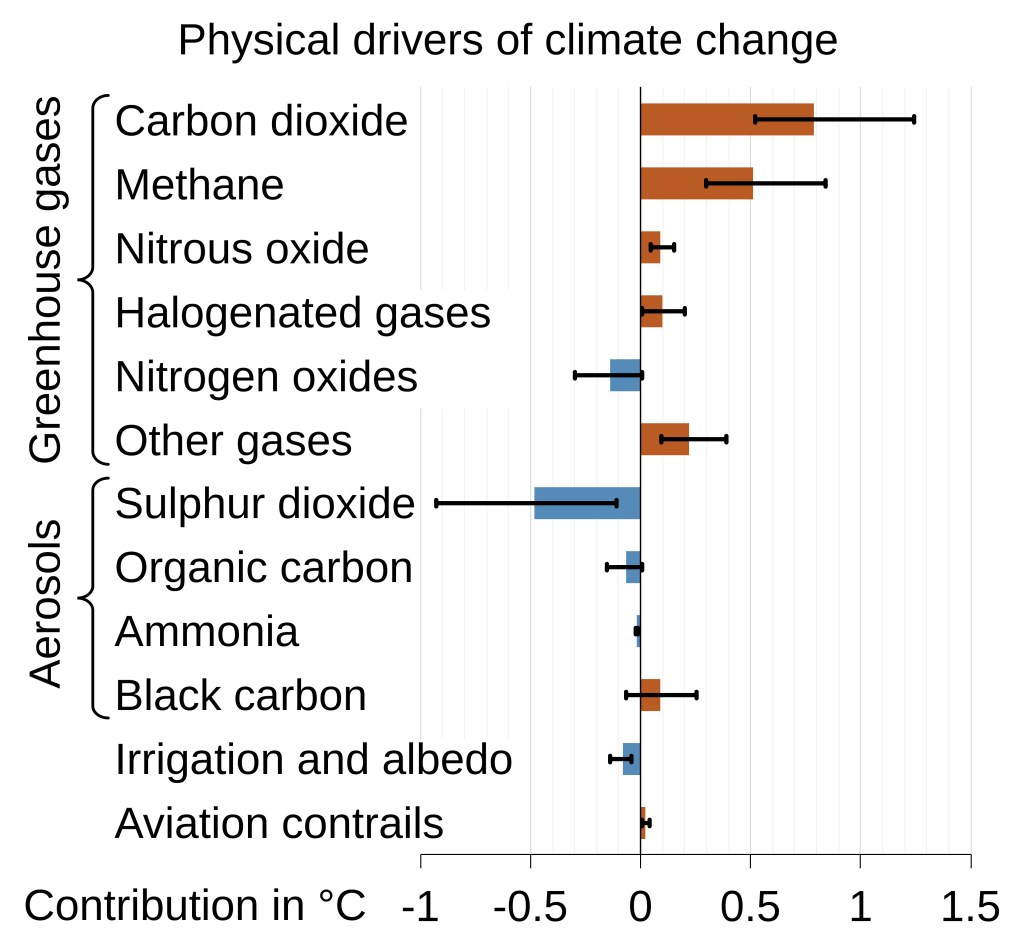
The illustration below shows the physical drivers of global warming that have happened so far. Carbon dioxide is a physical driver that will keep growing. Notice that water vapor is not listed. Water vapor is a powerful greenhouse gas but is not a physical driver of the rapid global warming that we are witnessing. 

Aerosols are included and they tend to have a cooling effect rather than a warming effect. Therefore, many people are suggesting to, for example, use Sulphur dioxide to cool the atmosphere and counter global warming. The problem with that is that it is just a different type of pollution that has other negative effects, such as acid rain, it causes breathing difficulties and has other kinds of effects on climate that are not necessarily plain cooling effects. This is a hotly debated issue.
The absorption bands of Earth’s atmosphere (grey color) delimit its atmospheric windows (middle panel) and the effect they have on both down going solar radiation and upgoing thermal radiation emitted near the surface is shown in the top panel. The individual absorption spectra of major greenhouse gases plus Rayleigh scattering are shown in the lower panel. This figure was prepared by Robert A. Rohde Д.Ильин: vectorization (File:Atmospheric Transmission-ru.svg); Cepheiden translation back to english, CC0, via Wikimedia Commons. This figure below is taken from this website.
The diagram shows the physical drivers for global warming including carbon dioxide, methane, nitrous oxide, halogenated gases, nitrogen oxides, and other gases. It also shows the effect of aerosols, particularly Sulphur dioxide, which is often the opposite. | The Most Important Greenhouse Gas Does Not Drive Global Warming
Physical drivers of global warming that have happened so far. Future global warming potential for long-lived drivers like carbon dioxide emissions is not represented. Whiskers on each bar show the possible error range. Eric Fisk, CC BY-SA 4.0 https://creativecommons.org/licenses/by-sa/4.0, via Wikimedia Commons. The illustration is taken from this site.

Conclusion

Water vapor is a powerful greenhouse gas but unlike carbon dioxide and methane it is not driving the rapid global warming that we are seeing. We are directly increasing water vapor via water vapor emissions, and if we did it would just come raining back down pretty quickly. However, when carbon dioxide warms the planet the atmosphere holds more water vapor, which amplifies the initial warming.

Other super facts related to global warming


To see the other Super Facts click here

Carbon Cycle Emissions Does Not Cause Global Warming
Superfact 128: There are a lot of natural carbon emissions from the soil, rotting plants, animal and human respiration, and oceans, and a small amount from volcanoes. However, carbon is also absorbed by the oceans, and by plants via photosynthesis, etc., and this creates a balance that has existed for many thousands of years. This is called the carbon cycle. Despite the fact that the carbon emissions from our burning of fossil fuels are much smaller than some of the naturally occurring carbon emissions mentioned, they are what is behind the increase of carbon in the atmosphere because they are a new addition that disrupts the carbon cycle.

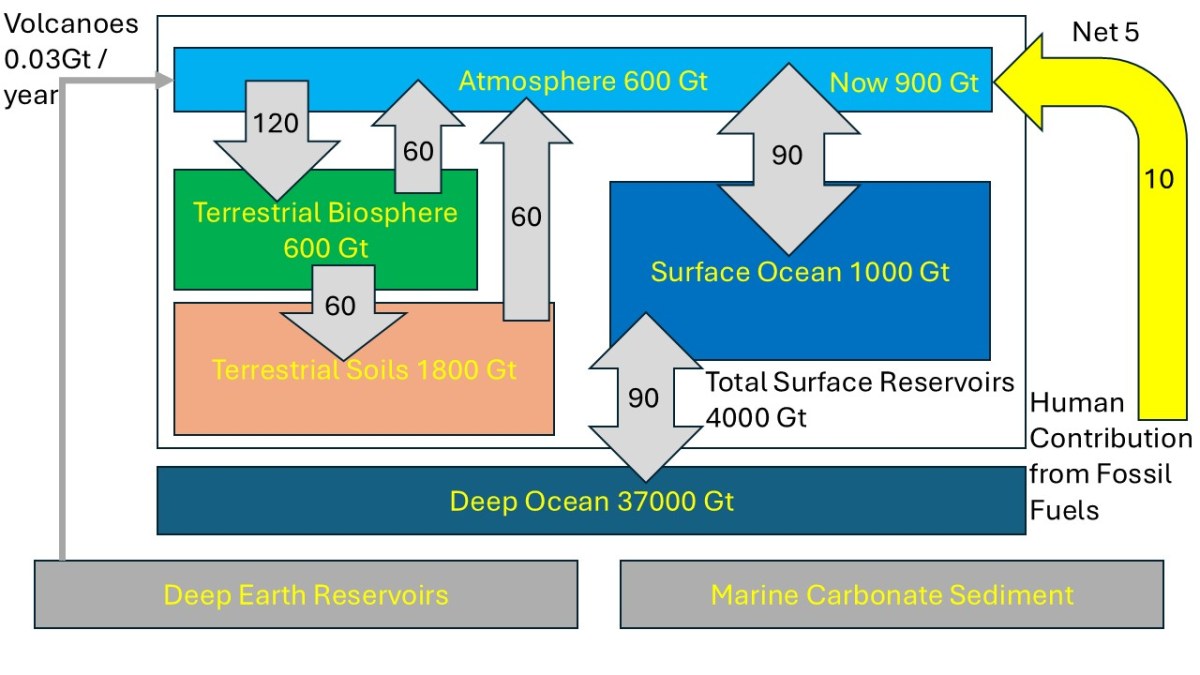
The carbon cycle in the picture shows that the terrestrial biosphere is absorbing 120 Gigatons of carbon from the atmosphere and emits 60 Gigatons to the atmosphere. It also adds 60 Gigatons of carbon to terrestrial soils. It also shows the Surface of the Ocean both emitting and absorbing 90 Gigatons of carbon to the atmosphere and both emitting and absorbing 90 Gigatons of carbon to the deep ocean. There are additional flows in the picture. It is complex but stable cycle. | Carbon Cycle Emissions Does Not Cause Global Warming
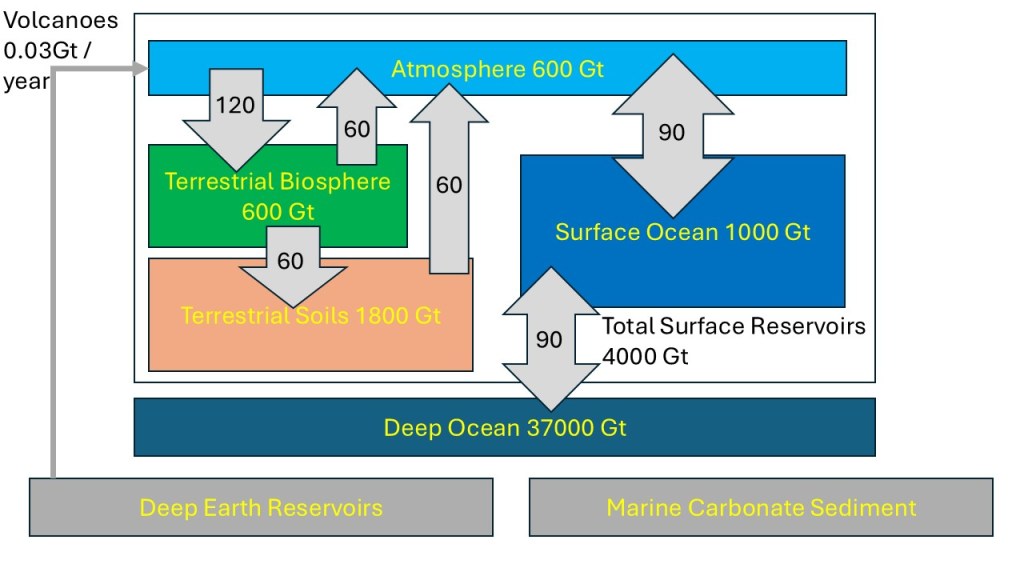
The picture above was drawn by me and is an adaptation of Figure 3.1 on page 31 in the book “The Physics of Climate Change by Lawrence M. Krauss”.

Regarding the picture above, the units are in Gigatons of carbon, i.e. the weight of the carbon atom. To get the numbers in Gigatons of carbon dioxide multiply all numbers by 3.67. The numbers in yellow inside the blocks correspond to how much carbon is stored in the system. The numbers without units in the grey arrows correspond to the number of Gigatons of carbon per year. I can add that Lawrence M. Krauss is not a climate scientist but a prominent theoretical physicist focusing on cosmology and quantum physics. However, he took a deep dive into the physics of climate change.

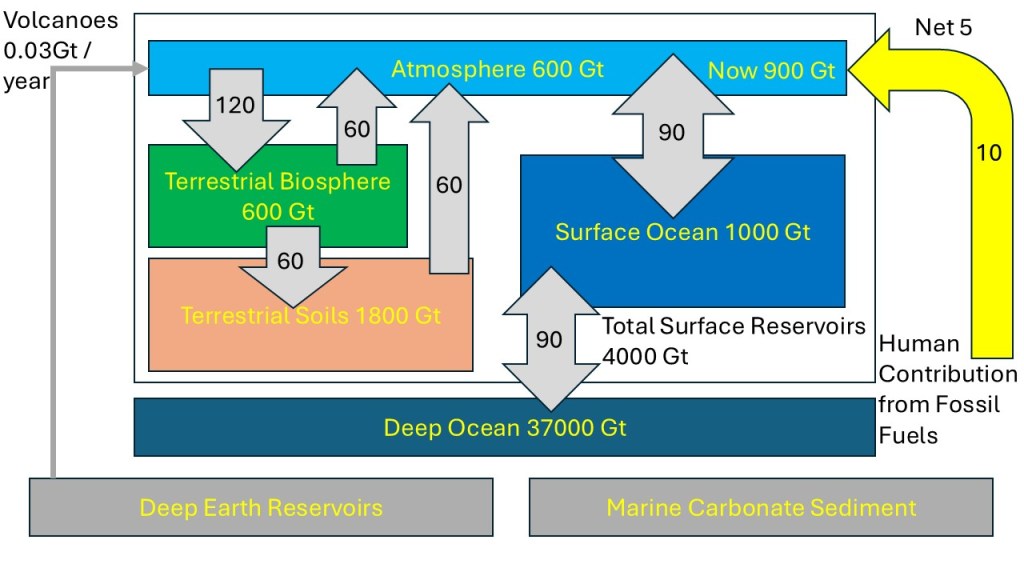
This picture is the same as above with the addition of our recent carbon emissions at 10 Gigaton. Oceans and other systems are absorbing some of it resulting in a net increase of 5 Gigaton per year.
This is the same picture as above, but I added the contribution from our recent additional carbon emissions such as the emissions from the burning of fossil fuels. This is depicted at far right in yellow. Since this is not part of the original carbon cycle the amount of carbon in the atmosphere grew from 600 Gigatons (pre-industrial) to 900 Gigatons.

As you can see in the picture above the amount of carbon stored in the atmosphere was 600 Gigaton originally and now we have increased it to 900 Gigaton. We are adding 10 Gigatons of carbon from our emissions, chiefly from burning fossil fuels, which correspond to 37 Gigatons of carbon dioxide. About half of this is absorbed by the ocean and other systems, resulting in a net addition of 5 Gigatons per year. The carbon dioxide added and stored in the atmosphere will be there for hundreds or thousands of years.

The existence of the carbon cycle and how it explains what is going on is an important fact that is widely misunderstood and therefore a surprising fact. You quite often see or hear claims such as “animal and human respiration emit a lot more carbon dioxide than our burning of fossil fuels, and therefore human caused global warming is BS”. The first part of that sentence is true, but the rest ignores the carbon cycle and the balance that has existed for many thousands of years. Therefore, this is a super fact.

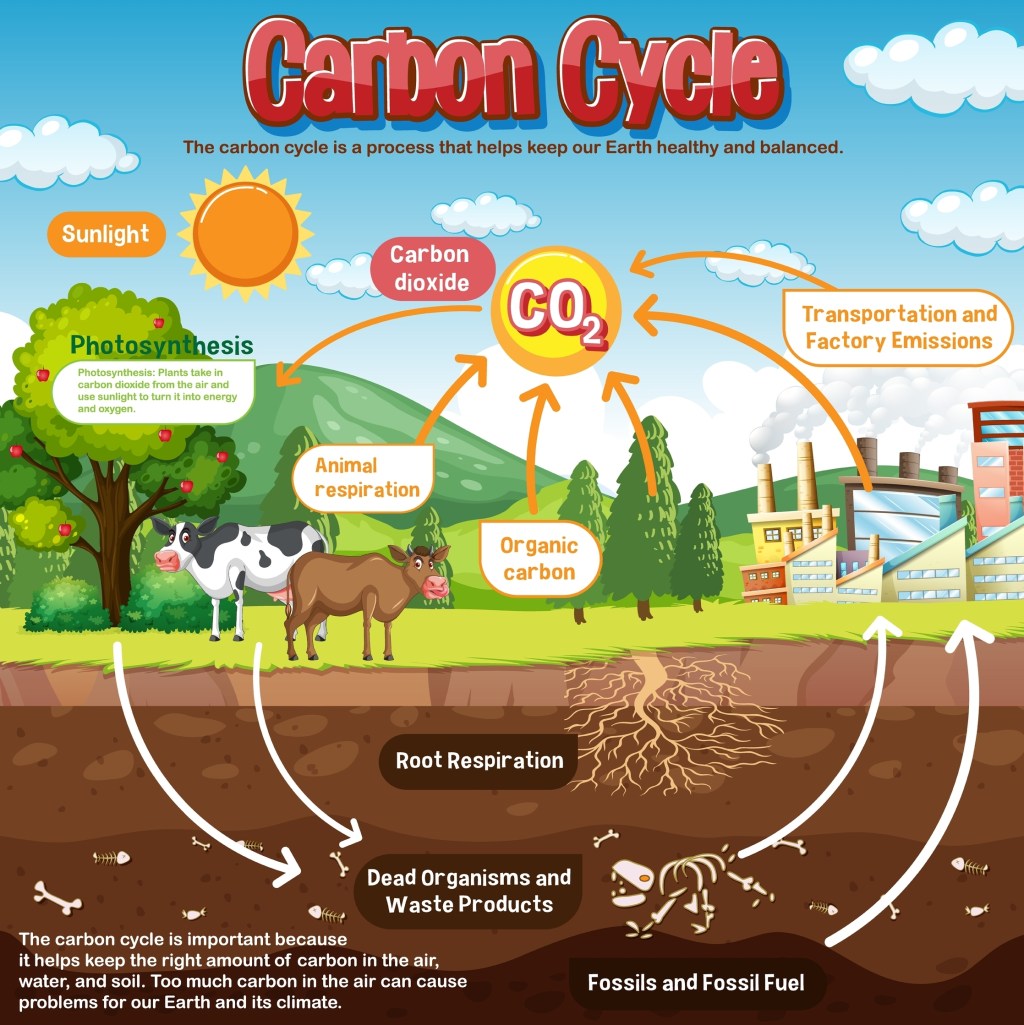
The diagram shows how carbon is emitted and absorbed between the various elements in nature and our planet. It shows animals, plants, the soil, and also emissions from factories. The text says “The Carbon Cycle is important because it helps keep the right amount of carbon in the air, water, and soil. Too much carbon in the air can cause problems for our Earth and its climate.” | Carbon Cycle Emissions Does Not Cause Global Warming
This illustration of  the Carbon Cycle is simplified but artistic. Shutterstock asset id: 2271978649 by GraphicsRF.com

More on the Carbon Cycle

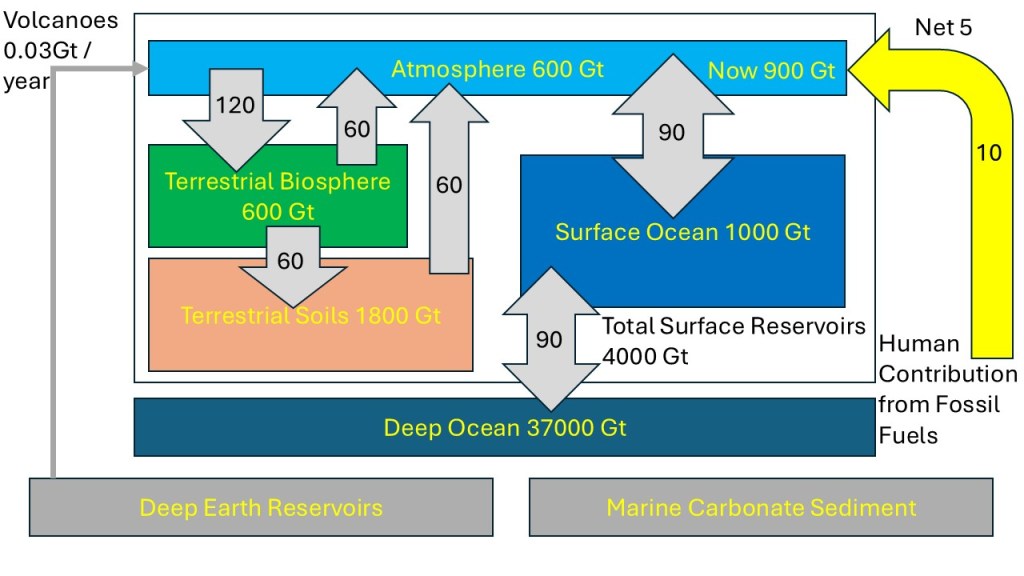
This picture is the same as the one above where I included our recent emissions from burning fossil fuels.
Same as the picture above but notice the flows depicted by the arrows and the total amounts stored in each system.

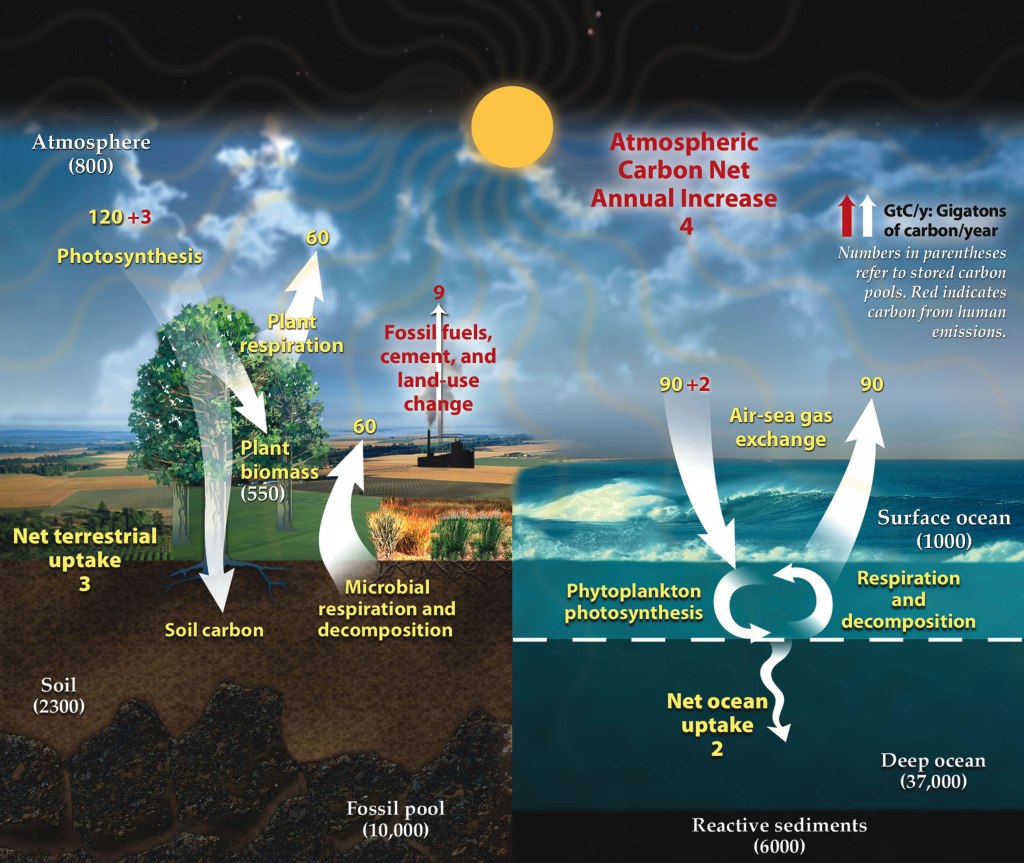
The carbon cycle describes the process in which carbon atoms continually travel from the atmosphere to the Earth and then back into the atmosphere. In the picture above you can see that the atmosphere, the oceans, the biosphere, and the soil, as well as deep Earth reservoirs and Marine Carbonate Sediments are all absorbing and emitting carbon (dioxide). For example, the terrestrial biosphere absorbs 120 Gigatons of carbon per year, chiefly through photosynthesis, and emits 60 Gigatons of carbon into the atmosphere, via for example, animal / microbial / human respiration, rotting plants, and it adds another 60 Gigatons of carbon to terrestrial soils. 120 Gigatons of carbon correspond to 440 Gigatons of carbon dioxide.

This is a fairly detailed picture of the carbon cycle from wikipedia. | Carbon Cycle Emissions Does Not Cause Global Warming
Carbon cycle schematic showing the movement of carbon between land, atmosphere, and oceans in billions of tons (gigatons) per year. Yellow numbers are natural fluxes, red are human contributions, and white are stored carbon. The effects of the slow (or deep) carbon cycle, such as volcanic and tectonic activity are not included. Diagram adapted from U.S. DOE, Biological and Environmental Research Information System., Public domain, via Wikimedia Commons.

The carbon cycle was relatively stable until we started burning massive amounts of fossil fuels. Our burning of fossil fuels emits 10 Gigatons of carbon (37 Gigatons of carbon dioxide) into the atmosphere. About 30% of this carbon is absorbed by the oceans. This slows the warming but causes ocean acidification, which is another dangerous problem. In total 50% of the carbon emissions are absorbed by oceans, the soil, the biosphere, etc., according to “The Physics of Climate Change by Lawrence M. Krauss”. This is why I wrote Net 5 Gigatons per year in the picture above. You can read more about the Carbon Cycle here and here.

Another thing to pay attention to in the diagrams above is that not only are volcanoes part of the carbon cycle, but their contribution to carbon emissions is tiny compared to our emissions, which contradicts the many false claims you see on social media. You can read about that in my post “Volcanoes emit a tiny fraction of carbon compared to humans”.

Conclusion

Many of our Planet’s systems (oceans, biosphere, terrestrial soil, atmosphere, etc.) emit (and absorb) more carbon dioxide than our burning of fossil fuels does. However, the fact that they are part of the long existing carbon cycle makes them irrelevant to the rapid and sudden global warming phenomenon that we are witnessing. The recent rapid Global Warming is happening, and it is caused by us, chiefly because of our burning of fossil fuels. I am illustrating this using the two bathtub pictures below.

The picture shows a glass bathtub half filled with water. There are a faucet and a drain with the same flow keeping the water level the same.
The stream of water from the faucet is the same as the stream from the drain keeping the water level steady. The bathtub is half full and stays half full. I generated the picture with the help of ChatGPT.
The picture shows a glass bathtub half filled with water. There are a faucet and a drain with the same flow keeping the water level the same. | Carbon Cycle Emissions Does Not Cause Global Warming
The stream of water from the faucet is faster than the stream from the drain so the water level increases. The additional amount from the faucet represents the carbon emissions we added. The bathtub is now 2/3 up and rising. I generated the picture with the help of ChatGPT.

Other super facts related to global warming


To see the other Super Facts click here